Hot Cross Buns: History, Origins & Folklore
Written by David Caldwell ·
Hot Cross Buns: A 2,000-Year History of Sacred Bread, Good Friday Folklore, and Spiced Tradition
By Haeretico | Updated for Good Friday
Every Good Friday morning, bakeries across Britain fill with the warm scent of spiced dough and the gloss of crossed loaves fresh from the oven. Hot cross buns are so familiar, so utterly embedded in the fabric of the season, that few people stop to ask where they actually came from. The answer, it turns out, reaches back far beyond Christianity - through medieval monasteries, Roman temple gates, ancient Greek offerings, and possibly even to the banks of the Nile. This is the story of one of Britain's most beloved foods: a small, sweet, spiced cake that has carried extraordinary cultural weight for at least two thousand years.
Pulling together sources from across two centuries of British newspapers - from the British Luminary of 1821 to the Wells Journal of 1990 - we can trace the surprisingly contentious, wonderfully rich, and occasionally bizarre history of the hot cross bun: its pagan ancestors, its Christian transformation, its folklore, its superstitions, and the legendary bun houses of Chelsea that made it fashionable for kings.
Before Christianity: The Ancient Origins of Sacred Spiced Bread
The hot cross bun's story does not begin with the Crucifixion. Centuries before the Christian era, sacred breads marked with a cross were offered to the gods of the ancient world. The Greeks presented consecrated loaves at the gates of their temples - bread that worshippers would purchase before entering, as a gift to the divine. One particular species of this offering was known as the boun, a term preserved in the writings of Hesychius, who described it as a cake shaped with two horns and made from fine flour and honey. Julius Pollux and Diogenes Laertius both recorded similar offerings, the latter noting a sacred loaf called a boun offered up by the philosopher Empedocles, composed - again - of fine flour and honey.
The Egyptians, too, made cakes known as 'bouns', imprinted with a cross, in honour of the moon. Phoenicians, Carthaginians, and Romans all partook of cross-marked bread at public sacrifices, and such loaves were purchasable at the doors of temples - a custom St Paul himself alluded to in his First Epistle to the Corinthians. The roundness of the bun was said to represent the full moon, and the cross its four quarters. Some historians took this lunar symbolism seriously enough to suggest that the earliest bun-bakers were Roman priests manufacturing moon-cakes near the vernal equinox - precisely the time of year when Good Friday falls.
Remarkably, physical evidence survives. During excavations at the Roman city of Herculaneum - buried by Vesuvius in 79 AD - archaeologists uncovered two small loaves plainly marked with a cross, a discovery widely cited throughout the nineteenth century as proof of the custom's antiquity. Whether the cross was a religious symbol or simply a practical scoring to make the bread easier to break remains debated, but its presence confirms that cross-marked bread is no medieval invention.
The Biblical Connection: Jeremiah and the Queen of Heaven
The practice of baking spiced, cross-marked cakes for a goddess was not limited to Greece and Rome. The prophet Jeremiah, writing in the sixth century BC, excoriated the Jewish women of Pathros in Egypt for making cakes to worship the Queen of Heaven - a practice encouraged by their husbands and bitterly condemned by Jeremiah as idolatry. The women's defiant response - 'Did we make her cakes to worship her?' - is one of the most vivid domestic details in the entire Old Testament, and it confirms that the offering of sweetened ritual bread was a living practice across the ancient Near East.
This Biblical reference was seized upon by Christian commentators from at least the seventeenth century onwards as evidence that the hot cross bun's roots lay in pagan idolatry - a point that made some Protestants distinctly uncomfortable about eating them at all. Others, however, argued that the Church had wisely adopted and sanctified an ancient instinct rather than trying to stamp it out entirely.
Saxon Roots: Eostre and the Festival Cake
Alongside the classical and Biblical threads runs a distinctly English one. According to the Dundee Evening Telegraph of 1922, the first buns were special cakes baked by the ancient Saxons in celebration of the festival of their spring goddess, Eostre - the deity whose name gave us 'Easter'. The practice of worshipping the Queen of Heaven with cakes at the spring equinox, the article argued, had been found 'in almost every other country', and when Christianity arrived in Britain, the Church found it impossible to eradicate the pagan celebration. Instead, it transformed it: marking the cross of Christ upon the bun, it sanctified a custom too deeply rooted in the folk calendar to be abolished.
This was the Church's characteristic approach to conversion. Rather than condemning every element of pre-Christian practice, missionaries and priests incorporated them into the new faith with altered meaning. The result, across centuries, was a layering of significance - moon-goddess, Queen of Heaven, Crucifixion, Resurrection - compressed into a small, round, spiced loaf.
The Christian Eulogie: From the Communion Table to the Street Vendor
Within the early Christian Church, the hot cross bun found its most immediate ancestor in the Eulogie - the 'consecrated bread' or 'blessed bread' distributed to members of the congregation who were unable to receive the Holy Eucharist due to illness, disability, or some other impediment. These loaves were made from the same dough as the Host itself, given out by the priest immediately after Mass, marked with the cross, and received with a kiss before being eaten. The practice was not restricted to Good Friday; in France and Spain, such bread was given to communicants throughout the year whenever they faced a long journey home or were too faint to receive communion in the usual way.
The transition from this ecclesiastical distribution to the Good Friday street vendor was gradual. Originally, scholars of the mid-nineteenth century noted, the cross bun was not associated with Good Friday at all - it was an Easter Sunday food, eaten in church immediately after Mass. Over time, as the Reformation swept away many Catholic practices in England, the 'blessed bread' distribution was suppressed, but the bun itself survived in popular culture, migrating from the chancel to the bakehouse and eventually to the street corner.
Interestingly, the Mid-Lothian Journal of 1895 recorded that this 'Blessed Bread' was still being given in France and Spain in the late nineteenth century, confirming that what had become a commercial street food in England retained its liturgical character on the continent.
The Medieval Monastery: Brother Rocliffe's Recipe
One of the most charming origin stories - and one that circulated widely in Victorian newspapers - centres on a fourteenth-century monk named Thomas Rocliffe, attached to the refectory of St Albans Abbey in Hertfordshire. According to a tale extracted from an ancient work entitled 'Ye Booke of St. Albans' and cited in both the Paddington Advertiser and the North London News of April 1862, in the year of Our Lord 1361, Brother Rocliffe caused a quantity of small sweet spiced cakes, marked with a cross, to be made and distributed to the poor who applied at the door of the refectory on Good Friday, in addition to the customary basin of good sack.
The cakes, the story goes, were so delicious that recipients talked of nothing else, and 'various were the attempts to imitate the cakes of Father Rocliffe all over the country, but the recipe of which was kept within the walls of the abbey.' Whether or not the story is literally true, it captures something important: the idea of the hot cross bun as an act of charity, a gift from the religious house to the hungry poor on the most solemn day of the Christian year.
The Water Cake and the Rise of the Sweet Bun
Before the spiced, enriched hot cross bun became dominant, a plainer predecessor held the field. The British Luminary of 1821 described a 'water cake' - composed of nothing but water and flour - that was once common on Good Friday. To compensate for its utter lack of flavour, the tops of these cakes were smeared with turmeric, which gave them a fine yellow colour. Only gradually did the sweet, spiced cross bun displace these austere fasting cakes, the richness of currants, spice, and sweetened dough representing a considerable culinary evolution from the self-denying simplicity of a water cake.
The spices themselves carry their own historical freight. The Wells Journal of 1990 noted that spices were brought back to England by the Crusaders from the Holy Land, and that it became customary to incorporate them into foods associated with religious festivals. For Easter there were spiced breads, hot cross buns, simnel cakes, 'wigs' (soft spiced buns), and spicy biscuits. The distinctive flavour of a proper Good Friday bun - as a Salisbury baker confirmed to the Salisbury Times in 1936 - is obtained by using a richer blend of spice than an ordinary currant bun would contain.
The Chelsea Bun Houses: Where Royalty Queued for a Penny Bun
No history of the hot cross bun can avoid Chelsea. From at least the early eighteenth century, the Chelsea Bun House - and later its rival, the Old Original Bun House - became the most celebrated purveyors of Good Friday buns in England, attracting crowds so enormous that constables were drafted in to keep order. The buns were brought up from the ovens on small black tin trays and given out through a window, with queues stretching into the street.
The royal connection was well established. According to the British Luminary of 1821, the present proprietor of the Chelsea Bun House related 'with exultation' that George II had often been a customer, and that his late Majesty - when Prince George, and often during his reign - had stopped and purchased his buns. The late Queen, and all the princes and princesses, had also been occasional customers. The Dundee Courier of 1931 added a further detail: that it was George III and Queen Charlotte, 'the imposing Royal Doyen,' who truly made bun-eating fashionable, while society flocked to Chelsea to eat buns and flaky custards, on one celebrated Good Friday disposing of £300 worth of hot cross buns at a penny each.
The house that served all this royalty eventually took the name of the Royal Bun-House. As always happens when something original and successful appears in London, a rival immediately arose and was 'obliged to advertise as the Old Original Royal Bun-House.' The rivalry between the two establishments was compared, by more than one Victorian journalist, to the Wars of the Roses. Both eventually passed from glory, but the memory of their famous flaky, angular, delicately flavoured buns - 'for none succeeded in successfully imitating the peculiar richness and delicacy' - lingered long in print.
The Glamorgan Gazette of 1912 attributed the original popularity of the Chelsea bun to a Richard Hand, said to have opened the famous house in the latter part of the seventeenth century. The Westerham Herald of 1925 placed the house's zenith in 1824, when on a Good Friday 'policemen were present to keep order, but even so, it was barely possible to get near to the windows in which the dainties were on view.' Four generations of the same family held the recipe, and four generations grew wealthy on it.
The Street Cry: 'One a Penny, Two a Penny, Hot Cross Buns!'
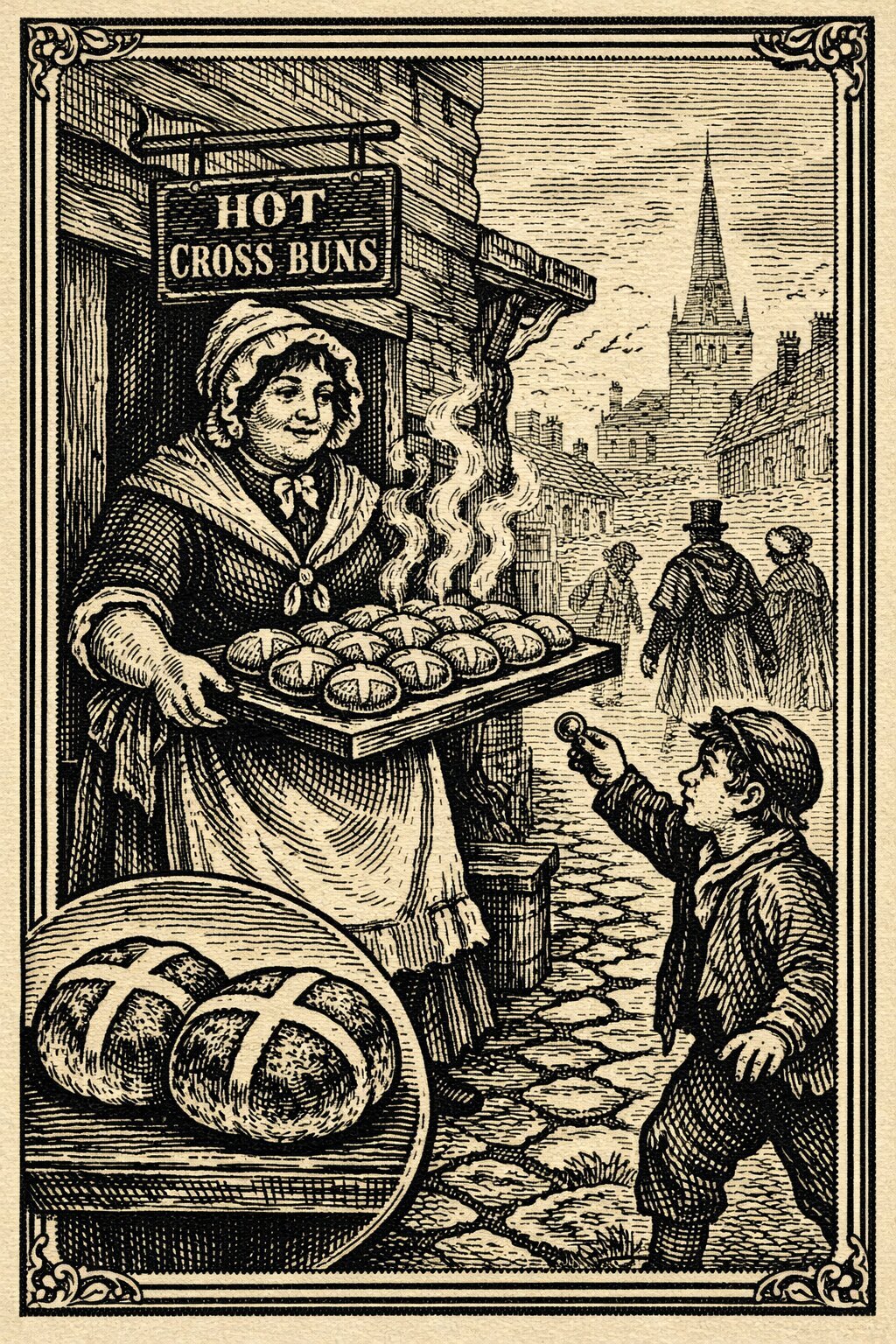
In the days before supermarkets and industrial bakeries, the arrival of Good Friday was announced before dawn by a sound that penetrated every street, court, and alley in every town of any size in England. The hot cross bun sellers - often hucksters who attempted no other trade at any time of year - were out from the break of day until midnight, their baskets wrapped in flannel and linen to keep the buns warm, their musical cries echoing through the sleeping streets.
'Hot cross buns - One a penny, buns - two a penny, buns - One a penny, two a penny, hot cross buns!'
The Salisbury Times of 1936 recalled that in that city, boys would visit the bakehouses before light to collect their stock of buns, then set off through the streets to sell them - though by the 1930s, the bakers had taken to delivering to order instead. The Morning Post of 1827 observed that pastry cooks on Good Friday thought of nothing but buns, and that 'from the break of day until midnight, the cries of one a-penny buns; two a-penny buns; one a-penny, two a-penny, hot cross-buns, re-echoes through the streets of the metropolis.'
Folklore, Superstition, and the Medicinal Bun
The hot cross bun was never merely food. Across England, Ireland, Scotland, and Wales, it accumulated a remarkable body of folklore that treated it as something between a charm, a medicine, and a holy relic.
Protection Against Fire
The most widespread belief was that a hot cross bun kept from one Good Friday to the next would protect a house from fire. The Nuneaton Observer of 1892 stated plainly that it was the custom in some parts of England 'to keep a hot cross bun from one Good Friday to another, and this is regarded as a charm against fire.' One Victorian chronicler noted, with dry amusement, that he had never heard of any house in which a bun was kept being totally destroyed by fire - which he took as sufficient evidence of its efficacy. At a dwelling in Brixton Hill, around twenty stale Good Friday buns were found strung on a card and hung above the street door, placed there in the belief that they would scare away evil spirits.
A Cure for Every Ailment
The bun's medicinal reputation was equally impressive. The Good Friday Evening Standard of 1878 recorded that in some districts, the mode of administration was to scrape a portion off the preserved bun, boil it, and form a kind of panada (a bread-and-water gruel). It was considered 'good for various directions, but especially for diarrhoea', and one cottager declared she had 'never known a child to die of this complaint' because she had always kept a bun for the purpose. In Sussex, agricultural labourers used the bread to cure 'scours' in their calves. A Hampshire woman, as recently as the late Victorian era, was known to grate a little of her Good Friday bun into cold water as a cure for a sore throat.
The Norfolk Diss bread - a spiced, herb-infused loaf baked on Good Friday morning - carried a particularly precise medical tradition. According to the Diss Express of 1979, from around 1200 AD to 1530 AD the bread was baked on Easter Monday, blessed by the priest, then put away until the following Good Friday, when a small portion was consumed. Thereafter, whenever one suffered an ache or pain, a portion of the bread was bandaged to the afflicted part. The Diss bread was famous enough to be celebrated in nineteenth-century verse: 'That tasteful bread, renowned through all the East, which yearning youngsters gorge at fair time feast.'
The Friendship Charm
One of the most appealing superstitions attached to the bun was the practice of two friends breaking one between them on Good Friday, each reciting the words:
'Half for you, and half for me, Between us two goodwill shall be.'
This was not only a pledge of friendship, the Westerham Herald explained in 1925, but 'also a spell against disagreement.' The same formula appeared in Mr H. Syer Cuming's paper to the Archæological Association in 1878, where he noted that breaking a bun 'betokened not only a pledge of friendship and unity, but as a surety against disagreement.'
Good Friday Itself: The Character of the Day
It is easy, focusing on the bun, to lose sight of the day it belongs to. Good Friday was, for centuries, the most solemn fast in the Christian calendar - a day of complete commercial suspension, black clothing, church attendance, and austere reflection. The Lincolnshire Chronicle of 1850 noted it was 'the only one besides Christmas which is honoured by a general suspension of business.' The Morning Post of 1827 observed that it was 'the most popular symbol of the Roman Catholic religion, in England, that the Reformation has left.'
Older Good Friday customs had an even more theatrical character. The monarchs of England were once required to perform a 'strange ceremony of creeping to the cross' - literally approaching the crucifix on their knees - and were also expected to hallow cramp rings at Westminster Abbey. These rings, distributed to sufferers of cramp and epilepsy, were believed to carry the sovereign's healing power, derived from a ring supposedly brought back from Jerusalem and presented to Edward the Confessor. Cardinal Wolsey received a supply of cramp rings via the ambassador Lord Berners in 1518, and Shakespeare alluded to the custom in As You Like It.
Other traditions attached to the day included the belief that eggs laid on Good Friday had the power to extinguish any fire into which they might be thrown; that washing done on Good Friday brought bad luck; and that crockery broken on the day was a sign of good fortune. In the midland districts of Ireland, the lower orders would prevent their children - even those at the breast - from tasting any food from midnight to midnight, and it was common to see men and women walking barefoot along the roads between market towns in procession, as a commemoration of Christ's Passion.
The Journeymen Bakers and the Ethics of Good Friday Labour
The enormous demand for hot cross buns on Good Friday created a problem that Victorian labour reformers found acutely uncomfortable. The Bath Herald of 1860 reported that a group of master bakers had determined to discontinue making buns on Good Friday, having received a letter from one of the city's principal master bakers pointing out the 'unnatural and severe labour imposed on the journeymen' by the hot cross bun custom. 'Good Friday, above all other days,' the paper editorialised, 'is one on which unnecessary labour or suffering should not be imposed on any class in order to minister to the mere gratification of appetite in others.'
The Operative Bakers' Society, meeting at the Tiger Tavern, Camberwell in 1847, had already taken up the question of night baking and excessive hours in the trade, noting an 1621 Act of Parliament that had actually provided for all cakes and spiced breads found in bakers' possession to be forfeited to the poor, except on Christmas and Good Friday - demonstrating the legal centrality of festival baking to the trade's very identity. The tension between the sanctity of the day and the commercial demands it generated was one that the Victorian era never quite resolved.
Spice Bread Beyond the Bun: A Broader Tradition
The hot cross bun was only the most visible member of a much wider family of British festival spice breads. The Blaydon Courier of 1937 observed that 'cakes are more closely connected with a country's religion than any other food', noting that every Church festival and sacrament was symbolised by a spiced bread or cake. The plum pudding and mince pie belonged to Christmas; the tansy cake and pudding pie to Lent; the simnel and carling cake to Mothering Sunday; the Beltein cake to the first of May.
In the North of England, Good Friday was sometimes marked by a dish called furmety (or frumenty) - a mixture of wheat, eggs, ale, and sugar served hot like soup. In Northumberland and parts of Scotland, salt fish was the preferred Good Friday dish. The tansy - a bitter herb - was widely used to flavour puddings and cakes at Easter, served alongside roast lamb or boiled gammon on Easter Day itself, and its use persisted into at least the nineteenth century.
The Glossop-dale Chronicle of 1877 records a Spring Bank Chapel in North Derbyshire providing 'spice bread' liberally to Sunday school scholars on Good Friday. The Blyth News of 1884 describes 'pasche eggs' and 'spice bread' being given to children at the Choppington Church Sunday school treat. 'Spice bread' appears repeatedly in Victorian records of Good Friday events, confirming that the enriched, spiced loaf existed in many forms alongside the specifically cross-marked bun.
Why We Still Eat Hot Cross Buns: The Survival of a 2,000-Year Tradition
The hot cross bun has survived the Reformation, the Enlightenment, two World Wars, the collapse of organised religion as a mass social force, and the arrival of the supermarket. It is now available in British shops from January onwards and is sold in millions every year. Why has it endured when so many other festival foods have vanished?
Part of the answer is sheer deliciousness. The combination of enriched dough, warm spice, plump currants, and soft crumb is deeply satisfying in a way that transcends religious affiliation. But part of the answer is also the bun's remarkable capacity to absorb meaning - pagan and Christian, ancient and medieval, royal and common, sacred and commercial - without being diminished by any of it. It has been a temple offering, a monastic charity, a Church sacrament, a royal indulgence, a street vendor's stock, a fire charm, a medicine, and a friendship token, all while remaining, at its core, a small sweet cake that costs a penny and smells wonderful.
The Hunts Guardian of 1878 put it well, summarising Mr Cuming's lecture to the Archæological Association: thousands who consumed Good Friday buns 'little thought of their Pagan origin, their adoption by the Christian Church, and how they should remind all of that awful, stupendous, and mysterious event which reconciled the world to an offended God, ransomed them from the bondage of sin, and opened the gates of paradise to all believers.' Whether or not one shares that theology, the bun carries the weight of those two thousand years in every bite.
Key Facts: Hot Cross Buns at a Glance
• The word 'bun' derives from the Greek accusative boun, a sacred offering to the gods.
• Cross-marked bread was found buried in the ruins of Roman Herculaneum, destroyed in 79 AD.
• Hot cross buns were originally eaten on Easter Sunday, not Good Friday.
• The Chelsea Bun House served royalty from George I to Queen Victoria, drawing crowds of 50,000 on a single Good Friday.
• Keeping a Good Friday bun for a year was believed to protect a house from fire.
• The bun was used medicinally for diarrhoea, sore throats, and as a bandage for aches and pains.
• In 1621, spiced breads found in bakers' possession were legally forfeit to the poor, except on Christmas and Good Friday.
• The distinctive flavour of a proper hot cross bun comes from a richer spice blend than an ordinary currant bun.
• The cry 'One a penny, two a penny, hot cross buns!' was heard in English streets from before dawn until midnight on Good Friday.
• Breaking a bun with a friend on Good Friday was believed to be a spell against disagreement for the coming year.
Primary Sources
This article draws on the following historical British newspapers, all consulted via archive research:
British Luminary, 22 April 1821
Morning Post, 9 April 1827
Exeter and Plymouth Gazette, 17 April 1830
Morning Herald (London), 25 March 1842
North Devon Journal, 16 April 1846
Morning Advertiser, 15 November 1847
Lincolnshire Chronicle, 5 April 1850
Halifax Courier, 8 April 1854
Newcastle Guardian and Tyne Mercury, 23 April 1859
Bath Herald, 24 March 1860
Paddington Advertiser, 26 April 1862
North London News, 26 April 1862
Meath Herald and Cavan Advertiser, 5 December 1868
Hunts Guardian, 27 April 1878
London Evening Standard, 19 April 1878
Glossop-dale Chronicle and North Derbyshire Reporter, 7 April 1877
Blyth News, 19 April 1884
Mid-Lothian Journal, 19 April 1895
Lloyd's Weekly Newspaper, 9 October 1898
Nottinghamshire Weekly Express, 8 April 1904
Manchester Evening News, 10 April 1906
Glamorgan Gazette, 12 April 1912
Time & Tide, 25 March 1921
Dundee Evening Telegraph, 14 April 1922
Westerham Herald, 11 April 1925
Liverpool Daily Post, 28 March 1929
Dundee Courier, 31 March 1931
Salisbury Times, 10 April 1936
Croydon Times, 8 February 1936
Blaydon Courier, 3 April 1937
Nottingham Journal, 1 April 1937
Diss Express, 5 October 1951
Diss Express, 18 May 1979
Wells Journal, 5 April 1990
This Topic
Festival Lore and the Ritual Year
Seasonal customs, feast days, holy tides, weather lore, and the old calendar that still haunts the modern year.
View Topic PageMore in this Topic
7 February 2026
The Poppy: From Forgetfulness to Remembrance30 December 2025
The Wheel of the Year, Rebuilt from Evidence20 December 2025
The Curious History and Folklore of the Mince PieLatest Posts
22 March 2026
What Does "Ne'er Cast a Clout Till May Be Out" Actually Mean?Is it about the month of May or the hawthorn flower? And what on earth is a clout? We dig into 170 years of British newspapers to finally answer one of folklore's most argued questions.
20 March 2026
The White Hart: The Ancient Legend Behind Britain's Most Common Pub SignFrom Greek mythology to medieval forest law, the white deer haunted the British imagination for centuries. Discover the real history behind the legend of the White Hart — royal badge, supernatural omen, and elusive quarry of the soul.
13 March 2026
Why Is a Horseshoe Lucky? The Surprising History Behind the World's Most Universal CharmThe horseshoe has been nailed above cottage doors, cathedral gates, and battleship masts for centuries. Discover the ancient beliefs in iron, the crescent moon, and the sacred horse that made it the world's most enduring good luck symbol.
12 March 2026
Saint Piran of CornwallPiran - patron saint of Cornwall, tin miners and the Cornish flag — from Irish origins to the buried oratory's remarkable 2014 excavation.
10 March 2026
Clare Island - Isle of Storms, Pirates and Naturalists: A History in Newspaper Voicesiscover the fascinating history of Clare Island, off the coast of Mayo - from the piratical legend of Grace O'Malley and bitter land disputes to a landmark natural history survey, told through contemporary newspaper voices spanning 1863 to 1986.
7 March 2026
The Wandering Fire - A History of Ball LightningFrom a French tailor stalked by a glowing sphere to thousands of iridescent globes hovering over a Dorset clifftop, discover the strange and fascinating history of ball lightning as recorded in British and Irish newspapers between 1792 and 1938 — and why science, for over a century, could only stand mute before it.