
Valentine’s Day: Candlemas, Lupercalia, and the Forgotten History of February 14
Written by David Caldwell ·
Valentine’s Day
Calendar Drift, Forgotten Saints, and the Long Shadow of Candlemas
Valentine’s Day is often presented as a simple story. A Christian priest defied a pagan emperor, secretly married lovers, and was executed for his faith. His martyrdom was commemorated on 14 February. Centuries later, poets added romance, and a feast of love was born.
The problem is that almost none of this survives contact with chronology.
Once the dates are examined carefully, Valentine’s Day stops looking like a single historical event and starts to resemble a convergence point. A knot of overlapping calendars. Liturgical arithmetic. Seasonal rites. Competing saints. Calendar reforms. Later medieval storytelling. Victorian antiquarian enthusiasm. Modern simplification.
Rather than asking whether Saint Valentine was “real” in a binary sense, it is more productive to ask why mid-February became such a contested and symbolically dense point in the year at all.
To answer that, we have to begin not with Valentine, but with Christmas. Or rather, Old Christmas.
Old Christmas, Epiphany, and the End of the Year That Would Not Sit Still
In much of early Christianity, Christmas was not fixed on 25 December. That date emerges gradually and unevenly. In the eastern Mediterranean especially, Epiphany on 6 January functioned as the primary feast of the Nativity. It marked the manifestation of Christ. Birth, baptism, revelation, and kingship blurred together.
In popular tradition, Epiphany often carried the weight of Christmas itself. Even in later centuries, Twelfth Night was treated as the true ending of the Christmas season. In Britain, the idea of “Old Christmas” lingered long after official calendars changed, especially in rural communities where habit mattered more than papal decrees.
This matters because of a rule that predates Valentine entirely.
Forty Days and the Logic of Purification
Both Jewish and early Christian tradition attach ritual significance to forty days.
In the Gospel of Luke, Mary undergoes purification forty days after the birth of Jesus. At the same time, the child is presented at the Temple. Simeon speaks the words that later give Candlemas its enduring imagery. A light to lighten the Gentiles.
If the Nativity is celebrated on 25 December, forty days later is 2 February. This becomes the Feast of the Purification of the Virgin Mary, later known as Candlemas.
If the Nativity is celebrated on 6 January, forty days later is 14 February.
That alone explains why older sources sometimes place purification observances on the fourteenth, and why later writers appear confused. The confusion is real. The calendar moved beneath their feet.
There is no need for conspiracy or deliberate replacement to explain this. Liturgical arithmetic does the work.
Candlemas Before It Was Candlemas
Candlemas is not a minor feast. It absorbed extraordinary symbolic weight.
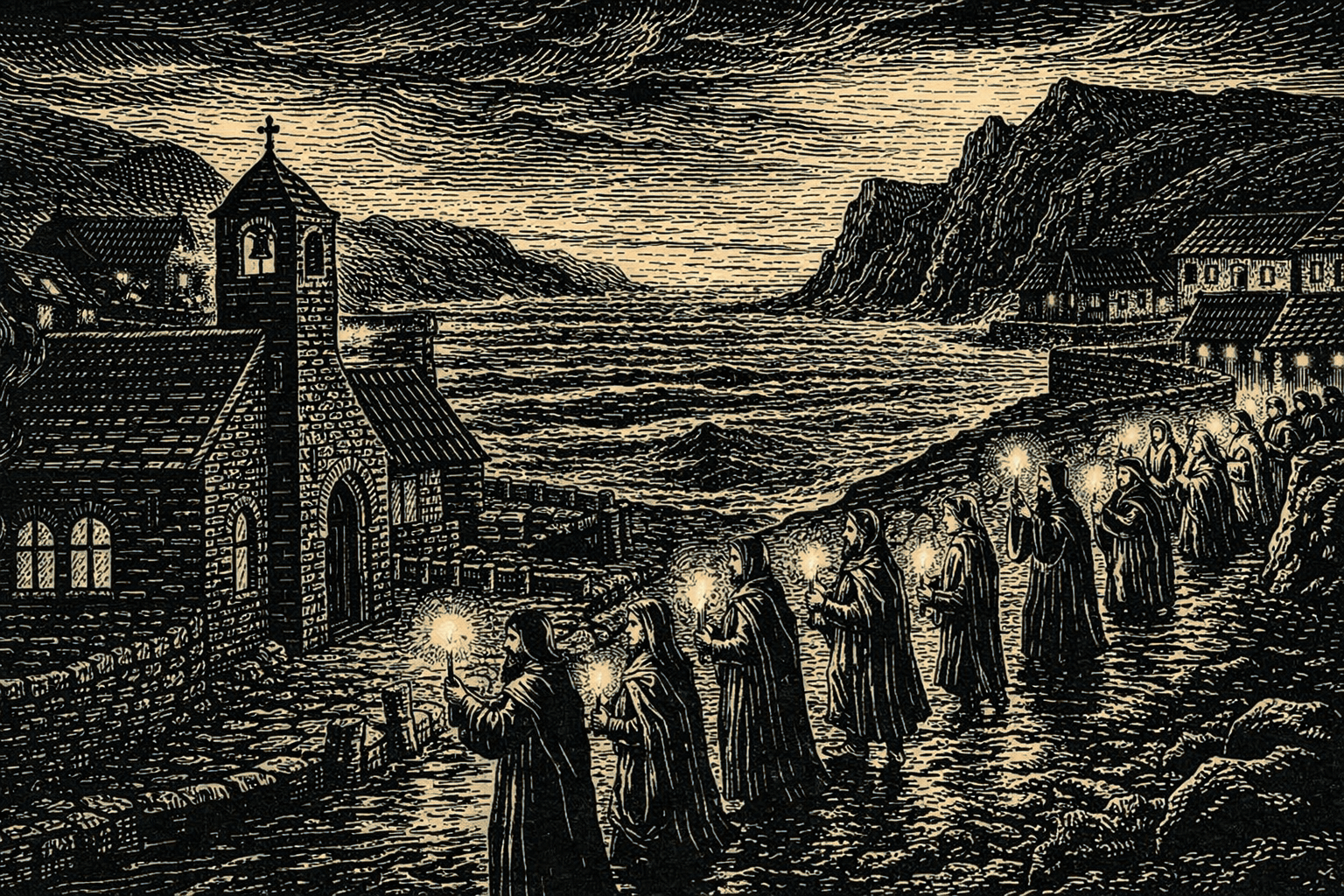
It involved light in the heart of winter. Blessing candles for the year ahead. Processions. Protection against illness, storms, and death. A threshold moment when the lengthening days became visible.
In northern Europe, early February already mattered.
This is not speculation. Folk customs across Britain, Ireland, and Scotland cluster here. Weather divination. Agricultural rites. The turning of winter. The return of milk and lambing. Household purification. Fire and light.
The Church did not invent the importance of early February in northern lands. It inherited it.
Imbolc, Brigid, and the February Threshold
In the Irish calendar, Imbolc falls around 1 February. It is associated with Brigid, later Saint Brigid, a figure who bridges pre-Christian and Christian worlds with remarkable ease.
Imbolc concerns light, renewal, fire, fertility, and the stirring of life beneath winter’s surface. These are not abstract ideas. They reflect lived experience in northern climates where February represents the first perceptible shift in the season.
When Candlemas settles on 2 February, it lands directly beside this existing symbolic cluster. That proximity matters more than intent. Once the dates align, customs bleed into one another.
Candles replace hearth fires. Saints replace goddesses. Blessings replace charms. The structure remains.
This is not replacement in the crude sense. It is accommodation.
Calendar Reform and the Sliding Feast
Later confusion arises because the calendar itself changed.
The Gregorian reform corrected the drift of the Julian calendar. In England, this adjustment arrived late and violently. Eleven days vanished overnight in 1752. People complained that time itself had been stolen.
Older traditions did not always shift cleanly with the calendar. Some dates remained fixed by habit rather than mathematics. Others migrated slowly. In popular memory, Candlemas could appear to move.
This explains antiquarian claims that Candlemas was “formerly” on 14 February. It was not moved from there by decree. It arrived there naturally when Epiphany functioned as the Nativity feast, and then retreated once Christmas became fixed.
And Then There Was Lupercalia
14 February was already occupied.
The Roman festival of Lupercalia occurred on 15 February, with rituals beginning the night before. It was ancient even by Roman standards. It involved purification, fertility, sacrifice, and the symbolic striking of women with strips of hide to encourage conception.
Later Christian writers were deeply uncomfortable with it.
Pope Gelasius I condemned Lupercalia in the late fifth century, describing it as morally incoherent and socially obsolete. His letter survives. It is not subtle.
What Gelasius did not do is create Valentine’s Day in its place.
There is no decree transferring Lupercalia to Saint Valentine. That claim is a later simplification. What Gelasius did do was suppress a public pagan rite that had already lost elite support.
What remained was a calendrical vacuum around mid-February. A date already hovering near purification rites depending on which Nativity feast one followed.
Convenience does not require conspiracy.
Enter Valentine. Or Rather, Valentines.
The Roman Martyrology lists multiple martyrs named Valentinus associated with 14 February.
One is described as a priest of Rome. Another as a bishop of Interamna, modern Terni. A third appears in Africa with companions.
Their stories overlap. Their dates blur. Their details are sparse.
What matters is that Valentinus was a common name, derived from valens, meaning strong, vigorous, healthy. It was not unique. It was not romantic.
Later antiquarians even speculated that “Valentine” was confused with galant or gallant. While that is linguistically weak, it shows how quickly meaning drifted.
Claudius II and the Problem of Persecution
The most persistent legend claims that Emperor Claudius II banned marriage for soldiers, and that Valentine defied this decree.
There is no contemporary evidence for such a ban.
Roman marriage in the third century was not a sacramental institution. It was a private legal arrangement. Informal unions were common. Soldiers often married despite restrictions on inheritance.
Claudius II was a military emperor engaged in constant warfare. His reign was brief. He did not initiate a systematic persecution of Christians.
Large-scale persecutions occur under Decius and Diocletian, not Claudius. Earlier violence under Nero was localised and politically motivated.
The idea of Claudius as a great persecutor serves narrative needs, not historical ones.
Asterius and the Miracle That Travels Well
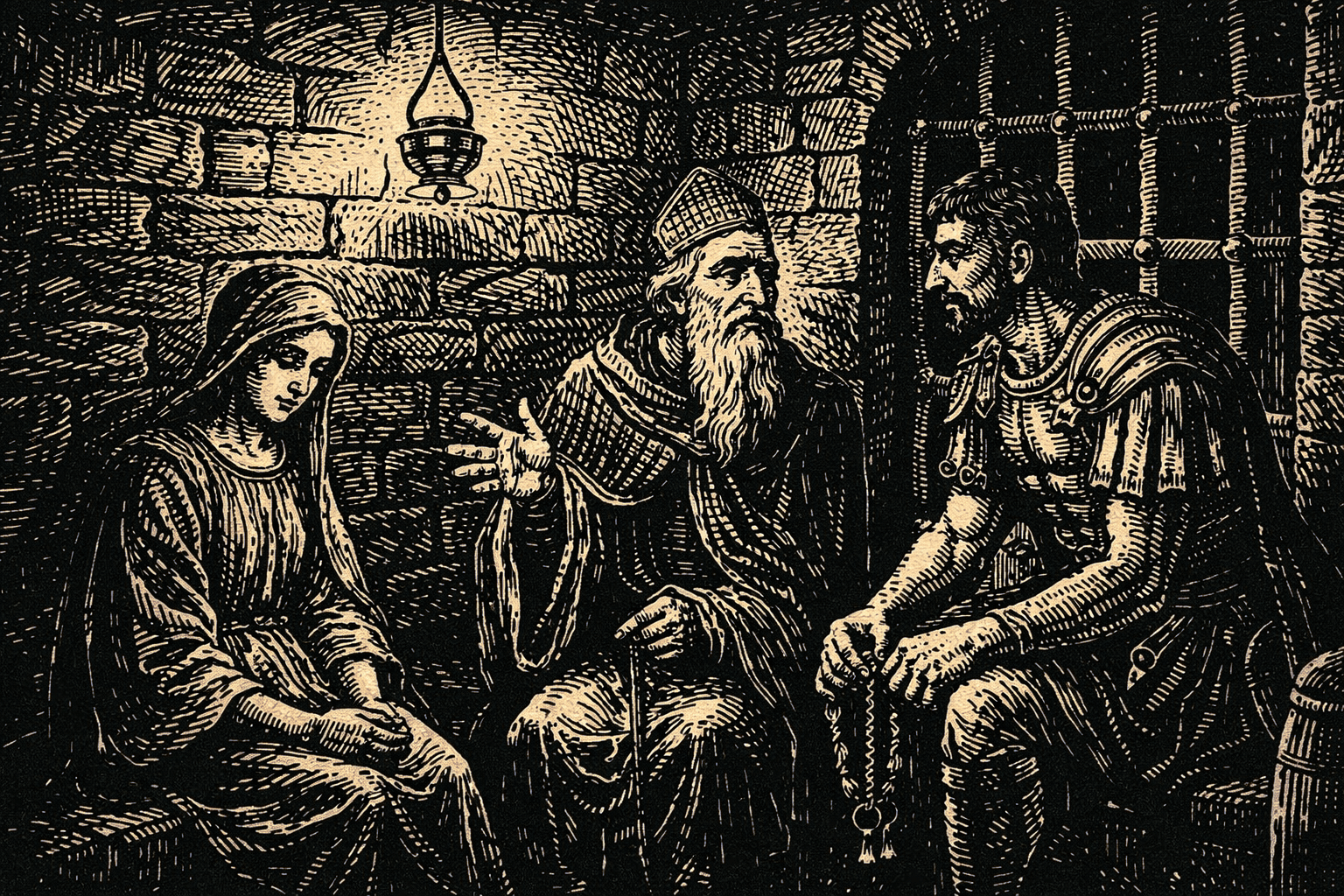
Several accounts introduce Judge Asterius, whose blind daughter is healed by Valentine. The household converts. Idols are smashed. Valentine is executed.
This story appears in multiple versions across centuries. It grows more elaborate with each retelling.
Asterius functions as a narrative device. He provides a miracle. A conversion. A reason for execution. A moral victory.
There is no independent evidence for him.
The Golden Legend and the Invention of Continuity
By the thirteenth century, Jacobus de Voragine compiles the Golden Legend. It is not history. It is devotional literature.
The Golden Legend does what medieval hagiography often does. It harmonises contradictions. It simplifies timelines. It provides moral clarity where sources are silent.
Valentine becomes a single figure. His story becomes coherent. His feast becomes fixed.
Later, the Nuremberg Chronicle adds visual authority. Images lend weight. Printing fixes what had previously been fluid.
Once a story is illustrated, it feels ancient.
From Feast to Romance
The association of Valentine’s Day with romantic love does not come from Rome.
It comes from medieval England and France.
Geoffrey Chaucer connects Saint Valentine’s Day with birds choosing mates. This reflects seasonal observation, not martyrdom. By mid-February, birds do begin pairing.
Courtly love poetry follows. Customs emerge. Letters are exchanged. Lot-drawing rituals are described. Names are paired. Games are played.
None of this requires Saint Valentine himself to be involved. His name becomes a label attached to an already meaningful date.
Relics, Catacombs, and Dublin
In the nineteenth century, relics attributed to Saint Valentine were distributed across Europe. One set arrived in Dublin, now housed at Whitefriar Street.
These remains were exhumed from Roman catacombs, a common practice in the period. Identification was often based on inscriptions, symbols, or hopeful attribution.
This does not mean fraud. It does mean uncertainty.
Relics function symbolically. They anchor devotion in place. They do not guarantee biography.
Gelasius Revisited
Pope Gelasius did suppress Lupercalia. He did reaffirm Christian moral authority. He did not invent Valentine’s Day as a romantic festival.
What he represents instead is a moment when older public rites were no longer tolerable within a Christianised elite culture.
The calendar did not reset. It accreted.
So What Is Valentine’s Day, Really?
Valentine’s Day is not the Christianisation of Lupercalia.
It is not the memorial of a single heroic martyr.
It is not a pagan festival in disguise.
It is a convergence.
A date produced by liturgical arithmetic. Shaped by calendar reform. Occupied by seasonal meaning. Reframed by medieval poetry. Stabilised by print. Simplified by modern culture.
The saints named Valentine were real enough. Their stories were not preserved. Later generations filled the silence.
What endured was the date.
Mid-February mattered long before hearts and cards. It still does.
Conclusion. The Power of the Hinge
Early February is the hinge of the year in northern lands. Winter loosens. Light returns. Life stirs.
Whether marked by Imbolc, Candlemas, purification rites, or lovers drawing names from a box, the impulse is the same.
To recognise that something has turned.
Valentine’s Day survives because it sits on that hinge. Everything else is embroidery.
This Topic
Festival Lore and the Ritual Year
Seasonal customs, feast days, holy tides, weather lore, and the old calendar that still haunts the modern year.
View Topic PageMore in this Topic
27 March 2026
Hot Cross Buns: History, Origins & Folklore7 February 2026
The Poppy: From Forgetfulness to Remembrance30 December 2025
The Wheel of the Year, Rebuilt from Evidence20 December 2025
The Curious History and Folklore of the Mince PieLatest Posts
27 March 2026
Hot Cross Buns: History, Origins & FolkloreDiscover the fascinating history of hot cross buns - from pagan offerings and Greek sacred bread to Chelsea bun houses and Good Friday folklore. Explore 2,000 years of spiced bread tradition.
22 March 2026
What Does "Ne'er Cast a Clout Till May Be Out" Actually Mean?Is it about the month of May or the hawthorn flower? And what on earth is a clout? We dig into 170 years of British newspapers to finally answer one of folklore's most argued questions.
20 March 2026
The White Hart: The Ancient Legend Behind Britain's Most Common Pub SignFrom Greek mythology to medieval forest law, the white deer haunted the British imagination for centuries. Discover the real history behind the legend of the White Hart — royal badge, supernatural omen, and elusive quarry of the soul.
13 March 2026
Why Is a Horseshoe Lucky? The Surprising History Behind the World's Most Universal CharmThe horseshoe has been nailed above cottage doors, cathedral gates, and battleship masts for centuries. Discover the ancient beliefs in iron, the crescent moon, and the sacred horse that made it the world's most enduring good luck symbol.
12 March 2026
Saint Piran of CornwallPiran - patron saint of Cornwall, tin miners and the Cornish flag — from Irish origins to the buried oratory's remarkable 2014 excavation.
10 March 2026
Clare Island - Isle of Storms, Pirates and Naturalists: A History in Newspaper Voicesiscover the fascinating history of Clare Island, off the coast of Mayo - from the piratical legend of Grace O'Malley and bitter land disputes to a landmark natural history survey, told through contemporary newspaper voices spanning 1863 to 1986.