Pontius Pilate: history, myth, and the long afterlife of Rome’s most famous governor
Written by David Caldwell ·
Pontius Pilate is a minor Roman official who somehow became a permanent resident of the Western imagination. Most provincial governors fade into the background, their names surviving only in inscriptions or administrative lists. Pilate does not. He appears in creeds, sermons, poems, polemics, travel writing, local legends, Cold War editorials, and newspaper oddities that treat him as everything from a symbol of political cowardice to a weather-haunting ghost who will not stay buried.
The reason is structural. Crucifixion is a Roman state punishment. Whatever pressures existed in Jerusalem, the execution mechanism belonged to Rome. Pilate is the hinge that connects a local religious crisis to imperial power, and that hinge became a storytelling joint that later centuries could bend in whatever direction they needed.
This article separates four layers that are often tangled together: the historical outline, the narrative Pilate of the trial accounts, the documentary fantasies and forgeries that grew around him, and the folklore that tried to pin his death and burial to specific places. The goal is not devotion and not debunking for sport, but a clear, well-sourced map of how Pilate became both a man in history and a character in legend.
1) The historical spine: what can be said without leaning on legend
The historically defensible outline is short.
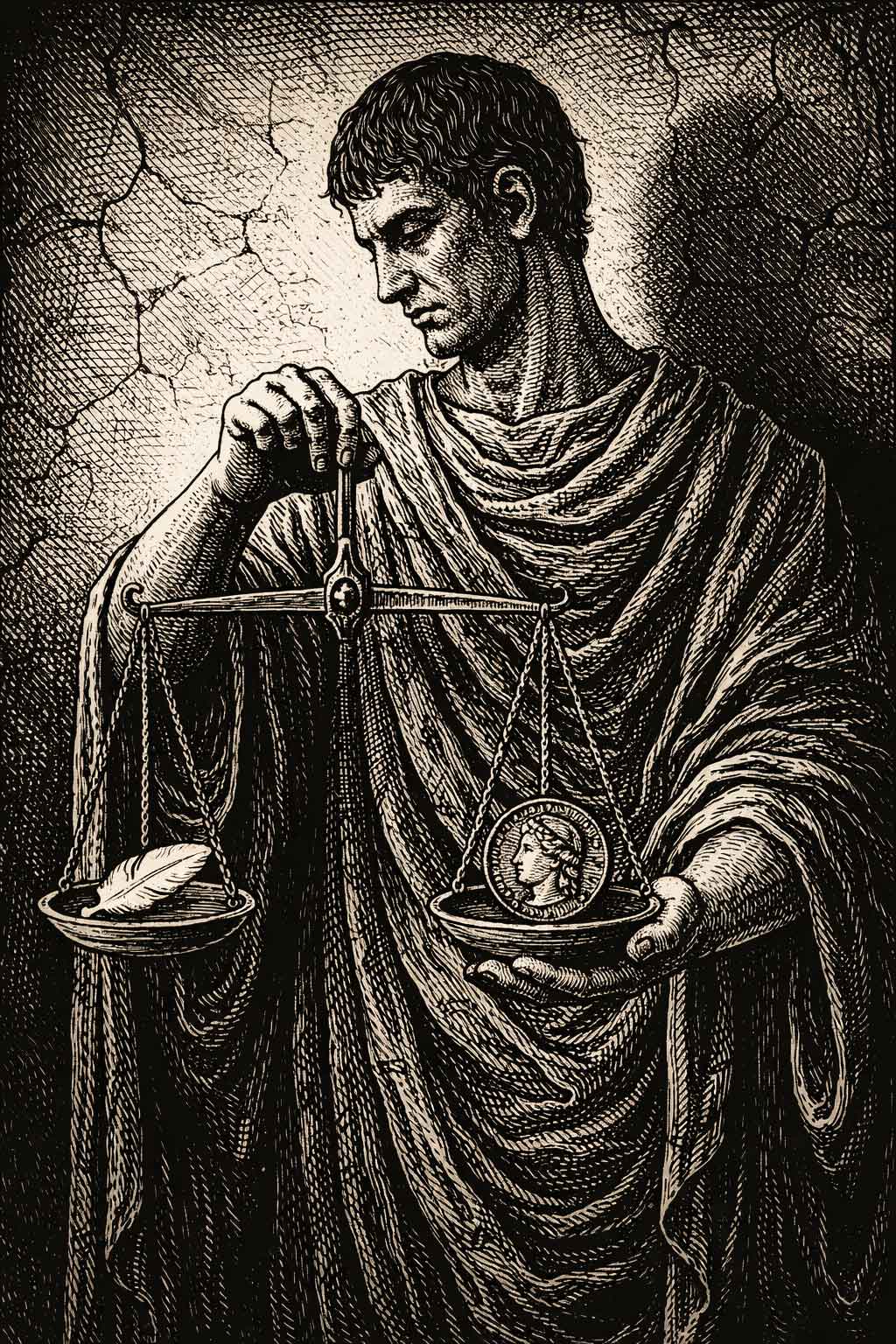
Pilate governed Judaea under Tiberius in the early first century. Contemporary and near-contemporary writers portray a tense province where crowd politics, religion, and imperial authority collided. Pilate was not an abstract judge in a philosophical drama. He was an administrator responsible for order, tax stability, and not embarrassing the empire.
Two categories of evidence matter here:
Archaeological anchors
Coins minted under Pilate’s authority survive, and an inscription from Caesarea Maritima, the famous “Pilate Stone,” preserves his name and title in Latin. These are blunt objects. They do not tell stories, but they confirm that Pilate was not invented by later Christian memory.
Ancient literary witnesses
Josephus and Philo are the key names that later Christian writers repeatedly cite when they want to ground Pilate in something more solid than church tradition. That habit shows up plainly in newspaper material from the nineteenth and twentieth centuries, which constantly return to “Philo and Josephus” as the respectable backbone for any discussion of Pilate’s character.
Josephus mentions Pilate mainly in connection with episodes of public disorder and Roman crowd control. In Antiquities he describes disputes over imperial symbols in Jerusalem and an aqueduct project funded from Temple money, both followed by protests and violence. He also reports that Pilate was ordered to Rome after a crackdown on Samaritans at Mount Gerizim prompted a complaint to Lucius Vitellius, the Roman governor of Syria; Josephus adds that Tiberius died before Pilate reached Rome. Josephus does not narrate Jesus’s trial under Pilate in these sections, but his Pilate is consistently framed as a hard provincial administrator operating in a volatile province.
One of the most-cited non-Christian references comes from Tacitus. Writing in the early second century, he mentions, almost in passing, that “Christus … suffered the extreme penalty during the reign of Tiberius at the hands of one of our procurators, Pontius Pilatus” (Annals 15.44). Tacitus offers no detail about the trial, only the blunt Roman framing: execution as state punishment under imperial authority.
A London Evening News feature from 3 April 1969, for instance, frames its entire portrait around these two witnesses. It treats Pilate as a hard Roman governor, not necessarily a monster, but a man capable of contempt and brutality, and it tries to read the Gospel courtroom scene as political crisis-management, not spiritual theatre.
That is the historical spine. Everything else grows outward from it.
2) Origin stories: when the evidence runs out, geography rushes in
Because Pilate’s birthplace and early career are not securely documented, later writers filled the gap with local pride, moral allegory, and “circumstantial” tradition. The result is a Pilate who can be born almost anywhere, which is usually a clue that the story is serving the needs of the teller more than the needs of history.
Scotland: Fortingall and the Perthshire Pilate
A striking example appears in Thomson’s Weekly News (Saturday 13 September 1902) under the headline “The Birthplace of Pontius Pilate.” The piece places Pilate in the village of Fortingall, ten miles from Aberfeldy, and treats the claim as a serious antiquarian tradition. A Roman embassy is said to have come to the court of a Scottish king. One of the ambassadors is described as Pilate’s father, and during the stay the future governor is said to have been born “shortly before the nativity of our Saviour.”
The same piece then uses the Fortingall yew as supporting atmosphere: a tree estimated at 3000 years old, “the oldest in Europe,” with a trunk once wide enough that a coach and four could drive through it. This is not evidence, but it is excellent folklore technique. It ties a famous name to an ancient object that can still be visited, photographed, and pointed at.
A later Scottish-flavoured fragment goes even further into the “what-if” imagination. The Dundee Courier (Friday 16 September 1938) reports a Rotary Club talk that jokes about world history being altered if Cleopatra’s nose had been slightly different. The punchline is that without Cleopatra’s influence there would have been no empire of Augustus and “neither Pontius Pilate nor Herod would have ruled in Syria.” The geography is sloppy, but the point is revealing: Pilate becomes a token that can be moved around the board in alternative-history games, because his name is culturally heavy.
Germany, Spain, and the Pilate-as-canvas effect
A 1916 Lloyd’s Weekly extract (“Pontius Pilate Searches His Memory”) turns Pilate into a literary device for philosophical reflection. A friend reminds an older Pilate of Jesus, and the story becomes a meditation on history and conscience. Another source, the Sunday Tribune (28 March 1999) reviewing a book titled Pilate by Ann Wroe, makes the key point directly: the scarcity of early sources has “allowed contrasting Pilates to be imagined,” each reflecting an author’s agenda and the climate of the time. That review even notes invented Pilate origins “from Spain and Germany,” treated almost as a symptom of the problem rather than a discovery.
When a figure can be convincingly born in Scotland, Spain, and Germany depending on who is speaking, the responsible approach is to treat birthplace claims as cultural artefacts unless they rest on hard evidence. They tell a story, but usually not the story they pretend to tell.
3) Pilate in the trial narrative: why he is pivotal, and why he is softened
The central tension is simple. Rome’s hand is structurally central because crucifixion is a Roman state punishment. Yet, as Christian memory develops, Pilate is often narratively softened and blame is displaced onto Jewish authorities, shaped by politics, polemic, and theology.
The newspaper sources show this softening in real time across decades.
Pilate as reluctant administrator
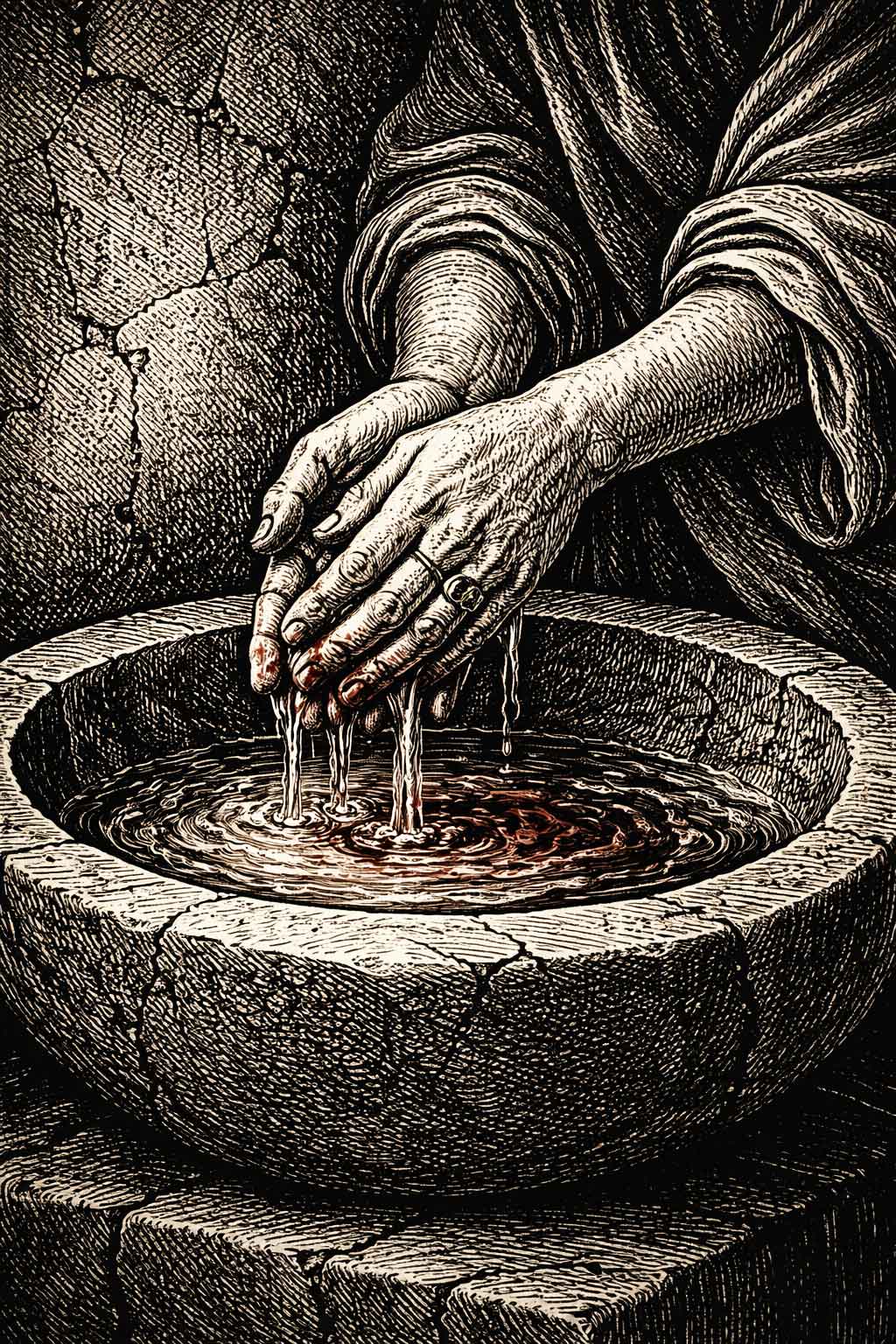
In Truth (Thursday 15 April 1954) Pilate’s handwashing is treated as a symbolic gesture of abdication. The piece is explicitly modern, explicitly moral, and even drags the hydrogen bomb into the same paragraph. Pilate becomes the universal image of “weak and lazy abandonment of effort,” a cautionary tale about personal standards collapsing in an age of mass destruction. This is not historical reconstruction. It is Pilate as mirror.
The Catholic Standard (15 April 1954) also paints Pilate as a man caught between an angry crowd and the machinery of law. It lingers on the scene of him sitting in judgment, looking down at a helpless prisoner, with the crowd demanding Barabbas. The emphasis is psychological: Pilate could have refused, but he would have been unpopular, and a Roman official with riots in his territory has a career problem.
The Evening News (London, 3 April 1969) asks, in plain tabloid language, “What manner of man WAS Pilate?” and attempts to triangulate his personality through Philo, Josephus, and the Gospels. It notes that Philo describes a man who had “a habit of insulting people” and acted with “cruelty,” while the Gospels preserve the courtroom image of evasiveness and political calculation. Again the same move: Pilate as a recognisable bureaucratic type.
Pilate as scapegoat, and the dangerous drift of blame
A long debate report in the East London Observer (Saturday 4 August 1888) shows how the argument over responsibility was fought in public. It describes a dispute over whether Tacitus and Josephus mention Jesus, and whether omissions prove anything. The tone is combative, and the key line lands bluntly: Jesus “was put to death under Pontius Pilate.” Here Pilate is a historical anchor used to argue about the credibility of Christianity itself.
The risk, historically and morally, is that “softening Pilate” can become “hardening the blame elsewhere,” and the sources show how easily polemic takes over. A neutral account needs to keep the structural fact in view: Rome executed. The narrative may explore who pushed, who manipulated, who feared riots, and who sought political advantage, but it should not turn a Roman execution into a purely local act.
4) Documentary fantasies, forged paperwork, and the hunger for “official proof”
Few things have fuelled Pilate mythology more than the idea that Rome must have kept records. That assumption is not absurd. Provincial reporting existed. Administrative documentation existed. But the leap from “records existed” to “we have a record of Jesus’s trial” is where forgery and wish-fulfilment multiply.
The “actual sentence” and the temptation of courtroom theatre
The Birmingham Daily Post (Monday 29 October 1888) prints a piece titled “THE ACTUAL SENTENCE PASSED BY PONTIUS PILATE.” It claims a correspondent extracted a “correct transcript” from a German paper, presenting a formal-sounding decree: Pilate sentencing “Jesus of Nazareth” to death by crucifixion, with references to “orders” and a supposedly engraved plate found in Aquila (Aquila in Italy is mentioned). The piece even admits doubts: it notes there is “some reason to doubt” authenticity and that the sentence may not correspond with the Gospels.
This is a perfect case study in how these texts function. They promise the thrill of bureaucracy, the cold stamp of the state, the fantasy of an official memo that ends all arguments. But the very form is suspect, and the provenance reads like a chain of hearsay.
Eusebius, Tertullian, and the report to Tiberius
Eusebius preserves a tradition that Pilate reported to Tiberius about Jesus, including wonders and resurrection claims, and that the matter reached the Senate. The point is apologetic: Christianity was known at the top, and it did not need the Senate’s permission anyway.
The difficulty is not the idea of reporting, but the content and the use. The account functions as a prestige ladder for the faith. It makes Christianity look like a matter that imperial governance had already considered.
The “Forged Acts of Pilate” under Maximinus
Eusebius also describes hostile forgeries. Under the persecuting emperor Maximinus, “Acts of Pilate” full of blasphemy were allegedly fabricated and distributed with official approval, posted publicly, and taught in schools. The same section describes coercion of “infamous women” into written declarations about supposed Christian crimes, then publishing those statements across cities.
That is propaganda with a familiar shape. Give the slander the weight of “documents,” add state distribution, and drill it into children.
Do any of the hostile forged Acts survive?
What survives clearly are later texts circulating under Pilate’s name, including various “Acts of Pilate,” Pilate letters, and the broad family of apocryphal courtroom literature. The problem is confident identification. The specific anti-Christian package Eusebius describes, posted on pillars and turned into school lessons, cannot be neatly matched to a single surviving text in a way that would satisfy a cautious historian.
That does not make Eusebius’s description meaningless. It shows that by the early fourth century, “Pilate documents” had already become a weapon that both sides could imagine and forge.
What if a genuine first-century record existed?
Even a genuine Roman document would not be a magic key. It could clarify procedure, charge framing, and administrative tone, but Roman paperwork is not designed to confirm theology. It would be historically priceless, not spiritually final. It might also be self-serving, because governors write to protect careers.
5) The later life problem: exile, suicide, execution, and why Pilate gets multiple endings
Once the Gospel narrative finishes, the urge to “close Pilate’s story” kicks in. A man so central to the crucifixion feels as if he must receive a fitting end. That end varies wildly depending on the tradition.
Malalas: Pilate dragged into imperial drama and executed
In the chronicle tradition associated with John Malalas, the story swells into imperial theatre. Nero, hearing of Christ, seeks him as a philosopher and miracle-worker, then learns he was already crucified. Annas and Caiaphas are brought to Rome in bonds and bribe their way out. Pilate is brought bound and remains in prison.
Later the tale folds Pilate into the Simon Magus episode, with Nero interrogating him. Pilate is presented as someone who can identify whether Simon is “the Christ,” and Nero’s anger shifts onto Pilate for having surrendered a blameless wonder-worker. The chronicle then has Nero order Pilate “cut down,” an execution that reads like cosmic justice delivered by imperial rage.
This is not administrative history. It is moral storytelling written as chronography, and it shows how the Pilate figure is used to bind the Gospel story into the apostolic age and into Rome’s palace itself.
Eusebius: Pilate’s suicide under Caius
Eusebius offers a different moral conclusion. Under Caius, Pilate falls into misfortunes and becomes “his own murderer and executioner.” This is Pilate as a warning: divine vengeance arrives quickly.
These endings cannot both be historical in a literal sense. Their importance is cultural. They show what later writers needed Pilate to be: either punished by the empire he served, or punished by his own conscience.
6) Vienne, towers, tombs, rivers: the folklore that nails Pilate to the landscape
If Pilate’s origins float, his death is nailed down in folklore, repeatedly, obsessively, to specific places. The strongest cluster centres on Vienne in Gaul and the Rhône, and another cluster centres on Mount Pilatus and storm-haunted lakes.
The Tower of Mauconseil and the Rhône
A compact version appears in the Dublin Evening Mail (Monday 23 September 1844): near Vienne stands a tall square Roman tower, the Tour de Mauconseil. Legends claim Pilate lived there and, in despair, threw himself from the windows into the Rhône, where he perished.
A longer, moodier version appears in the Cardiff and Merthyr Guardian (Saturday 27 September 1851) under the headline “THE DEATH-PLACE OF PONTIUS PILATE.” It adds atmosphere: the tower rising to an unusual height, overlooking river waters, casting a “perpetual gloom.” Pilate retires there “broken in spirit” after the crucifixion and leaps into the Rhône. The piece then expands the haunting beyond Vienne by mentioning an Alpine mountain and a lake called by Pilate’s name, where storms and disturbances are blamed on his troubled spirit and on his “writings.”
This is classic folklore mechanics. Pilate is not only punished. The landscape is altered by him. Nature itself reacts.
The Tomb of Pontius Pilate at Vienne
La Belle Assemblée (Monday 1 October 1849) publishes “THE TOMB OF PONTIUS PILATE,” attributed to Nicholas Michell, and treats the Vienne monument with quasi-antiquarian seriousness. It describes a Roman structure with an open square arcade on a solid basement, the whole above “sixty feet,” with no inscription visible. It claims that Pilate was sent into exile at Vienne and killed himself “about A.D. 38,” and that the monument’s tradition is ancient enough that anyone trying to shake it off will be performing a thankless task.
That is an unusually honest admission. The writer knows the tradition is sticky. The monument becomes a focal point for belief regardless of what inscriptions do or do not say.
Procopius, shipwreck, and the tourist’s Pilate
Later folklore often borrows the tone of travel writing and the authority of named witnesses. The material includes references to a tomb visited by a figure like “Mr Hood,” and to Procopius as a named source associated with locating or describing Pilate-related places and events, sometimes including a shipwreck motif connected to Crete. Whether each of these details stands up historically is beside the main point: they show how Pilate legend piggybacks on travel authority. A tomb feels more credible when a named visitor “saw it,” and a dramatic shipwreck feels like the universe refusing to let Pilate’s body rest.
The recurring pattern is that Pilate’s corpse becomes a problem that must be transported, relocated, rejected by one place, and finally pinned down somewhere remote.
7) Mount Pilate and the storm-haunted body
The Swiss strand is one of the richest, because it merges Christian moralising with folk weather-magic.
The Newcastle Chronicle (Saturday 5 September 1896) prints “THE LEGEND OF MOUNT PILATE.” It describes the mountain near Lucerne, the saying “The weather will be fine, if on an altar it will rain,” and the belief that strange legends hung around the mountain for centuries because Pilate’s body rested there. The legend explains storms, disasters, and superstitious fear as the physical effect of Pilate’s evil spirit. It even includes a social response: people petition for holy help, as if a ritual intervention could pacify the mountain’s mood.
This is not just Pilate as guilty man. It is Pilate as a contaminant whose presence disrupts the natural order.
8) Effigies, sailors, and popular ritual: Pilate on the yard-arm in Cork
One of the most vivid pieces of material is not about tombs or towers at all, but about popular ritual.
The Kentish Weekly Post or Canterbury Journal (Saturday 11 April 1747) reports from Cork that crews of two Portuguese ships hung Judas Iscariot “in effigy” on a yard-arm near the custom-house, fired shots at it all day, then shot it down, cut it into pieces, and threw it into the river. Then, “being their Easter,” they hung up the effigy of Pontius Pilate “in the same manner,” again with guns fired around two o’clock in the morning, alarming the inhabitants.
This is extraordinary because it shows Pilate not as theological puzzle but as a public villain in a ritual drama acted out by sailors with cannons. It also shows how blame is staged. Judas and Pilate are paired as symbolic targets, punished repeatedly in public performance. Whatever the historical Pilate did or did not do, folklore and popular religion had already decided how he should be treated.
9) Ethiopia, sainthood, and the uncomfortable truth that “Christian tradition” is plural
A brief clipping can correct an entire assumption.
The Bedfordshire Times and Independent (Friday 27 January 1933) notes that an Eastern legend commemorates Pontius Pilate as a saint in the Ethiopian Church, and that in the Greek Church Pilate’s wife is also regarded as a saint.
Another piece, Belfast News-Letter (Saturday 21 July 1973) in a “Study Chair” column about the ancient church of Ethiopia, casually includes “Pontius Pilate and his wife” in a list of saints to whom devotion is paid, alongside the Virgin Mary and others. It describes Ethiopian religion as a “strange mixture” through the eyes of the columnist, blending Christianity, Judaic elements, Islam contact, and what is called paganism.
Whatever one thinks of the framing, the factual takeaway is crucial: Pilate does not play the same role in every Christian memory. Some traditions preserve room for repentance, rehabilitation, or at least a more complex moral reading. That alone should caution against treating the harshest or the softest portrayal as “the” Christian view.
10) Modern reinventions: Notovitch, Allegro, and the market for discovered lives
The nineteenth and twentieth centuries produced a steady stream of “newly discovered” Jesus and Pilate material, often pitched as lost biographies, secret Eastern records, or suppressed archives.
The Notovitch story belongs in this family. A “new Life of Christ” discovered by M. Notovitch, presented as the work of a Russian traveller, is part of the wider market for sensational rediscoveries. These narratives thrive because they offer what ordinary history refuses to provide: extra detail in the blank years, secret documents, hidden monasteries, the feeling that the real story has been kept from the public.
The John Allegro phenomenon shows the same appetite from a different angle. The Evening News (London, 16 December 1965) runs “MIRACLES or MYTHS? Secrets of the Scrolls,” presenting Allegro’s provocative claims about Christianity’s origins in the wake of the Dead Sea Scrolls. The article distinguishes “part of history” from myth, noting that Herod Antipas and Pontius Pilate are certain historical details, while other elements are contested.
The relevance here is not that Allegro or Notovitch “prove” anything about Pilate. It is that Pilate repeatedly appears whenever writers try to renegotiate Christianity’s credibility. He is the fixed pin in the board. If the pin can be moved, the whole map shifts.
11) Pilate as a device: why sympathy grows, and what it costs
Across the sources, Pilate functions less like a recovered person and more like a device that authors use to talk about power, guilt, and responsibility.
- In moral essays, Pilate becomes the emblem of “washing hands” and abandoning responsibility.
- In apologetic histories, Pilate becomes the bureaucrat who reported up the chain, validating Christianity’s public status.
- In hostile propaganda, Pilate becomes a stamp of authority used to distribute slander as “official Acts.”
- In folklore, Pilate becomes a restless corpse that storms will not tolerate.
- In local legend, Pilate becomes a claimable origin story that pulls sacred history into local soil.
The softening of Pilate in some Christian storytelling traditions is understandable in context, but it has consequences. When the Roman state punishment is narratively downgraded, blame can drift toward local authorities in ways that later feed polemic. A careful account keeps both truths in view: Rome executed, and narratives about who pushed and who resisted were shaped over time by survival, theology, and conflict between communities.
Pilate’s continued sympathy, when it appears, also comes from recognisability. He looks like a modern type: the official trying to keep order, manage risk, and avoid career-ending disorder. That makes him feel close enough to judge. A tyrant is easy to condemn. A manager who chooses the path of least resistance is unsettling because it is ordinary.
Conclusion: a man history barely holds, and a legend that became a public utility
If the historical Pilate could see what happened to his name, he would probably be baffled. He appears on Scottish postcards, in Swiss weather legends, in the gun-smoke rituals of sailors, in Victorian claims of engraved sentences, in apologetic “reports” to emperors, and in modern debates about whether Christianity is miracle or myth.
The responsible way to hold all this material is not to choose one strand and pretend it cancels the others, but to see the full arc.
- The historical Pilate exists, anchored by archaeology and early sources, and he governed a tense province under an empire that punished by terror.
- The narrative Pilate is shaped by courtroom storytelling and by the political needs of Christian communities living under Rome.
- The documentary Pilate attracts forgeries because “official Acts” sound like final proof.
- The folklore Pilate becomes a wandering corpse until a tower, a river, or a mountain agrees to keep him.
Pilate is pivotal because he sits at the junction of sacred story and state violence. He survives because later centuries discovered that his name is useful.
This Topic
Saints, Relics and Holy Figures
Saints, relic cults, biblical personalities, holy kings, and the legends that grew around sacred lives.
View Topic PageMore in this Topic
12 September 2025
Saint Cuthbert: Life, Death & Legacy of Lindisfarne’s Saint7 September 2025
The Search for the Ark of the Covenant: From Egypt to EthiopiaLatest Posts
27 March 2026
Hot Cross Buns: History, Origins & FolkloreDiscover the fascinating history of hot cross buns - from pagan offerings and Greek sacred bread to Chelsea bun houses and Good Friday folklore. Explore 2,000 years of spiced bread tradition.
22 March 2026
What Does "Ne'er Cast a Clout Till May Be Out" Actually Mean?Is it about the month of May or the hawthorn flower? And what on earth is a clout? We dig into 170 years of British newspapers to finally answer one of folklore's most argued questions.
20 March 2026
The White Hart: The Ancient Legend Behind Britain's Most Common Pub SignFrom Greek mythology to medieval forest law, the white deer haunted the British imagination for centuries. Discover the real history behind the legend of the White Hart — royal badge, supernatural omen, and elusive quarry of the soul.
13 March 2026
Why Is a Horseshoe Lucky? The Surprising History Behind the World's Most Universal CharmThe horseshoe has been nailed above cottage doors, cathedral gates, and battleship masts for centuries. Discover the ancient beliefs in iron, the crescent moon, and the sacred horse that made it the world's most enduring good luck symbol.
12 March 2026
Saint Piran of CornwallPiran - patron saint of Cornwall, tin miners and the Cornish flag — from Irish origins to the buried oratory's remarkable 2014 excavation.
10 March 2026
Clare Island - Isle of Storms, Pirates and Naturalists: A History in Newspaper Voicesiscover the fascinating history of Clare Island, off the coast of Mayo - from the piratical legend of Grace O'Malley and bitter land disputes to a landmark natural history survey, told through contemporary newspaper voices spanning 1863 to 1986.