The Three Wise Men, the Kings of Cologne, and the Long Shadow of Epiphany
Written by David Caldwell ·
Few figures in Christian tradition have accumulated as many layers of belief, doubt, ritual, magic, and folklore as the Three Wise Men. Known variously as the Magi, the Kings of the East, or the Three Kings of Cologne, they stand at the intersection of theology, medieval relic culture, popular superstition, and seasonal custom.
Their story did not remain confined to scripture. It moved outward into churches, streets, kitchens, marketplaces, and even into protective charms worn on the body. What began as a brief biblical episode became a vast cultural system that shaped Twelfth Night traditions, domestic ritual, and European folklore for over a millennium.
Who Were the Three Wise Men?
The earliest source, the Gospel of Matthew, does not describe them as kings, does not name them, and does not specify their number. It speaks only of magi from the East, astrologer priests who followed a star and brought gifts of gold, frankincense, and myrrh to the infant Jesus.
From these three gifts, later tradition inferred three visitors. Over time they acquired names, identities, and symbolic roles. Medieval writers expanded the narrative, assigning them ages, ethnic identities, and theological meanings. They came to represent youth, maturity, and age, Europe, Asia, and Africa, gold for kingship, incense for divinity, and myrrh for mortality.
Long before these later embellishments, however, the Magi were already visually fixed in Christian imagination.
The Earliest Depictions of the Magi
Some of the earliest surviving images of the Magi appear in the Roman catacombs, dating from the second and third centuries. In these subterranean burial chambers, the Magi are shown striding toward Mary and the Christ Child, dressed in eastern clothing and offering gifts.
These early depictions are important for what they show and what they omit. The Magi are not crowned, not enthroned, and not presented as rulers. They appear instead as foreigners in motion, recognising divine significance rather than exercising authority. This imagery predates imperial Christianity and reflects a faith still outside political power.
Only later would crowns, royal attributes, and political symbolism be added.
From Magi to Monarchs
The transformation of the Magi into kings was shaped by theology rather than scripture. Psalmic prophecies about kings bringing gifts were retrospectively applied to the Nativity story. As Christianity aligned itself with imperial authority, the image of kings kneeling before Christ reinforced the idea of worldly power submitting to divine rule.
By the medieval period, the Three Kings were fully established in art, drama, and liturgy. They wore crowns, commanded entourages, and rode horses or camels. Their journey was reenacted in Epiphany plays, Feast of the Star dramas, and elaborate church processions across Europe.
Nowhere did this royal identity become more firmly anchored than in the city of Cologne.
Helena and the Origins of Relic Authority
Any account of Christian relics must address Helena, the mother of Emperor Constantine. According to early Christian tradition, Helena undertook a pilgrimage to the Holy Land in the early fourth century and was credited with the discovery of multiple foundational relics, including the True Cross.
Although Helena is not directly associated with the Magi in the earliest texts, her role is crucial for understanding how relic culture itself gained authority. Helena established the precedent that sacred objects and human remains connected to Christ’s life could be physically located, authenticated, translated, and venerated under imperial protection.
This matters because the later traditions surrounding the Three Kings followed the same pattern Helena helped normalise. The idea that holy figures could leave behind bodily traces, that those traces could be moved across continents, and that their presence sanctified a city all emerged within the same Constantinian world that Helena helped shape.
Without Helena, there is no accepted logic for relic discovery. Without relic logic, the Kings of Cologne remain symbolic figures rather than embodied presences.
The Kings of Cologne and the Cult of Relics
According to medieval tradition, the bodily remains of the Magi were transferred from the East to Constantinople, then to Milan, and finally to Cologne in the twelfth century. Their arrival transformed Cologne into one of Europe’s great pilgrimage destinations.
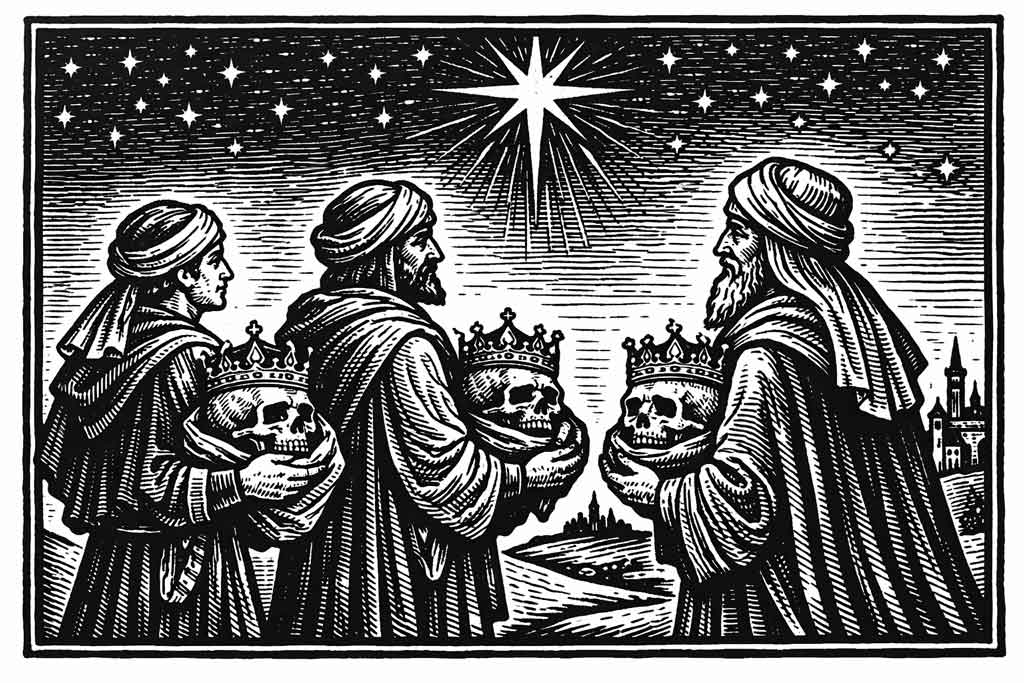
At the centre of this devotion stood the shrine in Cologne Cathedral. There, skulls believed to belong to the Three Kings were displayed, crowned, inscribed with their names, and enclosed within an elaborate gold and silver reliquary.
Nineteenth century newspaper accounts repeatedly describe these skulls as small, darkened, and richly adorned with jewels. One was believed to belong to an Ethiopian king, a conclusion rooted more in symbolic theology than anatomy. Doubts arose because of the skulls’ size, and when physicians were consulted, at least one was identified as belonging to a child, complete with milk teeth.
Rather than ending devotion, this discovery generated new explanations. Some suggested the skulls belonged to the kings as children. Others accepted that the spiritual power of relics did not depend on biological certainty.
This response reflects the deeper logic Helena had already set in motion. Relics did not need modern proof. They required continuity, tradition, and belief.
Relics, Scepticism, and Enduring Belief
Victorian reporting reveals not simple credulity, but friction. Scientific inquiry repeatedly collided with inherited belief. Scholars and physicians found themselves torn between professional judgement and devotional instinct.
Yet the cult of the Three Kings endured. Relics did not need to be historically authentic to function spiritually. Their power lay in what they symbolised: the submission of the non Jewish world to Christ.
What Are the Names of the Three Wise Men?
The most widely recognised names of the Three Wise Men are Melchior, Caspar, and Balthazar. These names became standard across Western Europe by the Middle Ages and are the ones most commonly inscribed on shrines, relics, and amulets.
Earlier and regional traditions, however, preserved a remarkable variety of alternative names. Historical sources record several different name sets, including:
Appellius, Amerus, and Damascus
Magalath, Galgalath, and Sarasin
Altor, Sator, and Peratoras
These variations suggest that the Magi were never fixed historical figures in early tradition. Their identities evolved through oral storytelling, liturgical drama, and local belief. The names functioned less as biography and more as symbolic keys.
Amulets, Charms, and the Magical Afterlife of the Kings
Outside churches, the Three Kings entered everyday magical practice. Their names were engraved onto parchment slips, rings, brooches, and amulets. These objects were rubbed against relics, worn on the body, or even written directly onto the skin.
Such charms were believed to protect against sudden death, disease, witchcraft, epilepsy, wounds, and execution. Newspaper reports describe condemned men surviving repeated attempts at execution until their talismans were removed. Others record criminals found wearing charms bearing the kings’ names centuries after such practices were assumed to have vanished.
In some traditions, writing the names of the Three Kings in blood on the forehead at New Year was believed to reveal the manner of one’s death at midnight.
These beliefs were widespread, persistent, and socially embedded.
Twelfth Night, Epiphany, and the Older Christmas
The story of the Magi is inseparable from Twelfth Night and the Feast of Epiphany on January 6. In early Christianity, this was not a secondary festival but the primary celebration of Christ’s manifestation.
Before December 25 became dominant, many Christian communities celebrated the Nativity on January 6. This older tradition survives in Eastern Christianity and lingered in the West as Old Christmas or Old Christmas Day. Epiphany originally united the birth of Christ, the visit of the Magi, and divine revelation into a single sacred event.
When December 25 was later adopted, Epiphany remained as a powerful echo of an earlier sacred calendar.
Twelfth Cakes, Twelve Portions, and the Ritual of Allocation
Central to Twelfth Night observance was the Twelfth Cake, a ritual object rather than a simple dessert. The cake was traditionally divided into twelve portions, reflecting the twelve days of Christmas that culminated on Epiphany. In earlier households, these portions were not distributed casually. Each slice was allocated by lot, sometimes drawn from a hat or assigned by rhyme, ensuring chance rather than hierarchy governed the outcome.
Hidden within the cake was a token, most commonly a dried bean and sometimes a pea. The recipient of the bean became King for the evening, while the finder of the pea was Queen. This temporary elevation carried authority over games, dances, and proceedings, echoing medieval customs of licensed inversion where ordinary order was suspended at liminal points in the year.
The number twelve itself carried layered meaning. It belonged simultaneously to Christian structure and older cosmology. Twelve apostles, twelve tribes, twelve months, and twelve zodiac signs all converge at this point in the calendar. The act of cutting the cake into twelve and redistributing it symbolically reset social balance as the old year closed.
Earlier forms of the custom appear to have gone further. Some traditions assigned slices not only to people but to abstract forces or household elements, such as “fortune,” “luck,” “the house,” or absent family members. In rural folklore, portions were sometimes set aside for spirits, animals, or the dead, suggesting survivals of older offering practices absorbed into Christian celebration.
What matters is that the Twelfth Cake was never merely celebratory. It functioned as a controlled ritual of fate, redistribution, and renewal. Like the Magi themselves, it brought order to uncertainty at a moment of transition.
Domestic Traditions and the Bed at Shottery
The reach of the Three Kings extended beyond churches into the fabric of domestic life. A striking example survives at Anne Hathaway’s cottage in Shottery, where a carved bedstead bears panels depicting the Adoration of the Magi.
The bed was not treated as furniture alone, but as a symbolic object. The presence of the Three Kings on a marital bed connects the Nativity story with protection, fertility, blessing, and household sanctity. It reflects a world in which sacred narratives were embedded directly into everyday objects.
Pagan Continuity and Christian Adaptation
The Church did not eradicate older customs. It absorbed them. Epiphany replaced earlier winter festivals tied to light, stars, and renewal. The Magi, astrologers guided by celestial signs, formed a bridge between pagan cosmology and Christian theology.
The star itself remained ambiguous. It was described as miracle, comet, planetary conjunction, or divine light. Medieval scholars debated it, and modern ones still do.
This ambiguity allowed continuity without rupture.
Why the Three Wise Men Still Matter
The Three Wise Men endure because they occupy a rare symbolic position. They are outsiders who recognise truth without conquest. They arrive, offer gifts, and depart. They do not rule, convert, or command.
Their legacy survives not only in churches, but in charms, furniture, food, and household ritual. Stirring a pudding, lighting a flame, hiding a token in a cake. These are quiet survivals of a much older worldview.
They remind us that belief does not disappear. It adapts.
Epiphany as Revelation
Epiphany does not mean arrival. It means manifestation. The Magi did not create meaning. They recognised it.
Perhaps that is why their story proved so resilient, capable of surviving scepticism, science, reform, and modernity. Long after relics are questioned and stars debated, the Three Kings still move quietly through winter customs, folklore, and memory.
This Topic
Saints, Relics and Holy Figures
Saints, relic cults, biblical personalities, holy kings, and the legends that grew around sacred lives.
View Topic PageMore in this Topic
12 September 2025
Saint Cuthbert: Life, Death & Legacy of Lindisfarne’s Saint7 September 2025
The Search for the Ark of the Covenant: From Egypt to EthiopiaLatest Posts
27 March 2026
Hot Cross Buns: History, Origins & FolkloreDiscover the fascinating history of hot cross buns - from pagan offerings and Greek sacred bread to Chelsea bun houses and Good Friday folklore. Explore 2,000 years of spiced bread tradition.
22 March 2026
What Does "Ne'er Cast a Clout Till May Be Out" Actually Mean?Is it about the month of May or the hawthorn flower? And what on earth is a clout? We dig into 170 years of British newspapers to finally answer one of folklore's most argued questions.
20 March 2026
The White Hart: The Ancient Legend Behind Britain's Most Common Pub SignFrom Greek mythology to medieval forest law, the white deer haunted the British imagination for centuries. Discover the real history behind the legend of the White Hart — royal badge, supernatural omen, and elusive quarry of the soul.
13 March 2026
Why Is a Horseshoe Lucky? The Surprising History Behind the World's Most Universal CharmThe horseshoe has been nailed above cottage doors, cathedral gates, and battleship masts for centuries. Discover the ancient beliefs in iron, the crescent moon, and the sacred horse that made it the world's most enduring good luck symbol.
12 March 2026
Saint Piran of CornwallPiran - patron saint of Cornwall, tin miners and the Cornish flag — from Irish origins to the buried oratory's remarkable 2014 excavation.
10 March 2026
Clare Island - Isle of Storms, Pirates and Naturalists: A History in Newspaper Voicesiscover the fascinating history of Clare Island, off the coast of Mayo - from the piratical legend of Grace O'Malley and bitter land disputes to a landmark natural history survey, told through contemporary newspaper voices spanning 1863 to 1986.