What Does "Ne'er Cast a Clout Till May Be Out" Actually Mean?
Written by David Caldwell ·
Ne'er Cast a Clout
Till May Be Out
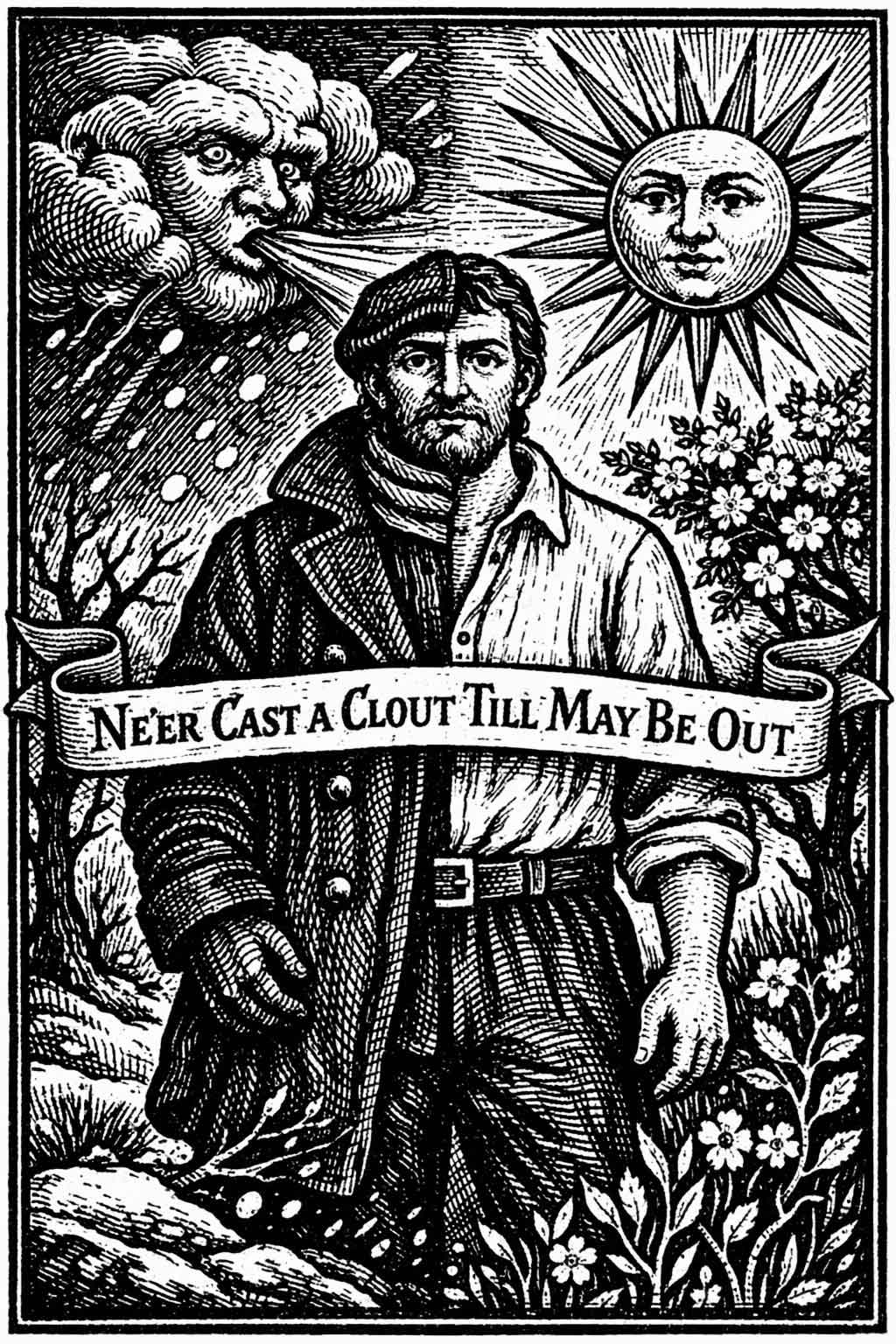
Ne’er cast a clout till May be out” means don’t put away your warm clothes too early. “Clout” means clothing. The main debate is whether “May” means the month of May or hawthorn blossom; the older Scottish evidence leans toward the month, though the blossom reading became popular later.
A proverb that has provoked argument for at least two centuries - and whose meaning, it turns out, nobody can quite agree on.
Every spring, as the temperature teeters between overcoat and shirtsleeve, someone will utter one of the most durable pieces of folk wisdom in the English language: Ne'er cast a clout till May be out. It is one of those sayings so deeply embedded in the culture that people repeat it without much thought - and yet, the moment you press on it, it begins to unravel in the most interesting way. What, precisely, is a clout? And what, when all is said and done, is May?
What on Earth is a Clout?
The word itself is the first puzzle. Writing in the Leicester Chronicle in April 1930, one commentator gave the question its due:
"What is a clout, anyway? The dictionary says the word is cognate with 'clod' and 'clot,' and both those words suggest a lump of some sort; but a clout is a rag. Perhaps the original idea was a lump of rag. Although 'clout' is as much like the word 'cloth' as it is like 'clot,' clouts are not etymologically cloths."
Leicester Chronicle, 5 April 1930
The same writer was quick to note that, despite the etymological murkiness, common sense had always understood the proverb to be about clothing - "that is to say of cloths." We are warned, he concluded, not to shed our winter garments prematurely. With that, at least, everyone agrees. It is everything else that is contested.
The Great May Debate
The central controversy of this proverb has rumbled through the correspondence columns of British newspapers for well over a century and a half. Does "May" refer to the month, or to the mayflower - the blossom of the hawthorn tree?
Those who favour the blossom have a poetic argument on their side. Writing to the Daily Mirror in May 1933, Charles A. Roach of Sidney Sussex College, Cambridge, made the case with crisp academic confidence:
"Surely it seems more reasonable to suppose that the old saying refers to the first appearance of the blossom of the hawthorn rather than to the end of the month of May! For in practice few people in England wait until June to cast a clout."
Daily Mirror, 23 May 1933
It is a compelling point. If "May" means the calendar month, then the saying instructs us to keep our winter vests on until the first of June - which, on many English summer days, is perfectly sensible advice, but which few people actually follow. The hawthorn blossom, by contrast, typically comes out in mid-to-late April, offering a more practical and timely signal to remove the long-johns.
The blossom camp also received support from an unlikely quarter: the Daily Mirror's own answers column in 1993, which told readers that the saying "means, 'Do not take off your warm winter woolies until the mayblossom is out'" and that it "dates from the time when people sewed themselves into warm clothing - or colours - for the duration of winter."
On the other side of the argument stands a formidable Scottish contingent. K. T. Rae of Ditchling, Sussex, wrote to the Daily News in April 1937 with the authority of one who has done their homework:
"The proverb 'N'er cast a clout till May be out' is originally old Scottish, and therefore the correct interpretation is the month of May. In Scotland 'May' is never used for the flower: the word 'hawthorn' is universal."
Daily News (London), 26 April 1937
The editors of the Sunday Post, weighing in on a similar letter in March 1934, sided with the floral interpretation on meteorological grounds: "The flower blooms, or is 'out,' about the middle of April, which appears to suit the sense of the proverb much better." But they also acknowledged the difficulty, noting that "the authorities can't agree" - a position that remains true to this day.
The Evidence of the Rhyme
For those who favour the month, there is a trump card: a fuller version of the verse, which several correspondents produced as clinching evidence. The Gloucester Journal in May 1927 printed it thus:
Ne'er cast a clout
'Till May be out.
Button to chin
'Till June be in.
This couplet - "Button to chin / 'Till June be in" - would be nonsensical if May referred merely to a flower. A blossom does not have a natural counterpart in June that would require buttoning to the chin until it appeared. The sequence only makes sense as a pair of calendar months. The Paisley Daily Express of June 1928 made the same point whilst also marshalling international evidence: in Spain, they say "Till May has passed do not leave off your overcoat"; in Italy, "May, dear May, you may have all the roses if I may have a warm overcoat"; and in Scotland there is the saying "Who doffs his coat on a winter's day / Will gladly put it on in May."
A longer and more elaborate version of the verse appeared in both the Daily Express in 1920 and the Birmingham Daily Post in 1963, the latter supplied by a reader named Leslie Sutton of Hurst Green who enquired - perhaps in vain - whether anyone knew its origin:
Ne'er cast a clout till May is out,
You change too soon while still in June.
In all July no clothes lay by.
In August and throughout September
It is essential to remember
That until October's death you mourn
Your winter vests must still be worn.
Whether one finds this extension reassuring or alarming rather depends on one's relationship with thermal underwear.
A Scottish Origin in an English Climate
The proverb's nationality has itself been a matter of some discussion. The Echo of London in April 1873 called it a "canny Scotch maxim," and the Scottish variants - "Ne'er cast a clout till May be oot," "Change nae a clout till May be out" - appear frequently and early in the record. The Westmorland Gazette in 1846 quoted what it called "an old Scotch proverb," giving the form "Till May be out / Change na a clout." The Cork Examiner's 1892 review of Dr Robert Chambers' Popular Rhymes of Scotland reproduced it as "Till May be out, / Change na a clout" - planted firmly in the Scottish folk tradition.
If the grass grow in Janiveer, 'Twill be the worse for't all the year.
If Candlemas day be dry and fair, The half o' winter's come and mair,
If Candlemas day be wet and foul, The half o' winter's gane at Yule.
Mist in May and heat in June, Mak's the harvest rich soon,
March dust and May sun, Makes clear and maidens dun.
Till May be out, Change na a clout.
If the evening's red and the morning's gray,
It is a sign of a bonny day,
If the evening's gray and the morning's red,
The lamb and the ewe will go wet to bed.
Yet the Sunday Post's editors noted a paradox: if the saying is Scottish in origin, then it almost certainly refers to the month, since Scots do not call hawthorn blossom "May." But if it is English in application - and it has been embraced most enthusiastically in England - then the blossom reading makes better meteorological sense, since an English June is rarely so cold as to demand a winter vest.
The Coatbridge Leader of May 1921 offered one of the more considered meteorological explanations for why the proverb has such enduring force, quoting the Glasgow Herald's correspondent on the treacherousness of May weather: a warm burst at the end of April encourages people to discard heavier clothing, "temporarily at all events," only for cold snaps, snowfalls, and what Continental Europeans call "the Festival of the Ice Saints" (the cold period around May 9–14) to remind them of their folly.
Weather, Frost, and Folk Wisdom
The proverb's longevity owes everything to the genuine capriciousness of May in these islands. The Northern Whig in June 1909 captured the meteorological reality with characteristic directness:
"The man who originated the old saying 'Never cast a clout till May is out' knew what he was talking about... It would appear as if when May comes in the demon of winter realises that his power is broken, and, like the prize-fighter when he knows that he must throw up the sponge, collects his strength first for the satisfaction of hitting as hard as he can at the finish."
Northern Whig, 5 June 1909
This, it turns out, has a basis in climatology. The cold snap of early-to-mid May - dismissed by some as superstition - is a real and recurring phenomenon, documented by meteorologists and noted by Dr. Buchan, who identified the period May 9 to 14 as frequently marked by a drop in temperature. The Stamford Mercury's detailed meteorological report of June 1867 recorded a maximum temperature of 97.4°F in the sun on 6 May, followed almost immediately by a hard frost on the night of the 24th, with the minimum thermometer "as low as 33.3 degrees in the shade." May, as the Dundee Evening Telegraph noted in 1912, is a month in which "a hot May fills the graveyard" - the old belief being that deceptively warm weather encourages premature undressing, with fatal results for the elderly and frail.
The Halesworth Times in 1918 filed the proverb under the category of common-sense superstitions - those folk beliefs which, when examined, turn out to have a rational foundation: "in our treacherous climate it is quite sound never to cast a clout till May be out." The Bath Chronicle in 1931 quoted Bath's Medical Officer of Health to the same effect: "one must not interpret the saying too literally," said Dr. Blackett, but "it is a wise precaution not to overlook it."
The Proverb in Context
The saying does not stand alone. The Westerham Herald of January 1927 placed it within a rich calendar of English and Scottish weather lore, sitting alongside such gems as "A hot May makes a fat graveyard," "Mist in May and heat in June, / Make the harvest come right soon," and the cheerful prognostication that "A swarm of bees in May / Is worth a load of hay." The Westmorland Gazette in 1846 quoted Boerhaave, the great Dutch physician, who when asked the proper time for putting off flannel is said to have answered: "On Midsummer night, and put it on again next morning" - a position that would satisfy the most cautious devotee of the proverb.
The Baptist Times of April 1943, writing in the extraordinary warmth of an early wartime spring when hawthorn was in full blossom and pears and plums had already "set," asked what becomes of the old saw in such exceptional years. Arthur Porritt noted that the saying "originally ran 'Never cast a clout until the May is out'" - the definite article before May suggesting, he thought, the blossom rather than the month. This is one of the more tantalising scraps of evidence in the long debate, though it remains unprovable.
A Proverb That Refuses to Settle
After sifting through nearly two centuries of newspaper argument, weather reports, folk-lore reviews, and letters to editors from Greenock to Cambridge, a honest conclusion is that the question cannot be definitively resolved - and that this is, in its way, entirely appropriate for a proverb about unpredictability.
What can be said with confidence is this: the saying is very old, probably Scottish in origin, and in its original form almost certainly referred to the month rather than the blossom, since Scots do not call hawthorn "May." As it migrated south into England, the blossom reading became attractive - and arguably more useful - because the hawthorn comes into flower in April, providing an earlier and more practically helpful release from winter clothing than waiting until June. The extended version of the verse, with its "Button to chin / 'Till June be in," supports the monthly reading. But the blossom reading suits the English climate better.
Perhaps the most satisfying gloss on the whole debate came, unwittingly, from a correspondent to the Greenock Telegraph in April 1902, who was complaining not about the proverb itself but about a government building whose heating had been switched off before the end of March: "There is a well known saying 'Ne'er cast a clout till May is out,'" he wrote, "and why fires in a place such as the writer refers to should be cut off before the end of March is more than his poor brain can fathom." The proverb, whatever its ultimate meaning, had clearly become a general warrant for the assertion that the cold is not yet over - and on that point, at least, everyone has always agreed.
- ✦ -
Sources drawn from British newspaper archives spanning 1846 to 1993, including the Westmorland Gazette, Montrose Standard, John o' Groat Journal, Elgin Courant, Stamford Mercury, Richmond & Ripon Chronicle, Echo (London), Greenock Advertiser, Cork Examiner, Greenock Telegraph, Northern Whig, Dundee Evening Telegraph, Halesworth Times, Daily Express, Coatbridge Leader, Leicester Chronicle, Gloucester Journal, Paisley Daily Express, Bath Chronicle, Sunday Post, Daily Mirror, Daily News, Baptist Times, Somerset Guardian, Westerham Herald, Birmingham Daily Post, and Leven Mail.
This Topic
Festival Lore and the Ritual Year
Seasonal customs, feast days, holy tides, weather lore, and the old calendar that still haunts the modern year.
View Topic PageMore in this Topic
27 March 2026
Hot Cross Buns: History, Origins & Folklore7 February 2026
The Poppy: From Forgetfulness to Remembrance30 December 2025
The Wheel of the Year, Rebuilt from Evidence20 December 2025
The Curious History and Folklore of the Mince PieLatest Posts
27 March 2026
Hot Cross Buns: History, Origins & FolkloreDiscover the fascinating history of hot cross buns - from pagan offerings and Greek sacred bread to Chelsea bun houses and Good Friday folklore. Explore 2,000 years of spiced bread tradition.
20 March 2026
The White Hart: The Ancient Legend Behind Britain's Most Common Pub SignFrom Greek mythology to medieval forest law, the white deer haunted the British imagination for centuries. Discover the real history behind the legend of the White Hart — royal badge, supernatural omen, and elusive quarry of the soul.
13 March 2026
Why Is a Horseshoe Lucky? The Surprising History Behind the World's Most Universal CharmThe horseshoe has been nailed above cottage doors, cathedral gates, and battleship masts for centuries. Discover the ancient beliefs in iron, the crescent moon, and the sacred horse that made it the world's most enduring good luck symbol.
12 March 2026
Saint Piran of CornwallPiran - patron saint of Cornwall, tin miners and the Cornish flag — from Irish origins to the buried oratory's remarkable 2014 excavation.
10 March 2026
Clare Island - Isle of Storms, Pirates and Naturalists: A History in Newspaper Voicesiscover the fascinating history of Clare Island, off the coast of Mayo - from the piratical legend of Grace O'Malley and bitter land disputes to a landmark natural history survey, told through contemporary newspaper voices spanning 1863 to 1986.
7 March 2026
The Wandering Fire - A History of Ball LightningFrom a French tailor stalked by a glowing sphere to thousands of iridescent globes hovering over a Dorset clifftop, discover the strange and fascinating history of ball lightning as recorded in British and Irish newspapers between 1792 and 1938 — and why science, for over a century, could only stand mute before it.