The Baleful Mistletoe: The Story of a Plant in Exile
Written by David Caldwell ·
Few plants carry quite as much myth, magic and mild embarrassment as the mistletoe. It hangs above winter doorways waiting for stolen kisses, yet in old stories it kills gods, cures epilepsy, opens locks and summons storms. It is a healer and a parasite, a sacred bough and a horticultural nuisance.
To understand how one modest green shrub acquired such a reputation, it helps to begin with the people who first made it famous in western Europe: the Druids.
Pliny and the Druids
The Roman naturalist Pliny the Elder gave the classic description of the Druidic mistletoe rite in his Natural History. For him, the strange plant was already surrounded by mystery. It did not grow from the soil like respectable herbs, but perched high in the branches of trees. When it appeared on an oak, that most venerated of trees, the Druids treated it as a direct sign from the gods.
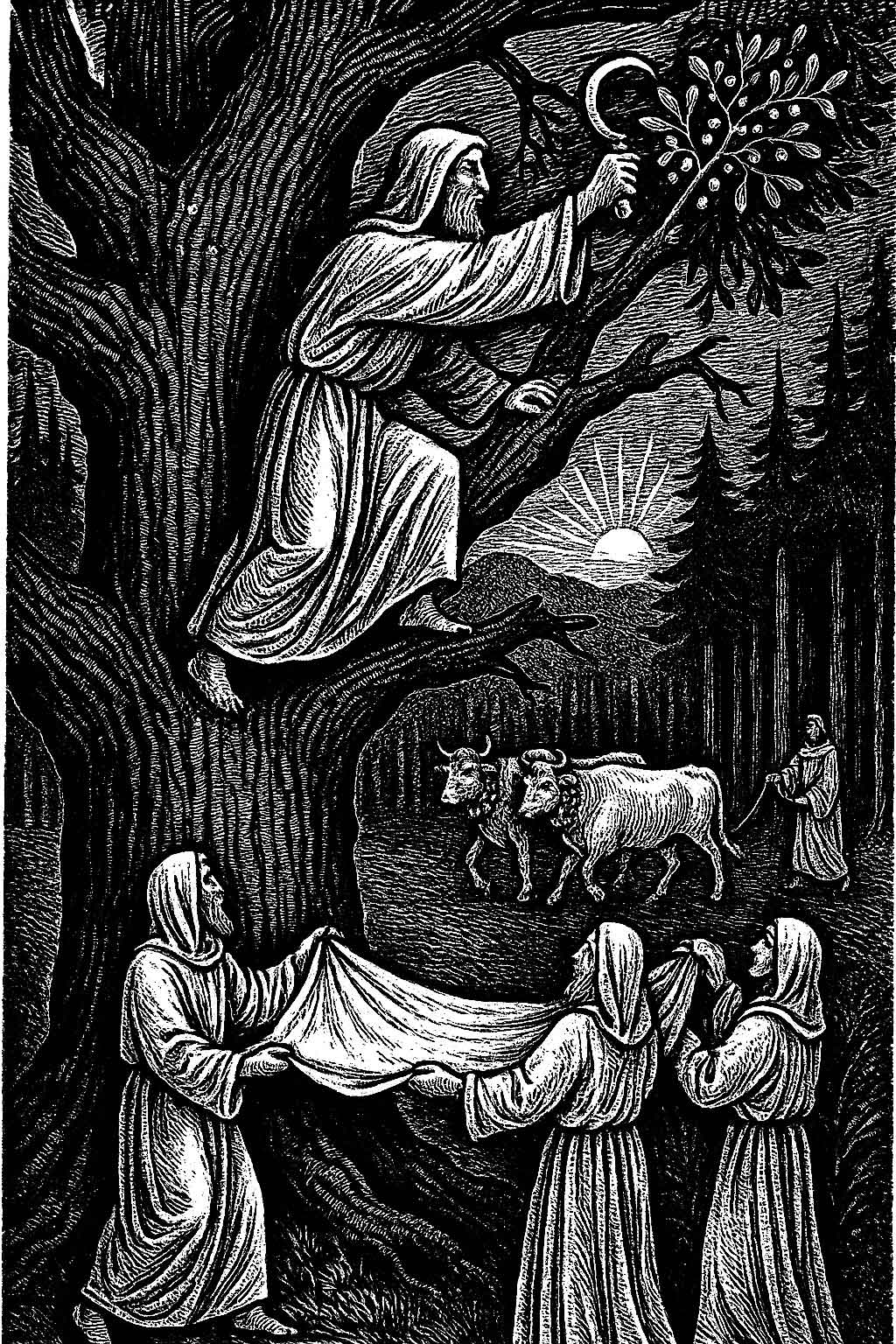
On the sixth day of the moon, so Pliny says, a great procession went out into the oak groves. The chief priest, clad in white, climbed the sacred tree carrying a golden sickle. Below, other Druids held out a spotless white cloth so that not a fragment of the plant would touch the earth. Two white bulls, never before yoked, were led to the tree as sacrifices. At the cutting of the mistletoe the bulls were slain, prayers were offered and the gathered plant was distributed among the people.
The mistletoe was called all-heal and was believed to protect against poisons, bring fertility to humans and animals, and act as a general charm against misfortune. Drunk in a potion or carried in the house, it was supposed to secure divine favor for the coming year.
Already in Pliny's account you can see the themes that haunted the plant for centuries: separation from the ground, association with the oak, and a sense that mistletoe was not quite of this world.
Classical and Early Medicinal Uses
The Druids were far from alone in valuing mistletoe as a medicine. Classical physicians and later herbalists praised it for a surprisingly wide range of ailments.
Greek and Roman authors regarded it as a remedy particularly for epilepsy and "convulsive" illnesses. Hippocrates spoke well of it, and later medical writers prescribed decoctions of the leaves and stems as nervine tonics. The plant growing on certain trees was said to be strongest of all. Oak mistletoe, chestnut mistletoe and hazel mistletoe occur again and again in old recipes.
Early modern physicians echoed these claims. One prescription attributed to a Dr Bruel recommends a mixture of mistletoe, peony roots, nutmeg, aniseed and sugar formed into large pills, each containing a whole ounce of ingredients. In the eighteenth century Sir John Colbatch strongly recommended oak mistletoe for epilepsy and "all convulsive diseases". Country doctors into the nineteenth century still included it in home remedies for fits and palsies.
In Brittany and parts of Britain, the plant continued to be celebrated as a panacea. People carried sprigs against lightning, fire, scalds and burns. When hung around the neck it was said to guard nearly every earthly ill and keep Satan and "all his crew" at a distance. In some places it was believed to open locks like the magical herb moonwort, provided it was gathered at midnight with the waning moon.
Modern medicine is far more cautious. The white berries, attractive as they look, are poisonous and have caused fatal accidents when eaten. The leaves and young branches are less dangerous and were ground with rye flour into famine bread in parts of Germany, but few doctors today would recommend mistletoe as food or medicine without strict preparation and dosing. Yet the idea of "all-heal" lingers stubbornly in folk practice.
A Parasite That Rarely Touches Oak
Because of the prestige of Pliny's oak rite, people often repeat that mistletoe especially loves the oak. Botanists quietly grind their teeth at this.
In reality the European mistletoe (Viscum album) is a partial parasite that grows on many host trees. It favors apples above all. One nineteenth century survey ranked host trees by frequency: apple far in the lead, followed by black poplar, hawthorn, maple, lime, ash and only finally oak. Another naturalist reckoned that in Herefordshire and Worcestershire, orchards of apple trees and lines of black poplars were "literally crowned" with mistletoe, while oak mistletoe remained an extreme rarity.
By the late nineteenth century botanists could list only about a dozen true mistletoe oaks in all of Britain. Names recur: Eastnor in Herefordshire, Tedstone Delamere, Hackwood Park near Basingstoke, an oak near Chepstow, another near Plymouth, a few in Worcestershire and Gloucestershire, and one or two famous trees that became minor tourist attractions. Even with field clubs and natural history societies eagerly searching, the total number of verified oak mistletoe trees barely crept above fifteen.
Because the oak is such an inhospitable host, some scholars suggested that the Druids might have used a related species, Loranthus europaeus, which prefers oaks and grows further south in Europe. Yet the scarcity of oak mistletoe may itself explain its sacred status. When something appears only once in a hundred groves, it is easy to see why priests would treat that rare, ghostly growth as a direct sign from the gods.
The Baleful Mistletoe in Norse Myth
If the Druids made mistletoe holy, the Norse gave it a darker reputation. Shakespeare picked up this northern echo when he called it "the baleful misletoe" in Titus Andronicus and used it to describe a gloomy, cursed landscape.
In the Norse myths, the plant is bound up with the death of Baldr, the shining god of light and joy. Baldr began to have dreams foretelling his own death. His mother, Frigg, devoted herself to preventing this fate. She went through the world extracting oaths from everything that could possibly harm him: fire, water, iron, stone, earth, sickness, metal and all living creatures. All promised never to injure her son.
The gods, now confident that Baldr was invulnerable, turned the situation into a game. At their gatherings they hurled stones and spears at him and laughed to see each missile fall harmlessly away.
One being had not sworn Frigg's oath. A weak, crooked little plant growing on an oak near the entrance to Valhalla had been overlooked. This was the mistletoe. Loki, the trickster and spirit of mischief, discovered the omission. He cut a shaft of mistletoe, sharpened it to a point and carried it to where the gods were amusing themselves.
Among them stood Höðr (often rendered Holdur), Baldr's blind twin. Loki placed the mistletoe dart in Höðr's hand and offered to guide his aim so that he too could join the game. The blind god threw. Guided by Loki, the mistletoe struck Baldr and pierced his heart. What stones and iron could not do, the slight, parasitic plant accomplished. Baldr fell dead and the world was plunged into grief.
Later tellings soften the story. In some versions Baldr is eventually restored and the mistletoe is placed under Frigg's care. It is never again to be a weapon of harm so long as it does not touch the earth. Instead it becomes a sign of peace. All who pass beneath it are to exchange a kiss of love and reconciliation, in token that the plant is no longer an instrument of mischief. This is one of the roots of the custom of hanging mistletoe from the ceiling and kissing underneath it.
The Cross of Mistletoe and the Plant in Exile
Another powerful legend, popular in western Europe, explains why mistletoe is a parasite at all.
In this story, mistletoe was once a great forest tree. Its wood, straight and strong, was chosen to make the Cross of Christ. After the Crucifixion the plant was punished for its unwilling role in the death of the Saviour. It was stripped of its trunk, reduced to a dependent shrub and condemned to cling to other trees for the rest of time. Never again would it stand on its own roots.
In France the plant was sometimes called Lignum Sanctae Crucis, the Wood of the Holy Cross. Breton peasants knew it as Herbe de la Croix, the herb of the Cross, and English country lore repeated that the mistletoe had "crept and crawled" as a mere parasite ever since it lent its timber to the Crucifixion. In some west country tales this fate explains its ambiguous status. It is at once holy, as a relic of the Cross, and somehow suspect, guilty by association.
The idea of exile captures the plant neatly. Mistletoe is never quite at home. It hangs in awkward balls high up in other trees, neither wholly of them nor entirely separate. It never touches the soil. It is a guest that gradually becomes an oppressor, feeding off the sap of its host until some branches wither and die. No wonder mythmakers saw in it an echo of fallen beings and lingering guilt.
Charms, Witches and Kissing Boughs
Once Christianity spread through Europe, much of the old reverence for mistletoe was officially discouraged, yet the plant never entirely lost its magical reputation.
Across Britain and Ireland it was carried as a charm against witchcraft, storms and lightning. In Switzerland people hung it up as a protection against tempests. In Cornwall the berries belonged to the pixies, and rubbing the eyes with mistletoe juice was said to let a person hear the donkey and ox speak as they had at Bethlehem. By the same anointing, according to some, you could see fairies dancing.
Irish and Scottish traditions gave it further duties. In Ireland, house garlands that included mistletoe and other evergreens were to be burnt under the pancakes on Shrove Tuesday, or misfortune would linger in the house. In parts of the West of England farmers believed that giving the first branch of mistletoe found after New Year's Day to their cows would prevent mischance in the herd. In Worcestershire the first cow to calve after New Year sometimes received a sprig of the plant as a sort of blessing. Breton peasants hung it as a preventative of storms and referred to it with reverence as a relic of the Cross.
Names hint at these powers. Old English and Welsh traditions call it All-heal or "the Celestial Tree". In Wales it was hung to avert storms. Some German and British country people treated it as a cure for every disease and mixed it into potions, plasters and even bread.
The best known custom, of course, involves kissing. By the seventeenth century, English halls were decorated with a mistletoe bough at Christmas or New Year, sometimes apart from the holly and ivy. Tradition said that any woman who passed beneath it could be kissed by a man who "claimed the privilege". In some regions one white berry was plucked from the bough for every kiss, and when the berries were gone the privilege ceased. In Worcestershire a stricter version demanded that a berry be broken against the maid's lips at each kiss.
Church authorities were less enthusiastic. Writers in Victorian church journals lamented that mistletoe had once been used in church decorations but was wisely excluded when mutual kissing crept into the festivities. Holly and ivy were tolerated, but mistletoe and its "indecorous" consequences were effectively banished from the sanctuary.
Outside church walls the custom flourished. Londoners bought tons of the plant every winter from the orchards of Herefordshire, Worcestershire and the apple districts of Normandy. Crates of mistletoe arrived in market halls by the hundredweight, destined for baronial halls, middle class parlors and crowded tenements. The plant became part of the seasonal economy, harvested from black poplars and apple trees, tied into great bundles and auctioned in town squares.
Names and the origin of “mistletoe”
The name of the plant has attracted as much speculation as its behaviour. In English it comes down from Old English misteltān. Several nineteenth-century writers pointed out that tān means a twig or branch, while mistel was glossed as “different” or “estranged,” giving the sense of a strange or separate twig growing out of the tree. Others linked the word to Old Norse mistilteinn, the “mistletoe twig” that becomes the fatal weapon in the story of Baldr.
Victorian naturalists loved a good folk etymology, and some repeated the idea that the word came from German roots meaning “dung twig,” because the plant is propagated from the droppings of birds. One writer even broke it into “Mistel-ta,” explained as “the plant or shoot propagated from the droppings of a bird,” which suits the way the missel thrush spreads the sticky seeds along the branches of trees. Popular belief also tried to derive “mistletoe” directly from the missel thrush itself, since the bird is so fond of the berries, although etymologists generally preferred the older Saxon explanation.
Whatever its exact linguistic path, the name captures the plant’s unsettling position. It is not a root in the soil but a “different twig,” hanging between earth and sky, neither fully part of its host nor fully independent, and that sense of strangeness runs through its myths as strongly as through its etymology.
Biology of a Half Parasite
Behind all this folklore lies an unusual piece of plant biology.
European mistletoe is a hemiparasite. It contains green chlorophyll and can photosynthesise its own sugars, but it relies on its host tree for water and mineral salts. The connection begins with the berries. These are smooth, translucent white spheres containing a single seed embedded in sticky, viscous pulp. Birds, especially the mistle thrush, redwing and fieldfare, devour the berries in winter when other food is scarce. The pulp clings to their beaks and feet. When they wipe themselves on a branch, they smear seeds onto the bark.
The seed does not send its root downwards into the soil. Its radicle always bends toward the host branch. It penetrates the outer bark and nestles in the cambium, the living layer where new wood is formed. From there the mistletoe develops a system of "sinkers" that extend into the host and wrap themselves in successive growth rings. Instead of a simple penetrating root, the plant becomes intertwined with the wood. In a cross section of a branch you can see the pale knots of mistletoe tissue like foreign islands embedded in the darker tree rings.
Because the parasite grows as the tree grows, it can be very long lived. Branches of apple and poplar have been found carrying mistletoe older than the host limbs to which they are now attached, having been grafted across from older trees.
The effect on the host varies. A few clumps of mistletoe may do little harm, but heavy infestations on poplars or orchard trees can reduce vigor and fruiting, and eventually kill branches by intercepting water and nutrients. Old avenues of lime or black poplar in Herefordshire and Worcestershire have been described as "crowned" with mistletoe, their upper boughs bowed under the weight of many green globes.
Despite its parasitic lifestyle, mistletoe does not behave quite like other plants even in death. Cut a mistletoe branch from its host and place it in water, and it will not draw up moisture through its own stem. Cut a piece of the host branch with the mistletoe still attached and place the host cut end in water, and the parasite continues to drink happily. The plumbing of the two plants has become inseparable.
Growing Mistletoe
For gardeners, mistletoe holds a particular fascination. It is one of the few native British plants that almost demands collaboration with birds or a careful mimicry of their habits.
Seeds must be sown while fresh. Many experienced growers recommend March, when the berries are fully ripe. The seed is squeezed out of the berry and pressed onto the underside of a young branch of a suitable host such as apple, hawthorn or crab apple. Some growers loosely tie a little moss over the seed to protect it from drying winds and birds. There is no need to cut the bark. The sticky pulp is enough to hold it in place until the radicle anchors itself.
Germination is slow. For several weeks nothing obvious happens apart from a slight swelling where the seed sits. Then a tiny green shoot appears and bends towards the bark like a peg. For a season or more the plant may consist of nothing but an embedded knot and a pair of leaves. Growth after that remains slow. Gardeners who hope for great kissing boughs within a year are usually disappointed. Three years from sowing to a modest cluster is perfectly normal. Ten years may pass before a plant forms a ball twelve inches across.
Sex complicates matters further. Mistletoe plants are usually either male or female. Male plants carry pollen but never produce berries. Female plants bear the white fruits but need access to pollen to set them. In the wild, birds solve this by spreading seeds indiscriminately. In a garden, a lone female plant on a treasured apple tree may stubbornly refuse to berry year after year. To secure a good crop, growers either plant both sexes on the same tree or graft male-bearing branches from another plant and dust the female flowers with pollen during the flowering season from March to May.
Some hosts are more accommodating than others. Apple and hawthorn are highly suitable, black poplar and lime less so in a garden setting because of their eventual size. Pear trees are notoriously resistant. Experiments have shown that mistletoe seeds can germinate on pear bark, but the parasite often kills the tissue around itself and the branch dies above the graft. Elm mistletoe is so rare that most reported cases have turned out to be misidentified poplars.
Oaks, as already seen, present their own challenge. For most would be Druids, an apple tree near the house will have to suffice.
From Baleful Arrow to Christmas Ornament
Strip away the legends and a ball of mistletoe is simply a small shrub in the wrong place. Yet stories have never allowed it to remain simple.
For Romans and Druids it was a potent medicine and a sign of divine favor. For Norse poets it was the slight, overlooked plant that killed the brightest of the gods, then became a pledge that mischief could be transformed into peace. Christian folklore turned it into a tree that supplied wood for the Cross and was condemned to exile among the branches of others.
Along the way people asked it to ward off epilepsy, storms, witchcraft and poverty, to protect cows and houses, to open locks, summon fairies and stamp out misfortune. They hung it over their doors in Brittany for the New Year, carried it through English streets as part of Christmas revels, and frowned at it from church pulpits. They traded it by the ton, argued about its proper host trees and spent years coaxing it to grow on their own orchard branches.
Today it is mostly a prop for slightly awkward kisses. Yet when you look up at a mistletoe bough hanging in a winter doorway, you are also looking at a shadow of Druid oaks, Viking halls and Breton farmhouses. It is a plant that has been healer, traitor, exile and matchmaker. Baleful or blessed, it continues to creep and crawl across the folklore of Europe, still very much alive.
This Topic
Pagan Mythology, Gods and Sacred Symbols
Ancient gods, sacred animals, ritual plants, symbols, charms, and the shifting meanings of mythic imagery.
View Topic PageMore in this Topic
12 February 2026
The Sator Square: Roman Charm, Church Code, Folk Spell27 September 2025
Epona: The Horse Goddess in Britain and Beyond25 August 2025
The Lore of the Unicorn - A Definitive GuideLatest Posts
27 March 2026
Hot Cross Buns: History, Origins & FolkloreDiscover the fascinating history of hot cross buns - from pagan offerings and Greek sacred bread to Chelsea bun houses and Good Friday folklore. Explore 2,000 years of spiced bread tradition.
22 March 2026
What Does "Ne'er Cast a Clout Till May Be Out" Actually Mean?Is it about the month of May or the hawthorn flower? And what on earth is a clout? We dig into 170 years of British newspapers to finally answer one of folklore's most argued questions.
20 March 2026
The White Hart: The Ancient Legend Behind Britain's Most Common Pub SignFrom Greek mythology to medieval forest law, the white deer haunted the British imagination for centuries. Discover the real history behind the legend of the White Hart — royal badge, supernatural omen, and elusive quarry of the soul.
13 March 2026
Why Is a Horseshoe Lucky? The Surprising History Behind the World's Most Universal CharmThe horseshoe has been nailed above cottage doors, cathedral gates, and battleship masts for centuries. Discover the ancient beliefs in iron, the crescent moon, and the sacred horse that made it the world's most enduring good luck symbol.
12 March 2026
Saint Piran of CornwallPiran - patron saint of Cornwall, tin miners and the Cornish flag — from Irish origins to the buried oratory's remarkable 2014 excavation.
10 March 2026
Clare Island - Isle of Storms, Pirates and Naturalists: A History in Newspaper Voicesiscover the fascinating history of Clare Island, off the coast of Mayo - from the piratical legend of Grace O'Malley and bitter land disputes to a landmark natural history survey, told through contemporary newspaper voices spanning 1863 to 1986.