From a Persian Court Physician's Rhinoceros to Narwhal Tusks Sold as Royal Medicine
There is a long straight wand of ivory that keeps turning up in the story of the unicorn, in one form or another, for about two thousand years. Sometimes it sits on a writing desk, bought for a few guineas from a London antiques dealer. Sometimes it hangs in a Paris treasury, seven feet long, insured against theft and touched by pilgrims. Sometimes it is being ground into powder and dropped into a king's wine, or set beneath his dinner plate to sweat if the food is poisoned, or split open to reveal, one Renaissance apothecary swore, the reason no man could ever quite agree on what colour it was supposed to be. It has been prescribed for leprosy, epilepsy, plague, drunkenness, and unclean teeth. Popes have given it as a wedding present. Alexander the Great is supposed to have nailed one to the wall of Apollo's temple at Delphi with a thank-you note attached.
The animal that supposedly grew this horn barely exists in the same way twice. A Greek doctor at the Persian court describes a bad-tempered wild ass with a tricolour horn. A Roman encyclopaedist describes something with a stag's head, an elephant's feet, and a boar's tail. A Byzantine monk paints the Virgin Mary breastfeeding it. A Chinese classic insists its horn is soft, fleshy, and used only to gore the guilty in criminal trials. A Victorian professor in Maine built one out of a calf and a scalpel. None of these are quite the same creature, and that, as it turns out, is the whole point: the unicorn was never one animal. It was a horn in search of a body, assembled and reassembled by every century that needed it, out of whatever rhinoceroses, oryxes, narwhals, antelopes, and outright inventions happened to be lying around.
This is the story of how that happened, as completely as the sources allow.
Ancient Descriptions and Early Reports
The unicorn enters Western literature by accident, in a book about somewhere else entirely.
Around 398 BC, a Greek physician named Ctesias of Cnidus returned home after roughly seventeen years serving as court doctor to two Persian kings, Darius II and Artaxerxes II. He had reportedly treated Artaxerxes for a wound sustained fighting his own brother at the Battle of Cunaxa, a rare, ringside seat on Achaemenid court life for a Greek. When he got home, Ctesias wrote two books: a sprawling History of Persia, and a much shorter one called the Indica, purporting to describe India. He had never been there. Northern India lay, at times, within reach of the Persian Empire's own frontiers and tribute networks, so Ctesias was very likely drawing not on sailors' gossip but on something more specific: Persian administrative knowledge of a genuinely tributary or neighbouring region, quite possibly filtered through Indian envoys and merchants he could have met in person at the Persian court itself. The Indica survives only as fragments quoted by later writers and a summary made five centuries later by a Byzantine patriarch named Photius, but among its wonders (pygmies, dog-headed men, giant "gold-digging" ants, a man-eating monster called the manticore) is this:
"The Indians have wild asses as large as horses, or even larger. Their body is white, their head dark red, their eyes blue. They have a horn on their forehead about one and a half cubits in length. The dust filed from this horn is administered as a protection against deadly poisons."
This is, as far as anyone can tell, the first unicorn in Western writing. It is worth noticing what it is not: it is not fierce for the sake of fierceness, not magical in any generalised sense, and not remotely similar to the creature medieval Europe eventually settled on. It is a horse-sized ass with a tricolour horn (white at the base, black in the middle, crimson at the tip) used by Indian noblemen as poison-proof drinking cups. Later writers, including Aelian two and a half centuries afterwards, added a name for it: Cartazonus, probably from a Sanskrit root meaning something like "lord of the desert," and almost certainly the ancestor of a real word for the rhinoceros. Aelian's fuller description (solitary, savage to its own kind except in the mating season, its young taken as colts to fight before the king at festivals) supplied most of the personality traits later writers would keep reusing for the next two thousand years.
It is easy to be unfair to Ctesias. Modern historians have pointed out that when he is describing things he had better information about, such as a talking parrot, correctly sized and coloured, correctly noted as capable of learning whichever language it was taught, his accounts hold up. His reliability seems to track the quality of his sources, not his honesty. Where the information passed through more hands and more languages before reaching him, as with the unicorn, the result drifts into composite fantasy; where it did not, as with the parrot, it stays recognisable. Ancient critics themselves mostly reserved their harshest scorn for the Indica specifically (a recognised genre of "wonder writing," thaumata, rather than history proper) and were comparatively gentle about his Persica.
Aristotle, writing a couple of generations later, gives the unicorn just one dry sentence, almost in passing, inside a much longer discussion of hoof-and-horn combinations across the animal kingdom: horns normally come in pairs and go with cloven hooves, he notes, except for "a few animals... known to be single-horned and single-hoofed, as the Indian ass; and one, to wit the oryx, which is single-horned and cloven-hoofed." That is the entire claim: no magic, no poison-cup, nothing supernatural. Modern editors of Aristotle's text gloss the "Indian ass" as almost certainly the rhinoceros and the oryx as the real antelope of that name, and it is worth pausing on how strange this is: this one hedged, anatomical footnote, from a writer not even especially interested in the animal, became one of the single most load-bearing citations in the entire history of the unicorn. Every major author for the next two thousand years (Pliny, Isidore of Seville, Bartholomaeus Anglicus, Sir Thomas Browne, even Victorian popularisers like John Ashton) cites this exact sentence as part of their evidence that educated antiquity believed in the beast. Aristotle's name did a great deal of work that Aristotle's actual words never asked it to do.
The animal most people now picture as "the" unicorn (the one with the stag's head, elephant's feet, boar's tail, and horse's body) is not Ctesias's creature at all. It first appears, fully assembled, in Pliny the Elder's Natural History (c. AD 77):
"The fiercest animal is the monoceros, which in the rest of its body resembles a horse, but has the head of a stag, the feet of an elephant, and the tail of a boar; it has a deep bellow, and a single black horn, three feet long, projecting from the middle of its forehead. They say it is impossible to capture this animal alive."
This is a meaningfully different beast: no tricolour banding, no white body, no resemblance to any single real animal, but a genuine four-way composite. It is Pliny's version, not Ctesias's, that Solinus copies almost verbatim a couple of centuries later (stretching the horn to four feet and calling the creature a "monster"), that Isidore of Seville repeats in the seventh century, and that filters all the way down through the medieval encyclopaedists into Topsell, Gould, and Ashton. Ctesias supplied the idea of a one-horned Indian animal and its medicinal horn; it was Pliny who actually built the body everyone kept redrawing for the next fifteen centuries. Tellingly, Pliny knew exactly what a real rhinoceros looked like. He describes one, correctly, with its horn on its nose, seen at the Roman games a few paragraphs earlier in the very same book, and never once connects the two animals. That fusion was still to come.
These classical portraits do, in fact, plausibly derive from two real animals: the Indian rhinoceros and the oryx. An oryx seen from directly side-on can appear to carry a single horn where in fact it has two, perfectly aligned; and males frequently snap one horn clean off fighting each other, which does the same job more permanently. Long, straight antelope horns of this kind were, and in parts of Africa still are, prized as trophies, and a nineteenth-century hunter's anecdote captures the mechanism nicely: an African guide, showing off a long straight horn as a great rarity from "a beast that carries only one," turned out on later inspection to have shot an oryx with a broken stump where the second horn should have been. Carried ceremonially, sold as a curiosity, described secondhand by someone who never saw the living animal, that single horn is more than enough to start a legend accreting around it.
The Biblical 'Unicorn' and the Aurochs
Quite separately from the Greek tradition, a one-horned animal wanders into the Bible, or more precisely into its translation.
The Hebrew word re'em appears seven times in the Old Testament, always as a byword for indomitable strength: "God brought them out of Egypt; he hath as it were the strength of the unicorn" (Numbers 23:22); "his horns are like the horns of unicorns" (Deuteronomy 33:17); "wilt thou trust him because his strength is great?" (Job 39:9-11). None of these passages actually require a one-horned animal: several use the plural "horns" for a single creature, which argues the opposite. But when Jewish scholars in Alexandria translated the Hebrew scriptures into Greek in the third century BC, they rendered re'em as monokerōs, "one-horned." The Latin Vulgate and, eventually, the King James Bible followed suit with "unicorn," and a straightforward translator's guess acquired the full weight of scriptural authority. For over a thousand years, this one word choice did more than any bestiary to keep the unicorn's existence beyond serious theological doubt: to question the beast was, uncomfortably, to question the accuracy of the Word of God itself.
Later scholarship has made a stronger case that the re'em was in fact the aurochs, Bos primigenius, the huge, ferocious wild ox of the ancient Near East and Europe, genuinely two-horned and genuinely capable of the terrifying strength the biblical poets describe. Julius Caesar, writing centuries after the biblical texts but describing the same species, found aurochs still roaming the Hercynian Forest of Germany, "little inferior to elephants in size," and the identification with Mesopotamian bas-reliefs of huge horned bulls has satisfied most modern biblical scholars. The species is now extinct, but it survived: Hector Boece, in his sixteenth-century history of Scotland, describes fierce, white, crisp-maned wild bulls in the ancient Caledonian forests that could only be taken by great cunning, and that reportedly died of sheer unbearable distress rather than endure captivity once caught, very possibly a genuine folk memory of Europe's last surviving aurochs herds, which lingered in isolated pockets into the later Middle Ages.
How the Medieval Unicorn Took Shape
The single most consequential moment in the whole history of the legend is also one of the quietest: a scholarly conflation, made almost in passing, by a seventh-century Spanish bishop.
Isidore of Seville's Etymologiae was the single most influential encyclopaedia of the early Middle Ages, copied and recopied for the best part of a thousand years, and its entry on the rhinoceros reads, in full:
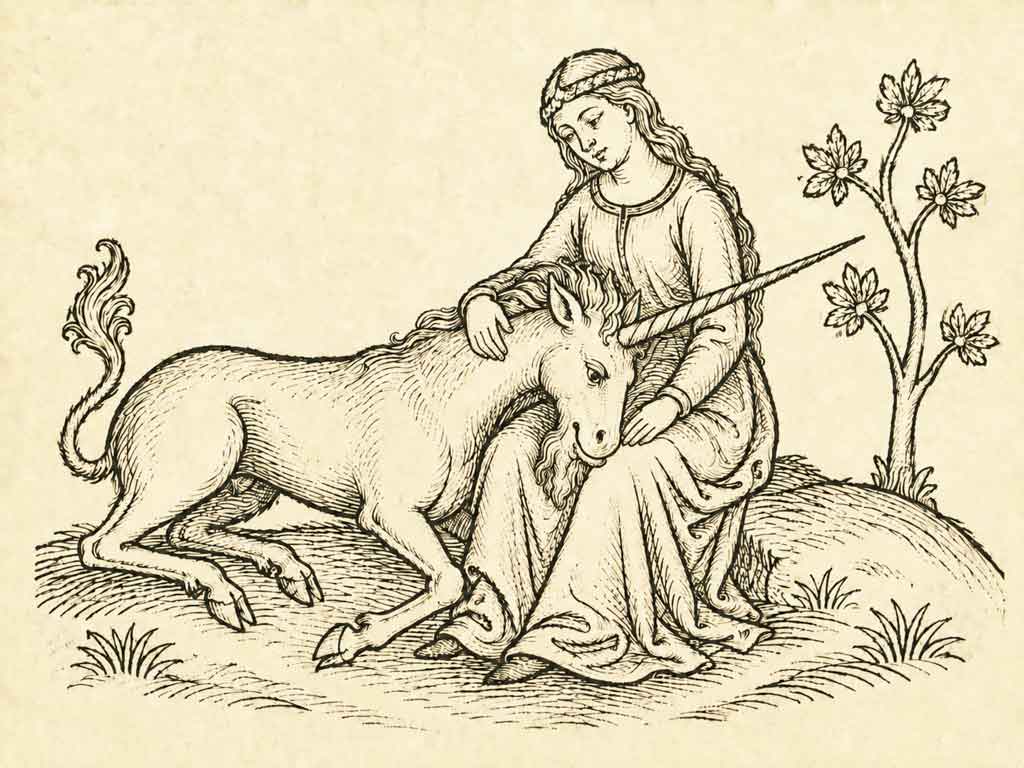
"The rhinoceros is so named by the Greeks; in Latin this is rendered 'horn-in-the-nose.' It is the same animal as the monoceros (that is, the 'unicorn') because it has a single horn in the middle of its forehead, four feet long, so sharp and so strong that whatever it strikes it either tosses aside or pierces clean through. It often does battle with the elephant... It is, moreover, of such great strength that it cannot be captured by any effort of hunters; but... a virgin girl is set out for it, who, as it approaches, opens her bosom to it, and in this bosom, having laid aside all its ferocity, it places its head, and thus, lulled to sleep, it is captured as though it were unarmed."
Read that carefully, and something odd is happening. Up to this point, the fierce classical animal (Pliny's composite beast, fought with elephants, uncatchable by force) and a completely separate Christian tradition (a small, gentle, kid-like creature tamed by a virgin, found in an early Christian nature-allegory called the Physiologus) had run on entirely different tracks, with no connection to each other at all. Isidore is the first major authority to simply announce that they are the same animal, apparently without noticing he has fused two different creatures. He does not even name his source for the virgin-capture claim, only "those who have written on the natures of animals." But because Isidore's word carried enormous authority, and because his encyclopaedia was copied "with slavish exactness" (in the words of one twentieth-century historian of the legend) by generation after generation of monks who could read Latin but had little inclination to question it, this one unremarked-upon conflation is the reason the medieval unicorn is simultaneously as tough as a rhinoceros and as gentle as a lapdog. It shows up almost word for word, translated into Middle English, in Bartholomaeus Anglicus's own hugely popular thirteenth-century encyclopaedia, and from there, via John Trevisa's 1398 English translation, straight into the pages of Edward Topsell's History of Four-Footed Beasts three centuries later, more or less unchanged.
To his credit, Bartholomaeus tried harder than Isidore to sort the resulting muddle out. He carefully distinguishes four separate "kinds" of one-horned beast: the Rhinoceros, the fierce composite Monoceros, the Indian one-horned Ass (crediting Aristotle by name), and, most interestingly, a small, gentle, goat-like creature he calls the Egloceron, literally "goat-horn," kept deliberately apart from the savage Monoceros. It looks very much like an attempt to give the Physiologus's original small kid-like creature its own separate name, rather than mashing it into the rhinoceros-beast the way Isidore does. He even cites Pope Gregory the Great's commentary on the Book of Job for the detail that a captured unicorn, rather than being tamed, simply dies of sheer temperamental fury within moments of capture.
The Christian virgin-capture legend Isidore was drawing on is, in its earliest recoverable Greek wording, considerably more startling than the tame medieval "lays its head in her lap" version everyone eventually settled on. The original Physiologus text says the virgin suckles the animal (the Greek verb, thēlazei, shares its root with the word for "nipple") and then carries it to the king's palace. This is not a small difference. It makes the underlying Christian allegory (the unicorn as Christ, tamed by entering the Virgin's body at the Incarnation) considerably more literal than "resting its head on her lap" ever conveys. A remarkable ninth-century Byzantine manuscript, the Pantokrator Psalter, illustrates the scene exactly this way: the Virgin, seated, points to her bare breast, and a leopard-skinned, lion-tailed unicorn lowers its head to nurse, with a caption reading, in translation, "Concerning the Son of God while he was suckled by the all-holy Theotokos." Strikingly, a near-contemporary manuscript (the Khludov Psalter, made around the same time) shows the identical scene with the nursing quietly removed: the Virgin now simply raises one hand in an ambiguous gesture, touching nothing. Within a couple of generations the image was toned down further still, into a fashionably dressed Byzantine court lady training a tame pet horse. It is hard not to read this as a small, precise fossil record of one culture growing steadily more uncomfortable with its own founding image.
A completely independent virgin-capture tradition, meanwhile, was circulating in the twelfth-century writings of Hildegard of Bingen, the German abbess and polymath. Her version owes nothing to Isidore's rhinoceros at all. In her Physica, Hildegard explains that the unicorn shuns men and is drawn to women for a specifically Edenic reason: "just as the serpent, at its first fall, shrank from the man and looked instead upon the woman, so too this animal shrinks from the man and looks instead upon the woman." Her unicorn has no interest in symbolising Christ's Incarnation at all; instead she supplies an entire pharmacopoeia drawn from its body: a translucent bone beneath the horn "as transparent as glass," a liver ground to powder and mixed with egg-yolk fat as a cure for leprosy, a hide made into belts and boots that ward off plague, and a hoof mounted beneath a dish of food or drink that will make poisoned fare visibly boil or steam. It is, as far as anyone can tell, the earliest European source to treat the unicorn's whole body, not merely its horn, as a walking medicine chest, a genuinely separate root of the legend from the one running through Ctesias, Pliny, and Isidore.
By the following century, the Flemish encyclopaedist Thomas of Cantimpré was filing the animal under an entirely different heading again: in his Liber de natura rerum, "monoceros" appears not among the land quadrupeds at all, but as a sea monster in the mould of the great sea serpents of later legend, capable of ramming and sinking ships with its single terrible horn, tempered, Thomas adds piously, by God's mercy in making the beast slow enough that sailors can outrun it. He builds this passage directly out of Isidore's own rhinoceros text, simply relocated wholesale into his catalogue of marine wonders. It is not the same discovery as the identification of "unicorn's horn" with an actual sea creature, the narwhal, which would not happen for another four centuries. But it is a striking, purely coincidental anticipation of it, arrived at for entirely different, moralising reasons.
The Lion and the Unicorn
Medieval and Renaissance writers loved to describe a natural enmity between the lion and the unicorn, in which the unicorn's own great strength becomes its undoing. Edward Topsell, quoting the older bestiary tradition almost verbatim in 1607, sets the scene: as soon as a lion sees a unicorn approaching, it flees to a tree; the charging unicorn buries its horn in the trunk trying to reach it; and the lion, once its enemy is stuck fast, "falleth upon him and killeth him." Spenser gives the same story its most polished verse in The Faerie Queene, and Shakespeare glances at it too, in Julius Caesar: "Unicorns may be betray'd with trees." The heraldic writer John Guillim, in 1610, adds his own moral gloss: the unicorn's willingness to die rather than be taken alive makes it, he says, kin to "the valiant-minded souldier," which is precisely why it deserved a crest.
Not every scholar who tackled this pairing reached for a hunting explanation, though. The Victorian mythologist Robert Brown Jr argued, at considerable and enjoyable length in 1881, that the whole story is really a piece of ancient astronomy in disguise: the lion is the sun, the unicorn is the crescent moon, and their perpetual combat re-enacts the daily cycle of sunset and moonrise, with the mythic "tree" in which the unicorn's horn sticks fast standing for a near-universal image of a cosmic World-Tree marking the border between the living world and the underworld, the same image, he points out, that turns up as Norse Yggdrasil, in the sacred groves and ancient tree cults of Europe, and in the "groves of Persephone" mentioned in Homer. His best piece of evidence is a real and genuinely striking Viking-age relic: the ivory Horn of Ulf, still held today by York Minster, whose carved imagery Brown reads as exactly this scene: a crescent-horned creature with its horn fixed fast in a stylised sacred tree. It is not an explanation that has aged especially well as scholarship. A later, more careful historian of the legend called such single-cause solar-and-lunar theories "dangerously seductive sirens," but the underlying intuition, that the unicorn's horn had something to do with water, purification, and the cycles of the heavens long before it had anything to do with virgins, deserves a fairer hearing than it usually gets.
That intuition finds its oldest and strangest expression not in Greece at all, but in Zoroastrian Persia. A cosmological text called the Bundahishn describes a "three-legged ass," golden-horned, standing amid the cosmic ocean, whose single hollow horn purifies all the water in the world of the poison introduced into it by the forces of evil: "with that horn it will vanquish and dissipate all the vile corruption due to the efforts of noxious creatures." This is, point for point, the same mechanism later attached to the Western unicorn's horn dipped in a poisoned forest pool so that the "clean" animals can drink safely behind it, a legend recorded as an eyewitness account as late as 1389, by a pilgrim priest named John of Hesse, who swore he had personally watched a unicorn purify a river near Mount Sinai at dawn. Given that Ctesias picked up his unicorn while serving at the Persian court, it is entirely possible this Zoroastrian water-purifying beast is a genuine ancestor of the whole tradition, glimpsed by a Greek physician who never quite understood what he was looking at.
Heraldry, Coins, and National Identity
By the time the unicorn reaches Scottish heraldry, most of this deep prehistory had long since been forgotten, and the animal had simply become a fixture of noble and royal iconography. The earliest surviving Scottish royal-arms unicorn is carved above the gateway of Rothesay Castle, probably from the late fourteenth century; gold and silver coins struck under James III in 1486–87, worth 18 and 9 shillings respectively, were even nicknamed "unicorns" and "half-unicorns" after the beast sejant on their reverse. Sir David Lindsay of the Mount, Lord Lyon King of Arms under James V, dutifully records the animal in his heraldic writings and repeats the maiden-capture legend as established zoological fact, and Hector Boece's history of Scotland went so far as to claim that unicorns had genuinely been seen roaming the Caledonian forests, very possibly, as noted above, a garbled folk memory of the last European aurochs rather than pure invention.
When James VI of Scotland became James I of England in 1603, he simply kept his native Scottish unicorn as one supporter of the newly unified Royal Arms and paired it with the lion already established on the English side, not, as popular tradition later assumed, because of any deliberate symbolic gesture toward reconciling two ancient enemies, but mostly because the lion was already there and needed a partner. The pairing nonetheless stuck immovably in the popular imagination, eventually supplying the nursery rhyme every English-speaking child still learns: "The lion and the unicorn were fighting for the crown." In heraldic depictions the Scottish unicorn is traditionally shown wearing a chain, not, as it might first appear, a symbol of defeat, but precisely the opposite: ferocious, untameable power now willingly bound in service to lawful royal authority. Chained, yet fundamentally still untamed. It is difficult to imagine a neater visual summary of everything the unicorn had been asked to represent for the previous two thousand years.
The Unicorn in Art: The Hunt and the Garden
Nowhere does the unicorn's full symbolic weight land more completely than in the great tapestry cycles of the late fifteenth and early sixteenth centuries, of which the most famous surviving example is the French set now in the Musée de Cluny in Paris: vivid reds, hunting lions, hounds, huntsmen, ladies of the court, and, presiding over the whole sequence, the unicorn itself. The narrative these cycles typically follow moves from a hunt (the beast discovered at a fountain, whose waters it purifies with its horn, precisely as the Zoroastrian three-legged ass purified the cosmic ocean fifteen centuries earlier) through pursuit by hounds, capture (almost certainly, in the missing panel of most surviving sets, showing the maiden with the tamed animal's head in her lap), and a final scene of the unicorn resurrected, whole and vigorous, penned safely within a fenced garden forever, read by contemporary viewers as an image of Christ's resurrection and the Incarnation completed. The genre was especially beloved in German art of the period, and the Musée de Cluny's own set only entered public hands by municipal purchase in 1852, saving what remains one of the single most reproduced images in the entire visual history of the legend.
This visual tradition of the Virgin and the unicorn is, as it turns out, centuries older than any surviving Western tapestry: it is simply that its earliest chapter was painted in Byzantium, not France, illustrating the Greek Physiologus rather than any French romance, and telling, as already noted above, a rather more physically intimate story than the version that eventually reached the looms of Burgundy and the Loire.
Tudor–Stuart Scholarship and the Slow Death of the Horn Trade
By the sixteenth and seventeenth centuries the unicorn had become, improbably, a live scientific controversy, and one of the more entertaining periods in the whole legend's history, since it pitted some of the sharpest minds of the age directly against a genuinely enormous and lucrative luxury trade.
The trade itself is worth pausing on, because the numbers are extraordinary. A whole "unicorn's horn" could sell for roughly ten times its own weight in gold; the horn kept at St Denis, near Paris, was seven feet long and weighed thirteen pounds; Pope Julius III reportedly paid ninety thousand scudi for a single specimen; and two magnificent examples were kept in the treasury of St Mark's in Venice, one of them scraped so frequently for medicinal powder that the Council of Ten eventually had to pass a formal decree banning unauthorised scraping. English apothecaries stocked powdered "unicorn's horn" on the official Royal College of Physicians drug list continuously from 1651 until it was finally, quietly dropped in 1746. Thomas Fuller, writing in the mid-seventeenth century, carefully catalogues the physical variety among the specimens then on display across Europe: some "plain" (like the St Mark's horns), others deeply "wreathed" or spiral, some white when freshly acquired but yellowing with age "like that lately in the Tower," without apparently noticing how strongly this variety itself argued against any single true source animal.
Fakes, naturally, were everywhere, and so were tests to catch them: the classic method involved feeding arsenic to two pigeons and dosing only one with scrapings of the horn in question, on the theory that the treated bird would survive; another instructed buyers to place the horn beneath a burning coal on a strip of silk, which, if genuine, was supposed to remain miraculously unburned. Sir Thomas Browne's great 1650 compendium of exploded popular errors, the Pseudodoxia Epidemica, devotes an entire chapter to methodically dismantling the whole edifice, not by denying unicorns outright but by pointing out, with real forensic patience, that no two authorities anywhere agreed on what the animal or its horn actually looked like, that most surviving "unicorn" horns showed every sign of coming from entirely different species, and, most devastatingly, that no ancient author had ever actually attributed medicinal power to the fierce classical Monoceros at all: the one classical writer who discusses a medicinal horn, Aelian, was describing the wholly different Indian ass, whose horn he describes as red and white and black, a colour scheme matching nothing then being sold in Europe. "With what security a man may rely on this remedy," Browne concludes, in one of the great deadpan lines of seventeenth-century English prose, "the mistresse of fooles hath already instructed some."
The mystery Browne could only gesture at was solved almost within his own lifetime. Genuine "unicorn" horns had, in reality, been trickling into Europe for the best part of a thousand years from a single, unglamorous source: the narwhal, a small Arctic whale whose males grow one immensely long, spiralling ivory tusk from the left side of the upper jaw. Icelandic sailors' bodies, found washed ashore in 1126 after a shipwreck, were recovered alongside a cargo of these tusks, already valuable enough that each man had his own name burned into his share; Martin Frobisher's Arctic expedition of 1577 recovered another from a dead narwhal floating off Baffin Island, and the resulting "Horn of Windsor" was shown off to visiting dignitaries at a value later estimated in the tens of thousands of pounds. The Danish scholar Ole Worm delivered the decisive public dissertation proving the connection in 1638, commissioned, in one of history's more satisfying ironies, to settle a purely commercial dispute among Copenhagen merchants about what they were actually selling. Sir Thomas Browne, writing just over a decade later, credits both Worm and the anatomist Thomas Bartholinus by name for having "now confirmed" that the long spiral horns kept as treasures across Europe "are but the teeth of Narwhales." The identification barely dented demand: the trade simply migrated to new, less scientifically literate markets, eventually reaching as far as Japan, where a Dutch trader at Nagasaki made a small personal fortune in 1775 selling narwhal ivory as "unicorn's horn" to buyers with an appetite for its supposed power over disease and old age that not even Ole Worm's dissertation, seventy years old by then, had managed to touch.
Eastern Parallels: Tibet, Nepal, and China
Long after European science had, at least officially, closed the case, travellers and naturalists kept reporting a one-horned animal across Central Asia, under a scatter of local names (the Tibetan serou, the Mongol kere, a Manchu term rendered bokoo, the Sanskrit khadga) and one particularly evocative place name: Serou Dzong, "the village of the land of unicorns," in the Kham region of eastern Tibet. A manuscript examined in the early nineteenth century by a British officer, Major Latter, records the Tibetan name tsopo and gives a specific, credible-sounding description of the horn itself: roughly fifty centimetres long, black, smooth, almost straight, knife-like along one edge.
The mystery resolved into ordinary zoology once the resident naturalist Brian Houghton Hodgson formally identified the animal as a genuine, if little-known, species of high-altitude antelope, the Tibetan chiru, given the scientific name Pantholops hodgsonii in his honour, whose paired, nearly parallel horns really do read as a single horn when the animal is seen side-on at any distance, exactly as with the African oryx. A specimen that died in the menagerie of the Rajah of Nepal, its skin and horn shipped on to Calcutta for formal examination, put the identification beyond real doubt. The Russian explorer Prejevalsky, writing rather later in the nineteenth century, found the same confusion still very much alive among the Mongols he travelled among: some insisting the animal, which they called the orongo, genuinely bore only one horn; others further along his route confidently denying it, while allowing that it might still be true somewhere further west. Also worth remembering here, and easy to garble, is the old Mongol story of a one-horned beast bowing three times before a conqueror at the top of a mountain pass and turning his army back from India in superstitious dread: the chronicles agree the conqueror in question was Genghis Khan, in 1224, not (as sometimes repeated) Timur, who came fully a century and a half later.
China's own tradition is, refreshingly, almost entirely independent of all of this, and considerably richer than the single "Chinese unicorn" most Western summaries mention. The best known figure, the Ki-lin (represented in Japan as the Kirin), is gentle almost to the point of pacifism: its horn is famously fleshy at the tip, incapable of wounding anything, and its appearance in the world is traditionally read as an omen marking the birth of a sage or the reign of a virtuous emperor, as it reportedly did shortly before the birth of Confucius. But Chinese classical sources catalogue at least half a dozen distinct one-horned beasts under separate names, each with its own character: the swift, greenish Kioh Twan, said capable of covering eighteen thousand li in a single day; the predatory Poh, horse-shaped but armed with tiger's teeth and claws, said to devour tigers and leopards outright and to have once rescued an unusually virtuous local magistrate from marauding beasts as a reward for his good governance; and, most strikingly of all, the Hiai Chai, a judicial unicorn, credited with the supernatural ability to distinguish guilt from innocence, reportedly used by a legendary judge to decide difficult criminal cases by having the animal itself gore whichever party was lying. None of this owes anything to Ctesias, Pliny, or Isidore; it developed on entirely separate lines, and arrived independently, by a different route, at many of the same basic ideas: a solitary, dangerous, ultimately benevolent one-horned creature, standing somewhere close to the border between the natural world and the sacred.
So Was There Ever a Real Unicorn?
Writers who have tried to settle this question have reached, roughly, every possible answer.
The rhinoceros and the oryx remain the two strongest real-animal candidates, and modern classical scholars translating both Aristotle and Aelian have independently reached exactly this identification for the "Indian ass" and the "Cartazonus" respectively. A late-Victorian geologist named Charles Gould, writing in 1886, surveyed the same evidence and drew a very different conclusion: he found it "impossible to believe that a creature whose existence has been affirmed by so many authors, at so many different dates, and from so many different countries" could be pure invention, and proposed instead that the unicorn might represent an occasional natural hybrid between an equine and a cervine species, or else a whole cluster of now-extinct animals loosely grouped under one traveller's label as they dwindled toward extinction sometime within human historical memory. Robert Brown Jr, as already discussed, thought the entire question of zoological reality was beside the point, and that the "real" unicorn had always been the moon.
In 1936, an American physiologist named Dr Franklin Dove at the University of Maine tried a more direct approach: he surgically transplanted the horn buds of a day-old bull calf so that, as the animal matured, the two horns fused into a single, central, functioning horn, producing, by any reasonable definition, a genuine living unicorn. Dove went on to speculate, with a straight face, that some ancient herdsman could easily have stumbled on the same trick centuries earlier, deliberately or by accident, and that a single altered bull, treated this way, might even have fought more effectively in combat than a conventionally two-horned rival, supplying, quite by chance, a modern echo of the old lion-and-unicorn contest for supremacy that medieval heralds never tired of drawing.
Meanings and Emblems
Strip away every attempt to pin the unicorn to an actual species, and what is left is arguably the more interesting animal. In medieval Christian art it stands for chastity and for the Virgin Mary herself, appearing alongside the Annunciation as a visual shorthand for the Incarnation; in its oldest recoverable form, as the ninth-century Byzantine Pantokrator Psalter makes startlingly explicit, that identification with Christ was not a distant metaphor but a nursing infant at his mother's breast. In Scottish heraldry the same creature becomes a chained but unbroken national emblem: fierce power submitted willingly to lawful order, independence bound but never quite tamed. In Renaissance Europe it became, more prosaically, one of the most successful luxury-goods scams in medical history, propped up for well over a century after the science that should have killed it was already public knowledge. In China it became a mark of virtuous government and a supernatural detector of lies.
None of these is more "real" than any other, and perhaps that is the actual lesson two thousand years of horn-traders, bishops, heralds, physicians, and one very determined Maine physiologist have left behind. The unicorn may be, as every generation eventually concludes, the animal that never was. In the accumulated weight of lore, symbol, scripture, art, and armorial splendour it has left behind, however, it remains something considerably harder to kill than a myth ought to be.