
Clare Island - Isle of Storms, Pirates and Naturalists: A History in Newspaper Voices
Written by David Caldwell ·
Off the coast of Mayo, at the mouth of Clew Bay, lies one of the most storied islands on Ireland's western seaboard. Clare Island - circular in shape, roughly six and a half square miles in area, and in stormy weather utterly inaccessible to the outside world - has been home to some of the most dramatic episodes in Irish history, from the piratical exploits of a sixteenth-century sea queen to bitter land disputes, remarkable feats of natural science, and the quiet struggle of a remote community for survival. What follows is the island's story, told largely through the voices of those who witnessed it: journalists, travellers, naturalists, and islanders themselves, writing across more than a century of Irish newspaper history.
I. A Portrait of the Island
Those who have made the crossing from the Mayo mainland have rarely failed to be struck by what they found. The approach alone - past the scatter of islands that dot Clew Bay, with the great cone of Croaghpatrick rising behind - is enough to stir even the most hardened traveller. Writing in the Western Morning News in 1874, one visitor described gazing westward from Westport Quay towards "a distant rushing outline" on the horizon: Clare Island, his destination.
The island presents a bold face to the Atlantic. Its eastern shore offers shelter - good pasture, patches of tillage, and a small harbour - but to the west and north, the cliffs drop sheer into the sea in some of the grandest and wildest coastal scenery in Ireland. A great ridge of high land, over fifteen hundred feet at its summit, dominates the interior, its slope falling away in a stupendous precipice directly into the Atlantic. From the summit of Croaghmore, as the great hill is called, the view is extraordinary: Achill to the north, the Twelve Pins of Connemara to the south, and Clew Bay spread below, gleaming on a hundred islands.
"Although the island is entirely without trees, which generally serve to constitute the beauty of island scenery, yet for its savage grandeur it can scarcely be surpassed." - Waterford Citizen, 1877
The island's population, which in the mid-nineteenth century numbered around three hundred souls in roughly one hundred families, lived a life shaped entirely by this landscape. They were farmers rather than sailors, working smallholdings carved out of the eastern shore, with grazing rights on the common mountain land above. Their boats were heavy and suited to sheltered waters rather than the open Atlantic. They were, as more than one visitor observed, a people of considerable intelligence and moral seriousness - deeply religious, hospitable to strangers, and knowledgeable in ways that repeatedly surprised outside observers. "A smarter, more intelligent, or a better people, religiously and morally, I never met," wrote the priest Anthony Waters from the island in 1878, defending his parishioners against what he considered an unjust reputation for lawlessness.
II. The Shadow of Granuaile
No account of Clare Island can begin anywhere other than with Grace O'Malley - Granuaile, or Gráinne Uaile in Irish - the sixteenth-century chieftain whose memory saturates the island as completely as the Atlantic saturates its cliffs. She was born around 1536, the daughter of Owen O'Malley, hereditary lord of the territory comprising what are now the baronies of Murrisk and Burrishoole on the Mayo coast, with Clare Island as perhaps his most prized possession. From childhood she accompanied her father on his seafaring expeditions, and when he died while she was still a young woman, she succeeded to the command of his fleet.
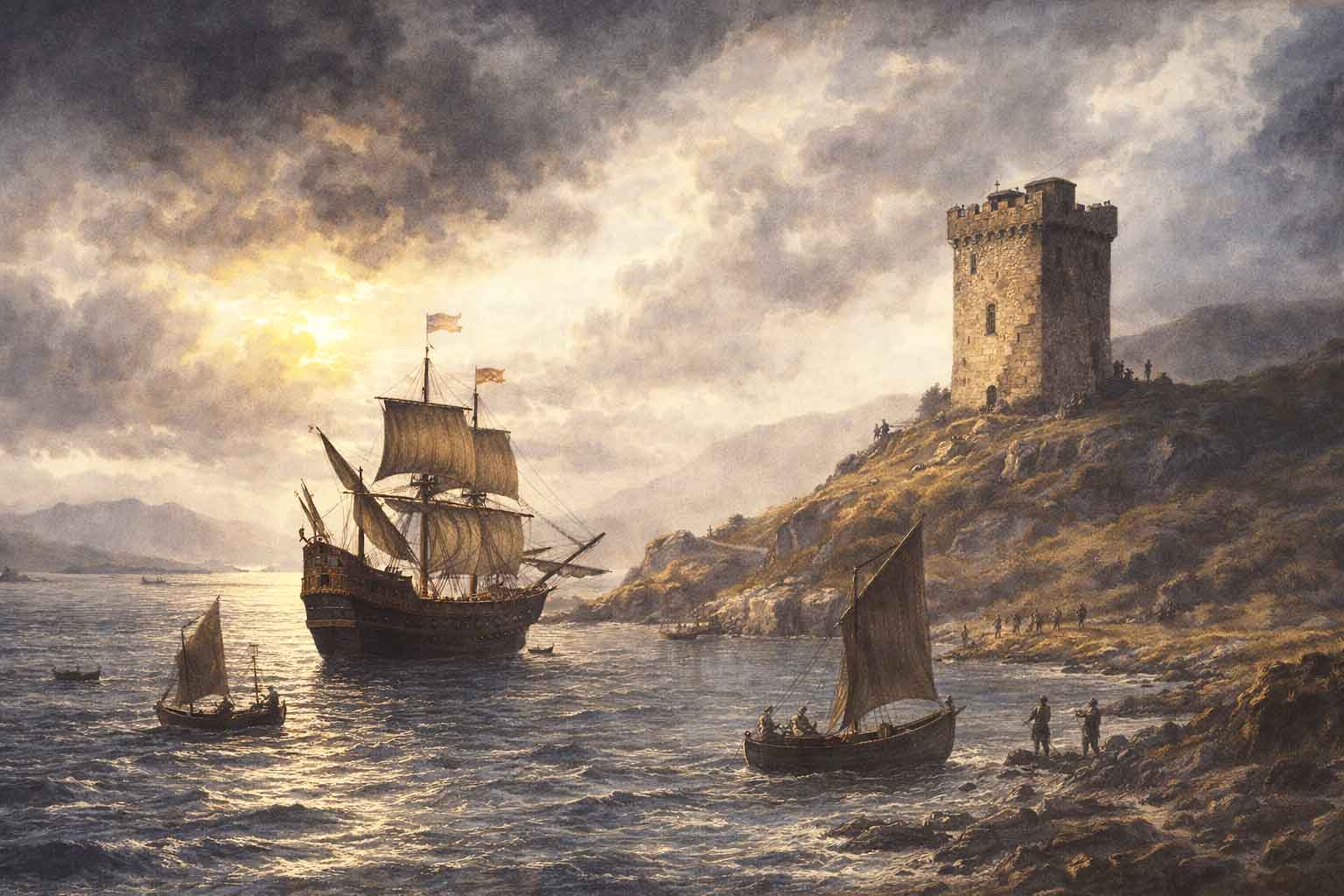
Nineteenth-century newspaper accounts were fascinated by Grace, and their retellings - however embellished - preserve something of the popular tradition that kept her memory alive on the island and along the western seaboard. She is described as having established her main stronghold at the castle on Clare Island, where she kept her largest vessels moored in the natural harbour while smaller craft lay at anchor at Carrigahowley - Rockfleet Castle - on the mainland shore. The island castle, standing on a sloping cliff overlooking the wide expanse of water that surrounds Clare on all sides, was ideally placed for her purposes: the inmates could see anything floating within twenty miles of them, while approaching vessels could not make out the castle until they were almost upon it.
Her operations ranged far. She attacked Spanish ships in what she considered her own waters, preyed on English merchant vessels, and conducted raids along the coast from Blacksod Bay to the very quays of Galway. "A terror not only to the cruising Spaniard, but to the English Government," as one account puts it. A reward of five hundred pounds was offered for her capture; troops were sent from Galway to besiege Carrigahowley. She defeated them. Sir Henry Sidney, Elizabeth's Lord Deputy, marched into Connaught to subdue her. Her husband accepted terms. Grace scornfully refused, gathered her men together and awaited Sidney's assault. When called upon to surrender, she replied with a discharge of grape shot and a loud shout of defiance. The English were driven back from the walls.
"She was high-spirited, bold and adventurous, and at an early age became fond of a maritime life. She was ever foremost in danger." - Connaught Telegraph, 1894
Her most celebrated encounter, however, was neither a battle nor a raid, but a diplomatic mission. In 1593, she sailed to London to petition Queen Elizabeth directly for the release of her sons, who had been imprisoned by the English administration. The encounter between the two queens - one enthroned in the full pomp of the Tudor court, the other arriving in a saffron mantle with a dagger in her girdle, conversing in Latin since she had no English - became a favourite set-piece in the popular literature of the following centuries. She refused the offer of an English earldom, declaring herself Elizabeth's equal. She is said to have returned with letters securing her sons' release, to the cheers of her waiting sailors.
She died in old age, universally beloved, and was buried at her own request in the Cistercian abbey on Clare Island - a foundation with which her family had ancient connections. The tomb, bearing the O'Malley motto Terra Marique Potens ("Powerful on land and sea"), can still be seen in the abbey's north wall, along with the remains of medieval frescoes on the groined ceiling beneath the tower. Reporting in 1894 on efforts to preserve her memorial, the Connaught Telegraph noted that the monument had at last been properly protected, though skulls and bones were still lying about exposed in the graveyard outside - a detail that would have perhaps amused the woman herself.
III. An Island in Distress: The Famine's Long Shadow
By the middle of the nineteenth century, the romantic associations of Clare Island with Granuaile's heroics were overlaid by a grimmer reality. The island's hundred-odd families held their land under the ruinous rundale system - every man's patches inextricably mixed with his neighbours', the grazing land held in common, fences absent or shared, all improvement discouraged. Their rents were in arrears. Their crops failed. Their fishing was conducted without proper boats or equipment. And when crisis came, the mechanisms of relief were, as the local newspaper record makes painfully clear, often as much a source of conflict as of comfort.
In July 1863, the Dublin Evening Mail published a detailed account of proceedings at the Westport Poor Law Union, which had been considering the distress on Clare Island. The meeting descended into something close to farce. The relieving officer - who also held the appointment of island pilot - admitted under questioning that he had distributed the oatmeal sent by the Central Relief Committee and the Society of Friends not according to need, but to everyone, including the landlord, Billy Malley, who paid £75 a year in rent and had £100 in the bank. Worse, he had been selling some of the donated meal at prices above the Westport market rate.
The subsequent exchanges in the boardroom cut to the heart of what was wrong with the relief system. Mr Robinson, the estate agent who had worked on the island for thirty years, was not without sympathy for the genuine poor - the old people with nothing but the four bare walls of a cabin - but he was clear that the system invited abuse. "The man who would take relief and not require it, while his neighbour was in want," he declared, "does not, in my opinion, deserve the qualifications of a voter."
"There are old persons who have only the four bare walls of a cabin. It would be better to put these into the workhouse." - Dublin Evening Mail, 1863
Behind the dark comedy of the relief meeting lay a structural crisis that no amount of oatmeal distribution could address. The island's land system made productive farming essentially impossible. The mingling of plots, the absence of proper fencing, the free-running cattle on common grazing that destroyed neighbours' crops - these were not problems that individual industry could overcome. They required systematic intervention. That intervention, when it finally came, would arrive in the form of the Congested Districts Board.
IV. The Rioting of 1878 and the Question of the Police
Before the Board's arrival, however, the island's tensions found another outlet. In April 1878, a flurry of press coverage - in both Dublin and Manchester - reported what was being described as a riot on Clare Island: the repulsion, by showers of stones from the clifftops, of a bailiff who had come to serve legal processes, and subsequently of a reinforced constabulary landing party. The incident was serious enough to attract a gunboat.
The newspaper reports painted the islanders in a poor light. But the letter written by Father Anthony Waters, the island's priest, published in the Freeman's Journal on 15 April 1878, told a rather different story. His account is worth examining at length, because it offers a rare insider's view of the conditions that produced the confrontation.
Waters began by noting that for thirty years, the island had been without a police station. Officers came when needed, did their work - often of a disagreeable nature - and were never once obstructed. What had changed was the ownership of the estate and with it the management of rents and taxes. Under the previous arrangement, the agent had collected both rent and taxes together in a single payment, giving a receipt for the combined sum. The new proprietor, Mr McDonnell, had separated the two: he collected the rent himself while employing a separate man, William Madden, to collect the taxes - and it was Madden's arrival with legal processes that had provoked the young people of the island to throw stones.
The processes themselves were confused and unjust, Waters argued: in one case, tenants were being sued for arrears of rent at the November sessions by the previous landlord, Mr Birridge, while simultaneously being retained as tenants by the new proprietor and expected to pay him rent for the same period. "Who, then, is to be held responsible for this violation of the law?" Waters demanded. "Surely not an oppressed and impoverished tenantry whose means are barely able to keep soul and body together."
Waters reserved his sharpest scorn for the Government's response. The constable of the district, he noted, had himself said that he could walk through the island with Madden and come out again without hearing an offensive word. Instead, the island had been visited by a gunboat with cannons and a twelve-pounder, a magistrate, and fifty police. "Surely when the people are already reduced to poverty it is not the time for the Government to harass them with further taxes by sending a station of police to the Island."
V. Reform and the Congested Districts Board
The Congested Districts Board, established in 1891, eventually took over Clare Island, purchasing the estate from its landlord and beginning the radical work of land redistribution that the island so desperately needed. A long article in the Morning Mail of June 1899 - unusually detailed for its time - described what had been achieved in the years since acquisition.
The work had been formidable. The old rundale system, under which every man's patches were inextricably mixed with his neighbours', was abolished. A boundary wall roughly six miles long was built across the island to separate the common grazing ground from the tillage land - a project to which the tenantry contributed their labour in partial discharge of accumulated rent arrears. The holdings were mapped, surveyed, and re-applotted - each man receiving a consolidated parcel of ground, fenced off from his neighbours. Some thirty miles of new fencing were constructed, with each tenant required to contribute between seven and twelve pounds towards the cost, to be eventually repaid from the purchase money when the land was formally sold back to them.
"The sound human material on which the Board has to work on Clare Island... the islanders have shown conspicuous probity and industry - some of them have made almost superhuman efforts to fulfil their undertakings." - Morning Mail, 1899
The reporter was at pains to emphasise that this was not charity. "There is no sort of spoon-feeding on Clare Island," he wrote. "The work was carried out with humanity and consideration indeed, but also with a certain wholesome exactitude of equality and business-like method." A credit society had been established to allow fishermen to borrow capital for boats; co-operative principles were being introduced. The people had responded well. Their probity and industry under extremely difficult conditions impressed everyone who observed it closely.
There was a note of caution, however. The formal transfer of ownership to the tenantry had not yet been completed. Until the purchase money was actually paid, the transformation could not be called definitive. The article ended with the judgement that the most important thing the Board had demonstrated was the quality of the people it was working with - "the sound human material" of Clare Island - and that this was the best possible earnest of success.
VI. The Great Survey: Science on the Edge of the Atlantic
In the early years of the twentieth century, Clare Island became the subject of one of the most ambitious scientific undertakings in Irish history. The Clare Island Survey, organised by the Royal Irish Academy and conducted between roughly 1909 and 1911, sent teams of specialists to the island to investigate virtually every aspect of its natural life - its geology, botany, marine algae, land plants, insects, reptiles, mammals, and more. The results, published in a series of detailed reports, added substantially to knowledge of Ireland's natural history.
The Irish Times reported on the survey's findings as they were presented to the Academy in June 1912. A paper on marine algae recorded 433 species and 34 varieties, over a hundred of which were additions to the Irish list. Three new species and two new varieties had been identified. The survey of mammals revealed that only two strictly terrestrial species - the field mouse and the shrew - were true natives; hare and rabbit had been introduced. The flying mammals were represented by a single species of bat.
A paper on reptiles and amphibians prompted an interesting digression. Dr Scharff noted that there had been considerable discussion in the Dublin press about the occurrence of the common newt in various parts of Ireland. He confirmed that it was perfectly well known to naturalists in every county - including, now, Clare Island. He took the opportunity to clear up a widespread confusion between the smooth newt (a reptile) and the creature known popularly as the "man-heeper" (a name for the newt in the Irish countryside), which was actually an amphibian. Both newt and frog were found in the survey area, though absent from Clare Island itself.
The survey also documented the island's remarkable plant life. Although no tree worthy of the name grew on Clare Island - the Atlantic exposure was too severe - the eastern shore carried a scrubby growth of oak, birch, mountain ash, holly, hazel, and willow. More striking was the presence, on the clifftops, of Alpine plants that would normally grow at altitudes two or three times higher than sea level. The Irish Times of September 1914 reported a paper on tree growth which argued that the island's original forest cover had disappeared due to a lowering of summer temperatures and increased rainfall in relatively recent times, probably associated with a higher sea level. Its flora connected Clare Island, the paper suggested, to a time when a land bridge had existed between the island and the Mayo mainland.
The natural history survey generated significant additions to the collections of the National Museum in Dublin, as the Connaught Telegraph noted in February 1911, reporting that large numbers of invertebrate animals had been identified, particularly among the insect collections assembled under Mr Halbert's supervision. The preservation and mounting of the material alone, the article noted, was a labour of years.
VII. The Grave, the Ghost, and the Island's Afterlife
Throughout all of this - the distress meetings and the land reforms, the surveys and the political agitation - the figure of Grace O'Malley remained at the centre of the island's sense of itself. Her memory was not merely historical. It was living tradition, passed down through generations by word of mouth on both the island and the mainland coast, preserved in songs, legends, and the physical fabric of the landscape.
Her abbey tomb attracted visitors and commentators throughout the nineteenth century. Colonel Philip Vigors, reporting to the Boston Pilot in 1894 on the state of ancient Irish graveyards, described the memorial tablet set in the north wall of the abbey: a stone about four feet high and three wide, bearing the O'Malley arms and the motto Terra Marique Potens - the last two letters turned up vertically for want of room. It had no date, and some people even doubted whether Grace was actually buried there, suggesting that she might rather have been interred at Carrigahowley Castle. But the monument was at last, by the 1890s, in a good state of preservation.
In a remarkable short story published in the Irish Independent in 1932, the writer Gerald Griffin imagined a boat journey to Clare Island as an occasion for a quarrel between three very different Irish types: a romantic idealist, a sentimental traditionalist, and a bluff, whiskey-drinking sceptic who dismisses Granuaile as "a half-tergid marauder" and announces his intention to dig up her grave in search of Spanish doubloons. The sceptic is immediately swept overboard by the boom of the mainsail - "'Twas Grania's ghost that surely hit him in the neck," one character remarks - and the story ends on the moonlit water off Carramore with a sound like a woman's wail carrying across the bay.
"Her name has gone down through the centuries from the utmost distance to alien domination, just as Grace's name was well known as the symbol of imperial majesty." - Connaught Telegraph, 1885
By 1986, when the Evening Herald reviewed two novels set in the world of Grace O'Malley - Eleanor Fairburn's The White Seahorse and Kevin Casey's A Sense of Survival - Clare Island had become a site of literary pilgrimage as much as historical interest. Fairburn, who grew up within sight of the island, was praised for her evocation of "the rugged and raw lifestyle of the West of Ireland" that underpinned the life of a woman who commanded a fleet and spent her whole existence fighting for herself or her enemies. Grace's grave on the island, the reviewer noted, remained a place of occasional pilgrimage, "pointed out to all tourists who pass that way."
Afterword
The story of Clare Island is in many ways the story of the Irish west in miniature: a landscape of almost painful beauty, an ancient culture with deep roots in the Gaelic world, a history of exploitation and neglect, and a people whose resilience in the face of poverty and isolation repeatedly surprised and moved those who came to observe them. The island's association with Grace O'Malley gave it a particular intensity of historical self-consciousness - a sense that the cliffs and the grey water and the ruined abbey were not merely backdrop but active participants in an ongoing drama.
The newspaper voices gathered here - the relief inspector and the Poor Law Guardian, the naturalist and the travel writer, the indignant priest and the romantic journalist - do not tell a single coherent story. They contradict each other, argue with each other, and see the island through very different eyes. But together they preserve something irreplaceable: the texture of how Clare Island was experienced by those who lived there and those who visited, across more than a century of Irish life. The island itself, as one 1910 traveller wrote after crossing from Roonah Quay on a swelling sea and setting foot on the pier, is still there - the still water, the clear depth, the cliffs above, and the grass-grown tower of Granuaile keeping watch over all of it.
Sources
This article draws on the following contemporary newspaper sources:
Manchester Evening News, 15 April 1878 • Connaught Telegraph, 9 May 1914 • Irish News and Belfast Morning News, 26 September 1914 • Connaught Telegraph, 11 February 1911 • Warder and Dublin Weekly Mail, 16 April 1910 • Dublin Evening Mail, 10 July 1863 • Irish Times, 25 June 1912 • Morning Mail (Dublin), 5 June 1899 • Freeman's Journal, 15 April 1878 • Roscommon Herald, 23 February 1878 • Munster Express, 27 October 1883 • Waterford Mail, 23 October 1883 • Connaught Telegraph, 31 March 1917 • Connaught Telegraph, 1 August 1885 • Western Morning News, 28 September 1874 • Irish Weekly and Ulster Examiner, 7 June 1952 • Connaught Telegraph, 23 June 1894 • Irish Independent, 30 January 1932 • Waterford Citizen, 27 April 1877 • Evening Herald (Dublin), 31 January 1986
This Topic
Celtic Britain, Sacred Landscapes and Lost Kingdoms
Sacred places, old kingdoms, borderlands, Atlantic routes, and the landscapes where memory, myth, and history overlap.
View Topic PageMore in this Topic
12 March 2026
Saint Piran of Cornwall26 October 2025
Elmet A Brittonic Kingdom and Enclave Between Rivers and RidgesLatest Posts
27 March 2026
Hot Cross Buns: History, Origins & FolkloreDiscover the fascinating history of hot cross buns - from pagan offerings and Greek sacred bread to Chelsea bun houses and Good Friday folklore. Explore 2,000 years of spiced bread tradition.
22 March 2026
What Does "Ne'er Cast a Clout Till May Be Out" Actually Mean?Is it about the month of May or the hawthorn flower? And what on earth is a clout? We dig into 170 years of British newspapers to finally answer one of folklore's most argued questions.
20 March 2026
The White Hart: The Ancient Legend Behind Britain's Most Common Pub SignFrom Greek mythology to medieval forest law, the white deer haunted the British imagination for centuries. Discover the real history behind the legend of the White Hart — royal badge, supernatural omen, and elusive quarry of the soul.
13 March 2026
Why Is a Horseshoe Lucky? The Surprising History Behind the World's Most Universal CharmThe horseshoe has been nailed above cottage doors, cathedral gates, and battleship masts for centuries. Discover the ancient beliefs in iron, the crescent moon, and the sacred horse that made it the world's most enduring good luck symbol.
12 March 2026
Saint Piran of CornwallPiran - patron saint of Cornwall, tin miners and the Cornish flag — from Irish origins to the buried oratory's remarkable 2014 excavation.
7 March 2026
The Wandering Fire - A History of Ball LightningFrom a French tailor stalked by a glowing sphere to thousands of iridescent globes hovering over a Dorset clifftop, discover the strange and fascinating history of ball lightning as recorded in British and Irish newspapers between 1792 and 1938 — and why science, for over a century, could only stand mute before it.