Long before "Cumbria" meant a county of fells, lakes, and stone farmhouses, it meant a kingdom, a Celtic one, ruled by warlords with names like Urien and Rhydderch, sung about by poets who called it Rheged, and remembered by its own people not as English or Scottish but as Cymry: fellow countrymen. For six centuries after Rome withdrew from Britain, a chain of Brythonic-speaking kingdoms held the ground between Hadrian's Wall and the Clyde, between the Pennines and the Irish Sea. Modern historians call this world Yr Hen Ogledd, "the Old North." It gave Britain its Arthur, its Merlin, and, quite possibly, the ancestors of the very Welsh dynasty that later produced Rhodri Mawr. Then it vanished so thoroughly that most people who live in Cumbria today have never heard its story.
This is that story: the kingdom, the language, the saints and poets who gave it a voice, and the slow, contested, three-centuries-long process by which it finally disappeared.
Quick Facts: The Kingdom of Cumbria at a Glance
- Also known as: Cumbria, Cumbraland, the Kingdom of the Cumbrians, Strathclyde (see below, the two names describe overlapping but not identical things)
- Language: Cumbric, a Brittonic Celtic language closely related to Old Welsh
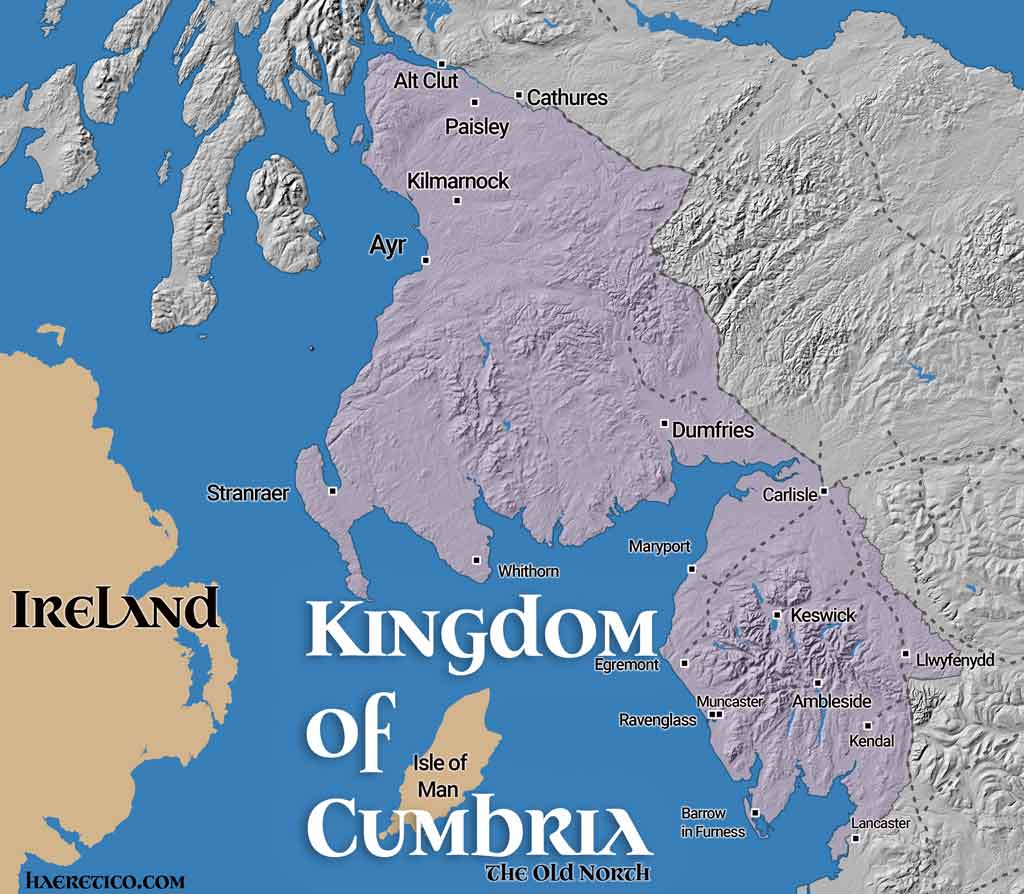
- Approximate territory: From the Clyde Valley in the north to the Solway Firth, and at times south into the Eden Valley, Lancashire, and the Pennines
- Capital(s): Alt Clut / Dumbarton Rock (pre-870); later centred on Govan and Glasgow; Carlisle (Caer Luel) was a key southern stronghold
- Existed: c. 5th century – late 11th/12th century (roughly 600 years)
- Ended: Gradually, through Viking pressure, Northumbrian and Scottish expansion, and finally Anglo-Norman annexation of Carlisle in 1092
Part I - Origins and Geography
Rome's Departure and the Birth of a Kingdom
When the Roman legions marched south for the last time in the early fifth century, Britain was left exposed to waves of invasion and fragmentation, the very collapse later lamented by the monk Gildas in his sermon on Britain's ruin. Yet in the north, beyond Hadrian's Wall, the Brythonic-speaking communities who had lived under Rome did not vanish. Instead, they reorganised themselves into new polities. Among these was Cumbria, remembered in Welsh tradition as part of Yr Hen Ogledd, "the Old North."
The name itself is telling. Cymry is the Welsh word for "our people," and Cumbria, linguistically and culturally, was one with Wales and Cornwall. The Cumbrians were not outsiders but kin to the wider Brythonic world. The historian Kenneth Jackson, lecturing to the Society of Antiquaries of Scotland in 1954, put the terminology as clearly as anyone ever has: the northern Britons called themselves in Latin Cumbri and Cumbrenses, "a Latinization of the native word Cymry, meaning 'fellow-countrymen', which both they and the Welsh used of themselves in common, and is still the Welsh name for the Welsh to the present day." Some earlier writers, he noted, called the northern Britons simply "Welsh," "following good Anglo-Saxon precedent", but that habit only breeds confusion. "The best term for them," Jackson concluded, "in the Dark Ages and early Medieval period, as long as they survived, is 'Cumbrians', and for their language, 'Cumbric'."
Tribal Foundations
The earliest Cumbrians were descended from several Romano-British tribes: the Brigantes, the largest tribal confederation in Roman Britain, whose territory once stretched from the Mersey and Humber all the way to the Scottish lowlands; the Carvetii around Carlisle; the Selgovae of the central Southern Uplands; and, further north, the Damnonii (or Damnii) of Clydesdale, Renfrewshire, and Ayrshire, the tribal bedrock on which the future kingdom of Strathclyde would eventually be built. Under Rome, these groups were heavily militarised, providing auxiliaries and manning the Wall. After Rome's collapse, they did not disappear but regrouped into Brythonic kingdoms, a pattern repeated the length of western Britain, from Dumnonia in the southwest to Gododdin in the east.
Evidence for their survival lies in continuity of place-names and in the persistence of Brythonic Christianity. Saints such as Ninian and Kentigern were received not by "barbarians" but by peoples still living within a recognisably Romano-British cultural frame, literate, at least partly Latin-speaking, and increasingly Christian even as the legions' pay chests emptied.
Centres of Power
Three sites in particular anchor our understanding of Cumbria.
Carlisle (Caer Luel): The old Roman fort at Luguvalium became a key stronghold of the native kingdom. Its Brythonic name (Caer, "fort," a word applied by the Britons specifically to old Roman military stations) shows continued occupation by native rulers long after the legions left. Carlisle's walls, still formidable in the Dark Ages, made it a natural southern capital, and it kept appearing in the historical record for centuries: St Cuthbert visited it in 685, finding its citizens still proudly showing off their Roman fountain and walls; the city was "utterly ruined" by Danish raiders around 875 and lay in ruins for two hundred years; and it was finally seized for England by William Rufus in 1092, the event that, more than any other, hardened the England–Scotland border along the Solway.
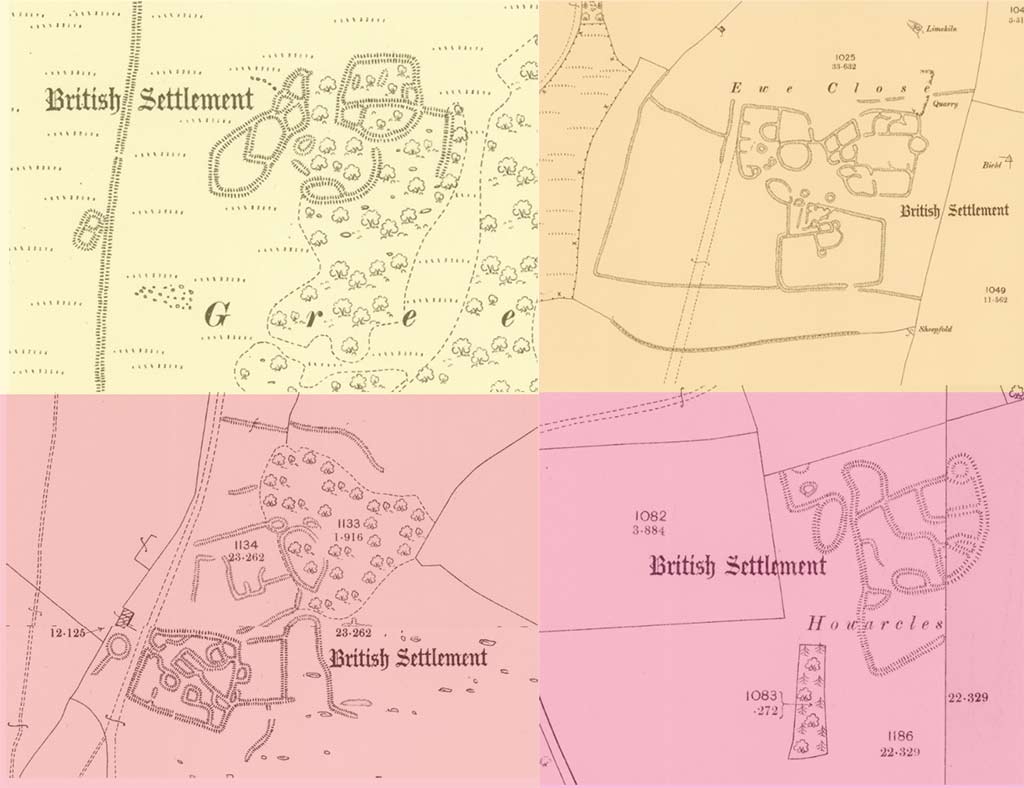
Llwyfenydd (Lyvennet Valley): Remembered in medieval Welsh poetry as a heartland of the Brittonic North, Taliesin himself calls Owain, son of Urien, "udd Llwyfenydd," lord of Llwyfenydd. The place-name survives today in the Lyvennet river and valley, south of Crosby Ravensworth, tying poetry directly to topography. The strongest archaeological candidate for a settlement here is Ewe Close, a substantial Romano-British enclosed settlement excavated by W. G. Collingwood in 1908. Historians disagree about how much weight to put on it: the archaeologist Mike McCarthy has argued the site's "royal" status rests on thin evidence and "can be dismissed," while a 1998 Lancaster University survey of the neighbouring Haweswater estate takes a more open view, noting it is "possible... that some of these enclosed settlements were also occupied prior to the Roman period, and even afterwards extending into the early medieval period." You can explore the earthworks of Ewe Close for yourself on an interactive elevation map of the Crosby Ravensworth site, which renders the settlement's enclosure banks in striking relief.
Dumbarton Rock (Alt Clut): Though technically in Strathclyde, this great fortress on the Clyde was so closely paired with Carlisle that chroniclers routinely referred to the "Kings of Alt Clut and Cumbria" as if their rule were interlinked. Bede himself, writing in the early eighth century, called it munissima urbs, "a very strongly fortified place." Its rulers may originally have been Roman-sponsored foederati, installed to guard the western end of the Antonine Wall after a Pictish raid in AD 367; one scholarly theory even traces the dynasty's epithet hael ("generous") back to memories of Roman gold subsidies. Whatever its origins, Alt Clut anchored the kingdom's identity for four and a half centuries, until catastrophe struck in 870.
Probable Borders
Defining Cumbria's extent is notoriously difficult. It was less a fixed state than a shifting coalition of communities, and its borders moved with every generation's fortunes. Yet clues survive:
- To the north, Cumbria met the Pictish and Gaelic zones of southern Scotland. Galloway and Ayrshire were contested ground, sometimes Brythonic, sometimes Gaelic.
- To the east, the Pennines and the River Derwent likely marked the frontier with Northumbria. The catastrophic Battle of Chester in 616 cut Cumbria off from Wales, forcing it to look north and west for allies.
- To the west, the Solway Firth and the Irish Sea linked Cumbria to sea routes, both a vulnerability to Norse attack and a highway for trade.
- To the south, its influence extended into Lancashire and even northern Cheshire in earlier centuries, though Anglo-Saxon expansion gradually shrank this zone. A 12th-century ecclesiastical description of the diocese of Glasgow (reckoned as coterminous with historic Cumbria) put its extent as running "from the Clyde on the north to the Solway Firth and the march with England on the south, and from the western boundary of Lothian on the east to the river Urr on the west."
Cumbria, Strathclyde, or Both? A Debate That Still Divides Historians
Here is a question the older popular histories tend to skate past, and it deserves a proper answer, because it sits at the centre of everything that follows: were "Cumbria" and "Strathclyde" simply two names for the same kingdom, or two related-but-distinct polities?
The honest answer is that historians are still arguing about it, and the argument itself tells us something important. The 19th-century pioneer of the subject, W. F. Skene, believed terra Cumbrorum was a single kingdom running "from the Clyde to the Derwent," and that the term "Cumbria" simply hadn't been used by any writer before the eleventh century. Later, D. P. Kirby proposed instead that Cumbria (south of the Solway) and Strathclyde (the Clyde valley, ruled from Dumbarton) began as genuinely separate kingdoms, with Cumbria absorbed into Strathclyde's orbit only in the tenth century. Others, such as P. A. Wilson, argued they were simply alternative names for one and the same kingdom all along, pointing to a late-tenth-century Latin chronicle that translates "Strathclyde Britons" straightforwardly as "Cumbri."
The modern historian Fiona Edmonds has offered what may be the most convincing resolution: the two names were "connected but not entirely synonymous, one evolved into the other." Crucially, "Strathclyde" itself barely existed as a name before 870. Before that catastrophic year, the Clyde kings were titled simply after their citadel, Alt Clut, "the name of the kingdom ruled from Alclud is unknown," as the place-name scholar Alan James puts it. Only after Dumbarton fell to Viking raiders and the old citadel-identity collapsed did "Strathclyde" emerge as a political label for the wider river valley. And only later still (as the kingdom's power expanded south and east beyond the Clyde basin) did "Cumbria" take over as the operative political term, rendering the older name for the Clyde valley obsolete.
We can actually watch this happen in the sources. In 945, the Anglo-Saxon Chronicle records King Edmund of England ravaging "all Cumbra land" and handing it to the Scottish king Malcolm, while the Welsh Annales Cambriae, describing what is almost certainly the very same raid, says instead that "Strathclyde was ravaged by the English." For a moment, in the mid-tenth century, the two names are demonstrably describing the same territory. By the twelfth century, when the future King David I of Scotland held an inquest into the lands of the diocese of Glasgow, he did so as "Cumbrensis regionis princeps" ("prince of the Cumbrian region") even though, as the inquest itself admits, "he did not in fact rule all of the Cumbrian region." "Cumbria," in other words, had by then become something bigger than any one lord's actual holdings: a remembered historical territory, stretching, in Edmonds's words, "from Clydesdale to the area south of Solway." Modern Cumbria (the English county) inherited only the southern fragment of that name, shrunk and relocated by eight centuries of history.
Part II - Language and Society
The Cumbric Language
At the heart of Cumbria's identity lay its language: Cumbric. This was a branch of the Brythonic Celtic family, which also gave rise to Welsh, Cornish, and Breton. To the Cumbrians themselves, there was little meaningful distinction between "Welsh" and "Cumbric": both were Cymric tongues, mutually intelligible dialects of one language community that simply happened to straddle the growing wedge of Anglo-Saxon England.
The term "Cumbric" itself is a modern coinage, "Jackson's inspired coinage," in fact, after the philologist Kenneth Jackson, who introduced it in 1953 to describe the northern branch of Brittonic speech. More recent scholarship, particularly the place-name specialist Alan James, has sharpened the definition further, restricting "Cumbric" strictly to a later phase of the language (roughly the late ninth to mid-twelfth centuries) and using a different label, "neoBrittonic," for the earlier, Rheged-era tongue. That distinction matters, because it connects to one of the more genuinely surprising findings in recent Cumbric scholarship: much of what looks like Cumbric place-name evidence in Cumbria and southern Scotland may not be an unbroken survival from the fifth and sixth centuries at all. James argues instead for "a significant revival or reintroduction" of the language in the Solway basin, concentrated especially in the first half of the tenth century: that is, after, not before, the Viking destruction of York (869) and Dumbarton (870). The archaeologist Deirdre O'Sullivan reaches a similar conclusion independently: British place-names cluster overwhelmingly in the northern half of Cumbria, and per the philologist Kenneth Jackson, most of these are "almost certainly late," connected to a tenth-century resettlement of the region by Britons from Strathclyde, not survivals from before the Anglo-Saxon conquest at all.
Modern scholars reconstruct Cumbric from three main sources:
Place-names. Cumbria is studded with names of Brythonic origin: Penrith (pen rhyd, "chief ford"); Carlisle (Caer Luel, "fort of Luel"); Blencathra (blain cathrach, "hill of the chair"); Lanercost (llaner gwas, "monastic enclosure"). These names survived centuries of Anglo-Saxon and Norse overlay, hinting at a strong underlying Brythonic substrate. One correction worth making here: the common "Cum-" element in names like Cumrew, Cumwhitton, and Cumdivock is often assumed, by analogy with Welsh cwm ("valley"), to mean the same thing, but the linguist Simon Rodway has shown it more likely derives from a different Cumbric root, *cümber-, meaning "confluence" (the same root that gives Welsh cymer). It's a small correction, but a satisfying one: not every "Cum-" name is a valley.
Legal and dialect survivals. Counting systems used by shepherds in the Pennines and Lakeland dales into the modern period show striking similarities to Welsh numerals. Examples like yan, tyan, tethera, methera, pimp are relics of Cumbric numeracy, passed down orally through a use (counting sheep) remarkably resistant to linguistic replacement.
Medieval glosses. A handful of words preserved in law codes and chronicles hint at Cumbric terms for landholding, kinship, and society, suggesting close alignment with Old Welsh but with local, northern forms.
Cumbric survived, in pockets, remarkably late. One antiquarian source claims British law and custom in the old Cumbrian kingdom persisted "until abolished by Edward I... A.D. 1304," and that in some secluded districts the language itself "is thought to have lingered until the Reformation." Cumbria, unlike Pictland (whose language and identity seem to have been absorbed with startling speed in the ninth century) never lost its Brythonic voice suddenly. It faded slowly, unevenly, and later than most people assume, absorbed piece by piece into the swelling tide of English, Norse, and Gaelic speech.
Religion and the Saints
The Cumbrians were not only a Brythonic people; they were also, from an early date, a Christian one. Christianity had taken root under Rome and endured afterwards, often in productive tension with older, pagan ways.
St Ninian. Based at Whithorn (Candida Casa, "the white house", so called, Bede says, because Ninian built it of stone, "which was unusual among the British") in Galloway, Ninian is traditionally credited with bringing Christianity to the southern Picts and the Cumbrians alike. His cult spread widely across the Solway; churches from Aspatria to Irthington carried his dedication for centuries afterward. Even his dates are contested (different sources place his mission anywhere between 397 and 432), a reminder of how thin the evidential ice really is this far back. One nineteenth-century source calls him bluntly "a Cumbrian Briton," a telling detail, since it shows the ethnonym being applied to him already by 1836.
St Kentigern (Mungo). Perhaps the most emblematic saint of Cumbria, Kentigern worked around the Clyde and Carlisle and is remembered as the founder of Glasgow, but his sphere, and his family tree, ran deeper into the Old North than his urban legacy suggests. Welsh genealogical tradition makes him a grandson of Urien of Rheged, through Urien's son Owain, one of several threads tying the Christian and heroic strands of Cumbrian memory into a single family story. His nickname, "Mungo," comes down to us via his tutor St Serf, who is said to have called the young Kentigern Mwyngu, "amiable," or "dear." Exiled at one point by a hostile local king, Kentigern founded a second bishopric at St Asaph in Wales before being recalled to Glasgow by Rhydderch Hael, his patron, and one of Cumbria's most storied kings.
St Cuthbert. Though usually associated with Northumbria, Cuthbert's career intersected repeatedly with Cumbrian lands. Hagiographies record his journeys into the region and a visit to Carlisle in 685, during which its citizens showed him their Roman walls with evident pride. His cult, too, left a footprint further south than is often realised: churches at Dufton and Cliburn, well down in the Eden Valley, both carry his dedication.
Religion reinforced Cumbria's Cymric identity rather than diluting it. Its saints were remembered in Welsh hagiographies, showing that Cumbria was understood, by its neighbours and by itself, as part of the same spiritual and cultural world as Wales.
Poetry, Prophecy, and Oral Tradition
Cumbria's culture was not only political and religious; it was also (perhaps above all) poetic. Fragments of medieval Welsh poetry preserve the voices of northern bards singing of Cumbrian kings and heroes, and they are among the earliest surviving vernacular literature anywhere in Europe.
Aneirin's Y Gododdin, though centred on Edinburgh (Din Eidyn), celebrates warriors from across the Old North gathered under their lord Mynyddawg Mwynvawr for a doomed cavalry raid on Catraeth (almost certainly Catterick, in Yorkshire). The numbers are precise and devastating: three hundred and sixty-three warriors rode to Catraeth after a year's feasting on their lord's mead; three came home. "Mead they drank, yellow, sweet, ensnaring," runs one refrain. "In that year many a minstrel fell." The poem's surviving narrator delivers one of the bleakest lines in early medieval literature: "I could wish to have been the first to fall in Catraeth, as the price of mead in the hall, and the beverage of wine."
Taliesin's poems praise Urien of Rheged and his son Owain in verse that still crackles with genuine feeling nearly fifteen centuries later. When Owain kills the Bernician warlord Fflamddwyn ("Flame-bearer") in a night attack, Taliesin sings: "Owain valiantly chastised them, like a pack of wolves pursuing sheep." When Urien himself is finally murdered, assassinated by a jealous ally, Morcant, while besieging the enemy on Lindisfarne, an anonymous elegist carries the dead king's severed head from the battlefield and speaks over it: "A head I bear by my side, / The head of Urien, the mild leader of his army, / And on his white bosom the sable raven is perched." The poem closes on the bare, terrible fact of it: "In Aber Lleu has Urien been slain."
Llywarch Hen, a fourth major poet of the Old North tradition often overlooked in popular retellings, deserves to stand alongside Aneirin and Taliesin, not least because he was Urien's own first cousin, the two of them grandsons of the same patriarch, Meirchion Gul. The verse-cycle attached to his name is built around a devastating conceit: Llywarch outlives all twenty-four of his sons, one after another, in the endless wars against the Angles. His favourite, Gwen (described in the poem as "Urien's own nephew") dies alone, defending a river ford: "On the ford of Morlas, Gwen was slain!" And in one of the cycle's most quietly shattering lines, the poet (carrying Urien's head, just as in Taliesin's elegy) cries out: "Gwae vy llaw, lladd vy nghefynderw!", "Woe to my hand, that my cousin is slain!" Two cousins, two elegies, one lost kingdom.
Myrddin (the figure who would eventually be softened and southernised into Merlin) belongs to this same world, and it is worth being precise about him, because later legend has muddied the waters considerably. After the battle of Arfderydd in 573, driven mad with grief for his slain lord Gwenddolau, Myrddin fled into the forest of Coed Celyddon and lived as a wild man, speaking in riddles and prophecies. His own verses, preserved in the Black Book of Carmarthen, are startlingly direct about his condition: "For after Gwenddoleu no princes honour me... I slept all alone in the woods of Celyddon," he says, and gives an exact, almost plaintive account of the years it cost him: "Ten years and forty... have I been wandering in gloom and among sprites." He even breaks with the institutional Church in his grief: "I will not receive the communion from excommunicated monks," he says, "May God himself give me communion!" This northern Myrddin (traumatised, forest-dwelling, at odds with both king and clergy) is a wholly different figure from the courtly wizard of later Arthurian romance, and the two traditions were, for centuries, understood as separate. (More on that below.)
Society and Law
Though few Cumbrian legal texts survive directly, parallels with Welsh law suggest a kin-based society in which land was divided among freeholders, and extended families (gwelyau) held significant collective rights. Medieval chronicles refer to "kings of the Cumbrians," but these rulers probably governed less like centralised monarchs and more through shifting networks of local chiefs and warbands, a "confederation of small local princes," as one modern description has it, with no coinage, no central administration, and no stone architecture beyond hillforts and citadels: "a military aristocracy, with its emphasis on noblesse oblige," organised around the teulu, the warband, that shared feast, music, and song in peace and moved as one in war.
Archaeology strengthens this impression. Hillforts such as Trusty's Hill in Galloway, with its Pictish-style carvings in a Brythonic context, show a society that was both defensive and artistic. Early Christian carved stones, such as those at Bewcastle and Ruthwell, blend local Brythonic tradition with the wider Insular art of the age, the Ruthwell Cross, in fact, preserves fragments of the Dream of the Rood poem in Northumbrian Old English, otherwise known only from a much later West Saxon manuscript, a small but striking reminder of how much cultural exchange was happening on this frontier.
Cumbria's Distinct Identity
What emerges from all of this is a kingdom with a strong sense of itself as Cymric. Its language tied it to Wales; its saints, to the wider Celtic church; its poets, to a heroic tradition that would eventually help shape the whole of British legend; and its society, to a kinship-based law recognisable across the Brythonic world.
Yet Cumbria was also distinctly itself: a northern frontier kingdom, resilient and adaptive, forever balancing its own traditions against the pressures of Angles, Picts, Gaels, and (eventually) Norse settlers arriving by sea.
Part III - Kings and Wars
Cumbria on the Battlefield
From its very beginnings, Cumbria was forged in conflict. It occupied a genuinely liminal zone, north of the Anglo-Saxons, south of the Picts, west of the expanding Anglian kingdom of Bernicia, and open on its coast to Norse raiders. To survive here was to fight, and the chronicles and legends of the Old North are dominated, almost wall to wall, by battles.
Where Was Rheged? A Question Historians Still Can't Agree On
Before going further into the wars, it's worth pausing on a genuine puzzle: where, exactly, was Rheged, the most famous of the Cumbrian sub-kingdoms, the one Urien and Owain ruled, the one Taliesin sang about?
The traditional answer, repeated in most popular accounts, is that Rheged was essentially Cumbria itself, centred somewhere around Carlisle and the Eden Valley. Dillon and Chadwick's classic 1957 survey The Celtic Realms states this flatly: Rheged's capital "was almost certainly Carlisle." But the archaeologist Mike McCarthy has mounted a serious challenge to this consensus. His striking observation: there is not a single reference to Carlisle anywhere in the core Book of Taliesin poems about Rheged and Urien's family. The famous phrase often cited as proof of a Solway-centred Rheged, "tra merin reget," "beyond the sea of Rheged", proves only that Rheged had a coastline, McCarthy points out; nothing pins that coastline specifically to the Solway rather than, say, Morecambe Bay or the open Irish Sea. He proposes instead that Rheged's original heartland lay much further west, in the Rhinns of Galloway, pointing to the place-name Dunragit ("fort of Rheged"), near Stranraer, and to Rerigonium (a Ptolemaic-era name surviving as "Penrionyd," said in later tradition to be one of the "three national thrones of Britain"). A third, older tradition, drawing on the historian Palgrave, places Rheged near Annandale instead. Even a 19th-century antiquarian, Beale Poste, weighed in with his own idiosyncratic theory, putting Rheged in Berwickshire, a minority view even in its own day, but a reminder of just how long this argument has been running.
There is no tidy resolution to offer here, and any honest account of Cumbria has to say so. What we can say is that Rheged was, in McCarthy's own careful phrase, "probably a territory rather than a people", a name that came to cover parts of several older tribal areas (Novantae, Selgovae, Carvetii, and others) under one royal house, rather than a single ethnic homeland with fixed borders. Wherever its throne actually stood, its influence, on the evidence of the poems, ran wide: Taliesin calls Urien an arbennig, an "over-king" to whom lesser kings' warbands were bound.
Arfderydd (Arthuret), 573
One of the most consequential conflicts associated with Cumbria is the Battle of Arfderydd, fought near modern-day Carlisle in 573 (though even this date is disputed, one source gives 577, another, idiosyncratically, 555). Unlike most of the wars discussed here, it was less a clash with outsiders than a civil war among the Britons themselves.
The causes are obscure, but later Welsh triads remember it as one of the "three futile battles of Britain." The core combatants were Gwenddolau, ruling from a stronghold near modern Carwinley, against his own cousins Gwrgi and Peredur. Gwenddolau was killed; his own court poet, Myrddin, survived, and, as described above, went mad with grief and fled into the forest, becoming the wild prophet of later legend. A colourful nineteenth-century reinterpretation cast the battle very differently, with Rhydderch Hael and Maelgwyn Gwynedd defeating Gwenddolau together, and made Myrddin Gwenddolau's own brother-in-law, but this reading has not held up against the earlier, primary sources, and modern scholarship sticks with the sons-of-Eliffer-versus-Gwenddolau account.
The memory of Arfderydd demonstrates two enduring truths about Cumbria: that Brythonic unity was fragile even at the best of times, and that its internal struggles generated myths (chief among them, Merlin) that would go on to shape the whole of later British folklore.
The Battle of the Carron and the Death of a Scottish King
A generation later, in 642, the Battle of the Carron pitted the Scots of Dál Riata, under their king Domnall Brecc, against the Britons of the north, commanded, on this occasion, by Owen of Dumbarton, a descendant of Rhydderch Hael. Domnall Brecc was killed, and the victory was remembered vividly enough to survive as an interpolated fragment inside the Gododdin itself: "the ravens tore the head of Domnall Brecc," the triumphant British bards sang. It is a rare case of a genuine, contemporary British victory-poem surviving embedded inside another poem entirely.
This episode shows that Cumbria (or, more precisely, the northern British kingdoms collectively) could be a serious military power in their own right, capable of killing a king of Dál Riata on the field. But it also reveals the ceaseless, exhausting nature of the wars that defined the region, fought simultaneously against Scots, Angles, and Picts.
The Battle of Chester, 616
A genuinely pivotal moment came with the Battle of Chester, fought between the expanding Northumbrians and a coalition of Britons. The result was disastrous for the latter. The Angles cut Cumbria and Wales apart, severing the cultural lifeline between the Cumbrians and their southern kin. From then on, Cumbria faced permanently north and west, cut off from the rest of the Cymry.
(A second, unrelated gathering also happened at Chester more than three centuries later (around 973) when the English king Edgar reportedly met a group of tributary British and Scottish kings there, among them "Malcolm, king of the Cumbrians." The two Chester episodes are separated by 350-odd years and should never be confused, though popular retellings sometimes conflate them.)
Yet even in isolation, Cumbria endured. Its kings maintained their courts, and its poets kept singing.
Kings of the Old North
The annals and poetry preserve the names of several rulers who defined Cumbria's story, and a fuller chronology than is usually given helps show just how long, and how eventfully, the kingdom actually lasted.
Urien of Rheged, celebrated by Taliesin, fought the Angles with real distinction, Nennius's Historia Brittonum records that he joined three other kings, Rhydderch, Gwallog, and Morcant, in besieging the Bernician king Theodric on Lindisfarne for three days and nights, before being murdered "at the instance of Morcant, out of envy" of his military superiority. His son Owain ap Urien killed the Bernician commander Fflamddwyn in a night raid and later passed into Arthurian romance as "Sir Urience"'s son, one of several points where the historical Old North and the legendary Round Table quietly overlap.
Rhydderch Hael ("the Generous"), king of Alt Clut, is remembered as a patron of both St Kentigern and the poet-prophet Myrddin, and appears independently in Adomnán's Life of St Columba, giving him the rare distinction, for a figure this early, of being cross-referenced in three separate traditions.
Kings of the Cumbrians (10th–11th centuries): Even as Anglo-Saxon England expanded, chronicles keep naming rulers "of the Cumbrians" right through the tenth and into the eleventh century, a persistence worth setting out year by year, because it's usually compressed into a single sentence in popular accounts, and the fuller sequence is genuinely dramatic:
- 927 (or 926, sources differ by a year): A royal summit at the River Eamont, near Penrith, brings together Athelstan of Wessex, Constantín of Alba, Hywel Dda of Wales, and a British king named Owain, described by one chronicler as "Owain rex Cumbrorum," king of the Cumbrians.
- 934 and 937: Owain (or his successor) allies first against, then alongside, Athelstan, joining the great confederacy defeated at the Battle of Brunanburh in 937.
- 945: In the best-documented episode of the whole story, King Edmund of England "ravaged all Cumbra land" and handed it to Malcolm I of Scotland, on condition Malcolm become his ally "by sea and land." A later, less reliable source adds a grim detail: that Edmund blinded the two sons of a king remembered as "Dunmail", the same name attached to the boundary cairn at Dunmail Raise, between Grasmere and Thirlmere, still visible on the road to Keswick today. (Some historians now think "Dunmail" here is simply a scribal corruption of "Domnal" or "Donald," meaning the popular legend of a distinct King Dunmail may rest on a copying error rather than a real king, one of several places where romance and record don't quite line up.) A rival local tradition, recorded much later, instead credits William the Conqueror with granting Cumberland to the Scots at this same spot, a different king, a different century, and a useful reminder that folk memory doesn't always keep its dates straight.
- 1018, Battle of Carham: Malcolm II of Scotland, allied with the Cumbrian king Owain Foel ("Owain the Bald"), defeats the Northumbrians and secures Lothian for Scotland. Owain Foel is the last securely attested king of the native Cumbrian royal line.
- 1054: In one of the more startling, under-remembered connections in this whole story, Earl Siward of Northumbria, fresh from defeating Macbeth in battle, installs "Máel Coluim, son of the king of the Cumbrians" as a client ruler. Some historians argue this Máel Coluim was not, as long assumed, the future Malcolm III of Scotland, but rather a genuine member of the old Cumbrian royal house, meaning the Shakespeare-famous defeat of Macbeth is tangled up, in the background, with the last flickers of native Cumbrian kingship.
- 1092: William Rufus captures Carlisle, expels its Cumbrian ruler Dolfin, refortifies the city, and resettles it with English farmers. This is the moment historians usually point to as the first hard, lasting division of Cumbrian territory between England and Scotland, before this, "Cumbria" had routinely meant a single cross-border region.
Arthur's Twelve Battles
Nennius's ninth-century Historia Brittonum preserves a list of twelve battles fought by a war-leader named Arthur, several of them plausibly sited in or near the Old North, including a battle at "the wood Celidon" (Coed Celyddon, the very forest Myrddin fled into) and, possibly, one at Bremenium (High Rochester, Northumberland). It's a tantalising list, and it feeds directly into the theories discussed below, though, as the place-name scholar Alan James dryly notes, pinning any of these sites down with certainty remains "in the realm of the wholly unprovable."
Warfare and Identity
Cumbria's wars were not only about survival. They were also, in a deep sense, about identity. Each battle reinforced the Cumbrians' sense of themselves as distinct from their neighbours, neither Saxon, nor Scot, nor Pict, but Cymric.
Even in defeat, their memory was preserved in song. Aneirin's Gododdin laments the slaughter of Brythonic warriors at Catraeth, some of whom may have come from Cumbria's own contingents; the heroic manner of their deaths was remembered, ever afterward, as proof of loyalty to the Cymric cause.
Part IV - Myths, Decline, and Legacy
Arthur in the North
The legend of King Arthur, and the long search for his court at Camelot, is usually associated with Cornwall or Wales, but a persistent strand of scholarship (stretching back well over a century) has argued that Arthur's original stage was the Old North: Cumbria, Strathclyde, and southern Scotland.
Nineteenth- and early twentieth-century antiquarian journals went so far as to call Arthur "unquestionably a Brythonic hero, probably in particular a Cimbric hero, for the scenes of his chiefest activities are laid in Cumbria, in Cambria, and in Cornwall", placing him firmly in the Cymric north rather than the far southwest.
- Mount Badon, the great victory that held back the Saxons for a generation, has been placed by some near Falkirk rather than Bath.
- Camlann, Arthur's final battle, is sometimes identified with Camelon, a Roman fort close to Cumbria's northern edge.
- Place-names across the region anchor his presence on the ground with real persistence: Arthur's Seat in Edinburgh; Arthur's Table at Penrith; the village of Arthuret, near Longtown, said by one antiquarian to derive from "Arthur's Head." Most tangibly of all, the great earthwork at Eamont Bridge, just outside Penrith (a circular enclosure with two opposed entrances, ideal, an eighteenth-century county history suggests, for jousting) is still known locally as King Arthur's Round Table, with the neighbouring henge of Mayburgh close enough that "the knights, after justing and exercise, might dine here."
Not every local Arthurian legend went unchallenged, even at the time. Pendragon Castle, in Mallerstang near Kirkby Stephen, was long said to have been "built about the time of Vortigern, by Uter Pendragon", commemorated in a local rhyme about his failed attempt to divert the River Eden to fortify the site: "Let Uter Pendragon do what he can, / Eden will run where Eden ran." But the same eighteenth-century historians who recorded that rhyme also pushed back against it, arguing "Pendragon" was really a warlike epithet, pen, "chief" or "great," plus dragon, a word "in all ages... applied to military persons", that might properly belong instead to a genuine, documented eleventh-century warlord, Uchtred, rather than to any legendary Uther. It's a rare case of an early source actively arguing against an Arthurian attribution rather than simply repeating it, a useful reminder that scepticism about these legends is nothing new.
Rather than a single historical warlord, Arthur may reflect the collective memory of Cumbric resistance against Saxon advance, a composite hero, assembled over centuries from the deeds of real northern war-leaders like Urien and Owain. His legend, preserved and elaborated in Wales and Cornwall, may have originated in the desperate wars fought across the land of Cumbria.
Merlin and the Prophetic Tradition - Two Different Wizards
Alongside Arthur stands Merlin, or rather, as we've already met him, Myrddin Wyllt, a genuinely Cumbrian figure. It's worth being unusually clear about this, because centuries of romance have blurred two originally separate traditions into one.
The northern Myrddin, the historical figure (or figures) behind the legend, is the traumatised survivor of Arfderydd: a real Brythonic warlord's poet, driven mad by civil war, living wild in the Caledonian forest, prophesying in verse, at odds with the institutional Church. This is the Myrddin of the Afallennau poems, mourning his lost lord Gwenddolau for "ten years and forty."
The southern Merlin of later Arthurian romance (Geoffrey of Monmouth's wonder-working advisor to Uther Pendragon and Arthur, born at Carmarthen, associated with Stonehenge and Tintagel) is a substantially different figure, built up centuries later. Even the name may be a back-formation: one influential theory holds that "Myrddin" was invented from a mistaken reading of Caerfyrddin (Carmarthen), whose second element actually derives from an unrelated word meaning "sea-fort", Merlin's name, in other words, possibly grew out of a place-name misunderstanding rather than the reverse. Geoffrey of Monmouth himself is largely responsible for fusing the two traditions; earlier and later writers alike kept them recognisably distinct, and even a source as old as William Camden's 1722 Britannia dismisses the wilder claims of the southern Merlin cycle (a "tomb" at Marlborough, credit for Stonehenge) as frankly "ridiculous," while treating the northern material with more care.
Later medieval writers made him Arthur's advisor, but his origin is distinctly, stubbornly Cumbrian: a traumatised Brythonic warlord's bard turned prophet, mourning a real battle fought on real ground you can still walk today.
Folklore and Local Legends
Other legends clustered around the Anglo-Scottish border preserve fainter traces of Cumbric memory. The tale of Fair Maid Lilliard, slain at Ancrum Moor in the sixteenth century, almost certainly echoes older Brythonic traditions of female warriors; place-names like Lilliot Cross and Lilliard's Edge suggest a continuity of memory stretching back well beyond her own century. Even children's games carried the border's older tensions forward: an eighteenth-century county history records local boys playing "Scotch and English," a miniature re-enactment of border reiving complete with its own taunting battle-cry, a small but vivid piece of evidence for how deep this frontier's memory ran, right down into the nursery.
The Decline of Cumbria - More Complicated, and More Interesting, Than "The Vikings Won"
By the tenth century, Cumbria was surrounded on all sides: Angles pressing from the east, Scots absorbing Strathclyde from the north, and Norse settlers arriving along the coast, their place-names, -by, -thwaite, -beck, still stamped across the map today.
The traditional story, repeated in most popular accounts, runs roughly like this: Dumbarton falls to Viking raiders in 870; British sovereignty collapses; the kingdom is absorbed into Gaelic-speaking Alba. But recent scholarship (building on the work of the historian Dauvit Broun) has pushed back hard against this tidy narrative, and the correction is worth dwelling on, because it changes the whole shape of the ending. The "870 = the end" story, it turns out, traces back to a single fourteenth-century chronicler, John of Fordun, writing more than four hundred years after the fact and shaped by his own era's political concerns. The archaeological and documentary evidence instead suggests a British-ruled kingdom persisted in Strathclyde until late in the twelfth century, continuing to identify itself as British throughout, never simply swallowed as a dependency of Alba.
Nor was the Cumbric language itself simply fading away in this period, as we've already seen: Alan James's research points instead to something closer to a revival, a re-rooting of Cumbric speech in the Solway basin precisely in the century after the great Viking shocks of 869–870, rather than a long, slow survival of it. And the Rees/Palgrave claim about British law surviving to 1304 (and language, in remote pockets, perhaps to the Reformation) pushes the whole story of decline later still.
None of which is to say the Norse settlement wasn't real or transformative: it plainly was. The archaeologist Deirdre O'Sullivan offers the necessary counterweight, and it's worth including precisely because it keeps this account honest rather than romantic: by the ninth century, she argues, it is "legitimate to see the region... as fully a part of the kingdom of Northumbria whatever the ethnic origin of its inhabitants," and Anglo-Saxon absorption, at minimum, "gave the area its language and its religion." The truth of Cumbria's decline sits somewhere between these two readings, neither a sudden extinction in 870, nor an unbroken survival that somehow never really ended, but a long, uneven, centuries-long unravelling, different in every valley.
Material culture captures the transition vividly. At Govan Old Parish Church, on the Clyde, archaeologists have found one of Britain's most remarkable collections of early medieval sculpture: five hogback grave-monuments (a stone type otherwise typical of Viking-settled Yorkshire) sitting alongside a sarcophagus possibly carved for a royal martyr, and thirty-one cross-slab gravestones, all suggesting a royal cemetery serving a residence just across the river. It is, in miniature, exactly what Cumbria's ending actually looked like: British tradition and Norse settlement, layered on top of each other, not one simply replacing the other.
Victorian Rediscovery
In the nineteenth century, Cumbria became the subject of considerable antiquarian fascination. Scholars debated whether Galloway was Pictish, Gaelic, or Brythonic; lectures at learned societies emphasised the survival of Kymry north of the Wall; and reviews of scholars such as Frederic Seebohm and, later, Kenneth Jackson highlighted the surprising endurance of the Cumbric tongue. Though often romanticised (and, as this account has tried to show, sometimes simply wrong on points of detail), this rediscovery placed Cumbria firmly back into the story of Britain, not as a forgotten margin but as a genuinely central player in the island's early medieval history.
The Legacy of Cumbria
Cumbria may never have been a great empire, but its endurance was remarkable. For six centuries, it held out as a Cymric kingdom amid overwhelming odds. Its kings patronised saints and poets; its warriors fought battles whose memory outlasted them in song; its language lingered in names and rhymes and sheep-counts; its myths gave Britain Arthur and Merlin, and, in one of history's stranger threads, its royal blood may even run into the later dynasty of independent Wales itself, through Merfyn Vrych, the ninth-century founder of the Gwynedd line that produced Rhodri Mawr, who Welsh genealogy and poetry both suggest was himself descended from the Old North (from both Coel Hen and Dyfnwal Hen of Dumbarton) by way of Llywarch Hen's own family line.
To walk the hills of Cumbria today is to tread a palimpsest: Norse becks and thwaites layered over Brythonic pens and caers, themselves laid over the vanished walls of Rome. Beneath every place-name, a Cumbric voice still whispers.
The story of Cumbria is, in the end, a story of survival, and of how untidy real survival actually is. It shows that history is not only written by the conquerors but remembered through the resilience of those who resisted, argued, migrated, intermarried, and adapted rather than simply vanished. In Cumbria, history and legend are inseparably entwined, a kingdom both real and mythical, both lost and, in its own quiet way, enduring still.
The ancient Cymric kingdom of Cumbria stood at the crossroads of Britain's early medieval world. Born from the ruins of Rome, sustained by its Brythonic language and culture, defended by its kings and warriors, and immortalised in its myths, Cumbria shaped the course of British history far more than its brief modern footnote (a Lake District county name) would suggest.
Its memory lives on not only in chronicles and place-names but in the stories that still capture our imagination. Arthur, Merlin, and the "Old North" are pieces of Cumbria itself, the Cymric kingdom that refused to be forgotten.
Frequently Asked Questions
What language did the ancient Britons of Cumbria speak?
They spoke Cumbric, a Brythonic Celtic language closely related to Old Welsh, so closely that Cumbrians and Welsh people of the time would have regarded each other as speaking the same tongue, or at least mutually intelligible dialects of it. Cumbric died out as a spoken language sometime between the 12th century and (in a few remote pockets, by some accounts) the Reformation, but it survives today in place-names like Penrith and Carlisle, and in shepherds' sheep-counting rhymes such as yan, tyan, tethera.
Is "Cumbria" a Welsh word?
Yes, in origin. "Cumbria" derives from Cymry, the Welsh word Britons used for themselves, meaning "fellow countrymen." The Cumbrians and the Welsh were, linguistically and culturally, one people who simply ended up on opposite sides of an expanding wedge of Anglo-Saxon territory after the Battle of Chester in 616 cut direct contact between them.
What is Yr Hen Ogledd, or "the Old North"?
Yr Hen Ogledd is the Welsh name for the wider zone of Brythonic-speaking kingdoms that survived in what is now northern England and southern Scotland after the Roman withdrawal, including Cumbria/Rheged, Strathclyde, Gododdin (around Edinburgh), and Elmet (around Leeds). It's remembered in Welsh tradition as ancestral homeland territory, the setting for the earliest surviving Welsh-language poetry, and the source of figures like Urien, Taliesin, and Myrddin (Merlin).
Where was the kingdom of Rheged?
Historians genuinely disagree. The traditional view places Rheged around Carlisle and the Eden Valley, in modern Cumbria. A more recent archaeological argument places its original heartland much further west, in the Rhinns of Galloway, pointing out that Carlisle is never actually mentioned in the surviving Rheged praise-poetry. No single answer currently commands full scholarly consensus.
Was King Arthur really from Cumbria, or the north of England?
There's a long-standing scholarly tradition arguing that Arthur's original setting was the "Old North" rather than Cornwall or Wales, based on place-names (Arthur's Seat, Arthur's Round Table near Penrith, Arthuret near Longtown) and on several of the battle-sites listed in the 9th-century Historia Brittonum, which sit plausibly in or near southern Scotland and Cumbria. It's a serious theory, not proven fact: most historians see "Arthur" as likely a composite figure built from the real deeds of several northern British war-leaders rather than one single historical individual tied to one single region.
Are Merlin and Myrddin the same person?
They share an origin but aren't quite the same figure. The original Myrddin was a Cumbrian/northern British poet-prophet, driven mad by grief after the Battle of Arfderydd (573) and said to have lived wild in the forest of Coed Celyddon. Centuries later, the writer Geoffrey of Monmouth fused this northern "wild man" tradition with a separate, southern Welsh legendary figure to create the courtly wizard-advisor known today as Merlin. The two traditions were originally distinct.
What happened to the Kingdom of Cumbria in the end?
There was no single dramatic ending. Norse settlement, Northumbrian and Scottish expansion, and internal fragmentation all eroded Cumbrian independence over roughly two centuries. King Edmund of England devastated the kingdom in 945 and granted it to the King of Scots; native Cumbrian kings are still attested into the 11th century; and William Rufus's capture of Carlisle in 1092 is usually taken as the point at which Cumbrian territory was finally, permanently divided between England and Scotland. Some historians argue British identity in the wider Strathclyde region actually persisted, in some form, into the late 12th century.
What is the difference between Strathclyde and Cumbria?
They were related but not simply identical. "Strathclyde" only emerges as a name after the fall of the citadel of Dumbarton (Alt Clut) in 870; before that, the Clyde kingdom was identified with its fortress, not a river valley. "Cumbria" became the operative political term later still, as the kingdom's territory and influence expanded south toward the Solway and beyond. For a time in the mid-10th century, sources use the two names interchangeably for the same territory, but they aren't simply synonyms across the kingdom's whole history.
Do any Cumbric words survive in use today?
Yes, mainly in place-names (Carlisle, Penrith, Blencathra) and in the sheep-counting rhymes still remembered, and occasionally still used, by shepherds in parts of the Lake District and the Pennine dales: yan, tyan, tethera, methera, pimp and onward. These numerals are close relatives of Welsh numbers and are among the most direct surviving fragments of the spoken Cumbric language.
Sources and Further Reading
This article draws on both primary medieval sources (Nennius's Historia Brittonum, the Annales Cambriae, the Anglo-Saxon Chronicle, the Book of Taliesin, the Book of Aneirin, and Gospatric's Writ) and on modern and historical scholarship, including Fiona Edmonds's work on the Strathclyde–Cumbria terminology question, Mike McCarthy's archaeological study of Rheged, D. P. Kirby's and Stephen Driscoll's political histories of the region, Alan James's place-name research (BLITON), Deirdre O'Sullivan's archaeological survey of early Christian Cumbria, W. F. Skene's Celtic Scotland and Four Ancient Books of Wales, Dillon and Chadwick's The Celtic Realms, Kenneth Jackson's foundational linguistic work, and the 18th- and 19th-century county historians William Camden, William Hutchinson, William Whellan, Joseph Nicolson and Richard Burn, and Beale Poste.