The Folklore of Britain’s Last Wolves: Where the Stories End, and Why They Never Quite Do
Written by David Caldwell ·
The Folklore of Britain’s Last Wolves
Where the stories end, and why they never quite do
There is a particular kind of story that thrives in countries that have tamed themselves. It is the story of the last bear, the last boar, the last wolf. The animal disappears, the landscape keeps its shape, and people begin to feel that something has gone missing in the bones of the place. The wolf becomes less an animal than a moving boundary between “then” and “now”.
Britain and Ireland are not unusual because wolves were hunted out. Many places did that. What is unusual is how the “last wolf” refuses to stay dead. Each generation inherits a tidy ending and then discovers someone else has pinned the ending somewhere else, with a different year, a different hero, and different hills.
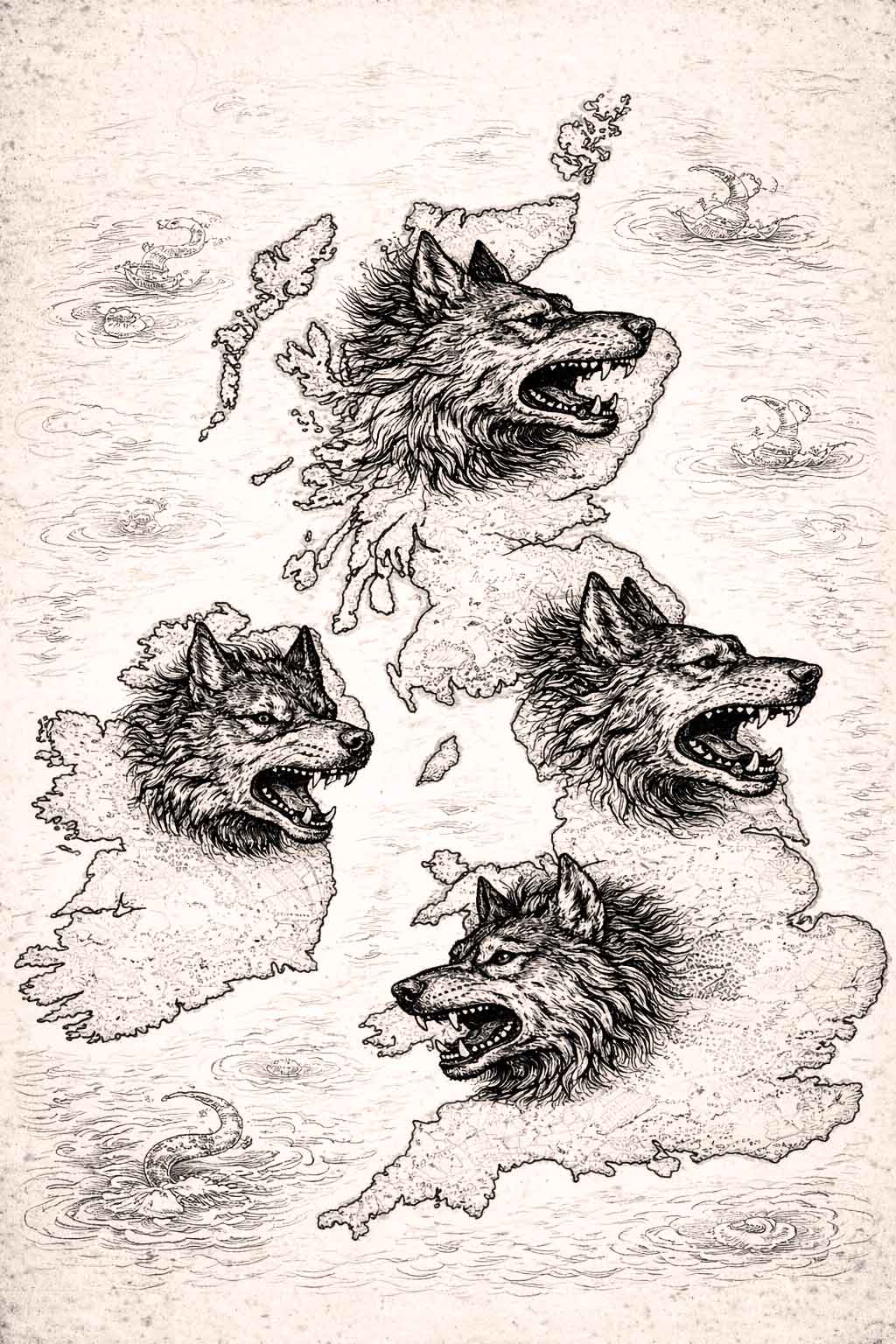
Even supposedly solid facts wobble when placed beside folklore. Modern historical writing generally places wolves extinct in England by the late medieval period, often around the early fifteenth century, while still acknowledging that precise “last kill” dates are hard to prove. A BBC overview repeats the accepted view that wolves disappeared from Wales by around the early thirteenth century, while showing how wolf place-names and local stories keep the animal present in memory. Meanwhile, newspapers and local tradition keep pushing later dates and sharper scenes, often dragging wolves forward into periods that feel almost modern.
That tension is the heart of the “last wolf” problem. Not only when did the last wolf die, but why does the date keep moving?
To understand that, it helps to start where the West’s wolf story begins: not in a British forest, but in Rome.
Romulus, Remus, and the two faces of the wolf
Rome’s founding myth is not merely wolf-adjacent. Romulus and Remus survive because a she-wolf nurses them. The wolf is danger, but also protection. It is feared, but it is also the creature that makes civilisation possible.
That double image matters because later British and Irish “last wolf” tales keep flipping it. In one set of stories, the wolf’s head becomes a trophy that proves the world is becoming safer. In another, the wolf becomes an ally or a guardian, almost a moral judge of the humans around it.
A striking inversion appears in the legends around St Edmund. In later tradition, Edmund’s severed head is found because a wolf guards it until it can be recovered. The wilderness becomes the custodian of a king. The wolf behaves better than the people who did the killing. That is the reverse of the “wolf head presented to the king” motif that appears elsewhere in folklore, where the wolf is reduced to proof of conquest.
This is the first rule of wolf stories. Wolves are rarely only wolves. They are instruments for talking about power, law, violence, and what kind of people emerge when the lights go out.
“Wolf-head” and the Saxon imagination
Long before anyone argues about the “last wolf”, the wolf is already embedded in the cultural architecture of the islands.
One reason wolves cling on in story is that they had a strong metaphorical life even when they were physically rare. Medieval and early modern writers used wolves to represent predation, outlaws, and the threatening edge of the world. In English legal language, the outlaw could be treated as a “wolf’s head”, a person outside protection, someone who could be killed without penalty. The wolf becomes a model for thinking about human violence.
This helps explain a recurring feature in newspaper material and local tradition: writers and readers often want wolves either in the distant past or in distant lands. If wolves belong to “back then”, modern Britain can feel innocent. If wolves belong to Hungary or Romania, modern Britain can feel safe without admitting what it took to make it so.
But the older Saxon and medieval motif is harsher. The wolf is not only a countryside menace. It is a template for how society imagines lawlessness.
Hillforts, enclosures, moats, and the architecture of fear
Once wolves exist in the mind as a constant pressure, they shape landscapes. Not always directly, not always as the main reason, but enough that the past is remembered as defensive.
Hillforts and enclosures were not only about human enemies. They also worked as practical boundaries for livestock. Farming is a calendar of vulnerability. Lambing season is an invitation to predators. Even later writers who romanticise wolves often concede the economic reality: wolves meant losses. Some clippings describe wages being paid to men to guard calves. Others speak of organised hunts and payments for wolf heads.
Over time, this hardens into a folk history of anxiety. Moats, walls, and wayside shelters become part of the wolf story even when they were built for mixed reasons. Folklore turns the landscape into a memory palace. The features that remain become evidence that danger once lived here.
The “last wolf” problem: the ending never matches the map
The “last wolf” is supposed to be a single moment: one beast, one death, one end.
Instead, the British and Irish record behaves like this:
- the last wolf dies in England, but also in Cornwall, and also on the Lake District fringe
- the last wolf dies in Scotland, but the honour is contested between clans, districts, and dates
- the last wolf dies in Ireland in Kerry in 1710, except when it dies later in Tyrone, Down, Sligo, or Leitrim
- the last wolf dies in Wales early, except when stories place the ending in Snowdonia’s remembered wild
This is not simply bad history. It is what happens when extinction unfolds unevenly. Wolves do not vanish like a switch. They shrink, fragment, retreat into rough country, and then retreat again into myth. What disappears first is everyday familiarity. What disappears last is story.
England: extinction as fact, survival as temptation
Historical summaries generally place wolves extinct in England by the late medieval period, often around the early fifteenth century. That is the accepted view in broad strokes, even if precise “last kill” dates are uncertain.
But folklore does not obey broad strokes. It likes sharp endings and named places.
Ludgvan near Penzance
A Cornish newspaper piece titled “The Last Wolf in England” claims that the last native wolf lived in the forests of Ludgvan near Penzance. It is described as a gigantic specimen that ravaged flocks. Tradition adds that it carried off a child, which could not be endured, so the peasants turned out and captured it at Rospeith, described as a farm name still existing in Ludgvan.
This reads like classic localisation. The terror is not abstract. It is attached to parishes and farms.
Lancashire traditions and the ballad-machine
A later feature, “Legend of the last wolf” in the Newton and Earlestown Guardian (1965), treats the last English wolf as a tradition rooted in North Lancashire. It places extermination “sometime between the reigns of Henry VII and Elizabeth I”, and then spins into aristocratic narrative: hunts, vows, rescues, marriages, coats of arms, and the scenery of the Lake District.
This is folklore doing what it does best. The wolf becomes a generator of names and identity. The animal provides a reason for memory to crystallise around a family, a place, and an emblem.
Humphrey Head, Ulpha, and “Lady Dub”
In a Lake District fringe clipping (Lytham Times, 1913), Ashford is said to be the village in which the last wolf was killed in England, though the writer pauses to admit it may be “mere tradition”. The same piece pivots to the Ulpha region, pointing out a pool called Ulpha’s Pool or Lady Dub, where a woman is said to have drawn in while escaping one of these animals.
This is landscape folklore at its purest. A pool becomes a fossil of fear. The story does not need proof to endure because the place remains.
Trawden Forest and the Wolf Stones
Another English texture appears in the Pennine uplands. A Nelson Leader (1956) piece refers to Bannister’s “Annals of Trawden Forest”, speaks of losses of stock through wolf attacks, and notes wages paid to men to guard calves. It then gestures to a boulder collection near Combe Hill, within Trawden Forest, known as Wolf Stones, said to have been a lair and hiding place in the dim past.
The voice is blunt. Wolves are destructive pests. The natural conclusion is extermination. This is the progress narrative.
The 1904 provocation
The Westminster Gazette “Nature and Science Notes” (1904) is important because it refuses to let the tidy ending stand. It frames the extermination date as uncertain and floats the provocative possibility that wolves might have survived longer than generally believed. It is exactly the kind of newspaper voice that encourages readers to push the “last wolf” closer to modernity.
Even if later survival claims are doubtful, their cultural function is clear. They shift extermination from “medieval” to “modern”. That shifts moral weight from “they” to “us”.
Wales: early extinction, late memory
A BBC overview repeats the accepted view that wolves disappeared from Wales by around the early thirteenth century. Yet it also shows how wolf place-names and “last wolf” traditions linger in the north, which is exactly where Wales looks wild enough to hold late memory.
A Snowdonia fragment in the Morning Leader (1897) drops a single line that does a lot of work: “We had seen where the last of the Welsh wolves were killed.” It places this claim amid dramatic topography: the saddleback ridge, Clogwyn Du’r Arddu rising as a black precipice, and the deep hollow of Cwm Glas.
The same passage also mentions having seen where Britons beat the Romans, then where Britons made a final stand and were beaten. Even if the precise battle identification is uncertain, the structure is perfect. Snowdonia becomes a stage where defeat and survival are layered into one walk. Britons versus Romans. Then wolves versus humans. The mountain holds both.
Wales offers the wolf story something it always needs: a believable place for survival, even when the accepted extinction date is early. Mountains are where the imagination insists animals lasted longer.
Scotland: contested honours, hard knives, and stones that fix stories
Scotland is where “last wolf” folklore turns competitive. Newspaper clippings repeatedly show the honour contested between clans and districts, with different endings pinned to different places.
Several major motifs repeat.
Sir Ewen Cameron of Lochiel, 1680
One set of tradition places a “last wolf” killing in 1680, credited to Sir Ewen Cameron of Lochiel. This appears in short newspaper summaries and in longer articles that treat the Lochaber claim as a serious competitor for “the last”.
MacQueen of Polloc-haugh and the Findhorn drama, 1743
Another powerful tradition places the last wolf in Morayshire in 1743, tied to a dramatic tale on the Findhorn. A wolf kills two children. Alarm spreads. A chief gathers his men at grey dawn. One trusted man fails to appear, then turns up dishevelled. He throws back his plaid, reveals the bleeding head, lays it at the chief’s feet, and jokes that it would have ill become Clan Mackintosh to need more than one man to dispatch one wolf. Some versions add the vivid detail that he buckled with the beast and dirked it, then whittled its neck for fear it might rise again.
This is folklore’s preferred ending. Intimate violence. A knife. A head presented as proof. The last wolf dies in a way that feels like myth rather than administration.
“Neeps and tatties”
A separate Scottish motif is smaller and more domestic: a girl escapes because she drops her “neeps and tatties”, the wolf takes the easy meal, and she runs. It is not a heroic hunt. It is ordinary life brushing against predation. That is part of why it sticks.
Polson, Sutherland, and the memorial stone at Lothbeg
Then there is the story that tries hardest to become geography. A Northern Times (1924) snippet describes a granite stone at Lothbeg near Brora erected to mark the place where the last wolf in Sutherland was killed by the hunter Polson in or about the year 1700. Another piece claims Langwell in Caithness is renowned as the spot where the last wolf in Britain was killed in the eighteenth century, again by Polson, in a cave, ending by stabbing.
This is folklore behaving like infrastructure. Once a stone exists, the story gains a weight that paper arguments struggle to rival.
Dionard, the cave, and the man who could not shoot
A Highland News (1929) article titled “The Last Wolf in the Highlands” offers a different emotional register. A shooting tenant in Sutherland loses his way in thick mist, finds a cave in the valley of Dionard, makes a fire, and falls asleep. He wakes at one o’clock to clear weather and senses something watching. He sees a great white form near the embers and loads his gun, but cannot bring himself to shoot. He throws food. He tries a ham sandwich. He offers gorgonzola, which the animal rejects with repulsion. The creature rises. It is a great silver-grey female wolf. In her eyes he reads loneliness and misery.
Whether this is zoologically true is not the only point. It shows a cultural turn. By the twentieth century, writers could make the wolf a figure of loss rather than a pest. The hunter becomes the intruder. The last wolf becomes the displaced remnant of an older Scotland.
“The last wolf is still at large”
Even humour joins the chorus. A Dundee Courier (1936) piece jokes that the last wolf is still at large, just going under the name of an Alsatian, after a poultry-farm massacre. The joke only works because the wolf remains a living explanation even after extinction.
Ireland: wolves, war, and the rebel-in-the-woods
Ireland’s wolf story is tightly knotted with conflict. Wolves survive longer in both record and tradition, and the reasons given are rarely “because nature”. They are political.
Irish discussion often links wolves to upheaval, plantations, and war. Forests, bogs, and hills become refuges for both rebels and predators, so wolf-hunting slips easily into the language of pacification. This is where the Cromwell motif enters, with later accounts describing a policy environment that treated wolves as a threat to be systematically removed, often through bounties.
The newspaper material shows the Irish ending scattered across counties and dates.
Kerry, 1710
A Portadown Times (1964) snippet, citing Basset’s “County Armagh” (1888), repeats the neat line: “The last wolf seen in Ireland was killed in Kerry in 1710.” That is the sort of sentence later summaries love because it finishes the story.
Tyrone, 1770
A Belfast Telegraph (1934) letter asks for particulars regarding a claim that the last wolf was killed in County Tyrone in 1770, noting that the location and date have been ascribed to various places. This is a useful reminder. Even when a claim is printed, it can be a prompt for evidence rather than evidence itself.
Down and the Warringtown tradition
A Northern Whig (1867) piece titled “The Last Wolf in Ireland” lays out a more elaborate tradition centred on Warringtown in County Down. It ties the story to family memory, speaks of a wolf killed in a stable, and treats this as potentially the last recorded appearance, while also admitting how hard it is to pin down.
Sligo, Leitrim, and the named wolf-killers
A Sligo Champion (1946) article embraces tradition openly, almost as a philosophy. It describes a carved stone at Ardnaglass Castle that looks like two animals locked together and it retells a Leitrim story of an infamous wolf. In that telling, a local chief O’Dowd of Tireragh has a famous wolf-dog. The dog and wolf are locked together in the fight. Place-names hold the memory, including a “quarter-land of the dog”.
These are the Irish equivalents of Scotland’s memorial stones. Geography becomes the filing system for the story.
So when did the last wolf die?
There is no single uncontested “last wolf” date for any of these countries. There are accepted ranges, and there are traditions that refuse to stay within them.
England
Accepted view: wolves extinct by the late medieval period, commonly placed around the early fifteenth century, though exact final killing dates are uncertain.
Newspaper and folklore claims: Ludgvan near Penzance, Ashford and Ulpha’s Pool, Lancashire ballad traditions, and provocative suggestions that survival might have been later than assumed.
Wales
Accepted view: wolves gone by around the early thirteenth century.
Folklore: “last wolves” remembered in Snowdonia, where the landscape looks like the right hiding place for a late survivor, even if the accepted date is early.
Scotland
Traditions cluster: late seventeenth to eighteenth century.
Key competing endings include Lochaber (1680, Sir Ewen Cameron), Morayshire (1743, MacQueen), and Sutherland (around 1700, Polson, with a memorial stone at Lothbeg). Some twentieth-century writing even toys with later sightings.
Ireland
Commonly repeated ending: early eighteenth century, with Kerry 1710 frequently repeated.
Competing claims: Tyrone 1770, Down traditions into later periods, and regional stories in Sligo and Leitrim that keep the wolf alive in local memory.
Why the “last wolf” keeps moving
Three pressures keep bending the story.
The last wolf must die where the land still looks wild
This is the Celtic fringe effect. Cornwall. Snowdonia. Sutherland. The Mournes. The Highlands. The story wants a landscape that still feels like it could hide something.
The last wolf must die in a way that feels old
The knife matters. The plaid and dirk. Wrestling in a glen. A cave. These details are not only about accuracy. They make the ending feel like myth.
The last wolf must carry a moral
Sometimes the moral is progress: calves are guarded, pests are exterminated, travel becomes safer. Sometimes the moral is loss: the last wolf is lonely, and the human cannot shoot.
Across the clippings, there is a visible cultural turn. Earlier voices often celebrate extermination. Later voices sometimes grieve it.
Wolves abroad: Hungary, Romania, and the comfort of distance
By the nineteenth century, British readers often preferred wolves to belong somewhere else. Central and Eastern Europe becomes the stage where wolves remain real enough to be frightening. Reports of attacks in Hungary and Romania do more than provide shock. They provide psychological relief. If wolves kill in far-off forests, Britain can imagine itself as safely modern.
Yet the fascination gives the game away. Wolves keep returning in print because the animal remains unfinished business. The “last wolf” story ends the physical wolf, but it does not end the wolf-shaped hole in the culture.
After the wolf: ecology, fear, and the most dangerous animal
When the last great predator is removed, something changes. Folklore sensed that long before ecology measured it. Predators shape prey behaviour, vegetation patterns, and the feel of a landscape. Remove the wolf and it is not only an animal that disappears. A set of pressures disappears with it.
This is why “last wolf” stories cling to place. They are not only nostalgia. They are a kind of moral accounting. They ask what was gained, what was taken, and whether the price was properly understood.
The last wolf is always dying in story. The wolf is never quite gone.
This Topic
British Folklore, Superstition and the Uncanny
Ghosts, omens, witch-lore, monsters, charms, strange weather, and the persistent afterlife of folk belief.
View Topic PageMore in this Topic
7 March 2026
The Wandering Fire - A History of Ball LightningLatest Posts
27 March 2026
Hot Cross Buns: History, Origins & FolkloreDiscover the fascinating history of hot cross buns - from pagan offerings and Greek sacred bread to Chelsea bun houses and Good Friday folklore. Explore 2,000 years of spiced bread tradition.
22 March 2026
What Does "Ne'er Cast a Clout Till May Be Out" Actually Mean?Is it about the month of May or the hawthorn flower? And what on earth is a clout? We dig into 170 years of British newspapers to finally answer one of folklore's most argued questions.
20 March 2026
The White Hart: The Ancient Legend Behind Britain's Most Common Pub SignFrom Greek mythology to medieval forest law, the white deer haunted the British imagination for centuries. Discover the real history behind the legend of the White Hart — royal badge, supernatural omen, and elusive quarry of the soul.
13 March 2026
Why Is a Horseshoe Lucky? The Surprising History Behind the World's Most Universal CharmThe horseshoe has been nailed above cottage doors, cathedral gates, and battleship masts for centuries. Discover the ancient beliefs in iron, the crescent moon, and the sacred horse that made it the world's most enduring good luck symbol.
12 March 2026
Saint Piran of CornwallPiran - patron saint of Cornwall, tin miners and the Cornish flag — from Irish origins to the buried oratory's remarkable 2014 excavation.
10 March 2026
Clare Island - Isle of Storms, Pirates and Naturalists: A History in Newspaper Voicesiscover the fascinating history of Clare Island, off the coast of Mayo - from the piratical legend of Grace O'Malley and bitter land disputes to a landmark natural history survey, told through contemporary newspaper voices spanning 1863 to 1986.