Unlucky 13: The Real History Behind Friday the 13th and the Number Thirteen
Written by David Caldwell ·
If you ask most people today which day is the unluckiest, they’ll give the answer without thinking Friday the 13th.
We dodge it for weddings, operations, house moves. Films, novels and tabloid spreads all treat it as a kind of ready-made curse. It feels timeless.
But when you start digging into older sources, the picture gets much stranger.
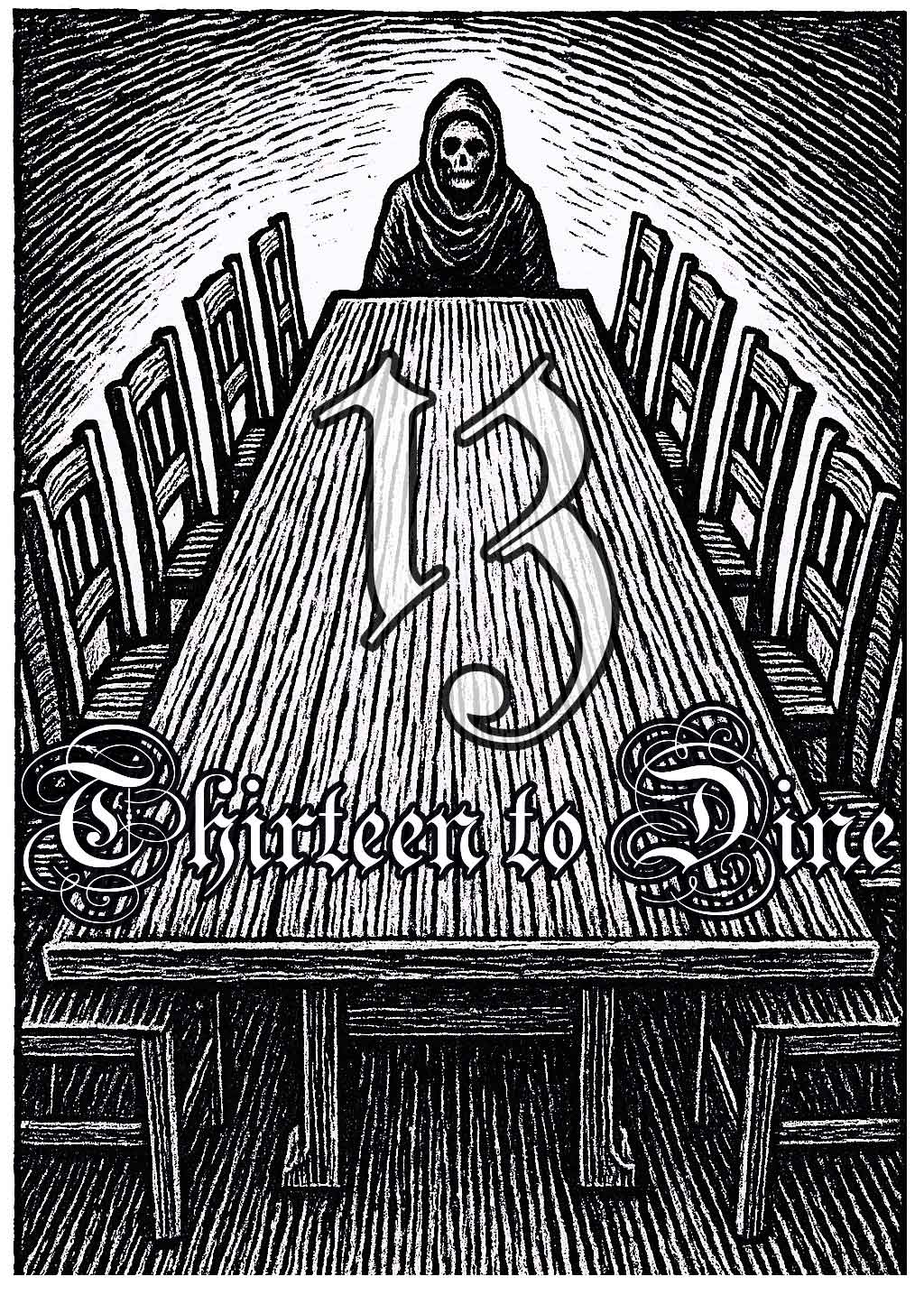
Thirteen to dine: the old superstition that one of thirteen at table must die within the year
In newspaper archives, you can find hundreds of nineteenth-century articles about unlucky thirteen, and plenty about unlucky Fridays. Yet for most of that period, Friday the 13th itself is… a complete non-event. In fact, it regularly turns up as a perfectly ordinary - and even popular - day for horse racing and other public entertainments.
What we seem to be looking at is not a single ancient superstition, but a braided myth:
- Old fears about Fridays
- Older and very widespread fears about thirteen
- A late-Victorian / early twentieth-century decision to bolt the two together, and then
- A modern rebranding of Fridays as “Feel-Good Friday”, with the bad luck squeezed into one or two dates a year.
This article traces that evolution: from unlucky dinners to unlucky dates, from fast days to TGIF, and from obscure club jokes to global horror brand.
Thirteen: the troublemaker before Fridays got involved
If we roll the clock back, thirteen has its own long and colourful history well before anyone worries about calendars.
Thirteen at a table
For centuries the classic anxiety is thirteen at table. That’s the superstition your nineteenth-century newspapers can’t stop talking about.
We meet it everywhere:
- A Parisian called Ambroise Fortin advertises himself on a brass doorplate as “Fourteenth”. His entire profession, reported in 1848, is to sit at home between six and eight in full evening dress, waiting to be summoned to swell a party from thirteen to fourteen.
- In one well-repeated anecdote, the singer Madame Catalani notices there are thirteen at dinner and promptly exiles a French countess upstairs until a latecomer arrives - at which point the countess is brought back down like a human spare chair.
- Count Orloff, dining abroad with members of the Narishkin family, refuses to sit at all and wanders from chair to chair rather than be the thirteenth person and trigger a walk-out.
Things get darker in rural stories. A Wiltshire rent-audit dinner in the 1910s happens to number thirteen; within days one tenant dies. At the next half-yearly audit, again there are thirteen diners; again, one falls ill and dies shortly after. The local paper solemnly notes how “forcibly” this recalls the superstition.
Other pieces take a more mocking tone. A London “Thirteen Club” and their cousins in New York and Paris delight in:
- dining in groups of thirteen
- walking under ladders
- crossing knives and spilling salt
- decorating the room with skulls and mock-funeral paraphernalia
Their entire act only works because the audience already knows the rule: thirteen at table = bad.
Why thirteen?
But why did thirteen get this reputation?
Nineteenth- and early twentieth-century writers offer a bundle of overlapping explanations:
1. Beyond twelve: the number that doesn’t fit
Essayists like Charles Platt (summarised in the Rochdale Observer in 1926) argue that early people simply “stopped at twelve”.
- Twelve months
- Twelve hours of day and night
- Twelve signs of the zodiac
- Twelve tribes, apostles, Olympians…
Twelve becomes the unit of completeness. Thirteen, in this telling, isn’t so much a number as a blur past the edge: “three-ten”, “one more than enough”, a vague quantity that early counters never really used.
Because the unknown feels dangerous, thirteen picks up an aura of being fateful - not necessarily evil, but full of unpredictable possibilities. If twelve means order, thirteen becomes the little rip in the fabric.
That, Platt says, is why we still half-consciously stop our multiplication tables at “twelve times twelve”: a fossil of an older instinct about where numbers “ought” to end.
2. Mythic banquets: Loki and Judas
Popular writers pull in two big mythological feasts:
- In Norse myth, twelve gods feast peacefully in Valhalla until Loki, the uninvited trickster, turns up and insists on joining them as the thirteenth. He provokes an argument and engineers the death of the radiant god Balder. A number of British pieces in the early 1900s repeat this story as “the” origin of unlucky thirteen at table.
- In Christian tradition, the Last Supper adds a second layer. Christ plus the twelve apostles make thirteen; within hours, one (Judas) betrays, and another (Christ) is dead. Victorian columnists constantly point the finger at this scene as the source of the dinner-party taboo.
Sometimes the Christian and pagan strands are even woven together in the same paragraph: Loki and Judas, Balder and Christ, two sacrificial deaths echoing each other across time.
3. Judas, red hair and spilled salt
Around Judas a whole thicket of folklore grows.
A 1916 Reading Observer article on “Legends of Judas” collects beliefs that:
- Judas had red hair and beard, giving us phrases like “Judas-coloured”.
- In Leonardo’s Last Supper, Judas is painted as the one spilling the salt.
Salt in older European symbolism stood for friendship and incorruptibility. To share bread and salt with someone was to seal a bond; to overturn the salt cellar at their table suggested enmity or broken trust. So spilling salt becomes another omen of treachery and bad luck. The familiar remedy - throwing a pinch over the left shoulder to blind the devil behind you - is still in use today.
Leonardo’s painting, widely reproduced, probably did as much as any sermon to fix the visual association: thirteen at table, one traitor, scattered salt.
4. Calendars and the thirteenth month
A more esoteric theory, printed in the Roscommon Herald in 1922, reaches back to ancient calendars:
- The solar year gives you twelve months.
- The lunar year gives you roughly thirteen.
Some commentators in the early twentieth century tried to root this unease in the history of calendars. They pointed out that many ancient Near Eastern peoples, including the Israelites, used lunar calendars with an occasional thirteenth “intercalary” month to keep in step with the solar year. When later systems standardised on a neat twelve-month cycle, the dropped thirteenth month could be imagined as a kind of numerological ghost - an extra piece that no longer fit the official year, and so came to feel like an intruder.
One 1922 newspaper article pushed this much further, claiming that “in old Hebrew numeration the sign for thirteen was identical with the sign for ‘death’.” Modern scholarship is clear that this is false: Hebrew uses letters for numbers, 13 is simply written as 10+3, and in Jewish tradition the number 13 is generally positive, associated with the age of bar mitzvah, the 13 Attributes of Divine Mercy and the oneness of God. The fact that a Christian writer felt able to assert the opposite - turning Hebrew into a source of hidden death-symbols - tells us more about later attempts to justify the superstition (and about casual prejudice) than it does about ancient Judaism.
5. Houses, hotels and the missing number
Unlike some superstitions, this one leaves material traces.
- In Florence, nineteenth-century reporters note streets where house numbers run 11, 12½, 14, neatly dodging 13.
- Roman landlords supposedly struggle to let properties numbered 13; house-hunters avoid them.
- A Nottingham paper in 1909 describes English streets where 13 is simply omitted or relabelled “11a”. The writer notes drily that a landlord who insists on using the number is “courting loss”.
- Hotels do the same game vertically: no room 13, or no thirteenth floor. The room exists, but the brass figures on the door read 14. The bad luck sticks to the numerals, not the bricks.
By the early twentieth century you even get letters to the editor protesting that railway companies and councils have begun “abolishing” the number 13 in their numbering schemes. “What has the poor little number done,” demands one exasperated correspondent, “that it should be hounded out of Britain?”
6. Thirteen as lucky - depending where you stand
To complicate things further, not everyone agrees thirteen is unlucky.
Some of your clippings note that in Italy, thirteen is positively lucky in lotteries. Gamblers will back 13 and its multiples and even wear charms with the number.
In the old tarot, the thirteenth trump is the card of Death, which looks ominous, but in some traditions, death is a symbol of transformation and can be read positively. A 1930s lecture on playing cards points this out as a possible root of people’s uneasiness about thirteen - but also hints at the ambiguity.
Across the Atlantic, early America leans into thirteen as a kind of patriotic mascot:
- Thirteen original states
- Thirteen stripes
- Thirteen letters in E Pluribus Unum
- Thirteen-gun salutes when Washington raised the new flag
So even before Fridays enter the story, thirteen is already a contested symbol: cursed at the dinner table, dodged in street plans, cherished in lotteries and flags, lurking on the Death card.
Fridays: bad luck day long before the weekend
All of that is happening while Fridays have their own unlucky history.
Long before anyone talks about “Friday the 13th”, Friday is:
- the day of the Crucifixion in Christian tradition
- a routine fasting and penitential day
- widely avoided for the start of journeys, marriages and new ventures
Medieval and early modern writers drop hints about this general distrust. In English proverb lore, you find Friday treated as a day when “ill luck will surely attend” anything begun.
By the nineteenth century:
- Italian reports say many people will sign no contracts on Friday, nor light three candles.
- Sailors are famously wary of launching ships on a Friday. Even if you strip away the tall tales, maritime folklore is full of warnings about that day of the week.
- A striking 1890s essay in The Queen lists a whole string of superstitions and concludes, almost in passing, “Friday [is] always unlucky…”
Notice, though, what’s not happening yet.
For most of the period you’ve searched, Friday is unlucky as a category, and thirteen is unlucky as a number, but newspapers are perfectly happy to advertise:
- race meetings
- markets
- theatre openings
…all happening on Friday the 13th, with no comment at all. It’s just another Friday.
If you run a phrase search in a newspaper archive for “Friday the 13th” plus “unlucky”, you get:
- only a handful of hits before 1900
- a jump to nearly 300 between 1900 and 1949
- over 600 between 1950 and 1999
Given how many millions of pages that represents, the near absence in the nineteenth century is telling. For most people then, the unlucky thing is Friday itself, not the thirteenth Friday.
Early collisions: when Friday and 13 start to meet
So when do they get combined?
Modern summaries often point to three types of early source:
1. French literary references (1830s)
In the 1830s, French writers are already joking about the coincidence of the two superstitions.
- In the Revue de Paris, an anecdote about a Sicilian nobleman includes the lament that “it is always Fridays and the number 13 that bring bad luck!” - pairing them in the same breath.
- In the play Les Finesses des Gribouilles, a character blames all his misfortunes on having been “born on a Friday, 13 December 1813”.
But here they’re still treated as two separate curses that have happened to collide in a particular life, not yet as a fixed rule that any Friday the 13th is ominous.
2. Rossini’s death (1868/1869)
The Italian composer Gioachino Rossini died on Friday 13 November 1868. A year later, British journalist Henry Sutherland Edwards published his biography and couldn’t resist this little flourish:
“If it be true that, like so many Italians, he regarded Fridays as an unlucky day and thirteen as an unlucky number, it is remarkable that on Friday 13th of November he passed away.”
Again, Edwards is marvelling at the double coincidence for a man known to dislike both Fridays and number 13. He isn’t telling his readers, “this date is generally feared”; he’s saying, “isn’t it spooky that his death lined up with his own superstitions?”
Still, little observations like this are important. They show that by the late nineteenth century, people are noticing when a Friday and a 13 align - and filing that away as meaningful.
3. The Thirteen Club (1880s-1890s): turning a murmur into a meme
The real catalyst, though, seems to be the Thirteen Club.
Founded in New York in 1880, this was an organisation dedicated to:
- dining in groups of thirteen
- walking under ladders
- breaking mirrors
- spilling salt
- and, crucially, holding their banquets on Fridays - “Friday the 13th” where possible.
By the late 1880s and 1890s, British newspapers are running amused pieces on the club’s antics. One 1890s column notes that they prefer to dine on Friday the 13th, passing under a ladder before sitting down and habitually spilling salt. A 1894 essay in The Queen lumps it all together in a single line: “Friday always unlucky, especially Friday the Thirteenth.”
Two things are happening here:
- The club is deliberately welding already-existing fears - unlucky Friday and unlucky thirteen - into a single, maximum-bad-luck package.
- The British press is treating “Friday the Thirteenth” as a phrase the reader will already understand, at least vaguely.
It’s not that the Thirteen Club invented the myth. But they gave it a name, a ritual and a story, and got those stories reprinted thousands of miles away.
How disasters “prove” the superstition
Once that combined idea exists, it becomes a magnet for confirmation bias.
We can watch it working in real time:
- Rossini’s death in 1868 is retro-framed as ominous because he disliked Fridays and the number 13.
- A terrible Midland Railway accident in the early 1900s, with thirteen deaths, is said to have given the “thirteen” superstition “renewed vitality” in Britain; newspapers made much of the number.
- The steamship Sardinia, owned by the Ellerman-Papayanni line, catches fire after leaving Malta and drifts onto rocks; over 120 people die, including the captain who tries to beach her. A 1908 illustrated report notes that she was to have sailed on Friday 13 November, but the date was postponed because sailors thought it unlucky. The implication is clear: you can’t cheat fate.
Every time such a coincidence occurs, the narrative thickens:
- We remember the hits (the Rossinis, Sardinias, crashes, sudden deaths).
- We completely ignore the vast number of normal Friday the 13ths where nothing at all happens, and the Jacobite disasters, plagues and battles that happened on boring Wednesdays.
By the early twentieth century, British papers are noticing, cataloguing and reprinting “Friday the 13th” stories precisely because their readers now recognise the hook. A date that was once just a scheduling detail has become part of the drama.
From dining room to diary: the superstition moves house
Putting this together, we can see a clear shift.
Phase 1: Thirteen lives at the table
In the eighteenth and nineteenth centuries, the fear around thirteen is overwhelmingly about:
- thirteen at table, and
- thirteen as a label (house number, room number, hotel floor).
Horoscopes, tarot cards and numerologists give it extra texture, but when ordinary people fret, they fret about seating plans and door numbers, not calendar squares.
Phase 2: Friday carries the weight
In the same period, Friday carries its own freight of misfortune:
- day of the Crucifixion
- day of fasting and abstinence
- “bad day to start anything”
- “hangman’s day” in popular memory
People avoid Fridays in general for contracts, journeys, weddings, sailings - not Friday the 13th in particular.
Phase 3: The two get married (late 19th / early 20th century)
Then, in a relatively short window:
- French writers play with the coincidence,
- Rossini’s death is framed as an example,
- the New York Thirteen Club turns “Friday the 13th” into a ritualised stunt date,
- British magazines like The Queen talk about “Friday always unlucky, especially Friday the Thirteenth”,
- and accidents like the Sardinia fire and high-profile train wrecks provide macabre illustrations.
- Before 1900 - almost no explicit linking of “Friday the 13th” as such with bad luck. Lots of Friday superstition; lots of thirteen superstition; the combination is rare and newsworthy.
- 1900-1949 - mentions of “unlucky Friday the 13th” explode into the hundreds.
- 1950-1999 - the phrase is everywhere.
By this point, the dread has migrated. As one neat way to put it:
Nineteenth-century Britain feared thirteen in the dining room; twentieth-century Britain learned to fear it in the diary.
The redemption of Friday: from penance to “Feel-Good Friday”
There’s another twist to the story: Friday itself changes character.
In a pre-industrial world, Friday is a religious fast day and a folk “bad-luck day”. In a post-industrial world, it becomes the gateway to the weekend.
Industrial time and the birth of the weekend
As industrialisation standardises work, time gets chopped into a five- or six-day working week plus rest days. Over the late nineteenth and early twentieth centuries:
- Six-day weeks with Sunday off are common.
- Reformers and unions push for shorter hours and two rest days.
- In 1926, Henry Ford adopts a five-day, forty-hour work week at his company without cutting pay. Other firms follow.
Once the pattern Monday-Friday work, Saturday-Sunday off becomes normal, the emotional meaning of the days is rewired:
- Monday: back to the grind
- Wednesday: “hump day”
- Friday: last day of work, often payday, and the eve of your only real block of free time.
No wonder Friday starts to get rehabilitated.
TGIF and the Friday “glow”
The language reflects this shift:
- By 1904, a New York magazine runs an article titled “Thank God It’s Friday,” already treating Friday as a day of relief after drudgery.
- By 1946, the acronym TGIF - “Thank God / Goodness It’s Friday” - is recorded as American slang.
- In 1965, a New York bar is opened and named TGI Friday’s, explicitly trading on that feeling of end-of-week freedom.
By the late twentieth century, you get:
- “Feel-Good Friday” features on radio
- office “dress-down Fridays”
- “Friday feeling” in adverts
- songs like “Friday I’m in Love”
For millions of workers, Friday is no longer a day of death, fasting and bad omens, but the start of their only guaranteed leisure space.
So what happens to the old unease?
It doesn’t disappear; it’s compressed. Most Fridays get to be fun. One or two Fridays a year - the ones that happen to fall on the 13th - are left to carry the last of the old dread.
Friday is redeemed as a whole, and Friday the 13th becomes the designated “bad” one.
Friday the 13th today: an old fear in new clothing
Put all this together and the modern picture looks something like this:
- Thirteen has been a loaded number for a very long time - linked to incomplete cycles, dangerous “extra” guests, mythic deaths and awkward leftovers in our numerical systems.
- Fridays have been unlucky days in Christian Europe for centuries - bad days to begin things, marked out by the Crucifixion and by custom.
- For most of that time, the two superstitions run in parallel. Friday the 13th is not special; it’s just a day when a fast day and a disliked number accidentally coincide.
- In the late nineteenth century, literary winks, biographical coincidences and the provocations of groups like the Thirteen Club start to fuse the two ideas into one.
- In the early twentieth century, a handful of dramatic events that happen to land on Friday the 13th, plus novels and press stories, give this new hybrid superstition mass media traction.
- At the same time, industrial working patterns and the creation of the weekend transform Friday from a naturally “bad” day into a naturally good one - pushing the lingering unease into a single date, which is easier to fear without giving up the joy of “Friday feeling”.
So, is Friday the 13th an ancient curse? Not really.
It’s better understood as a modern packaging of much older anxieties:
- the fear of stepping outside a complete cycle
- the fear of starting something on a solemn day
- the human habit of remembering coincidences and forgetting all the times that nothing happened
- and, more recently, the need to keep a thrilling little pocket of doom in an otherwise secular, industrial week.
If there’s a lesson in that, it’s this: our “ancient” fears are often much younger than we think. But once a date gets enough stories stuck to it, it doesn’t really matter how new it is.
We mark it on the calendar. We look up at the sky. We watch the headlines a little more closely. And in doing so, we quietly write the next chapter of the superstition ourselves.
This Topic
British Folklore, Superstition and the Uncanny
Ghosts, omens, witch-lore, monsters, charms, strange weather, and the persistent afterlife of folk belief.
View Topic PageMore in this Topic
7 March 2026
The Wandering Fire - A History of Ball LightningLatest Posts
27 March 2026
Hot Cross Buns: History, Origins & FolkloreDiscover the fascinating history of hot cross buns - from pagan offerings and Greek sacred bread to Chelsea bun houses and Good Friday folklore. Explore 2,000 years of spiced bread tradition.
22 March 2026
What Does "Ne'er Cast a Clout Till May Be Out" Actually Mean?Is it about the month of May or the hawthorn flower? And what on earth is a clout? We dig into 170 years of British newspapers to finally answer one of folklore's most argued questions.
20 March 2026
The White Hart: The Ancient Legend Behind Britain's Most Common Pub SignFrom Greek mythology to medieval forest law, the white deer haunted the British imagination for centuries. Discover the real history behind the legend of the White Hart — royal badge, supernatural omen, and elusive quarry of the soul.
13 March 2026
Why Is a Horseshoe Lucky? The Surprising History Behind the World's Most Universal CharmThe horseshoe has been nailed above cottage doors, cathedral gates, and battleship masts for centuries. Discover the ancient beliefs in iron, the crescent moon, and the sacred horse that made it the world's most enduring good luck symbol.
12 March 2026
Saint Piran of CornwallPiran - patron saint of Cornwall, tin miners and the Cornish flag — from Irish origins to the buried oratory's remarkable 2014 excavation.
10 March 2026
Clare Island - Isle of Storms, Pirates and Naturalists: A History in Newspaper Voicesiscover the fascinating history of Clare Island, off the coast of Mayo - from the piratical legend of Grace O'Malley and bitter land disputes to a landmark natural history survey, told through contemporary newspaper voices spanning 1863 to 1986.