The Hole of the Rain: Myths of Lake Bala and the Welsh Dream of Patagonia
Written by David Caldwell ·
The hole of the rain
If you stand in Bala on a wet September afternoon, you quickly understand why people in North Wales jokingly call the town twll y glaw - the hole of the rain.
A visiting German scholar in the 1870s wrote that it seemed to rain there in every imaginable way. Sometimes it poured as if someone had tipped halberds from the clouds, sometimes it fell in long ropes. He would be tempted out by a shy ray of sun, wander along the lakeshore, and come back soaked to the skin.
Just beyond the town spread the waters that shape everything here: Llyn Tegid, usually called Bala Lake. The town’s own name, Y Bala, means "the outfall", the place where the waters leave. That sense of being a lip or threshold runs through the whole story of Bala. Water does not simply sit in the landscape. It flows, overflows, swallows and sends people away.
The German visitor heard at once that the lake hides an engulfed town, that a crocodile-like creature once broke its banks and started the Flood, and that the little castle mound at the edge of town is really Mount Ararat in disguise. He smiled at the impossible details, but he wrote them all down. For the people who lived here, those tales were simply part of how you understood the lake.
If you want to see why Bala eventually launched people across the Atlantic to start again, you have to start with that water.
A sacred river and a Roman road
Llyn Tegid is the largest natural lake in Wales. Along its middle locals say you can sometimes see a narrow silver band, a slightly different shimmer that runs from one end to the other. That band is said to be the River Dee passing straight through the lake without mixing, entering at Llanuwchllyn and sliding out again beneath the bridge at Bala.
In Welsh the river is called Dyfrdwy. Old explanations hear in that name dwr Duw - the water of God. For centuries writers spoke of the "Sacred Dee" and treated it as a river with a life and character of its own. Along its banks people swore oaths, made offerings and told stories about how its level foretold the fate of kings.
Follow the Dee downstream and you reach a very different world. The Romans built the fortress of Deva Victrix at its mouth, where the river widens towards the sea. Today you know it as Chester. From there a paved military road ran up into the Welsh hills. One branch passed close to the Bala valley, with a small fort at Caer Gai near the southern end of the lake.
Archaeology shows that Caer Gai held a garrison of auxiliary troops and a scatter of workshops and civilian houses. You can imagine soldiers tramping along the road, crossing the Dee, glancing at the long dark lake to their right. To them it was a supply route and a defensive line. To later generations it became the childhood home of Cai Hir, Sir Kay of Arthurian legend. Roman stone turned into Arthurian myth, because in Bala almost everything eventually does.
Cauldrons, bards and a witch on the shore
Long before anybody preached here in black frock coats, people were already telling spiritual stories about the lake.
One of the richest is the tale of Ceridwen. Medieval Welsh texts place her household on the shore of Llyn Tegid with her husband Tegid Foel, Tegid the Bald, whose name still clings to the lake. They have two children: the beautiful Creirwy and her brother Morfran, who is deformed and slow-witted. To compensate for her son’s misfortune, Ceridwen decides to brew a cauldron of inspiration.
She sets the pot over a fire by the lake, fills it with herbs and water, and commands a boy named Gwion Bach to stir it for a year and a day. At the end of that time, three drops will rise to the surface. Anyone who tastes them will gain poetic genius, prophecy and all knowledge. The rest of the brew will be poisonous.
On the final day three drops spit onto Gwion’s thumb. He sucks the burn without thinking. Instantly he understands what has happened. Terrified of Ceridwen’s anger, he runs. She sees his theft and pursues him.
What follows is a whirlwind chase through the Welsh landscape. Gwion turns into a hare, Ceridwen becomes a greyhound. He dives into a river as a fish, she follows as an otter. He bursts into the air as a bird, she sweeps after him as a hawk. Finally, exhausted, he drops to the ground as a grain of wheat. Ceridwen transforms into a black hen, pecks him up and swallows him.
Months later she gives birth to a shining child. The boy’s radiance softens her fury. She cannot bring herself to kill him. Instead she sews him in a leather bag and sets him adrift on the water of Llyn Tegid. He floats downriver until he is caught in a salmon weir and found by a prince. Given the name Taliesin, "radiant brow", he grows into the greatest bard of Wales.
Later religious writers, working in Latin cloisters, took this lake-child seriously enough to slot him into their histories. In one Victorian essay on Llancarfan, the author states calmly that Taliesin, son of Tegid Foel and Ceridwen, spent much of his early life in the monastery there. A story of shape-shifting and witchcraft that begins on the shore of Llyn Tegid ends in the company of Christian saints and moralists.
Whether you treat Ceridwen as goddess, witch or symbol of creative power, her cauldron leaves a mark on the lake. The water becomes a kind of womb, a place where identities dissolve and reform, where inspiration is equal parts gift and danger.
Flood, afanc and the town under the water
When the German visitor looked for stories about Bala, he did not have to look far.
One tale, explained to him with a straight face, said that the biblical Flood itself began here. The culprit was the afanc, a monster said to be part crocodile and part beaver that once lived in Llyn Tegid. Thrashing in anger, it broke the banks of the lake and loosed the waters. In old triads a hero named Hu Gadarn hauls a similar beast out of its lair with four enormous oxen, saving the land from drowning. At Bala that myth is firmly nailed onto this particular body of water.
The same people told him that the small earthen castle mound on the edge of town, Tomen y Bala, was really Mount Ararat. The ark, they said, came to rest on it when the floodwaters went down. The visitor, a man who took measurements seriously, noted that the mound is only about thirty feet high and gently pointed out that such a flood would have to have shrunk considerably by the time it left the ark high and dry on that modest hill. His arithmetic did nothing to dent the tale.
Closely tied to this is the tradition of the drowned town. Locals insisted that a settlement once stood on the site of the lake. The details vary, but the ending is always the same.
In one version, a well in the middle of the town had to be sealed every night. One evening the man responsible went drinking and forgot. Water surged from the open mouth all night. People in the lower houses woke to find their floors awash and bolted for the hills. By dawn the valley had become a long, black sheet of water. When the villagers looked down from safety, their homes were gone. The well, people say, is still pouring into the depths. The lake has already grown from three miles to five and may yet swallow more of the valley.
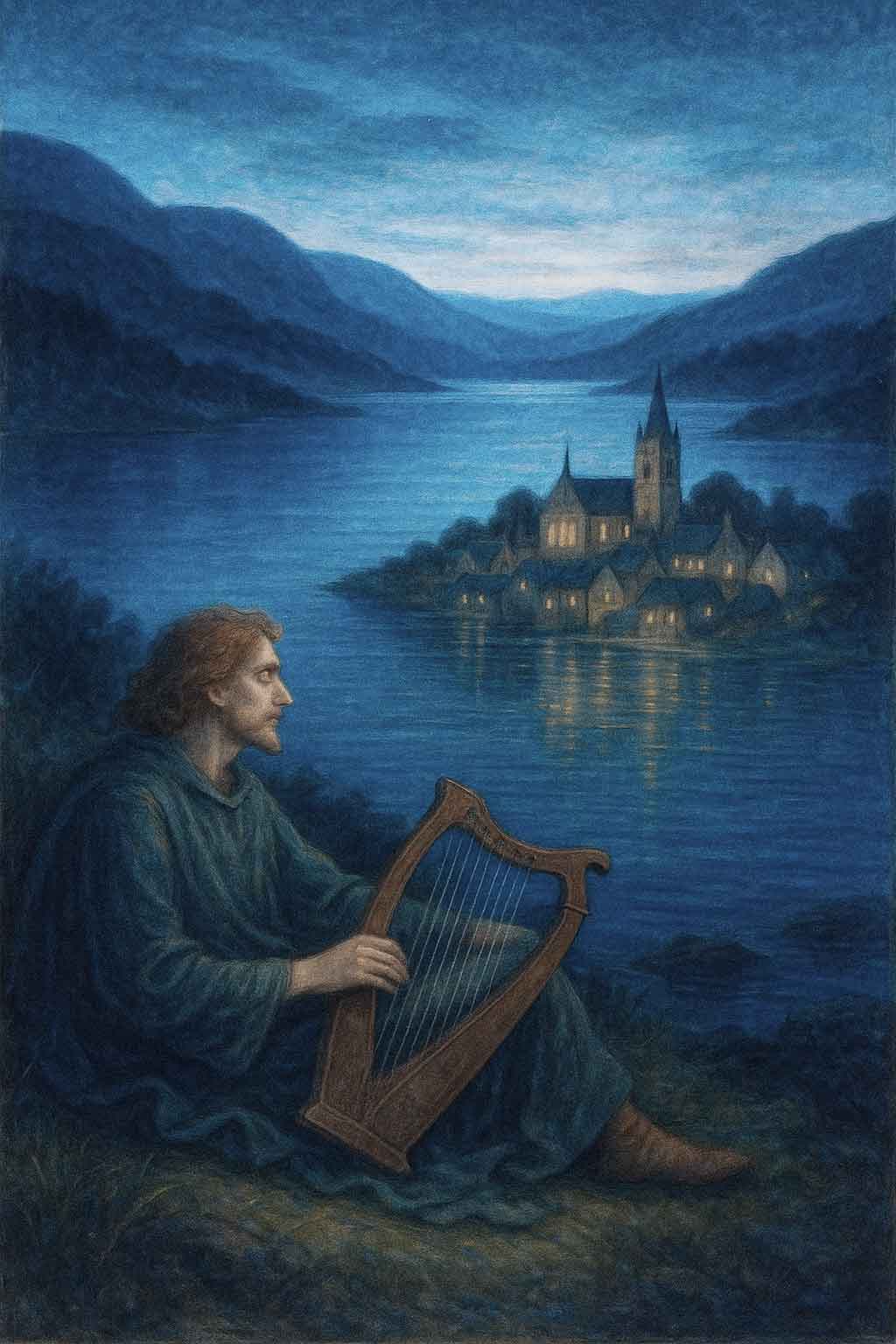
Another telling is more moral. A stranger with a harp is hired to play in a great hall for a feast. In the midst of music he hears a faint voice on the wind repeating the word "Repent". He steps outside and sees a small spectral bird pointing toward the mountains. Alarmed, he follows, climbing higher and higher as the town behind him roars with celebration. When he finally turns back he sees a black wall of water racing up the valley. The hall and the town vanish in a single raging surge. When the water settles there is only a lake. Sometimes, say people who fish there, you can still hear bells tolling far below the surface.
Think of that the next time you stand on the Bala promenade on a still evening. The waves licking the stones are ordinary. The stories they hold are not.
Ice, fairies and red bandits
The water of Llyn Tegid is not always soft and dark. In some winters it freezes, and the ice is as dangerous as the flood.
One tale tells of a traveller who crossed what he thought was a flat snowy plain. He trudged over it without incident and only when he reached Bala did people tell him that he had just walked across the frozen lake. Realising how thin the ice might have been and how deep the water below, he dropped dead on the spot from pure shock. In some retellings he is even named as one of the heroes of the Round Table, because in Bala almost every story eventually finds a way to brush past Arthur.
Another story binds the lake to real events. In the 1550s a gang of red haired outlaws known as the Gwylliaid Cochion Mawddwy - the Red Bandits of Mawddwy - plagued the border hills south of Bala. They robbed travellers, raided farms and eventually murdered the Sheriff of Meirionnydd. They were hunted down and executed, but in later folklore a part of the gang escapes the hangman and rides north in winter.
Trying to cross Llyn Tegid on the ice, they reach the middle when the surface suddenly gives way. Horses and riders vanish into the freezing water. Ever since, the lake is said to be troubled by them.
A twentieth century newspaper article adds a modern witness. An Englishman living in Bala used to walk his two dogs along the lakeside. With nothing visible on the water, the animals would suddenly stop, stare fixedly at a spot out on the lake, then bolt away in the opposite direction. For intelligent, steady dogs, their behaviour was unnerving. The man said he was not ready to believe in anything supernatural, but he could not explain the way the dogs acted.
Nearby lakes add their own oddities. One high on the flanks of Snowdon is known for a floating island - a raft of turf that can drift across the surface and return. Older storytellers say it was once the meeting place of a fairy husband and wife. Between the drowned town, the treacherous ice and the wandering island, you get the sense that solid ground around Bala is more negotiable than it looks.
A Norman mound and a Bible town
Step away from the lake for a moment and look at the town itself.
That modest hill, Tomen y Bala, is almost certainly a Norman motte built in the twelfth century to control the surrounding district of Penllyn. In the early 1300s a planned borough took shape below it. A single straight street stretched along the slope, houses pressed against each other for protection. Over time that street became the modern High Street.
By the eighteenth century Bala had acquired a new fame, not for soldiers or traders but for preachers and teachers.
One of the key figures was Thomas Charles, a Calvinistic Methodist minister who settled in Bala and organised circulating schools throughout Wales. In the year 1800, a sixteen year old girl called Mary Jones walked around twenty five miles barefoot from her home near Cader Idris to Bala with the money she had saved to buy a Welsh Bible from him. Charles was so moved by her perseverance that, working with friends in London, he helped to establish what became the British and Foreign Bible Society. Bibles printed as far away as China and Africa owe a little of their history to that long walk to Llyn Tegid.
Later in the nineteenth century Bala was crowded with students. The Calvinistic Methodists set up Coleg y Bala to train their ministers. The Independents opened their own college, Bodlondeb. For a while you could hardly walk down the street without passing a budding preacher with a Greek New Testament in his pocket. Public events ended with speeches and sermons as naturally as rain ended in puddles.
One German visitor complained cheerfully that it was impossible to imagine any gathering in Wales without a discourse. In the evenings he would sit in his lodging by the fire while his landlady made toast, read a chapter of the Bible aloud to her in Welsh, and then beg for ghost stories. She knitted, raised her eyebrows for emphasis and told them.
It was from within this intense, bookish, rain-damp world that the most ambitious Bala scheme of all emerged: the idea of a new Welsh homeland in Patagonia.
From Bala to the Chubut Valley
The driving force behind the Patagonian project was Michael Daniel Jones, a minister and principal of the Independent college at Bala. Born in the nearby village of Llanuwchllyn, he loved the Welsh language and culture and was deeply anxious that constant emigration to English speaking countries would dissolve both. His solution was imaginative and radical. If Wales could not be safe in Wales, perhaps it could be safe somewhere else.
Reports from the south of Argentina described a fertile valley along the river Chubut, near a natural harbour called Bahia Nueva. Admirals and surveyors spoke of good soil and a climate that might suit European farmers. Jones and his supporters imagined a Welsh colony there where chapel life would be central and Welsh would be the everyday language.
An agent, Lewis Jones, travelled out to inspect the site and returned with glowing descriptions. Prospectuses in Welsh promised emigrants one hundred acres of land for each family group of three adults, gifts of horses, cows and sheep, tools, seed and enough wheat for bread until the first harvest. The language of the leaflets was vague on details, but the dream was clear: a valley where a poor quarryman could become a landowner and hear the Gospel in his own tongue.
In May 1865 the first group of about one hundred and fifty emigrants left Liverpool in the ship Mimosa. Many of them came from North Wales. Quite a few had personal links to Bala’s congregations and colleges. The voyage itself was rough. Children died at sea. Landing at the new harbour they found an empty coast, a howling wind and a long trek inland to the river valley. The timing was disastrous. They arrived too late in the year to plough and sow before winter, and the earlier promises about provisions had been overly optimistic.
A British diplomat who visited them two years later described their first months in grim detail. Families trudged on foot across the scrubby plain, some spending nights outside with almost no food. Women and children crowded into a small schooner for the journey along the coast and up the river. The voyage took far longer than expected. Food ran short. Some of the children died. When they finally reached the valley they found themselves almost out of supplies, in a place where there was no wood, little shelter and no easy way to send for help.
For a time their survival was in doubt. Appeals reached the Argentine government in Buenos Aires. The minister of the interior, Señor Rawson, arranged emergency grants of flour, meat and animals and promised monthly support. Surveyors measured out farm lots along the river. Slowly, painfully, the Welsh dug irrigation channels, built mud brick houses and learned to coax crops from a land where rain usually falls only a few times a year.
Decades later, newspaper reports back in Wales would look at the transformation with sober pride. What had begun as a desperate experiment was now a region of thriving wheat fields and sheep farms. The President of Argentina himself toured the colony and unveiled a monument to its founders. The principal of Bala College was remembered as one of the chief organisers of the whole venture.
The human stories that spin out from this are full of quiet romance. One early pastor in the Chubut valley sent his son home to Wales for education at Bala College. Years later the son visited Patagonia, fell in love with a young woman who spoke Welsh, Spanish and English, and discovered that her grandparents had emigrated from North Wales. They married, served churches in Manchester, then returned to the colony where she joined the congregation her grandfather had helped to found. Other Patagonian born women came back to Wales to marry ministers and carried fresh stories of the far valley into Bala’s chapels.
In that way the lake sent out its people like messages in bottles and then, slowly, drew some of them back.
Teggie and the Ice Age fish
The stories of Bala did not end with the sailing of the Mimosa.
In the mid nineteenth century the writer George Borrow visited Bala and described Llyn Tegid as the possible home of a mystic beast, something between a crocodile and a beaver. He linked it with the old tale of Hu Gadarn dragging a monster from the depths with the help of four huge oxen. More than a century later, in the 1960s, letters in regional newspapers mentioned Borrow’s account when people began talking about organising a hunt for a lake monster. One correspondent suggested that recent sightings might owe as much to the strength of Bala beer as to the survival of any prehistoric creature.
By then the beast had a nickname: Teggie, taken from the Welsh name of the lake. People reported seeing a large dark shape moving just below the surface, a head like a football with big eyes, unexplained wakes on days when the air was still. Anglers spoke of the water in front of their boats suddenly heaving as if something huge had surfaced and dived again. In the late 1970s this flurry of stories reached the pages of the Shropshire Star. In the 1990s television crews brought a miniature submarine, complete with cameras and sonar, to explore the depths. They found mud, curious blips and not much else, but the search added another layer to the lake’s reputation.
While monsters remained elusive, one very real creature caught scientific attention. Llyn Tegid is home to the gwyniad, a small silvery fish related to herring that lives nowhere else in the world. Trapped when the glaciers retreated at the end of the Ice Age, it spends most of its life in deep, cold water for which the lake is perfectly suited.
In the 1960s researchers from Liverpool and elsewhere began studying the gwyniad. They set nets at different depths, weighed and measured the fish, examined their stomach contents and checked them for disease. They used echo sounding equipment like that on deep sea trawlers to locate shoals and map their movements. One article of the time described it as "the mystery of an Ice Age fish". In later decades, when pollution and the arrival of predatory ruffe threatened the species, eggs were transplanted to a remote mountain reservoir to create a backup population.
There is something satisfying about the thought that, beneath all the tales of afanc, drowned towns and Teggie, the lake truly does shelter a relic from another age, quietly going about its life while people argue above about ghosts and monsters.
A lake that sends people out
When you put all these strands together, Bala becomes more than a picturesque stop on a tourist route.
You have a Roman road and fort linking the valley to a seaport. You have a sacred river that seems to slip through the lake in a ribbon. You have a witch stirring a cauldron on the shore, a bard floating downstream in a leather bag, and a crocodile beast breaking the banks. You have a town that may or may not lie beneath the waves and dogs that refuse to look at certain spots on the water. On the hill above stands a Norman mound that in the local imagination doubles as Mount Ararat.
Then, layered over that, you have a town full of Bibles and hymnbooks where a barefoot girl buys a copy of the Scriptures and sets off a global Bible society. From the same streets you have a college principal who dreams of a new Wales in South America and helps send families off to carve farms along an unfamiliar river.
If you stand on the shore of Llyn Tegid today with all this in your head, the place feels compressed and charged. The rain falls. The Dee slides through. Somewhere far away descendants of those Bala emigrants speak Welsh under a dry Patagonian sky and tell their children about a long dark lake in the old country.
The water of Bala does what water here has always done. It collects stories. It reflects them back. And every so often it carries some of the people who live by it out into the wider world, as if the lake were not only a basin but a kind of launching place, a quiet Welsh Galilee where new lives first take shape.
This Topic
Celtic Britain, Sacred Landscapes and Lost Kingdoms
Sacred places, old kingdoms, borderlands, Atlantic routes, and the landscapes where memory, myth, and history overlap.
View Topic PageMore in this Topic
12 March 2026
Saint Piran of Cornwall26 October 2025
Elmet A Brittonic Kingdom and Enclave Between Rivers and RidgesLatest Posts
27 March 2026
Hot Cross Buns: History, Origins & FolkloreDiscover the fascinating history of hot cross buns - from pagan offerings and Greek sacred bread to Chelsea bun houses and Good Friday folklore. Explore 2,000 years of spiced bread tradition.
22 March 2026
What Does "Ne'er Cast a Clout Till May Be Out" Actually Mean?Is it about the month of May or the hawthorn flower? And what on earth is a clout? We dig into 170 years of British newspapers to finally answer one of folklore's most argued questions.
20 March 2026
The White Hart: The Ancient Legend Behind Britain's Most Common Pub SignFrom Greek mythology to medieval forest law, the white deer haunted the British imagination for centuries. Discover the real history behind the legend of the White Hart — royal badge, supernatural omen, and elusive quarry of the soul.
13 March 2026
Why Is a Horseshoe Lucky? The Surprising History Behind the World's Most Universal CharmThe horseshoe has been nailed above cottage doors, cathedral gates, and battleship masts for centuries. Discover the ancient beliefs in iron, the crescent moon, and the sacred horse that made it the world's most enduring good luck symbol.
12 March 2026
Saint Piran of CornwallPiran - patron saint of Cornwall, tin miners and the Cornish flag — from Irish origins to the buried oratory's remarkable 2014 excavation.
10 March 2026
Clare Island - Isle of Storms, Pirates and Naturalists: A History in Newspaper Voicesiscover the fascinating history of Clare Island, off the coast of Mayo - from the piratical legend of Grace O'Malley and bitter land disputes to a landmark natural history survey, told through contemporary newspaper voices spanning 1863 to 1986.