Mighty Oaks from Little Acorns: Legends, Lore and History of the Oak Tree
Written by David Caldwell ·
If Britain has a totem tree, it is surely the oak.
It props up our myths, our navies, our parish churches and even our window blinds. Acorns fed Iron Age pigs, financed medieval pannage rights, and still dangle-turned in bone or brass-from modern umbrella handles as quiet lightning charms.
What follows is a long wander through the history and folklore of oaks and acorns, using a lot of curious details preserved in old newspapers and antiquarian notes - the kind of material that rarely makes it into modern summaries
1. Sacred food and sacred trees
Long before the oak became “the British tree,” it already had a sacred résumé around the Mediterranean.
Ceres’ oak and the age of acorns
A 1910 article in The Academy reminded readers that ancient writers believed there was once an age when people lived entirely on the fruit of trees-especially acorns-until Ceres taught them the use of corn. At festivals in Ceres’ honour Roman farmers wore oak wreaths, a nod to this debt. The Twelve Tables, Rome’s oldest law code, even contained a special clause protecting the right to gather fallen acorns from another man’s land, so important were they as fodder and food.
In later Latin poetry the value of the oak is wrapped into images of longevity and justice. Ovid gives us the husbandman “crowned with the twisted oak,” Virgil and others link the tree with oracles and divine voices in the leaves. The oak was not just a useful timber; it was an axis between gods, law and subsistence.
Zeus at Dodona
The same article recalled the oracle of Zeus at Dodona in Epirus, one of the oldest Greek sanctuaries. There, Zeus was believed to dwell in a brotherhood of venerable oaks. The rustling of their leaves in the wind was heard as his voice. Later tradition claimed that prophetic women called peleíades (“doves”) interpreted these sounds, perhaps descended from an older bird cult.
An ancient line that schoolboys used to stumble through can be loosely rendered:
“They went to Dodona, to the oak of Zeus,
to hear the will of the high-crested god from the talking tree.”
Already we can see two strands that will persist right into modern British folklore:
acorns as primordial food;
oaks as trees that speak, judge and punish.
2. Oaks that punish: myth, Bible and thunder-gods
A Victorian reviewer in the Saturday Review once joked that “the tree that punishes is a tolerably common element in mythology,” and gave the Biblical story of Absalom as an example: the rebellious son of David whose long hair was caught in the branches of an oak while his father’s men closed in. Divine justice hangs, quite literally, from the bough.
In Greek myth another oak episode ends less visually but even more grimly. Erysichthon, who cut down a sacred tree of Demeter, was cursed with insatiable hunger. It’s an ancient story of environmental vandalism: violate the holy grove, and you will consume yourself.
Thor’s tree and St Boniface’s axe
Across the Germanic world the oak belonged to the thunder god-Donar, Thunar, Thor. An article in the Leicester Catholic News (1923) retold the mission of St Boniface, the Anglo-Saxon apostle to the Germans. In the 720s he resolved to strike at paganism by felling a huge “Thunder-Oak” at Geismar, sacred to Thor.
Crowds of pagans gathered, expecting their god to hurl a thunderbolt at the intruder. Boniface swung his axe. Once only a moderate notch had been cut, a sudden wind arose and the oak crashed down-splitting neatly into four quarters. The onlookers, who had been cursing the missionary, burst instead into praise of the Christian God. Boniface used the timber to build a chapel of St Peter. The “king of the god-trees” had literally been turned into a church.
This story would echo later in the British Isles, where the oak, thunder and Christianity continued to wrestle with one another.
3. Druids, mistletoe and the “golden bough”
From Pliny onwards, writers have associated the Celtic Druids with oak groves and mistletoe. A late-Victorian piece titled “The Ways of the Druids” stressed that they would not perform a ceremony unless they could use oak foliage; anything that grew upon the oak was considered sent from heaven.
On the sixth day of the moon they were said to cut mistletoe from the tree with great pomp. Two white bulls were brought, a priest in white climbed the branches with a golden sickle, and the falling plant was caught in a white cloak so it never touched the ground. Afterwards the bulls were sacrificed; the mistletoe decoction was believed to cure infertility and serve as an antidote to poison. The same article relished Pliny’s description of the “serpents’ egg,” a druids’ amulet formed from snakes tangled in foam and magically hardened - another story that binds oak, thunder, and the uncanny.
Twentieth-century writers carried on the speculation. A 1971 column in the Rugeley Times noted how some historians had tried to turn Cannock Chase into a Druidic centre on the basis of local stone names-Druid’s Heath, Knave’s Heath-and the memory that the Druids performed many rites beneath oak trees. The writer was sceptical but admitted there was “no evidence to the contrary”.
Whether we accept these reconstructions or not, they show how tightly “Oak + Druids + thunder” are soldered together in the British imagination.
4. Acorns: from golden age to poison
Oaks are not just symbolic; they feed both people and animals-sometimes to death.
Food of the golden age
The Western Mail in 1939 quoted the 17th-century divine Thomas Fuller:
“Plenty of acorns were men’s meat in the golden age; hog’s food in the iron age.”
He added that pigs “going out lean, return home fat” from the oak woods “without other cost to their owners.” Chaucer confirms the point; bacon was as central to medieval English farm life as it had been to the halls of Odysseus.
An essay in The Academy likewise emphasised that acorns were once a staple, not a mere woodland nuisance. Only later, with Ceres’ gift of grain, do they become animal feed.
Acorn poisoning
Yet abundance brings risk. In 1893 the Huddersfield Daily Chronicle warned of “acorn poisoning” after a dry, hot summer. In mast years, when acorns are plentiful and herbage scarce, young cattle gorge themselves. An outbreak of disease-distinct from simple indigestion-was recorded across Middlesex, Kent, Hertfordshire, Warwickshire, the New Forest, and elsewhere. Young beasts wasted away with diarrhoea, pale urine, sunken eyes and a temperature actually below normal. Entire herds were lost.
There was no cure; the only preventive was to keep cattle away from oak woods while acorns were falling. It is a reminder that the generous tree of myth can be lethally double-edged in practice.
5. “The place of the oaks”: Derry, Doire and Londonderry
Oaks also etch themselves into place-names. One of the most contested examples in the British Isles is Derry / Londonderry. The Irish word Doire is usually translated as “oak grove” or “oak wood,” and nationalist writers have leaned hard on that meaning. A 1947 piece in the Irish Weekly and Ulster Examiner insisted that “there was a Derry long before the city of London was founded,” and that no amount of “foreign propaganda” could induce a true Derry man to adopt the Anglicised county name. The same article stressed that Saint Columcille’s grey eyes “longed for Derry-my little oak grove,” not for any Londonderry.
Earlier twentieth-century accounts repeat the story that the original settlement, burned to the ground many times, was simply Derry, and that after St Columba founded his abbey in 546 it was sometimes styled Derry-Columbkille. Unionist historians, however, emphasise the later legal layer: during the early-seventeenth-century Plantation the London livery companies financed a new fortified town, officially named Londonderry, and Dr James Stevens Curl has argued that “County Derry” never existed in law at all, the county being Londonderry while “Derry” properly referred to the earlier ecclesiastical site.
Beneath the politics sits the older linguistic root. Doire belongs to the same Indo-European family of words as Welsh derw (oak) and, many philologists suggest, the first element of druid itself, often glossed as “oak-seer” or “oak-knower.” Not everyone accepts that etymology without qualification, but it is widely repeated in Celtic studies and popular writing alike. Either way, both sides in the naming dispute at least agree on this much: the name points back to an oak grove.
6. Royal forests, royal deaths and royal hiding places
Edmund, Rufus and the oaks of the chase
Royalty haunts oak forests. William Rufus – Rufus the Red – was famously killed while hunting in the New Forest, traditionally near a stone and an oak that still bear his name. In later retellings the fatal arrow is said to have glanced from the trunk of an oak before striking the king, as though the tree itself had taken part in the judgement. Saint Edmund, king and martyr, is less securely fixed to a single tree, yet East Anglian tradition places his last moments at Hoxne, where he was bound to an oak and used for target practice by Viking archers before his beheading; for centuries a replacement “Edmund’s Oak” was pointed out to pilgrims.
Nor is England alone in these royal entanglements: on the banks of the Wear, local lore in Durham tells how King David I of Scotland hid in the hollow of an oak after defeat in battle, echoing the later story of Charles II at Boscobel. In each case the oak stands not just as scenery but as witness, accomplice and sometimes refuge in the high dramas of kingship.
The Royal Oak of Boscobel
The most beloved royal oak, though, is the one that did not kill but saved a king.
After the defeat at Worcester in 1651, Charles II fled across the Midlands. A rich narrative reconstructed in The People’s Friend (1893) describes his journey to Boscobel House on the Shropshire–Staffordshire border-a modest, wood-surrounded dwelling already used as a priest-hole refuge by Catholic families.
From here Charles was guided by the Penderel brothers into nearby woods. At one point he and Colonel Careless spent an entire day hiding high in an oak tree, while Parliamentary soldiers searched the ground below. The king, we are told, rested his head on the colonel’s lap and occasionally dozed, wrapped in a cloak, as Roundheads moved within earshot.
After the Restoration, the “Royal Oak” became an object of compulsive veneration. Royalists cut souvenirs from the bark until, as the diarist Evelyn tartly observed, the tree had “ceased to be a living tree… so rapidly had it fallen a sacrifice to the destructive zeal” of its admirers. By the 19th century the original oak had disappeared entirely, replaced by a guarded descendant. Visitors still came to pose in its branches.
The story seeded a whole forest of cultural offshoots:
countless inns named The Royal Oak;
keepsakes carved from “Boscobel oak”;
oak-apple day, 29 May, when people wore sprigs or oak-apple galls to celebrate the king’s restoration.
One newspaper writer noted that even in the 1940s Staffordshire could boast multiple Royal Oak inns whose signs showed the disguised king peering through leaves while soldiers milled below.
Gospel Oaks
Gospel Oaks were once a familiar feature of the British countryside: ancient boundary trees where the sacred and the everyday met. At Polstead in Suffolk, villagers still remembered a vast “Gospel Oak” under which, according to tradition, the first Christian missionaries preached to the local Saxons; later research claimed the tree itself might have been 2,000 years old, already venerable when the preachers arrived.
In earlier centuries such oaks stood all over England. On Rogation Days the clergy and parishioners would walk the bounds of the parish, pausing at certain great trees; there, beneath the spreading branches, a passage from the Gospels was read and a short sermon delivered, literally rooting the Word of God in the landscape. Seventeenth-century poet Robert Herrick alluded to this custom in his Hesperides, and a few place-names like Gospel Oak in London - still echo the time when the parish sermon was as likely to be delivered under an oak as inside a church.
7. Hearts of Oak: navies, empires and a timber crisis
If kings hid in oaks, ships were built out of them.
Calculating the forest of a navy
In 1813 the Chester Chronicle printed a stark calculation under the heading “Oak Timber for the British Navy.” Government commissioners had estimated that to maintain the fleet at its then establishment, the country would need 100,000 acres planted with oak. If you raise forty trees per acre, you must fell the equivalent of 1,000 acres of full-grown oaks every year-while planting another 1,000 acres to keep the cycle going.
Crown forests could supply only about 60,000 acres: Dean, New, Bere, Alice Holt, Woolmer, Parkhurst and Delamere. It was proposed to plant 4,000 acres annually, completing the program in thirty-five years. The figures are blunt; they show how intimately the age of sail depended on a slowly regrowing, living resource.
The same article gave another revealing number: between 1790 and 1806 the navy consumed on average over 25,000 “loads” of oak per year.
The Forest of Dean and Pepys’ problem
The Forest of Dean in Gloucestershire was one of the most important naval timber reserves. A detailed piece by J. B. Wallis in 1925 traced how Samuel Pepys, as a naval official, consulted Sir John Winter-local landowner and ironmaster-about the forest’s timber. Evelyn, speaking at the Royal Society in 1662, urged a systematic replanting of Dean because its “choicest ship timber in the world” had already been heavily cut.
By the early 20th century Wallis could still call Dean “the second largest forest in England,” but worries about softwood plantations were creeping in: too many conifers, not enough oak.
One giant tree for one giant ship
Another article, “The British Oak” in the Belfast Telegraph (1911), celebrated a single enormous tree felled in 1810 near Newport, Monmouthshire, for naval use. Its main trunk, 9½ feet in diameter, yielded over 2,400 cubic feet of usable timber. Five men took twenty days just to cut it down; sawyers then spent five months converting it into ship-ready planks. Even the bark-six tons of it-was valuable. When they sliced through the trunk they found a stone six inches across, wholly enclosed in the wood, and counted around four hundred annual rings, suggesting the tree had been growing, and improving, for close to a thousand years.
A millennium of growth for one generation of ships.
“There is no such durability in foreign oak”
By 1933, the mood had changed. A thoughtful article in the Stratford-upon-Avon Herald lamented that Britain was now “practically dependent upon imported supplies” of timber. Nearly all the oak used in the country was foreign, and “not as good as British oak.” When the piles of old London Bridge-oak driven in the 13th century-were drawn up in 1827, they were sound after six centuries under water. No foreign timber, the writer insisted, could match that durability.
But most of the great native stands had been felled. Hard times had driven landowners to sell their woods. The age of oak fleets and forest statutes had left behind a much thinner, younger generation of trees.
8. Oaks, thunder and the small magics of everyday life
For all the grand themes-gods, kings, navies-the oak also infiltrates the domestic imagination in small ways.
Acorns against lightning
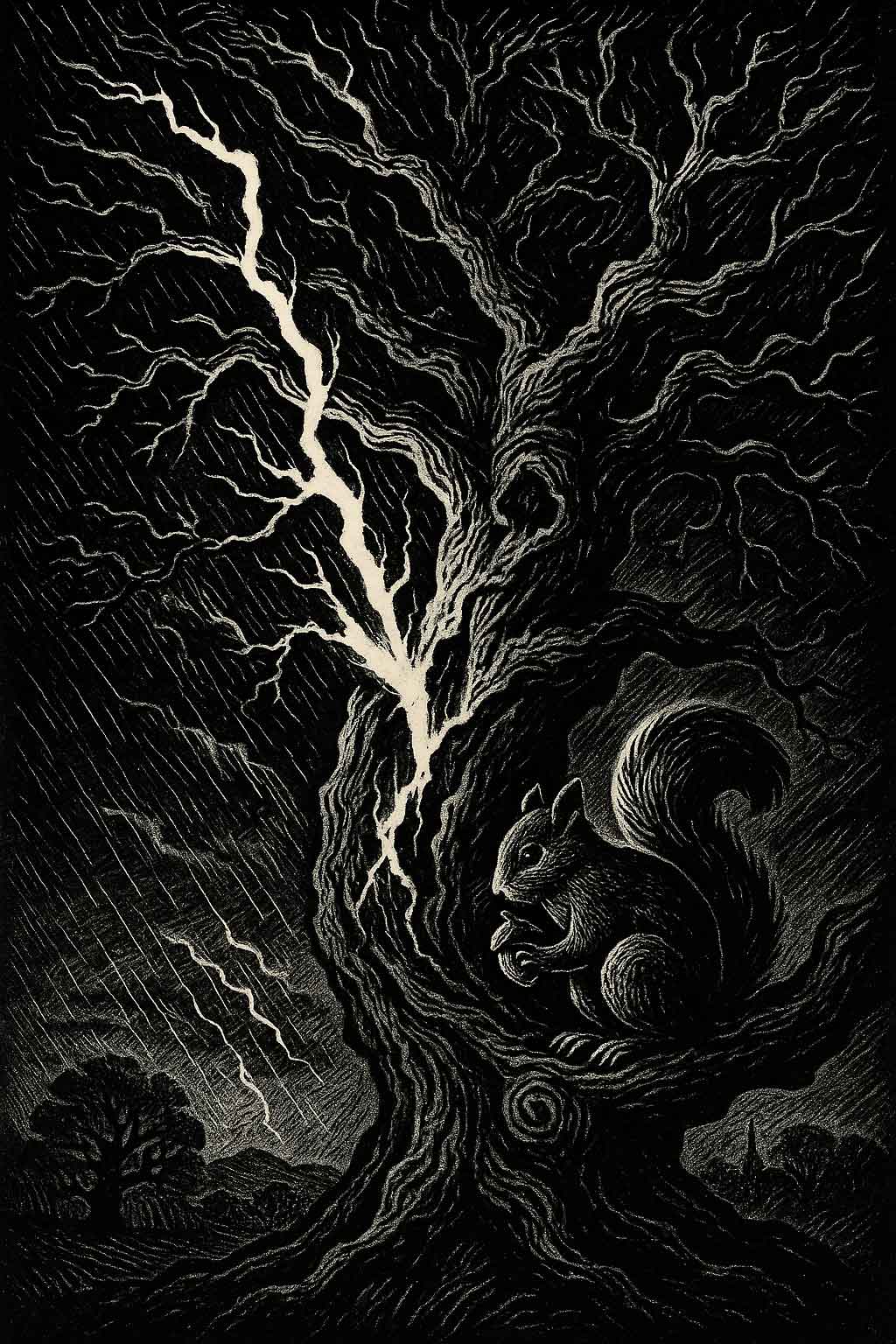
A charming 1929 piece in the Derby Daily Telegraph, “Why the Acorn?”, asked why so many linen blind pulls end in acorn-shaped knobs. The answer, it said, lay in an ancient belief that acorns protect against lightning. Thor, it reminded readers, had his home in the oak tree; fearful householders once hung bunches of acorns over doors and windows so the thunder-god would spare the building for the sake of his sacred tree. The superstition has faded, but the acorn knobs remain.
A 1978 article in the Morpeth Herald made the same point, noting that acorn finials appear on newel posts, gable ends, weather vanes, mastheads and blind cords. Like holly, oak was thought to safeguard against storms. Even umbrellas sometimes ended in little bone or wooden acorns, as though the walker carried a miniature thunder-tree in their hand.
The irony, noted back in 1896 by a naturalist writing on “The Oak Tree,” is that oaks are statistically more likely than many trees to be struck by lightning. American figures suggested fifteen oaks struck for every one birch. Perhaps that is precisely why they needed protective folklore.
From cradle to coffin
That same Morpeth article also observed that oak remains one of the preferred timbers for coffins. It is the tree that sees us out, just as it once held our ancestors’ gods. Churches are full of oak pews and pulpits; lychgates and rood screens, chancel doors and parish chests all speak of the same durable relationship between English piety and English timber.
Older folklore ventured further. One 19th-century miscellany of oak lore explained that carved human heads-“oak men”-were sometimes said to be spirits of the woodland, benevolent unless angered by an axe. Other sources described farmers wearing belts of oak leaves on certain feast days, or churchwardens keeping an “oak staff” that doubled as symbol of authority and very literal support.
9. Sacred oaks and saints’ trees
Alongside kings and thunder-gods, saints also acquire their oaks.
An 1894 Irish piece on “Some Sacred Oak Tree Legends” recalled a venerable oak dedicated to St Columba, whose splinters were carried as charms against violent death; a single bite from its wood was believed to protect Christian martyrs from the executioner’s block. Another story told of the “Holy Oak of Kenmare,” blown down in a storm and later guarded by angels in a new site.
In Brittany, according to a 19th-century tour of famous oaks, there was once a “sacred oak of Vetron” associated with St Martin. A staff cut from it healed the sick, and the tree itself was venerated long after the saint’s time. In Devon, Saint Winifred was said to have cut down an oak dedicated to Thor-an echo of Boniface’s tale in German lands.
Even the modern Catholic press made room for oak legends. The story of St Boniface and the Thunder-Oak, already mentioned, was retold as evidence that one spectacular felling could “sound the death-knell of paganism” in a region.
10. Oaks, vandalism and loss
By the early 20th century a new theme creeps into oak writing: anxiety over vandalism and loss.
A 1930 column in the Sheffield Daily Telegraph began with the myth of Erysichthon and the sacred tree, then swung to contemporary Britain. Vandals, it argued, were not necessarily more numerous than before, but they had “more opportunity than ever” in an age of road-building, bungalow development and mass tourism. Unlike those who cut trees for “practical and economic necessity,” flower-and-branch collectors in the countryside were branded as purely ignorant. Their greed would, in the long run, bring “helpless privation.”
The writer compared the fate of wildflowers-lily-of-the-valley, lady’s slipper orchids-to what might well happen to oaks if we were equally careless. Once-common species can vanish astonishingly quickly. A thousand-year-old oak is not simply “a big tree”; it is an archive of grazing patterns, storms, mast years, birds’ nests, fungal invasions and human decisions.
In Ireland, the Derry/Londonderry debate ironically highlights the same theme: a town named for its oak grove now has to go to great lengths to plant and protect individual commemorative oaks.
11. Why oaks and acorns still matter
Taken together, these scattered clippings and traditions reveal a remarkably coherent picture.
Oaks stand at thresholds: between pagan and Christian, king and commons, sea-power and woodland, lightning and shelter, life and death.
Acorns mark both poverty and plenty: food of the golden age, hog-mast of the iron age, dangerous temptation for hungry cattle in drought years.
The tree is both punisher and protector: Erysichthon’s curse, Absalom’s entangling branches, yet also acorn charms on blinds and umbrellas, thunder-oaks turned into chapels and churches.
Politically, oaks are tied to identity and memory: the Royal Oak of Boscobel, the oak-grove of Doire that becomes Derry-Columbkille and then Londonderry, the oaken piles of London Bridge, the forest laws of Dean and the New Forest.
For a long time Britain quite literally lived off its oaks. They gave us hog-fat and tanner’s bark, parish roofs and man-of-war hulls; they lent symbolism to saints and kings, and vocabulary to place-names. In return, we nearly felled them into oblivion, then scrambled to calculate how many acres we would need to replant.
Today the acorn knobs on our blinds, the Royal Oak pub signs, the carved pew-ends and the soft green light of surviving ancient woods are the thin end of a much older wedge-remnants of a world where to cut an oak was to risk starvation, lightning or divine anger.
This Topic
Pagan Mythology, Gods and Sacred Symbols
Ancient gods, sacred animals, ritual plants, symbols, charms, and the shifting meanings of mythic imagery.
View Topic PageMore in this Topic
12 February 2026
The Sator Square: Roman Charm, Church Code, Folk Spell5 December 2025
The Baleful Mistletoe: The Story of a Plant in Exile27 September 2025
Epona: The Horse Goddess in Britain and Beyond25 August 2025
The Lore of the Unicorn - A Definitive GuideLatest Posts
27 March 2026
Hot Cross Buns: History, Origins & FolkloreDiscover the fascinating history of hot cross buns - from pagan offerings and Greek sacred bread to Chelsea bun houses and Good Friday folklore. Explore 2,000 years of spiced bread tradition.
22 March 2026
What Does "Ne'er Cast a Clout Till May Be Out" Actually Mean?Is it about the month of May or the hawthorn flower? And what on earth is a clout? We dig into 170 years of British newspapers to finally answer one of folklore's most argued questions.
20 March 2026
The White Hart: The Ancient Legend Behind Britain's Most Common Pub SignFrom Greek mythology to medieval forest law, the white deer haunted the British imagination for centuries. Discover the real history behind the legend of the White Hart — royal badge, supernatural omen, and elusive quarry of the soul.
13 March 2026
Why Is a Horseshoe Lucky? The Surprising History Behind the World's Most Universal CharmThe horseshoe has been nailed above cottage doors, cathedral gates, and battleship masts for centuries. Discover the ancient beliefs in iron, the crescent moon, and the sacred horse that made it the world's most enduring good luck symbol.
12 March 2026
Saint Piran of CornwallPiran - patron saint of Cornwall, tin miners and the Cornish flag — from Irish origins to the buried oratory's remarkable 2014 excavation.
10 March 2026
Clare Island - Isle of Storms, Pirates and Naturalists: A History in Newspaper Voicesiscover the fascinating history of Clare Island, off the coast of Mayo - from the piratical legend of Grace O'Malley and bitter land disputes to a landmark natural history survey, told through contemporary newspaper voices spanning 1863 to 1986.