
Sacred Wells of the British Isles: Holy Wells, Wishing Wells, Folklore & Healing Waters
Written by David Caldwell ·
Sacred Wells of the British Isles: Where Springs, Story, and Stone Meet
Across the British Isles there are places where the ground does not just hold history, it pours it out. A sacred well can be nothing more than a damp hollow, a trickle in a stone basin, or a spring in a hedge. Yet generation after generation has treated certain waters as different from ordinary water, as if the landscape itself has a memory and the spring is one of the ways it speaks.
If you start looking closely, you see the same pattern repeating from county to county and island to island. A spring is noticed. People begin to visit it at particular times. They wash, drink, circle, pray, or make wishes. Offerings appear, often the smallest things: pins, coins, pebbles, rags. Then the stories arrive, and once a story has attached itself to a water source it can outlast churches, laws, and fashions.
For thousands of years, springs and wells across the British Isles have been treated as something more than mere water sources. From pre-Christian times through the medieval period and into the modern era, these natural fountains have been regarded as places of healing, devotion, and magic. The story of Britain's sacred wells reveals a fascinating continuity of belief that survived Roman occupation, Christian conversion, and even the iconoclasm of the Reformation.
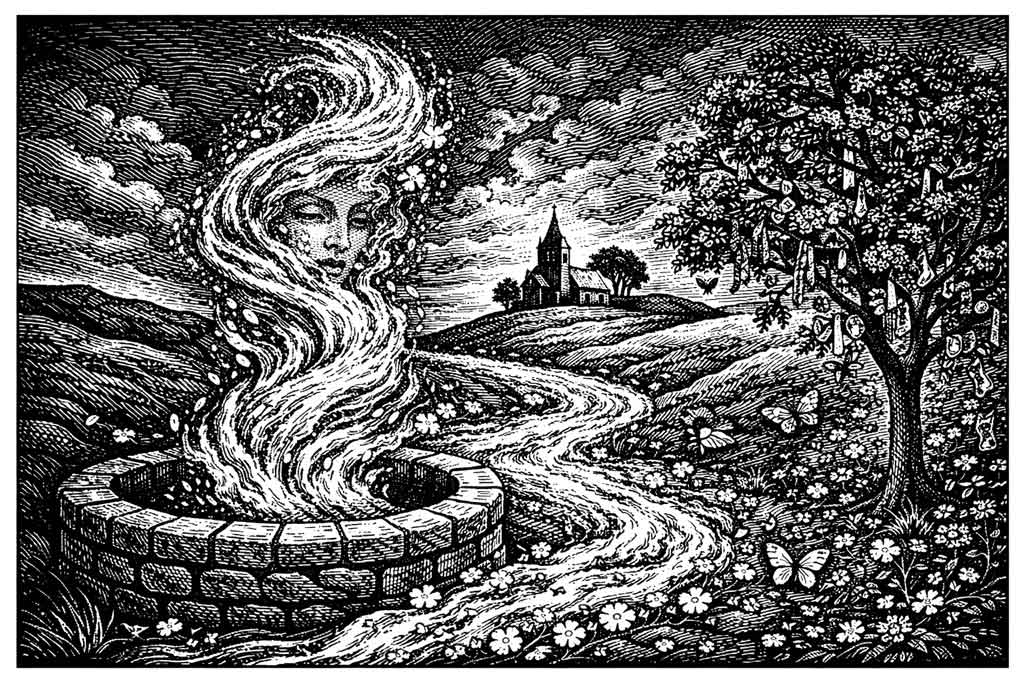
What Makes a Well Sacred?
A sacred well is never only a water source. It is a boundary point where everyday needs and deeper hopes overlap. It's a place where water meets story, where practical necessity encounters the numinous. Across England, Wales, Scotland, and Ireland, these springs occupy a peculiar space in the landscape, neither fully natural nor entirely cultural, but rather sites where human belief has transformed geology into something approaching magic.
The pattern is remarkably consistent across the sources. Wells are repeatedly linked to:
Healing, especially of the eyes and skin, but also internal diseases, madness, and weakness after severe illness
Vows and tests, where the water is believed to reveal truth or falsehood, or to judge the worthiness of the supplicant
Wishing, with very specific rules and rituals that must be followed precisely
Protection and warning, including divination about illness, thunder, or war
Community ceremony, where wells are decorated, blessed, and visited in large numbers on specific feast days
And in many places, you can watch older practice being reinterpreted rather than erased. The water stays the same. The explanation changes.
From Pagan Springs to Holy Wells: The Long Conversion
The veneration of water sources in Britain predates Christianity by millennia. Long before Christianity reached these islands, Celtic and pre-Celtic peoples recognized springs as liminal places, thresholds between the seen world and something older, deeper, more dangerous. As one 19th-century antiquarian observed, "it is not possible to fully understand the hold which the holy well of the middle ages had in the popular imagination, without going back to pre-Christian days, when the ancients, far and wide, paid divine honour to certain springs and sources of great rivers."
The Roman occupation added another layer to this tradition. The festival of Fontinalia, dedicated to the spirits of streams and fountains, exemplified classical attitudes toward sacred waters. The classical poet Horace celebrated the Bandusian spring in his odes, promising it offerings of a young goat and flowers in gratitude for its life-giving waters. This same impulse to honour water sources with decoration and offerings would persist through the centuries, merely changing its outward form.
When Christianity arrived in Britain, the church proved pragmatic in its approach to these sacred sites. Rather than attempting to eradicate deeply rooted customs, early missionaries often redirected them. Pope Gregory's famous advice to Augustine of Canterbury advocated for repurposing existing sacred sites and redirecting festivals toward Christian observances. A pagan spring could become a saint's well, its healing powers attributed to Christian intervention rather than ancient spirits.
This matters because it helps you read what is happening in the landscape. When a medieval chapel is built beside a spring, the building is not the start of the story. It is often the latest layer. A spring once feared as dangerous or haunted could be turned into proof of Christian power through blessing. The method is striking because it accepts the old idea that water has power, it simply claims a different source for that power.
The Medieval Flowering of Well Pilgrimage
By the medieval period, holy wells had become thoroughly integrated into Christian devotional life. These sites were not merely curiosities but active pilgrimage destinations, often "thronged with crowds of devotees, anxious to have a dip in their mysterious waters." Wells were dedicated to various saints, with each developing its own traditions and reputation for specific healing properties.
Each well developed its own elaborate protocols. Some required drinking at sunrise. Others demanded circling the well sunwise a specific number of times. Many involved immersion, sometimes between sunset and sunrise. The water might need to be applied while praying to a particular saint, or combined with specific offerings to achieve its effect.
St. Winifred's Well: A Welsh Giant Among Holy Wells
Among Britain's holy wells, few achieved the fame and longevity of St. Winifred's Well at Holywell in Flintshire. Some wells become famous enough to pull in visitors from far beyond their county, and the Holywell spring sits in that rarer category: a place where legend, architecture, pilgrimage, and later testimonial accounts all reinforce one another.
The legend attached to this spring contains all the dramatic elements that medieval hagiography loved. According to tradition, Winifred was a young woman of noble birth who rejected the advances of Prince Caradog. Enraged by her refusal, he beheaded her. Where her head struck the ground, a spring burst forth, its stones stained red, its moss fragrant and medicinal. St. Beuno, Winifred's uncle, restored her to life, and she lived for another fifteen years before dying peacefully and being canonized.
The well became one of the most important pilgrimage sites in Britain. As the Farnworth Chronicle noted in 1912, until the suppression of the monasteries under Henry VIII, the site "was always thronged with crowds of devotees, anxious to have a dip in their mysterious waters."
Yet what makes the site stand out is not only the medieval reputation, but the way modern reports continue to frame cures in practical, almost journalistic terms. Accounts describe the scale of the water itself, claiming the spring produces "100 tons of water" and that bathing "cures many distempers" and strengthens those weakened by severe illness.
What makes St. Winifred's Well particularly remarkable is the persistence of reported cures well into the modern era. In January 1920, the Drogheda Advertiser reported that Mrs. Lewes of Glasgow, declared incurable by medical doctors for an internal ulcer, claimed to be cured after bathing fifty times in the well. The same article described a Liverpool ex-serviceman who had been deafened when blown up at Bullecourt during World War I, but whose hearing was restored "by bathing in the Well last month."
Even more striking is the epitaph of Winifred White, recorded in the Tablet in 1865. Her gravestone at Black Ladies reads: "Here lies Winifred White (late of Wolverhampton), who was instantaneously cured of hemiplegia by bathing in Saint Winifred's Well, Flintshire, June 28, 1805. Died of consumption, January 13th, 1824; aged 45 years."
One Hampshire correspondent writing in 1887 adds a sharp, human detail that proves these were not abstract traditions: "about twenty years ago, on one occasion, I found myself travelling from Manchester to Chester with a party of Roman Catholic well pilgrims, natives of Ireland, on their way for curative purposes to the holy well at Holywell, Flintshire."
That single line is important because it is not vague "folklore talk." It is a memory of real people moving across the country with a purpose, treating a well as a destination with a medical hope attached.
Cornwall's Holy Waters and Hard Evidence: Madron Well
Cornwall's well tradition has a particular intensity in the historical record, partly because antiquarians kept returning to the same sites, arguing over what they meant, what had been damaged, and what the customs revealed about earlier belief. The Cornish material does not treat wells as romantic blur, it gives measurements, building details, and disagreements about interpretation.
One 1855 description of the chapel near Madron's spring reads like field notes: the entrance position, the altar slab, and the curious "square sink" cut into the granite, described as "nine inches" across and "about an inch deep," with the author asking whether it held a cross socket or received offerings.
Then the tone shifts from measurement to alarm. An 1889 report appeals directly to "ANTIQUARIANS," describing the chapel as partially demolished, the stream deliberately diverted through the ruins, and stones ripped out of the structure to force the water into it, with a reward offered for information. That is sacred wells in real life: not only tradition, but vandalism, land use, water supply, and the struggle to preserve a place that still matters.
Healing Customs That Do Not Die Easily
Several Cornish passages focus on eye cures and the persistence of ritual. One writer notes that people with "weak eyes" still come to wash them and leave "votive rags on the bushes around and within," adding the blunt observation that washing itself may be the main benefit.
Even that slightly skeptical voice is revealing. It shows the custom is alive enough to provoke commentary, and the author still describes it as a continuation of older devotion, just with a practical explanation attached.
The Dungeon and Skull Folklore at St. Michael's Mount
Cornish transcriptions also carry a darker strand: a small dungeon space associated with the Mount, described as "secure from discovery," and linked to legends of "notes" and a "skull" found there. This is a recurring feature of well lore. Water that heals can sit beside stories that warn, unsettle, or hint at secrets under the stone.
A Well as a Judge of Truth
By the twentieth century, sources also preserve a literary echo of an older belief: the well as a test, where water can expose falsehood. A poem presented as R. S. Hawker's "Doom-Well of St. Madron" turns the spring into a moral instrument, the place you dare not approach with a lie in your blood. Even if you read it as legend rather than history, it matters because it shows what people wanted the well to be: not just a cure, but a force that can judge.
The Geography of Sacred Waters
Sacred wells are scattered throughout the British Isles, though certain regions possess particularly rich concentrations. What follows is a journey through the most significant sites, organized by region, with attention to both their historical importance and the specific customs that sustained them.
London and the Wells That Shaped Place-Names
London's relationship with sacred wells reveals how healing springs could evolve into entertainment venues and give their names to entire districts. The wells of Clerkenwell were particularly significant, known early and attended by clergy caring for the poor and sick. Clerks' Well and Skinners' Well became gathering places, and religious houses were built nearby. There is a striking claim that miracle plays were first acted around these wells, with parish clerks performing for audiences including royalty.
Other London wells that shaped the urban landscape include:
- - Goddeswelle
- - Sadler's Wells (transformed from healing site to famous entertainment venue)
- - Islington Spa
- - Muswell Hill (linked to a healing well tradition)
- - Camberwell (well-derived place-name)
- - Shadwell (well-derived place-name)
- - Bridewell (well-derived place-name)
- - Chigwell (well-name etymology discussed)
- - Ealing (linked to "healing well")
- - Hanwell (linked to St. Anne's Well)
The transformation of a healing well into a famous entertainment venue at Sadler's Wells is a perfect symbol of what happens after belief changes. The crowd stays. The meaning shifts.
Hampshire and the Isle of Wight: Medieval Wells, Wishing Wells, and Mineral Cures
Hampshire and the Isle of Wight boast particularly rich well traditions, with T.W. Shore's detailed 1887 survey providing invaluable documentation. As Shore observed, Hampshire's wells with reputed curative properties "are all, or nearly all, chalybeate, containing traces of, or a small proportion of, iron, and they issue from the tertiary or greensand geological formations."
St. Boniface Well at Bonchurch on the Isle of Wight once commanded such reverence that sailors passing within sight of the island would lower their topsails in respect. "As late as last century it was customary for the youth of both sexes to assemble at the well on St. Boniface's Day and decorate it with chaplets of flowers." Your readers will find accounts of this well and these assemblies in Tonkin's 'History of the Isle of Wight,' vol. II, p. 121.
St. Lawrence Well on the Isle of Wight inspired Henry Brinsley Sheridan to write a poem on 'A Legend of St. Lawrence's well.'
Hampshire's documented sacred wells include:
- - St. Clare's Well near Beaulieu
- - St. Mary's Well at Sheet near Petersfield
- - Holybourne spring at the holy bourn near Alton
- - St. Ann's Well near Andover (noted as a modern imitation as far as the name is concerned)
Wells with specific healing reputations:
- - Iron Well or Lepers' Well at Fritham in the New Forest (chalybeate spring)
- - Shanklin chalybeate spring
- - Sandrock spring near Chale
- - Tutter's Well at Stanpit near Christchurch (noted for efficacy in weakness of sight)
- - Bedhampton springs (one noted for healing)
- - Botley chalybeate spring on the north of the old church (formerly in much repute)
- - Buckland Rings spring near Lymington
- - Swathling mineral spring near Southampton (formerly resorted to for disorders of the eyes, but lost through excavation for Southampton Water Works pipes)
Place-names derived from holy waters:
- - Waterwell Cross (hamlet south of Tangley, name probably derived from a cross placed over a well)
- - Holy-water near Bramshot
- - Holybrook at Shirley
- - Hollhead in Winton
Chemical analysis of water from the Lepers' Well at Fritham confirmed that iron content was "the only special chemical character that the water possesses," yet this mineral property may well account for some genuine therapeutic effects for those suffering from iron deficiency or certain skin conditions.
Yorkshire: The Well That Never Freezes
St. Helen's Well at Eshton near Gargrave, dedicated to Saint Helena, mother of Constantine the Great, represents one of Yorkshire's most significant sacred sites. The Leeds Mercury reported in 1936 that this well "has never been known to freeze or fail. Ages ago it was the subject of pagan worship," and efforts were being made to have it scheduled as an ancient monument by the Yorkshire Archaeological Society.
This well demonstrates how sacred sites become the subject of three kinds of attention: local use where water is collected and people make vows; antiquarian debate where writers argue about what "counts" as the real well; and archaeological framing where societies push to schedule or preserve sites as monuments.
Shropshire and the Rules of Wishing: St. Oswald's Well
If you want a single site that proves wishing wells can be exact rather than hazy, it is St. Oswald's Well at Oswestry. As Charlotte Burne noted in her folklore collection, this well "in all probability was a pagan sacred spring frequented long before his time to whom it was afterwards dedicated."
The antiquary F. M. Dovaston, quoted in 1842, wrote that "the feeble and infirm still believe and bathe in the well," and that bottles of its water are carried away to wash the eyes of the short-sighted and "the tardy or erring legs of such as are of weak understandings."
But the ritual detail at St. Oswald's Well gets even sharper. Multiple ceremonies were prescribed for obtaining one's heart's desire:
The Midnight Method: Go to the well at midnight, drink part of the water while forming a wish, then throw the remainder onto a particular stone at the back of the well where tradition claimed King Oswald's head was buried. A striking physical detail is preserved: a "carved head wearing a crown" once projected from the wall above that place. The condition is precise: if all the water landed on this stone without touching any other spot, the wish would be granted.
The Jet Method: Throw a stone onto a green spot at the bottom of the well to create a jet of water, then put one's head under the spout while wishing.
The Bathing Method: Bathe one's face while making a wish.
The Beechnut Divination: Search among the beech trees near the well for an empty beechnut husk resembling a human face, throw it into the water face-up. If it swims while the diviner counts twenty, the wish will be fulfilled, but not otherwise.
Whatever ceremony be practiced, the wish must be kept secret. That is not vague folklore. It is a rule-based practice, almost like a spell with instructions.
Other Shropshire wishing wells include:
- "Sunny Gutter" well near Ludlow (drop a stone to fulfill wishes)
- Rhosgoch well on the Long Mountain in the Montgomeryshire portion of the Shropshire parish of Worthen (famous for eye healing and sweethearts' wishes)
At Rhosgoch, one cottager reported that the bottom was "bright with pins, straight ones," and that "you could get whatever you wished for the moment the pin you threw in touched the bottom. It was mostly used for wishing about sweet-hearts."
Norfolk and North Yorkshire: Wishing Traditions
- - Walsingham Wells
- - Mother Shipton's Well
Wiltshire: Healing and Darker Folklore
- - Hog's Well
Wales: Healing Practice Remembered in Everyday Fear and Habit
Welsh wells carry a particular intensity of domestic tradition. One account describes a roadside healing well opposite Coeden Fawr where the practice was so common it became part of ordinary life.
- - St. Tegla's Well
Cornwall and West Country Wells Beyond Madron
Cornwall's well tradition extends far beyond Madron, with numerous sites preserving both Christian dedications and older customs:
- - Gurnard's Head Holy Well
- - Pave-an-Chapel
- - St. Euny's Well
- - St. Keyne's Well (linked to marriage folklore where whichever spouse drinks first after marriage will become ruler of the household, a well as social theater)
- - St. Malvern's Well
Derbyshire, Staffordshire, and Mineral Springs Associated with Deep Time
- - Kedleston mineral springs
- - Quarn mineral springs
- - Buxton Well
- - St. Chad's Well
- - St. Morden's Well
- - St Erasmus' Well
- - Woolbridge well
Scotland and the Islands: Offerings, Divination, and Local Spirits
Scottish well traditions preserve some of the most elaborate ritual sequences, particularly around healing madness and divination practices. The offerings, rules, and seasonal timing suggest layers of practice that long predate Christian overlay.
Wells for madness and restraint: In Perthshire and Strathfillan, rituals for curing madness included immersion between sunset and sunrise, retrieving stones from the bottom of the pool, walking sunwise around cairns, and then being tied all night to a stone or pillar. If the person was loose in the morning, hope followed. If not, the case was judged hopeless. These are rites that combine cure, ordeal, and social judgment in one cold sequence.
Scottish sacred wells include:
- - Tobir nimbuadh (also called the Spring of Many Virtues)
- - Rag-well (named as an example where the bush becomes a visible catalogue of offerings)
- - St. Andrews's Well (divination custom)
- - St. Michael's Well (divination by waves)
- - St. Routon's Well (warnings against thunder)
- - The Well of Oundle (warnings of war)
- - Loch Siant Well
- - Loch Scorr Well
- - St. Fillan's Well
- - St. Tredwell's Loch
- - Maelrubha's Well
- - St. Mungo's Well
- - Bouting Well
- - Drumming Well
- - Chapel Well
- - Rumbling Well
- - Doany Well
- - Tullio Ballone
- - Trinity Gask Well
- - Craigie Well
- - Newton Well
- - Sandford Well
At certain island springs, none dared approach without leaving "pebbles, pins, coins, needles, or rags", offerings treated as required etiquette rather than optional devotion.
Somerset: Ceremony and Heritage Protection
Chalice Well at Glastonbury represents a well that has become a civic symbol, protected by trusts, surrounded by legend, and treated as a town's inheritance. Efforts were made to safeguard the site "for posterity," with medieval references noted and legend and repeated visitation keeping the well alive as a cultural asset rather than a private superstition.
Derbyshire's Well Dressing: Living Tradition
Perhaps the most spectacular survival of well veneration occurs in Derbyshire's well-dressing ceremonies. This custom, which continues to the present day, likely represents the adaptation of the ancient Roman Fontinalia, a yearly festival dedicated to the spirits of streams and fountains, to Christian usage.
In Tissington, the ceremony supposedly originated during a great drought in 1615 when the village's five wells continued flowing while other water sources failed. Ascension Day was marked as a public thanksgiving, and since then the wells have been dressed and blessed annually on that day.
As the Sheffield Weekly Telegraph described in 1950, "folk in some of Derbyshire's quaint little villages will take time off from their farming, shopkeeping, and other occupations to lend a hand in the traditional ceremony of well-dressing."
The well-dressing process is an intricate art form passed down through generations. The well-dressers create elaborate Biblical scenes using flowers, mosses, heather, bark, and clay. The scenes are outlined in pieces of bark on walls of wet clay, and thousands of flower petals, pieces of moss, sprigs of heather, and leaves are pressed into place, filling the picture frames with glowing color.
Many well-dressers inherited the art from their fathers and grandfathers, with some having fifty years of experience in this highly specialized craft. Each year, thousands of visitors from neighboring counties visit villages like Tissington, Wirksworth, Tideswell, Barlow, Stoney Middleton, and Buxton to admire these ephemeral works of devotional art.
The 1910 Tissington well-dressing descriptions preserve the craft with almost museum-quality detail. Inscriptions, designs, borders, and materials are carefully documented: moss, holly, ivy, pansies, geraniums, rhododendrons, and everlasting flowers appear repeatedly. Even rice and beans are used to create texture. The descriptions are so careful that you can almost rebuild the panels in your head. This matters for sacred well history because it shows a custom that is not vague or sentimental, it is technical, organized, and proud.
The Science Behind the Sanctity
Modern geological analysis reveals that many wells with reputations for healing share common characteristics. T.W. Shore's observation that Hampshire's curative wells are predominantly chalybeate, containing iron, and issue from tertiary or greensand geological formations provides a scientific framework for understanding their therapeutic reputation.
The mineral properties may well account for genuine therapeutic effects. Chalybeate springs could benefit those suffering from iron deficiency. Cold, clear water might soothe inflamed eyes. Whether the cures were miraculous or medicinal, they reinforced belief in the wells' special properties and ensured their continued veneration.
Even the slightly skeptical Cornish observer who noted that washing itself might be the main benefit for weak eyes was inadvertently documenting a real therapeutic practice, clean, cold water applied regularly to inflamed eyes would provide genuine relief.
The Reformation's Impact and the Rise of Wishing Wells
The Protestant Reformation dealt a severe blow to well pilgrimage. The suppression of the monasteries under Henry VIII targeted not just monastic institutions but the entire fabric of popular Catholic devotion, including shrines, relics, and pilgrimage sites. Chapels built over wells were demolished. Devotional images destroyed. The theological framework that had sustained holy wells for centuries was officially discredited.
Yet the wells survived, if in altered form. The transition from "holy wells" to "wishing wells" in the post-Reformation era reflects both continuity and transformation. As T.W. Shore explained, the change "is easily understood, as we cannot suppose they were visited by any devotees in ancient days who did not wish or pray for some cure or other result of their visit." The act of veneration remained; only its theological framework shifted.
Where church-endorsed sanctity faded, folk practice often survived as wishing, throwing pins, tying rags, and visiting on certain days. In other cases, faith was replaced by finance. A well that once promised healing could become a paying attraction. The water remained. The story around it changed.
The Archaeology of Offerings: Small Things That Survive
Offerings are one of the most persistent behaviors across sacred well traditions, and for archaeology, these tiny objects matter tremendously. They are physical traces of belief, often more honest than grand stories, because people leave them quietly and repeatedly.
Rags appear as votive objects throughout Britain and Ireland, often associated with transferring illness away from the body. The practice seems to involve sympathetic magic: the cloth that had touched the diseased body part would be left at the well, transferring the sickness with it. As the rag rotted, so too would the disease fade. One Newcastle site earned the nickname "Rag-well" because of the number of cloth offerings that accumulated on surrounding bushes.
Pins and pebbles appear repeatedly, especially in Cornish and Scottish healing well descriptions. The pin tradition is particularly precise, straight pins, not bent ones, thrown into the water at the moment of wishing.
Coins and needles appear in accounts of island springs where offerings are treated as required etiquette rather than optional devotion.
These small objects accumulate at well sites, creating a tangible archaeological record of visitation and supplication that can span centuries. A well bottom bright with pins, a thorn bush heavy with rags, these are the physical evidence of continuous belief.
Living Memory: Modern Voices
If you ever need to demonstrate that holy well belief is not only medieval and not only romantic, 20th-century testimonials prove the continuity of these practices into modern family life.
St. Wulfruna's Well: A 1978 Account
A letter from 1978 describes a child whose measles left her eyes weak, and a doctor advising the mother to bathe the eyes with water from St. Wulfruna's Well in Wolverhampton. The writer concludes simply: "It proved a great success."
There is no mystic language in that letter. No elaborate theology. It reads like household medicine. That is exactly why it is powerful evidence of continuity. Sacred wells survive not only in pilgrimages, but in family practice and local advice passed from mother to daughter, from neighbor to neighbor.
Other modern accounts recall mothers bathing children's eyes in roadside wells, or carrying bottles of well water home for therapeutic use. These practices blur the line between folk medicine and devotional practice, between practical remedy and ritual action. The water might be believed effective because of mineral content, or because it came from a blessed source, or simply because "it always worked before." In many cases, multiple explanations coexisted without apparent contradiction.
Dark Waters: Wells of Warning and Danger
Not all well traditions emphasize healing and hope. Some wells carry darker folklore involving demons, danger, and nighttime encounters. A sacred place that can heal might also threaten. A spring powerful enough to cure might be powerful enough to curse.
Powerful places attract both hope and dread. Stories of demons rising from wells, seizing wanderers, forcing them to repeat words, and then releasing them with money appear in several regional traditions. Whether you believe it or not, the pattern is consistent: a sacred place becomes a stage for moral fear. Do not wander. Do not mock. Do not go at night unless you must. The well becomes a warning as well as a cure.
The dungeon space at St. Michael's Mount, the skull folklore, the Doom-Well of St. Madron where you dare not approach with a lie, these darker strands remind us that wells occupied an ambiguous space in the popular imagination, neither wholly benevolent nor entirely malevolent, but rather potent and unpredictable.
May and the Timing of Sacred Practice
May sits at the hinge of the year, when growth is visible, when livestock move, when people feel the weather turning. The records repeatedly return to May as a time when wells were visited for cures and for luck. Beltane appears in the folklore of Perthshire, with people walking nine times around a sacred spring on May Day. Elsewhere, wells are visited at sunrise, or watched through the night, or approached with a kind of respectful fear.
May is also the month that later moralists loved to attack, because May customs can look like permission to step outside ordinary rules. This timing reveals wells as part of a broader calendar of sacred practice, connected to agricultural cycles, seasonal transitions, and communal celebration.
Wells as Oracles and Tests
Some wells functioned not just as cures but as oracles, used to diagnose the future, the next year's health, or whether a sick person would recover. A wooden bowl might be set on the water and watched. A garment could be thrown in and read like a sign. A spring that remained clear after immersion could mean hope, while water turning brown was taken as a bad omen.
St. Andrews's Well and St. Michael's Well both had specific divination customs preserved in the records.
St. Routon's Well offered warnings against thunder, while The Well of Oundle provided warnings of war.
These are not medicines in the modern sense, but they represent a coherent system of seeking knowledge from the landscape.
Weather Magic and Wind Raising
In some island traditions, wells were used to raise winds and influence weather. The method was as blunt as it was uncanny: a heap of stones covered a spring. When a favorable wind was needed, stones were removed, the well was cleared with a wooden dish or clam shell, and water was thrown toward the desired direction while words were spoken. Then the stones had to be put back, because failing to restore the order of things was believed to risk a storm.
This practice shows wells being treated as levers in the world's machinery. You do not merely ask the well. You operate it.
Continuity Across Transformation
The history of Britain's sacred wells reveals how beliefs and practices persist through dramatic religious and cultural transformations. The same springs that received offerings in pre-Roman times became sites of Christian pilgrimage in the Middle Ages, weathered the hostility of the Reformation, and emerged in modern times as wishing wells, tourist attractions, subjects of folklore study, and occasionally still as sites of domestic healing practice.
Throughout these transformations, certain constants remain:
- The recognition of water as life-giving and precious
- The human tendency to seek meaning in natural phenomena
- The desire for healing and wholeness
- The impulse to mark special places with ritual, decoration, and offering
Whether framed as pagan veneration, Christian miracle, folk magic, or cultural heritage, the treatment of wells as sacred reveals something fundamental about how humans relate to their landscape.
Why These Wells Still Matter
If you read the historical record as a whole, the definitive point is not that every story must be literally true. It is that the same few human impulses keep resurfacing in new clothing:
People look for relief where medicine is limited, and a spring becomes a hope you can reach on foot.
Communities mark water as precious with rules, offerings, and ceremony.
Antiquarians measure, argue, and sometimes rescue what would otherwise crumble into the ground.
Folklore fills the spaces that written history leaves blank, sometimes with healing, sometimes with fear, sometimes with a skull in a hidden place under a chapel.
And when a twentieth-century letter calmly says a doctor advised well-water for weak eyes, you are not reading a medieval curiosity. You are reading a living thread.
The well-dressing ceremonies of Derbyshire, the pilgrims still occasionally visiting St. Winifred's Well, the bottles of water carried home for eye washing, and the local traditions surrounding countless springs across Britain suggest that sacred wells have not entirely lost their power. They remind us that some connections to place and tradition run deeper than doctrine or fashion, persisting through centuries precisely because they answer some basic human need, for healing, for hope, for connection to something larger than ourselves flowing up from the depths of the earth.
As St. Helen's Well at Eshton demonstrates, a spring that "has never been known to freeze or fail", these waters continue to flow, indifferent to the changing beliefs of those who visit them. The springs remain what they have always been: sources of pure water emerging mysteriously from the earth. That humans have chosen to see in them something more than mere hydrology speaks to our enduring need to find the sacred in the natural world.
The story of Britain's sacred wells is ultimately a story about continuity and change, about how traditions transform while preserving their essential core. It's about water that keeps flowing, stones that remember offerings, and humans who keep returning to certain places because something in us recognizes them as special, set apart, worthy of reverence.
In these springs and wells, we find not just water but a mirror reflecting thousands of years of belief, hope, fear, and wonder. They are archives that never closed, stories that never ended, traditions that refused to die. And as long as water rises from the earth and humans seek meaning in their landscape, Britain's sacred wells will continue to flow, carrying their ancient mysteries into whatever future awaits them.
This article draws on historical accounts from the Drogheda Advertiser (1920), the Tablet (1865), the Farnworth Chronicle (1912), the Hampshire Independent (1887), the Leeds Mercury (1936), the Sheffield Weekly Telegraph (1950), and the Guernsey Star (1886), as well as folklore collections including Charlotte S. Burne's "Shropshire Folk-Lore" and T.W. Shore's detailed survey of Hampshire wells.*
This Topic
Celtic Britain, Sacred Landscapes and Lost Kingdoms
Sacred places, old kingdoms, borderlands, Atlantic routes, and the landscapes where memory, myth, and history overlap.
View Topic PageMore in this Topic
12 March 2026
Saint Piran of Cornwall26 October 2025
Elmet A Brittonic Kingdom and Enclave Between Rivers and RidgesLatest Posts
27 March 2026
Hot Cross Buns: History, Origins & FolkloreDiscover the fascinating history of hot cross buns - from pagan offerings and Greek sacred bread to Chelsea bun houses and Good Friday folklore. Explore 2,000 years of spiced bread tradition.
22 March 2026
What Does "Ne'er Cast a Clout Till May Be Out" Actually Mean?Is it about the month of May or the hawthorn flower? And what on earth is a clout? We dig into 170 years of British newspapers to finally answer one of folklore's most argued questions.
20 March 2026
The White Hart: The Ancient Legend Behind Britain's Most Common Pub SignFrom Greek mythology to medieval forest law, the white deer haunted the British imagination for centuries. Discover the real history behind the legend of the White Hart — royal badge, supernatural omen, and elusive quarry of the soul.
13 March 2026
Why Is a Horseshoe Lucky? The Surprising History Behind the World's Most Universal CharmThe horseshoe has been nailed above cottage doors, cathedral gates, and battleship masts for centuries. Discover the ancient beliefs in iron, the crescent moon, and the sacred horse that made it the world's most enduring good luck symbol.
12 March 2026
Saint Piran of CornwallPiran - patron saint of Cornwall, tin miners and the Cornish flag — from Irish origins to the buried oratory's remarkable 2014 excavation.
10 March 2026
Clare Island - Isle of Storms, Pirates and Naturalists: A History in Newspaper Voicesiscover the fascinating history of Clare Island, off the coast of Mayo - from the piratical legend of Grace O'Malley and bitter land disputes to a landmark natural history survey, told through contemporary newspaper voices spanning 1863 to 1986.