Saint Piran of Cornwall
Written by David Caldwell ·
Archaeology, Hagiography and Legend of the Patron Saint of Cornish Tin Miners
Drawing on newspaper archives 1844–1956, the medieval Vita Sancti Pirani, and recent archaeological investigation
Of all the saints who carried the Christian faith from Ireland to the western extremities of Britain during the fifth and sixth centuries, few have left so vivid and enduring a mark upon the landscape, the folklore and the national identity of a people as Saint Piran of Cornwall. Patron saint of tin miners, bearer of the flag of Cornwall, and the subject of legend, archaeology and scholarly controversy across fifteen centuries, Piran stands as one of the most compelling - and most persistently elusive - figures of the Celtic Christian world.
He is remembered in the dunes of Perranzabuloe, in the tin mines of West Cornwall, in the parish churches of Perran-ar-Worthal and Perranuthnoe, on the coast of Nigeria where Cornish miners carried his name across the sea, and in the ancient monastic city of Saighir in County Offaly, Ireland, where his story almost certainly began. To understand Piran fully one must follow him across the Irish Sea, through the shifting sands of centuries, and deep into the contested ground between history, archaeology and myth.
I. Origins: The Irish Saint Kieran of Saighir
The scholarly consensus, advanced most authoritatively by Canon G. H. Doble of Cornwall and confirmed by the Gotha manuscript examined in 1942, is that the Cornish Saint Piran is almost certainly the same person as Saint Kieran of Saighir - the first bishop and patron saint of the Diocese of Ossory in Ireland. The identification rests on shared feast days, overlapping traditions, and the structure of the medieval Life itself. The canons of Exeter Cathedral, to whom the church of Perranzabuloe had been appropriated after 1106, wrongly conflated Piran with a different Irish saint. As Canon Doble demonstrated, Piran was in truth a figure whose origins lay in Ireland but whose cult in Cornwall was distinct and ancient.
The single most important primary text is the medieval Latin Life preserved in the Nova Legenda Angliae, a collection of saints' lives printed in 1516 by Wynkyn de Worde and based on a legendary assembled by John of Tynemouth in the fourteenth century. In 2022 Roger Pearse published an English translation of this Life with a critical introduction that places it in its proper scholarly context. His conclusion is unambiguous: the Life of Saint Piran is not independent history. It is a version of the Life of the Irish Saint Ciaran of Saighir, produced by changing the name and omitting those passages which stated the saint was buried in Ireland rather than in Cornwall. It was almost certainly composed by one of the canons of Exeter. It has no independent biographical value - but it is of the highest importance for understanding how the cult of Piran was shaped and transmitted in the medieval period, and the stories it preserves are vivid and entertaining in their own right.
The Life opens with Piran's parentage: he is from Ossory in Ireland, his father named Domuel and his mother Wingella. Before his birth, his mother saw in a dream a star brighter than all others falling into her mouth - the standard hagiographical portent of exceptional sanctity. He came to the island called Clera and for thirty years served God with great abstinence and holy works, then departed for Rome to study the Holy Scriptures, remained fifteen years, and received episcopal rank. The Irish sources identify Clera as Cape Clear, the southernmost point of Ireland, and give the birth year as approximately 352 AD. Kieran studied at the great Italian schools of the age and received his ordination at the Monastery of Lerins in the Mediterranean, where he also met Saint Patrick, serving as his spiritual guide for seven years. He returned to Ireland around 402, converted his mother Lidania, and established his monastery at Saighir.
II. Patrick's Commission and the Self-Ringing Bell
In Rome, the Life records, Piran encountered Saint Patrick, who gave him a remarkable instruction:
"Make haste before me, my beloved son, and construct a house for yourself in the midst of an island on the bank of the river Waran. For it is pleasing to God, and He foresaw that in that place the honour of your holiness will be declared to men. But finally you will arrive in Britain, serving God until the end of your life, and you will await the blessing of the common resurrection and eternal life."
Expressing doubt about finding the place, Piran was presented with a small bell: wherever the bell rang of its own accord, without anyone touching it, there he was to settle without hesitation. Coming into Ireland, near the appointed river his bell rang with no one touching it. This detail - the self-ringing bell - appears also in the Irish sources, where it connects Kieran with Seir-Kieran in King's County.
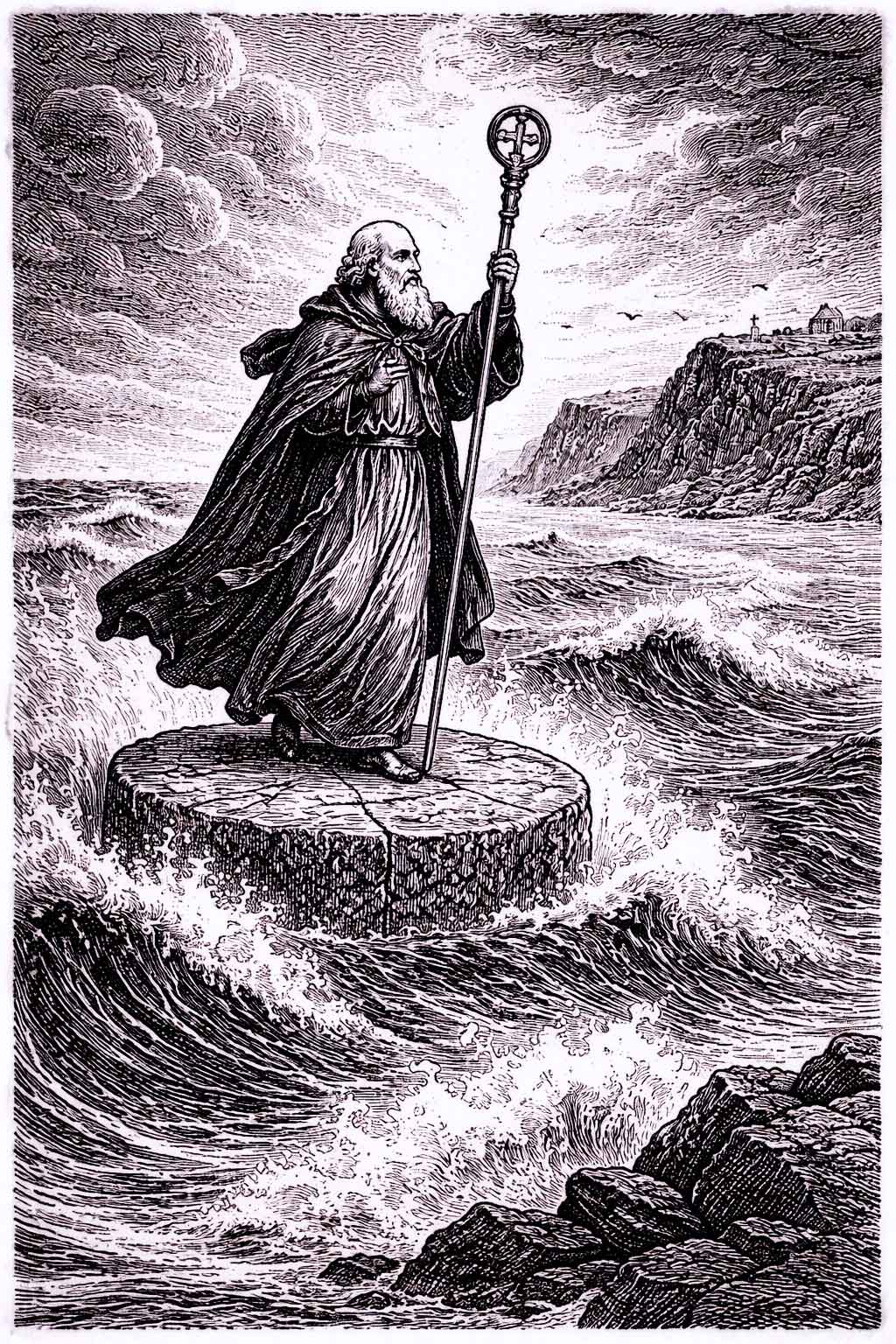
The first community Piran attracted was not human but animal. A boar, a fox, a badger, a wolf, and a hind with a fawn came to him humbly and served him obediently. These animals were his original monastics, his first community before any human disciple arrived. A subsequent episode introduces comedy: the fox stole Piran's shoes, desiring to eat them, and carried them to his former den. Piran sent the badger to hunt for the fox. Finding him, the badger cut off his ears and tail with his teeth and violently pulled off his hair. The chastened fox followed the badger back to the saint, carrying the shoes safe. Piran rebuked him: 'Why did you cause so much wrong by not enduring a shortage of food and drink?' The fox repented and fasted for three days. In the Irish original, the badger discovers the fox has already eaten the ears and thongs from the shoes - a detail the Cornish version quietly glosses over.
III. Miracles, Kings and the Character of the Saint
The central section of the Life is a catalogue of miracles of considerable variety and narrative energy. King Geranus, imprisoned by a tyrant for giving away the royal cauldron to the poor, is promised release if he can produce seven hornless cows, red-haired with white heads. Searching in vain, he comes to Piran. The following morning, walking along a riverbank with the saint's blessing, Geranus finds precisely seven such cows; he gives them to the king for his freedom, and that night the animals vanish and are never seen again.
A servant extinguishes the monks' fire at the instigation of the devil. Piran declares that no fire shall come to that place until fire comes from God. The boy is slain by wolves in the forest the following day. When Geranus arrives, Piran prays and fire falls from heaven onto his chest; he carries it to their lodging in his clothes, uninjured. The dead boy is then raised to life during supper. Saint Wingella, Piran's mother, lived nearby with her maidens and had a beautiful fosterling named Bruncta, seized by a king. Piran demanded her release; the king refused unless a stork should crow in winter to wake him. That night snow covered the whole land except where Piran stood, and in the castle a crane sang contrary to its nature and woke the king, who submitted. The king later repented and tried to take Bruncta back, but found her dead; his citadel caught fire in punishment, and his son left behind in the burning house was found safe and sound, having been commended to Piran's hands. The king submitted entirely, and Bruncta was raised from the dead by Piran's prayer.
Among the most spectacular miracles is the raising of seven harpists belonging to King Cohingus, slain and cast into a lake. After a three-day fast by Piran, the lake dried up, the bodies were found at the bottom, and all were immediately revived - though they had lain dead under the water for an entire month. The lake remained dry ever afterwards. In another episode Piran fed Saint Patrick, ten kings of Ireland and their armies for three days, having slaughtered eight of his own cows, and turned the water of the fountain into excellent wine for the duration.
The Life closes with a formal portrait of Piran's character that represents the ideal of the Celtic monastic saint:
"Saint Piran in his entire life never wore sheep's wool, but the skins of wolves and wild animals. He manfully abstained from flesh and fleshly desires, and he did not drink intoxicating drink. He did not even worry about sleeping, except a little rest. But the angels frequented him with constant visits. He ordained innumerable priests, bishops, and clergy. For more than two hundred years he lived in the body, without the pain which is accustomed to infest naturally the elderly, and without diminishing either in teeth or eyesight."
The claim of two hundred years of life is hagiographical convention, but the substance of the portrait - fasting, sleepless nights, cold, hunger, thirst, nakedness and chastity - places Piran squarely in the tradition of Irish peregrine monasticism. Piran was, the Life states, one of the twelve chief bishops appointed by Patrick to preach the gospel in Ireland, a claim echoed in the feast sermon at Perranuthnoe in 1905.
His departure from Ireland is narrated with an extended farewell speech of considerable pathos, in which Piran prophesies the troubles to come - mortality and battles, deserted churches, truth turned to iniquity, shepherds attending to themselves more than to their flock - before sailing to Cornwall to found his house and show many miracles. His death is described with great economy: he called his brothers, instructed them concerning the kingdom of God, ordered a tomb to be prepared, and descending into the pit, on the third of March, his soul entered the heavens. The Life concludes with a topographical note: 'He rests in Cornwall above the sandy sea, fifteen miles from Petrockstowe, and twenty-five from Mousehole' - one of the very few details in the text that may have independent Cornish origin.
IV. The Journey to Cornwall: Millstone and Miracle
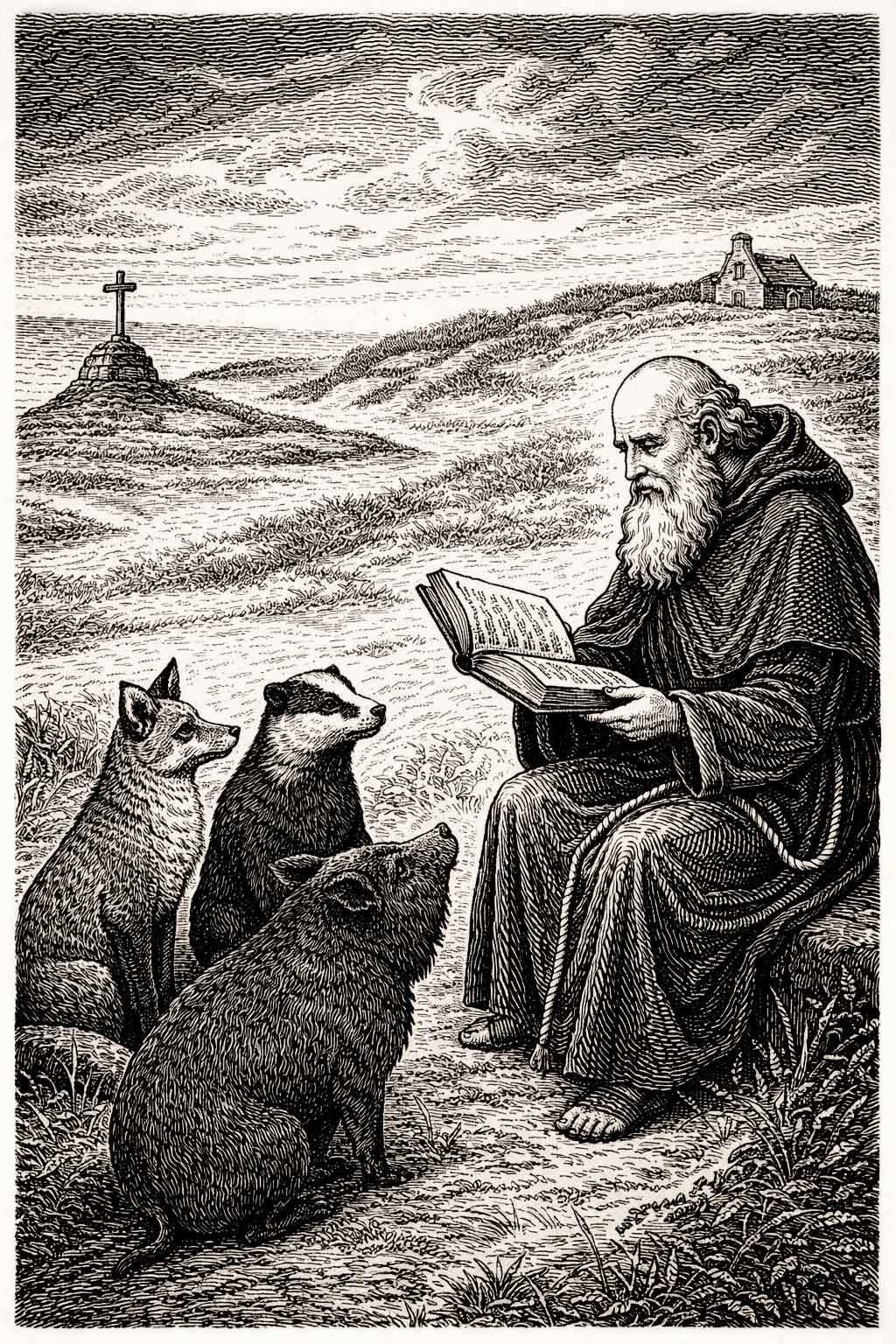
The tradition of how Piran came to Cornwall is one of the most vivid in the whole treasury of Celtic saint-lore. The medieval Vita is relatively sober: Piran sailed to Cornwall after his farewell to the Irish community. But the popular tradition is far more colourful. According to this version, Piran had become unpopular at the Irish court - one source identifies the king as Aegnus - by performing miracles at inconvenient moments. The chiefs, feeling that he needed a change of air, sent him on a precipitate cruise to the Cornish Riviera, securely fastened to a millstone which they happened to have to hand.
The stone floated when it hit the water - an inversion of the expected natural order that itself constitutes a miracle - and carried Piran across the Celtic Sea to Pirran Bay on the north coast of Cornwall. Here he found the West Country folk more to his liking, settled happily with them, and helped them build a church. The Museum of Cornish Life records that his first converts in Cornwall were animals, before he gradually won the local population - a detail that resonates directly with the account in the Vita of the boar, fox, badger, wolf and hind who formed his first community in Ireland.
A more elaborate tradition recorded by Baring-Gould holds that Piran brought with him a bottle of whisky. On landing he found a hermit named Chegwidden, and the two became friends. When the whisky ran out, Piran proposed to demonstrate how to distil more. Chegwidden collected black stones and they built a fire, whereupon a liquid stream like silver ran from the heated stones - and that, the story concludes, is how tin was discovered in Cornwall. The name Chegwidden means the White House.
V. The Cornish Flag: White Cross on Black Ground
The legend of the discovery of tin is inseparable from the origin of the Cornish flag, and the two traditions mutually reinforce each other. When the white-hot metal flowed from the black rock in Piran's fire, it is said to have formed the shape of a cross - and from this image the flag of Cornwall takes its design: a white cross on a black background, known in Cornish as Baner Peran. An alternative tradition holds that the white cross represents good and truth overcoming the evil of the world, the black field representing the darkness that Cornwall's saints came to dispel.
The flag's connection to Piran was articulated with particular passion by a correspondent to the Royal Cornwall Gazette in December 1879: the banner of Cornwall - a white cross on a black ground - was once the standard of the whole county, he wrote, and should not be allowed to remain in a desecrated state. That a saint so associated with tin mining should also be the source of Cornwall's national emblem is apt: for centuries the mining industry was the economic foundation of Cornish life, and the miner's patron saint was naturally also the people's saint. As Sir Arthur Quiller-Couch told an audience at St. Agnes in 1929, the footprints of the saints had been wiped out by drifting sands, but the faith they preached still remained. The flag, it might be added, still flies.
VI. The Buried Oratory: First References and Historical Record
The oratory at Perranzabuloe, situated on a desolate dune system known as Gear Sands to the north-east of Perranporth on the North Cornwall coast, is now a Scheduled Monument (number 1018955) owned by Perranzabuloe Parish Council. It sits within a Special Area of Conservation and a Site of Special Scientific Interest. The surrounding dunes have shaped every chapter of its history - burying it, preserving it, and presenting its excavators with a fresh crisis in every generation.
The first definite historical reference to the oratory can be dated to 1586, when William Camden published his Magna Britannia. Camden described the building as a sacellum - a small sanctuary or chapel - a term that the archaeologist T. G. Dexter later pointed out was unlikely to have been used of the nearby, much larger, parish church, and that therefore almost certainly referred to the oratory. In 1620 Nicholas Roscarrock described it as 'overblown' and 'drowned' with sand. William Borlase, writing in 1740, noted that 'the church of Piran San was anciently situated further to the west, now swallowed up by the sands.' Then in 1789 a man named Christopher Cotty Jenkin was walking on the dunes, came to a spring to drink, and from that vantage point saw the end of the church just appearing from the summit of a sand dune - the first recorded observation of the emerging walls.
By 1817, when Davies Gilbert wrote his Survey of Cornwall, the two end walls were partly visible above the sand, and on the south side the burial ground was observable, already full of human bones. In 1820 a correspondent reported 'thousands of teeth and other human bones, even whole skeletons, lying exposed in regular order.' The site was already associated, by universal local tradition, with Perranzabuloe's patron saint and with the Domesday Book entry of Lanpiran, recorded in 1086 as an important ecclesiastical Lan - suggesting that in the eleventh century the settlement was thriving and its lands wholly free of sand. Baragwanath King, writing in the West Briton of March 1932, argued compellingly that the catastrophic inundation was not an ancient and continuous process but a dramatic medieval event, perhaps the phenomenal tempest that was said also to have overwhelmed the lands of Cubert and Holywell.
VII. The 1835 Excavation: William Michell and the Discovery
In the late summer of 1835, William Michell, a Truro businessman, undertook the first systematic excavation of the buried oratory, deliberately choosing September when the water table would be at its lowest - an astute decision that his successors did not always emulate. Writing to the West Briton in a letter dated September 15th, 1835, he described what he had found:
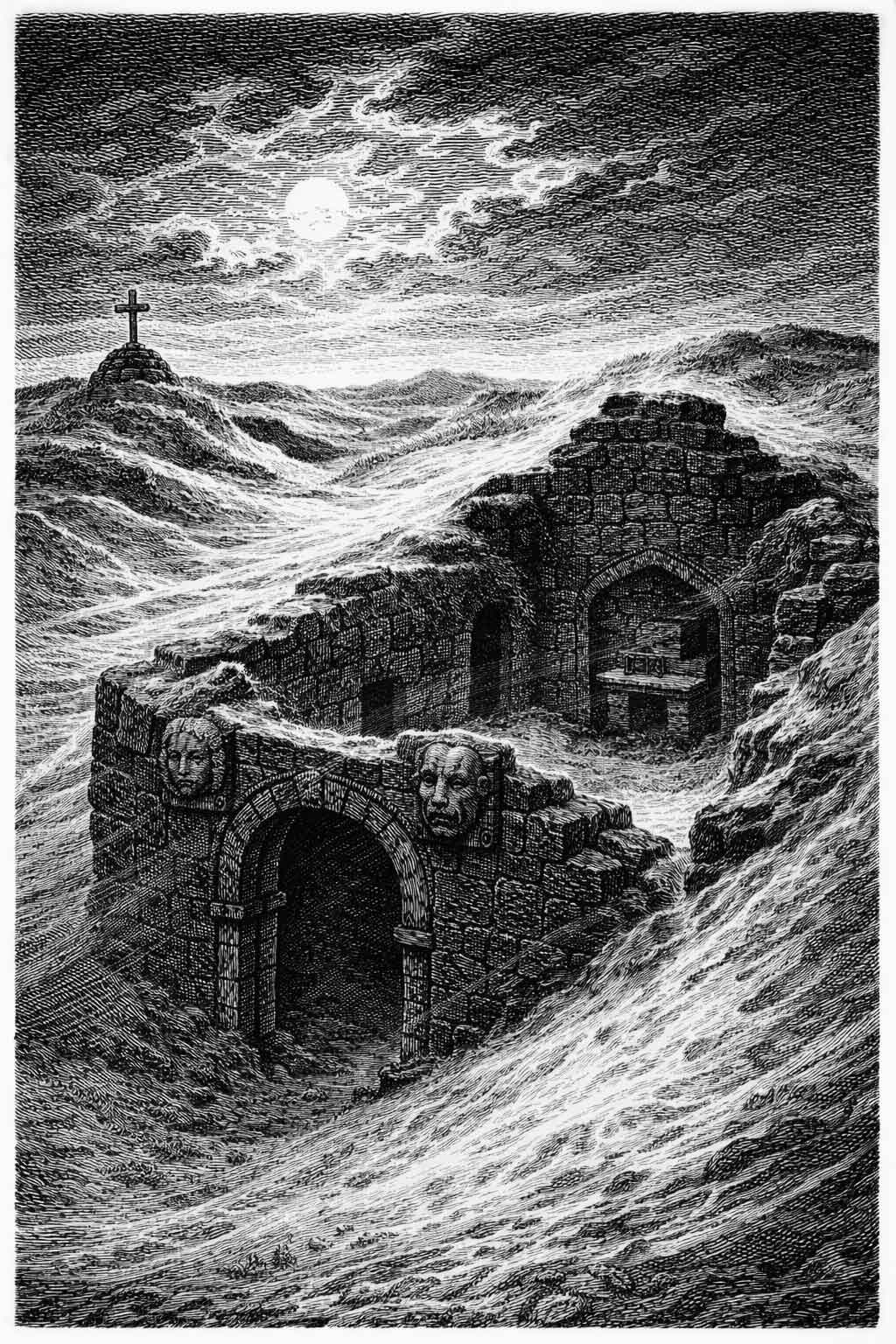
"I have just removed the sand from the oldest church in this parish, which appears to have been overwhelmed by it, according to tradition, supported faintly by records, 500 or 600 years ago. This church is probably one of the most ancient ever laid open and wants nothing to render it as complete as when first erected, except its roof and doors. The length of the church within the walls is 25 feet; without 30; the breadth within, 12 and a half feet; and the height of the walls the same. At the eastern end is a neat altar of stone, covered with lime, 4 feet long, by 2 and a half wide and 3 feet high. Eight inches above the centre of the altar is a recess in the wall, in which probably stood a crucifix, and on the north side of the altar is a small doorway, through which the priest must have entered."
He described the doorway in the south wall as 'an extremely neat Saxon arched doorway, highly ornamented, 7 feet 4 inches high, by 2 feet 4 inches wide,' the keystone of the arch bearing a rudely sculptured tiger's head. At the points of the curve were the carved head of a man and that of a woman. Stone seats ran around the west, north and south walls of the nave, twelve inches wide and fourteen inches high. The floor was composed of sand and lime. The building had no windows except a small aperture in the south wall of the chancel ten feet above floor level - meaning, Michell concluded, that the services must have been performed by the light of tapers. Around the building lay thousands of human bones and teeth exposed to the elements.
The 2025 archaeological report by Cornwall Archaeological Unit confirms and elaborates Michell's dimensions: the north wall measures 9.6m externally, the south 9.5m (10.2m including a later buttress), east 5.7m and west 5.15m. Wall widths range from 0.55m to 0.9m at base. The west gable wall, the most intact surviving section, stands internally to a height of 3.5m. The building is constructed from uncoursed rubble, predominantly angular slate in grey and reddish tones, probably sourced locally from nearby cliffs. The primary fabric is bonded with clean sandy mid-brown to yellow-brown clay with no trace of mortar - a building method long associated with early Christian structures in Ireland and Cornwall, though as the archaeological analysis makes clear, this does not in itself establish a pre-Norman date.
In addition to the oratory, Michell also excavated a second small building approximately a hundred yards to the south-east - a structure measuring twelve feet by sixteen feet and approximately ten feet in height, with a window in the south front and a door about seven feet high, accompanied by a shell midden. This was later described by Thurstan Peter as a 'priest's house' or hermit's cell, possibly connected with the oratory. A square bank in approximately this location may still be the earthwork remains of this structure.
Also discovered in 1835 were the remarkable skeletal remains beneath the altar. Three skeletons were found with their feet lying under the altar stone; one of these was of gigantic dimensions, measuring some seven feet six inches - headless, the skull having been removed as a relic at some point in the medieval period, Sir John Arundell having left forty shillings in his will of 1433 to provide a rich and costly shrine for it. Beside these lay three more skeletons also without their heads, the heads having been apparently cemented together and placed between the knees of the skeleton nearest the south wall. William Michell interpreted these as the probable remains of martyrs who had suffered for the faith Saint Piran preached. In the burial ground to the south and west of the oratory, the bodies had been laid in the sand unenclosed in wood, probably covered with linen or flannel, in graves a few feet beneath the surface; flat stones were found underneath and around the skeletons. All lay east-west, with the legs frequently crossed in the manner of Knights Templar.
VIII. The Doorway, the Stone Heads, and Their Fate
The most remarkable architectural feature of the oratory, and the one most eloquent of its date, was the south doorway with its cable-moulded frame and three projecting carved heads. The doorway had a semi-circular head with a continuous cable moulding decorating its exterior face, from which projected three carved stone heads: an animal (tiger or lion) at the keystone, and a man and a woman at the curve-points. Projecting heads are a well-attested feature of Norman architectural decoration, found on fonts and arcades across Cornwall and Devon, and the cable moulding is similarly characteristic of Norman work in the county. Building archaeologist John Allan, who carried out the historic buildings analysis for the 2025 report, concluded that the doorway is probably of Norman date, and that the most plentiful parallels date from the twelfth century, especially its middle and later years.
The doorway's survival lasted precisely three days after Michell's excavation was complete. As William Haslam, curate of Perranzabuloe, recorded in the Archaeological Journal of 1845: 'within three days after the discovery was announced the doorway was destroyed, and the only cut stones of the building were carried away.' Michell, speaking at the Royal Institution of Cornwall annual meeting in 1838, clarified that fearing theft and vandalism he had had the three carved heads removed to the museum of that society. In 1909, anticipating the construction of the concrete protective building, the Royal Institution of Cornwall commissioned three resin cast copies of the heads from the British Museum so that the originals could safely be returned to the site. The rebuilt doorway arch of 1910 has three clear rebates where the heads were positioned, fixed with copper wire. However, only one original stone head and three resin casts are now held by the Royal Cornwall Museum; two original stone heads are at present unlocated.
The cable-moulded stonework of the doorway was carved in 'Sandrock' - a coarse, open-textured yellow sandstone that outcrops to the north of the site and was used locally in the medieval churches of Cubert and Crantock. Only the bottom thirty centimetres or so of each doorjamb survived the collapses of the nineteenth century; above that level the doorway was crudely rebuilt in machine-made brick and Portland cement during the 1910 works. These lowest surviving courses, bonded in the same yellow-brown sandy clay as the rest of the early masonry, are considered to represent the only intact sections of the primary Norman build. The question of whether the decorative cable-moulded frame is bonded in the same material as the original walling - which would confirm it as a primary feature - had not been definitively resolved at the time the 2025 report was written, pending further investigation by a conservator.
Also noted during the 2014 excavation was a so-called 'inscribed stone' built upside down into the rebuilt east jamb of the south doorway, first recorded by Hencken in 1932 and included in the Scheduled Monument listing. The stone bears the letters RN, FA, and adjacent letters MH or HW. It had long been suggested that these might indicate a fifth- or sixth-century date for the building. The 2014 examination found the letters to be very sharply incised and of modern appearance, and the report concludes that they were most probably inscribed in the nineteenth century following the initial discovery, subsequently collapsed from the wall, and replaced upside-down during the 1910 reconstruction of the doorway.
IX. Haslam, Vandalism and Victorian Neglect
The excavation of 1835 proved to be both a discovery and the beginning of a long history of damage. Within three days of announcement the doorway had been stripped of its carved stones. A further excavation was undertaken in 1843 by William Haslam, then curate of Perranzabuloe, who rebuilt the altar as a slab inscribed 'Sanctus Piranus' - a piece of well-intentioned Victorian reconstruction that was subsequently criticised by Thurstan Peter and others as historically misleading. By 1855 Michell himself was writing despairingly: 'the hand of curiosity proved more ruthless than the sand. The north and west walls are only portions left entire. The south and east with doors and windows have fallen to the ground and sand is gathering round the ruin.'
A correspondent writing to the Royal Cornwall Gazette in December 1879 under the initials F.G.S. described visiting the little oratory to find the altar overthrown, the granite slab tossed into the centre of the building, and the grave rifled. Strewn around were the broken remains of numerous bottles, plainly identifying the class of despoilers. He wrote with evident disgust that picnic parties to the old church would howk up one of the numerous skeletons that lay buried so closely in the little churchyard, merely covered by a few inches of sand, apparently for amusement. He begged visitors to respect the bones of those who slept within.
The sand again filled the building. A second excavation in the early 1890s cleared the interior, and iron railings were erected around the building in 1892 to keep vandals out. This, as Morley Collins later explained at the Royal Institution of Cornwall annual meeting in December 1910, was an unfortunate course: by excavating the interior only and leaving the exterior sand in place, extreme weight was put on the walls, 'the pressure of the sand externally at once exerted itself and forced the masonry out of the perpendicular.' Late-nineteenth-century photographs show the walls bowing inward under this pressure, the building partially flooded, and substantial patches of white lime plaster still surviving on the interior walls - plaster that Michell's original account had described as 'beautifully white' and extending around the entire interior, a detail confirmed by the 2015 historic buildings analysis which identified surviving traces on both the west and south interior elevations.
X. The 1910 Concrete Structure
By 1904 the condition of the oratory was critical, and an appeal was launched by the Royal Institution of Cornwall. A trust was formed with the architect E. H. Sedding - author of Norman Architecture in Cornwall - in charge of the restoration works. In 1910 a contract was signed for the construction of what was described as a 'preserving structure' - a concrete shell building to be erected over the entire oratory to protect it from sand, flooding and vandals.
The works were extensive. Approximately 1,500 hollow concrete blocks were manufactured from waste material taken from the Bolingey Mine at Perranporth. A foundation trench was dug to considerable depth around the oratory - probably down to or below the level of the oratory's own foundations - destroying archaeological deposits and disturbing human burials in the surrounding cemetery without any detailed recording. The resulting structure was a modern-looking building with external buttresses, a vaulted concrete roof with roof lights, and a strong oak door. Over the doorway of the new building a granite lintel was inscribed 'Sanctus Piranus In Zabulo.'
The works also included the rebuilding of large sections of the oratory walls, particularly the south doorway, which had collapsed entirely. Brick buttresses and reinforced concrete beams were installed inside the building to shore up the walls, and at some point, probably in the 1930s or 1940s, a concrete floor was laid. In a subsequent effort to improve drainage, holes were drilled through this floor - an intervention that had precisely the opposite of its intended effect, allowing the rising water table to flood the interior more easily.
Not everyone admired the result. Dr T. G. Dexter, the archaeologist who had earlier excavated the medieval parish church nearby, wrote in 1922 with impassioned horror: 'if the buried church could speak, she would complain bitterly of the writers who have misunderstood her, of the trippers who have robbed her, of the Church that sold her, and of the enthusiasts who have entombed her in that hideous cement structure, which suggests a reservoir, a motor garage, an aerodrome, a picture palace, anything - except a church.' This description is, if anything, an improvement on the building's actual function: the concrete shell did little to prevent flooding, which remained a chronic and intractable problem throughout the twentieth century.
XI. The 1980 Reburial and the Sand Mound
The site continued to be a popular destination and place of pilgrimage throughout the mid-twentieth century. Services were held regularly, the altar was kept supplied with fresh flowers, and names from across the country were scratched into the brick buttresses and plastered altar front by visitors - a record of twentieth-century pilgrimage that the 2014 excavators recorded carefully, ranging from 'Keith Kingston, choirboy' to 'Major Philp, Crownhill, Plymouth 1945' and 'Elisabeth Truscott, Corby, July 1956.'
But water levels rose every winter and by the 1970s the problem of regular flooding had become insupportable. The local parish council took the decision to bury the site once more in sand, in this course of action supported by the Department of the Environment. A DoE site visit note held by the St Piran Trust is revealing in its frank assessment: 'A full inspection of the chapel showed that this is now largely a very bad 20th century rebuild, held up by a clumsy concrete corset, excavated to below footing level and devoid of any features or details. Even if it were possible to expose the site it would need an expensive unpicking and consolidation exercise to display what little remains of the original building … the importance of the site now lies in its historical and spiritual associations rather than in the rather dubious physical remains, and the best way of respecting these is [to] cover the sadly squalid little building and erect over it a suitably simple memorial.' The note added, somewhat dryly: 'Nor will this action inhibit future generations from digging it all up again.'
The reburial was carried out in August and September 1980. The outer concrete shell was partially demolished, and sand excavated from an area to the east of the building was used to cover the oratory, building up an artificial dune. The walls of the oratory were protected by an average of eight feet of sand above their highest surviving point. The small Latin cross that had stood on top of the bunker was removed to Perranzabuloe church. A granite slab memorial was placed on the new sand mound, inscribed: 'This stone is dedicated to the glory of God and in memory of Saint Piran, Irish missionary and patron saint of tinners, who came to Cornwall in the 6th century.'
Despite being hidden from view, the site's iconic status continued to grow. By this time Saint Piran had become Cornwall's adopted patron saint and a powerful symbol of regional and political identity, with the oratory at its core. Services and plays continued to be held around the sand mound on and around Saint Piran's Day each year. The St Piran Trust, formed in 2000, committed itself to uncovering the oratory once more and making it accessible and managed for present and future generations.
XII. The 2014 Re-Excavation
After years of ecological assessment, hydrogeological survey and negotiation with Natural England - necessary because the oratory lies within a Special Area of Conservation, home to the protected shore dock (Rumex rupestris) - excavation was finally approved. All necessary consents from Historic England and Natural England were in place by early 2014.
Excavation officially started at 10.30am on Monday 17th February 2014. Eileen Carter - the longstanding St Piran Trust trustee who had been the driving force behind the project for years, and to whose memory the 2025 report is dedicated - cut the first turf. The local MP, Sarah Newton, joined the team to help, and there was a strong media presence. Sand was excavated by hand using shovels and spades, transported by mini-digger and dumper to a spoil heap to the north-west as agreed with Natural England and the Ministry of Defence, whose training area adjoined the site. Over the following five weeks more than eighty volunteers helped, including, memorably, one dog.
Stage 1, which ran through February and March 2014, was defeated by the water table before the floor level could be reached. The end of an unusually wet winter had left the ground saturated, and despite continuous pumping, daily water seepage from all directions made excavation below a certain level impossible. The excavation was suspended and the exposed walls were covered with hessian and geotextile for protection. Stage 2 resumed in November 2014 after a dry summer and autumn, and on 13th November the concrete floor of the oratory was reached for the first time since 1980. The surviving oratory was found to be in remarkably good condition, given the radical interventions it had undergone in the twentieth century.
The surviving walls showed clearly the distinction between the primary medieval fabric and the areas of twentieth-century rebuild. The north wall was probably the most intact, though distorted and bowed by the weight of sand bearing against it over many decades. The east wall had been completely rebuilt, probably in the 1930s or 1940s; the west gable wall, standing highest and in many respects the most original portion, showed a change in masonry character towards the top - a course of larger boulders - which may represent either a lift in the original construction or a later rebuilding of the gable. The concrete floor itself had been subsequently drilled in an attempt to improve drainage, which had the opposite of its intended effect, allowing ground water to enter through the holes as the water table rose.
XIII. The Cemetery: Burials Old and New
The most significant new archaeological finds of the 2014 excavation came not from inside the oratory but from the burial ground surrounding it. While reducing sand levels outside the north-west corner of the concrete structure to relieve pressure on the walls, archaeologists revealed twelve articulated burials. Eleven were excavated under a coroner's licence, with all remains screened from public view and treated with due reverence.
The results were striking. Ten of the eleven excavated individuals were young children or infants, most below the age of five. The two exceptions were both female adults: one individual aged between seventeen and twenty-five (SK212), and a second, mature adult female of at least forty-five years (SK222). The left arm and left side of the torso of skeleton SK221, a child aged approximately three years, lay directly above the right femur of SK222, and both individuals displayed a distinctive anatomical trait known as metopism - a condition in which the frontal bone of the skull fails to fuse, which has a hereditary component - suggesting a probable family relationship between the two.
With the exception of one unusual burial in a flexed, crouched position aligned north-south, all skeletons were extended and supine, orientated east-west with the head to the west, the limb positions suggesting they had been wrapped in cloth or shrouds at burial. Several were associated with finds: white quartz pebbles were found with two burials, selected for deliberate deposition at the time of burial as part of a ceremonial act of remembrance recognised at other medieval burial sites in Britain. With one child burial (SK211) was found a Bronze Age flint blade, approximately 3,500 years old, placed flat beneath the skeleton on the base of the grave cut. The excavators interpreted this as a found item special to the child, treated perhaps as a lucky charm and deliberately placed in the grave. A Neolithic flint scraper found in the re-deposited sand suggested the presence of a prehistoric site somewhere in the vicinity.
Two burials were selected for radiocarbon dating. Skeleton SK208 gave a calibrated date at 95.4% probability of 780–875 cal AD, and skeleton SK211 gave a calibrated date of 750–886 cal AD. These dates - both firmly in the middle Saxon period - provide the first scientific evidence that the cemetery around the oratory was in active use during the ninth century, and are consistent with the use of the building as an active Christian site in that period.
As of August 2024, sixteen skeletal samples from the 2014 excavation have been transferred to Trinity College Dublin for fine-scale ancestry analysis using ancient DNA. Initial screening has demonstrated good preservation of genetic material, with an average yield of 43.16% human DNA, and results - which are expected to include details of individual physical characteristics such as eye and hair colour, as well as broader population ancestry and relationships to other ancient and modern British genomes, including modern Cornish genomes - are anticipated in 2025.
The wider cemetery is evidently extensive and extends to considerable depth, with the time-depth of burial activity suggesting centuries of continuous use. In 1910, during the construction of the concrete building, a mother and infant were unearthed near the south-west corner of the foundations - an adult (female?) alongside an infant wrapped in the remains of a shawl or shroud. At the same time, Dexter recorded several cist graves of slate without bases under the north and south walls, and a skull with skin still attached found nine feet below the surface in a five-slate cist capped with a large stone, which Dexter surmised - without strong evidence - might be the head of Saint Piran himself.
XIV. The Building Date: Norman or Early Christian?
Since the oratory's rediscovery in 1835 the question of its date has been among the most contested in Cornish archaeology. The initial presumption - shared by William Michell, E. H. Sedding, Howard Jenner and T. G. Dexter - was that the building dated from the fifth or sixth century and was therefore among the oldest standing Christian structures in Britain. This view was supported by comparison with early Irish oratories, especially the Gallarus oratory in County Kerry, then believed to date from the third or fourth century AD.
Modern scholarship has largely overturned both the early dating of the Irish parallels and the assumption that clay bonding indicates an early date. Peter Harbison's important paper on the Gallarus oratory argued that the earliest stone churches in Ireland dated to around 900 AD, that building in stone became more common in the tenth century and general practice only in the eleventh and twelfth centuries. The Gallarus oratory itself may be as late as the twelfth century; St Patrick's Chapel at Ardrass, Co. Kildare, once cited as an early parallel, is now considered late medieval, probably fifteenth century. The use of clay bonding - Sedding's key argument for a pre-Saxon date - is now known to have been standard building practice for both secular and ecclesiastical structures in Cornwall throughout the medieval and even post-medieval periods. The choir walls of the parish church of Perranzabuloe itself proved to be clay-bonded.
John Allan's 2015 historic buildings analysis for the Cornwall Archaeological Unit report concluded that the oratory's primary fabric is, strictly speaking, undatable from its construction technique alone. However, the cable-moulded doorframe and the three projecting carved heads are datable architectural features, and their parallels lie firmly in the Norman period, especially the twelfth century. Allan's conclusion: 'In summary, the doorway is probably of Norman date, and the most plentiful parallels to it are in the 12th century, especially perhaps its middle and later years. Unless this is a unique survivor, the oratory is probably of Norman date. Were it not for the site's association with St Piran and its evident antiquity (confirmed now by C14 dates), it would surely have been regarded simply as a single-phase Norman chapel.'
This conclusion does not, it should be noted, disprove the existence of an earlier Christian site at Perranzabuloe. The radiocarbon dates for the cemetery burials firmly establish activity in the ninth century; the Domesday entry of Lanpiran confirms the site's ecclesiastical importance by 1086; and the tradition of Saint Piran's residence may well preserve a genuine historical memory of an earlier wooden or other impermanent structure on or near the site of the surviving building. The Norman chapel may have been built to replace or honour an earlier foundation whose physical remains have not survived.
XV. The Flooding Problem: A Chronic History
From the moment William Michell first excavated the oratory in 1835, choosing September specifically because of water, flooding has been the defining challenge of the site. The building sits in a natural bowl in the dune landscape, directly over a high water table fed by surface run-off and the adjacent pond; in particularly wet winters, the two bodies of water merge into a single sheet. Services in the mid-twentieth century were sometimes conducted with the congregation standing on duckboards over a flooded floor.
In 1958 the mine engineer Ron Hooper was commissioned by Perranzabuloe Parish Council to assess the feasibility of a drainage channel. He concluded that drainage was possible in principle by trenching at a gradient of one foot in two hundred feet from the oratory to a water channel to the north. A partial drainage system was installed in the 1950s, but the pipes soon clogged with sand. In 2016 the St Piran Trust and Cornwall Archaeological Unit tested a syphon drainage approach, demonstrating the principle successfully - water was pumped from the oratory sump to the stream to the north-east over a distance of about a hundred metres - but a flexible pipe collapsed under vacuum pressure, and Phase 2 of the trial was never carried out. The fundamental problem remains unsolved: any drainage solution must contend with the ecological sensitivity of the surrounding SAC and SSSI, which constrains the scale of any excavation or pipe-laying that might be carried out.
XVI. Conservation, Vandalism and the Future
Since 2014 the oratory has been accessible once again to visitors and pilgrims, and services are held on Saint Piran's Day (5th March). The 2019 conservation programme by Old Light Building Conservation carried out a 'light touch' programme of stabilisation: unpicking unstable wall-tops, rebuilding in feebly hydraulic lime (NHL 2), and soft-capping the walls with turf cut from the surrounding dune landscape, held in place with biodegradable coir mesh until the native vegetation could root. This work produced a considerable improvement in the appearance and stability of the building, though the flooding regime means that every summer the St Piran Trust volunteers must clear muddy silt and any stones dislodged from the walls during the winter months.
The condition of the structure as of March 2025 - when the Cornwall Archaeological Unit report was finalised - remains concerning in several respects. Vertical cracks run through the west wall; the concrete buttresses added in 1910 are showing signs of degradation as the iron reinforcement bars corrode and expand, cracking away the concrete faces. Vandalism is a continuing problem: stones have been dislodged from walls and thrown into the water, and the drainage sump grille has been thrown into the middle of the oratory. The 2025 report was commissioned as part of Cornwall National Landscape's Monumental Improvement Project, with the aim of feeding into a future Conservation Management Plan for both the oratory and the nearby remains of the twelfth-century parish church, which was itself abandoned to the sand in the early nineteenth century.
XVII. Quarrelling Saints: The Folklore of Celtic Christianity
Alongside the testimony of archaeology runs a parallel tradition of folklore that brings the Cornish saints to life in a wholly different register. These stories reveal a distinctively human Christianity - saints who quarrel, throw stones at one another, steal chalices, distil illicit whisky and catch fish by miracle.
The tale most frequently told of Piran and his fellow saint Germoe concerns a shared bath. Piran invited Germoe to share the tub, and though the water was cold, Germoe was rewarded by catching a fish in it. The tradition at Perranuthnoe added that Saint Germoe was Piran's intimate friend, Saint Just his tutor, Saint Madron his pupil, and Saint Sennen his inseparable companion - a social network of Celtic saints that mirrors the interconnected monastic world described in the Vita.
The most celebrated of the Cornish saint-lore tales concerns Saints Just and Keverne. Saint Just visited Saint Keverne of the Lizard and the two enjoyed themselves together drinking from Keverne's chalice. When Just departed, Keverne found his chalice missing. Setting out in pursuit, armed with boulders and ironstone fragments picked up over Crowza Downs, Keverne called to the retreating Just repeatedly; Just paid no attention and made the best of his way home. Keverne resorted to throwing the rocks. Just eventually dropped the cup. The place where the boulders fell was known ever afterwards as Tremenkeverne - the three stones of Keverne - a toponym that survived as living witness to the quarrel. Arthur Salmon, writing in the Western Morning News of 1903, found in this irreverence not disrespect but evidence that the Celtic imagination kept the holy and the human deliberately close.
XVIII. The Patron Saint of Tin Miners and the World Beyond Cornwall
Central to Piran's cult in Cornwall is his association with tin mining and his legendary role in the discovery of tin. Whether through the Chegwidden story of heating black stones by the fire, or the image of molten metal flowing in the shape of a cross, the tradition that made Piran patron of the Cornish mining industry was deeply rooted and widely observed. His feast day on the fifth of March was kept as a holiday by tinners across the county for centuries.
The global reach of the cult is illustrated by a detail recorded in the Brechin Advertiser of February 1956. When the Queen and the Duke of Edinburgh visited the tin-mining country of Nigeria during their tour, they attended a church dedicated to Saint Piran - the Cornish saint carried to West Africa by the miners themselves. Cornwall's natural tin deposits, exploited since antiquity and industrialised during the eighteenth and nineteenth centuries, made Cornwall briefly one of the richest regions in Britain, and the miner's patron saint travelled wherever the miners went.
XIX. Saint Piran's Day: Modern Celebration
Saint Piran's Day on the fifth of March has grown considerably in prominence in modern times. Parades, parties and re-enactments - which rose in popularity during the twentieth century, assisted by the broader Celtic revival - now draw large crowds at Perranporth and elsewhere. The annual procession across the dunes to the oratory, marching over the very site of the buried building during the years of its reburial, is a central element of the celebrations, giving the ancient ecclesiastical site renewed life as a place of communal memory and Cornish identity.
The Cornish flag - Baner Peran - flies on the fifth of March from buildings across the county and far beyond it, a white cross on a black background that connects the celebration of a saint to the tradition of tin mining, to the legend of accidental discovery, and to the nine centuries during which the oratory and its surrounding cemetery lay beneath the sand, unknown and unvisited, while the memory of the saint who founded it was kept alive by the three successively larger churches built to replace it.
XX. A Saint for All Seasons
Saint Piran is, in many ways, the perfect embodiment of the Celtic Christian tradition - a figure of whom history preserves just enough to tantalise while folklore supplies the colour, the comedy and the humanity that the dry record denies. The medieval Vita, as Roger Pearse's translation and analysis makes clear, is not independent biography but a transplanted Irish hagiography; the oratory bearing his name, far from being the early Christian foundation it was long claimed to be, is in all probability a Norman chapel of the twelfth century, built over or near a site of earlier activity that the sands have concealed. And yet these revisions, important as they are, do not hollow out the tradition. They clarify its origins and correct its excesses; they do not erase it.
He was almost certainly a real historical person: an Irish bishop closely associated with Saint Patrick who crossed to Cornwall in the late fifth or early sixth century. Around that historical core the folk tradition constructed a figure of inexhaustible vitality: a saint who crossed the sea on a millstone, discovered tin by accident, shared his bathtub with a visiting colleague, and is now the subject of cutting-edge genomic research at Trinity College Dublin. The radiocarbon dates from the cemetery - 780 to 875 AD - confirm that this site was a living Christian community during the period when the Viking raids were reshaping Ireland, when the great Carolingian empire was fracturing, and when the Cornish people were pressing their identity against the expanding kingdom of Wessex. The bones of that community, now being analysed for the genetic secrets they carry, may yet tell us more about who these people were than fifteen centuries of hagiography has managed to reveal.
His white cross on a black ground has survived as the most enduring testament to his influence. The footprints of the saints, said Sir Arthur Quiller-Couch at St. Agnes in 1929, had been wiped out by the drifting sands, but the faith they preached still remained. The same might be said of Saint Piran himself. Much that was once associated with him has been buried, scattered, rebuilt in concrete, drilled through, flooded and vandalised. But the faith, and the flag, and the stories endure.
Principal Sources
James Gossip (Cornwall Archaeological Unit), St Piran's Oratory: History, Rediscovery and Conservation, CAU Report No. 2025R013. Commissioned by Cornwall National Landscape. March 2025.
Roger Pearse (trans.), The Life of St Piran (De sancto Pirano episcopo et confessore), from the Nova Legenda Angliae (1901 Horstman edition). Translated and published 2022. Public domain.
Trin Gleason, 'A Profile on Saint Piran: Patron Saint of Cornwall', Museum of Cornish Life, 2024.
Newspaper archives 1844–1956: the Kilkenny Journal, the Sun (London), the Royal Cornwall Gazette, the Southern Star (Skibbereen), the Cornubian and Redruth Times, the Western Morning News, the Cornishman, the West Briton and Cornwall Advertiser, the Irish Independent, the St. Austell Gazette, the Gloucestershire Echo, and the Brechin Advertiser.
This Topic
Celtic Britain, Sacred Landscapes and Lost Kingdoms
Sacred places, old kingdoms, borderlands, Atlantic routes, and the landscapes where memory, myth, and history overlap.
View Topic PageMore in this Topic
26 October 2025
Elmet A Brittonic Kingdom and Enclave Between Rivers and RidgesLatest Posts
27 March 2026
Hot Cross Buns: History, Origins & FolkloreDiscover the fascinating history of hot cross buns - from pagan offerings and Greek sacred bread to Chelsea bun houses and Good Friday folklore. Explore 2,000 years of spiced bread tradition.
22 March 2026
What Does "Ne'er Cast a Clout Till May Be Out" Actually Mean?Is it about the month of May or the hawthorn flower? And what on earth is a clout? We dig into 170 years of British newspapers to finally answer one of folklore's most argued questions.
20 March 2026
The White Hart: The Ancient Legend Behind Britain's Most Common Pub SignFrom Greek mythology to medieval forest law, the white deer haunted the British imagination for centuries. Discover the real history behind the legend of the White Hart — royal badge, supernatural omen, and elusive quarry of the soul.
13 March 2026
Why Is a Horseshoe Lucky? The Surprising History Behind the World's Most Universal CharmThe horseshoe has been nailed above cottage doors, cathedral gates, and battleship masts for centuries. Discover the ancient beliefs in iron, the crescent moon, and the sacred horse that made it the world's most enduring good luck symbol.
10 March 2026
Clare Island - Isle of Storms, Pirates and Naturalists: A History in Newspaper Voicesiscover the fascinating history of Clare Island, off the coast of Mayo - from the piratical legend of Grace O'Malley and bitter land disputes to a landmark natural history survey, told through contemporary newspaper voices spanning 1863 to 1986.
7 March 2026
The Wandering Fire - A History of Ball LightningFrom a French tailor stalked by a glowing sphere to thousands of iridescent globes hovering over a Dorset clifftop, discover the strange and fascinating history of ball lightning as recorded in British and Irish newspapers between 1792 and 1938 — and why science, for over a century, could only stand mute before it.