
The Wandering Fire - A History of Ball Lightning
Written by David Caldwell ·
As recorded in the British and Irish Press, 1792–1938
Of all the spectacles that a thunderstorm can produce, none is more strange, more unsettling, or more fiercely debated than the phenomenon known as ball lightning. It has been called a fireball, a globular thunderbolt, a wandering fire, and - by those who doubted its very existence - a trick of overexcited eyes. It has been seen rolling across kitchen floors, drifting through church windows, hovering over cliff tops, and exploding with the force of a cannon. It has killed a pig in rural France, blinded the crew of a steamer off the coast of Scotland, and passed harmlessly through the legs of a French tailor who was wise enough to sit very still.
For well over a century and a half, accounts of ball lightning filled the columns of British and Irish newspapers. Vicars described it from the pulpit. Scientists debated it in learned societies. Curious letter-writers wrote to editors to ask if anyone else had ever seen such a thing, and often found that they had. Yet for all the testimony - spanning continents, centuries, and every walk of life - science struggled to explain what it was, where it came from, or why it behaved as it did.
This is the story of ball lightning as the newspapers told it: a phenomenon that refused to be dismissed, and refused to be explained.
I. First Sightings: The Gorgon and the Cape of Good Hope
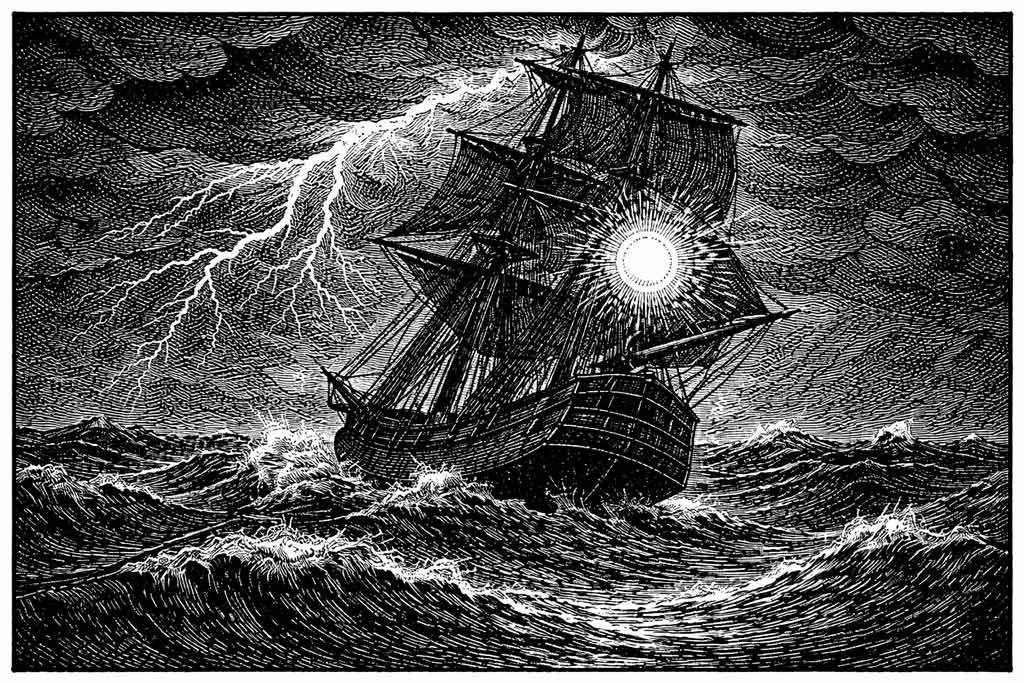
The earliest reference in the newspaper archive comes not from a scientist but from a ship's log, relayed in the pages of the Sherborne Mercury in June 1792. The story concerned HMS Gorgon, a 44-gun warship returning from Botany Bay, where the infant colony of New South Wales had been found 'in the greatest distress, being in want of every necessary of life.'
The Gorgon's homeward journey was eventful. Somewhere in the southern latitudes, on a night of violent thunder, the ship was engulfed by something extraordinary:
About a week before the Gorgon reached Jackson's Bay, in a violent thunder storm, a ball of lightning struck and wounded the fore and main masts, broke to pieces a leager full of arrack, and knocked down several of the people, without, however, doing them any considerable injury. - Sherborne Mercury, 25 June 1792
The account is matter-of-fact in tone, sandwiched between news of passenger lists and the appointment of Barrington the famous highwayman as High Constable of Paramatta. Ball lightning aboard a man-of-war was, it seems, merely one more hazard of the southern seas - remarkable, but not astonishing. What the men saw that night, and what exactly struck the masts and the cask, is not elaborated upon. The newspaper moves quickly on.
It would be many decades before the press began to dwell on such things.
II. The French Tailor and the Curious Case of Val de Grace
By the middle of the nineteenth century, ball lightning had acquired a literature. The French meteorologist M. Babinet had been commissioned by the Academy of Sciences in Paris to investigate the phenomenon, and his most celebrated case study - reported in the Kilkenny Journal of January 1857 - has lost none of its peculiar charm in the intervening years.
The scene was a tailor's lodging in the Rue St. Jacques, Paris, around the year 1843. The tailor had just finished his meal when the chimney board fell, as if overset by a slight gust of wind. Then:
A globe of fire, about the size of a child's head, came out quietly and moved slowly about the room, at a small height above the floor. The tailor said it looked like a good sized kitten, rolled up into a ball, and moving about showing its paws. It was bright and shining, but he felt no sensation of heat. - Kilkenny Journal, 28 January 1857
The globe came near his feet, like a young cat soliciting attention. The tailor, with admirable presence of mind, gently moved his feet aside rather than attempting to stamp on it or flee. It appeared to examine him for several seconds, then rose to the height of his head, elongated slightly, and made for a hole in the chimney above the mantelpiece - a hole that had been pasted over with paper for the winter.
'The thunder,' the tailor said, 'could not see the hole.' But the ball found it anyway, removing the paper without damaging it, and disappeared up the chimney. Moments later came a dreadful explosion from above, destroying the upper part of the chimney and sending fragments crashing onto the rooftops of smaller buildings nearby. The tailor's lodging was on the third floor. The floors below were untouched.
Babinet's account became one of the most quoted in the entire literature of ball lightning - a neat, self-contained story with a beginning, a middle, and a dramatic ending. It had the great virtue of a single, reliable witness, and the ball itself had behaved exactly as the phenomenon was supposed to behave: slowly, deliberately, apparently intelligently, and then with sudden, catastrophic violence.
III. The Village of Salagnac and the Pig Who Dared to Smell It
Almost as celebrated as the French tailor's encounter was an incident that took place on the 10th of September, 1845, in the village of Salagnac, in the valley of the Corrèze. This case was reported in multiple British newspapers throughout the 1860s and 1870s, having been gleaned from de Fonvielle's widely-read work 'Thunder and Lightning,' translated into English in 1867.
A ball of lightning entered the kitchen of a farmhouse and rolled across the floor. Three women and a young man were present. The women, unaware of what they were dealing with, shouted to the young man - near whose feet the ball was rolling - to step on it and extinguish it. As the Newcastle Chronicle retold the story in 1869, what saved him was an unlikely piece of good fortune:
Luckily for him this peasant had been to Paris, and had been electrified one day on the Champs Elysees for two sous. He had learned to respect the mysterious fluid and its shocks; and in spite of the imprudent exhortation of the girls, he allowed the ball to pass by. - Newcastle Chronicle, 29 May 1869
The ball drifted through the kitchen without harming anyone, passed into an adjoining stable, and exploded. It killed the pig that happened to be shut up there - a creature that, the Newcastle Chronicle noted with wry satisfaction, 'knowing nothing about the wonders of thunder and lightning, dared to smell it in a most rude and unbecoming manner.'
The story became something of a parable. Do not run. Do not stamp on it. Do not, above all, attempt to smell it. Simply sit still and let it find its own way out. This was the advice that J. Longman of High Holborn was still dispensing to readers of the Northern Chronicle, the Southern Reporter, and the Caerphilly Journal in the autumn of 1938 - nearly a century after the pig of Salagnac had learned the same lesson the hard way.
IV. The Church at Stralsund and the Ball That Bred
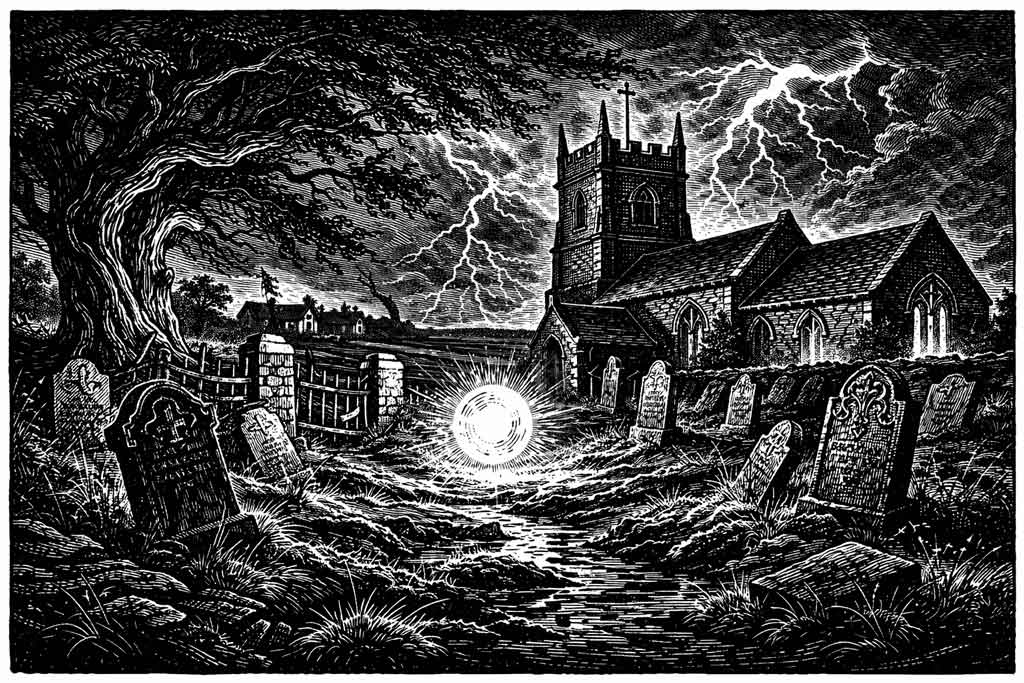
Not all encounters with ball lightning ended in mere explosions. One of the most extraordinary events on record - frequently cited in the Victorian press - took place in the church of Stralsund in Germany, where a ball of lightning entered during a service and, on exploding, 'projected a number of balls, which exploded in their turn like shells.'
This strange reproductive behaviour - a single ball giving birth to a cluster of smaller ones, each with its own destructive charge - was reported in the Yarmouth Independent in January 1868, and again in the Wicklow News-Letter, the Enniscorthy News, and several other papers that carried translations from de Fonvielle's work. It was precisely the kind of detail that made ball lightning so difficult to dismiss as mere optical illusion: the secondary balls were as destructive as the first, and their explosions were heard by the entire congregation.
A similar multiplication of effects was reported in the church at Altenmarkt, near Fustenfeld, in Austria, in August 1892. While the priest was administering the sacrament, the church was struck by lightning, followed by a loud explosion. There was nothing to show how the lightning had entered, but it was supposed to have come through the conductor leading from the steeple. It was said to have been a large globe, tapering towards the upper part, and after the explosion it left a strong sulphurous smell. 'The explosion was very loud,' reported the Jersey Express, 'and shook the building.' The congregation fled in panic, ignoring the priest's assurances that there was no danger.
V. The Ringstead Bay Spectacle: Thousands of Glowing Spheres
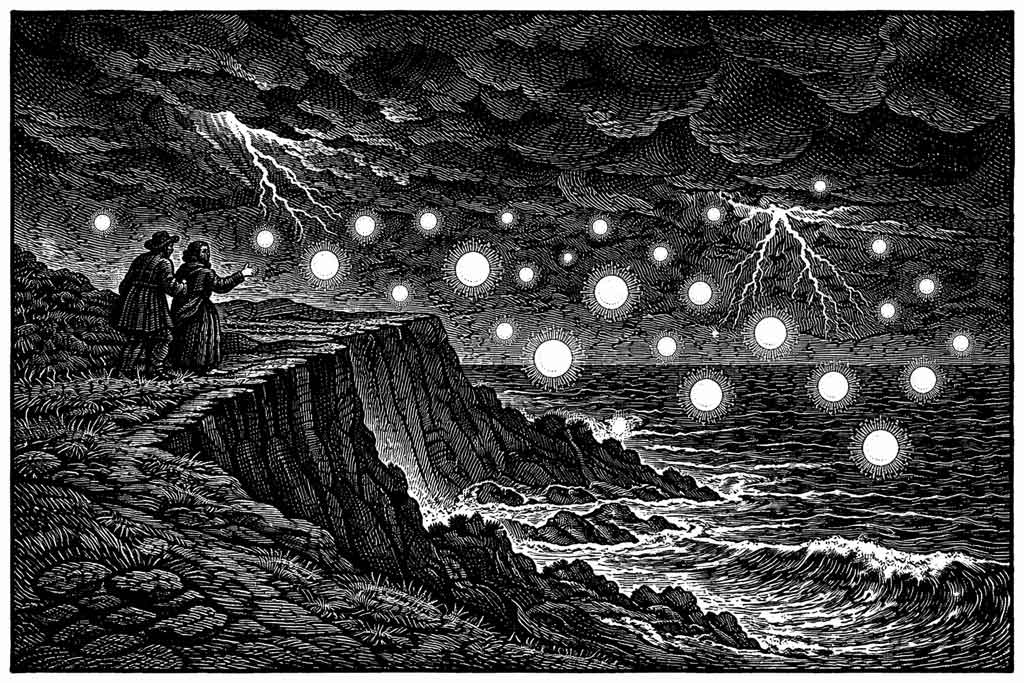
Most encounters with ball lightning involved a single sphere. The events at Ringstead Bay in Dorset on August 17, 1876, were in a different category altogether. The account, communicated to the Royal Meteorological Society by Mr. H. S. Eaton, M.A., and reported in the Edinburgh Evening News in September 1887, describes something that sounds more like a vision than a natural phenomenon.
Between two and five in the afternoon, those who were on the cliff at Ringstead Bay found themselves surrounded, on all sides, by numerous globes of light the size of billiard balls. These globes were moving independently, vertically up and down, sometimes eluding the clutches of the observers, but always eluding their grasp. As the Cork Weekly News described it:
The balls were all aglow, but not dazzling, with a soft iridescence, rich and warm of hue, and each of variable tints, their charming colours heightening the extreme beauty of the scene. Their numbers were continually fluctuating, thousands of them at one time enjoying the scene, then there would be no more than a score, to be succeeded the next few minutes by swarms as numerous as ever. - Edinburgh Evening News, 8 September 1887
The phenomenon was entirely noiseless. This distinguished it from most ball lightning encounters, which ended in explosion. It was also remarkably prolonged, lasting for at least three hours. No satisfactory explanation was ever offered for what the observers at Ringstead Bay witnessed that summer afternoon.
VI. A Bolt Through Aberavon: The Schoolroom and the Weather-Vane
The drama of ball lightning was not always a matter of philosophical curiosity. Sometimes it arrived without warning in places where people gathered - churches, schoolrooms, kitchens - and left chaos behind it.
On a Tuesday evening in June 1859, about forty persons were assembled at a weekly service in the Boys' National Schoolroom at Aberavon in South Wales. The Reverend D. Evans was reading the evening service when the storm broke around them. Having observed the female portion of the congregation full of fear, he urged them to composure, reminding them that their lives were in God's hands and that nothing could befall them without His permission. As the British Ensign reported:
While the preacher was showing them that the God of the thunder and storm was the God of His people in every peril, their refuge and strength... the metallic weather-vane of the schoolroom had (it is supposed) drawn down the 'bolt of heaven.' Then was heard, amid the screams of women and children, an awful crash and a terrific booming within the place - a sound as of a rushing mighty wind, filling the place with a sulphurous smoke. - British Ensign, 29 June 1859
The aperture in the wall where the lightning entered was very large, and several persons were sitting directly beneath it. Yet, despite this, all lives were preserved. The newspaper attributed the deliverance to merciful Providence. The only damage was to the building itself and the shock given to those present.
VII. The North Riding Storm: Ball Lightning Like Inverted Rockets
Not all ball lightning crept quietly through rooms and stables. The great storm that struck the North and East Ridings of Yorkshire in August 1871 produced something altogether more spectacular. As the Huddersfield Daily Examiner reported, alongside accounts of deaths by lightning at Knavesmire and Bakewell:
In addition to the ordinary forked lightning there was a horizontal play from cloud to cloud, and a frequent discharge of the so-called 'ball' lightning, resembling inverted rockets. For an hour the sky was a continued blaze, and sheet lightning prevailed for some hours. - Huddersfield Daily Examiner, 21 August 1871
This image - ball lightning like inverted rockets, streaming upwards from cloud to cloud on a blazing sky - is one of the most vivid in the newspaper record. It suggests something more energetic than the slow, drifting spheres of the French accounts: a ball lightning that moved with the speed and violence of a firework display, visible across the entire Yorkshire sky.
The same storm killed a man at Knavesmire, blinded his wife and child (the wife subsequently dying of her injuries), killed another man at Albury Grange near Bakewell, killed a labourer at Dore near Sheffield, and struck dead a young man named Baxter in Manchester. Ball lightning was only one component of a catastrophe.
VIII. The Australian Correspondent: Lightning in the Antipodes
Ball lightning was not merely a European phenomenon. A vivid account from Mount Gambier in South Australia, printed in the Montrose Review in April 1861, described the particular character of electrical storms in the southern hemisphere - and noted that ball lightning was among their regular features:
Sheeted, forked, and ball-lightning may be frequently seen at the same moment. Not only, however, are the forms of the lightning varied, the colours of the light also vary. Now it is a glare of white light, then it is blue, anon a deep lurid red. Sometimes there is scarcely any perceptible interval between the flashes, so rapidly are they repeated. - Montrose Review, 12 April 1861
The correspondent, writing on January 16, 1861, offered a consoling thought: lightning was less dangerous in Australia than in Europe, since the trees everywhere acted as natural lightning conductors. The colonists, he wrote, had become so accustomed to the displays that one soon ceased to regard them with apprehension. 'I, for one, feel less nervous fear during an Australian thunder-storm than I have often felt during a brief local thunder-shower at the foot of the Grampians.'
He did, however, note that three men had recently been killed while mowing in a field near Adelaide - having injudiciously held their scythes during the storm.
IX. The Scientists Weigh In: Arago, De Fonvielle, and the Question of Ozone
By the 1860s, the phenomenon had attracted serious scientific attention. The French physicist Arago had classified lightning into three types - forked, sheet, and ball - and his taxonomy was widely reproduced in the British press. The Reading Mercury, in October 1863, offered as clear a summary as any:
Lightning of the third kind is called ball-lightning. This so-called lightning appears, perhaps, more a meteor, which, on rare occasions, accompanies electric discharge, or lightning proper, than a phenomenon in itself electrical. It is said to occur in this way: After a violent explosion of lightning, a ball is seen to proceed from the region of the explosion, and to make its way to the earth in a curved line like a bomb. - Reading Mercury, 10 October 1863
This was the established view: ball lightning was essentially a by-product of a forked discharge, a ball of fire that emerged from the point of explosion and travelled independently until it struck something or spontaneously detonated. It was dangerous, it was real, and a lightning conductor offered no protection against it.
The Bradford Observer of September 1866 cited the great astronomer Sir John Herschell, who had noted that the sudden appearance of a rapidly moving ball of fire during a thunderstorm - popularly called a thunderbolt - was 'erroneously supposed to fall as a solid body.' And it quoted Arago's famous observation that 'many questions might be asked of ball lightning, in presence of which science would stand mute.'
As the nineteenth century gave way to the twentieth, theories began to proliferate. The Barnsley Independent in 1921, and several other papers around the same time, proposed that ball lightning was 'composed of oxygen and ozone thrown off from a negatively charged cloud,' and that its eventual explosion was caused by the energy released when ozone reverted to ordinary oxygen. The Clifton and Redland Free Press elaborated: the ball was 'probably an isolated sphere of ozone gas containing a considerable amount of energy stored in it by the action of electricity during a thunderstorm, which falls earthwards as a luminous ball after a severe flash of lightning, and explodes with extreme violence on nearing the earth.'
It was a tidy theory. Unfortunately, it did not entirely fit the facts. Ball lightning had been observed rising from the ground as well as falling towards it. It had been seen in rooms with no obvious connection to the outside. It had drifted horizontally, apparently against the wind. And it had, on occasion, passed through walls.
X. The Lecturer at Leeds: Ball Lightning and the Electric Telegraph
The Durham Chronicle of October 1861 carried a detailed report of a lecture on lightning delivered by the Reverend Temple Chevallier, Professor of Astronomy at Durham University, to the Leeds Working Men's Institute. Chevallier divided lightning into three classes - zig-zag, sheet, and fire-ball - and offered some practical safety advice for his audience: avoid trees during thunderstorms, especially ash trees; do not stand near the walls of a house; do not carry too much metal about your person.
On the subject of ball lightning specifically, Chevallier was unequivocal: it was 'the most difficult to account for' and 'the most concentrated form of electricity.' Most people thought a flash of lightning lasted a considerable time, he noted, but in ordinary cases it lasted no more than a thousandth part of a second. Ball lightning, by contrast, persisted - visibly, independently, and dangerously - for seconds or even minutes.
Chevallier also made a point that would recur throughout the Victorian treatment of the subject: lightning was 'the same agency - though in a much more highly concentrated form - which was used in the electric telegraph.' The harnessing of electricity for communication, then transforming Britain, was made of the same stuff as the wandering fire. The implication was both thrilling and slightly unsettling.
XI. Mr. Varley's Experiments and 'Ball Lightning' at the Royal Society
The most remarkable scientific attempt to explain ball lightning described in the Victorian press was that of Mr. Cromwell F. Varley, reported in the London Evening Standard following the Royal Society soirée of March 1871. Varley - an electrical engineer involved in the laying of the Atlantic telegraph cable - had constructed an apparatus specifically to demonstrate the conditions under which ball lightning occurred.
Using a glass tube containing rarefied hydrogen, a powerful electromagnet wrapped in nearly a ton of copper wire, and discharges from thirty cells of Grove's nitric acid batteries, Varley produced a luminous arch that followed the course of the magnetic field. When the polarity of the magnet was reversed rapidly, this luminous arch dissolved, reformed, and in doing so performed a complete revolution. Varley argued that this confirmed his theory that ball lightning was the result of electric discharge in the atmosphere behaving in accordance with Ampere's theory of magnetic currents.
The Standard reported that Varley considered his experiment to account for 'all the well-authenticated descriptions of this phenomenon which have been given by the few who have had the good fortune to be witnesses.' Not everyone agreed. But the attempt to reproduce ball lightning in a laboratory - however indirectly - was a significant step, and Varley's paper to the Royal Society on ball lightning had, as he himself noted, been accepted without controversy, in contrast to other, more contentious research he had pursued.
XII. Queen Mary College and the Five-Inch Fireball
By 1938, ball lightning had acquired a curious new celebrity. Professor J. T. MacGregor-Morris of Queen Mary College, London - who had helped to develop one of the leading courses in high-voltage electricity in the country - had described producing a fireball experimentally in his laboratory. Even more arresting was the account of one of his students, who had been sitting in a room when 'a ball of fire about five inches in size came slowly past him within three feet, entering at one door and out at another.'
This story, circulated by J. Longman of High Holborn in a series of identical letters to newspapers across Britain and Ireland in the autumn of 1938, prompted a flurry of correspondence. Longman's practical advice - do not run; the fireball will follow the draught you create; better to sit still and hope it exits as it entered - was reprinted in the Northern Chronicle, the Southern Reporter, the Caerphilly Journal, and the Daily News (London), among others.
'Has any of your readers met this curious phenomenon?' Longman asked, in each letter. The question had been asked, in various forms, for a hundred and fifty years. The answers, when they came, were always the same: yes, I have seen it; no, I cannot explain it; yes, it is exactly as you describe.
XIII. The Colour of the Thing: Descriptions Across the Centuries
One of the most striking features of the newspaper record is the consistency of description across time and geography. From a Dorset clifftop in 1876 to a Brighton kitchen in 1921, from a French tailor's lodging in 1843 to a Swedish dining room in 1902, the accounts share the same essential qualities.
The ball is luminous. It moves slowly. It respects no boundary of wall or window. It leaves behind a strong smell of sulphur or ozone. And it ends - usually - with a violent explosion.
The colours vary. The Edinburgh Evening News described globes of 'soft iridescence, rich and warm of hue, and each of variable tints.' The Montrose Review correspondent spoke of white, blue, and 'a deep lurid red.' The Bromley Local Guide, summarising the Continental literature in 1914, described the typical ball as being 'generally of a bluish colour.' The Enniscorthy News noted that at Goethen in Anhalt, a ball lightning had appeared distinctly green.
The size ranges from a few inches to nearly three feet. The luminosity ranges from a gentle glow to a flash that eclipses the moon. The behaviour ranges from the utterly harmless - passing through a kitchen without disturbing so much as a hair - to the catastrophic: destroying church steeples, killing livestock, splitting ancient trees to their roots, and on one terrible night in Yorkshire, blinding a woman and killing her husband in their own doorway.
XIV. Science Would Stand Mute
Arago's phrase - that 'many questions might be asked of ball lightning, in presence of which science would stand mute' - was still being quoted in newspapers seventy years after he wrote it. It captured something true about the phenomenon's relationship with natural philosophy: it was too well attested to be dismissed, too strange to be explained.
Every theory proposed had its difficulties. The ozone hypothesis did not account for ball lightning that rose from the ground. The electrical discharge theory struggled to explain its persistence and its apparent independence. The optical illusion argument collapsed in the face of multiple witnesses, of objects moved and animals killed and buildings damaged.
The Bellshill Speaker, in a thoughtful piece from September 1915, summarised the state of scientific opinion with admirable honesty: 'All attempts to reproduce them experimentally have failed, and their nature has hitherto remained a mystery.' The Bromley Local Guide of 1914 agreed: 'The question is unlikely to be solved until some means of reproducing the phenomenon experimentally is discovered.'
In the meantime, the wandering fire continued to wander. It drifted through kitchens and stables, rolled down ship's masts, hovered over cliff tops and dining tables, followed water mains and railway lines, and occasionally - following no discernible logic - sat very still and then disappeared without a sound.
Perhaps the most fitting summary was offered not by a scientist but by the Morning Post's correspondent J. K. Laughton, writing in August 1884, after Lady Borthwick had described her own encounter with the phenomenon. Ball lightning, he wrote, had never been satisfactorily explained. As to its formation, or what it was made of, 'we are quite in the dark; all that can be said with certainty is that it is not solid; and yet such a ball passing along the surface of soft land ploughs it up in a way that no cannon ball could do.'
It is not solid. And yet it ploughs the earth. After a century and a half of newspaper testimony, that remains, perhaps, as good a description as any.
Sources: British and Irish newspaper archives, 1792–1938
This Topic
British Folklore, Superstition and the Uncanny
Ghosts, omens, witch-lore, monsters, charms, strange weather, and the persistent afterlife of folk belief.
View Topic PageMore in this Topic
Latest Posts
27 March 2026
Hot Cross Buns: History, Origins & FolkloreDiscover the fascinating history of hot cross buns - from pagan offerings and Greek sacred bread to Chelsea bun houses and Good Friday folklore. Explore 2,000 years of spiced bread tradition.
22 March 2026
What Does "Ne'er Cast a Clout Till May Be Out" Actually Mean?Is it about the month of May or the hawthorn flower? And what on earth is a clout? We dig into 170 years of British newspapers to finally answer one of folklore's most argued questions.
20 March 2026
The White Hart: The Ancient Legend Behind Britain's Most Common Pub SignFrom Greek mythology to medieval forest law, the white deer haunted the British imagination for centuries. Discover the real history behind the legend of the White Hart — royal badge, supernatural omen, and elusive quarry of the soul.
13 March 2026
Why Is a Horseshoe Lucky? The Surprising History Behind the World's Most Universal CharmThe horseshoe has been nailed above cottage doors, cathedral gates, and battleship masts for centuries. Discover the ancient beliefs in iron, the crescent moon, and the sacred horse that made it the world's most enduring good luck symbol.
12 March 2026
Saint Piran of CornwallPiran - patron saint of Cornwall, tin miners and the Cornish flag — from Irish origins to the buried oratory's remarkable 2014 excavation.
10 March 2026
Clare Island - Isle of Storms, Pirates and Naturalists: A History in Newspaper Voicesiscover the fascinating history of Clare Island, off the coast of Mayo - from the piratical legend of Grace O'Malley and bitter land disputes to a landmark natural history survey, told through contemporary newspaper voices spanning 1863 to 1986.