The White Hart: The Ancient Legend Behind Britain's Most Common Pub Sign
Written by David Caldwell ·
The White Hart Phantom, Badge & Legend
From the ancient myths of Greece and Rome to the inn signs of England, the white deer has haunted the British imagination for centuries - royal emblem, supernatural portent, and elusive quarry of the soul.
There are few creatures in British folklore more persistently strange than the white deer. It moves through our legends with an almost theatrical insistence - appearing at turning points in dynastic history, standing at the threshold between the human and the otherworldly, fleeing down forest paths only to vanish when the arrow is loosed or the noose is set. In Britain, you will find it on the signs of a thousand public houses, carved in the stonework of Westminster Hall, painted on a medieval altarpiece now in the National Gallery, and preserved in the folklore of counties stretching from Dorset to the Scottish Highlands. The story of how it got there is worth telling in full.
The white hart - a male deer of five years or older, by the old forester's reckoning - occupied a very specific place in Tudor and medieval law. As the naturalist and antiquary J. E. Harting explained in 1909, a stag that had been hunted by the king, escaped, and had its life spared, was thereafter known as a hart royal. If proclamations were then issued forbidding others from pursuing it, it became a hart royal proclaimed - a creature protected by royal decree across whole counties. To kill such an animal was to insult the crown itself, and it is precisely this legal distinction that lies at the heart of the most famous English legend attached to the white deer.
✦ ✦ ✦
Before England: The Classical Root
The white hart with a golden collar is not a native English invention. The image is far older, and its origins lie in the mythological traditions of the ancient world. As several Victorian antiquaries noted from their reading of the History of Signboards - that invaluable compendium compiled by Larwood and Hotten - the story was already old when Aristotle recorded it. The philosopher reported that Diomedes had consecrated a white hart to the goddess Diana, and that the same animal was still alive a thousand years later when it was killed by Agathocles, King of Sicily. Pliny, writing in his Natural History, attributed the capture of a white stag with a golden collar to Alexander the Great.
Medieval writers found these stories irresistible. Unable to leave a good legend alone, they substituted Julius Caesar for Alexander, transplanting the fable westwards into the forests of Europe. The result was that by the high medieval period, almost every major kingdom in Western Christendom could claim to have produced a white hart collared with gold. One such deer was said to have been caught in Windsor Forest; another on Rothwell Haigh Common in Yorkshire; a third at Senlis in France; and a fourth at Magdeburg, where - according to the legend - it was eventually killed by Charlemagne. The same emperor was said to have caught yet another white stag in the forests of Holstein, attaching the usual golden collar to its neck. Over three centuries later, in 1173, that very animal was supposedly slain by Henry the Lion, a story commemorated to this day in a Latin inscription on the walls of Lübeck Cathedral.
The remarkable persistence of these legends across so many cultures and centuries is not mere coincidence. As the 1894 article in Black & White observed, no legend is more widely spread than the one in which a hunter is suddenly confronted by a milk-white stag or hind, and fears to shoot - or if he shoots, misses, and is thereafter possessed by an insatiable desire to follow and find the ghostly quarry. The legend in Britain centred not on red deer but on the fallow deer, that alien species which became the chief object of the medieval forester's chase. In Germany and France, where fallow deer were rarer, it was the red deer, larger and fiercer, that took on the magical white skin. Either way, the meaning was the same: the white deer belongs to another world, and mortals pursue it at their peril.
"There is no legend so widely spread as that one that tells how the hunter is suddenly confronted by a milk-white stag or hind, and fears to shoot - or if he shoots, misses, and is for years possessed by an insatiable desire to follow the ghostly quarry."
- Black & White, January 1894
The Vale of Blackmore: Henry III and White Hart Silver
The most celebrated English legend of the white hart is set in the forest of Blackmore in Dorset - a great expanse of ancient woodland in the northern and western parts of the county that came to be known as Whitehart Forest, a name it carries still in the Vale of the White Hart. The story, recorded by Camden in his Britannia and retold by Fuller in his Worthies of England, runs as follows.
King Henry III, hunting in the forest, ran down several deer but spared the life of a beautiful pure-white stag. According to some versions of the legend, the animal was fitted with a collar of brass engraved with the words "I am a Royal Hart, let no one harm me." The creature was thereby designated a hart royal proclaimed, and no person was to kill or chase it on pain of fine or imprisonment.
Unfortunately for local landowner Thomas de la Lynde - also recorded as De la Linde - the temptation proved too great. He and his companions hunted the white hart down and killed it at a bridge near Pulham, thereafter known as Kingstag Bridge. The king, highly offended, imposed a perpetual annual tax on all the lands of those involved - a mulct paid into the Exchequer and known ever after as White Hart Silver. Fuller himself, writing in the seventeenth century, noted with some rueful wit that he had personally paid his share of the fine, being a resident of Dorset - and that he had never tasted a morsel of the king's venison himself.
What is particularly striking about this legend is that it was not merely a story. The tax appears to have been real. Thomas Fuller recorded it as still being paid in 1662. The Ancient Tenures of Land, edited by Beckwith in 1815, noted that certain Dorset lands were still paying it at that date. The naturalist J. E. Harting, writing in The Field in 1909, described a correspondence with the late Mr C. W. Dale of Glanville's Wootton, who confirmed that his father had paid the tax of white hart silver up to his death - assessed at five shillings for the parish of Glanville's Wootton, collected by the agent of Lord Alington and paid into the Exchequer. Remarkably, encaustic tiles found in Glanville's Wootton Church bear the image of a white hart collared and chained, alongside a mounted huntsman - physical remnants, carved in clay, of a legend nearly eight centuries old.
Primary Sources - The legend of White Hart Silver is discussed in: J. E. Harting, The Field (5 June 1909); the Enniskillen Chronicle and Erne Packet (5 March 1835); the Taunton Courier (1 July 1908 and 15 July 1908); and the Blandford Express (12 October 1872), the latter in a notice of the new edition of Hutchins' History of Dorset, which provided the first detailed published account of the De la Lynde family.
The question of whether the story was historically accurate troubled antiquaries for generations. A correspondent to the Taunton Courier in 1908, signing themselves merely "D," pointed out that no payment called White Hart Silver was recorded in the time of Henry III, and that as some Dorset lands in Winfrith - far from the Vale of Blackmore - were making similar payments in Henry's reign, the story may well have been constructed retrospectively to explain a pre-existing land tax. The Magna Carta had, after all, constrained the ability of English kings to impose arbitrary fines on their nobles; the bardic tradition of explaining inconvenient fiscal arrangements through colourful legend was alive and well. Yet the Blandford Express noted in 1872 that the new edition of Hutchins provided a detailed pedigree of the De la Lynde family, confirming that Sir John De la Lynde was indeed Forester of the Royal Forests of Blackmore, Gillingham, and Poorstock - a man of real power and consequence. The legend, the paper concluded, was not quite as apocryphal as had been supposed.
Richard II and the Heraldic Hart
Whatever the truth of the Blackmore legend, the white hart as a symbol reached its greatest political prominence in the reign of Richard II, who adopted it as his personal badge. Richard inherited it from his mother, Joan Holland - the Fair Maid of Kent - whose own cognisance was a white hind. He wore it throughout his reign, and it became so thoroughly associated with his kingship that at a tournament held at Smithfield in 1390, in honour of the Count of St. Pol, Caxton observed that the entire household wore livery embroidered with white harts, their necks encircled with golden crowns and chains of gold - so that the king's household could be distinguished from others in the press of the tournament.
The badge was painted, carved, and embroidered on an extraordinary scale. The corbels of Westminster Hall, designed by the master carpenter Hugh Herland and completed in 1398, are studded with white hart couchant - gorged with a crown and chained - and a correspondent to Eddowes's Shrewsbury Journal in 1885, who signed himself "Wildmoor," noted that the design was repeated eighty-three times across the hall, with no two harts exactly alike. The same badge was painted on the walls of the Muniment Room at Westminster Abbey, and appears on the famous Wilton Diptych - that extraordinary portable altarpiece, now in the National Gallery, in which the young king kneels before the Virgin surrounded by angels each wearing the white hart as a brooch. When the diptych was purchased for the nation in 1929 for £90,000, The Sphere described the white hart on its reverse panel as the emblem of "the last and weakest, though not the most vicious, of the Plantagenets."
Richard's white hart was distinguished in heraldic terms from the Lancastrian antelope - the Antelope Crowned and Chained borne by the Bohun earls and inherited by Henry IV through his wife Mary, daughter of the last Bohun earl. The antiquary "Wildmoor" was at pains to make this distinction clear: the White Hart Lodged (lying down) was specifically Richard's badge, later claimed by Edward IV as the true Yorkist heir. This is why so many public houses bearing the White Hart sign are to be found along old coaching roads in counties with strong Yorkist sympathies - Shropshire, for instance, where the sign was plentiful on major highways, possibly linked to Edward IV's establishment of royal postal relay stations at intervals of twenty miles.
The Sign of the Inn
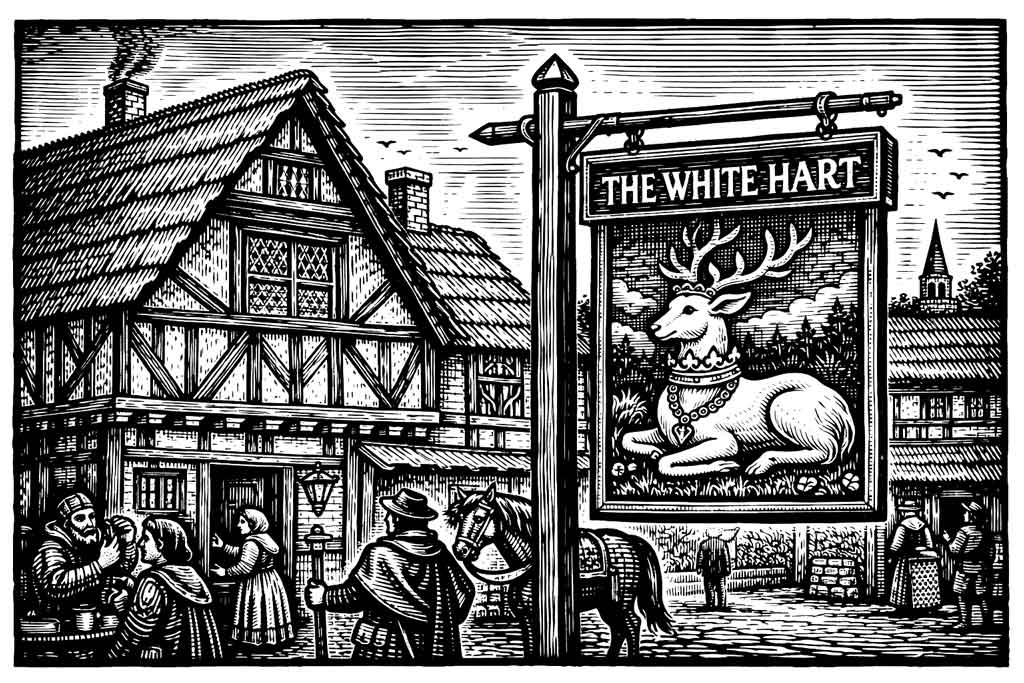
The proliferation of White Hart inns across England is one of the more visible legacies of this medieval heraldic tradition. When the fourteenth-century corporations entered the victualling trade under royal charter, they naturally adopted the king's own badge. A tavern keeper of the period was often called a "tippler" - a word that has since migrated from the supplier of drink to its consumer - and the White Hart became the commonest of all inn signs after the generic colours.
Among the most famous of these establishments was the White Hart at Southwark, where Jack Cade established his headquarters in 1450. Shakespeare put the inn in the mouth of his rebel captain in Henry VI Part II, and it was at this same hostelry that Sam Weller first encountered Mr Pickwick in Dickens's novel, before the inn was eventually burnt down in 1675. The White Hart at Scole in Norfolk achieved a different kind of renown, possessing what Sir Thomas Browne described in 1664 as "the noblest sighnepost in England" - a carved sign spanning the entire roadway, depicting stories from mythology including Charon and Cerberus, Actaeon and Diana, with the white hart itself hanging carved in a stately wreath at the centre. According to the Sheffield Daily Telegraph in 1928, the sign cost over a thousand guineas to erect in 1655.
The Bath White Hart Hotel, demolished in 1867, had been the most celebrated coaching inn in the west of England, with proprietors at one time running upwards of five hundred horses and sixty coaches simultaneously. Its loss prompted the Bath Chronicle to a lengthy elegy, noting that it had been a centre of Bath social life for generations, visited by Pepys, presided over at convivial meetings by Beau Nash himself, and badly damaged in the Reform riots of 1831.
"The White Hart, as a sign, has many associations with history and literature... it has certainly the most elaborate sign in the country."
- Sheffield Daily Telegraph, September 1928
The origin story that attached itself most tenaciously to the sign - at least in Hampshire - was rather different from the Blackmore legend, and involved not Henry III but Henry VII. According to this account, recorded as early as the 1847 review of Mrs David Hanbury's novel One Day in the Life of a Stag, the king went hunting in the New Forest and selected for the day's sport a celebrated white hart named Albert. The chase was long and spirited. When the hart was finally brought to bay in a meadow near Ringwood, the ladies of the court interceded for its life. Albert was spared, fitted with a golden collar, and removed to Windsor. The keeper of the royal forests, one Sir Halliday Wagstaffe, was knighted that same day at Ringwood. The inn where the court took refreshment adopted the white hart with golden chain as its sign - and thus, ran the story, every other town in England did the same.
Uncanny Beasts: The White Deer in British Superstition
The white deer was not only a heraldic symbol and a legal concept. It was also deeply embedded in popular superstition. A Manchester Courier article of 1892 on "Uncanny Animals" placed the white hart in the company of black cats, spectral dogs, and enchanted hares as one of the creatures most consistently associated with the supernatural in British folklore. The white deer was held, in some traditions, to be a harbinger of otherworldly events - its appearance a sign that something momentous, and usually terrible, was about to occur.
Nowhere was this belief more elaborately developed than in the folklore of Lancashire. The Rev. T. T. Wilkinson, delivering a lecture on Lancashire customs and superstitions in 1860, described how the spectral huntsman of Cliviger Gorge was said to pursue a white doe around Eagle Crag on All Hallows' Eve. The hunter was identified as the ghost of the lord of Bernshaw Tower, and the white doe as the enchanted form of his wife, Lady Sybil. This legend was still circulating in the area in the early twenty-first century, as reported by the Halifax Evening Courier in 2003: Lady Sybil had sold her soul to the devil, was pursued in the form of a white doe by her suitor William Townley (aided by a witch in the shape of a hound), captured with a silken noose, and thereafter married - though she eventually died of the effort of restoring herself after losing a paw while shape-shifted as a white cat.
The proximity of white deer to witchcraft was reinforced by their association with the spectral hounds known as Gabriel Ratchets or Gabriel's Hounds - the sound of which, heard in the air above Lancashire moorland, was a death omen. Towneley Hall near Burnley was said to have its own white doe haunting the estate, whose appearance foretold the death of a member of the household staff. This tradition was still being reported by elderly residents in the 1860s.
The Levens Hall Tradition
In Cumberland, the white deer occupied a slightly different folkloric position - not as omen of death, but as condition for the breaking of a curse. The York Herald reported in October 1896 that Levens Hall had laboured for over two hundred years under a tradition that no luck would attend the family, and the estate would not pass from father to son, until a white deer was born in the park. The curse further specified that it would persist as long as the River Kent continued to flow. Since Tennyson had famously written of a brook that flows forever, both conditions seemed designed to be unfulfillable. Yet in February 1896, a white deer was indeed born among the herd in the park, and an heir to the estate followed on the same date. The incumbent owner, Captain Bagot, called it "just luck." The neighbourhood found it more satisfying than that.
Scotland: Faery Deer of the Highlands
In Scotland, the white deer belonged most distinctively to the fairy world. The folklorist R. Erskine of Marr, writing in the Aberdeen Press and Journal in 1926, recorded the Gaelic legend of Loch Bhrodain in Badenoch, a story centring on a hunter's magical hound named Brodan and the famous white stag of Ben Alder. In Gaelic tradition, all white deer were held to belong to the faeries - a piece of folk belief that the hunter in the story knew perfectly well, but which did not prevent him from pursuing the creature regardless. The chase eventually ended with both hound and stag plunging into a desolate loch, from which neither emerged.
The Newcastle Journal noted in 1902 that the legend of King Robert the Bruce's pursuit of a milk-white doe was one variant of a tale found in many tongues - appearing, apparently, even in the Sanskrit Hitopodesa. In the Scottish version, the hounds of St Clair of Rosslyn, through the intervention of St Katherine to whom the knight had prayed, finally ran down the deer that had till then baffled all pursuit. The same basic structure - magical white animal, prolonged impossible chase, miraculous resolution - recurs across European and Asian folklore with a consistency that suggests a very ancient common root.
White deer were also observed as genuine natural phenomena in Scotland, their rarity lending them an air of the preternatural even in modern times. The Sunday Post of May 1960 carried an account by a Mr Dick Brown of Stevenston, Ayrshire, who while visiting relatives on the Isle of Arran came upon the legendary white deer of the island - which had been the subject of controversy for years, many believing it mythical - quietly grazing about a hundred yards away. It watched them for twenty minutes, then vanished into the hillside. In 2004, the Aberdeen Press and Journal reported on a white albino Nile lechwe fawn born at Blair Drummond Safari Park near Stirling - a creature so rare, the chief game warden noted, that he knew of no others in Scotland, and thought there were likely none in Britain. The article concluded with a reflection that in Britain the white hart or stag had long been seen as a herald of otherworldly events, and was still to be found on pub signs to this day.
Holy Deer: Saints and Sacred Does
The sanctity of the white deer was not confined to pagan or folkloric tradition. Several Christian saints were associated with white does in ways that closely parallel the older mythological pattern. St Withburga, the seventh-century East Anglian princess and abbess, daughter of King Anna of East Anglia, was said to have been sustained during a harsh winter at her convent in East Dereham by two gentle does that came to the convent door each morning to be milked. When a local lord sent his huntsmen to chase the does away, he was thrown from his horse and killed - divine retribution following the same logic as the Blackmore legend. After Withburga's death, the monks of Ely stole her body, and a spring burst forth from her empty grave; St Withburga's Well in East Dereham churchyard still exists today. Her white does appear on the Burlingham rood screen in Norfolk.
St Chad of Lichfield, the seventh-century bishop, was likewise said in legend to have been hidden from his enemies and nourished by the milk of a white doe. A memorial window placed in the Collegiate Church at Wolverhampton in 1869 depicted this scene: the saint with the white doe beside him, as testimony to a tradition that had persisted for over twelve hundred years. A similar story attached itself to St Kentigern in the Scottish tradition, and echoes of the same motif - the holy person sustained or guided by a white animal - appear repeatedly across the hagiographies of the early medieval church.
The White Doe of Rylstone
No account of the white deer in British culture would be complete without Wordsworth's White Doe of Rylstone, that long narrative poem published in 1815 and set against the background of the ill-fated Rising of the North in 1569. The poem drew on genuine local tradition: Richard Norton of Rylstone, a prominent Catholic gentleman of Craven in Yorkshire, joined the rebellion with his eight sons. When it failed, several paid for it with their lives. Francis Norton, who had opposed the rising, was killed near his home by a troop of horse and buried in Bolton Abbey. His sister Emily, the last survivor of the family, was said to have been accompanied in her grief by a white doe - a creature Francis had given her - which continued to make a weekly pilgrimage to Bolton Abbey long after Emily herself had died of sorrow, lying at the graveside throughout the Sunday service before returning home. The locals held that the ghosts of Emily and the doe were still to be seen roaming the precincts of the Priory.
Wordsworth transformed this tradition into a meditation on faith, loss, and spiritual consolation. The doe in his poem is explicitly linked to the supernatural - a creature that moves between the worlds of the living and the dead, an embodiment of faithful love that outlasts death itself. The poem's final image of the doe lying alone at the grave - white as a lily, silent as a dream - drew directly on the folkloric tradition of the white deer as a creature that belongs to another order of existence.
"The legend of the white hart had its origin in Greek mythology, so one can suppose that it is a very old inn name - at least one such sign was described in the 17th century as 'the noblest sighnepost in England.'"
- Cornish Guardian, October 1955
The Living Animal
Underlying all of this mythology and heraldry was the simple biological fact of white deer - genuine albino or leucistic individuals that appeared occasionally in herds across Britain and Europe, and whose strangeness in the wild needed no mythological amplification to make an impression. The Black & White article of 1894 made this point crisply: the ancient myth was nothing but a modern material fact, and it was not magic but albinism that converted the coat of the red deer to white. The Berlin Zoological Gardens had recently acquired a full-grown white stag and hind from somewhere in the deep forests of Germany, and their two fawns had been born with white coats spotted with chocolate - the surviving one gradually losing its spots as it came into the full white colour of its parents. These were not pure albinos, the writer noted: their eyes and noses were natural in colour, suggesting that they would "breed true" - that the white colouration was a heritable trait rather than a one-off aberration.
This distinction mattered. The true albino - pink-eyed, delicate, weakly - rarely survived long in the wild. But the leucistic deer, white-coated yet otherwise vigorous, could persist in a population for generations. It was exactly these animals that hunters would have encountered in medieval forests, and whose repeated appearances in the same locality would have seemed to confirm the legend of an immortal white hart that no arrow could kill. Harting, writing in 1909, suggested that this was precisely the origin of the "hart royal proclaimed" in English forest law: the king who spared such an animal was not merely being merciful, but was acknowledging a creature that seemed to partake of something beyond the ordinary.
Conclusion: The Enduring Quarry
The white hart has never quite been caught. It stands at the intersection of so many different strands of British culture - classical mythology, medieval heraldry, Christian hagiography, common law, pub culture, Romantic poetry, Lancashire witch-lore, Highland fairy tradition, and the simple astonishment of seeing a white animal emerge from a dark forest - that it is impossible to reduce it to any single meaning. It is the badge of a murdered king, the tax that was never remitted, the dog that drowned in a Highland loch, the doe that outlived the last of her family, the saint's companion in the winter wilderness, the enchanted witch of Cliviger Gorge, and the strange pale shape that grazed quietly on the Isle of Arran until, with a toss of its magnificent head, it vanished as mysteriously as it had appeared.
What unites all these figures is the quality of elusiveness - the sense that the white deer cannot be possessed, only glimpsed. Those who pursue it too eagerly tend to come to grief. Those who spare it, or simply watch it in wonder, are rewarded with something harder to name than a trophy: a moment of contact with a world that lies just beyond the edge of ordinary experience. In an age when genuine white deer still occasionally appear in British parkland and are greeted with the same astonishment as ever, it seems unlikely that the legend will stop here. The quarry is still running. The chase is not yet done.
✦ ✦ ✦
Sources Consulted
Taunton Courier and Western Advertiser, 14 October 1939 - Notes & Queries on White Hart Forest and White Hart Silver
East Cornwall Times and Western Counties Advertiser, 16 December 1865 - Origin of the White Hart Sign (from the Southampton Times)
Exeter and Plymouth Gazette, 15 March 1946 - Richard II's badge and the White Hart
Enniskillen Chronicle and Erne Packet, 5 March 1835 - Origin of the White Hart Sign: the Blackmore legend
John Bull, 2 October 1847 - Review of One Day in the Life of a Stag by Mrs David Hanbury
Potter's Electric News, 3 October 1866 - The Sign of the White Hart
Bath Chronicle and Weekly Gazette, 22 August 1867 - The Old White Hart (demolition notice)
Norfolk Chronicle, 29 August 1896 - Sign of the White Hart (Query 30)
Folkestone, Hythe, Sandgate & Cheriton Herald, 4 November 1899 - The White Hart
The Field, 5 June 1909 - White Hart Silver, by J. E. Harting
Oxfordshire Weekly News, 9 February 1910 - The White Hart at Chipping Norton
Richmond Herald, 11 November 1916 - The origin of the White Hart sign
Derby Daily Telegraph, 19 September 1925 - The White Hart and Richard II
Blandford Express, 12 October 1872 - Hutchins' History of Dorset and the De la Lynde family
Taunton Courier and Western Advertiser, 1 July and 15 July 1908 - White Hart Silver (Notes & Queries)
Farnborough News, 6 May 1977 - Road works uncover the Basing Stone
Sheffield Daily Telegraph, 18 September 1928 - The Ubiquitous White Hart
Louth Standard, 23 September 1939 - About Inn Signs
The Sphere, 14 March 1914; 23 June 1923; 22 June 1929 - Richard II, the Wilton Diptych, Westminster Hall
Illustrated London News, 20 May 1961 - A Misjudged Monarch? Review of Hutchison's life of Richard II
Eddowes's Shrewsbury Journal, 20 May 1885 - Salopian Inn Signs
Sunday Post, 15 May 1960 - Dick Sees a "Ghost" Eating Grass
Aberdeen Press and Journal, 28 June 2004 - Albino deer at Blair Drummond
Black & White, 20 January 1894 - Albino Red Deer
Derbyshire Times, 24 March 1883 - Public House Signs
Aberdeen Press and Journal, 16 July 1926 - The Legend of Loch Vrodin, by R. Erskine of Marr
Hull Packet, 1 August 1884 - The Legend of the White Deer (from the New York Tribune)
York Herald, 24 October 1896 - An Ancient Cumbrian Tradition: Levens Hall
Banffshire Journal, 8 February 1944 - Old Inn Signs
Cornish Guardian, 6 October 1955 - The legend of the white hart
Dalkeith Advertiser, 11 May 1972 - White Hart Street, Dalkeith
Manchester Courier, 4 June 1892 - Uncanny Animals
Newcastle Journal, 8 February 1902 - The Bruce's White Deer
Bradford Observer, 27 March 1937 - The White Doe of Rylstone
Leeds Intelligencer, 13 September 1851 - The Church of St Peter, Rilston
Morayshire Advertiser / Staffordshire Advertiser, February 1869 - Memorial Window to the Late Bishop of Lichfield
Cromer & North Norfolk Post, 4 July 1913 and 19 November 1904 - St Withburga's Well
Daily Express, 11 June 1935 - King Anna of East Anglia and St Withburga
Burnley Gazette, 29 January 1870 - Lecture on the Customs and Superstitions of Lancashire
Halifax Evening Courier, 16 May 2003 - Cornholme has historic links with witchcraft
Burnley Express, 1 December 1888 - Boggarts of the Brute Creation
Limerick Reporter, 28 August 1888 - The Fate of Bran (poem by Hester Sigerson)
This Topic
British Folklore, Superstition and the Uncanny
Ghosts, omens, witch-lore, monsters, charms, strange weather, and the persistent afterlife of folk belief.
View Topic PageMore in this Topic
Latest Posts
27 March 2026
Hot Cross Buns: History, Origins & FolkloreDiscover the fascinating history of hot cross buns - from pagan offerings and Greek sacred bread to Chelsea bun houses and Good Friday folklore. Explore 2,000 years of spiced bread tradition.
22 March 2026
What Does "Ne'er Cast a Clout Till May Be Out" Actually Mean?Is it about the month of May or the hawthorn flower? And what on earth is a clout? We dig into 170 years of British newspapers to finally answer one of folklore's most argued questions.
13 March 2026
Why Is a Horseshoe Lucky? The Surprising History Behind the World's Most Universal CharmThe horseshoe has been nailed above cottage doors, cathedral gates, and battleship masts for centuries. Discover the ancient beliefs in iron, the crescent moon, and the sacred horse that made it the world's most enduring good luck symbol.
12 March 2026
Saint Piran of CornwallPiran - patron saint of Cornwall, tin miners and the Cornish flag — from Irish origins to the buried oratory's remarkable 2014 excavation.
10 March 2026
Clare Island - Isle of Storms, Pirates and Naturalists: A History in Newspaper Voicesiscover the fascinating history of Clare Island, off the coast of Mayo - from the piratical legend of Grace O'Malley and bitter land disputes to a landmark natural history survey, told through contemporary newspaper voices spanning 1863 to 1986.
7 March 2026
The Wandering Fire - A History of Ball LightningFrom a French tailor stalked by a glowing sphere to thousands of iridescent globes hovering over a Dorset clifftop, discover the strange and fascinating history of ball lightning as recorded in British and Irish newspapers between 1792 and 1938 — and why science, for over a century, could only stand mute before it.