Why Is a Horseshoe Lucky? The Surprising History Behind the World's Most Universal Charm
Written by David Caldwell ·
Iron, Crescent and Charm
The Lore of the Horseshoe
Drawn from British and Irish newspapers, 1870-2003
A Universal Superstition
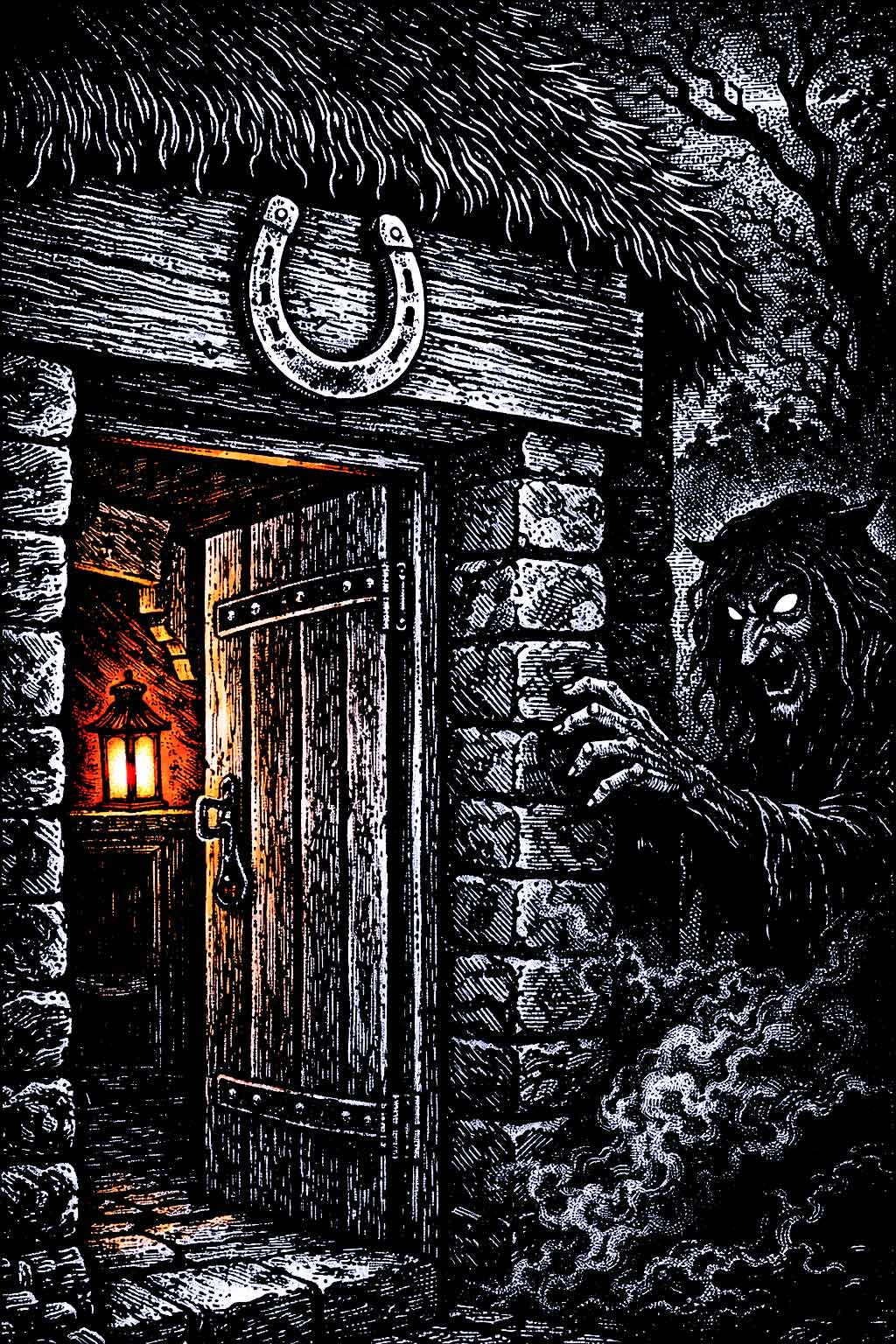
There are few objects so humble, yet so freighted with meaning, as the cast-off iron shoe of a horse. Rusty and unglamorous, it has hung above cottage doors and palace gates, been nailed to the masts of warships and worked into the architecture of churches, tucked under the pillows of the sick and placed on the thresholds of the newly wed. It has been gilded in my lady's parlour and left to redden with rust above the stable door. Across centuries and continents, cultures that agreed on almost nothing could agree on this: the horseshoe is lucky.
"The origin of belief in 'horseshoe luck' is so ancient," observed the Lichfield Mercury in 1905, "that it has never been determined with certainty, and no superstition is more universal." The Dundee Courier of 1900 put it still more plainly: the questions of why a horseshoe is lucky and why it is hung over the door may seem easy to answer at first, but just try them, and you will have to say, "Well, I don't just know."
Yet not knowing has never diminished the feeling. The Glasgow Evening Post of 1889 noted that horseshoe belief flourishes "among all the Teutonic and Scandinavian races" and as far east as Hindostan. The Dundee Evening Telegraph of 1892 found it equally alive across Asia. As the Banffshire Advertiser put it with characteristic economy in 1929: "It runs through all lands and all ages."
Why? Because the horseshoe is a meeting place of three powerful streams of ancient belief, each one capable of generating superstition on its own. It is made of iron. It has been worn by a horse. And its shape is that of a crescent moon. Together, these three properties have made it perhaps the most potent lucky charm in the Western world. As the Gloucester Citizen stated as early as 1890: "Three things serve to contribute to the properties which a horseshoe is supposed to possess: first, its half-moon shape; secondly, that it belongs to the horse; and thirdly, that it is made of iron."
The Power of Iron
Of the three elements, iron is the oldest and the deepest. The Stockton Herald of 1900 captured its strangeness beautifully: "Writing had been practised for several thousands of years in Egypt and Mesopotamia... The order of the world had been settled for ages before that strangest of metals appeared; ideas and customs were fixed, religions were already venerable, nations and frontiers were established. Suddenly a new and terrible force burst into the scene."
Iron was not simply a useful metal -- it was a world-altering one, and its arrival was attended almost everywhere with dread. The Egyptians called it "Bones of Typhon," naming it after their great evil spirit. The Stockton Herald writer reasoned that this revulsion was not accidental: the Dorian invaders who overthrew ancient Greek civilisation almost certainly did so with iron weapons; a similar catastrophe may have befallen Egypt through the iron-equipped Hyksos. Small wonder that the peoples whose worlds had been shattered by this new metal regarded it with a mixture of horror and awe.
Yet from that same dread grew a curious inversion: iron became protection. If the evil spirits feared iron, then iron could be used against them. The Romans drove nails into the walls of their cottages as an antidote to the plague. In the Scandinavian tradition, the Neckan or water spirit could be exorcised by sticking an open knife in the bottom of one's boat, or driving a nail in the mast or oar. When Arabs in the desert were overtaken by a sandstorm, they would stretch out a finger and cry "Iron! Iron!" -- believing the metal would propitiate the evil djinn who had sent the storm. In Wales, a man set upon by pixies on a mountain road at night had only to draw his knife to send them scuttling away at a safe and respectful distance.
This protective power was perceived as inherent to the metal itself, not merely to its shape or origin. In the North-East of Scotland, as the Fife Herald of 1951 recorded, when death visited a house, the family would take a piece of iron -- a knitting needle, a nail -- and stick it into whatever meat or provisions were in the home, to prevent corruption. The whisky, they believed, would turn the colour of milk if this precaution were neglected. In some fishing villages, all onions and butter were thrown out, and iron was the great ward that stood between the living and the darkness.
The West Briton and Cornwall Advertiser of 1951 offers a further refinement: because iron is made in fire and has been purified by it, it is a thing incompatible with the cloven foot of the Evil One. In olden times, when horses suffered mysterious illness, the trouble was attributed to their shoes having been imperfectly purified. The horse would be taken to the smithy, the door closed, the shoes removed and placed in the fire, and the witch responsible for the trouble would thereby be compelled to remove her evil spell.
The Sacred Horse
But iron alone does not fully explain the horseshoe's particular hold on the imagination. After all, a nail or a knife would serve equally well as an iron charm. What elevated the horseshoe was its association with the horse -- an animal that, across all the Aryan races of Europe and Asia, occupied a position of profound sacred significance.
The Dundee Evening Telegraph of 1892, drawing on an article from Cornhill Magazine, put the point with some force: "The horse was one of the most sacred animals in the ancient Aryan religion. The sacrifice of a horse, which seems to have been eaten sacramentally by its devotees, was one of the great rites of the early Hindu religion." In northern European mythology, the horse was the peculiar beast of Thor, an animal of divine power. The White Horses carved into the hillsides of Berkshire and Somerset were understood as memorials to this ancient sanctity. By eating the sacred beast, people believed they took into themselves something of the divinity.
In Yorkshire, well into the nineteenth century, it was believed that disease could be cured by burying a horse alive. Camden, writing about Ireland, noted that when a horse died its feet and legs were hung in the house as sacred objects. In rural districts generally, placing a horse's hoof under the bed of an invalid was a common folk remedy. Even after the animal had been stripped of these formal religious associations, the horseshoe retained its sanctity: "Horses, in the proper mythology of England," the Glasgow Evening Post noted, "were looked upon as luck-bringers."
There is a further maritime connection. Neptune, god of the sea, was traditionally depicted driving a chariot drawn by horses. The little fish called the hippocampus, with its horse-shaped head, was said to be the origin of the horse in legend. The connection between ships and horses ran deep in the seafaring imagination -- which is why, as we shall see, horseshoes were regularly nailed to the masts of warships.
The Crescent and the Goddess
The third element is perhaps the most visually obvious: the horseshoe's shape. Held upright with points skyward, a horseshoe is unmistakably crescent-shaped -- and the crescent is one of the most universally venerated forms in human symbolic history.
The Banffshire Advertiser of 1929 offered a striking explanation: "In an upright position the horseshoe resembles the crescent or moon-horns of the goddess Isis. Hence their presence in Tutankhamen's tomb. These moon-horns were on the Egyptian cake which was the original predecessor of the hot cross bun." The Birmingham Daily Gazette of 1919 reported the curator of the British Museum's folk-lore section as saying that horseshoes were favoured by sailors partly because they were supposed to represent the crescent moon. Early figures of the goddess Isis represent her as wearing a crescent new moon on her head, with the two points suspended from the shoulders -- and the moon, he noted pointedly, is never seen with its points downwards.
A Turkish Muslim, asked why horseshoes were lucky, would explain that they are in form like a crescent -- the sacred emblem of Islam. A Polish Jew would note that at Passover, the blood sprinkled on the lintel and doorposts in the manner prescribed by ritual forms the chief points of an arch: arch-shaped talismans have therefore always held protective power. The Chinese built their tombs in semi-circular form. The Moors used the crescent arch throughout their architecture. Even the nimbus or halo surrounding the heads of saints and angels in Christian iconography, noted the Glasgow Evening Post, "bears a rude resemblance to a horseshoe" -- one of those coincidences that, over centuries, deepens a symbol's hold on the collective mind.
The Lichfield Mercury of 1905 also recorded the explanation given by the Chinese: that horseshoes are nailed above doors as a charm against evil spirits because of their resemblance to the arched body of the sacred snake, Nagandra, one of their principal deities. Thus the same shape could simultaneously evoke a goddess, a crescent moon, a sacred serpent, and a holy arch. The horseshoe's genius is that it speaks to nearly every tradition at once.
St. Dunstan and the Devil
It would be impossible to write about horseshoe lore without lingering on the legend that became its defining story in the English-speaking world: that of St. Dunstan and the Devil. It appears, with small variations, in newspapers from Wexford to Australia across more than a century, and it is worth telling at some length.
St. Dunstan -- a real tenth-century Archbishop of Canterbury, famously skilled as a metalsmith -- was, so the story goes, working at his forge one day when a visitor arrived. The visitor was the Devil, come in disguise with a request: he wanted his "single hoof" shod. Dunstan, being a man of uncommon perception, recognised his customer at once but said nothing. He set to work. And then, as the Mid Sussex Times of 1909 tells it, "he gave him such a doing while pretending to fix the shoe that he begged for mercy."
In the Sussex Express's 2003 version of the tale, St. Dunstan "grabbed his nose with his red hot pincers and the devil ran for water which he found in the Devil's Dyke." The saint released his captive only after extracting a solemn promise: that neither the Devil himself nor any of his lesser spirits would ever molest the inmates of a house where a horseshoe was displayed.
The Bedford Record of 1934 notes, with some legal sharpness, that "there appears to have been a serious omission from the contract, for nothing was said about which way up the horseshoe was to be fixed" -- which may explain centuries of subsequent debate on that very question. Gloucester's mayoral chain was made of horseshoes with points facing downward in accordance with tradition; yet a previous mayor, "taking no risks," had the horseshoes altered to face points upward. No particular luck resulted either way, and the chain was restored to its original state.
The Irish Legend
If the English have St. Dunstan, the Irish have a more romantic tale entirely. The name "Ireland" -- or "Ironland" -- so the story goes, originated in an ancient catastrophe. The whole island was once submerged beneath the sea, rising only once in seven years, and then only for a brief time. Many attempts had been made to break the spell and raise the island permanently above the waters, but all had failed.
Then one day, as the Lichfield Mercury of 1905 tells it, "a daring adventurer threw a horseshoe from a boat on the topmost peak of Wicklow mountains just as they were disappearing beneath the waves. Then at last was the ban removed. The Emerald Isle began forthwith to rise again from the ocean depths into which it had sunk. And it has been dry land -- more or less -- ever since."
Whether or not this etymology has any scholarly standing -- and it does not -- it captures something true about the horseshoe's hold on the popular imagination. It is a story about salvation through iron, about the power of a humble object in the face of overwhelming natural forces. It is the same story, in different dress, as the Arab crying "Iron!" into the sandstorm, or the Roman hammering nails against the plague. Iron saves. The horseshoe, as iron's most familiar form, saves too.
Which Way Up?
Few questions in the history of superstition have generated more heated opinion than this: should the horseshoe be hung with points upward or downward? Both positions have their passionate defenders, and both have a certain logic.
The Banffshire Advertiser of 1929 states the matter firmly: "To be fortunate, a horseshoe must be nailed on with the points upwards." The Yorkshire Evening News of 1907 explains the reasoning: if you hang a horseshoe with the convex part towards the ceiling, "the luck will run out at the points." The proper way is to reverse the shoe so that the points face upward, allowing the luck to run into the curved part and be retained there. The Birmingham Daily Gazette of 1919 agreed, invoking the goddess Isis: the crescent moon is always depicted with points upward, and so should the horseshoe be.
Yet the inn sign at the Three Horseshoes at Mongeham, Kent -- dated 1735 and described by the Maidstone Telegraph of 1937 -- shows all three shoes hanging points downward, and the house "has stood for over 200 years as a quiet and decently conducted house." The journalist noted with some glee that "certain nit-wits express the opinion that they cannot hold any luck in this position" for it will all fall out of them -- dismissing the downward-pointing camMaidstone Telegraph writer also made the interesting observation that the shoes in the sign were of a shape quite unlike the modern horseshoe, with ends too broad and the toe too wide: a genuine document for the history of farriery as well as superstition.
There is something almost philosophical in the persistence of this debate. The two parties agree completely on the value of the horseshoe, and disagree only on the direction of its power. Superstition, like theology, generates its own vigorous internal controversies.
Regional Customs: Scotland and Ireland
The Fife Herald of 1951 provides the most thorough account of Scottish horseshoe customs, in a scholarly article by Philip Ardagh, F.L.A. In Dunfermline, nailing a horseshoe to the stable, byre, or kitchen door was believed to be a powerful preservative against witchcraft. In Kirkcaldy, keeping a horseshoe in the house was a lucky thing -- so much so that one woman, on losing her child, declared it was a direct consequence of having moved the horseshoe. In Lomond, it was considered particularly lucky to find a well-worn cast-off shoe, since this was regarded as a sign that its good luck was the result of the weight of fatality it had endured.
The "canny woman" -- the local wise woman or cunning woman -- played a significant role in Scottish horseshoe ritual. When someone died suddenly on a farm, she would be sent for, and she would declare the body to be "a shift deid by the darts o' the fairies." She would then make a careful search for a likely spot to nail a horseshoe charm, and after a suitable lapse of time, she invariably produced one. J. F. Campbell, in his Popular Tales of the West Highlands (1860-62), records a case at Glenfyne of an old man whose cows suddenly lost their milk. He sought the advice of a wizard, who declared the cause to be a neighbour woman, and told him to nail a horseshoe above the door in secret. From that day onwards, the cows yielded plentifully.
The Irish peasants modified the customs somewhat. Rather than nailing horseshoes above the door, they would nail them on the threshold, and plant cloves of wild garlic above the door for additional protection. The Dundee Courier of 1900 also notes that over the door of one of the principal churches of Suffolk a prominent horseshoe was worked into the architecture -- probably with the idea of keeping the witches out -- and that fifty years before the article was written, many churches had horseshoes nailed over their doors.
Ships and the Sea
The relationship between horseshoes and the sea deserves its own chapter. Up to the third quarter of the nineteenth century, as the Fife Herald records, horseshoes were frequently fixed to the masts of ships to ensure safe and prosperous voyages. The belief was that a spell would thereby be engendered against the forces of evil, rendering their machinations powerless. Nelson nailed a horseshoe to the mast of the Victory before Trafalgar. The Vindictive, sunk to block Zeebrugge Harbour in the Great War, could be seen in photographs with a horseshoe nailed to one of its masts. The Felixstowe Times of 1944 noted: "Many of the most famous battleships have carried this emblem in the past."
In the North-East of Scotland, as the Fife Herald records, certain words were absolutely forbidden on a fishing voyage: "minister," "kirk," "salmon," "trout," and above all "swine," "pig," or "sow." These taboo words were so powerful that entire substitutions had been developed: a church became "the bell house," and a minister "the man in the black guyte." If by accident a man mentioned one of the proscribed words while at sea, he had to shout immediately "cold iron!" -- or, better still, touch the horseshoe fixed to the mast. Strangely enough, the presence of a minister in a fishing boat was itself considered unlucky, and there was a superstition that the tolling of the kirk bell in the home village would cause the fish in nearby waters to move away.
Other Uses and Customs
Beyond door and mast, the horseshoe found its way into an astonishing variety of folk remedies and protective customs. The Gloucester Citizen of 1890 reports that in parts of Ireland it was looked upon as a certain cure for some illnesses to bring to the sick person's bedside the ashes of a freshly-burned horse. In Scotland, the country people placed a horseshoe under the sufferer's pillow. When a horse died, its hoof was dried and jealously guarded in the family as a charm against all sorts of evils.
The Highland News of 1903 records a rich set of customs regarding found horseshoes. If you are on foot and find a shoe with the bended arch towards you, lying in the position in which the horse wore it, this is good luck and you must pick it up. If found in an oblique position, it should be lifted up with the foot, and its angle will indicate in which direction to travel to find good fortune. Most importantly, a horseshoe should never be passed without lifting it and carrying it part of the way with you -- to neglect this duty is to invite trouble. A ring made out of a horseshoe nail, worn on the third finger of the left hand, will cure gout, lumbago, or rheumatism. And any young lady anxious to know her fate should place a horseshoe under her pillow before sleeping -- "she will know as much by morning as the magicians of old could hope to tell her."
One of the more unexpected uses was recorded by Mr. Edward Lovett, the well-known authority on folk-lore, in a lecture reported by both the Londonderry Standard and the Sunderland Daily Echo in February 1922: "everybody in Camberwell," according to one of his informants, hung a horseshoe covered with red cloth at the head of the bed in order to prevent nightmare. The combination of iron (to repel evil spirits) and red cloth (itself a powerful protective colour in folk tradition) represents that characteristic double-banking of charms that characterises folk magic at its most thorough.
The Dundee Courier of 1900 records one of the most practically minded uses of all: the reversed horseshoe as an aid to military escape. At the battle of Blore Heath in 1459, Queen Margaret, seeing that the battle would be lost, made her escape on horseback having had the blacksmith reverse the shoes on her horse, so that it would appear she was galloping towards the scene of battle rather than away from it. This scheme was put into practice during the American Civil War -- but the Courier journalist establishes that the earliest authenticated instance of the ruse occurred thirty-three years before Columbus set sail, when a medieval woman used it to save her husband and his followers.
The Origin Debate
Scholars and journalists debated the ultimate origin of horseshoe luck with considerable energy throughout the Victorian and Edwardian periods. The Wexford People of 1893, drawing on a writer from Cornhill Magazine, offered one of the most thoughtful analyses: the horseshoe superstition first arose because people selected a horseshoe as the best available bit of iron to repel trolls, fairies, witches, and warlocks -- not merely because it was iron, but because it had its own inherent sanctity derived from its connection with the sacred horse.
"When the horseshoe superstition first arose," the Cornhill writer argued, people chose it specifically because it had a certain inherent sanctity of its own derived from its connection with a sacred animal. This sanctity helped the superstition to persist even after Christianity had displaced the older religion, because the horseshoe could serve simultaneously as a symbol of the old gods and as protection against the new devils that replaced them. It was as much as to say to the elves: "Don't come near; 'ware iron; we're under Thor's protection"; and on the other hand, to Thor: "We're still your men; we've never abjured you; take good care of us."
The Fife News of 1886 makes a related argument: from being merely the negative charm of dispelling ill-fortune, iron naturally came to be regarded as more actively significant, and as an augury of good luck to come. The Cornhill article adds that the horseshoe had peculiar advantages over other pieces of iron in this regard: it was cheap, easily found in the road, ready-made with convenient holes for hanging, obviously appropriate to a stable or farm -- and, crucially, shaped like a crescent moon. It had every advantage that a good luck charm could want.
The Cork Examiner of 1895 adds the dimension of archaeology: the nearest thing to the modern horseshoe found in excavation was discovered in the grave of an old king of Arabia who died some 1,500 years ago. It had nail-holes in the shoe -- the first known mention of nailing a shoe on. And it was almost certainly placed on the grave for the same protective purpose that the horseshoe serves today. The continuity is remarkable: fifteen centuries of iron, crescent, and horse, and still the shoe hangs above the door.
Decline and Persistence
"Lucky Dr. James" -- a celebrated eighteenth-century quack -- attributed the success of his fever powders entirely to his having found a horseshoe, which symbol he adopted as a crest for his carriage. Aubrey, writing in the seventeenth century, tells us that most houses in the west end of London had a horseshoe nailed over the threshold. In 1813, Sir Henry Ellis counted seventeen horseshoes in Monmouth Street alone. By 1841, only five or six remained.
The Gloucester Citizen of 1890 noted the great irony with some acuity: "The unsentimental generation of to-day, especially in cities, looks upon a horse shedding its shoe only as an advantage to the blacksmith; but in spite of the fact that the belief in the power of the horse-shoe is dying out among us, the variety of ornaments which are made in the form of the horse-shoe testify that, in spite of having broken through all old superstitions, we still keep up many of them in a different form."
This observation -- that the horseshoe persists as ornament even when it has ceased to be a talisman -- is perhaps the most telling commentary on the whole subject. The lucky horseshoe on the wedding card, the horseshoe brooch, the horseshoe-shaped door knocker: these are the last echo of a belief system that once connected the iron-smelters of the ancient world with the fishing boats of the Hebrides, the Egyptian tombs with the Yorkshire farmyards, the Wicklow mountains with the fleet at Trafalgar.
The Uxbridge Gazette of 1935, reporting a lecture by Miss Gertrude Wallis to the National Council of Women, heard the speaker explain that the horseshoe has three distinct reasons for its luck -- iron, horse, and crescent -- and that these three reasons reinforced each other across so many cultures and so many centuries that the belief became self-sustaining, a magical magnet capable of drawing luck in the direction of all who believed in it. Even those who know all of this, who can trace each strand of the superstition back to its source, still, as the Dundee Courier admitted, half-laughingly pick up an old horseshoe when they come across one in the road. And carry it home.
~ ~ ~
Sources
Banffshire Advertiser (1929) · Birmingham Daily Gazette (1919) · Birmingham Daily Post (1870)
Bedford Record (1934) · Cork Daily Herald (1899) · Cork Examiner (1895)
Cumberland & Westmorland Herald (1895) · Derry Journal (1893) · Diss Express (1916)
Dundee Courier (1900) · Dundee Evening Telegraph (1892) · Felixstowe Times (1944)
Fife Herald (1951) · Fife News (1886) · Glasgow Evening Post (1889)
Gloucester Citizen (1890) · Highland News (1903) · Kilkenny Moderator (1915)
Lichfield Mercury (1905) · Londonderry Standard (1922) · Lyttelton Times (1907)
Maidstone Telegraph (1937) · Mid Sussex Times (1909) · Monitor and New Era (1905)
Preston Herald (1905) · Preston Pilot (1876) · Seaham Weekly News (1933)
Stockton Herald (1900) · Sunderland Daily Echo (1922) · Sussex Express (2003)
Uxbridge & W. Drayton Gazette (1935) · West Briton and Cornwall Advertiser (1951)
Wexford People (1893) · Yorkshire Evening News (1907)
This Topic
British Folklore, Superstition and the Uncanny
Ghosts, omens, witch-lore, monsters, charms, strange weather, and the persistent afterlife of folk belief.
View Topic PageMore in this Topic
7 March 2026
The Wandering Fire - A History of Ball LightningLatest Posts
27 March 2026
Hot Cross Buns: History, Origins & FolkloreDiscover the fascinating history of hot cross buns - from pagan offerings and Greek sacred bread to Chelsea bun houses and Good Friday folklore. Explore 2,000 years of spiced bread tradition.
22 March 2026
What Does "Ne'er Cast a Clout Till May Be Out" Actually Mean?Is it about the month of May or the hawthorn flower? And what on earth is a clout? We dig into 170 years of British newspapers to finally answer one of folklore's most argued questions.
20 March 2026
The White Hart: The Ancient Legend Behind Britain's Most Common Pub SignFrom Greek mythology to medieval forest law, the white deer haunted the British imagination for centuries. Discover the real history behind the legend of the White Hart — royal badge, supernatural omen, and elusive quarry of the soul.
12 March 2026
Saint Piran of CornwallPiran - patron saint of Cornwall, tin miners and the Cornish flag — from Irish origins to the buried oratory's remarkable 2014 excavation.
10 March 2026
Clare Island - Isle of Storms, Pirates and Naturalists: A History in Newspaper Voicesiscover the fascinating history of Clare Island, off the coast of Mayo - from the piratical legend of Grace O'Malley and bitter land disputes to a landmark natural history survey, told through contemporary newspaper voices spanning 1863 to 1986.
7 March 2026
The Wandering Fire - A History of Ball LightningFrom a French tailor stalked by a glowing sphere to thousands of iridescent globes hovering over a Dorset clifftop, discover the strange and fascinating history of ball lightning as recorded in British and Irish newspapers between 1792 and 1938 — and why science, for over a century, could only stand mute before it.