
Children of the Stars: Aliens, Angels and the Plurality of Worlds
Written by David Caldwell ·
“I have never seen Australia, and yet I believe that Australia exists.”
- Lord Dowding, explaining why he believed in flying saucers
Einstein liked to say that his most important equipment was not a telescope or a laboratory, but a chair and a good imagination. His famous thought experiments, chasing beams of light or riding in elevators that fall weightlessly through space, were feats that any Stone Age sky-watcher could in principle attempt.
For as long as humans have been able to look up and wonder, they have done exactly that. Long before relativity, shepherds, priests and bureaucrats tracked the rising of the Moon, the wandering of the visible planets, and the fiery march of the Sun across the sky. The first observatories were not domes with brass instruments; they were temple roofs and desert horizons.
By the nineteenth century those temple roofs had become church pulpits and newspaper columns. Victorian and Edwardian preachers, letter-writers and popularisers debated Martians, plural worlds and messages to Jupiter with as much passion as any modern podcast. They planned vast smoke signals to catch the eye of Mars, worried about the salvation of non-human souls, and wondered if angels were simply extra-terrestrials by another name.
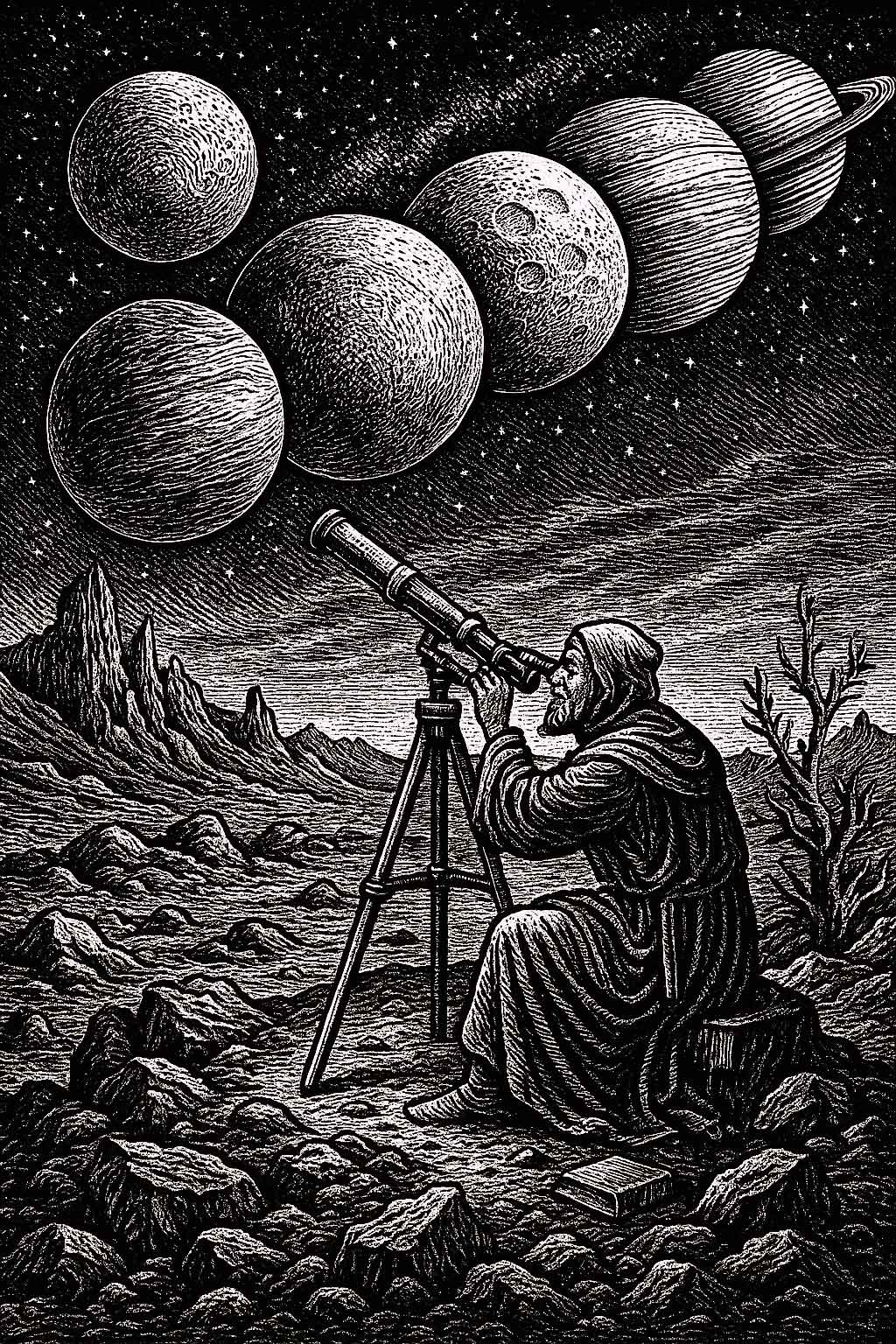
Somewhere in that long vigil a dangerous thought crystallised:
If the Earth is a globe in space, one world among many, then who or what lives on the others?
That question has haunted philosophy, theology and science ever since. The answers have ranged from sober arguments about probability to glorious nonsense about Martian canals and Jupiter’s wise elders. Along the way, "aliens" have taken on the roles once played by angels, demons and pagan gods, sometimes comforting, sometimes terrifying.
What follows is a tour through that story: from Democritus and Epicurus to Giordano Bruno, Victorian Martians, Jesuit theologians, flying saucers, and modern clergy who wonder whether the "angels, archangels, thrones and dominions" of Scripture might in fact be inhabitants of other planets.
1. When the Earth Stopped Being Special
“Innumerable worlds, some like this one, some unlike.”
- Epicurus
The Greeks were already playing Einstein’s game, doing physics with the mind alone.
Atomists such as Democritus and Epicurus pictured an infinite universe, full of atoms tumbling in the void. If matter and space are infinite, it is very strange to assume that only one little world has formed and only one has life. Epicurus explicitly spoke of “innumerable worlds, some like this one, some unlike,” and later writers record that some of these worlds were inhabited while others were barren.
That is already a clear doctrine of extra-terrestrial life, constructed with no telescopes, no instruments and no laboratory besides the human imagination.
However, this philosophical plurality of worlds never quite became the common sense of the ancient Mediterranean. For Plato and Aristotle the cosmos was a single ordered whole with Earth in the centre. The heavens were made of a special, changeless substance; the stars were divine fires moving in perfect circles. The question “Are there people living on other planets?” does not really arise when there are no planets in the modern sense, only wandering lights embedded in crystalline spheres.
Still, the idea that the stars might be “worlds” rather than lamps is present, flickering in the background, waiting to cause trouble.
2. Christendom’s Closed World
When the classical world fractured and Christianity rose to dominance in the Latin West, the Aristotelian and Ptolemaic cosmos was eventually baptised.
God now sat beyond the sphere of fixed stars; angels pushed the planets in their circles; Earth was the stage on which a single cosmic drama played out: Creation, Fall, Redemption, Judgement. In this mechanical, Platonic and Aristotelian clockwork, everything had its place and meaning.
The Bible spoke of heavens and earth, of thrones and dominions, Seraphim and Cherubim. It did not speak of Neptunians or Jovians. That silence mattered.
If there were other inhabited worlds, awkward questions followed.
Did Christ die once on Earth for all rational creatures everywhere?
Or did God the Son have to be incarnated, crucified and resurrected separately on each planet?
Is humanity still the centrepiece of salvation history, or just one province in a vast empire of souls?
Medieval theologians toyed with such problems, usually in the realm of angels rather than aliens. Speculation about many worlds tended to be viewed with suspicion, especially when it smelled of pagan atomism.
The urge to pluralise never completely died, however, and in the Renaissance it returned with a vengeance.
3. Bruno and the Infinite Universe
Giordano Bruno became, in later retellings, a kind of patron saint of alien speculation. An ex-Dominican friar, he absorbed Copernicus and went far beyond him. Not only did the Earth move; the universe, he argued, was infinite and full of suns, each with its own planets, many of them inhabited by beings who worshipped God in their own ways.
For Bruno this was not a cool astronomical hypothesis but a mystical vision. To deny other worlds was, in his view, to insult God’s creative power.
The Inquisition saw other issues, including pantheistic ideas and denials of key doctrines, but his belief in a plurality of worlds certainly formed part of the indictment. In 1600 he was burned in Rome. Later generations turned him into a martyr for science against dogma, even though the real story is more tangled.
Bruno matters here because he forces the theological question into the open. If the universe is full of inhabited worlds, how does Christian salvation work? Later Catholic polemicists summarised the charge against him as teaching “a doctrine repugnant to the whole tone of Scripture, inimical to revealed religion, especially as regards the plan of salvation.” That is exactly the point.
4. Enlightenment, Telescopes and the Respectable Martian
By the eighteenth and nineteenth centuries, once the Enlightenment and the telescope had matured, the plurality of worlds had become almost respectable. Many natural theologians and astronomers took it for granted that the planets, and perhaps even the stars, were inhabited.
The argument often went like this:
God does nothing in vain.
It would be wasteful to create huge planets and suns and leave them lifeless.
Therefore the planets and stars are probably homes for rational creatures.
Victorian newspapers, sermons and popular science lectures are full of this reasoning. In mid-nineteenth-century discussions of “The Plurality of Worlds” one finds careful debates about whether Jupiter’s belts could support life, or whether Saturn’s rings would interfere with agriculture. Religious writers wrestled with the idea that millions of worlds might be peopled by beings who, like humans, reflected the divine image.
Some pushed back. Spectroscopy and the “researches of Roscoe, Huggins and R. A. Proctor” seemed to show that the Sun and most stars were far too hot for life as we know it. “Scientific inquiry has dispelled this illusion,” complained one correspondent in 1856. Yet even he admitted that countless suns must have planets, and that if only one in a thousand had a habitable globe, there would still be thousands of such worlds.
Others leaned heavily on chemical kinship. The new technique of spectroscopy showed the same metals and gases in the atmospheres of stars as in earthly laboratories. Writers argued that if the universe is built from one set of elements, then the story of life might repeat again and again. An 1879 essay in The People’s Friend pointed to this unity of matter and concluded that it would be absurd to think life had flowered only once.
Astronomy was still young, but the cosmic imagination was in full bloom.
5. Signals From Mars and Smoke to the Heavens
By the late nineteenth century, Mars had become humanity’s favourite mirror. Telescopes hinted at dark canals; seasonal changes in colour fuelled dreams of vegetation and civilisation.
Newspaper archives from around 1900 capture the mood. Reports discuss strange lights supposedly seen on the Martian surface and suggest that these might be deliberate signals. The idea quickly appears that the Martians, if they exist, are trying to communicate, and that humanity should reply.
Schemes proliferated. One French enthusiast proposed huge patterned bonfires across Europe, lit in cities such as Bordeaux, Marseilles, Paris, Amsterdam and Stockholm, to form a vast geometric signal. Others suggested artificial lakes in the Sahara, or enormous mirrors that could flash sunlight across space. A 1902 article recalls how one set of supposed Martian “signals” turned out simply to be a patch of cloud.
Sir Robert Ball, the great populariser of astronomy, took a cooler view in a note titled “Communication Between Planets.” He doubted schemes for conversing with “inhabitants of other planets” and joked that if London turned every street lamp on and off in patterns, any hypothetical Martian observer would have no idea what it meant.
Inventors and showmen also joined in. A 1901 article on Nikola Tesla’s new lighting tubes ends by speculating that, once the practical problems of artificial light on Earth are solved, Tesla might turn his attention to “endeavouring to converse with the inhabitants of other planets.” What begins as a piece on energy efficiency glides naturally into interplanetary conversation.
At the same time, more cautious voices grew louder. A 1916 piece in the Lyttelton Times reviews Jupiter, Saturn, Uranus, Neptune, Mercury, Mars and Venus, and concludes that the gas giants are too extreme for human life, Mercury is too small and scorched, and even Mars and Venus would be harsh. Not every world could be a twin Earth. Probability could cut both ways.
6. Theologians Under the Red Planet
While astronomers debated canals and atmospheres, theologians tried to decide what aliens would do to Christian doctrine.
In the early twentieth century there is a striking variety of responses.
At the 1924 Conference of Modern Churchmen in Oxford, the Rev. H. C. Macpherson spoke on “The Universe as Revealed by Modern Astronomy.” He stressed how tiny Earth is, “a dwarf planet revolving round a dwarf star” in a galaxy tens of thousands of light years across, and argued that it would be absurd to think that only on “one small speck of matter” had the cosmic process resulted in life. For him, the plurality of worlds actually confirmed monotheism. A unified universe, governed by the same laws everywhere, hints at one Creator rather than many. Astronomy, he insisted, was “in a very real sense the handmaid of faith.”
In 1952, the Jesuit review Civiltà Cattolica published a twelve-page article on “Theology and the Possibility of Inhabitants on Other Planets.” Far from panicking, the author argued that even if science proved the existence of rational beings elsewhere, “neither Catholic theology nor the teaching of the Catholic Church will be in any difficulty.”
The key move is simple and bold. If such beings exist and are rational, they do not belong to the human family of Adam. They would be a different race of creatures, governed by the same God but not subject to Adam’s Fall. The article even toys with a striking possibility. Perhaps, it suggests, these beings had their own probation, their own version of the garden test, and unlike humanity they passed. If so, they would not bear original sin at all. They would be, in the technical sense, sinless. The Jesuit writer imagines that their civilisation might be morally and spiritually ahead of ours, with “a degree of scientific progress far superior to ours” and without the long detour through guilt and redemption that shapes human history.
Anglican clergy followed similar lines. Canon Howard Marlow, writing a “Theme for the Day” column in the late 1950s and again in 1969, said he did not believe that humanity is “the only rational being in creation.” Scripture speaks of “angels, archangels, thrones, dominions, cherubim and seraphim”; for all anyone knows, he wrote, some of these terms may refer to inhabitants of other planets. The failure to find Martians is disappointing, but it would be odd if Earth were the only world that produced rational life. Whatever is encountered in space, he insisted, has been created by God, and “no light years can separate us from His love.”
Here theology does what it has always done when confronted with a new cosmos: stretch and reinterpret.
Sometimes the stretching goes so far that it snaps. Secular critics of Roman Catholicism in the 1930s pointed back to Bruno and Galileo and painted the Church as waging a “bitter, ruthless war” against science, terrified that a plurality of worlds would unravel salvation history. The history is more nuanced than that, yet the anxiety is real. If there are many races of rational beings, do they all need a saviour? Is humanity still special, or is it the naughty child of the universe, while others remained in a kind of unfallen Eden?
There is a darker mirror to this attractive picture. If work, frustration and death are consequences of the Fall, then so are many of the engines that drive what humans call progress. Technology, medicine and science grow out of sickness, scarcity and fear. A sinless race, living in a world without want or danger, might have no need to invent antibiotics, blast furnaces, radio or rockets. Their “advance” could be almost entirely spiritual and contemplative. In that case, the Jesuit scenario raises a strange possibility. Humanity’s misery has produced telescopes, accelerators and space programmes; the sinless may gaze at the same heavens with no desire to dissect them. The fallen might be more ingenious precisely because they are broken.
Perhaps the cosmos holds races that never fell and never needed to progress, and others, like ours, that progress precisely because they fell.
7. Spiritualists, Messages and “High Intelligences”
As wireless telegraphy and radio matured, a new hybrid myth arose: interplanetary spiritualism.
A letter to the Daily News in 1920 wonders whether mysterious wireless messages and spiritualist manifestations might all be part of “one big scheme of things.” Perhaps, it suggests, these phenomena are attempts by inhabitants of other planets, far outside the Solar System, to communicate with Earth using forces “akin to electricity, unknown to scientists.” The line between discarnate spirits and extraterrestrial beings blurs; the ether of radio waves becomes a metaphysical medium.
In 1925 the Civil & Military Gazette in Lahore reports on Sir Walter Gibbons, who claimed to be in touch, via a medium, with “high intelligences” from other planets. These beings, he said, had made it clear that Earth is in an early stage of development compared with the fortunate inhabitants of the other worlds. They assured him that all the planets except Mercury were inhabited, and that some, especially Jupiter, were far more desirable places to live.
An astronomer, given space in the same article, coolly points out that Jupiter’s surface must be at a very high temperature and that its gravity, far stronger than Earth’s, would pin any emigrant “to the spot on which he landed.” The tension between mystical testimony and physical calculation is obvious.
In this period, aliens drift in and out of the same imaginative space as spirits, guides and angels. The heavens are crowded, but the identities of the inhabitants are unstable.
8. Flying Saucers and the New Demons
By the mid twentieth century the conversation shifts. The question is no longer mainly philosophical (“Are there other worlds?”) but practical: “What are these things in the sky?”
In 1928 the Daily Chronicle reports on Professor A. M. Low’s suggestion that humanity might attract the attention of Martians with a “vast pillar of fire” or a giant smoke cloud twenty miles high, or with an extraordinarily elaborate system of illumination. At the same time bishops and scientists argue publicly over whether it is “almost inevitable” that there are other planets bearing life. The mood is optimistic and confident.
After 1947, with the first modern UFO wave, that optimism darkens. Air Chief Marshal Lord Dowding, the commander of Fighter Command in the Battle of Britain, publishes an article titled “I Believe in Flying Saucers.” He calmly states that he has never seen a saucer, yet he believes that they exist on the basis of cumulative testimony. They cannot all be hallucinations or misidentified meteors, he argues, and the more solid reports show speeds and manoeuvres that no human pilot could survive. They are not Russian or American secret weapons. Therefore they must be extraterrestrial.
Dowding then raises a more unsettling issue. What are their motives? Some visitors might wish to help, he suggests, to guide humanity to a higher level. Others might be scientific observers, regarding humans the way humans regard insects. He warns against attempts to shoot them down. Such “gratuitous folly” might turn neutral curiosity into active hostility, and any beings capable of crossing the stars would certainly be capable of defending themselves.
At this point aliens have fully taken over the roles once filled by angels and demons. They can be messengers, guardians or tempters; they are technologically and perhaps spiritually superior; they provoke either hopeful millenarianism, in which they bring wisdom and peace, or apocalyptic dread, in which they judge or destroy.
Einstein’s armchair thought experiments have been replaced by radar traces and blurry photographs, but the underlying question is the same. What kind of universe is this, and who shares it with us?
9. Would Aliens Kill God?
Would the discovery of extra-terrestrial life disprove God? Historically, very few serious theologians have thought so. Most Christian responses fall into several broad types.
The Copernican Extension
Just as Earth turned out not to sit at the centre of the Solar System, humanity might not sit at the centre of rational life. This is humbling but not fatal to faith. God’s love can be lavish. Scripture already speaks of “worlds” in the plural in places, and arguments like Macpherson’s belong in this camp. A unified universe, full of life, speaks of one Creator more powerfully than a tiny sterile cosmos.
Christ the Cosmic Logos
If Christ is understood as the divine Logos, the principle through whom all things were made, then the incarnation on Earth can be seen as a local event with universal significance. The Jesuit article of 1952 leans toward this view. Aliens, if rational and moral, would stand in some relation to the same God and the same Logos, even if the mode of redemption lies beyond human concepts.
Multiple Incarnations
Some speculative thinkers have suggested that the Second Person of the Trinity might have been incarnated on other worlds as well, different stories and different crosses for different races. This is the scenario that horrified Bruno’s judges and delights many science-fiction writers.
Aliens as Angels in New Clothes
Canon Marlow’s suggestion that biblical “angels, archangels, thrones and dominions” might be inhabitants of other planets collapses the distinction between celestial spirits and corporeal extra-terrestrials. Modern UFO lore often does the reverse, turning aliens into thinly veiled demons or faeries. In this reading, humanity has always believed in non-human intelligences; the argument is only about what costume they are currently wearing.
For hard-line materialists the discovery of microbial life on Mars or complex life around another star would be another blow to human specialness. For some religious fundamentalists it would trigger a crisis. For much of historic Christianity, however, plurality of worlds has been an inconvenience rather than an impossibility. The most unsettling possibility is perhaps not that aliens would disprove God, but that they would quietly confirm something like the Jesuit speculation: humanity is not the only rational race, and not necessarily the best behaved.
10. From Fire Signals to Radio Telescopes
The present moment looks oddly familiar when set alongside the Victorian and Edwardian past.
Nineteenth-century dreamers planned enormous pyres to signal to Mars. Tesla hoped his tubes would one day flash messages to Venus. Early wireless enthusiasts wondered whether alien speech might be buried in the static.
Today, radio telescopes and laser experiments scan the sky for narrow-band signals that nature is unlikely to produce. Carefully coded beeps and mathematical patterns are sent out into the dark. The technology has changed, but the imaginative posture is much the same. A small, clever primate stands under the Milky Way and asks, as its ancestors did:
Is anybody else out there, and if they are, what does that make us?
Einstein once remarked that “the most incomprehensible thing about the universe is that it is comprehensible.” Whether the future reveals microbes in Martian soil, cities under the clouds of some exoplanet, or beings that would have looked to medieval eyes like choirs of luminous angels, that basic mystery remains.
Humanity lives on a dwarf planet circling a dwarf star near the edge of a galaxy, a mere point in space, as nineteenth-century writers liked to say. Yet from this point it is possible to reconstruct the lives of suns, read the chemistry of distant stars, and begin to imagine minds wildly unlike our own.
Aliens may turn out to be cosmic cousins, judges, nightmares, or fellow children of a God whose imagination is far less parochial than ours. Or humanity may be, for all practical purposes, alone in an unimaginably large but strangely intimate universe.
Either way, the ancient question retains its sting. Are the “inhabitants of other planets” simply seraphim, Nephilim, angels and “high intelligences” updated for a scientific age, or are angels and demons the first clumsy sketches of something real that has not yet stepped fully into view?
If future historians of belief read our sermons, paper columns and UFO reports the way we read Victorian debates on Martian canals, they may see our age as one more chapter in a very old story: a species that cannot stop looking up, and that keeps using new tools, new words and new gods to ask the same dangerous question.
Until there is an answer, the same tools remain: the night sky, a scattering of instruments, and the dangerous freedom of thought.
Epilogue
Imagine a future in which a fallen, ingenious species finally solves interstellar travel and stumbles upon an Edenic planet whose inhabitants never fell. It would not be a meeting of wise space brothers and primitive tribes, but something closer to the conquistadors stepping ashore in the “New World”: gunpowder and smallpox arriving in paradise. The question would not be whether the sinless could cope with our technology, but whether they could survive contact with our wounds.
Perhaps the stars are silent not because no one is there, but because heaven runs a quarantine around a dangerous world. A universal act of mercy.
This Topic
Christian Origins, Heresy and the Making of Doctrine
Early Christianity, theology, sects, church power, heresy, angels, demons, and the long making of orthodoxy.
View Topic PageMore in this Topic
8 November 2025
How the Conquering Sun Became the Conquering Galilean24 October 2025
The Ebionites: When the Poor Carried the GospelLatest Posts
27 March 2026
Hot Cross Buns: History, Origins & FolkloreDiscover the fascinating history of hot cross buns - from pagan offerings and Greek sacred bread to Chelsea bun houses and Good Friday folklore. Explore 2,000 years of spiced bread tradition.
22 March 2026
What Does "Ne'er Cast a Clout Till May Be Out" Actually Mean?Is it about the month of May or the hawthorn flower? And what on earth is a clout? We dig into 170 years of British newspapers to finally answer one of folklore's most argued questions.
20 March 2026
The White Hart: The Ancient Legend Behind Britain's Most Common Pub SignFrom Greek mythology to medieval forest law, the white deer haunted the British imagination for centuries. Discover the real history behind the legend of the White Hart — royal badge, supernatural omen, and elusive quarry of the soul.
13 March 2026
Why Is a Horseshoe Lucky? The Surprising History Behind the World's Most Universal CharmThe horseshoe has been nailed above cottage doors, cathedral gates, and battleship masts for centuries. Discover the ancient beliefs in iron, the crescent moon, and the sacred horse that made it the world's most enduring good luck symbol.
12 March 2026
Saint Piran of CornwallPiran - patron saint of Cornwall, tin miners and the Cornish flag — from Irish origins to the buried oratory's remarkable 2014 excavation.
10 March 2026
Clare Island - Isle of Storms, Pirates and Naturalists: A History in Newspaper Voicesiscover the fascinating history of Clare Island, off the coast of Mayo - from the piratical legend of Grace O'Malley and bitter land disputes to a landmark natural history survey, told through contemporary newspaper voices spanning 1863 to 1986.