Before the Shamrock
Ireland, Egypt, and the Forgotten World of Early Celtic Christianity
Ireland's reputation as the 'island of saints and scholars' is well known, but the deeper story behind it rarely is. Long before Saint Patrick arrived in 432 AD, Christianity had already taken root in Ireland through a web of Atlantic trade routes, sea-borne contact, and the movement of ideas across the ancient world. This article traces those forgotten connections - from the Iberian hair gel of an Iron Age bog body to an eighth-century psalter lined with Egyptian papyrus found buried in a Tipperary bog - and asks what the ancient chronicles, medieval manuscripts, Ogham inscriptions, and archaeology together reveal about Ireland's surprisingly global origins.
Drawing on Irish and Welsh sources, newspaper reports from 1864 to 1962, the travel writings of the ninth-century geographer Dícuil, and the single most important sentence in the early Irish documentary record - Prosper of Aquitaine's 431 AD note that Palladius was sent to the Irish 'believing in Christ' - this article makes the case that Ireland was never an isolated island waiting to be discovered by Rome. It was a node in an ancient network, absorbing influences from Egypt, Gaul, Britain, and beyond, and eventually sending its own scholars and monks back out into the world to become one of the great civilising forces of early medieval Europe.
✦ ✦ ✦
There is a story about Ireland that most people never hear. It begins not with Saint Patrick kneeling on the Hill of Slane in 432 AD, not with the serpents being driven into the sea, and not with the shamrock held aloft to explain the Holy Trinity to wondering pagans. It begins earlier - much earlier - and it unfolds across trade winds and sea lanes, across the sands of Egypt and the stone circles of Wales, through the smoky lamplight of scriptorium rooms where monks who had once walked beside the Nile now scratched their memories onto vellum at the edge of the known world.
Ireland's bogs - those vast, dark, waterlogged expanses that cover perhaps a sixth of the island - are central to this story in ways that are only beginning to be understood. They have preserved things that should not have survived: the body of a man who died two thousand years ago with imported Spanish hair gel still set in his hair; a handwritten book of Psalms from the eighth century whose leather cover is lined with Egyptian papyrus. Each of these objects, pulled from the same ancient peat that the monks once drained to build their hermitages, tells us something different about Ireland's connections to a wider world. Together they reframe Ireland not as a remote island at the edge of civilisation but as a place where the world, in all its strangeness and reach, had always arrived.
✦ ✦ ✦
✦ ✦ ✦
An Island That Was Never Alone
The conventional image of pre-Christian Ireland - wild, rain-lashed, severed from civilisation by a wall of grey water - is almost entirely wrong. Archaeology has been steadily dismantling it for decades. Ireland was not isolated. It was connected, plugged into an Atlantic seaboard that functioned as a maritime highway along which goods, people, and ideas flowed with a regularity that would astonish those who picture ancient peoples as rooted and immobile.
The evidence for this connectivity reaches back far beyond Christianity. The Atlantic coast in the Bronze Age formed what archaeologists now call an Atlantic system: a network of exchange linking Ireland to Cornwall, Brittany, Iberia, and ultimately the Mediterranean. Ireland produced gold in extraordinary abundance - the lunulae, those breathtaking crescent-shaped gold ornaments of the early Bronze Age, are among the finest metalwork objects ever made in these islands. The copper that went into Irish bronze had to be married to tin that came, in all probability, from Cornwall and possibly Armorica, the same south-western tin country later claimed by Saint Piran, patron of Cornish tin miners. And a Durham-led archaeological study has chemically and isotopically traced tin found in a Mediterranean shipwreck off southern France, dated to around 600 BC, directly to south-western Britain. The chain of connection from an ancient vessel in the Mediterranean back through Gaul, Brittany, and Cornwall to Ireland is not speculation - it is embedded in the material record itself.
Irish mythology preserves a folk memory of these connections. The pseudo-historical origin legends in the Book of Invasions record waves of mythical settlers arriving in Ireland from Spain, from Greece, from the East. Scholars rightly treat these as literary confections rather than documentary history. Yet confections are made of something. The traditions that spoke of links with the Hellenistic world, that remembered a race coming from the direction of Iberia, grew from the sediment of genuine, long-term, cross-cultural contact. And a remarkable Iron Age bog body found in County Meath in 2003 proves the point with an intimacy that no poem or chronicle could match.
The Man from the Bog: Clonycavan Man and the Iberian Connection
In March 2003, a peat-harvesting machine in Clonycavan, County Meath, drew up from the ground the preserved remains of a young man who had been dead for more than two thousand years. Clonycavan Man, as he came to be known, was in his early twenties when he died, killed by a series of savage blows from what appears to have been an axe. He was later disembowelled. The site where he was found lies close to a hill thought to have been used for ancient kingship ceremonies, and the manner of his death - the overkilling, the multiple wounds, the location near a place of ritual power - has led many scholars to conclude that he was a sacrificial victim, a king or substitute king offered to the land in a ceremony of the kind that Father Lee, in his 1892 lecture at the Limerick Catholic Literary Institute, called the dark heart of Druidic practice.
What makes Clonycavan Man exceptional, however, is not only his death but his hair. Raised into an elaborate style above his head and fixed in place with a substance that analysis has identified as a mixture of plant oil and pine resin, his hair gel was imported from south-western France or northern Spain. Radiocarbon dating places his death between 392 and 201 BC - centuries before the Roman Empire reached Iberia, and long before any Christian influence had touched Ireland. Yet here, preserved in the acid peat of a Meath bog, is physical proof that a wealthy Irishman of the Iron Age was using cosmetics imported from the Iberian Peninsula.
The implications ripple outward. If luxury goods were moving from Iberia to Ireland in the fourth or third century BC - goods so refined that they represent personal vanity rather than practical necessity - then the trade routes were already well established, already reliable, already carrying far more than tin and copper. The same routes that brought hair gel from Spain could carry ideas, religious practices, stories, and people. When we later find evidence of Egyptian or Oriental influence in early Irish Christianity, we should not be surprised. The infrastructure for such connections had existed for centuries.
Clonycavan Man also tells us something about the Druidic world that early Irish Christianity grew into and, in many ways, grew out of. Father Lee, in his 1892 lecture, noted that the Druids 'seem to have had some connection with a perpetually burning fire' and that they 'presided at sacrifices and at feasts.' They were the keepers of law, poetry, genealogy, and prophecy. The bog in which Clonycavan Man was found was no convenient dumping ground. It was a liminal space, a threshold between worlds, where the ordinary rules of the living did not apply. That same understanding of the bog as a sacred borderland would, centuries later, lead Irish monks to hide their most precious possessions in the very same kinds of places.
The trade routes that had carried Cornish tin into the Mediterranean since the Bronze Age had not closed. As late as the seventh century, the Life of Saint John the Almsgiver - patriarch of Alexandria, who died in 616 - records a Church of Alexandria ship arriving at the islands of Britain during a famine, exchanging wheat for tin and gold; a story remarkable enough that even scholars sceptical of direct Egyptian contact with the western Atlantic have felt unable to ignore it entirely.
✦ ✦ ✦
The Desert at the Edge of the Sea
In the third and fourth centuries AD, something extraordinary happened in the Egyptian and Syrian desert. Men and women began retreating from society in enormous numbers, seeking God in solitude, silence, and self-mortification. The Desert Fathers - Antony, Pachomius, Macarius - became legendary figures whose spiritual authority radiated across the entire Christian world, part of the same Egyptian ferment that also produced Alexandria's Gnostic and Hermetic traditions. Their sayings were collected and circulated. Their way of life spawned the monastic movement. And their ideas - about exile, about withdrawal, about the holy person as someone who inhabits the margins rather than the centre of the world - took root in a place they may never have heard of.
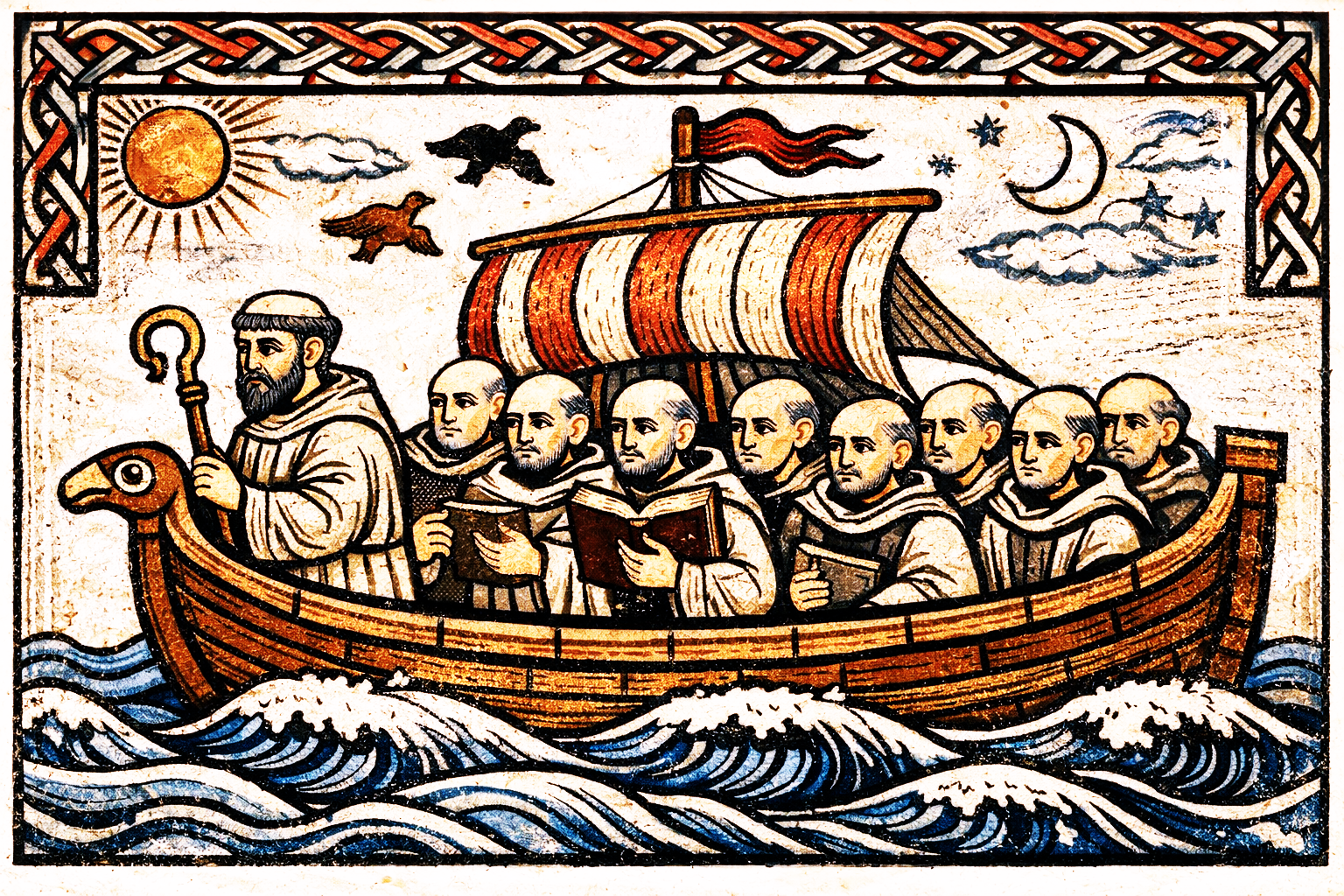
Ireland had no desert. But it had something else: the ocean. Cold, pewter-grey, stretching westward into a void that no map had charted. And in that ocean, on rocks and skerries barely large enough to stand on, Irish monks found their desert. The theology of peregrinatio pro Christo - pilgrimage for Christ, voluntary exile - became one of the most distinctive features of Irish Christianity. To leave everything familiar, to cast off in a currach into the Atlantic with no certain destination, was understood not as recklessness but as the highest possible act of spiritual devotion.
The 1908 edition of The Tablet made precisely this point: the Irish treated the western ocean as their desert, in exactly the same spirit that Egyptian monks had treated the Sahara. The structural parallel is so precise, and so unusual, that it demands explanation. Something of the Egyptian ascetic ideal - its logic, its theology of place, its vocabulary of holy withdrawal - had reached Ireland. The question scholars have wrestled with ever since is how.
The Seven Monks of Disert Uilaig
There is a line in an early Irish litany - preserved in the manuscript tradition associated with the Book of Leinster, that twelfth-century compilation housed in the Royal Irish Academy in Dublin - that has generated more argument than almost any other fragment of early medieval religious writing in Ireland. It invokes, among the saints to be venerated, 'the seven monks of Egypt in Disert Uilaig.'
Disert Uilaig. The very name is a clue. Diseart is the Irish form of the Latin desertum - a desert, a wilderness, a hermitage. The Irish landscape is scattered with díseart place-names: Dysert O'Dea in Clare, Desertmartin in Derry, Dundesert near Crumlin in Antrim. Each one marks a site associated with the desert ideal - a place of holy withdrawal, named after the spiritual geography of Egypt. In 1962, a Coptic monk named Father Makary, visiting Belfast for a conference of the World Council on Christian Education, travelled to Dundesert in County Antrim, searching for evidence that monks of his own tradition had once lived and died there. He was following the trail of that single line in the Book of Leinster.
'It was known that Egyptian monks had come to Ireland and settled and died in one of its monastic establishments. Perhaps much of our own Christianity had come direct from the Egyptian Church before we were influenced by Rome.'
- Rev. A. R. R. Howell, Glasgow Egypt Society lecture, reported in the Witness (Belfast), 22 March 1929
The mainstream scholarly position is that Irish monasticism absorbed Egyptian desert ideals mostly through the mediation of the Latin West - through writers like John Cassian, who transmitted Egyptian monastic teaching to Western audiences - rather than through direct Coptic missionaries in Ireland. But indirect influence, deep and pervasive, is beyond serious doubt. And then there is a stone.
The Ogham Stone at Aghabulloge: Olan the Egyptian
In the centre of a wild parish in the county of Cork, in a little churchyard at Aghabulloge shaded by venerable trees, stands a time-worn pillar-stone with an Ogham inscription cut along its edge. Ogham is the ancient Irish script - a system of notched lines arranged along a central stem - and this stone is one of several thousand that survive across Ireland, Wales, and south-west Britain. Most record names and genealogies. This one records something entirely different.
In a paper read before the Royal Irish Academy on 14th February 1848, Dr Graves interpreted the inscription on the Aghabulloge stone. As Father Lee reported to the Limerick Catholic Literary Institute in October 1892, and as the Cork Constitution confirmed in its own account of the same lecture published the following week, the inscription reads: 'Pray for the soul of Olan the Egyptian.'
'Thus here we have established two points. 1st. That Egyptians came to Ireland in the sixth century; and 2nd, that the early Irish Christians made use of Ogham writings.'
- Rev. Father Lee C.C., Catholic Literary Institute, Limerick, October 1892 (reported in Limerick Chronicle, 29 October 1892, and Cork Constitution, 1 November 1892)
Father Lee drew two firm conclusions from this inscription, and while the second - that early Irish Christians used Ogham - has been debated ever since, the first is extraordinary: that a man identified specifically as Egyptian was buried in a Christian churchyard in County Cork, commemorated in the indigenous Irish script, and prayed for by the local community. He was not a curiosity. He was not hidden. He was honoured.
The Aghabulloge stone is not a legend, not a litany line, not a hagiographic tradition. It is a physical object, still standing in its churchyard, still bearing its carved inscription. It does not prove that entire communities of Coptic monks settled in Ireland; but it proves something almost as significant - that at least one Egyptian man died in Ireland, was buried there according to Christian rites, and was sufficiently integrated into local devotional culture that the community wished to preserve his memory and ask prayers for his soul. He had a name. He had a grave. He had mourners who could write.
✦ ✦ ✦
The Welsh Connection: Ogham, Druids, and the Sea Road
The Aghabulloge stone is not an isolated phenomenon. It belongs to a much wider story about the Ogham script and its geography - a story that connects Ireland to Wales in ways that the history books have consistently underplayed.
Along the western coasts of Wales, particularly in Pembrokeshire, Ceredigion, and the Llyn Peninsula, there survive dozens of standing stones inscribed in Ogham. These are datable, physical, archaeological evidence of Irish people living in Wales in the fourth, fifth, and sixth centuries. Some stones carry both Ogham and Latin inscriptions, a bilingualism that speaks of communities navigating two worlds simultaneously - the indigenous Irish world and the Latin Christian one. The concentration of these stones at the western tip of Wales, at the point nearest to Ireland, speaks to a traffic across the Irish Sea that was constant and bidirectional.
The Welsh word for an Irishman - Gwyddel, plural Gwyddelod - preserves a linguistic memory of Irish presence that is remarkable for what it implies. Edward Llwyd, the Oxford antiquarian, first argued in the eighteenth century that the Irish had dwelt in parts of Wales before the Welsh-speaking Kymry arrived. Later Welsh-language scholarship explored this at length, noting that stone circles called Cytiau'r Gwyddelod - 'the huts of the Irish' - on the mountains of Gwynedd represent traces of an Irish population that once inhabited north Wales. And the Welsh name for the alphabet itself - Gwyddar or Gwyddor - preserves a memory of the same Irish intellectual heritage: it signifies both 'the alphabet' and 'gate,' a compound derived from the Gwyddoniaid, the learned men.
One extraordinary Welsh scholar of the nineteenth century went further, arguing that when the Roman Emperors from Claudius onwards issued edicts to hunt down and exterminate the Druids of Gaul and Britain, those who escaped fled to Ireland. In this reading, the intellectual prestige that clustered around Ireland in the early medieval period was not a sudden efflorescence but the long-term result of Ireland having absorbed and protected the intellectual class of the Celtic world during the Roman persecution. The Druids carried their learning to the one corner of the western world that Rome had never conquered. And the monks who eventually replaced them in that same landscape - who learned to write in Ogham before they learned to write in Latin - were in some ways their heirs.
The Aghabulloge stone, then, belongs to both stories simultaneously. It is an Ogham inscription, an example of that pre-Christian or at least pre-Roman script now repurposed for Christian commemoration. And it commemorates an Egyptian. The script that may have begun as a Druidic alphabet, that spread with Irish settlers across the Irish Sea to Wales and beyond, here records the last resting place of a man from the banks of the Nile. The Atlantic world and the Mediterranean world meet in a single carved stone in a County Cork churchyard.
The presence of ogham inscriptions in Wales, Cornwall, and even as far east as Silchester shows that Irish influence in sub-Roman Britain was not confined by the sea between Britain and Hibernia; it moved freely around the Celtic Sea and beyond.
✦ ✦ ✦
The Monks Who Went the Other Way
There is one piece of evidence that cuts through the speculation about Irish-Egyptian connections with exceptional clarity, and it comes not from stone or manuscript but from a monk's travel report - a first-hand account so vivid and specific that its authenticity is beyond doubt. His name was Dícuil. He was an Irish monk who produced, in the year 825, a geographical treatise called De mensura orbis terrae - 'On the Measurement of the World.' Among its sources is the testimony of a monk named Fidelis, almost certainly another Irishman, who had actually been to Egypt.
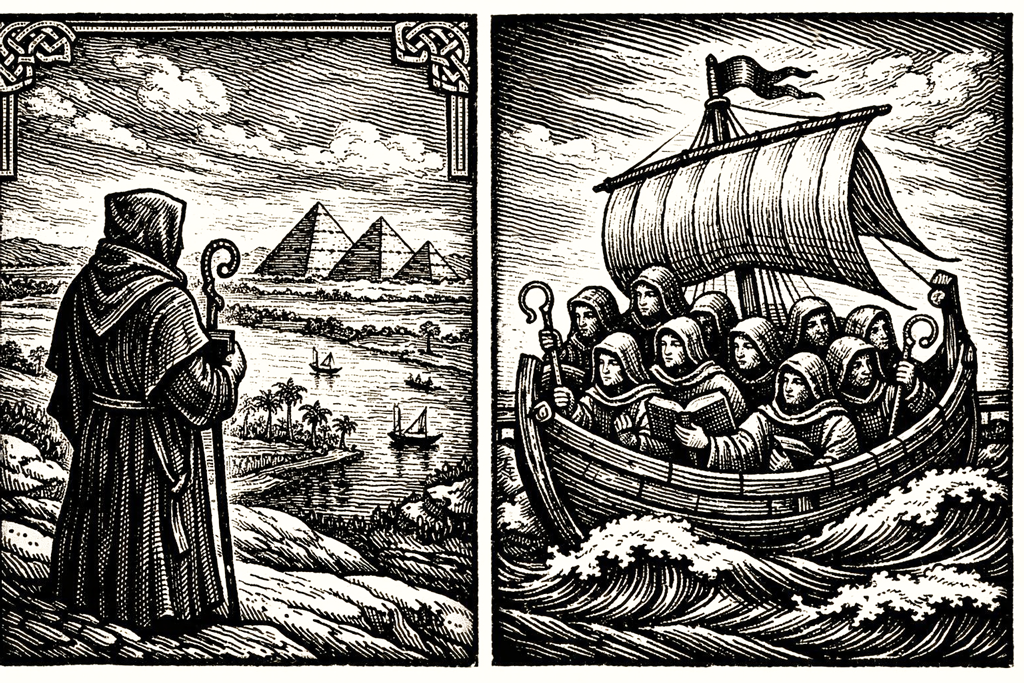
Fidelis had sailed up the Nile. He had passed through the canal connecting the Nile to the Red Sea - the ancient Trajanic Canal, originally cut by Ptolemy Philadelphus. He had stood before what he called the 'Barns of Joseph,' the medieval name for the Pyramids of Giza, and measured one of them: four hundred feet along the base, so high that 'a man could not see the top, verging to a slender point.' He then sailed into the Red Sea, following the path of Moses, and observed that the colour of that sea was unlike any other water he had seen.
'Then coming to the mummies (pyramids) clearly they were amazed to find that from their foundation to their summit they were all composed of stone. Then they were so high that a man could not see the top, verging to a slender point. After this the brother above named measured one of the granaries from one corner to the other, and found it to be four hundred feet.'
- Dícuil, De mensura orbis terrae, 825 AD
Dícuil also records that Irish hermit monks had reached Iceland - which he calls Thule - as early as 795 AD, noting with precision the phenomenon of the midnight sun: how at midsummer in that place the sun barely dipped below the horizon, and a man could perform all his ordinary business by the light that remained. The Norse, according to all accounts, did not discover Iceland until around 865 AD. Irish monks were there seventy years before them.
What Dícuil and Fidelis together demonstrate is something crucial: Irish monks of the early medieval period were participants in a vast intellectual and spiritual network that stretched from the deserts of Egypt to the edge of the Arctic. If Fidelis could sail to Egypt, why should we be surprised that influences from Egypt might have found their way - along the same trade routes that had connected the Mediterranean to the Atlantic for millennia - back to Ireland? The connections ran in both directions. They always had.
✦ ✦ ✦
The Bog That Remembers: The Faddan More Psalter
In July 2006, a bulldozer driver named Eddie Fogarty was extracting peat from the Faddan More bog in north County Tipperary when his machine brought to the surface something that should not have survived. It was a book. Specifically, it was a psalter - a handwritten copy of the Book of Psalms - dating from around 800 AD. The National Museum of Ireland declared it one of the most significant archaeological finds in Ireland in decades. Bernard Meehan of Trinity College Library described it as the first discovery of an early medieval Irish manuscript in two centuries.
The psalter is extraordinary in itself: sixty sheets of vellum in a leather wallet-cover, the Latin text of the Psalms written in a single column in Insular majuscule script, its opening psalms decorated in black, red, and yellow. But it is what was found inside the leather cover during conservation work between 2006 and 2010 that links it, startlingly and concretely, to Egypt. The cover was lined with papyrus.
Papyrus - the writing material of ancient Egypt, manufactured from reeds that grow along the Nile, and used for millennia across the Mediterranean world - had been used to stiffen the leather cover of an Irish psalter buried in a Tipperary bog. It was probably used as a liner, a stiffener, a practical material to hand in the scriptorium where the book was made. But papyrus is not native to Ireland. It does not grow in Tipperary, nor in Britain, nor anywhere north of the Mediterranean basin. For papyrus to be used - even as a scrap of stiffening material in a book cover - it had to have been imported. And the suggestion that this connection points to links between Irish Celtic Christianity and the Coptic churches has been made by experts advising on the discovery itself.
Concealed, Lost, or Offered? The Mystery of the Bog
Why was the Faddan More Psalter in the bog? This is the question that haunts the find and gives it its deepest resonance. Bogs were not rubbish dumps in early medieval Ireland. They were not accidental places. The same qualities that make them extraordinary preservers - the low oxygen, the acid peat, the anti-microbial sphagnum moss - were understood in some fashion by the communities that lived around them. Objects went into bogs deliberately. People went into bogs deliberately, as Clonycavan Man grimly attests.
The most prosaic explanation for the Faddan More Psalter is concealment. The area around Faddan More is rich in medieval monastic foundations: Lorrha and Terryglass in County Tipperary, Birr and Seirkieran in County Offaly are all nearby. Six years before the psalter was found, a leather satchel - radiocarbon dated to between the seventh and ninth centuries - was found just one hundred metres away. Two ancient wooden vessels had also been recovered from the same bog in the years before 2006. The satchel may originally have contained the book. The picture that emerges is of a community in flight - perhaps from Viking raiders, who were devastating Irish monasteries from the 790s onwards - hurriedly hiding their most precious objects in the bog, confident that the peat would protect them, hoping to return. They did not return. Or perhaps they could not.
But there is another possibility, one that sits uncomfortably alongside the Viking-raid narrative and connects the psalter to a much older tradition. Bogs in Ireland had been sacred spaces for over a thousand years before this book was made. Clonycavan Man, buried in one around 300 BC, may have been a sacrificial offering to the powers that lived in the liminal world between earth and water. The votive tradition - of offering precious objects to sacred spaces, rivers, lakes, and bogs - is documented across Iron Age Europe. The famous Broighter Gold hoard from County Derry, including a magnificent gold boat, was deposited in what may have been a ritual lake offering. Could the Faddan More Psalter, lined with its strip of Egyptian papyrus, have been placed in the bog not to be hidden but to be given?
We cannot know. That uncertainty is itself a kind of knowledge - a reminder that the boundary between the pragmatic and the sacred was far more porous in early medieval Ireland than our modern categories allow. What we can say is this: a book written in an Irish monastery around 800 AD, in the tradition of a faith that had been shaped by Egyptian desert monasticism and carried along trade routes that predated Rome, ended up in the same kind of dark, liminal, transformative landscape where Clonycavan Man had lain for two millennia. The bog holds both of them. It held a man who styled his hair with Iberian resin and a book whose cover was stiffened with Egyptian reed. Ireland, the peat says, was always at the centre of something larger than itself.
✦ ✦ ✦
The Egg and the Tomb: A Symbol That May Have Travelled the Same Roads
There is one further thread worth pulling, because it connects Egyptian Christianity to a custom so familiar that its origins are rarely questioned. In the Eastern churches, the egg becomes an unusually direct emblem of the Resurrection: a sealed shell that looks like a dead thing, yet holds life that will break out. The same logic appears very early in Christian tradition further east, where the custom of colouring eggs is often traced through Mesopotamian Christianity into the Orthodox world, and from there into Western Europe.
In Egypt the symbolism is explicit in living tradition. Eggs are eaten as a resurrection symbol at Sham El Nessim, the Monday after Easter, when the “garden” outing echoes paradise restored. And in some Coptic churches an ostrich egg is hung in the sanctuary as a visual reminder to keep watch - a small, bright object that pulls the eye upward, like a prompt to readiness.
Fasting intensifies the meaning. In the Coptic discipline, fasting commonly means a vegan abstinence from animal products, including eggs - so their return at Pascha becomes a kind of edible punctuation: abundance after deprivation, life after a little death.
And the deeper archaeology is there if one wants it. Long before Christianity, ostrich eggshell objects are found in Predynastic Egyptian burial contexts - the egg already present as a high-value container and a potent form in a funerary setting. The Church did what it so often did: it did not need to invent the symbol from nothing; it could take what was already intelligible and read it through Resurrection.
None of this “disproves” Eostre - but it does loosen the grip of any claim that Britain and Ireland must have had an egg-goddess to explain why eggs became attached to Easter. Even the name-story for Eostre rests heavily on Bede and is debated; the egg, by contrast, already has a well-lit Christian pathway into the West through Eastern practice and fasting logic.
✦ ✦ ✦
Before Patrick: The Untold Story
The single most important sentence in the documentary record of early Irish Christianity may be one of the shortest. It appears in the chronicle of Prosper of Aquitaine, entered under the year 431 AD: 'Palladius was consecrated by Pope Celestine, and sent as the first bishop to the Irish believing in Christ.'
Five words - 'to the Irish believing in Christ' - overturn an entire mythology. If Palladius was sent as bishop to Irish people who were already Christians in 431, then Christianity in Ireland did not begin with Patrick. It was already there. Palladius was not a pioneer; he was an administrator, sent to organise a community that already existed. Patrick, who arrived the following year, was not the apostle of a pagan land but the dominant missionary figure among people some of whom had already heard the Gospel.
A 1907 lecture reported in the Banbury Guardian put the logical implication of this with admirable clarity: 'About the year 400, Pelagius' heresy flourished in Ireland, and there could not have been a heresy unless there was a previous form of Christianity.' Pelagius - the theologian whom some sources identify as Irish, whom St Jerome described as sprung from 'a Scottish race, from the neighbourhood of Britain,' and whom a richly detailed 1888 letter to The Tablet debated at length as either British or Irish - had been generating theological controversy across Ireland before Palladius ever arrived. You cannot have heresy without orthodoxy to diverge from.
The pre-Patrician saints reinforce this picture. Declán of Ardmore, patron of the Déisi of Munster. Ciarán of Saigir, the earliest of Irish monastic founders. Abban, Ailbe, Ibar - the four saints of Munster's pre-Patrician tradition, all remembered in later hagiography as Christians who preceded Patrick and whose authority he had to negotiate rather than simply override. The medieval Lives of these saints must be treated with scholarly caution - they were written centuries after the events they describe and serve clear ecclesiastical agendas. But they encode a persistent and widespread memory: that Christianity in Ireland was older, and more various in its origins, than the Patrick story allows.
Pelagius and the Proof of Prior Christianity
The Pelagian controversy is worth dwelling on, because it illuminates how thoroughly Ireland was already entangled in the wider Christian world before any formal mission reached its shores. Pelagius - whoever he was - had studied in Rome, debated with Augustine and Jerome, and spread his ideas about free will and grace across Africa, Palestine, and Gaul before the Pope finally felt compelled to act. When Prosper of Aquitaine records that Palladius was sent partly in response to the Pelagian problem - 'Agricola, a Pelagian… corrupted the churches of Britain, by insinuation of his doctrine' - he is telling us that Ireland and Britain had Christian communities sophisticated enough to be susceptible to complex theological controversy. These were not recently baptised communities still learning the Lord's Prayer. These were places where people argued about the nature of grace.
The same routes that had carried Iberian hair gel to a Meath chieftain in 300 BC, that had carried Egyptian papyrus to an Irish scriptorium around 800 AD, had been carrying Christian ideas - and Christian controversies - to Ireland for generations before Palladius stepped ashore.
✦ ✦ ✦
The Island of Saints and Scholars
By the sixth century, Ireland had become something extraordinary. The monasteries that spread across the island were institutions of remarkable intellectual ambition. They preserved Latin. They studied Greek - the Book of Armagh, written in 807 AD, contains Gospel chapter headings in Greek letters. They attempted Hebrew - one manuscript tradition records a Psalter of Columba with Hebrew annotations in the margins.
And, crucially, they wrote down everything else. The secular epics, the mythology, the law tracts, the genealogies, the place-lore, the astronomical observation, the geographical knowledge. A Victorian scholar summarised the tradition: 'According to Professor O'Curry, there never was a bishop or priest educated in Ireland from St. Patrick's time till the 16th or 17th century who had not studied Irish literature and history as a part of his education.' Bede records that in his day, students from England and the continent were travelling to Ireland to study, and that the Irish furnished them with books and received them all. A later commentator said they arrived 'in boat-loads.'
Father Lee, in that remarkable 1892 lecture in Limerick, gave his audience a vivid picture of ancient Irish learning: the Aenachs, those great national gatherings where law was proclaimed and poetry recited; the five kingdoms and their elected kings; the Brehon law codes; the ancient colleges at Tara, Aileach, and Cashel; the poets who could 'rhyme rats and mice to death'; the Druids who maintained the sacred fires. He described a society that was, by the standards of its age, sophisticated, literate in its own terms, and deeply connected to a world beyond its own shores. It was from this world - not from a blank pagan darkness - that Irish Christianity grew.
Kildare and Saint Brigit: The Engine of Sanctity
No discussion of Irish Christianity's flowering would be complete without Brigit of Kildare, the third of the great Irish saints alongside Patrick and Columba, and in many ways the most deeply rooted in the Irish landscape. The earliest substantial Life of Brigit, written by Cogitosus around 650 AD, presents Kildare in terms that modern scholars have compared to a 'New Jerusalem' - a symbolic holy centre, a place of refuge and miraculous authority. The monastery was unusual in being a double house, accommodating both monks and nuns, a structural innovation that may itself speak to Eastern monastic influence.
The persistent overlap in popular tradition between the Christian saint Brigit and the pagan goddess Brigid - associated with fire, poetry, smithcraft, and healing - is a reminder that Irish Christianity did not simply replace what came before it. It transformed and incorporated it. The same mechanism that turned Egyptian desert theology into Atlantic ocean spirituality, that repurposed Ogham script for Christian epitaphs, that lined a Christian psalter with Egyptian papyrus, also turned a goddess of fire into a patroness of pilgrims. Ireland remade everything it received in its own image. That is perhaps its most enduring achievement.
✦ ✦ ✦
Whitby and the Question of Difference
In 664 AD, at the Synod of Whitby, the Northumbrian king Oswiu, raised in exile among the Irish of Iona just as his brother Saint Oswald had been, was asked to choose between two traditions of Christianity. On one side stood the church of Iona - Irish-founded, Irish-trained, with its own method of calculating Easter and its own distinctive style of monastic tonsure. On the other stood the Roman tradition, newly arrived via Canterbury. Oswiu chose Rome.
The differences that Whitby exposed - in Easter calculation, in tonsure, in monastic organisation - were not accidents. They were the accumulated evidence of a church that had grown up differently, that had absorbed different things, in a land where the usual Roman infrastructure of cities, roads, and diocesan bishops had never existed. And there is a delicious irony embedded in the controversy: the 'Roman' Easter method that won at Whitby had its origins in the astronomical traditions of Alexandria. The Egyptian connection was present on both sides of the argument.
But the deeper significance of Whitby lies in what it reveals about the nature of Irish Christianity over the two centuries before 664. It had grown from a community already Christian before Palladius arrived. It had been shaped by the same Atlantic trade networks that brought Iberian resin to Meath and Egyptian papyrus to Tipperary. It had absorbed the desert theology of Egypt and translated it into the language of ocean and stone. It had preserved the Ogham script and used it to commemorate an Egyptian in a Cork churchyard. It had produced monks who sailed to Iceland and pilgrims who measured the pyramids. And it had sent its scholars back out into a Europe that was struggling to recover from the collapse of Rome, lighting the lamps of learning in Bobbio, Luxeuil, St Gallen, and Würzburg - returning to a continent what the continent had, in some sense, first sent to them.
To understand all of that is to understand why the story of Irish Christianity cannot begin with Patrick. It must begin much earlier: with a chieftain in Meath who wanted his hair to look magnificent and knew where to get the best products; with traders on Atlantic sea roads that had been busy for a thousand years; with a man named Olan who came from Egypt and died in Cork and whose neighbours carved his name in stone so that the living might pray for his soul; and with a book of Psalms, lined with Egyptian reed, that went into the dark embrace of a Tipperary bog and stayed there for twelve hundred years, waiting to be found.
✦ ✦ ✦
A Note on Sources
The medieval sources discussed in this article include: Prosper of Aquitaine's Chronicle (434 AD); the Confessio of Saint Patrick; the Life of Brigit by Cogitosus (c.650 AD); the Book of Armagh (807 AD); and Dícuil's De mensura orbis terrae (825 AD). The litany invoking 'seven monks of Egypt in Disert Uilaig' is preserved in manuscript traditions associated with the Book of Leinster (12th century). The Ogham inscription 'Pray for the soul of Olan the Egyptian' at Aghabulloge, County Cork was identified by Dr Graves in a paper read to the Royal Irish Academy in February 1848, and reported in lectures by Father Lee C.C. at the Limerick Catholic Literary Institute, published in the Limerick Chronicle (29 October 1892) and Cork Constitution (1 November 1892). Clonycavan Man, found in County Meath in 2003, is dated by radiocarbon to 392–201 BC; analysis of his hair product by the Garda Technical Bureau confirmed its origin in south-western France or northern Spain. The Faddan More Psalter, discovered in a County Tipperary bog in July 2006, is dated to approximately 800 AD; the papyrus lining of its cover was identified during conservation work 2006–2010, and the suggestion that it points to links between Irish Celtic Christianity and the Coptic churches was made by specialists advising the National Museum of Ireland. The newspaper sources quoted range from the Catholic Telegraph (1864) to the Belfast News-Letter (1936) and the Northern Whig (1962). Robert K. Ritner's 'Egyptians in Ireland: A Question of Coptic Peregrinations' (1976) remains the most rigorous scholarly treatment of the direct-contact hypothesis.
✦ ✦ ✦