What Are the Borrowed Days?
Every year, as winter grudgingly loosens its grip on the British Isles, an ancient piece of weather folklore comes back into play. The last three days of March - the 29th, 30th, and 31st - have long been known across Scotland, England, and Ireland as the "Borrowed Days" or "Borrowing Days," a period popularly believed to be stormier, colder, and more treacherous than the season should reasonably allow. The explanation, passed down through centuries of cottage firesides and parish pulpits, is both charming and strange: March, that most fickle and boisterous of months, borrowed these days from mild April in order to wreak one last act of meteorological mischief before spring could properly take hold.
The tradition is ancient. The earliest known written reference appears in The Complaynt of Scotland, printed at St Andrews in 1548, where the author describes entering a green forest only to find the flowers stripped bare by what he calls "the borial blastis of the thre borouing dais of Marche." The phrase is used there as something entirely familiar, requiring no explanation for the reader - suggesting the belief was already well established in popular culture long before the sixteenth century.
Why Did March Borrow the Days?
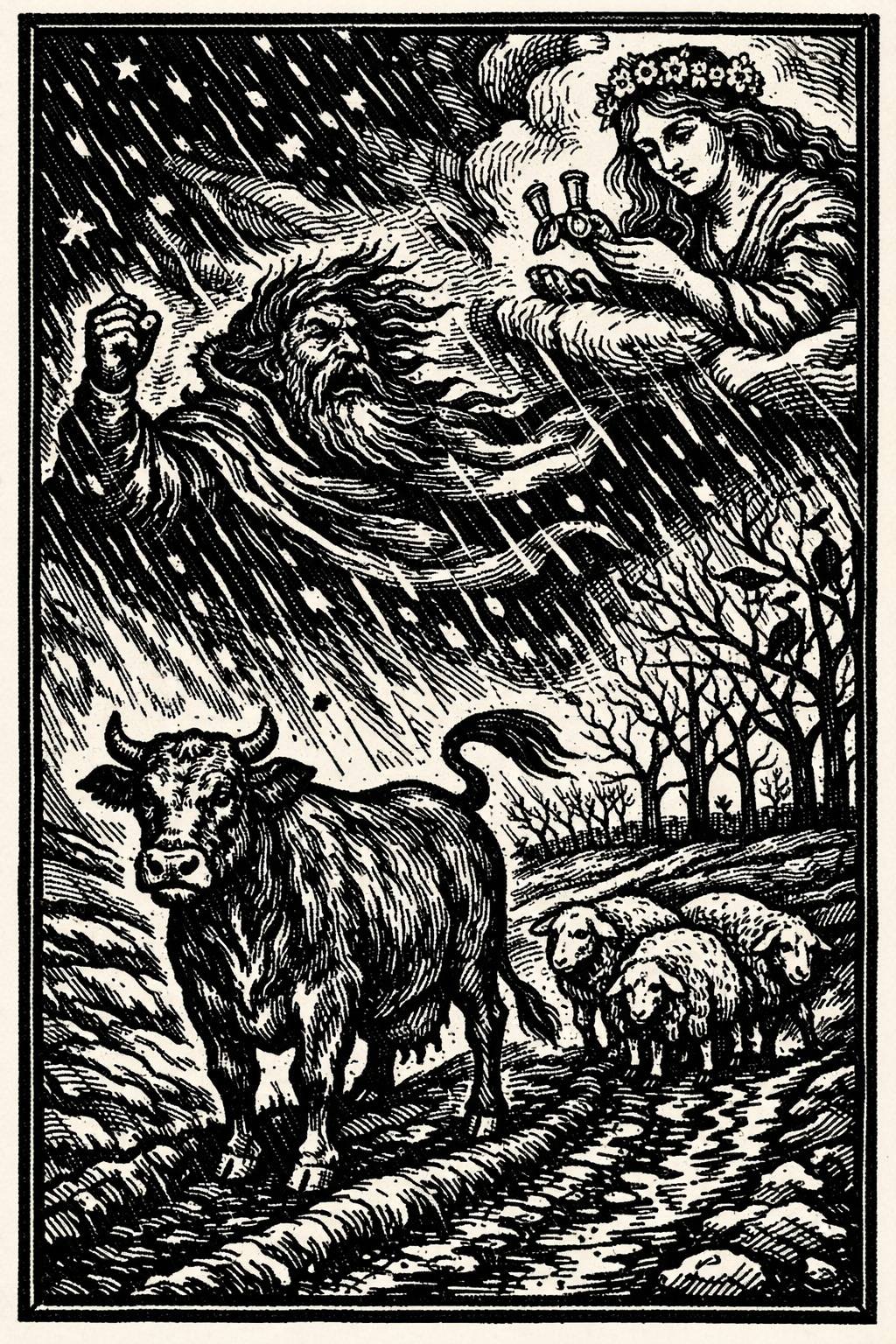
The popular legend, as recorded by Robert Chambers in his Popular Rhymes of Scotland and quoted in newspapers across Britain throughout the nineteenth and twentieth centuries, holds that March borrowed those three days for one express and uncharitable purpose: the destruction of a small flock of young sheep that had dared to graze upon the hillside in the early spring warmth, apparently taunting the month with their survival.
The most widespread Scottish version of the story is enshrined in a rhyme known as far north as Aberdeen and as far south as Yorkshire. March addresses April directly, demanding the loan of three days. April obliges, and the borrowed days arrive in sequence - first with wind and rain, then with snow and sleet, and finally with such a severe freeze that the birds' beaks are stuck fast to the trees. When the three days are past and gone, the sheep - variously described as "hoggs" (the old Scots word for a sheep in its second year), "hogs," or "lammies" - come limping home, bedraggled but alive, having survived March's best efforts.
This detail - that the sheep survive - is itself significant. As multiple commentators noted across the decades, March's borrowed scheme ultimately fails. The month does his worst and still cannot finish the job.
The Brindled Cow: An Irish and Ulster Variant
While the Scottish tradition centres on hoggs or young sheep, a fascinating parallel legend from Ireland introduces a rather different animal: the old brindle cow, sometimes called in Irish tradition the "ould stripper." This variant appears to be particularly associated with Ulster and the province's oral storytelling culture.
In the Irish telling, it is not merely a flock of anonymous sheep that defies the winter month, but a single magnificent, cunning old cow - hardy, scornful, and apparently indestructible. All the winter months conspire against her: November threatens fog, December promises burial in snow, January and February claim they will finish her quietly. But it is March who steps forward with the most ambitious scheme, vowing to send her "to pot with a tearing nor'-easter."
March storms and blusters through his own days with tremendous violence, yet the old cow simply wags her tail - strong as a blackthorn flail, according to one poem - in magnificent contempt. When March's own days run out and the cow is still grazing, he turns to young April in desperation and begs three days. April, characterised throughout this tradition as sunny, gentle, and perhaps a little naive, agrees. The borrowed days descend on the Irish hillside with ferocious cold. The old cow is bent low by the hardship, and when she finally falls exhausted into a furrow, March crows in triumph and declares he is about to skin her.
But here the Irish genius for storytelling adds an irresistible twist: just as March speaks, his borrowed time runs out. And from the furrow leaps the old cow, fit as ever, having apparently been shamming all along. March is left staring in disbelief, and "Hurroo!" crows the cow, "sure I'm not skinned yet." From that day to this, goes the legend, March takes bad about this time of year and borrows three days from April in his mad, impotent rage - forever pursuing the ghost of a cow that no one ever sees, for she died long ago on the slopes of Slievegallon.
The Drogheda Independent of 1920 preserves yet another variant in which the brindled cow appears as a phrase within the tradition of weather lore: reference is made to "the days of the brindled cow" as part of a catalogue of unpleasant spring phenomena, alongside "the fierce storms of Shrove" and "the month of showers" - indicating that the cow legend was woven deeply enough into Irish weather consciousness to serve as a shorthand for late-winter cold spells.
Regional Variations Across Britain and Ireland
One of the most striking features of Borrowed Days folklore is the sheer variety of its forms across different regions. While the core narrative - March borrowing days from April to wreak havoc on livestock - remains consistent, the details shift significantly depending on where the story was told.
In Scotland, the hoggs of the rhyme are the central victims, and the tradition was so firmly embedded that it carried genuine social weight. Throughout rural Scotland, the Borrowed Days were considered deeply unlucky for lending or borrowing anything at all. Any item lent during this period was believed liable to be used in witchcraft against its owner, a superstition recorded as late as the early twentieth century. So strong was the tradition in Scotland that when the Covenanting army under the Marquis of Montrose marched into Aberdeen on 30th March 1639, and the weather happened to be fine and clear, a Presbyterian minister preached that this was a miraculous dispensation of Providence on behalf of the good cause - for everyone knew that a fine day during the Borrowed Days was almost supernatural.
In Cheshire, the first eleven days of May were historically known as "Borrowed Days," on the grounds that under the old Julian calendar they properly belonged to April. A local saying held that cold weather in early May simply meant "we're only in the borrowing days yet." Meanwhile, in parts of Northumberland, it was considered deeply unlucky to allow any light to leave the house "while the Borrowing Days were on." In Lincolnshire, the first three days of May were called "Blind Days," and no farmer would sow seed until they had safely passed.
The first three days of February were also known as "Borrowed Days" in some traditions, and were considered prophetic: if stormy, the rest of the year would be fine; if fair, bad weather lay ahead for the entire year.
The Highland Faoilteach: A Related Tradition
An important parallel exists in the Gaelic Highlands, where a period known as the Faoilteach - sometimes translated as "the wolf month" or simply understood as a period of bitter late-winter cold - occupies a similar position in folk consciousness, but falls in February rather than March. The Faoilteach was said to represent three days borrowed by February from January, with January bribed by the gift of three young sheep. These days, reckoned by Highland tradition to fall between the 11th and 15th of February, were considered the most favourable possible omen if they were stormy and miserable - the worse the Faoilteach, the more certain the coming spring and summer would be fair. Mrs Grant, in her work on Highland superstitions, recorded this tradition in considerable detail, noting that the Faoilteach was used as the very "ultimatum of bad weather" in Gaelic speech.
European Parallels: Spain, France, and Provence
The Borrowed Days tradition is far from uniquely British. Strikingly similar legends were recorded across Spain and France, suggesting a shared European inheritance of weather mythology, likely connected to medieval Church calendars. An ancient Romish calendar cited in Brand's Popular Antiquities contains an obscure reference to "a rustic fable concerning the nature of the month" and the "rustic names of six days which shall follow in April or be last in March" - suggesting a pre-Reformation clerical awareness of the tradition.
In Andalusia, the Spanish version of the story has a distinctly moralistic flavour. A shepherd promises March a lamb in exchange for calm weather to protect his flock. March agrees, the weather relents, the flock prospers - and then the shepherd refuses to hand over the promised lamb. The outraged month borrows three days from April and sends such storms that the whole flock perishes. Here, unlike in the Scottish rhyme, March succeeds: the sheep do not come hirpling home.
The French Provençal version, recorded in detail in correspondence to the Daily News in 1900, is richer still. A proud old woman taunts February at the end of the month, boasting that her flock has survived the winter unharmed. February, furious, borrows three days from March and kills every animal she owns. Having lost her sheep, the old woman then buys cows - and boasts again too soon. March this time borrows four days from April and destroys the cattle as well. The period of cold connecting February and March in Provence still bears the Provençal name Reguignado de la Vièio - "the kicking of the old woman" - a vivid memorial to the legend. A further period in late March and early April, locally unlucky for cows, is known as li Vaqueiríeu.
The Calendar Question: Old Style vs New Style
A recurring puzzle in the Borrowed Days tradition is the question of exactly which days are meant. When Britain adopted the Gregorian calendar in 1752, eleven days were dropped from the reckoning, meaning that what was previously the last three days of March old style now corresponds to approximately April 9th–11th on the modern calendar. This has led to centuries of debate about whether the Borrowed Days should be observed at the end of March or in early April.
Correspondents to newspapers in the 1880s and beyond noted this confusion with varying degrees of exasperation. One writer in the Edinburgh Evening News in 1943 argued firmly that the borrowed days were "of course, the first three days of April" - while correspondents to the Dundee Courier and other papers consistently placed them at the end of March. A writer in the Illustrated Berwick Journal in 1916 pointed out with some amusement that "for a century and a half people have gone on guilelessly repeating these wise old saws just if Pope Gregory had never reformed the calendar."
Meteorologically, the confusion may be less important than it seems. As several scientific commentators noted, there does appear to be a genuine cold snap that recurs across the northern hemisphere in mid-April, corresponding to the beginning of the month under the old calendar - unseasonable frosts, snow showers, and cutting northerly winds. Modern meteorologists did not endorse the three-day specificity of the tradition, but they did acknowledge that the underlying observation of late-season cold spells had a basis in real weather patterns.
The Luck of the Borrowed Days: Superstition and Social Practice
Beyond the mythology of sheep and cows, the Borrowed Days carried significant practical weight in the communities that believed in them. The prohibition on lending and borrowing was widely observed, particularly in Scotland, and extended logically from the name itself: if these were days defined by borrowing, then borrowing during them was to court the worst kind of ill-fortune. Any object lent during the Borrowed Days was thought to carry the malign influence of the season with it, potentially being used as a charm against the lender.
Farmers in England were advised not to plant seed on the Borrowed Days, on the understanding that nothing sown in that period would bear fruit - hence the Lincolnshire name "Blind Days" for the equivalent period in early May. More broadly, the Borrowed Days were understood as a time to sit tight, avoid new enterprises, and wait for the storm to pass.
As the Perthshire Advertiser observed in 1945, there were still "a good many folk who think it courting misfortune to launch any new enterprise during the tail end of March." The tradition had survived, even in attenuated form, well into the twentieth century.
The Etymology of "Borrowed": A Deeper Theory
One of the most intriguing philological arguments about the Borrowed Days appeared in the Banffshire Journal in 1882, where a correspondent proposed that the word "borrowed" in this context had nothing to do with lending at all. Drawing on the old Saxon word bergen - meaning to shelter or protect - he argued that the "Borrowed Days" were originally the "Sheltering Days": the period during which cattle and livestock had to be driven indoors for protection against the last ferocious storms of winter. Under this interpretation, the tradition was originally practical agricultural advice, later mythologised into the story of March and April. The word burgh, borough, and harbour all share this sheltering root, the writer noted - suggesting the Borrowed Days were simply "the days when you needed a harbour."
Whether or not this etymology is correct, it points to something important: behind the charming myth of the conspiring months and the indestructible cow lies a genuine meteorological reality, one that farmers and shepherds observed over many generations and enshrined in story, rhyme, and calendar custom.
Legacy: The Borrowed Days in Literature and Culture
The Borrowed Days have left their mark on a surprising range of cultural and literary contexts. Sir Walter Scott referenced them in The Heart of Midlothian, where a character mentions that "the warst blast o' the borrowing days couldna' kill the three silly poor hog-lams." Sir Thomas Browne included them in his Vulgar Errors of 1646 as a popular superstition, while simultaneously acknowledging that they were "usually stormy." Robert Chambers gave them extended treatment in his Popular Rhymes of Scotland. Mistral's Provençal epic Mirèio preserves the French version of the legend.
More personally, letters to Scottish newspapers as late as 1977 record elderly correspondents writing in to share versions of the rhyme learned from their mothers and grandmothers - living chains of oral tradition stretching back through the centuries to those "borial blastis" described in the Complaynt of Scotland in 1548.
Conclusion: Why the Borrowed Days Still Matter
In an age of satellite weather forecasting and climate science, it might be tempting to dismiss the Borrowed Days as mere superstition. But their persistence across so many centuries, so many countries, and so many variant forms suggests they encode something real: the observation, accumulated over generations of outdoor living, that the transition from winter to spring is rarely smooth, and that the last days of March (or the first days of April) have a habit of delivering one final, brutal reminder of what has just passed.
The story of the old brindle cow - shamming in the furrow, surviving against all odds, leaping up to crow her defiance - is perhaps the truest emblem of the season itself: the sense that spring, however battered and delayed, will always outlast whatever winter throws at it in those final furious borrowed days.
This article draws on historical newspaper sources from across Britain and Ireland, including the Drogheda Independent (1920), Dundee Courier (1926, 1966, 1970, 1977, 1993), Liverpool Evening Express (1905), Accrington Observer (1910), Belfast Telegraph (1952), East Suffolk Gazette (1917), Country Life (1941), Cumbernauld News (1966), Banbridge Chronicle (1972), Daily News London (1900, 1936), Aberdeen Evening Express (1881, 1894), Preston Herald (1888), Glasgow Herald (1888), Pall Mall Gazette (1907), Blackburn Times (1929), and many others.