
Long before she became Adam’s rebellious first wife, Lilith haunted the mythic landscapes of Mesopotamia as a restless female demon of wind, desolation, and night. This article traces how she traveled from Sumerian myth and Isaiah’s wastelands into rabbinic lore, childbirth amulets, and the later imagination of the modern world.
A History of the World's Most Dangerous Woman
She has been called the first wife of Adam, the mother of demons, the queen of the night, the enemy of newborns, and the maid of the wind. She has haunted willow trees on the banks of the Euphrates, taken up residence in the midst of rabbinical debate, inspired one of the great Victorian painters, and lent her name to a sensational devil dance performed at the London Coliseum in 1929. She is Lilith, and few figures in human mythology have proved so old, so strange, or so hard to put back in the ground.
To trace Lilith's origins is to travel back through four thousand years of religious imagination, folkloric anxiety, and cultural transmission. She begins not in the Garden of Eden but in the alluvial plains of ancient Sumer, long before Adam drew breath. And she ends - if she ends at all - somewhere in the modern world, still slipping through cracks in the walls of houses where newborns sleep.
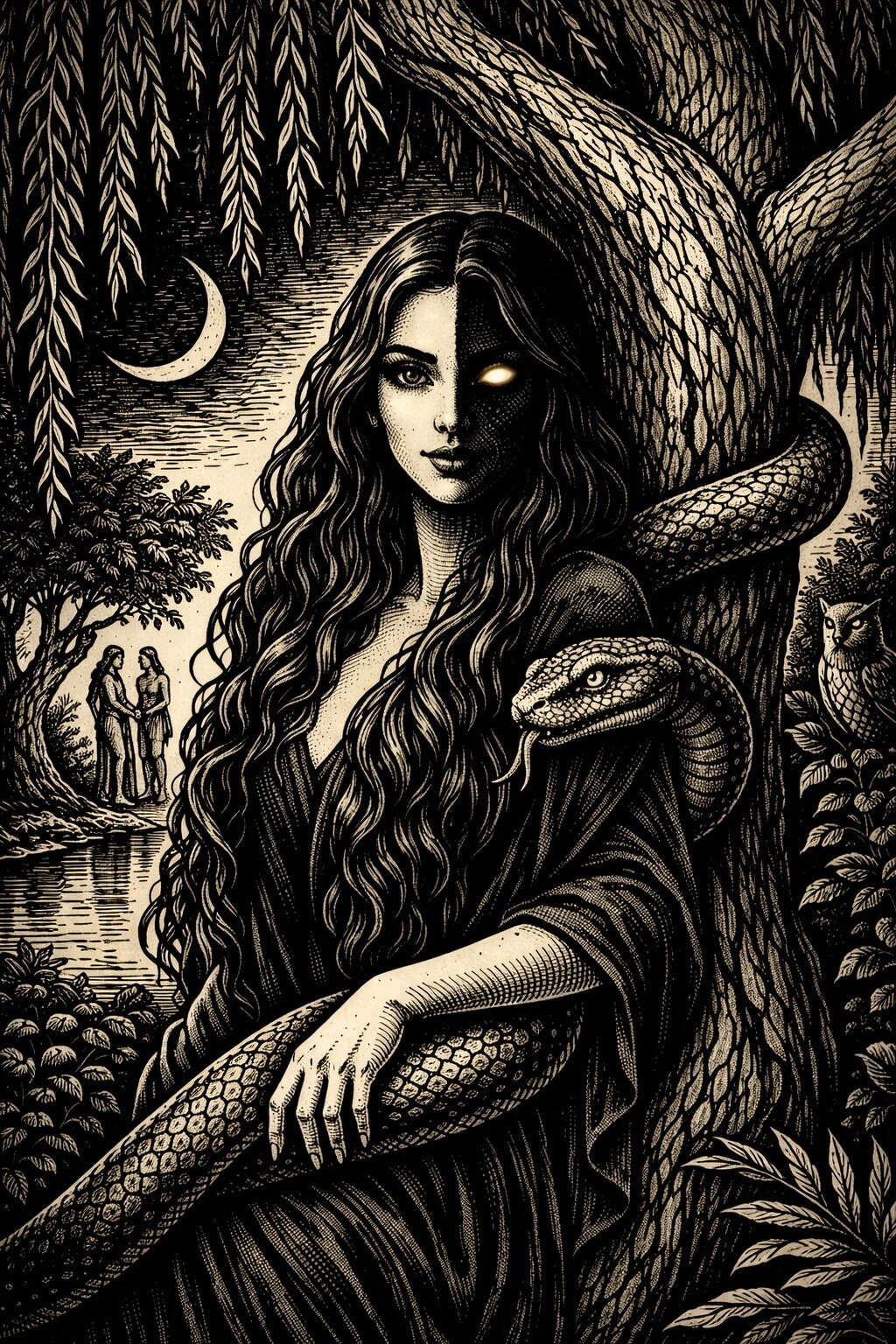
I. The Maid of the Wind: Sumerian Origins
The earliest known literary appearance of Lilith occurs in a remarkable Sumerian poem reconstructed by the scholar S. N. Kramer from five fragmentary cuneiform tablets dated to approximately 2000 BC. All were excavated from the ruins of the ancient city of Nippur in what is now southern Iraq. Kramer titled his translation "Gilgamesh and the Willow Tree."
The poem opens in mythological time, after heaven and earth have separated and the gods have taken their respective domains. The goddess Ninanna - the Sumerian counterpart of the Semitic Ishtar and the Greek Venus - rescues a willow tree from the bank of the Euphrates, where it has been uprooted by the great southwind, and plants it in her sacred garden at Erech, hoping one day to fashion from it a holy throne and couch. Years pass. The tree grows enormous. But Ninanna cannot cut it down, because three malevolent beings have taken up residence within it: a snake at the roots, the rebellious Zu-bird in the branches, and - in its very midst - Lillith, who has built her house there.
In Kramer's glossary, Lillith is defined as "a destructive demoness personifying barrenness and everlasting restlessness." He makes a striking claim about her etymology: though the word entered English as a loan from the Semitic languages, it is actually of Sumerian origin, and its literal meaning is "Maid of the Wind." When Gilgamesh finally comes to his sister Ninanna's aid - armoured and armed with a bronze axe of seven talents - he drives away all three inhabitants. The snake is slain at the roots; the Zu-bird flees to the mountains with its young; and Lillith tears down her house and flees to the desert wastes.
Even in this earliest appearance, the essential features of the Lilith myth are already present: her connection to wind and air, her association with desolation and flight, her enmity towards order and human flourishing, and - crucially - her ultimate defeat and banishment to the wilderness. She is a figure of restless, dangerous energy, ungovernable by the civilised world.
II. From Sumer to Babylon: The Archaeological Evidence
The journey from the Sumerian poem to the Jewish demon of later tradition passes through the rich and complex religious world of ancient Babylonia. The connection was made explicit at a lecture delivered to the Society of Biblical Archæology in December 1903, reported in the Jewish World, in which the Reverend Dr A. Lowy read a paper on Hebrew and Babylonian traditions relating to the "female demon" Lilith. Dr Lowy pointed out that previous accounts of Lilith had been derived almost entirely from secondary sources, but that new fields of research opened by Sir Henry Layard's excavations in Mesopotamia had allowed her origins to be traced back to the ancient gods of the Babylonian pantheon.
The Authorised Version of the Bible, Dr Lowy noted, had mistakenly rendered the word Lilith in Isaiah xxxiv.14 as "screech-owl" - a rendering that, while picturesque, obscured the demonic import of the original. Other translators had come closer to the mark by comparing Lilith with the Hebrew noun La-yil, meaning "night," so that Lilith appears to represent a nocturnal demon. This etymology was independently confirmed by the scholar A. L. Mayhew in a letter to the Academy in June 1884, which drew parallels between Lilith and the Greek strix - a screech-owl that sucked the blood of children - and traced a remarkable genealogy through Semitic, Teutonic, and classical traditions in which the owl, the night, and the female demon are intertwined across multiple cultures.
Most dramatically, Dr Lowy drew attention to the incantation bowls unearthed by Layard at Mound Amran - part of ancient Babel - now held in the British Museum. These ceramic bowls, inscribed in a spiral of Jewish Babylonian Aramaic and dated to the sixth through eighth centuries AD, were buried upside down beneath the corners and thresholds of Jewish homes in the diaspora settlement at Nippur. One of their principal functions was the exorcism of Lilith. According to modern scholarship, nearly every house excavated at the Jewish settlement in Nippur contained one or more of these bowls, and Lilith was among the most frequently named targets of their inscribed spells. Sixth-century Aramaic bowls depict her with dishevelled hair - a visual detail that connects her to the long-haired seductive woman of later Rabbinical description.
These bowls represent the material, physical evidence of Lilith's power over the popular imagination - not a literary or theological abstraction, but a daily, domestic terror requiring active ritual containment. They also demonstrate that the tradition was not exclusively Jewish: the bowls were commissioned across religious lines, by Jews, Christians, Mandaeans, and pagans alike, suggesting that fear of Lilith was a shared cultural inheritance of the ancient Near Eastern world.
Dr Lowy further noted that the Babylonian Jews mentioned male demons called "Lilin," and that the sun-god Bel was simultaneously worshipped as El-Lil - the God of Night - whose partner could be held to be Lilith herself. When Babylon fell to the Persians and the supreme Babylonian god was degraded in his own country, Lilith was gradually re-imagined as a vampyre-like demon. Persian influences percolated into many old Jewish legends, among them the tradition that "Ormuz was the son of Lilith."
III. The Screech Owl of Isaiah
For biblical scholars, the single most contested passage in the Lilith tradition is Isaiah xxxiv.14, part of the prophet's vision of the desolation of Edom: "The wild beasts of the desert shall also meet with the wild beasts of the island, and the satyr shall cry to his fellow; the screech owl also shall rest there, and find for herself a place of rest." The Hebrew word translated as "screech owl" - or in some versions "night monster" - is Lilith.
The Century Cyclopaedia of Names, quoted in an 1909 article in the Ashbourne Telegraph, defined Lilith as a Hebrew word meaning "night monster" and described her as "a demon that dwells in deserted places, mentioned in Isaiah xxiv., 16; in Rabbinical literature depicted as a female roaming in the night, and especially dangerous to children and to women in childbirth. The demon is probably of Babylonian origin; its name occurs frequently in the incantations. The Talmudists say that the name of Adam's first wife was Lilith."
This passage in Isaiah - isolated, enigmatic, sitting in a list of wild creatures among the ruins of a fallen civilization - provided the Rabbinical tradition with a toehold. If Lilith haunted the desolations of Edom, she must be a creature of the margins, an entity expelled from the ordered world. The question was: expelled from where? And by whom?
IV. The Talmudic Tradition: Demons and Their Mothers
By the time the great Rabbinical academies of Babylon were producing their commentary on Hebrew scripture in the Talmudic period, Lilith had become a figure of considerable theological complexity. An 1879 article in the Pall Mall Gazette, reviewing the Agadic traditions of the Talmud, noted that "the demons owe their birth to the four spectral mothers of darkness - Lillith, Naama, Aguereth, and Mahala. Each of these governs one season of the year. They gather round Mount Naspa and turn to the north. But King Solomon rules them and uses them at his pleasure."
The Gazette's anonymous author offered an allegorical reading of this passage: "Lillith (night) is ignorance, represented as a spectre of darkness which hovers over and is the enemy of youth - one period of our life." But the article also acknowledged the more literal dimension of the superstition, noting the practice among orthodox Jews of sticking up in the room of a new-born infant a charm on each of the four walls, "to guard the child from the sorceress Lillith, who, according to that glorious 'book of lies,' the Zohar, is bent upon sucking the marrow from the bones of all new-born children."
In the Stalybridge Reporter of June 1906, a passage from Talmudic tradition was summarised describing how the first "helpmeet" for Adam was created in the person of Lilith, who forsook Adam to become "the mistress of the air and the mother of demons" - after which Eve was created and married to Adam in the presence of Jehovah and the angels, "the sun, moon and stars dancing together to the angelic music rendered."
The Globe newspaper in June 1887 published an account of a lecture on Palestinian demonology delivered to the Society of Biblical Archæology, which described the Rabbinical demon in vivid terms. In the ordinary actions of life - eating, drinking, sleeping, dying - demons were like men. Like angels they had wings. They were invisible, yet they had hens' feet. They preferred ruins, the shadow of a ship, the shade of a solitary palm tree. And among them, Lilith "was a lady and made herself particularly objectionable to children upon Wednesday and Saturday nights."
V. The First Wife: The Alphabet of Ben Sira
The tradition of Lilith as Adam's first wife - the story most people mean when they invoke her name today - reaches its fullest and most influential literary form in the Alphabet of Ben Sira, an anonymous medieval work composed in a Muslim country during the geonic period, possibly as early as the eighth century. The text is preserved in several versions and was translated for the volume Rabbinic Fantasies: Imaginative Narratives from Classical Hebrew Literature (Yale University Press), edited by David Stern and Mark Jay Mirsky.
The Lilith episode arises in the Alphabet during Ben Sira's sojourn at the court of the Babylonian king Nebuchadnezzar, when the king's young son falls ill and Ben Sira is called upon to write a healing amulet. He inscribes the names of three angels - Snvi, Snsvi, and Smnglof - and when the king asks who these angels are, Ben Sira tells the story of Lilith's origin.
God created Adam alone. Then, drawing from the same earth from which Adam had been made, He created a woman for him and named her Lilith. Almost immediately the trouble began. Lilith refused to lie beneath Adam during sexual intercourse, arguing that they were equals since both had been formed from the earth. Adam disagreed, insisting on the superior position. Neither would yield. When the deadlock became irresolvable, Lilith spoke the Ineffable Name of God - an act of supreme presumption - and flew up into the air, departing from Adam entirely.
Adam prayed to God, who sent three angels - the same Snvi, Snsvi, and Smnglof of Ben Sira's amulet - to pursue Lilith and bring her back. They found her in the midst of the Red Sea, in the same mighty waters where the Egyptians would later drown. God's ultimatum was delivered: return, or one hundred of your children shall die every day. Lilith refused. She declared that she had been created specifically to cause sickness to infants - boys for their first eight days of life, girls for twenty. The angels threatened to drown her, but she swore by the name of the living God that whenever she saw their names or images inscribed on an amulet, she would have no power over the infant it protected. She accepted the terrible daily death of one hundred of her own children as the price of her freedom.
This, the text explains, is why one hundred demons perish each day, and why the names of these three angels are written on amulets for newborn children - when Lilith sees their names, she remembers her oath, and the child is spared.
The Alphabet of Ben Sira is a remarkable document: part aggadic midrash, part academic burlesque, irreverent in its treatment of biblical and rabbinic material in ways that led some scholars to identify it as a deliberate parody. Yet its Lilith episode became the primary vehicle through which the tradition of Lilith as Adam's first wife entered widespread cultural circulation. The John Gregory passage quoted in the Bradford Weekly Telegraph of 1884 - citing the seventeenth-century work Episcopus Puerorum - already references the Constantinople printing of Ben Sira as a source for information on Lilith, demonstrating that this medieval text was known to and cited by English scholars nearly three centuries before the Victorian Lilith craze.
VI. The Etymology Debate: Night, Wind, or Owl?
Running through the scholarly literature on Lilith is a persistent argument about what her name actually means - and the answer matters, because the etymology shapes the character. Is she a creature of the night (layil)? A creature of the wind (Sumerian lil)? Or something older and stranger still?
The Ashbourne Telegraph article of 1909 surveyed the Assyrian origins most carefully, tracing Lilith back to three Assyrian demons - Lilu, Lilit, and Ardat Lilit - and noting that the name "would seem to be suggested by the Hebrew word layil (night)." Mayhew's 1884 Academy letter connected her to the Latin strix and the Greek στρίγξ, a screech-owl which sucked the blood of young children - a word that also meant, in its Latin form, a woman bringing harm to children. The Academy piece traced this tradition through Teutonic mythology: the Old High German hágazussa (hag), the Middle Dutch haghedisse, all pointing to a forest-dwelling, owlish, supernatural being in woman shape.
Kramer's Sumerian etymology - "Maid of the Wind" - adds yet another dimension, connecting Lilith to the primordial storms that tore at the roots of Ninanna's willow tree, and to the tradition consistently noted across sources that demons "fly in mid-air," inhabiting the space "between the divine and the human."
What unites all these etymologies is the same cluster of associations: darkness, air, the margins between civilisation and wilderness, and something essentially female and ungovernable.
VII. The Rabbinical Imagination at Work
The Rabbinical writers expanded the Lilith tradition with characteristic thoroughness and creativity. The London Evening Standard of August 1875, quoting an article on the Talmud from Cornhill magazine, provided one of the richest Victorian summaries of the Ben Sira narrative, noting that Lilith "was Adam's first wife, like a bird with the fair evil face of a woman" - a description that immediately calls to mind both the winged succuba of Hittite ritual and the screech-owl of Isaiah. The article noted that Lilith "bears some similitude to the Latin Strix, which indeed is an interpretation of her name."
The 1875 Standard article also described the Rabbinical practice of writing protective words on the walls of birthing rooms: "Let Adam and Eve be here, but let Lilith remain outside." Three angel-names - Senci, Sansenoi, and Sammangeloph - would be added, marked with cabbalistic crowns to strengthen the charm. The same practice was reported in the Leamington Spa Courier of October 1850, which noted that in Tunis, Jews posted amulets on "the doors, windows, chimneys, and the bed of confinement, so as to prevent that vixen's ingress in any way whatever" - attributed to a book by the Reverend Moses Margoliouth.
This protective practice, attested from Tunis to Germany to Eastern Europe, was the living continuation of the incantation bowl tradition going back to ancient Nippur. The Daily Mirror of January 1965 - nearly three thousand years after the first bowl was buried at Nippur - was still fielding readers' questions about the origin of Lilith, and reporting that "superstitious Jews used to put four coins inscribed with the names of Adam and Eve and the words 'Avaunt thee, Lilith' in their wives' rooms."
The Falkirk Herald of 1903 gave a vivid portrait of Rob Moishe, an East End Jewish marriage broker and community scribe, whose tasks included writing amulets for the sick and, whenever a child was born, "making up the needful form of exorcism to guard against Lillith and her wiles."
VIII. Lilith in Islamic and Wider Traditions
Lilith's reach extended beyond the Jewish world. The Globe article of 1887 noted that the Babylonian tradition of Lilith had been modified by Persian influences during the Babylonian captivity, and that in Islamic legend she was associated with Satan's entry into Noah's ark. The Home News for India, China and the Colonies (January 1879) reviewed Moncure Daniel Conway's Demonology and Devil Lore, noting Conway's argument that after being cast out by Adam, Lilith joined forces with the arch-demon Samael - who, "sympathising with her woes, married her. To this pair was born a large - indeed, an endless - family of little devils."
The Academy review of Charles Leland's Aradia, or the Gospel of the Witches (December 1899) connected Lilith to Italian witch-lore, noting that the spirit Herodias - a doubling of the goddess Diana in Italian folk magic - could be identified with "another Herodias, who is the same as Lilith, the first wife, according to Talmudic tradition, of Adam." This remarkable passage suggested that Lilith's influence had percolated into the strega traditions of rural Italy, where she appeared among the names and notions of "Talmudic or other Oriental provenance" woven into the occult circle alongside Etruscan, Siluric, and Iberic elements.
IX. Lilith's Character: Queen, Rebel, Seductress
Across all these traditions, Lilith's character remains remarkably consistent. She is always a figure of refusal: she refuses to submit to Adam, refuses to return from the sea, refuses to be bound by any convention of the ordered world. The Seaham Weekly News of November 1934, reviewing the first English translation of the Midrashim, summarised her story economically: "His first wife, Lilith, who was created out of dust, thought that she was Adam's equal, and finally deserted him." The Daily Mirror of June 1934, in a reader's letter on legends about Adam, noted simply: "(1) He had a wife called Lilith before Eve."
She is also consistently associated with seduction and danger to men. In the Westminster Gazette of January 1928, a review of John Erskine's novel Adam and Eve described Lilith as possessing "all the arts of the complete 'vamp' and a natural inclination to henpeck a weak, simple-minded, and not over-intelligent man." The reviewer concluded that it would have been "much better if Lilith, after all, had been the mother of the race."
The Bradford Weekly Telegraph of January 1884, in a remarkable contribution signed "Nomad," quoted Mephistopheles's warning in Goethe's Faust about the "first wife of the first man": "Beware - beware of her bright hair / And the strange dress that glitters there / Many a young man she beguileth / Smiles winningly on youthful faces / But woe to him whom she embraces."
The Public Opinion of October 1911, in a piece about a fantasy novel, presented a striking literary version of the myth in which Lilith was a woman-angel who had loved Adam in paradise, searched the universe to find him again after his earthly creation, and taught him to love her afresh - until God found them together beneath a giant tree (henceforth the weeping willow) and pronounced his terrible punishment: another woman, more like Adam than Lilith, would be created, and Lilith would be made barren for ever. "But, because of thy sweet singing, I will not slay thee."
X. Rossetti's Lilith: The Victorian Transformation
No account of Lilith's cultural history would be complete without Dante Gabriel Rossetti, who seized on her with the fevered intensity that characterised his entire creative life. The Darlington and Richmond Herald of April 1879 - the same year as the founding Pall Mall Gazette Talmud article - printed Rossetti's sonnet "Adam's First Wife" (signed simply "D. Rosetti"), which appeared to be an early or alternative version of what would become his famous sonnet "Body's Beauty":
Of Adam's first wife, Lilith, it is told (The witch he loved before the gift of Eve) That e'en the snakes her sweet tongue could deceive, And her enchanted hair was the first gold.
Rossetti's Lilith - a painter's Lilith, all golden hair and fatal beauty - drew from the same Rabbinical sources that informed his contemporaries, but transformed the demonic mother-killer into something more subtly dangerous: a woman of absolute self-possession whose enchantment operates through beauty rather than terror. The Bradford Weekly Telegraph noted that the subject "naturally had a fascination for the luscious imagination of the painter-poet D. G. Rossetti."
His painting Lady Lilith - a red-haired woman absorbed in combing her own hair, indifferent to the world - gave visual form to the Lilith of the Alphabet of Ben Sira: the woman who would not submit, who looked not to Adam but to herself, who sang so beautifully that even God could not bring himself to kill her.
XI. The Rabbi Abdon: Lilith in Nineteenth-Century Fiction
By the 1890s, Lilith had become a stock figure of Jewish Gothic literature. The Jewish World of March 1898 published a story translated from the French entitled "Rabbi Abdon," in which an aged kabbalist in a remote Russian village broods over his lost wife and estranged son amid the volumes of the Talmud and Zohar. The story described how the Rabbi, despite his mastery of the Cabbalah and his power over spirits and demons - including the ability to "force the beautiful she-devil Lillith to obey him" - was powerless against the mist of human loneliness and grief. Lilith appears here not as a direct character but as a measure of the Rabbi's power: to control Lilith is the highest magical achievement, but it is worth nothing against love and loss.
The Hull Times of January 1900 reviewed a novel entitled The Daughter of Lilith, whose protagonist Azubah was described as a woman clothed in glittering, scale-like fabric who struck observers as resembling "some beautiful but venomous serpent," surrounded by the green gleam of magnificent emeralds. The novel's central conceit - that a daughter of Lilith could make princes grovel at her feet but was ultimately capable of love and redemption - was one of the more optimistic treatments of the Lilith tradition in Victorian fiction.
XII. The Demon of Conformity: A Modern Reading
The most audacious modern re-reading of the Lilith tradition came from the journalist W. J. Brown, writing in Truth magazine in August 1951. Brown used Lilith as an extended metaphor for the spirit of conformity that he saw infecting every institution of modern life - education, medicine, trade unionism, politics, and statecraft. "For Lilith is the spirit of Conformity," he wrote. "She will, if she can, take each new human creature, and lure or haze him out of all those special and unique features which make him essentially himself."
Brown's Lilith - described as a "demon Goddess of Conformity" who "arrives with the doctor and his black bag" and "presides over every Ministry of Education in the world" - was a long way from the willow tree on the Euphrates. But she was recognisably the same figure: the enemy of individual human flourishing, the force that waited for each new child as it entered the world and tried to reduce it to the same uniform pattern. Brown's reading was eccentric but not without insight. The myth of Lilith has always been, at its core, a story about the ungovernability of certain kinds of energy and the human impulse to contain it.
XIII. On Stage: The Temptation of Satan
Not all of Lilith's modern appearances were so philosophically ambitious. The St Marylebone and Paddington Record of April 1929 reported with obvious relish that the Russian dancer Nikolska and her partner Andre Drosdoff had made a considerable success at the London Coliseum in a sensational dance entitled "Lilith! The Temptation of Satan." "According to the Talmud," the paper explained, somewhat approximately, "Lilith was Adam's first wife, who flew away from Adam and went straight to the Devil, whereupon Eve was created from Adam's rib. It is a dance of allurement, largely acrobatic."
The juxtaposition is perfect: from cuneiform tablets in ancient Nippur to a West End variety stage in three thousand years. The essential story remained intact. The flight, the devil, the dance of allurement - Lilith, the "Maid of the Wind," was still in motion.
Conclusion: The Persistence of Lilith
What explains Lilith's extraordinary durability? She appears in no canonical scripture. She is the product of the speculative, sometimes playful traditions of Rabbinical commentary - a figure who emerged from a single ambiguous word in Isaiah xxxiv, was elaborated through Babylonian inheritance, given her definitive literary form in a medieval text of uncertain authorship, and then transmitted across centuries of popular belief, high literature, folk practice, and theatrical performance.
Part of the answer lies in the universality of the anxieties she embodies. The dangers of childbirth, the vulnerability of newborns, the threat of the night, the fear of female autonomy - these are not exclusively Jewish or Babylonian concerns. They are human concerns, and every culture that has encountered Lilith has found in her a vessel for its own particular version of them.
Part of the answer lies in her character. Lilith frightens, but she also draws you in. She is the woman who said no to Adam, who spoke the Ineffable Name and flew away, who bargained with angels in the middle of the sea and won - or at least survived. Even in the Alphabet of Ben Sira, with its ostentatiously misogynistic framework, the Lilith episode carries an undeniable charge of admiration. She is barren, but she is free. She kills infants, but she sings so beautifully that God himself cannot destroy her.
The willow tree in Ninanna's garden was eventually felled by Gilgamesh, and Lilith fled to the desert. But the desert is a large place, and four thousand years have not been enough to keep her there.
Sources drawn upon in this article include: S. N. Kramer, "Gilgamesh and the Willow Tree," The Open Court (c. 1938); "The Alphabet of Ben Sira," trans. Norman Bronznick, in Rabbinic Fantasies: Imaginative Narratives from Classical Hebrew Literature, ed. David Stern and Mark Jay Mirsky (Yale University Press); Harry A. Hoffner Jr., "Some Contributions of Hittitology to Old Testament Study," Tyndale Bulletin (1968); and contemporary newspaper sources including the Pall Mall Gazette (1879), Darlington & Richmond Herald (1879), Bradford Weekly Telegraph (1884), Academy (1884, 1899), Home News for India China and the Colonies (1879), Newcastle Courant (1885), Globe (1887), Jewish World (1898, 1903), Hull Times (1900), Falkirk Herald (1903), Ashbourne Telegraph (1909), Public Opinion (1911), St Marylebone and Paddington Record (1929), Daily Mirror (1934, 1965), Seaham Weekly News (1934), Westminster Gazette (1928), London Evening Standard (1875), Leamington Spa Courier (1850), Stalybridge Reporter (1906), and Truth (1951).