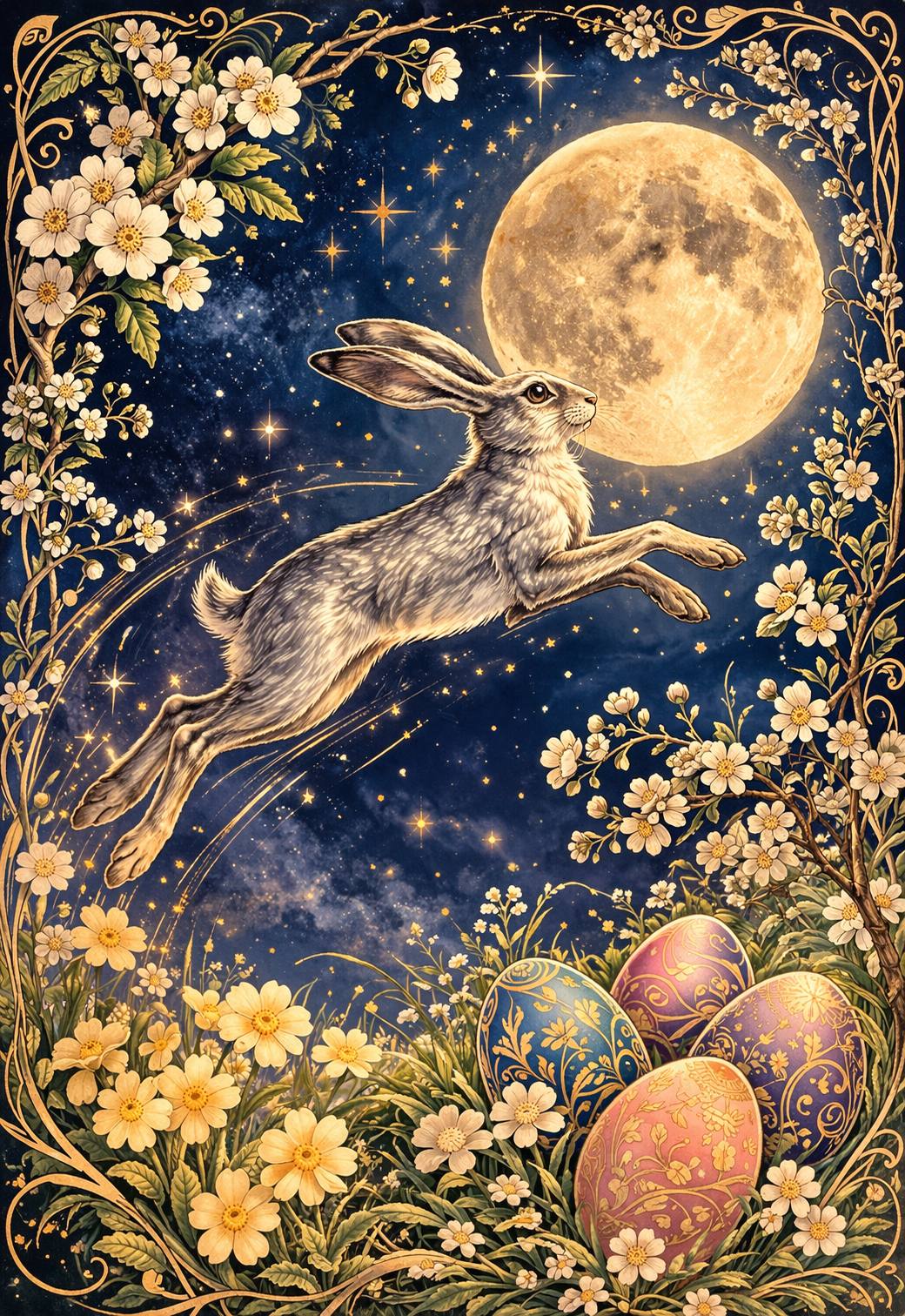
The Easter Bunny has its roots not in rabbits but in the hare, an animal sacred to the moon, connected to the spring goddess Eostre, and revered across ancient Egypt, India, China, and Northern Europe.
Because Easter is a lunar festival, fixed by the first full moon after the spring equinox, the hare, long regarded as the moon's own creature, became its natural symbol. German immigrants brought the tradition of the Osterhase to America, where the hare gradually became a rabbit, and the rabbit became the Easter Bunny. This article explores the full folklore trail: from lunar mythology and pagan spring goddesses to English hare-hunting customs, Easter egg traditions, and the magic of the March full moon.
The Easter Bunny's Secret History: Hares, the Moon, and the Magic of the Spring Festival
Why does a rabbit bring eggs at Easter? The answer stretches back thousands of years, across continents and cultures, to a creature far older and stranger than any chocolate confection.
The Hare, Not the Rabbit
Let us begin with a correction that has been quietly waiting for centuries. The familiar figure who arrives each Easter Sunday bearing a basket of decorated eggs is almost universally called the Easter Bunny, but the original was no rabbit at all. It was the hare.
The distinction matters. Hares and rabbits belong to the same family, but they are quite different animals. Hares are larger, faster, and more solitary. They live above ground, and, crucially, their young are born in the open, with their eyes wide open. Rabbits, by contrast, are born blind and naked in underground burrows. That difference between open-eyed and blind, between creature of daylight and creature of darkness, turned out to be enormously significant in the symbolic imagination of the ancient world.
The Open-Eyed Watcher of the Night
To understand why the hare became the companion of Easter, you must first understand the moon.
Easter is a lunar festival. Its date has been fixed since the Council of Nicaea in 325 AD as the first Sunday after the first full moon following the spring equinox: a definition that ties Christianity's greatest celebration directly to the turning of the moon. And for thousands of years before any Christian calendar existed, the hare had been the moon's own animal.
The connection was made across cultures separated by vast distances. In ancient Egypt, the name for the hare was un, a word that meant not only "open" but also "period": a unit of time, the very essence of cyclical measurement. The moon measures time; the hare, whose eyes were fabled never to close, watches the moon without blinking. The Egyptians believed the moon gazed open-eyed throughout the night, and the hare, born with eyes open and said never to shut them, was the moon's earthly mirror.
In China, the image was even more elaborate. Across the face of the moon, countless artists had painted the hare, and Chinese mythology represented the moon as a rabbit pounding rice in a mortar. Their lunar goddess was depicted as a beautiful woman with a double sphere behind her head and a rabbit at her feet. The Siamese held the same belief. In Ceylon, the spots on the moon were explained as the outline of a hare. The pattern was repeated across the ancient world with a consistency that speaks to something deep in the human habit of looking up at the full moon and seeing a familiar shape gazing back.
The March Full Moon and the Mad March Hare
The full moon nearest to the spring equinox, the very moon that determines Easter, falls in March, the month when hares behave most dramatically. Their extraordinary leaping and boxing matches, their wild coursing across open fields in the early morning light, have given rise to the proverb "mad as a March hare," which was old when Chaucer used it and has never quite gone away.
This madness is now understood as courtship behaviour (the boxing matches are largely female hares fighting off unwanted suitors), but for centuries it seemed like pure enchanted frenzy, as though the animals were responding to something in the spring air that humans could feel but not quite name. The old Saxons represented their Goddess of Love as attended by hares, two acting as her trainbearers while others went before her carrying lights. Spring, fertility, the returning sun, the mad hare leaping at moonrise: all of these belonged to the same cluster of feeling.
The hare's lunar associations were deepened by another peculiarity of its biology. The female hare can conceive while already pregnant, carrying young at different stages of development simultaneously, a phenomenon known as superfetation. Her gestation period of approximately one month matches the lunar cycle almost exactly. The moon waxes and wanes; the hare carries her young through a month's turning; both are creatures of periodicity, of rhythm, of the ceaseless return.
The Goddess Eostre and Her Hare
The name Easter itself explains much of this symbolism. The word derives from the Old Saxon Eostre or Ostara, the name of the dawn goddess of spring, whose festival was celebrated at the spring equinox. The month of April was known in Old English as Ostermonath, Eostre's month, and the echoes survive not only in English but in German, where Easter is still Ostern.
Eostre, according to legend, kept as her companion a large and beautiful bird. In a fit of anger she transformed it into a hare, but the hare retained the bird's ability to lay eggs. On the first day of spring, remembering its former nature, it built a nest and filled it with brightly coloured eggs. This is the story, at least, as it came down through the centuries. Whether the legend is genuinely ancient or a later confection is a matter scholars have debated (the cautious note is that our earliest hard evidence for Easter hare customs is antiquarian rather than mythological), but the symbolic logic is beautifully coherent. A bird becomes a hare; the hare lays eggs; eggs symbolise the Resurrection and new life; the moon governs Easter; the hare belongs to the moon. Each element connects to the next.
A Hindu Echo
The association of the hare with sacrifice and celestial honour appears not only in Europe but in the oldest literature of India. In Hindu mythology, the god Indra, disguised as a hungry pilgrim, appeals to a hare for food. The hare, having nothing else to offer, throws itself into the fire to provide a meal. Moved by such selfless sacrifice, the god places the hare's image on the moon, where it remains as an emblem of generosity. The left hind foot of a graveyard rabbit, in many folk traditions, represents the last quarter of the moon, and hence its reputed power to bring luck.
The same tale surfaces in Buddhist legend, where the Buddha himself is the wandering pilgrim, and the hare leaps willingly into the flames. You can still, it was said, see the outline of a rearing hare in the face of the full moon if you know how to look.
The Easter Hare in Germany and Beyond
It was the German tradition that most directly shaped the Easter customs now familiar across the world. In Germany and in parts of Bohemia, Hungary, and Czechoslovakia, the Osterhase, the Easter hare, was as significant a figure as Father Christmas at midwinter. Children were told that the white hare watched their behaviour in the weeks before Easter, and would only leave beautifully coloured eggs for those who had been good. On the night before Easter Sunday, mothers coloured eggs and hid them in odd corners of the house and garden. On Easter morning, children hunted for the eggs with great excitement, accepting them as gifts from the watchful white hare.
The eggs themselves were works of art. Red, the original colour, was held to be emblematic of the blood of Christ. Later they were arrayed in every imaginable colour: green from spinach, yellow from onion skins or saffron, blue from washing blue, each colour carrying its own folk significance. Pink eggs promised a handsome lover; white eggs brought luck; violet blue meant friends fond and true. French and Belgian Easter cards depicted the hare dancing along with his basket, sometimes pulling a little triumphal chariot piled with eggs. The image became so widely recognised that it was exported across the Atlantic with the German immigrants who settled Pennsylvania, and from there the Easter Bunny spread to every corner of the English-speaking world.
The Hare in England: Customs and Curiosities
England had its own Easter hare traditions, though more fragmentary and harder to trace. The antiquarian Thomas Blount, writing in 1679, recorded a custom at Coleshill in Warwickshire: if the young men of the parish could catch a hare and bring it to the parson before ten o'clock on Easter Monday, the parson was obliged to provide a calf's head, a hundred eggs, and a groat. Blount calls it an ancient custom, but offers no explanation of its origins. A similar practice was recorded at Leicester, where the tradition of hunting the Easter hare continued until the end of the eighteenth century.
In Leicestershire the custom of the Hare Pie Scramble and Bottle Kicking at Hallaton survives to this day. Each Easter Monday, a large hare pie is cut up by the local rector and pieces distributed to the assembled crowd, which uses them as ammunition in a rough scramble before a bottle-kicking game between Hallaton and the neighbouring village of Medbourne. When a nineteenth-century rector tried to divert the festival funds to more sober purposes, the villagers chalked on his walls and door: No pie, no parson, and a job for the glazier.
At Coleshill in Warwickshire (where the young men's hare-catching custom was recorded), the vicar reputedly held his living on condition of providing the breakfast. Whether this legal obligation was ever real or was a later embellishment remains disputed: as a local paper drily noted in 1957, Blount supplies evidence of the custom but not its explanation, and the historian may have confused his Coleshills.
Hares, Witches, and the Black Art
The hare was not only a creature of sacred spring festivals. It carried a darker magic too. In Scotland and Ireland, in Wales and the north of England, the hare was the preferred disguise of witches, a belief so persistent it lasted into the eighteenth century and beyond.
The standard story followed a fixed pattern: a hare is hunted, escapes all ordinary means of capture, and can only be caught by a bullet moulded from a silver coin or by a dog fed on milk. The hare retreats to a cottage; the hunters force the door; they find not a hare but an old woman, breathless and bandaging a wound that matches exactly the injury the hare sustained. The witch is identified; in some versions she dies; in others she gives her solemn word never to mislead the hounds again.
In Ayrshire, the celebrated wizard Michael Scott (real enough as a medieval scholar, but transformed by legend into a master of the Black Art) was himself temporarily turned into a hare by a local witch who snatched his wand and gave him three lashes with it. His own greyhounds were set on him and he was driven to swim a river and take refuge in his own castle's sewer before he could disenchant himself. He later took a satisfying revenge.
The Welsh tradition offered a gentler version. St Melangell, a virgin living in deep devotion in the woods of Powys, sheltered a hare beneath her robe when the Prince of Powis rode up in the chase. The hare faced the hounds boldly; they retreated howling. The Prince gave the saint a piece of land as a sanctuary. Ever afterward, hares in that parish were known as Wyn Melangell, St Monacella's lambs, and no one would kill one. If a hare was being pursued and someone cried God and St Monacella be with thee, the creature would escape.
Easter Eggs: An Egyptian Heritage
While the hare brought the eggs, the eggs themselves have their own ancient pedigree. They were a symbol long before Christianity gave them the meaning of Resurrection. To the ancient Egyptians, the egg contained the elements of future life; to the Persians, red eggs were exchanged at the spring festival; to the Romans, the earth itself was conceived as a great egg.
A medieval English prayer asked that the egg might become wholesome sustenance for the faithful, eating in thankfulness to Thee on account of the Resurrection, and this prayer was recited at Easter in churches across the country. Under Edward I, four hundred eggs were decorated and distributed to the Royal Household. These paschal eggs became pace eggs in northern England, where the tradition of Pace-egging, a kind of Easter mumming play with costumed performers, wooden swords, and folk rhymes, continued for centuries, the players rewarded with eggs, pennies, or sweetmeats.
Egg rolling, still practised each Easter Monday on the lawn of the White House in Washington, came to America from England, where it was itself a survival of much older customs. The egg is rolled to represent the stone rolled away from the tomb; or, in earlier and less Christian interpretations, to represent the sun rolling across the spring sky.
New Clothes, the East Wind, and the Dancing Sun
Easter gathered other folklore around it like a tide gathering shells. To wear nothing new on Easter Day was considered deeply unlucky: ill fortune would follow the wearer for the remainder of the year. The remedy was simple: at least one new article of clothing must be put on, however small. In Lancashire, children who appeared in old clothes on Easter morning were told they would be visited by crow-droppings before the day was out.
In Ireland and parts of England, the devout rose before four o'clock on Easter morning to watch the sun dance in honour of the Resurrection. This was no superstition confined to the credulous poor: many highly respectable families shared it. If the sun could not be seen directly, a bucket of water was placed to reflect the sky, and the trembling of the water in the morning breeze was taken for the dancing of the sun.
The east wind on Easter morning was both dreaded and respected. Its presence called for immediate counter-measures: drawing water and washing in it, or going out to wash in the morning dew, would neutralise the harmful influence. Rain on Easter Day, however, was welcomed by farmers, who said it promised good grass, though little enough hay.
From the Osterhase to the Easter Bunny
The transformation of the hare into the rabbit, and of the rabbit into the pastel-coloured, basket-carrying Easter Bunny of modern commerce, is largely a story of emigration and adaptation. German settlers brought the Osterhase to Pennsylvania, where children built nests of grass and moss for the hare to fill. The rabbit, more familiar and more abundant in the New World, gradually substituted for the hare. Non-German children, seeing the baskets and the coloured eggs, wanted to participate; the custom spread; the image softened; the chocolate industry discovered it; and the Easter Bunny as we know him was born.
Yet the hare is still there, if you know where to look. He is in the full moon of late March that determines the festival's date. He is in the Egyptian name for the open eye. He is in the Buddhist legend of the creature who leaped into the fire. He is in the German grandmother who hid coloured eggs in the corners of the house on the night before Easter. And he is, perhaps, in the face of the full moon itself, if you look long enough and let your imagination do what the imaginations of a hundred generations did before you.
The Easter Bunny may be a rabbit now, chocolate-moulded and basket-carrying, beloved by children across the world. But behind him stands a much older creature: the hare who never closes its eyes, who watches the moon through every night of the turning year, and who has been carrying the magic of spring from hand to hand for longer than anyone can quite remember.
Sources: Contemporary newspaper articles from the Leamington Spa Courier (1904), Lyttelton Times (1903), Newry Reporter (1906), Suffolk Chronicle (1908), Widnes Examiner (1910), Birmingham Daily Post (1956), Hartlepool Northern Daily Mail (1979), Barrow News (1915), Hull Times (1930), Portsmouth Evening News (1938), Huddersfield Daily Examiner (1981), Graphic (1877), Welsh Gazette (1958), Pall Mall Gazette (1912), and others.