
The Mandaeans and the Legacy of John the Baptist: Origins, Theology, and the Primary Sources of a Surviving Gnostic Religion
Introduction
In 1815, the Swedish orientalist Matthias Norberg published the first European edition of a scripture he called the Codex Nasaraeus, Liber Adami appellatus - a Latin translation, made from a single defective manuscript, of the sacred book of a small, secretive baptizing community living in the marshes of Ottoman Iraq. Norberg's preface set the terms of a debate that would run, largely unresolved, for the next century and a half: he read the text alongside Cerinthus, Saturninus, Basilides, and Valentinus, mapped its vocabulary onto the technical language of Greek Gnosticism - Pleroma, Aeons, Sophia, Achamoth - and drew a direct lexical line to the opening of John's Gospel. From that first act of translation onward, this community's own name for its central rite of repeated river-baptism, and its own intense reverence for John the Baptist, invited a single, magnetic question: were these people, quite literally, the surviving disciples of John?
What follows is an attempt to answer that question as honestly as the sources allow - drawing on the full run of material examined in this research, from Norberg's 1815 edition through Jacques Matter's 1828 Histoire critique du gnosticisme, Nicolas Siouffi's 1880 ethnography, Wilhelm Brandt's 1893 translations, Mark Lidzbarski's philological editions of the 1910s and 1920s, E. S. Drower's fieldwork of the 1930s, Kurt Rudolph's definitive 1960s synthesis, and the ancient witnesses - Josephus, the Gospels, Acts, Hippolytus, the Nag Hammadi codices, and even a disputed Slavonic recension of Josephus - against which the whole question must ultimately be tested.
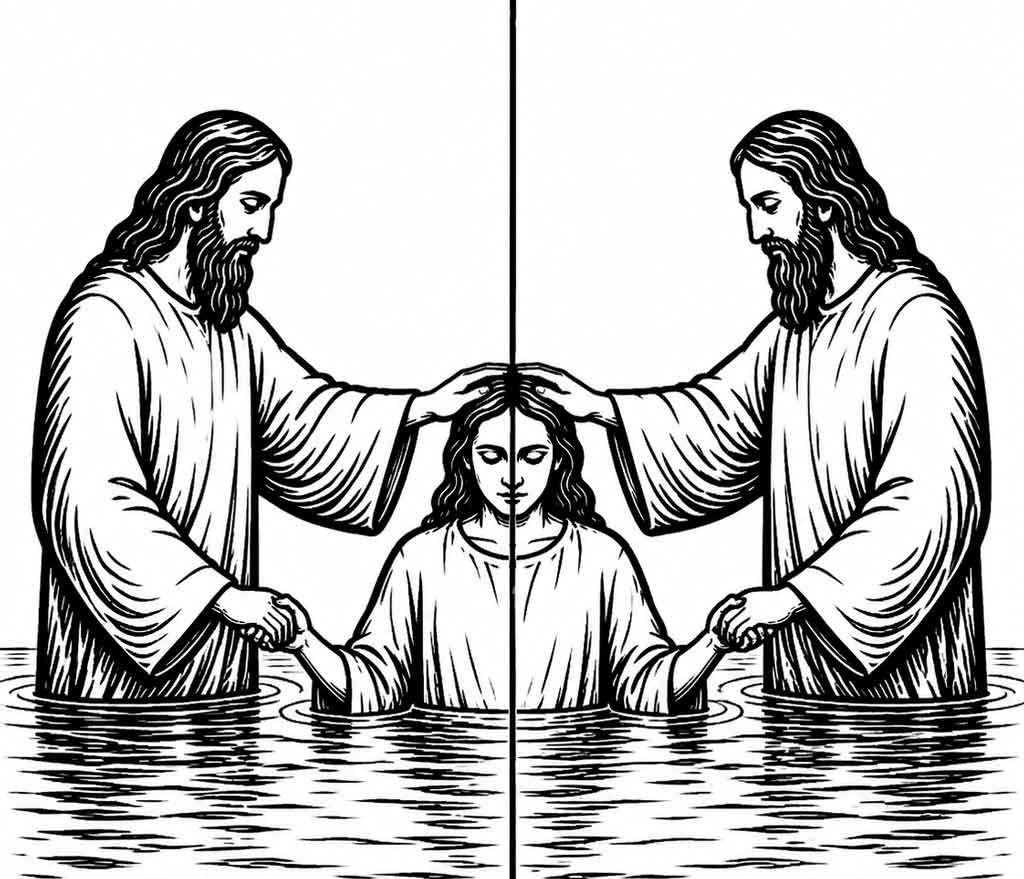
Naming and Identity
The community calls itself, in its own texts, Mandayi ("knowers" - the root manda meaning "gnosis," a philological point Nicolas Siouffi's informant made explicit to him directly: that Manda corresponds to the Chaldean and Hebrew words for knowledge, "the equivalent of the Greek γνῶσις"). It also calls itself, and perhaps more precisely, Nasoraeans - a technical term reserved, in E. S. Drower's account, for the initiated core of the community.
Outsiders, however, have used a shifting and often confused set of labels. European travelers who found a community that baptized repeatedly and revered John assumed they must be a Christian sect and called them "St. John Christians" - a label a 1927 popular account by Captain Daniel Clark explicitly rejects as a "misnomer," insisting that "the 'John' to whom they profess to adhere is certainly not a Saint, nor are they Christians in any sense of the word." Islamic sources, and following them most of the European scholarly tradition through the nineteenth century, called them Sabians (al-Ṣābiʾūn) - the name under which the Qur'an guarantees a "People of the Book" certain legal protections, which the community, per Clark's account, seems to have deliberately claimed for its own protection under Muslim rule. Matter's 1828 study wrestled at length with the term's ambiguity, since "Sabaean" was also the name of the ancient South Arabian kingdom and, via Maimonides and the philosophers of Harran, of a quite different tradition of star-worship; Siouffi's informants used Soubba or Subba ("those who immerse"), the term that survives colloquially into Drower's fieldwork as well.
The Question of Origins
The Nineteenth-Century Thesis: Direct Descent from John's Disciples
Working from Norberg's flawed but pioneering translation, Matter built the first serious European theory of Mandaean origins. He treated the "disciples of St. John" mentioned in Acts 19:1–7 - the group Paul finds at Ephesus who "have not so much as heard whether there be any Holy Ghost," having received only "unto John's baptism" - as the historical seed of the whole tradition. Matter placed this Ephesian community in the same religious ferment that produced Cerinthus and the Gospel of John itself, and read the Mandaeans as its distant, migrated, and much-altered descendants: a "remnant, greatly degenerated," as he put it, of the same ancient oriental gnosis that also fed Christian Gnosticism. He supported this by noting Matthew, Cerinthus, and Marcion's biography all placed disciples of John at Ephesus, and that Marcion himself reportedly consulted them there.
Brandt's Revision: A Pre-Christian, Non-Christian Gnosis
Wilhelm Brandt's 1893 Mandäische Schriften - his German translation of roughly a quarter of the Right Ginza - complicated this picture substantially. Brandt argued the Mandaean corpus was built from four distinct historical layers, compiled and scrambled by later redactors: an oldest layer, pre-Christian and non-Jewish, centered on the figure of Manda ḏ-Hiia ("the personified gnosis of life"), which Brandt insisted explicitly was not of Christian origin; a second layer of hymns on the soul's postmortem fate showing only Zoroastrian influence; a third layer of Mandaean reworkings of genuinely Christian-Gnostic material; and a youngest layer, the developed "King of Light" doctrine, synthesizing Zoroastrian dualism with a monotheistic strand absorbed from Christianity. Brandt's own summary judgment - quoted approvingly decades later by Rudolph - was that he remained convinced "we encounter here a Gnosis independent of Christianity."
Rudolph's Synthesis: The Definitive Modern Reckoning
Kurt Rudolph's two-volume Die Mandäer (1960–61) remains the field's standard critical account, because Rudolph tested the mythological evidence (Volume 1, Das Mandäerproblem) against the ritual evidence (Volume 2, Der Kult) independently, and found both pointed to the same conclusion.
On mythology: the oldest textual stratum, recoverable chiefly from the hymn literature, reveals a fundamentally unified system whose central motifs - a doctrine of the soul, a Primal Man, and a repeatedly-descending redeemer - point to an early Syrian Gnosis of the West, and are demonstrably pre-Christian. The community's pronounced Jewish coloring, in Rudolph's reading, points to genuinely western, Palestinian-Syrian roots reaching back into a Judaism that had already turned heretical before being drawn into the wider vortex of the Gnostic movement of Late Antiquity. This "proto-Mandaean" stage, formed on the ground of Near Eastern syncretism, already contained Iranian-Mesopotamian material - planetary doctrine, dualism, light-symbolism - of a kind attested widely across the region, including in other heretical Jewish circles of the period.
From this proto-Mandaean stage, Rudolph draws two further lines of descent. First, toward Manichaeism: Mandaean religion in this early form is, in his words, a stage that Manichaeism partly grew out of - "Mani grew up within Mandaeism." This dovetails with the report, preserved by the tenth-century Arabic bibliographer Ibn al-Nadim in his Fihrist and cited by both Drower and Rudolph, that Mani was raised among the Mughtasila, "those who wash themselves," a Mesopotamian baptizing sect nearly all commentators identify with the same milieu that produced the Mandaeans. Second, toward Christianity itself: Rudolph argues there is a demonstrable relationship of motif and style between proto-Mandaean material and parts of early Christian literature, without this implying any provable direct historical encounter - proto-Mandaeism, on this reading, is one of several pre-Christian Gnostic formations, most of whose independent textual witnesses are now lost, that nascent Christianity found already present in its cradle and drew upon to shape its own mythic vocabulary.
And on the specific question that had driven the field since Norberg and Matter, Rudolph is unambiguous: "the Mandaeans have nothing to do with the disciples of the Baptist John; they adopted his figure only later, from particular traditions, and made him one of their prophets." John's centrality, in other words, is a secondary accretion onto an already-formed system - not, as the nineteenth century had assumed, the system's point of origin.
Historically, Rudolph traces a forced eastward migration in the second century CE - plausibly, he suggests, connected to the upheavals of the Bar Kokhba revolt - carrying the community from the Jordan-Euphrates corridor into Mesopotamia along a fertile connecting zone, where it absorbed further Iranian and Mesopotamian material and eventually took on its familiar historical shape. He notes too that Byzantine Christian anti-heretical legislation, not only Islamic pressure, helped push the community entirely out of Syria and into the more remote southern Mesopotamian territory where later observers, from Siouffi to Drower, would find it.
Rudolph's ritual analysis in Volume 2 independently confirms this. He identifies baptism (Masbuta) and the soul-mass (Masiqta) as the community's two load-bearing rites, and shows they have entirely separate deep roots even though they now function as one system: baptism traces to Jewish washing practice, given its specific form within the world of East-Jordan and Syrian baptist sects of semi-Jewish character - the same milieu, as we will see, documented independently by Hippolytus; while the Masiqta points essentially to Iranian conceptions of the soul's ascent, already reshaped in Gnostic form, with close parallels in actual Manichaean practice. The convergence of these two lines of inquiry - myth and ritual, worked out separately - is what gives Rudolph's conclusion its force.
The Primary Sources
The evidence for Mandaean religion falls into two bodies that developed almost entirely independently of one another: the community's own vast internal scripture, and a thin, contested trickle of external testimony.
The Mandaeans' Own Scriptures
The Ginza Rabba ("Great Treasure"), the largest and most authoritative text, exists across three major translation efforts examined here, each reflecting the state of the field in its own moment: Norberg's 1815–16 Latin edition, made from a single manuscript and later judged defective by every subsequent scholar who used it; Brandt's 1893 partial German translation, framed by his four-layer historical thesis; and Lidzbarski's 1925 complete German translation, the modern scholarly standard.
The Drasha ḏ-Yahia ("Book of John"), a separate collection of roughly ninety short pericopes built around cosmogony and an extended legendary cycle of John's preaching and death, was translated definitively by Lidzbarski in 1915 from the oldest known Mandaic manuscripts, collated from the Bibliothèque Nationale's "Code Sabéen" holdings.
The Qulasta, the canonical prayer book containing the actual liturgies spoken at baptism and the death-mass, was translated by Lidzbarski in 1920, based primarily on the oldest dated Mandaean manuscript known - Oxford's Bodleian MS Marsh 691, from 936 AH.
External and Historical Testimony
Flavius Josephus, writing in his Antiquities of the Jews (18.116–119, composed 93/94 CE), gives the earliest datable non-Christian witness to John: a popular Jewish moral teacher, executed by Herod Antipas out of political fear that his mass following might tip into rebellion - a baptism, in Josephus's specific formulation, intended not for remission of sin but for the purification of a body whose soul had already been cleansed through righteousness beforehand.
The New Testament - Mark, Matthew, Luke, John, and Acts - supplies both the earliest Christian portrait of the historical John and, in Acts 18–19 particularly, direct evidence that a distinguishable "baptism of John," separable from full Christian initiation, persisted as a live category among certain believers decades after his death.
Hippolytus of Rome, in his early third-century Refutation of All Heresies, preserves two bodies of material of direct relevance. Book IX describes the Elchasaites, a second-century Mesopotamian baptismal sect whose repeatable river-baptism for remission of sin, sworn by "seven witnesses" (heaven, water, holy spirits, prayer-angels, oil, salt, earth), astrologically-timed rituals, and healing-by-immersion practice closely anticipate the ritual world later described by Siouffi and Drower - background evidence, in Rudolph's own reading, for the wider baptist milieu Mandaeism grew from. Book V describes the Naassenes, who allegorized Joshua's crossing of the Jordan as a cosmic myth of the river's normal, downward flow (symbolizing carnal generation) being driven back upward by Jesus, a reversal encoded in the technical term Zeesar. Hippolytus also preserves the so-called Naassene Psalm, a hymn of the soul's fall into "aqueous form" and its rescue by a descending redeemer bearing "seals" and imparting Gnosis.
The Nag Hammadi library, though a fourth-century Coptic collection of Greek originals with no direct Mandaean connection, preserves close structural parallels worth noting as evidence of a shared regional thought-world: the Testimony of Truth repeats the Naassene "Jordan turned back" motif almost exactly, allegorizing the river as bodily desire; and the Apocryphon of John contains a Pronoia hymn in which a redeemer figure descends three times into darkness to awaken a sleeping, imprisoned soul, finally sealing it "in the light of the water with five seals" - a triple-descent, water-sealing redemption pattern closely comparable to Hibil Ziwa's repeated katabases in the Mandaean material.
Nicolas Siouffi's Études sur la religion des Soubbas (1880) and E. S. Drower's The Mandaeans of Iraq and Iran (1937) are the two principal modern ethnographies, and it is important to weigh them differently. Siouffi's account rests entirely on the testimony of a single informant and was later judged, by both Lidzbarski and Drower, to be a genuine but garbled, folklorized oral tradition - valuable for ritual texture, unreliable as a guide to the actual textual theology. Drower, by contrast, worked directly with Mandaean priests over decades of fieldwork and remains the discipline's most trusted observer; her own earlier travel account, By Tigris and Euphrates (1923), quoted at length by G. R. S. Mead, corroborates Siouffi's ritual descriptions independently on several key points, which is itself useful evidence that both were describing a real and stable practice rather than an invented one.
Finally, G. R. S. Mead's The Gnostic John the Baptizer (1924) draws together several of these threads and adds one genuinely distinct body of material: a set of eight passages found only in the Slavonic (Old Russian) translation of Josephus's Jewish War - absent from every Greek manuscript, and judged by the German scholarship Mead surveys as almost certainly a later interpolation, not authentic Josephus - which nonetheless preserve an extended, otherwise unattested tradition of John's confrontations with Herod and an independent, hedging account of rumors surrounding Jesus's death.
Theology and Cosmology
Setting the historical debate aside, the Mandaean corpus preserves one of the richest Gnostic cosmological systems to survive from antiquity into modern ethnographic record - described independently, and with real consistency of core structure, across Norberg's Latin, Brandt's and Lidzbarski's German, and Siouffi's and Drower's field-recorded oral tradition.
At the summit stands the Great, First, Alien Life - the opening invocation of Lidzbarski's Qulasta calls on "the great, first, alien Life from the worlds of light, the exalted one who stands above all works" - also titled Malka ḏ-Nhura, the King of Light. Norberg's Latin text preserves the same figure in its opening hymn: "unus est Rex lucis in suo regno, nec ullus qui eo altior" - "he is the one King of Light in his kingdom, none higher than he," an unending, fatherless sovereign whose crown "never falls from his head." Matter, working from this very passage in 1828, had already noted its close parallel to the Kabbalistic and Zoroastrian "King of Light" terminology, without knowing quite what to make of the coincidence; Rudolph's later work supplies the explanation - a shared regional dualist inheritance, not direct borrowing in either direction.
From this source proceed the First and Second Life, and - depending on which of the Ginza's several, mutually inconsistent creation accounts one reads (Drower counts at least seven, differing even on whether Gabriel, Hibil Ziwa, or Pthahil is the primary agent) - a cascade of emanated beings, the uthras, governing natural phenomena. Opposing this World of Light is a World of Darkness ruled by the monstrous Ur, described in the Mandaean pictorial tradition Drower recorded as having the head of a lion, the body of a dragon, the wings of an eagle, and the flanks of a tortoise - a description close enough to descriptions of Mani's own "Primal Devil" (head of a lion, body of a dragon, wings of a bird, tail of a fish) that Brandt built an entire comparative argument on the resemblance, reading the Mandaean myth as historically prior to, and likely a source for, its Manichaean cousin.
The central redeemer figure across every version of the myth is Hibil Ziwa (rendered Hivel-Zivo by Siouffi, Hiwel Ziwa by Drower), son of the highest Life, who descends repeatedly through hostile underworld kingdoms to combat the powers of darkness. Brandt's translated Höllenfahrten des Hibil Ziwä ("Hibil Ziwa's Descents into Hell") narrates Manda ḏ-Hiia dispatching him against a demon grown dangerously powerful in the lower darkness; Siouffi's version has him undertake a quest through the hostile kingdoms of Achdoum, Anathon, and Akroun to abduct a woman named Rouhaia, using a magical looking-glass and a shapeshifting trick to escape a forced marriage; Drower's independently recorded version, matched against Lidzbarski's Ginza summary, has him disguise himself as one of the dark beings - "more beautiful than them all," in his own words as recorded in the Ginza - to court the dark kingdom's ruling family, before ascending with the pregnant Rouhaia/Ruha and imprisoning the demonic offspring, Ur, that results. That three independently transmitted versions of this myth - a nineteenth-century French orientalist's informant, a twentieth-century British fieldworker's priest-informants, and the scholarly German translation of the Ginza text itself - converge on the same basic narrative shape is strong internal evidence for the myth's antiquity and stability within the tradition.
A subordinate, morally mixed figure, Ptahil (explicitly compared already by Drower to the Egyptian god Ptah), performs the actual physical work of shaping the material world - tainted, in most versions, by contact with the primordial dark water, and consequently prone to failure on his first attempts. The creation of humanity follows the same pattern of flawed, multi-stage effort recorded independently by Lidzbarski's Ginza excerpts and Drower's fieldwork: the Soul (Nishimta), shown the crude, ape-faced first attempt at Adam, recoils in horror - "must I dwell in this flesh and blood, this house of uncleanness?" - and agrees to inhabit the body only once promised that the material world will replicate the World of Light in every particular: flowers, trees, light, running water, baptism, priests.
Two further figures anchor the system's ethical and eschatological dimension: Abatur, keeper of the celestial scale weighing souls after death - who, in Lidzbarski's Book of John, is himself given a lament, protesting his reduction to this humiliating cosmic office; and the divine principle Ruha, a genuinely ambivalent figure across the sources - mother of the powers of darkness in most tellings, yet, per Drower's later fieldwork, capable of a "kindlier character" in living popular belief, in harmony once more with the Great Life.
Ritual, Baptism, and the Ancient Sanctity of the Jordan
Mandaeism is, before anything else, a baptizing religion - and the sanctity it attaches to running water did not arise in a vacuum. William Robertson Smith's Lectures on the Religion of the Semites (1889), though written decades before Norberg's edition reached wide scholarly use and concerned with ancient Arabian and Israelite religion generally rather than the Mandaeans specifically, documents a much older regional substrate of belief that the Mandaean and Naassene material both, in different ways, inherited. Robertson Smith reads the episode of Naaman the Syrian (2 Kings 5) - his indignant refusal to bathe in the Jordan, and his confidence that "the rivers of Damascus were better than all the waters of Israel" - as evidence that the Jordan was already understood, well before any Christian or Gnostic elaboration, as the sacred healing stream of the Hebrews, exactly as the Abana and Pharpar were sacred to the Syrians. He notes further that the source of the Jordan at Paneas was sacred to Pan in the Hellenistic period, occupying the same site as the ancient Israelite sanctuary of Dan - a continuous history of the river's sanctity reaching back well before the first century CE.
This ancient substrate matters directly for reading the later Gnostic material. Hippolytus's Naassenes took this same river and inverted its ordinary flow into a technical theological term: the "great Jordan," he reports, "flowing on here below," was driven back and "made to flow upwards" by Jesus - a reversal symbolizing the turn from carnal to spiritual generation, encoded in the name Zeesar. The Testimony of Truth from Nag Hammadi preserves what appears to be a related but theologically opposite reading of the same motif: there, the Jordan's reversal at Jesus's approach is read as an escape from the river, allegorized as bodily desire, with John recast as "the archon of the womb."
The Mandaean tradition inherits the same ancient river-sanctity but develops it in the opposite direction from the Naassenes - not escape from the water, but total, repeated, sacramental immersion in it. Drower's glossary defines Yardna simply as "running water, river, a pool of flowing water" - the term used for any body of water fit for baptism, wherever it physically is, a linguistic fact Rudolph treats as decisive evidence of the rite's ultimate derivation from the actual Jordan valley. Lidzbarski's Qulasta preserves the liturgical language directly: a Masiqta hymn addresses the water itself - "Living water are you, you have poured yourself out from a sublime place, from the House of Life" - and extends the river's downward flow into a moral metaphor, praying that sin might be forgiven "just as water falls to the earth." Drower's own fieldwork records a priest-informant making the cosmology explicit: earthly rivers are only faint images of a heavenly Yardna, and "a little of this heavenly yardna is in all earthly yardnas."
Rudolph's ritual analysis (Volume 2 of Die Mandäer) confirms baptism's Jewish-sphere origin on precisely this linguistic evidence - the exclusive use of flowing "living" water and the generic use of the Jordan's own name for it - while tracing the community's second core rite, the Masiqta or death-mass, to a separate root in Iranian soul-ascent doctrine, already Gnostically reshaped before Mandaeism absorbed it. A particularly striking variant of this rite, the Massakhto/Chalmono, in which a living person undergoes the funerary liturgy in advance to become a permanent renunciate, is independently attested by Siouffi (1880) and by Drower, whose own earlier account (in By Tigris and Euphrates, 1923, quoted at length by Mead) matches Siouffi's description closely enough - the same seven-day preparation, the same sacramental bread and dove-flesh diet, the same closing scene of priests holding a final mouthful of food through the prayer for the dead - to count as strong corroboration between two otherwise independent informant traditions forty years apart.
The Many Lives of John: Comparing the Legends
Luke's Gospel gives John a full birth narrative - priestly lineage, a late miraculous conception, Zechariah's temporary muteness - but leaves his entire childhood and young adulthood an unnarrated gap between his circumcision and his appearance as an adult preacher. Three later traditions, examined here side by side, fill that gap in strikingly different directions.
The Coptic Christian tradition fills it with martyrdom and historicized suffering. An anonymous panegyric preserved in Vatican Coptic MS 62 (edited by Henri De Vis, 1922) extends the Massacre of the Innocents narrative to include John's own father: Herod's soldiers, unable to find the infant John, kill Zechariah "on the steps of the altar" - a tradition De Vis traces to the Protevangelium of James and notes was defended explicitly by Severus of Antioch against contemporary critics. Elizabeth then flees with the infant John into the desert, where she dies, and John - per the text - buries her himself before living alone in the wilderness for thirty years. A separate Coptic panegyric attributed (disputedly, per K. H. Kuhn's philological study) to Theodosius of Alexandria closes instead with a numerological flourish: the seven Greek letters of ΙΩΑΝΝΗΣ are each assigned a symbolic value - Jesus, the Father, the Unity, the Holy Spirit, the aeons of light, Immanuel, the Savior - described as "seven seals with which God rules heaven and earth," a structural echo, though a theologically unrelated one, of the Nag Hammadi "five seals" baptismal terminology.
The Mandaean tradition, recorded independently by Siouffi and by Drower, fills the same gap with celestial initiation rather than earthly suffering. The infant Yahia is carried by the celestial being Anosh-Uthra to the heavenly world Olmi-Danhoura and nursed on the milk of a paradise-tree; an uthra baptizes him and teaches him to read the Book of Souls; at twenty-one he is formally consecrated a priest by the uthras before being sent back to Jerusalem to begin his ministry. Siouffi's version adds a folk-legendary layer entirely absent from any Christian source: a persecution narrative involving a converted Jewish princess, a Mandaean exodus mirroring the Exodus in reverse (the pursuing Jews, not the Mandaeans, drown), and a line of high priests including one Adam Abu'l-Fahr.
The death narratives diverge just as sharply, and here the divergence runs through nearly every source examined. Mark and Matthew stage an elaborate court drama: Herodias's grudge, her daughter's dance, the rash oath, the platter. Luke drops the banquet scene entirely. Josephus gives a purely political motive, with no Herodias, no dance, no platter at all - Herod fears John's mass popularity might tip into open rebellion. The Mandaean tradition, in Drower's recorded version (via the informant Hirmiz bar Anhar), replaces all of this with a mystical psychopomp scene: a small child approaches John at the Jordan asking to be baptized, the river itself recoils before him, and he reveals himself as Manda ḏ-Hiia, come to take John's soul; John's body dies gently in the water, and the redeemer buries the corpse himself while John, watching from above, grieves for his own abandoned body before being carried up to join the perpetual worship of the Light-King.
One recurring narrative device crosses the Christian/Mandaean divide entirely, worth flagging as evidence of a shared regional storytelling convention rather than direct borrowing: both the Coptic panegyric and the Mandaean "Qiqel" legend (recorded by Drower) stage a frustrated demonic tempter cataloguing, in direct speech, his own failed attempts to corrupt the holy man - food, women, every trap sprung and every trap defeated - before resolving to destroy him by an indirect route instead.
Where the Primary Sources Disagree
Even confining the comparison strictly to the earliest and most historically proximate sources - Josephus and the four Gospels - the record is genuinely inconsistent on points that matter directly to the question of John's relationship to Jesus and to any later movement claiming his legacy.
The baptism scene itself. Mark narrates it without comment. Matthew inserts John attempting to refuse ("I need to be baptized by you") and Jesus explaining the act is needed "to fulfil all righteousness" - visibly patching a scene that could otherwise imply John's superiority. Luke mentions John's imprisonment before narrating the baptism and never explicitly states John performed it. John's Gospel omits the baptism scene entirely, reducing John to a witness who testifies he saw the Spirit descend.
John's certainty about Jesus. In John's Gospel, immediate and total: "Behold, the Lamb of God." In Matthew 11 and Luke 7, an imprisoned John instead sends disciples to ask directly, "Are you the one who is to come, or should we expect someone else?" - a substantially less certain John, whichever way one resolves the theological question of whose benefit the question was really for.
The reason for John's execution. Mark and Matthew's court drama (Herodias, the dance, the platter) against Luke's terser account (the banquet scene dropped) against Josephus's purely political motive (mass popularity, feared rebellion) - three genuinely different explanatory frameworks for the same event.
Herodias's first husband. Mark, followed by Matthew, names him "Philip." Josephus's own account, read carefully, is internally inconsistent on this point: he has Herodias leave one husband for Antipas, yet elsewhere states that Herodias's own daughter Salome married "Philip the tetrarch" - a genealogical tangle among the Herods that most modern readers of Josephus (a judgment reflected in the modern secondary literature surveyed here) treat as an outright confusion in the transmitted tradition, whether originating with Josephus, the Gospel writers, or an earlier common source.
The timeline. The Gospels nest John's death inside a narrative flashback during Jesus's active ministry. Josephus situates the retelling of John's death within the context of Herod Antipas's later conflict with Aretas IV of Nabataea and the popular interpretation of Herod's subsequent military defeat as divine punishment - a framework that, without contradicting the Gospels outright, sits uneasily against any attempt to pin the execution neatly to the early portion of Jesus's ministry.
Evidence of a surviving "John movement." Here the New Testament's own internal evidence is unusually strong. Acts 18:24–25 introduces Apollos, an eloquent Alexandrian teacher instructed accurately about Jesus yet knowing "only the baptism of John," corrected privately by Priscilla and Aquila. Acts 19:1–7 has Paul, in Ephesus, find roughly a dozen disciples who had "not so much as heard whether there be any Holy Ghost" and had received only John's baptism - requiring rebaptism and the laying on of hands. John's own Gospel preserves a telling moment of anxiety: John's disciples report to him that Jesus "is baptizing, and all are going to him," immediately followed by an editorial clarification that Jesus himself was not personally baptizing, only his disciples - a clarification many readers take as the author quietly managing an awkward historical overlap between two baptizing movements.
The disputed Slavonic Josephus material. Mead's translated selections from the Old Russian Jewish War interpolations - judged by the German scholarship he surveys as almost certainly not authentic Josephus, but a later interpolation of disputed date - preserve an extended and otherwise unattested confrontation between John and Herod over Herodias, with John accusing him directly ("Why hast thou taken the wife of thy brother?... thou too wilt be reaped off by the heavenly sickle"), and a hedging, agnostic account of rumors following Jesus's death: some said he had risen, others that his body had been stolen, with the narrator declining to adjudicate ("I, however, do not know which speak more correctly"). Whatever its authenticity, this material demonstrates that a non-canonical, argued-over tradition about both figures was in circulation and being narrated in a register distinct from any canonical source.
Set against all of this stands the Mandaean corpus's own, sharply divergent testimony: where every Christian source, however internally inconsistent, subordinates John to Jesus in the end, the Ginza and the Book of John reverse the relationship entirely, treating Jesus (Kristus in the texts) as a false, deceiving messiah, sent by the hostile planetary powers to corrupt the true teaching John represents.
Was Mandaeism a Rival to Christianity?
The sources examined here support a layered rather than a single answer.
In terms of direct historical descent, no. Rudolph's synthesis of the mythological and ritual evidence - the two independent lines of argument converging on the same conclusion - rules out any credible direct line from the historical Ephesian "disciples of John" of Acts into the later Mesopotamian Mandaean community. John's centrality is a later accretion onto an already-formed pre-Christian Gnostic system, not that system's point of origin.
In terms of theological posture, yes, and deliberately so. Whatever its actual origin, the Ginza's treatment of Jesus as a corrupting false prophet, set against John as the true and final revealer, stakes a rival claim to precisely the same territory Christianity claims for itself - the true meaning of John's baptism and his relationship to the coming Messiah - argued to the opposite conclusion.
In terms of common ancestry, the two traditions are better described as estranged siblings than as rivals in the ordinary sense. Rudolph's own language is precise on this point: the "rootedness" of Christian Gnosis in a pre-Christian Jewish Gnosis is, in his judgment, demonstrable specifically in the cultic sphere, since Christian Gnosis represents a more spiritualized stage that nonetheless carries forward the older ritual substrate. Mandaean religion, on this reading, is a branch and remnant of the same pre-Christian Gnostic formations that Christianity itself grew out of and absorbed - not an external competitor, but a surviving cousin that took the shared inheritance in the opposite theological direction.
In terms of lived historical experience, Mandaeans suffered at Christian as well as Muslim hands. Rudolph notes specifically that Byzantine Christian anti-heretical legislation helped drive the community entirely out of Syria and into the remote Mesopotamian territory where later observers would find it - meaning institutional Christian, and not only Islamic, persecution shaped the community's historical geography.
In terms of scale, never a genuine rival at all. Captain Daniel Clark's 1927 popular account records that the community numbered "about 20,000 families" in the eighteenth century, reduced by his own day to "does not exceed 3,000 souls" - attributing the decline, in terms that match the causes independently discussed in Drower's and Rudolph's more scholarly accounts, to historical persecution, internal strife, and the steady loss of women who married outside the faith, since Mandaeism, unlike Christianity, has never accepted converts. A tradition of that scale, however theologically pointed its rivalry, was never in any position to compete with Christianity for adherents.
Conclusion
Read together, the sources examined here - from Norberg's flawed 1815 Latin edition through Rudolph's rigorous 1960s synthesis, and from Josephus's spare political notice through the Ginza's own mythic elaboration - describe not a single settled history but a long, genuinely unresolved argument conducted from two directions at once. Christianity built its account of John as forerunner, subordinate from the outset to the one he baptized. The Mandaean tradition, working from what Rudolph's evidence suggests was the same pre-Christian Jewish-Gnostic root, built the opposite account: John as the true and final revealer, and the one he baptized as an impostor sent to corrupt his teaching. Neither tradition, on the evidence examined here, can honestly claim unbroken historical descent from the man himself. What the sources do show, clearly and consistently across two millennia of contradictory testimony, is that the question of who truly understood the man at the Jordan was never a settled one - only an old one, still being argued in the texts themselves.
Sources
Primary Mandaean Texts
- Norberg, Matthias. Codex Nasaraeus, Liber Adami appellatus. 3 vols. Lund: Londini Gothorum, 1815–1816. [Latin translation of the Mandaean Ginza, Tomus I and III]
- Brandt, Wilhelm. Mandäische Schriften, übersetzt und erläutert. Göttingen: Vandenhoeck & Ruprecht, 1893.
- Lidzbarski, Mark. Das Johannesbuch der Mandäer. 2 vols. Giessen: Alfred Töpelmann, 1915.
- Lidzbarski, Mark. Mandäische Liturgien. Abhandlungen der Königlichen Gesellschaft der Wissenschaften zu Göttingen, Phil.-hist. Kl., N.F. Bd. XVII, 1. Berlin: Weidmannsche Buchhandlung, 1920.
Classical, Patristic, and Biblical Sources
- Josephus, Flavius. Antiquities of the Jews, Book 18.116–119. Composed c. 93/94 CE.
- The New Testament: Gospel of Mark; Gospel of Matthew; Gospel of Luke; Gospel of John; Acts of the Apostles (esp. 18:24–25, 19:1–7).
- Hippolytus of Rome. Refutation of All Heresies (Philosophumena). Translated by J. H. MacMahon. Ante-Nicene Christian Library. Edinburgh: T&T Clark, 1868 [text as reprinted, early 3rd century composition].
- Robinson, James M., ed. The Nag Hammadi Library in English. Rev. ed. San Francisco: HarperCollins, 1990. [esp. The Testimony of Truth and The Apocryphon of John]
Coptic Hagiographical Sources
- De Vis, Henri, ed. and trans. Homélies coptes de la Vaticane. Coptica I. Copenhagen: Gyldendalske Boghandel–Nordisk Forlag, 1922.
- Kuhn, K. H. "A Coptic Panegyric on John the Baptist Attributed to Theodosius, Archbishop of Alexandria." Le Muséon 76 (1963): 55–77.
Ethnographic Studies
- Siouffi, Nicolas. Études sur la religion des Soubbas ou Sabéens, leurs dogmes, leurs mœurs. Paris: Imprimerie Nationale, 1880.
- Drower, E. S. The Mandaeans of Iraq and Iran: Their Cults, Customs, Magic, Legends, and Folklore. Oxford: Clarendon Press, 1937.
Comparative and Critical Scholarship
- Matter, Jacques. Histoire critique du gnosticisme, et de son influence sur les sectes religieuses et philosophiques des six premiers siècles de l'ère chrétienne. 3 vols. (Tome premier; Tome second; Atlas). Paris/Strasbourg: F. G. Levrault, 1828.
- Mead, G. R. S. The Gnostic John the Baptizer: Selections from the Mandæan John-Book. London: John M. Watkins, 1924. [incl. translated selections from the Slavonic recension of Josephus's Jewish War]
- Rudolph, Kurt. Die Mandäer, I: Prolegomena. Das Mandäerproblem. Forschungen zur Religion und Literatur des Alten und Neuen Testaments, N.F. 56. Göttingen: Vandenhoeck & Ruprecht, 1960.
- Rudolph, Kurt. Die Mandäer, II: Der Kult. Forschungen zur Religion und Literatur des Alten und Neuen Testaments, N.F. 57. Göttingen: Vandenhoeck & Ruprecht, 1961.
- Smith, William Robertson. Lectures on the Religion of the Semites. 3rd ed. London: Adam and Charles Black, 1927 [1st ed. 1889].
Contemporary Press Accounts
- Clark, Captain Daniel. "The Star Worshippers of Mesopotamia." West Lothian Courier, 24 June 1927.