
In a Bavarian poem written some seven centuries after his death, King Oswald of England is helped to win his bride by a talking raven. He has miracles to perform, a chaste marriage to consummate, and a heathen father-in-law to outwit; the raven does most of the heavy lifting. The Northumbrian warrior-king Bede had once called "the most Christian king" would not have recognised himself. Yet across the medieval Alps and down the Danube, in churches from Venice to Vienna, this was the Oswald people came to know.
How did the austere saint-king of seventh-century Bernicia (baptised in exile on Iona, killed by a pagan in a battle still half-remembered in Shropshire and Lancashire) become a folk hero with a raven? How did one man's dismembered body end up shaping the religious topography of England, scattering relics from Bamburgh to Gloucester, from Lindisfarne to Peterborough, and across the sea to Hildesheim, Weingarten, and Reykjavík?
The story of Saint Oswald is one of the strangest and most far-reaching in the medieval record. It is also, almost everywhere it touches, a story about place -about how an obscure Northumbrian moor, a tidal island, a Mercian abbey, and a holy well in Lancashire could each become, for a time, the centre of a saint's universe.
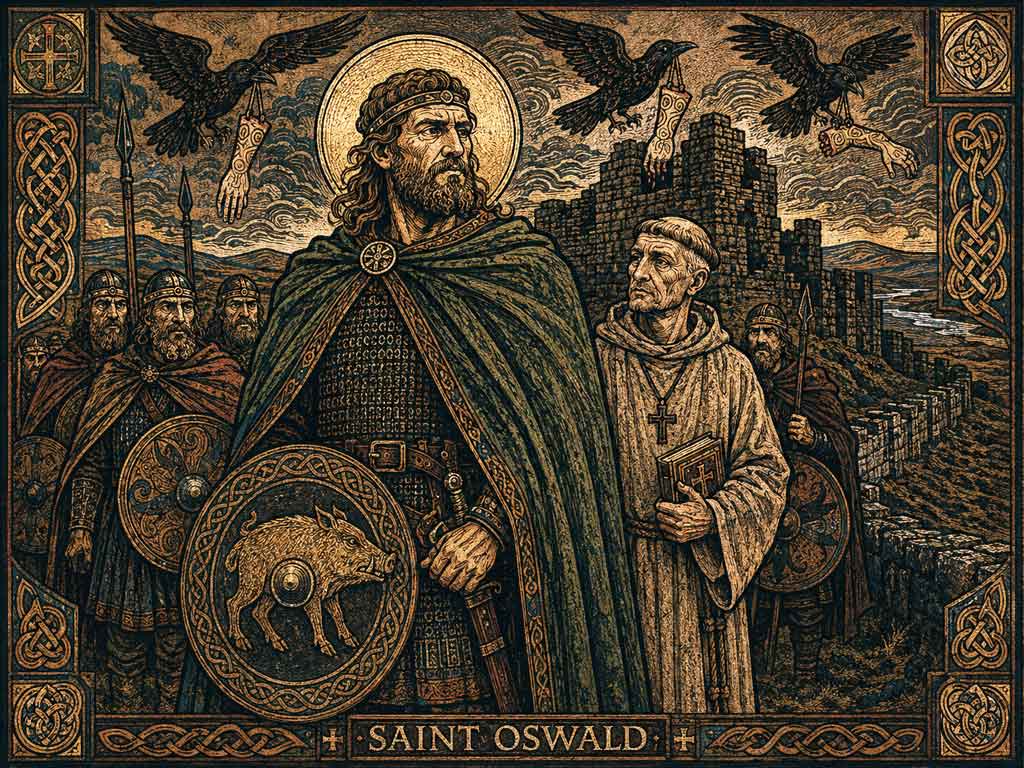
A Warrior-King Born into Civil War
To understand Oswald you need to know how violent the world he was born into really was. He came into it around 604, at the opening of the seventh century, the son of King Æthelfrith of Bernicia, the northern half of what would soon be Northumbria. The southern half, Deira, lay roughly along modern Yorkshire and was ruled by a rival royal house. Æthelfrith united the two by force, married Acha of Deira, and drove his brother-in-law Edwin into exile.
Edwin nursed his vengeance for years and finally returned, killing Æthelfrith in 616. Now it was Oswald's turn to flee. With his brother Oswiu, his half-brother Eanfrith, and a band of young nobles, he was bundled off, first to the Picts of southern Scotland, and from there to the holy island of Iona, founded by St Columba just a generation earlier. He was perhaps eleven or twelve years old.
He stayed nearly twenty years.
What he received in those decades on Iona was more than refuge. The monks of Columba's community baptised him, taught him Irish (a language he would later speak more fluently than the bishop he eventually summoned to Northumbria), and shaped him in the austere, missionary, deeply ascetic Christianity of the Celtic Church. Adomnán's Life of Columba preserves a tradition that Columba himself appeared in a vision to Oswald on the eve of his return to Britain, promising him victory. Whether or not the vision was Oswald's own memory or a later embellishment, the connection to Iona was the spiritual fact of his life.
In 633 he had reason to return. Edwin, who had ruled Northumbria for seventeen years and had himself become a Christian, was killed at the Battle of Hatfield Chase by an unholy alliance of Penda of Mercia, an avowed pagan, and Cadwallon ap Cadfan of Gwynedd, who was nominally Christian but, in Bede's view, was something worse than a pagan: an apostate Briton who behaved like a tyrant. Two Northumbrian kings tried to take Edwin's place in the year that followed; both apostatised from Christianity, and both were killed by Cadwallon. Bede was so disgusted by this annus horribilis that he refused to dignify it with a regnal year of its own and attributed the whole twelve months retrospectively to Oswald.
The Wooden Cross at Heavenfield
In the late summer or early autumn of 634, Oswald came south with what Bede admits was a small army "protected by their faith in Christ." He met Cadwallon's much larger British force near Hadrian's Wall, at a place the English called Hefenfelth (Heavenfield), about four miles north of Hexham.
The night before the battle, Oswald did something that became the founding image of his cult. He had his men cut a wooden cross from the moor-trees and dig a hole for it. Then, while the soldiers tamped the earth around the base, the king himself held the cross upright with both hands. When it stood firm, he called the whole army to its knees and prayed: that God, who knew their cause was just, would deliver his people from the proud and cruel enemy. They attacked at dawn. Cadwallon was killed; the British army shattered.
The cross stayed where it had been planted. Within a generation, pilgrims were cutting splinters from it, putting them in water, and drinking the water as medicine. Bede records the case of a Hexham monk named Bothelm, who broke his arm falling on ice and was healed overnight by tucking a piece of moss from the Heavenfield cross into his clothing at supper. The monks of Hexham Abbey adopted the site as a place of annual vigil; eventually they built a church there. A wooden cross still stands at the spot today, marking the moorland edge of the Roman Wall just east of Chollerford. A Workers' Educational Association party from Tynemouth and Newcastle made a pilgrimage there as recently as 1930, listening to a curator from the Laing Art Gallery quote Bede over a picnic on the grass.
The point of Heavenfield, theologically, is that it inverts the usual logic of Anglo-Saxon kingship. Oswald wins not by being the biggest war-band leader but by being the most prayerful. His cross (raw, hastily made, planted by his own hands) becomes both battle-standard and pulpit. From this single act, the iconography of Oswald flows: in nearly every medieval depiction of him, in stained glass and on monastic seals, he is shown holding a cross.
Aidan, Bamburgh, and the Silver Dish
Now king of a reunited Northumbria, Oswald sent immediately to Iona for a missionary bishop. The first man dispatched (Bede does not name him; later tradition calls him Corman) was a disaster. He came back to Iona complaining that the Northumbrians were uncivilisable. At the council called to decide what to do, a quiet voice broke the silence. "It seems to me, brother," said the monk Aidan, "that you have been unduly severe with your ignorant hearers. You should have followed the apostle's guidance and offered them at first the milk of simpler teaching, until growing strong on the food of God's word they could take in a fuller statement of the faith." Everyone realised the man for the job had just spoken. Aidan was consecrated bishop on the spot and sent.
Oswald gave him the tidal island of Lindisfarne (twice a day connected to the mainland by a wet ribbon of sand, twice a day cut off by the sea) as his episcopal seat. It became, almost overnight, a second Iona, a missionary base from which the new faith spread out across the moors of Bernicia. Aidan walked everywhere rather than ride, fasted on Wednesdays and Fridays, gave away kingly gifts to the poor, and ransomed slaves. When his English was halting in the early years, Oswald himself, fluent in Irish from his exile, stood beside him at preaching tours and translated.
The most famous story of their partnership belongs to Easter at Bamburgh, the great seacliff fortress that was Oswald's royal seat. The king and the bishop sat down to a feast on a silver dish. Outside, a crowd of starving beggars gathered at the gates. Oswald immediately ordered the food taken out to them, and the silver dish broken up into fragments and distributed among the rest, so they could buy more food elsewhere. Aidan, who had not yet begun to eat, seized the king's right hand and blessed it: Nunquam inveterascat haec manus. "May this hand never grow old." May it never perish.
After Oswald was killed in battle, his followers cut off that right arm and kept it. It was found to be incorrupt, as Aidan had blessed. For a time it was kept in a silver shrine at Bamburgh (Bede's "Bebbanburgh," named after Æthelfrith's queen Bebbe). Centuries later, when Bamburgh's status had declined, a Peterborough monk by the name of Wynegot would steal it for his own monastery in the Fens. That is roughly how Peterborough Abbey, hundreds of miles from any place Oswald had set foot in life, became the chief site of his English cult.
The Death at Maserfield: Where Did Oswald Fall?
On the 5th of August in 642 (though some sources date it to 641, depending on how Bede's indictions are reconciled), Oswald met Penda of Mercia again, this time in a battle he could not win.
Bede tells us only that the place was called "Maserfelth." For the better part of a thousand years, the consensus has placed it at Oswestry in Shropshire, on the Welsh border. The name itself was read as "Oswald's Tree" (Oswald's-treow), preserving the memory of the stake on which Penda is said to have mounted the king's severed head and arms. A famous holy well in Oswestry, covered by a stone chapel in the sixteenth century, marked the place where Oswald's head was traditionally said to have fallen, or to have been buried.
But there is a stubborn rival claim further north. The Lancashire village of Winwick, near Warrington, has insisted since well before the Domesday Book that it was Maserfelth: that the name preserves the older district name of Makerfield, that the battle was fought there, that the church and its St Oswald's Well mark the place where Oswald died. Local tradition tells of "Red Bank," where his palace stood, and points to a curious carving of a pig on the church tower, the subject of a folk legend in which the building stones moved themselves at night to their preferred site. When the Bishop of Warrington lectured on the parish in 1919, he weighed the evidence and concluded that the Lancashire claim "might be said to outweigh the claims of Oswestry." When excavators uncovered three skeletons of "gigantic size" beneath the chancel in 1828, lying together without coffins eight or ten feet below the floor, the natural local guess was that they were Oswald's chieftains, fallen with him at the same fight.
The truth is that nobody knows. Modern scholarship, including the 2025 British Academy volume edited by Johanna Dale, treats the location of Maserfelth as genuinely uncertain. What both sites prove is something more interesting: that within a generation or two of the king's death, communities a hundred miles apart wanted Oswald to be buried in their soil. The cult was already outrunning the corpse.
The Body That Became a Map
What Penda actually did with the body, as Bede tells it, was barbaric and consequential. He had Oswald dismembered, the head and arms struck off and mounted on stakes. There they remained, exposed on the battlefield, for about a year, until Oswald's brother and successor Oswiu rode south, retrieved them, and began the long, peculiar process by which the king's body was scattered, piece by piece, across the religious sites of England.
The head went to Lindisfarne, the island Aidan had made into the centre of northern Christianity. When Viking raiders later forced the monks to flee, they took the head with them in the coffin of their other great saint, Cuthbert. From Chester-le-Street it travelled with Cuthbert's body to Durham, where it has rested ever since. When Cuthbert's coffin was opened in 1899, some of Oswald's bones were found inside. This is the reason that, in medieval iconography across the north of England, St Cuthbert is so often depicted holding a crowned head: it is Oswald's. You can see the image in stained glass at St Hilda's Church in Hartlepool, on Durham's conventual seal, on alabaster panels and church monuments across Yorkshire. The Durham monks, faced with a vast and beautiful Roman gem found in their grounds (probably engraved with Jupiter's head), simply mounted it as a seal-matrix and inscribed it CAPUT SANCTI OSWALDI REGIS ("the head of Saint Oswald the King"), using it for centuries to authenticate their charters.
The right arm (the one blessed by Aidan) was kept incorrupt at Bamburgh until the eleventh century, when the visiting Peterborough monk Wynegot, judging that the once-royal city had declined too far to honour the relic properly, stole it. At Peterborough it became the single most important object in the abbey's spiritual life, the foundation of an entire liturgical office that scholars are still mapping. Johanna Dale's 2025 study argues that because it was a right arm, heavy with liturgical symbolism of blessing, oath-taking, and kingship, it shaped the whole rhythm of the year at Peterborough, not only Oswald's feast day on 5 August. King Stephen made a pilgrimage to honour it, presenting his own ring and remitting a debt of forty marks to the abbey. The relic vanished, presumably destroyed, at the Reformation.
The body went, by way of Oswald's niece Osthryth (queen of Mercia), to Bardney Abbey in Lindsey. Bede tells the famous story that the monks of Bardney, resentful that a Northumbrian king who had once ruled over them was being foisted on their house, refused to admit the relics. The wagon carrying the bones stood outside the gates all night, until a pillar of light streamed from the body to heaven and the chastened monks rose at dawn to beg that Oswald's bones be enshrined among them.
In 909, with the Danelaw still threatening the English Midlands, Æthelflæd "Lady of the Mercians", Alfred the Great's redoubtable daughter, translated Oswald's bones from Bardney to a new minster church she founded in Gloucester. This was both a religious act and a political one, asserting Mercian custody of the great saint of the north and rallying English resistance to the Danes. The ruins of St Oswald's Priory still stand beside Gloucester Cathedral; in 1935 Bishop Headlam, addressing the Gloucester Rotary Club after lunch in the Mercers' Hall, urged his audience to protect them.
By the time the Normans arrived, Oswald was everywhere. Relic lists survive from Bath, Durham, Glastonbury, Hyde, Peterborough, Reading, St Albans, Salisbury, St Paul's, Twynham, Tynemouth, and York. He was one of the three royal saints invoked for the king in the laudes regiae (the great liturgical acclamations chanted for English monarchs), alongside Edmund of East Anglia and the obscure Visigothic prince Ermengild. He had become a national saint.
Wells, Rushes, and Pigs: The Folklore Oswald
By the later Middle Ages, the cult had migrated downward as well as outward. It seeped into the soil and the village customs. Christina Hole, the English folklorist whose 1950 Saints in Folklore gathered some of the strangest material, identified Oswald's afterlife in places no chronicler bothered to record.
At Oswestry and Winwick alike, holy wells were credited to him, almost certainly older pre-Christian springs whose pagan associations had been folded into the new faith. At Oswestry, pilgrims would drop a green pebble through the carved stone above the well, drink a little water with the left hand, and make a wish; if their wish was true, the pebble would fall on the carved head face-down. The rituals are so far from any orthodox Christian practice that they make plain the well had been a sacred place long before Oswald's name was attached to it. Hole observes the natural progression: once memory of the saint faded, such wells reverted to being simple wishing-wells, the patron saint quietly forgotten.
At Grasmere in the Lake District, where the parish church is dedicated to Oswald, the medieval custom of "rush-bearing" survives to this day. On the Saturday nearest his feast (5 August), the village carries rushes into the church, some loose in sheets borne by six young girls, others woven into elaborate emblematic shapes: harps, gates, maypoles, a serpent on a pole. Among them are emblems of Oswald himself: a crown, a banner, a single human hand. Afterwards, children receive gingerbread stamped with the saint's name. Hole traces the custom back to the days when church floors were beaten earth strewn with rushes that needed periodic renewal; the renewal became a procession, and the procession a saint's-day celebration.
At Winwick, the carving of a pig on the church tower (the famous "Winwick Pig") is associated with a moving-stones legend: every night, during the building of the church, a pig carried the stones from the chosen site to a different spot, until the workmen gave up and built on the pig's preferred ground. Hole reads this, plausibly, as the buried memory of a pagan sanctuary that resisted being overwritten by a Christian church. The Bishop of Warrington in 1919 was crisper: he called the pig "the most uninteresting thing in Winwick" and tried to direct his audience's attention to a far older blood-stone on the Newton road.
There are Oswald churches scattered across England in patterns that tell a story of cult routes and local politics. In the Yorkshire Dales: Askrigg, Horton-in-Ribblesdale, Thornton-in-Lonsdale, Arncliffe. On the Isle of Axholme in Lincolnshire: Althorpe, Crowle, Luddington, the last of which kept an ancient bell inscribed SANCTE OSWALDE ORA PRO NOBIS ("Saint Oswald, pray for us") until the mid-nineteenth century. At Nostell Priory in Yorkshire, an Augustinian foundation of the early twelfth century gave its name to a baronial title. When Tory MP Rowland Winn was raised to the peerage in 1885, he chose to be styled Baron St Oswald, after the priory whose estates his ancestors had bought after the Dissolution. The title is still held today. At Paddlesworth in Kent, on the highest ground in East Kent, sits a tiny Norman church (one of the smallest in England) dedicated to Oswald in pre-Conquest days, probably (the antiquarians speculated) by Queen Ethelburga of Kent, who had outlived him by five years and was related to him by marriage.
Oswald was, in the language of the 2025 Dale volume, both "multi-local and multi-regional." He never quite reached the saturation of England's two greatest royal saints, Edmund of East Anglia and Edward the Confessor, but in the variety of his depictions, and in the breadth of places that claimed him, he was their nearest rival.
The Continental Oswald: A Raven, a Bridal-Quest, and a Saint in a Toga
Then there is the other Oswald, the Continental one, who diverges so far from the original that the two are barely recognisable as the same man.
His cult travelled the Continent in waves. Northumbrian, Irish, and Frisian missionaries carried his name across the Channel from very early; St Willibrord, the Anglo-Saxon apostle of the Frisians, owned an Oswald relic at his foundation of Echternach. But it was high-status dynastic marriages that really pushed the cult deep into German-speaking Europe: Judith of Flanders, who married Welf IV of Swabia in the eleventh century, brought English relics with her to the Welf proprietary foundation at Weingarten. Matilda Plantagenet, daughter of Henry II of England, married Henry the Lion of Saxony in 1168, and seems (the 2025 Dale volume argues) to have been the real vector by which the so-called "Flemish" Office for Oswald reached Weingarten, replacing the older candidate, Judith, who turns out on closer inspection to have been too early.
From Weingarten, dedications to Oswald multiplied across Württemberg, Bavaria, Austria, the Tyrol: eight churches and eighteen chapels and eleven altars in Württemberg alone, in one nineteenth-century count. The cult crossed linguistic borders, drifting south through the German-speaking villages of the Südtirol and down into the plains of northern Italy. There is a seventeenth-century sculpture of Oswald on the front of the church of St Eustace on the Grand Canal in Venice. He wears a Roman toga and looks mildly ecstatic. From Regensburg eastward along the Danube the cult travelled with the soldiers of the Second Crusade, who gathered there in 1147 -Oswald, the king who had fought heathens beneath the cross, was a natural patron for the crusading venture. He reached Scandinavia, where his liturgies blend English (Sarum) and German (Bavarian) influences; he eventually reached Iceland, where a fifteenth-century Ósvalds saga preserves a vernacular life of him in Old Norse.
And then, at some point that scholars can now date to the late fourteenth century or early fifteenth (not, as older literary historians long maintained, to the twelfth), something strange happened to the story. In German-speaking lands Oswald began to acquire a new layer of legend: a bridal-quest narrative, in which the king sets off to win a pagan princess as his wife, aided by a talking raven who acts as his messenger, his spy, and his comic accomplice. The best-known version, the Munich Oswald, runs to thousands of lines of verse. The raven steals rings, delivers speeches, threatens to undermine Oswald's sovereignty and sanctity, and finally has to be made dispensable, because no medieval narrative could really let an animal that articulate stay loose forever. Sarah Bowden, in the 2025 Dale volume, reads the raven through the lens of medieval animal studies as a creature who embodies the impossibility of fully containing the animal: he must be domesticated, deployed for human use, but eventually disposed of.
The strangeness is real. It is hard to square the Bavarian Oswald of the Munich Oswald with the Heavenfield Oswald of Bede. They feel like two different men. The 2025 Dale volume's deepest claim is that the gap between them can only be closed by tracing the cult away from the famous monasteries (Peterborough, Weingarten, Hildesheim) and into the dozens of small alpine chapels and Lancashire wells and Yorkshire parish churches where Oswald was venerated for centuries, half-remembered, half-reinvented. The cult's centre of gravity, in other words, was never just in the great institutions. It was in the local churches with their cracked bells and rush-bearings and pig-carvings.
The Other Oswald, Briefly
A word of warning: there are two medieval saints called Oswald, and they are easily confused.
The first is the one this article has been about: Oswald of Northumbria, the warrior-king, killed in 642.
The second is Oswald of Worcester (c. 925–992), a tenth-century Benedictine of Danish parentage who became Bishop of Worcester in 961 and Archbishop of York in 971. He was one of the three architects, with St Dunstan and St Æthelwold, of the great English Benedictine Reform under King Edgar. His monastic foundations included Westbury-on-Trym and (greatest of all) Ramsey Abbey. He died at Worcester on 28 February 992, in the act of washing the feet of twelve poor men, a daily practice for which he was famous.
Most English churches dedicated to "St Oswald," and almost all of those mentioned in this article, honour the Northumbrian king. The Worcester Oswald has his own cluster, mostly in the West Midlands. Some of the most respected Anglo-Saxon scholarship on him remains J. Armitage Robinson's St Oswald and the Church of Worcester (1919), which argued, against earlier hagiographic tradition, that his reforms at Worcester were gradual, peaceful, and accomplished by substitution rather than expulsion.
Why Oswald Still Matters
What makes Saint Oswald worth knowing in 2026, when we no longer drink water with splinters of cross in it or carry rushes into churches in August?
Partly it is the sheer surrealism of his afterlife. Few historical figures have generated a stranger pattern of survival: a king dismembered on a Welsh-border battlefield in the seventh century, whose head and arm and bones became the foundation of monastic identity at Durham, Peterborough, and Gloucester, and whose memory drifted across Europe until he ended up in a Bavarian comedy with a talking bird. The story is a reminder that medieval saints' cults were never tidy: they sprawled, mutated, and went where they were welcomed.
Partly it is what Oswald reveals about how power and holiness intersected in early medieval England. The image of the king holding the cross upright with his own hands while his soldiers tamp the earth around it is one of the founding visual icons of Christian English kingship: not the king as conqueror, but the king as supplicant. That this image was honoured for a thousand years, copied onto seals and stained glass and stone, suggests something durable about the way English political culture preferred its rulers to be remembered.
And partly it is the places themselves. The wooden cross still stands at Heavenfield. The tide still comes in twice a day at Lindisfarne. The well still flows at Oswestry, and the rushes are still carried into Grasmere church on the Saturday nearest 5 August. The pig still sits on the wall at Winwick. The ruined nave of St Oswald's Priory still stands beside Gloucester Cathedral. The tiny church at Paddlesworth is still one of the smallest in Kent. The Earls St Oswald still take their title from Nostell Priory.
Oswald's life touched all these places: sometimes in fact, more often in legend, occasionally in mistaken identity. To walk through them with his story in mind is to feel the long, strange persistence of medieval memory in a landscape that was never as Christian, or as pagan, or as fixed, as it now looks.
His feast day is 5 August. He is the patron of soldiers and of European children, the latter presumably an inheritance of the silver dish at Bamburgh.
If you want to read further, the indispensable modern starting point is Johanna Dale, ed., Liturgy, Literature and History: Oswald of Northumbria and the Cult of Saints in the Middle Ages (British Academy, 2025), which represents the latest and best interdisciplinary scholarship on the cult. For the primary source, Bede's Ecclesiastical History of the English People Book III, chapters 1–13, is the foundation of everything. Christina Hole's Saints in Folklore (1950) remains a charming guide to the English folkloric Oswald. Eleanor Shipley Duckett's The Wandering Saints of the Early Middle Ages (1959) is the best literary synthesis for the general reader.