
How Prophecy Became Policy: The Long Campaign to Trigger the Second Coming
There is a peculiar strand running through Victorian public life that mainstream history has tended to overlook or dismiss as eccentric fringe enthusiasm. It concerns the conviction, held not by madmen in attics but by cabinet ministers, members of Parliament, celebrated preachers, diplomats, popular journalists and Church of England bishops, that the Second Coming of Jesus Christ could be prepared for, hastened, and perhaps even engineered, not simply awaited.
To understand it fully, we need to go back further than Victoria's reign. The roots of this extraordinary movement lie in the millenarian excitement of the early nineteenth century, when a particular reading of biblical prophecy fused with the trauma of the French Revolution, the rise and fall of Napoleon, and the long, slow dissolution of the Ottoman Empire into something altogether more urgent and world-historical: a systematic programme for fulfilling the conditions that scripture had laid down as prerequisites for the return of Christ.
This article traces that programme from its intellectual origins to the remarkable events of the 1880s and 1890s, when a small number of men and women actually went to Palestine, bought land, lobbied sultans, and set about creating the conditions that their theology told them would trigger the end of the world.
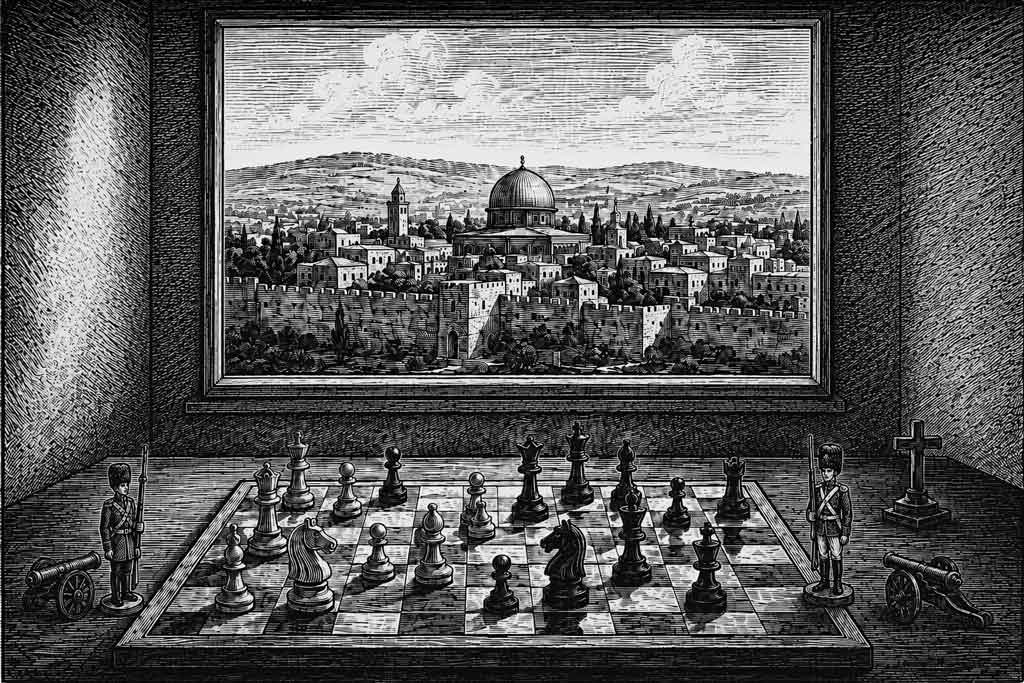
The Prophetic Architecture: Building the Framework
Before any attempt to engineer the apocalypse could begin, there needed to be a coherent theory of what the apocalypse required. That theory was assembled, brick by brick, across the first half of the nineteenth century, drawing on Daniel, Ezekiel, Zechariah, and the Book of Revelation.
The key texts were not new - Protestant interpreters had been working with them since the Reformation. What was new, in the early Victorian period, was the degree of systematic precision with which they were applied to current events, and the confidence with which their interpreters announced that the prophecies were now, unmistakably, being fulfilled in real time.
The framework rested on several interlocking propositions:
First, the present age - what theologians called "the Gentile dispensation" - was drawing to its close. The evidence was all around: the fall of the Papacy's temporal power, the spread of infidelity, the social upheavals unleashed by the French Revolution. These were not accidents of history but the precise events foretold in the Book of Revelation as the "seven vials" of divine wrath being poured out upon the earth in sequence.
Second, the Ottoman Empire - Turkey - was the fulfilment of the prophecy in Revelation 16:12, the sixth angel pouring out his vial upon "the great river Euphrates," whose waters were to be "dried up" to prepare the way for the kings of the east. As Turkey declined, the way was being opened for the return of the Jewish people to Palestine.
Third, the restoration of the Jewish people to their ancestral land was itself a precondition for the Second Coming. Christ would not return, in this reading of scripture, until Israel was gathered from the nations and restored to the Holy Land.
Fourth, a great final battle - Armageddon, identified with the plain of Megiddo in what is now northern Israel - would precede the establishment of Christ's millennial kingdom on earth.
Fifth, and most significantly for our purposes: Britain had a providential role in all of this. Whether as the "ships of Tarshish" mentioned in Ezekiel, as the maritime power that would protect the restored Israel, or - in the more extreme Anglo-Israelite version - as the literal descendants of the lost ten tribes of Israel, Britain was written into the prophetic script as a key actor in the final drama of history.
The logical conclusion was inescapable, and its implications were revolutionary: if these were the conditions for the Second Coming, then working to bring them about became a sacred duty. If you could help restore the Jews to Palestine, weaken the Ottoman Empire, and break the power of the Papacy, you were not interfering in divine providence; you were co-operating with it.
The Prophetic Entrepreneurs: Edward Irving and the Albury Circle
The first systematic attempt to apply this framework to current events can be dated with unusual precision to the 1820s, and to a remarkable series of conferences held at Albury Park in Surrey, the estate of Henry Drummond, a wealthy banker and MP.
Henry Drummond was one of those extraordinary Victorian figures whose wealth, intellect, and religious intensity combined to produce genuine historical consequences. At his Albury conferences, held annually from 1826, he gathered around him a group of clergymen, theologians, and laymen to study prophecy systematically. The star of these gatherings was Edward Irving, a Scottish minister of volcanic rhetorical gifts, whose sermons at his Regent Square church in London were drawing enormous crowds.
Irving's preaching on prophecy was electrifying precisely because he refused to treat it as abstract theology. In his 1826 sermon at the National Scottish Church, reproduced in the New Times of London in February of that year, he laid out with breathtaking boldness the prophetic schedule he believed was now unfolding. The seven vials of Revelation, he announced, were not figures of speech - they were a timetable. The French Revolution was the outpouring of the first vial. Napoleon was the fourth vial - the scorching fire of the sun, the gathering brightness of imperial glory. The temporal humiliation of the Papacy was the fifth. And now, in the 1820s, the sixth vial was being poured upon the Euphrates: the Ottoman Empire was visibly weakening, and when it finally fell, the way would be open for the gathering of Israel and the return of Christ.
Irving was not a marginal crank. He was the most celebrated preacher in London. His congregation at Regent Square included Members of Parliament, cabinet ministers, and literary figures. When he spoke of Armageddon and the restoration of the Jews, he spoke to people who could actually do something about it.
The Albury circle also included Lewis Way, a wealthy barrister turned missionary who had devoted his fortune to the cause of Jewish conversion and restoration, and who had personally lobbied the Congress of Aix-la-Chapelle in 1818 to include Jewish civil rights on the European diplomatic agenda. For Way, as for Irving and Drummond, the conversion and restoration of the Jewish people was not a sentimental aspiration - it was a prophetic necessity that human action could help bring about.
The Institutional Machine: The London Society for Promoting Christianity Amongst the Jews
The Albury circle had its institutional counterpart in the London Society for Promoting Christianity Amongst the Jews, founded in 1809 and known familiarly as "the Jews' Society." By the 1840s this organisation had a budget larger than many missionary societies, maintained missions in Jerusalem, Constantinople, and throughout Europe, and counted among its supporters some of the most powerful men in the country.
The Society was heard at length in the Leicester Chronicle of November 1853, when its annual meeting in Leicester drew a platform of clergy who were entirely explicit about the prophetic stakes. The speakers did not present Jewish conversion as a work of charity. They presented it as a prophetic programme. The weakening of Turkey, the gathering of the Jews, the return to Palestine - these were the dominoes that, falling in sequence, would bring about the events foretold in scripture and usher in the return of Christ.
The chairman, the Rev. C. Lea, made the connection with his characteristic unselfconsciousness. He told the Leicester audience that the restoration of England's attitude to the Jews was "most intimately connected with the second coming of Christ." The eyes of Europe, he said, were on Turkey, and the fate of Israel was "intimately connected with the momentous struggle going on there." He quoted what he apparently believed to be a fact: "We have now the beginning of the end."
Crucially, the Society backed its words with action. It employed missionaries, built schools, ran medical missions, and worked systematically to create the conditions - converted Jews, a sympathetic British government, diplomatic pressure on the Ottoman authorities - that would make Jewish restoration to Palestine practically achievable. The prophetic and the political were inseparable.
Lord Shaftesbury: The Politician Who Read the Signs
No figure better illustrates the merger of prophetic conviction and political action than Anthony Ashley Cooper, seventh Earl of Shaftesbury, whom the Lewis book described as "Victorian England's greatest humanitarian and most prominent Christian Zionist." To his contemporaries, Shaftesbury was known primarily as the great reformer of factory conditions, of lunacy laws, of child labour in mines. What is less commonly appreciated is that his reforming zeal was inseparable from his prophetic convictions.
Shaftesbury read the newspapers and the Bible in parallel. He was chairman of the London Society for Promoting Christianity Amongst the Jews. He lobbied the British cabinet on foreign policy questions relating to Palestine. In 1840 he persuaded Lord Palmerston - his stepfather-in-law - to instruct the British consul in Palestine to extend protection to Jewish residents there, a move of significant diplomatic consequence.
His diary, now held at the University of Southampton, reveals the prophetic framework underlying every political calculation. He believed that the Jewish restoration to Palestine was imminent, that British policy should actively facilitate it, and that its fulfilment would be one of the signs preceding the return of Christ. When he looked at the Eastern Question - the slow collapse of Ottoman power and the consequent scramble of European powers for influence in the Near East - he did not see a conventional diplomatic crisis. He saw the drying up of the Euphrates.
In the interview published in the Belfast Weekly Telegraph in October 1884, conducted at Castle-Wemyss, Shaftesbury is found at the end of his life still working to resettle Jews in Palestine, explaining with forensic detail why his Cyprus colony scheme had failed and how the lessons learned should be applied to future efforts. He was, by this point, a very old man. But his prophetic horizon remained unchanged: the restoration of Israel was coming, the signs were being fulfilled, and Britain's duty was to facilitate it.
The Popular Theologian: John Cumming and the Mass Market for Prophecy
If Shaftesbury represented the aristocratic-political dimension of this movement, John Cumming - minister of the National Scottish Church at Crown Court, London - represented its popularisation. Cumming was the Dr. Cumming whose Exeter Hall lectures were reported in the Morning Herald and the Daily News in December 1853. More importantly, he was the author of the book we have read in detail: The End; or, The Proximate Signs of the Close of This Dispensation, a volume of fourteen lectures that brought the full prophetic framework to a mass audience.
Cumming was a remarkable figure - prolific, lucid, and with an unerring instinct for the dramatic. His lectures at Exeter Hall drew overflowing crowds. His books sold in their tens of thousands. When he announced that the drying up of the Euphrates had begun in 1820, that the sixth vial was now being poured out, and that the events they were witnessing in the Near East were the literal fulfilment of Revelation 16, he was not speaking to a fringe audience of enthusiasts. He was speaking to mainstream, educated, middle-class Victorian England.
The architecture of his prophetic system was careful and systematic. Each of the seven vials of Revelation, he argued, corresponded to a specific historical event: the French Revolution for the first, the Napoleonic naval wars for the second, the devastation of the Rhine and Danube valleys for the third, Napoleon's imperial glory for the fourth, the humiliation of the Papacy for the fifth. The sixth - the drying up of the Euphrates, meaning the decline of Ottoman/Turkish power - was in progress in his own lifetime. The seventh would usher in the fall of Babylon (Papal Rome), great cosmic upheavals, and the Second Coming.
The practical implication was unmistakable: the decay of Ottoman power was not to be mourned, resisted, or stabilised. It was to be recognised as the hand of God preparing the way for Jewish restoration and the return of Christ. British policy towards Turkey was therefore a matter of prophetic significance, not merely diplomatic calculation.
The Russia chapter of The End is perhaps the most striking for our purposes. Taking his text from Ezekiel 38, Cumming identified Russia as the "Gog" of prophecy - the great northern power that would descend upon a restored Israel in the last days, provoking a divine intervention that would destroy its armies and signal the opening of the Millennial Kingdom. Russia, in this reading, was a prophetic actor, not simply a geopolitical rival, its aggression against a restored Jewish Palestine written into the script of the end of the world.
When the Crimean War broke out the following year, the prophetic excitement was intense. Here was Russia, the identified Gog, advancing against Turkey, the Euphrates that was being dried up. The pieces on the board were moving exactly as the prophetic interpreters had said they would. Letters to provincial newspapers from Huddersfield to Liverpool, from Hereford to Belfast, drew the connections with an urgency that shows how widely Cumming's framework had penetrated popular thought.
The Dissenters: Voices of Scepticism
Not everyone was convinced, and it would be misleading to suggest that the prophetic programme went unchallenged. The Hebrew Observer - a Jewish newspaper - published a blistering review of the 1853 Exeter Hall conversion meeting that is worth quoting in spirit if not at length. The reviewer compared the assembled clergy to the prophets of Baal on Mount Carmel, noted with some satisfaction that "the Lord was not in the fire" of their theatrical performances, and observed that Canon Stowell's enthusiasm for sending Jews to Jerusalem was transparently a desire to be rid of them from England, where they had legal protections that they would not enjoy in Palestine.
The Jewish critique was sharp and prescient: the prophetic programme for Jewish restoration, however sincerely felt, served Christian theological interests rather than Jewish ones. The Jews were to be collected, transported, converted, and installed in Palestine as actors in a drama written by Christian interpreters for Christian audiences. Their own feelings about the matter were largely beside the point.
The Reverend G. Croly, writing in the Morning Advertiser in December 1859, offered a different kind of dissent - from within the prophetic tradition itself. Croly took direct aim at John Cumming and his predecessor Mr. Elliot for the dangerous practice of date-setting. The Turkish power, he noted with some asperity, had been scheduled for extinction at 1849. It had not obliged. The repeated failure of specific prophetic predictions, Croly argued, brought the whole enterprise into disrepute and - more dangerously - had practical consequences. If the world were to expire in 1866 or 1867, as some were suggesting, what nation would invest in railways, canals, navies, or constitutions? What inducement would there be to plant a tree or educate a son?
His argument is remarkable in its modernity. He was pointing to what we might now call the social costs of eschatological expectation - the way that confident predictions of imminent ending can corrode the long-term thinking on which civilised life depends.
The Parliamentary Orator: Francis Dobbs and the Irish Dimension
Among the most remarkable documents in our collection is the speech delivered to the Irish Parliament in 1800 by Francis Dobbs, member for Charlemont, on the occasion of the third reading of the Act of Union. Published in the Chester Chronicle of September 1800, it deserves more attention than historians have generally given it.
Dobbs stood before the Irish Parliament and told his colleagues, without embarrassment or apology, that the Act of Union was irrelevant because the world was about to end. The prophecies of Daniel and Revelation were being fulfilled before their eyes. The fall of the Papacy, the decline of the European empires, the approaching return of the Jewish people - these were the signs of a dispensational ending that made the constitutional future of Ireland a secondary matter.
More striking still was his specific claim about Ireland's prophetic role. Drawing on an identification of "Armageddon" in the Hebrew with a place-name in Ireland, and on traditions connecting the prophet Jeremiah with the Irish monarchy through a Davidic princess, Dobbs argued that Ireland - not Palestine, not England - was the country where the Messiah would first appear. The gathering of the armies described in Revelation was, in his reading, to take place in the neighbourhood of Ireland, and the restoration of Israel would begin from these shores.
This was eccentric even by the standards of the day. But Dobbs was not a marginal figure: he was a sitting Member of Parliament, and his speech reduced the House to silence. The sheer seriousness with which he was heard - whatever private reservations his colleagues entertained - tells us something important about the pervasiveness of prophetic thinking in educated British and Irish society at the turn of the nineteenth century.
The Man in the Field: Laurence Oliphant in Palestine
If the story of Victorian prophetic thinking could be told only through sermons, newspaper letters, and parliamentary speeches, it would be interesting but ultimately somewhat theoretical. What makes it genuinely world-historical is the fact that some people actually went to Palestine and tried to do something.
Laurence Oliphant was, as his editor describes him, one of the most colourful personalities of the nineteenth-century Western world. Diplomat, journalist, adventurer, Member of Parliament, mystic, and from 1878 onwards devoted champion of Jewish settlement in Palestine, Oliphant spent the last decade of his life living at Haifa and the neighbouring Druse village of Dalyat-al-Karmil, using his energy, his connections, and his personal fortune to facilitate the return of the Jewish people to the land that prophecy told him was their destiny.
His book Haifa, or Life in the Holy Land 1882–1885 - assembled from his dispatches to the New York Sun - is a unique document: the eyewitness account of a Christian Zionist watching prophecy unfold around him, describing not the abstract drama of the end times but the concrete realities of land purchase, Ottoman obstruction, Jewish colonisation, and the political dimensions of the Eastern Question as experienced from a house on Mount Carmel.
Oliphant's motives were, as his editor candidly acknowledges, an admixture: religious conviction that the restoration of Israel was divinely ordained, humanitarian sympathy with the persecuted Jews of Eastern Europe, and British imperial interest in strengthening influence in the Near East at the expense of the weakening Ottomans. These three threads were, for him and for his contemporaries, not separate things to be disentangled but a single unified purpose.
He had contacted the Sultan in 1879, seventeen years before Herzl's famous audience. He had devised a specific scheme for Jewish settlement in the Belka region east of the Jordan, complete with a proposed railway connecting Haifa, Damascus, Akaba and Egypt. He had lobbied Jewish donors, written articles for British and American newspapers, helped failing village communities, and worked, day by day, on the practical infrastructure of a return that he believed was prophetically certain.
When he visited Megiddo - the biblical site of Armageddon - in September 1884, he was doing so not as a tourist but as a potential property developer. He had been approached by the indebted villagers of Lejjun, who wanted to sell their land. Standing on the Tell et Mutsellim above the plain of Esdraelon, looking out across a landscape of biblical resonance towards Nazareth and Mount Tabor, he noted with characteristic dry wit that the notion of becoming proprietor of a battlefield with such "interesting historical associations in the past, to say nothing of the future, which may be mythical or not, according to theological fancy" had induced him to visit.
The juxtaposition was deliberate and deeply characteristic of the movement as a whole: the last days, in prophetic terms, were also real estate. Armageddon needed a proprietor. The return of Israel required land to be purchased, Ottoman permissions to be obtained, agricultural communities to be established. The engineering of the apocalypse was, in its practical dimension, a matter of irrigation, railways, diplomatic negotiation, and colonial administration.
The Battle for Armageddon: Prophetic Geography in the Popular Press
By the 1860s, 1870s and 1880s, the prophetic framework had so thoroughly permeated popular culture that it appeared not only in sermons and theological lectures but in regional newspaper correspondence, local meeting reports, and the ordinary discourse of provincial religious life.
The article from the Stalybridge Reporter of January 1913, looking back on the history of Armageddon interpretations, traces a tradition stretching back centuries. But the density of engagement with the topic in the Victorian period was something qualitatively new, driven by the combination of mass literacy, cheap newspapers, popular preaching, and the genuine geopolitical drama of the Eastern Question.
The South London Observer of March 1893 reported a Sunday evening lecture at the Surrey Masonic Hall on "The Battle of Armageddon" by a Mr. F. W. Porter, who told his audience that the battle would take place in the neighbourhood of Jerusalem, that Russia would be the aggressor, and that the nations were about to make war on Christ himself - the Lamb who would overcome them because he was King of Kings and Lord of Lords. The West Briton of May 1870 reported the Rev. M. Baxter lecturing in Cornwall on the Second Coming, including a belief that Napoleon (the third Napoleon, then still on the French throne) was the Antichrist, the beast with seven heads and ten horns, and that the battle of Armageddon was imminent. The Malton Messenger of June 1877 reported a devotional meeting at which the Rev. F. E. Sadgrove connected the Russo-Turkish War then in progress to the prophecies of Ezekiel, the drying up of the Euphrates, and the approaching battle of Armageddon - and then read two newspaper extracts aloud to his congregation as evidence that secular journalism was inadvertently confirming the prophetic timetable.
What is striking about these reports is the social breadth they represent. This was not a movement confined to any one denomination or class. Nonconformists and Anglicans, bishops and lay preachers, aristocrats and mill workers - all were engaged with essentially the same prophetic framework, derived from the same key texts, and reaching broadly the same conclusions about what the present moment required.
The Anglo-Israelite Variation: Britain as the Chosen Nation
Running alongside the mainstream Christian Zionist tradition - and sometimes intersecting with it - was the more radical Anglo-Israelite movement, whose central claim was that the British people were themselves the literal descendants of the lost ten tribes of Israel. This view gave the prophetic programme an even more urgent practical dimension: if Britain was Israel, then Britain's national policy was inseparable from Israel's prophetic destiny.
Edward Hine, whose lectures in Huddersfield and elsewhere in 1877–78 we have followed in some detail, was the most energetic populariser of this position. His lectures in Huddersfield - reported in the Huddersfield and Holmfirth Examiner in February 1878 - attracted large audiences and generated intense public discussion. Hine argued that there were three hundred prophetic marks identifying Israel, and that the British nation responded to all of them where other nations responded to only a handful. The keeping of the Sabbath, the maritime empire, the judicial system, the Davidic lineage of the monarchy - all were offered as evidence.
The political implications were spelled out with some precision. If Britain was Israel, then the Eastern War could not be settled apart from the prophetic destiny of the British nation. British neutrality, British possession of Constantinople, British facilitation of Jewish restoration to Palestine - these were questions of prophetic fulfilment as much as imperial policy. Hine even argued, in his analysis of the Great Pyramid of Giza, that the structure's mathematical properties contained a prophetic timetable pointing to 1881 as a year of special significance.
The Dumfries and Galloway Standard's report of a public conference on the Ten Lost Tribes in March 1877 captures the flavour of these gatherings: earnest, disputatious, deeply serious, and animated by a genuine sense that the participants were living at the hinge of history. The discussion ranged from Assyrian cuneiform tablets to the genealogy of Queen Victoria, from the Norman Conquest to the Irish monarchy, from the tribal identities of the Saxons and Danes to the question of whether Oliver Cromwell had broken the continuous Davidic lineage of the British throne. It was, in its way, a remarkable intellectual exercise - amateur scholarship placed in the service of prophetic conviction, and prophetic conviction placed in the service of political action.
The Clerical Establishment: The Bishop of Lincoln at the Church Congress
Perhaps the most significant indicator of how mainstream this tradition had become by the 1870s is the paper delivered at the Church Congress of 1877 by the Bishop of Lincoln, published in the Nottinghamshire Guardian of October that year.
The Church Congress was not a gathering of enthusiasts. It was the principal annual assembly of the Church of England's intellectual and clerical leadership. And here was its Bishop of Lincoln arguing at considerable length for the unity and practical importance of biblical prophecy, tracing the prophetic thread from Genesis to the Apocalypse, applying it explicitly to the fall of the Papacy and the Eastern Question, identifying the Babylon of Revelation with Papal Rome, and declaring that the Armageddon battle of the sixteenth chapter was one of the key events through which the prophecies were being worked out.
The Bishop's paper was careful, learned, and deeply conservative in its theology. It was also entirely committed to the prophetic framework that Irving and Cumming had popularised a generation earlier. The drying up of the Euphrates, the fall of Babylon, the great conflict preceding the New Jerusalem - these were not the marginal obsessions of a fringe. They were the considered conclusions of the Church of England's senior hierarchy.
The Question That Haunted Everything
Underneath all of this activity - the sermons, the lectures, the lobbying, the colonisation schemes, the prophetic calculations, the parliamentary speeches - lay a question that nobody quite asked directly, but that everyone was implicitly engaging with: if the fulfilment of prophecy depended on specific historical conditions being met, and if human beings could help bring those conditions about, then what was the relationship between divine sovereignty and human agency in bringing the Second Coming to pass?
This was, in theological terms, a profound puzzle. On one hand, the God of the prophets was omnipotent and sovereign: what he had decreed would come to pass regardless of human effort. On the other hand, these same Victorians believed that God worked through human instruments - that he used nations, diplomats, missionaries, and philanthropists to accomplish his purposes. They could point to the scriptural precedent of Cyrus the Great, the pagan Persian king whom Isaiah had named as God's instrument for restoring the Jewish people from Babylonian captivity. If God could use Cyrus, could he not use Lord Shaftesbury, or Laurence Oliphant, or the British Foreign Office?
The answer that most of them arrived at, implicitly, was that human agency and divine sovereignty were not in competition but in collaboration. God had appointed the end; he had also appointed the means; and those means included the decisions of British politicians, the activities of missionaries, the labours of colonisation societies, and the quiet diplomatic work of people who believed that history was moving towards its appointed conclusion and that they had a role to play in that movement.
This conviction gave the Victorian prophetic movement its peculiar energy: an activist eschatology, quite unlike the quietist belief that the end would come in God's good time and there was nothing to be done but wait. The signs of the times demanded response. The approaching end was to be prepared for, facilitated, and in some meaningful sense brought about, not simply observed.
Whether any of this could genuinely "trigger" the Second Coming was a question that most of them were too theologically careful to ask explicitly. But the logic of their position was clear. If the conditions were being assembled - if Turkey was weakening, if the Jews were beginning to return to Palestine, if the Papacy was losing its temporal power, if the Gospel was being preached to all nations - then the divine machinery was in motion, and human co-operation with that machinery had become a duty rather than a choice.
The World They Were Making
It would be a mistake to treat the Victorian prophetic movement as merely a curiosity of intellectual history - an eccentric backwater of religious enthusiasm that had no consequences for the real world. On the contrary, its consequences were substantial, and they were felt in domains far removed from theology.
The British diplomatic tradition of engagement with the Eastern Question - the consistent pressure on the Ottoman authorities regarding the treatment of Jews in Palestine, the willingness to use naval power in the eastern Mediterranean to protect what were called "British interests" but which often included the interests of Jewish communities - was shaped in part by the prophetic convictions of those who directed and influenced British policy. Lord Shaftesbury's pressure on Palmerston in 1840 was not an isolated episode: it was one instance of a sustained effort, rooted in prophetic conviction, to align British foreign policy with what its advocates believed were the requirements of divine providence.
The colonisation societies, the missionary organisations, the philanthropic networks that channelled money and personnel towards Palestine throughout the Victorian period - these were institutions built by people who saw their work as prophetic, not simply humanitarian. Helping persecuted Jews find a safer home was, in their eyes, only half the point: they believed they were preparing the ground for the return of Christ.
By the 1880s, the practical infrastructure of what would later be called Zionism was being laid down by Christian believers who had no interest in secular nationalism and every interest in prophetic fulfilment. When Laurence Oliphant died in 1888 - buried in England, his scheme for the Belka colony unrealised - he left behind him a tradition of practical engagement with Palestinian land settlement, a set of established relationships with Ottoman authorities and Jewish community leaders, and a template for the kind of diplomatic and philanthropic work that would be necessary if Jewish restoration to Palestine were ever to become a reality.
He was celebrated in Jewish homes across Eastern Europe as "Prince Oliphant." His portrait hung on walls where his hosts had no interest in his prophetic theology and every interest in his practical support. The movement he represented had, without quite intending it, created allies across the boundary of faith - and in doing so had begun to assemble the conditions it believed were necessary for the end of the world.
Whether those conditions, once assembled, would produce what the Victorian prophets expected - and what role, if any, human engineering had played in their assembly - remained, as the century closed, an open question. The Ottoman Empire was still standing, if shakily. The Jews were returning to Palestine in increasing numbers, but not yet in the flood tide that the prophecies seemed to demand. Armageddon had not been fought. Christ had not returned.
But the infrastructure was there. The networks were in place. The idea that prophetic destiny could be facilitated, prepared for, and perhaps actively brought about had embedded itself in British religious culture, British foreign policy, and British imperial self-understanding in ways that would take generations to work themselves out.
The Victorian attempt to engineer the apocalypse had not yet succeeded. But it had changed the world.
Key Figures
Edward Irving (1792–1834) - Scottish-born preacher whose Regent Square lectures were the most celebrated prophetic addresses of the 1820s. His interpretation of the seven vials as a historical timetable from the French Revolution to the imminent Second Coming became the template for the entire movement.
Henry Drummond (1786–1860) - Banker, MP, and host of the Albury prophetic conferences, which brought together the leading prophetic thinkers of the 1820s in systematic study of eschatological scripture.
Lord Shaftesbury (1801–1885) - Seventh Earl, reformer, and the most politically influential figure in Victorian Christian Zionism. His lobbying of Palmerston in 1840 produced the first British diplomatic representation explicitly charged with protecting Jewish interests in Palestine.
John Cumming (1807–1881) - Minister of the National Scottish Church, Crown Court, London, and the most prolific prophetic writer of his generation. His Signs of the Times lectures and his book The End brought the prophetic framework to a mass audience and gave popular currency to the identification of Turkey with the Euphrates and Russia with Gog.
Laurence Oliphant (1829–1888) - Diplomat, journalist, and practical Christian Zionist who spent the last decade of his life in Palestine, working to create the conditions for Jewish restoration. His Haifa, or Life in the Holy Land is the unique eyewitness record of a Christian Zionist who lived inside the very prophecy he preached.
Francis Dobbs (1750–1811) - Irish MP whose 1800 speech to the Irish Parliament on the occasion of the Act of Union was perhaps the most remarkable parliamentary statement of prophetic conviction in British political history.
Edward Hine (1825–1891) - The most energetic populariser of Anglo-Israelitism, whose lectures in the 1870s and 1880s argued that the British people were the literal descendants of the lost ten tribes of Israel and that British foreign policy was therefore a matter of prophetic destiny.
Further Reading and Primary Sources
The primary sources on which this article is based include:
- The End; or, The Proximate Signs of the Close of This Dispensation - Rev. John Cumming (1854), Internet Archive
- Haifa, or Life in the Holy Land 1882–1885 - Laurence Oliphant (1887), Internet Archive
- The Origins of Christian Zionism: Lord Shaftesbury and Evangelical Support for a Jewish Homeland - Donald M. Lewis (Cambridge University Press, 2010)
- Newspaper sources from the British Newspaper Archive including the Morning Herald, Daily News, Huddersfield Examiner, Leicester Chronicle, Newcastle Courant, Belfast Weekly Telegraph, Morning Advertiser, Aberdeen People's Journal, Nottinghamshire Guardian, Dumfries and Galloway Standard, Malton Messenger, Bolton Evening News, South London Observer, West Briton and Cornwall Advertiser, Stalybridge Reporter, Hereford Times, Cork Constitution, Chester Chronicle, Leamington Spa Courier, Hebrew Observer, and Liverpool Daily Post.
- C. H. Spurgeon, Sermon 582: "The Restoration and Conversion of the Jews" (Metropolitan Tabernacle, 1864), Christian Classics Ethereal Library