Why does Ireland light bonfires at midsummer while England lights them in November? Why do two thousand people gather at Stonehenge to watch a sunrise that is almost always obscured by cloud? And what happened to the great St. John's fires that once blazed from every hilltop in England, Wales, Scotland and Ireland, fires whose smoke was thought to drive away disease, whose flames cattle were driven through for luck, and whose embers carried home were believed to protect a household from witchcraft for a full year? The answer reaches back further than Christianity, further even than the Druids. It begins with the sun itself.
The Longest Day: What the Solstice Actually Is
The summer solstice, from the Latin solstitium, meaning "sun standing still", is the moment at which the sun reaches its greatest distance north of the equator, pausing at the zenith of its apparent annual journey before beginning its slow retreat southward. In the northern hemisphere this falls on or around June 21st, giving us the longest day and shortest night of the year.
But which day is actually the longest? The question confused Victorian newspaper readers just as it confuses us. The Aberdeen Press and Journal of 1928 ran an entire article explaining why the longest day in any given year might be June 21st or June 22nd, depending on when precisely the solstice occurred. "The determining factor is the time when the summer solstice occurs," the paper explained. "A year ago this took place in the forenoon of June 22nd, hence that was the longest day; but this year the solstice occurs in the afternoon of June 21st." The astronomer Lalande caused similar confusion in 1801 by calculating that the solstice had fallen at precisely midnight, making both June 21st and June 22nd "of perfectly equal length," as the London Packet and New Lloyd's Evening Post reported with evident fascination.
The Northampton Mercury of 1813 noted with characteristic precision that on June 21st "the sun enters Cancer, which makes the summer solstice, or true midsummer", while Midsummer Day itself, June 24th, has "no astronomical or solar significance," being simply the feast day of St. John the Baptist, a quarter day adopted for legal and financial purposes. This distinction between the astronomical solstice and the religious feast day is crucial to understanding everything that follows.
The Oldest Fire on Earth: Sun Worship Before Christianity
The worship of the sun at the solstice is not a curiosity of one culture or one age. It is arguably the oldest and most widespread religious impulse in human history.
J. Norman Lockyer, in his landmark 1894 work The Dawn of Astronomy, demonstrated that the great temple of Amen-Rā at Karnak in Egypt was oriented so that at the summer solstice, the setting sun sent a beam of light along its entire five-hundred-yard length into the sanctuary, functioning, as Lockyer put it, as a kind of "horizontal telescope" calibrated to the solstice to the highest precision. The same principle, he argued, governed Stonehenge: "Just as surely as the temple of Karnak once pointed to the sun setting at the summer solstice, the temple at Stonehenge pointed nearly to the sun rising at the summer solstice." And from this observation Lockyer drew his most arresting conclusion: "Stonehenge, there is little doubt, was so constructed that at sunrise at the same solstice the shadow of one stone fell exactly on the stone in the centre; that observation indicated to the priests that the New Year had begun, and possibly also fires were lighted to flash the news through the country. And in this way it is possible that we have the ultimate origin of the midsummer fires."
Lockyer also pointed out that Christian church orientation preserved this solar logic in plain sight. Any church "properly built" would have its axis aligned to the sunrise on its patron saint's day, meaning a church dedicated to St. John the Baptist, whose feast falls at the summer solstice, would point to the midsummer sunrise. "A church dedicated to St. John ought not to be parallel to a church dedicated to St. Peter," he wrote. The Suffolk correspondent Edward Stone, writing in 1965, was struck by just this realisation when he noticed the unusual number of Suffolk medieval churches dedicated to St. John the Baptist: "Since thinking about the summer solstice and midsummer day it has hit me between the eyes. The observation of the patron saint's day and the vigil allowed for a continuation in a similar form of the ancient customs which were the summer counterpart of the yuletide observances."
This solar continuity runs very deep. The Newcastle Chronicle of 1886 argued that "it is certainly no casual coincidence that Christmas Day is fixed on the day appointed by Julius Caesar for the time of the winter solstice, while the day of John the Baptist's birth is assigned to June 24, the corresponding day for the summer solstice." The two great solstice feasts of the Christian year map precisely onto the two great turning points of the sun.
Baal, Baldur and the Baptist: How Paganism Became Christian
The substitution of St. John the Baptist's feast for the pagan midsummer celebration was a deliberate act of ecclesiastical policy, and an extraordinarily successful one.
Mrs. White, writing with considerable erudition in La Belle Assemblée in 1860, traced the thread from ancient Baal worship through the Greeks and Romans to the medieval bonfire. "Under its name of Baal we find the Phœnicians and Israelites, after that they had fallen from the worship of the true God, bending before its altars," she wrote, and traced the same fire-worshipping impulse through Moloch, Apollo, and the Druids. The key figure in the transformation was Gregory, Bishop of Neo Cæsaria in Pontus, who "substituted annual festivals to the saints and martyrs, and thus furnished the calendar from the Pagan holidays of Greece and Rome. Hence the ivy and yule-log at Christmas, and the bonfires on Midsummer Eve." Maximus Tauricensus, who lived around AD 400, is generally identified as the first to mention the festival of St. John the Baptist explicitly, but from the remotest antiquity, as Mrs. White noted, Baal fires had blazed on the eve of the day now sacred to the saint, and the practice continued long after its meaning had passed away.
The Westminster Gazette of 1910 put it beautifully: "long ages before St. John the Baptist's birthday was thought worthy of the Judæan wilderness, the Midsummer Solstice was the great festival of the pagan year. In fact, the early Fathers of the Church, who were as wise in their generation as leaders of great movements have ever been, and who had need of all the wisdom they could get, deliberately substituted the celebration of the feast of St. John for that widely popular festival the heroes of which were the two 'white' gods of Valhalla who represented the sun." One was Heimdal; the other was Baldur the Beautiful, of whom an ancient Norse poet said: "He is so fair of countenance and sight, that he shines of himself; there is a grass so white that it is evened with Baldur's brow." The festival of "White St. John," as the saint was called in ancient calendars, spread across Europe carrying the old solar magic in a new Christian vessel.
The Dundee Courier of 1927 described the same process from a Norse perspective. When King Olaf converted Shetland to Christianity in the eleventh century, "the priests adopted the main fire-feast days, and turned them into sacred saint days, thus making the pagan Up-Hellyaa 'Mother Night' into Christmas Day, and the midsummer day became the day of the 'feast of St John the Baptist,' or Johnsmass." Even the Shetlanders' name for the festival, Johnsmas, preserves the double identity. A remarkable account of a Johnsmas celebration held by Shetlanders in Wellington, New Zealand in 1933, reported in the Shetland Times, described a speaker explaining at length why the old midsummer sun feast was displaced by the feast of John the Baptist, and how the Christian ceremony absorbed rather than abolished the pagan one, right down to the bonfires.
The Blandford Weekly News of 1889 cited the distinction preserved in an ancient homily, which described three kinds of Midsummer fire: one of clean bones and no wood (a "bone fyre"), one of clean wood and no bones (a "wodde fyre"), and one of wood and bones together. Each had its symbolic meaning, the first drove away dragons, who "hate nothinge more than the stench of burning bones"; the second was a lantern visible from afar "betokennynge that Saynt Johan was a lanterne of light to the people"; and the third commemorated the Baptist's martyrdom, "for his bones were breate."
The Great Bonfire Tradition of Europe
Across Europe the St. John's fires were not a marginal survival but a universal institution, maintained with solemnity and joy well into the twentieth century.
The Coventry Standard of 1855 described the ceremony at Stoole near Downpatrick in Ireland, where at midnight on Midsummer Eve, crowds assembled at a sacred mount consecrated to St. Patrick, running around heaps of stones, kneeling with bare legs and feet as penance, and pressing to wash away infirmities at the holy wells, "the halt, maimed, and blind, pressing to wash away their infirmities with the water consecrated by their patron saint." The South London Observer of 1911 described how at the village of St. Jean in Brittany "hundreds of peasants assemble yearly on June 23, and the rite of kindling the fires is solemnized with special pomp. Then for hours the villagers dance joyously round the flames and the cattle are made 'to pass through the fires' to preserve them from disease."
Anatole Le Braz, in his extraordinary book The Land of Pardons, gave the most vivid account of all: the Tantad, or Sacred Fire, at Saint Jean-du-Doigt in Brittany, where from time immemorial a great pyramid of gorse was built on the hilltop above the valley of Traoun-Mériadec. At the moment of lighting, the crowd cried "An Tân! An Tân!" ("The Fire! The Fire!"), and Le Braz called the scene "indescribably barbarous and beautiful," hearing in the cry a sound "hallowed by numberless solar festivals" that "rose from the very depths of the soul of the ancients." The local belief was absolute: if the Sacred Fire was not lit on the feast of St. John, no sun would be seen throughout the succeeding year. In 1793 a republican official arrived to forbid the lighting in the name of the Revolutionary Tribunal, and that very night his own farm burned to the ground, with all his cattle. "No one doubted that Saint John himself had wrought this vengeance."
The Southern Reporter of 1897 described the custom in Lorraine: a great wooden wheel covered with straw bundles was set on fire and rolled down a hillside to the river below, while the men waved torches and the women and children shouted from the banks. "If the wheel burned in the water the people of the village gained the vintage." The Blandford Weekly News confirmed the same custom in England: "it was the custom to bind an old wheel about with straw, then at night, on the top of a steep hill, to set it on fire and let it roll down, while music and dancing accompanied its fiery course." The rolling wheel of fire was a universal symbol of the travelling sun, still on his journey.
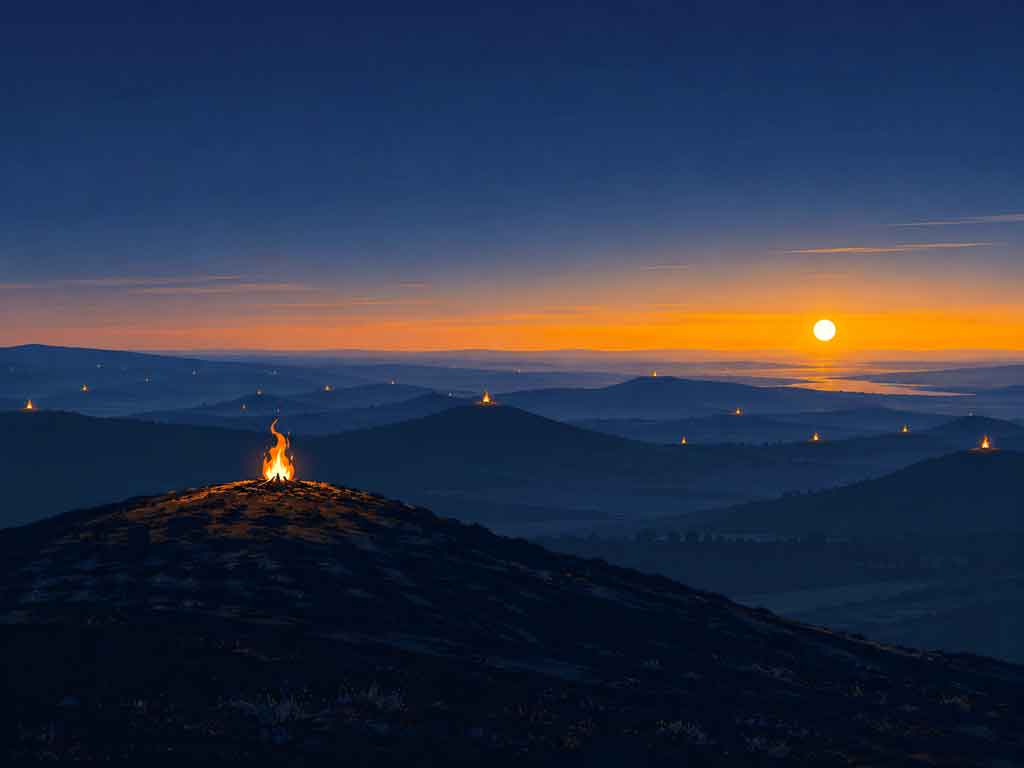
In Cornwall the bonfire tradition was revived in the 1920s and 1930s by the Old Cornwall Societies, who organised a chain of beacon fires running from Land's End to the Tamar on Midsummer Eve. The Cornish Guardian of 1930 described the scenes in vivid detail: fire after fire kindled in signal sequence across the hilltops, with Kit Hill, Hensbarrow, Pendennis, Carn Brea and dozens of others visible to one another across the night sky. The fires were lit with Cornish miner's flint and steel, and the crowds, sometimes numbering in the thousands, cheered as each new beacon appeared on the horizon. The local Cornish name for Midsummer, as noted by the old antiquary Borlas, was Goluan, meaning both light and rejoicing.
The Shetland fire festivals, reported in the Dundee Courier, preserved yet another layer: the bonfires of Midsummer and Hallowmass were lit "in circular places, enclosed with standing stones, supposed to have been sites of temples to the god Thor," and the young people leapt through the flames in the early mornings, while another custom was to throw bones into the fire at the moment of its greatest heat. Frazer's Golden Bough, cited by several of the newspaper sources, argued that the explanation for all these European fire festivals was that "they are sun charms, or magical ceremonies", that by imitating and honouring the sun's fire, the people were believed to help it on its celestial course, ensuring good weather, plentiful crops, and healthy livestock.
England's Great Loss: How the Bonfires Went Out
In England, unlike Ireland, Wales, Cornwall or Brittany, the Midsummer fires gradually dwindled and died. The Graphic of 1904 observed laconically: "The Beltaine fires themselves are quite extinct." The pagan custom had survived for some centuries by the device of calling the fires St. John's Fires, "but they survived chiefly in Wales and Cornwall, and when Wesley made those Celtic countries his own, that which might have been overlooked as merely pagan became anathema as presumably Popish."
The Worthing Herald of 1935 noted that the midsummer bonfire at Whalton in Northumberland was "now no more than a tradition kept alive by the elders", a vestige rather than a living custom. The bonfire at the Eton boys' school was mentioned by several sources as a late survival, but even that was extinct by the mid-nineteenth century. Mrs. White in 1860 concluded bleakly: "unless it be in the wild districts of that stronghold of Druidism, Cornwall, we believe no relics of the antique Baal fires remain in England at the present time."
Why did England lose its Midsummer fires when Ireland kept them? The question is almost never asked directly, yet the answer is hiding in plain sight. England did not lose its great bonfire night, it simply moved it. When Guy Fawkes and his fellow conspirators attempted to blow up Parliament on the night of November 5th, 1605, the explosion that never happened was commemorated with exactly the same apparatus as the old Midsummer festival: bonfires lit on high points, effigies burned, flames leaped over, crowds dancing in the dark. The November 5th bonfire absorbed the energy, the customs, and the communal fire-magic of the old Midsummer night, and gave it a new Protestant, patriotic meaning. The wheel of the sun became the wheel of the Guy; the sacred fire became the political fire; but the instinct, to gather around a great blaze in the dark, to feel the heat, to shout and dance, remained exactly the same.
Ireland never had a Guy Fawkes. Its bonfire night stayed in June, where it had always been, gathering the same symbolic weight that the English had transferred to November. To this day, Midsummer Eve bonfires burn across Ireland on the night of June 23rd, exactly as they burned when the druids walked the hills, and when the early Christian priests nervously blessed what they could not suppress.
The Suffolk correspondent of 1954, writing with quiet perceptiveness, noted: "And what would be more natural for the Christian fathers, realising that they could not stamp out such a custom, to adapt it for making it a counter attraction for their converts? Of course they could not tell their followers the underlying notion, and it was surely a brain wave to link up the 'man sent from God,' who 'was not that Light, but was sent to bear witness of that Light,' 'a burning and a shining light' as described in St. John's Gospel, with the midsummer occasion."
The Magic Plants of Midsummer
No account of Midsummer Eve is complete without its botanical dimension. The night was dense with plant magic, and certain herbs gathered at the precise moment of the solstice were believed to possess powers unavailable at any other time of year.
Fern seed was the supreme prize. Ferns do not flower and therefore appear to produce no seed, their reproduction being invisible to the naked eye, which led to the belief that their seed existed but was magically concealed from all but the most determined searchers. To possess fern seed was to possess invisibility. Shakespeare's Falstaff alludes to it directly: "We have the receipt of fern-seed, we walk invisible." To gather it, one had to go alone at midnight on Midsummer Eve to where the ferns grew in rocky moorland or by a ghost-haunted crossroad, hold a plate beneath the fronds without touching the plant, and wait for the stroke of midnight, when the fern would burst into momentary bloom and shed its "fiery gold" seed. The Evening News of 1925 recorded a seventeenth-century account by the antiquary Aubrey of a credulous villager who attempted exactly this: "The spirits whisked by his ears like bullets and sometimes struck his hat and other parts of his body." He collected a large quantity of seed, wrapped it in paper and placed it in a box, but when he reached home the paper was empty. Another method, reported in the Westminster Gazette of 1910, was to shoot at the sun at noon on Midsummer Day: three drops of blood would fall to the ground, and these, carefully preserved, would transform into the seed.
St. John's Wort (Hypericum perforatum) was known in Pliny's time as "sun of the earth" and Fuga Daemonium, the Devil's Fugue, for its supposed power to banish demons and witchcraft. Gathered on Midsummer Eve, it was hung in windows and above doors across England, France, Germany, Italy and Wales as a charm against storms, evil spirits, and all unholy influences. The East Suffolk Gazette of 1914 described how "girls used to gather sprigs of this plant to hang up in their rooms on Midsummer Eve." The Hartlepool Northern Daily Mail of 1922 noted that in parts of England the plant was called "Midsummer Man," and girls would lay it on stones for the night, then examine it in the morning: if the stalk inclined to the right, the lover was true; to the left, faithless. The Louth and North Lincolnshire Advertiser described the same divination with the stalk set in clay. The Westminster Gazette quoted Mrs. Hemans's verse:
Trefoil, vervain, John's wort, dill, Hinder witches of their will.
Orpine (Sedum telephium), also known as "Livelong" or "Midsummer Men," was another plant of the season, placed in pots and shells on Midsummer Eve. In 1801, a gold ring was found at Cawood in Yorkshire bearing the device of two Orpine plants joined by a true love knot, with the motto "Ma fiance veit" ("My sweetheart wills") and the legend "Joye l'amour feu." The ring was of fifteenth-century date. The Worthing Herald described how the orpine test of love exactly parallelled the St. John's Wort test: if the plant bent towards the right, the lover was faithful; to the left, faithless.
The rose gathered in silence on Midsummer Eve and kept wrapped in paper, never looked upon until Christmas Day, would, if the lover was true, be found as fresh as when picked. The Blandford Weekly News gave a full poetic account of this charm. Vervain was the "sacred herb" of the ancient world. Rue was the "sour herb of penitence and grace." Hemp seed could be sown at midnight while singing:
Hemp seed I sow, Hemp seed I hoe, He that's my true love Come after me and mow.
If the girl then looked over her left shoulder, she would catch a glimpse of her future husband, and then he would vanish.
The Church Porch Watch
Perhaps the most eerie of all Midsummer customs was the solitary church porch watch. It was believed across England that if a person sat up fasting and alone in the church porch throughout the night of Midsummer Eve, neither sleeping nor eating, the spirits of all those who would die in the parish during the coming year would come to the church door in the order in which they were to die, knock, and pass inside.
The Coventry Standard of 1855, the Halifax Evening Courier of 1935, the Louth and North Lincolnshire Advertiser of 1942 and 1943, and the Hampshire Advertiser of 1932 all recorded this custom. The Halifax Evening Courier added a dry observation: "No doubt, in those days of superstition, people who were valiantly trying to keep awake on an empty stomach could easily credit seeing many things."
The terrible danger of the custom was that the watcher's own spirit might be counted among those that appeared. The La Belle Assemblée account of 1860 told of a watcher who fell asleep, "so soundly that he could not be awakened", while his spirit in the interim joined the procession and asked admission within the church. The Irish tradition, related in the same account, held that on Midsummer's Eve "the souls of all people leave their bodies and wander to the place - be it on land or sea - where their souls will finally pass from their bodies." To sleep on Midsummer's Eve was therefore to take a brief journey towards one's own death.
Giants, Dragons and the Procession of Midsummer
In medieval England, Midsummer was also the season of the great civic processions, with their fantastic pageantry of giants, dragons, and burning cressets.
The Worthing Herald's 1935 article by A. L. Horwood described the custom at Burford in Oxfordshire, where an image of a dragon was made every year and carried up and down the town with "great jubilation on Mid-summer Eve", the tradition commemorating Cuthbert's victory over Ethelbald at the Battle of Burford in 750 AD, when he won a shield bearing a golden dragon. Giants paraded at Chester in 1599, and at the Mid-summer pageants in London in 1589 "great and ugly giants 'marching as if they were alive' were paraded in the streets." The mythical giants Gog and Magog were exhibited in the Old Guildhall in 1706.
Stowe's Survey of London, quoted by both Mrs. White and the Chester Chronicle of 1813, described the streets of London on Midsummer Eve: "every man's door being shadowed with green birch, long fennel, St. John's wort, orpin, white lilies, and such like, garnished upon with garlands of beautiful flowers, had also lamps of glass, with oil burning in them all the night: some hung out branches of iron, curiously wrought, containing hundreds of lamps lighted at once." The marching watch, thousands of armed men with cressets blazing and swordsmen on horse and afoot, processed through the flower-hung streets until daybreak. Henry VIII himself, curious, disguised himself as one of his own guard to mingle with the spectators in Cheapside and watch the watch go by. The custom survived in Nottingham into the reign of Charles I.
Love Divination: The Midsummer Marriage Market
If Midsummer's Eve was terrifying for those who might see their own death, it was enchanting for the young who hoped to see their future love.
The options available to an unmarried woman on Midsummer's Eve were remarkable in their variety. She might go backwards into the garden at midnight, pluck a rose, and keep it wrapped until New Year's Day, at which point, if her lover was true, she would find it as fresh as when picked. She might sow hemp seed by moonlight. She might lay St. John's Wort on a stone and read her fortune from its inclination in the morning. She might, according to the Hartlepool Northern Daily Mail, fast and then set a meal for two at midnight, leaving the street door open, and her future husband would come in, sit down, drink to her, and vanish.
The La Belle Assemblée described Spanish customs of surpassing prettiness: maidens dressing a milk-white sheep with flowers full of dew and dancing before it on a hilltop. If the sheep stood still (keeping the dew on the flowers), it was a happy omen and they returned sure of the good saint's blessing and the fidelity of their lovers. In Devon and Cornwall, girls placed their shoes in the form of a T before going to bed and recited:
I place my shoes like a letter T, In hopes my true love I shall see In his apparel and his array As he is now and every day.
The Aberdeen Press and Journal of 1928 described how young girls in England met in privacy on Midsummer's Eve to dry their smocks before a fire in silence. "If silence reigned, the mysterious shadow of a future spouse would appear to turn the pot. Those who were destined not to enter happy wedlock found their smocks neglected and 'heard a bell afar off.'"
Stonehenge and the Modern Imagination: A Crowd Grows Across the Centuries
The modern gathering at Stonehenge for the summer solstice sunrise is often presented as an ancient custom or a Druidical survival. It is neither. It is a Victorian invention, and a surprisingly recent one.
The earliest detailed newspaper account of visitors gathering at Stonehenge specifically for the solstice sunrise appears in the Sheffield Daily Telegraph of July 1874, which reported a party of Americans who arrived to find, to their surprise, that a gathering of local people, "principally belonging to the poorer classes", had preceded them, drawn by a tradition "that had trickled down through any number of generations" that "at Stonehenge something unusual was to be seen at sunrise on the morning of this summer solstice." The elderly gentleman among the party confirmed that at the winter solstice, a corresponding phenomenon was visible in the direction of certain other stones to the westward. The correspondent drew the connection to Baalistic sun worship, and the precision of Stonehenge's orientation struck him as irrefutable evidence of intent.
By 1883 the gathering had grown. The Salisbury Times reported that "about 200 waiting excursionists were assembled at Stonehenge" from Salisbury, Wilton, Devizes, Marlborough, Chippenham, Warminster, and Melksham, the sky, as usual, became clouded at the critical moment. In 1884 the Devizes and Wilts Advertiser reported five hundred visitors, again disappointed by cloud, though those who stayed the following morning saw the sun rise "almost directly over the 'heel' stone in front of the entrance avenue." In 1913 the Bath Tramways Company was running three charabancs to the site. By 1910 the Westminster Gazette counted "two thousand pilgrims to the ancient temple of the Druids at Stonehenge," many of them having come from London by motor car.
The Druid presence at Stonehenge was equally a modern construction. The Salisbury Times of 1919 described the "Pilgrims of the Universal Bond", a Druidical order led by Chief Druid Dr. McGregor Reid, encamping at Spring Bottom and processing to the stones for their solstice ceremony, depositing the ashes of their late "Dastur Abu" upon the altar stone. By 1924 the gathering was large enough that one lady who "claimed to belong to the Ancient Order of Druids rebuked the crowd for merrymaking." The paper reported with dry amusement that the sunrise on this occasion was "one of the best sunrises seen for a large number of years."
What had changed between 1874 and 1924 was Lockyer's Dawn of Astronomy, published in 1894, which gave the Stonehenge solstice alignment scientific and intellectual respectability. The site was no longer merely a curiosity or a picnic destination: it was evidence of a sophisticated prehistoric solar religion, a British Karnak, whose orientation had been calculated thousands of years before the Romans came. The Illustrated London News of 1894 reviewed Lockyer's book with enthusiasm, reproducing his drawings of the Egyptian colossi "oriented to the sunrise at the winter solstice" alongside plans of Stonehenge. The popular imagination, fired by this combination of ancient mystery and astronomical precision, grew year on year.
"It Was the Best and Longest Light": St. John and the Sun
Several newspaper accounts from across the decades tried to explain theologically why St. John the Baptist was placed at the summer solstice. The most widely repeated explanation, found in the Northampton Mercury of 1813, the Louth and North Lincolnshire Advertiser of 1942 and 1943, the Blackburn Times of 1933, and elsewhere, drew on John's own words in the Gospel: "He must increase and I must decrease." At the December solstice, about the Nativity of Christ, the days begin to increase in length; at the June solstice, they begin to decrease. Christ increases, John decreases. The astronomical calendar and the theological calendar mirror each other perfectly.
The Penistone, Stocksbridge and Hoyland Express of 1932 made the further observation, confirmed by the Harrogate Advertiser of the same year and the Blandford Weekly News of 1889, that St. John the Baptist is "the only saint whose birthday, or Nativity as the Prayer Book styles it, is celebrated by the Church; in the case of all the others the commemoration is that of their death." This uniqueness was deliberate: the Baptist was consecrated "from the very womb," as Scripture had it, and the celebration of his birth rather than his martyrdom was calculated to align with a pagan festival that had always celebrated new life and the height of summer. It was observed as early as the fourth century, and by the sixth century was classed with Easter, Christmas, Epiphany, Ascension Day, and Whitsuntide as one of the days upon which no man was to "forsake his own church."
The Midsummer Fires of Ireland
While England's Midsummer fires were smothered by Puritanism and eventually displaced by November bonfires, Ireland's survived with remarkable tenacity, and in some cases are still lit today.
Mrs. White in 1860 gave one of the most vivid accounts of Irish Midsummer: "one of our most vivid recollections, as a child, is of the serene and gorgeous sunsets that were almost certain to ensue in Cork Harbour on this anniversary, sunsets that seemed to linger longer on this than on any other evening." And then: "from every hill and eminence rose up the flames of the Midsummer fires, that, from the days of Druidical superstition, have annually shone on these high places, illuminating all the harbour round, and springing up with a simultaneous radiance as the first star shone out."
The Irish custom of gathering materials for the bonfire many months in advance, seeking always a horse's head for the centre of the conflagration, and drinking and dancing round the flames till morning was noted by the Survey of the South of Ireland, which remarked that in doing so, the Irish "annually renew the sacrifice that used to be offered to Apollo, a confirmation of old Scaliger's assertion: 'En Ireland ils sont quasi tous papistes, mais c'est Papaute mêlée de Paganisme'" (they are virtually all Catholics, but it is a Catholicism mixed with paganism). Each family snatched up a brand at the end to carry home as a charm against fairies and evil spirits, which was then suspended above the cottage door or placed near the bed.
The question of why Ireland kept its bonfire night in June while England moved it to November is partly religious (Ireland was never Puritan), partly political (Ireland had no Guy Fawkes moment to absorb the custom), and partly cultural: the Irish simply never stopped. The great chain of summer fires running from hill to hill across Cork Harbour on Midsummer's Eve is, in that sense, one of the oldest unbroken traditions in Europe.
"What Hath This Day Deserved?": The Midsummer's Eve We Lost
In his comedy King John, Shakespeare put into the mouth of Philip Faulconbridge a question about the feast of St. John that has not lost its resonance: "What hath this day deserved? what hath it done, that it in golden letters should be set amongst the high tides in the calendar?"
Mrs. White, who chose the line as her epigraph in 1860, was asking a genuinely mournful question about a festival already fading from English life. The bonfires were going out, the watching in the church porch was becoming a ghost story rather than a lived experience, the fern seed was no longer seriously sought. Yet she noted, with the eye of a good observer, that the "spirit" of a custom outlives its "form", that somewhere in the instinct to gather, to light a fire, to stay out all night at the height of summer, something very old persists.
The Sphere of 1958, in a long and thoughtful essay by Brian Vesey-Fitzgerald, made the same point from the perspective of natural history. The midsummer bonfire at Whalton in Northumberland, he wrote, "still has about it an air of spontaneity, something of the atmosphere of a festival, with youths and girls dancing round the fire until the flames die down." The Summer Solstice itself, June 20th or 21st, remains "the zenith of the year and the true midsummer," and the countryside communicates it without assistance from any calendar: in the silencing of the nightingale, the peak and turn of the Dawn Chorus, the sainfoin in flower, the reeds of the river beds at last fully green.
Conclusion: Why It Still Matters
The folklore of the Midsummer Solstice is not the preserve of eccentrics in white robes or enthusiasts photographing sunrises over ancient stones. It is the accumulated wisdom, and accumulated wonder, of every human generation that has ever watched the sun reach its highest point, felt the heat of a June night, and understood that something remarkable was happening in the sky.
From the priests of Amen-Rā calculating the beam of light in the sanctuary of Karnak, to the builders of Stonehenge positioning the Friar's Heel to catch the solstice sunrise, to the Celtic peoples rolling burning wheels down hillsides into rivers, to the medieval Londoners hanging their doors with birch and fennel and setting their lamps of glass burning all night long, to the women of Shetland gathering their Johnsmas flowers, to the two thousand pilgrims assembling in the Wiltshire dawn, the thread is unbroken, even when it is forgotten.
Ireland remembered to light its fires. England, for three hundred and fifty years, has been burning its effigies in November and wondering, on summer solstice mornings, why the hill feels so charged, why the light seems different, why it seems important to be outside. Perhaps, with this history in hand, the instinct makes a little more sense.
The sun is at its highest. The year turns. Light your fire.
Sources: Historical newspapers including the London Packet and New Lloyd's Evening Post (1801), Northampton Mercury (1813), Chester Chronicle (1813), Blandford Weekly News (1889), Southern Reporter (1897), Gentlewoman (1900), Daily News London (1906), Sheffield Daily Telegraph (1874), Salisbury Times (1883, 1919, 1924), Devizes and Wilts Advertiser (1884), Illustrated London News (1894), La Belle Assemblée (1860), Newcastle Chronicle (1886), Cornish Guardian (1930), Worthing Herald (1935), Halifax Evening Courier (1935), Aberdeen Press and Journal (1928), Penistone Stocksbridge and Hoyland Express (1932), Harrogate Advertiser (1932), Blackburn Times (1933), Shetland Times (1933, 1937), Westminster Gazette (1910), The Sphere (1958), Suffolk Chronicle (1954, 1965), East Suffolk Gazette (1914), Hartlepool Northern Daily Mail (1922), Hampshire Advertiser (1932), Dundee Courier (1927), Clifton Society (1913), Louth and North Lincolnshire Advertiser (1942, 1943, 1948), South London Observer (1911), Cromer & North Norfolk Post (1907), Forres Elgin and Nairn Gazette (1932), Evening News London (1925), South Shropshire Journal (1992). Books: J. Norman Lockyer, The Dawn of Astronomy (1894); Anatole Le Braz, The Land of Pardons; The Church Seasons Historically and Poetically Illustrated.