
From devil's bird to bringer of joy, from the Norse god Odin's messengers to the Paiute Ghost Dance, from a magpie that disrupted a Scottish church service to one that stole a 10-franc piece in Holland - the magpie's place in legend, superstition and folk belief across the centuries
Few birds have captured the human imagination quite so persistently as the magpie. Bold, beautiful and undeniably brazen, this black-and-white member of the crow family has accumulated a weight of folklore almost unmatched in the natural world. Across centuries and continents, the magpie has been feared as a servant of Satan, revered as a bringer of good fortune, blamed for storms, credited with bridging the Milky Way, identified with the daughters of King Pierus, sacred to Bacchus, and even venerated in the medicine shirts of the Paiute Ghost Dance. Whether you instinctively salute one when you see it, or simply feel a vague unease at a solitary bird on a fence post, you are participating in a tradition of belief that stretches back thousands of years.
The Bird Itself: Why the Magpie Demands Attention
Before turning to the mythology, it is worth asking why the magpie provoked such a strong response in the first place. Writing in the Leicester Mercury in 1977, naturalist David Gunston described the magpie as the most conspicuous and showy bird in Europe - its iridescent purple-and-green plumage making it "extremely striking wherever it appears." Its harsh rattling cry is unmistakeable, its gait on the ground oddly sideways, and its intelligence both impressive and unsettling. Country Life magazine, in 1929, captured the paradox neatly: the magpie is "a fine fellow in his suit of bottle green black and rather doubtful white," yet simultaneously a ferocious thief with an impish intelligence who would steal artificial dentures and be genuinely unable to tell you what it had done with them.
What's in a Name? The Magpie's Etymology
The magpie's name has a richly tangled etymology. Writing in Country Life in 1905, Maud Sargent noted that explanations range from a corruption of the French magot (a secret hoard, reflecting the bird's love of hiding things) to a simple contraction of the name Margaret - just as we have Robin Redbreast and Jenny Wren. The older English names were "magotpie," "magata-pie" and "maggot-pye," all recorded well into the eighteenth century. In Lancashire the bird was traditionally called the "pynot," in Scotland the "piett."
The Italian name for the magpie - gazza - has a particularly interesting modern legacy. As Angelo De Gubernatis observed in his monumental Zoological Mythology of 1872, the word gazza gave rise to gazzetta, the term still used today for newspapers, on the grounds that newspapers, like magpies, divulge secrets and chatter incessantly about everyone's business. Every time we read a "gazette," we are tipping our hat - quite unintentionally - to the magpie's reputation for indiscretion.
The Devil's Bird: Christian Mythology and the Ark
The most widespread origin story for the magpie's ill reputation places it squarely in the biblical tradition. According to a belief recorded across England and Scandinavia, the magpie was the only bird that refused to enter Noah's Ark. While every other creature took shelter from the Flood, the magpie preferred to perch on the roof and chatter over the drowning world - an act of gleeful indifference that earned it a permanent curse.
A servant maid interviewed in the nineteenth century gave her version with admirable directness: it was "the only bird which did not go into the ark with Noah; it liked better to sit outside, jabbering over the drowned world." A Durham lad offered an even stranger variant, recorded in the Newcastle Courant of 1882, suggesting that the magpie was a hybrid between the raven and the dove and therefore - uniquely among creatures - had never been baptised in the waters of the Deluge.
The American naturalist Ernest Ingersoll, writing in Birds in Legend, Fable and Folklore, recorded the variant most commonly given for why the bird was banned from the Ark: the magpie was simply too garrulous - it was "not permitted to enter the ark, but was compelled to perch on the roof because it gabbled so incessantly." Whichever version is preferred, the outsider status is the same.
This outsider status translated directly into diabolical associations. In Scotland the magpie was known as "the devil's bird," and was widely believed to carry a drop of the devil's own blood beneath its tongue. Ingersoll observed that under the influence of Christian teaching, the Norse god Odin gradually became identified throughout northern Europe with Satan, and consequently the raven and all the corvids became "devil's birds" in the folklore of the North. The magpie's chattering, he noted, was held ominous of evil and required "various rustic charms to counteract its harm."
The St James's Gazette reported in 1887 that in Germany witches frequently transformed themselves into magpies, or used them as their steeds, while in Oldenburg a cross cut into a magpie's nesting tree was sufficient to drive it away - the logic being that no creature so imbued with Satanic principles could endure such a symbol. De Gubernatis recorded the corresponding German belief that the magpie must be killed during the twelve days between Christmas and Epiphany - precisely the period when the days begin to lengthen again, and the powers of darkness (with which the magpie was identified) are in retreat.
One for Sorrow: The Counting Rhymes and Their Variations
Nothing demonstrates the magpie's grip on folk imagination more powerfully than the sheer number of counting rhymes that have accumulated around it. The principle is simple: the number of magpies seen together determines your fate. But the specifics vary considerably from region to region and decade to decade, and collecting these variations reveals a detailed picture of a living, evolving oral tradition.
The version most people recognise today runs roughly:
One for sorrow, two for mirth, Three for a wedding, four for a birth, Five for silver, six for gold, Seven for a secret never to be told.
That culminating seven is no accident; the number carries its own deep well of numerological superstition quite apart from the magpie. But the rhyme itself is only one strand of a much more tangled skein. A Dundee Evening Telegraph piece from 1901 noted that in the year 1730 the rhyme ended with "four for a death" rather than a birth - a considerably more alarming outcome. The Dumfries and Galloway Courier of 1892 recorded two competing versions side by side: one ending "four's a death," the other "four's a birth."
The Scottish versions tend to be longer and darker. The Queen magazine in 1868 published what it called the old Scottish rhyme:
One's sorrow, two's mirth, Three's a wedding, four's a birth, Five's Heaven, six is Hell, Seven's the Devil's ain sell.
Another Scottish version extended further still, with "five's a christening, six a dearth," while yet another variant, recorded in the Newcastle Courant, offered a cheerful coda to the extended version: "Five a sickening, six a christening, seven a dance, eight a lady going to France."
The Echo of London in 1896 reported a rhyme collected in Scotland by the Rev. Walter Gregor as part of the Ethnographical Survey of the United Kingdom:
Yane's sorrow, Twa's mirth, Three's a beerial, Four's a birth, Five's a ship in distress at sea, Six is a love letter comin' t' me.
Ireland had its own variant. The Country Life piece of 1905 recorded that in the south of Ireland the rhyme ran: "One for sorrow, two for joy, three for a wedding, and four for a boy" - reflecting, as the author drily observed, the Irish peasant's almost Oriental preference for male offspring. Meanwhile the Toronto Saturday Night of 1892 noted the Irish belief that it was particularly unlucky to meet an odd number of magpies, preserving the rhyme: "One comes for sorrow, two for mirth, three for a buryin', and four for a birth."
By 1969, the Burton Observer was publishing an extended version reaching all the way to ten: "One for sorrow, two for mirth, three for a wedding, four for a birth, five for silver, six for gold, seven for a secret not to be told, eight for heaven, nine for hell, ten for the Devil himself." A Scottish version recorded by the naturalist James O'Hagan in The Scotsman in 1989 had the more compact ending: "Five for Heaven, six for Hell, Seven for the De'il's ane sel'."
Ernest Ingersoll, observing this rural British tradition from across the Atlantic, noted that although magpies were common in the American West, "nobody is superstitious about them there" - the lore was a strictly Old World inheritance that had not transferred. He did note, however, that even in parts of New England it was considered unlucky to see two crows flying together toward the left - describing this as "a plain borrowing from the magpie-lore of Old England." The settlers had transplanted the belief but lacked the original bird, so they grafted it onto the nearest available corvid.
Saluting, Spitting and Crossing Yourself: Warding Off the Bad Luck
Simply reciting the rhyme was not always considered sufficient protection. A remarkable variety of physical rituals developed to avert the ill omen of a single magpie, and the geographic variation in these customs is itself a kind of folklore map of Britain.
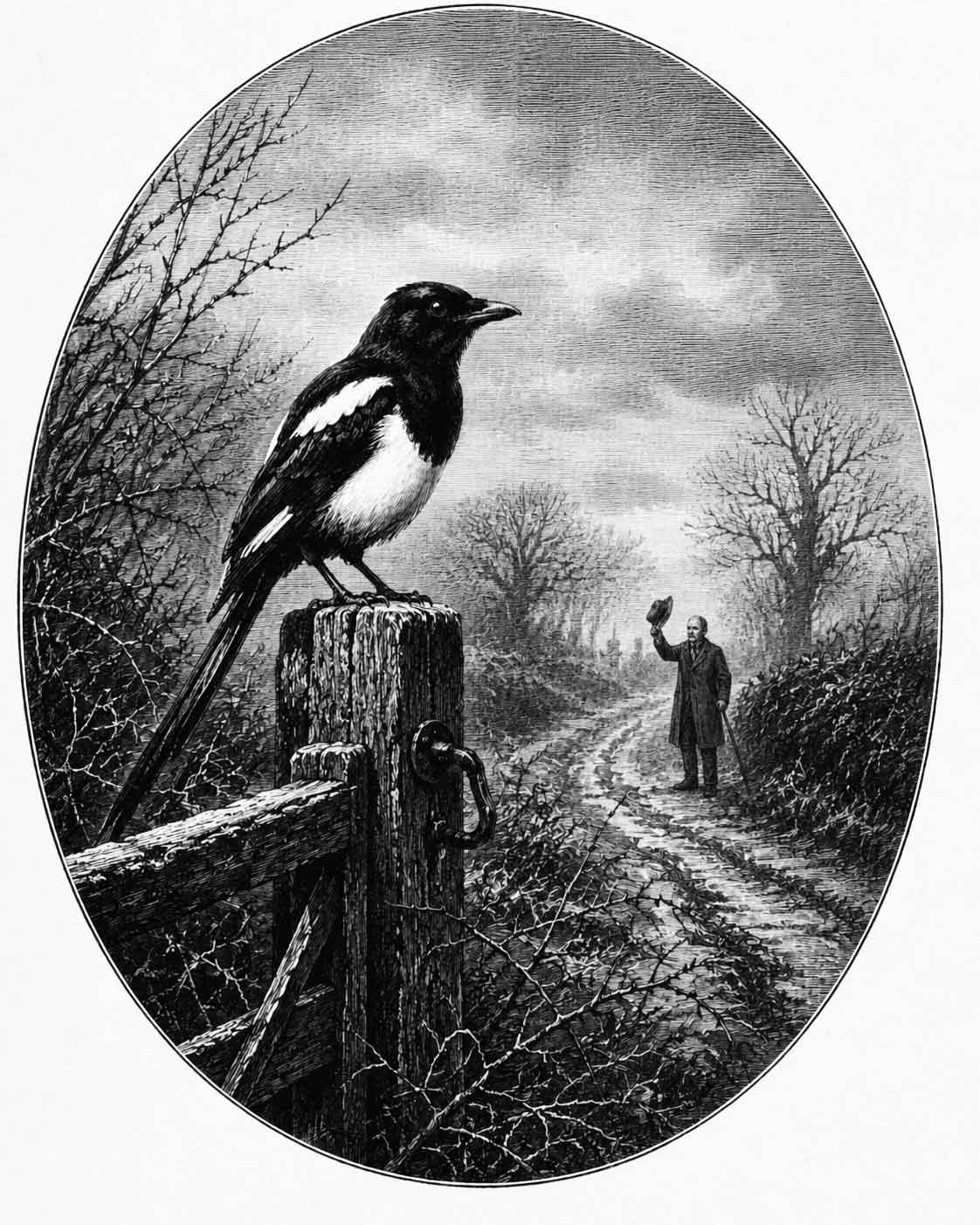
A correspondent to the Reading Mercury in 1866 described watching a country fellow near Berkshire suddenly pull off his hat and make a sort of bow to something invisible - only to be told that a magpie had just crossed the road, and that it was general practice in that area to doff the hat to the bird "for luck."
The Newcastle Courant recorded that one lady would make a cross in the air whenever she encountered a magpie, while a gentleman of her acquaintance lifted his hat. A Yorkshire lady preserved her family's charm in verse: "I cross the magpie, the magpie crosses me: bad luck to the magpie, and good luck to me."
The Mid Sussex Times of 2003 collected a range of regional customs still remembered at the turn of the millennium: in Sussex, bowing and saying "good morning Joe"; in Yorkshire, crossing your thumbs to avert evil; in Devon, spitting at it. Anywhere, you could make the sign of the cross in the air, or cross your feet.
In Ireland, according to the Country Life piece of 1905, country folk would curtsey or make the sign of the Cross, while the men would take off their hats or exclaim: "One, two, three, four, five, six, seven, eight, nine, ten - Devil, I defy thee!" It was considered particularly unlucky to meet a single magpie before breakfast when setting out on a journey, and if one came to the house door it brought a warning of death. The Dundee Evening Telegraph account of 1901 noted that in Berkshire the act of turning around three times was required to break the spell, supplemented by spitting on the ground.
The Magpie as Weather Prophet and Angling Omen
Not all magpie superstition was purely about fate and fortune. Several traditions connected the bird's behaviour to the weather, and specifically to the prospects of anglers.
The explanation - which appears in multiple sources from the 1860s onwards - is surprisingly rational. Sir Humphry Davy's Salmonia (as quoted in both the Newcastle Courant and the Queen magazine) explained it thus: in cold and stormy weather, one magpie leaves the nest in search of food while the other stays to sit on the eggs. When the weather is mild and warm, both birds venture out together. Therefore a single magpie in spring signals bad weather; a pair signals fine conditions - and, crucially, good fishing.
The North British Advertiser of 1887 quoted Chambers' Popular Rhymes of Scotland as providing this same explanation, noting that it "nearly always" turns out there is some practical reason for a proverb. The proverb itself ran: "A single magpie in spring, foul weather will bring." Curiously, the Newcastle Chronicle of 1899 noted that this superstition appeared to be reversed at Kelso, according to "The Lay of the Last Angler" by the Hon. and Rev. R. Liddell - suggesting that even within the rational explanations, regional variation persisted.
Good Omens: The Other Side of the Story
It would be misleading to present the magpie purely as a bird of ill omen. In many cultures and regions, it was regarded with great affection and even reverence.
In Scandinavia, as the Leicester Mercury noted, magpies were seen as bringers of good fortune, especially if a pair nested near a farmhouse. In France, magpies were admired for their tameness and were almost uniquely left unpersecuted among larger wild birds. In Germany, the magpie's chattering was interpreted not as an evil sign but as a natural warning system announcing the arrival of strangers - "the magpie chatters: we shall have visitors."
The St James's Gazette noted that throughout Norway magpies were considered harbingers of good luck, in direct contrast to their English reputation. In Shropshire too, they were viewed more favourably than elsewhere in England.
In China, the magpie held an especially honoured place. The Mid Sussex Times reported that magpies were a favourite bird of the Manchu dynasty and the emblem of happiness, with a magpie nesting near the house considered a powerful good omen. In Oriental folklore, hearing one call before you set out on a journey was lucky.
The Magpie in Ancient Mythology: Ovid, the Pierides, and the Muses
The association between magpies and garrulous women has a distinguished classical pedigree. Ovid in his Metamorphoses described how certain gossiping women were transformed into magpies as punishment for their impertinence - their tongues, as the poet put it, continuing in their endless chatter even after the transformation. Country Life in 1905 quoted the lines: "And still their tongues went on, though changed to birds, / In endless clack and vast desire of words."
The same mythological principle appears in the story of the daughters of Pierus, recounted in the Dundee Evening Telegraph of 1894 and given particular attention by De Gubernatis. Pierus, a neighbouring king to the realm of the Muses, had nine daughters - sometimes called the daughters of Euippes - who considered themselves fine singers and challenged the nine Muses to a contest on Mount Helicon. When the mortal music was compared to the divine, the heavens themselves reacted: clouds gathered, rivers paused, the very mountain swelled with pride. After the celestial Nine performed, the sun broke through the clouds and the stars stood still. The nine presumptuous daughters were duly punished for their ambition by being transformed into magpies.
De Gubernatis noted that this myth was sufficiently powerful to be invoked by Dante, who, calling on Calliope, wished to continue his song "with that sound of which the wretched Pies felt the blow, such that they despaired of pardon." The Pierides - the bird-women created by punishment for daring to rival the Muses - became a recurring image of artistic presumption.
The classical magpie was not only proverbial as a singer but as an imitator. In Theocritus the magpie defies the nightingale in singing; in Galenus it is proverbially emulous of the Sirens. The ancient Greeks also believed, according to the Toronto Saturday Night, that the magpie possessed the soul of a gossiping woman - the same Ovidian transformation made permanent by folk belief.
Sacred to Bacchus: The Roman Magpie
One of the more unexpected classical associations preserved by De Gubernatis is the identification of the magpie with the wine-god Bacchus. The Greeks and Latins held the magpie sacred to Bacchus, De Gubernatis explained, because the bird was held to be in connection with the ambrosial drink - and because, as drunkards are garrulous, so the magpie was famous for its garrulity. The chattering of the bird was understood as a kind of perpetual drunken speech, fitting it naturally for the god of wine and intoxication.
This identification underlies a charming detail recorded by the Mid Sussex Times in 2003: "Originally sacred to Bacchus, the god of wine, magpies became associated with drunkenness (the party reference stands) and even Noah sent it out of the Ark for stealing and talking too much." The two great traditions - classical Bacchic devotion and biblical disgrace - meet at exactly this point: the magpie as the bird that won't stop talking, won't stop drinking, won't sit quietly.
The Roman writer Petronius preserved a different but related image: in his Satyricon, the entry to a rich man's house featured a golden cage above the lintel containing a magpie, trained to greet visitors as they entered. This bird-as-doorman tradition is, as we shall see, deeply embedded in magpie lore.
Magpies in Roman Augury: The Magician's Tongue
The Romans took bird-prophecy with extreme seriousness, and the magpie held its place in their elaborate system of augury. The poet Charles Churchill caught the spirit of it in lines quoted by Ingersoll:
Among the Romans not a bird Without a prophecy was heard. Fortunes of empire often hung On the magician magpie's tongue, And every crow was to the state A sure interpreter of fate.
De Gubernatis traced the magpie's enduring association with the supernatural to precisely this - the bird's documented role in Roman divinatory practice. He suggested that the survival of folk traditions of counting magpies and reading their movements as omens preserved, in fragmented and debased form, what had once been a systematic divinatory science.
The Magpie at the Crucifixion
Several European legends attempted to explain the magpie's dual colouring - black and white - through Christian narrative. The Devizes and Wiltshire Gazette of 1883 recorded a French tradition in which the swallow and the magpie were both present at the Crucifixion. The robin extracted the thorns with compassion; the magpie watched with heartless indifference. As punishment, the magpie was stripped of its beautiful voice and peacock-like tail, while the robin was rewarded with the permanent affection of mankind.
The Country Life 1905 article described an alternative tradition: at the Crucifixion, God condemned the magpie to make its nest on the topmost branches of trees, exposed to the elements and universally detested - while the compassionate swallow was blessed with safe nesting and universal love.
De Gubernatis, characteristically, read all of this through his solar-mythological lens: the black and white of the magpie's plumage represented its two mythological natures - the white the luminous, spring-like character, the black the wintry, infernal one. Within his framework, the bird could be both malignant fairy and benignant fairy simultaneously, and the same creature that brought a warning of death could also bring the balsam herb that healed and renewed.
The Bringer of the Balsam Herb: The Magpie in German Mythology
It is here that De Gubernatis introduces one of the more unexpected elements of magpie folklore: the bird as a bringer of healing magic. In a German legend recorded by the brothers Grimm, the magpie is the creature that brings the Springwurzel - the springwort or balsam herb, a magical plant believed to possess the power to open any lock and to spring forth healing wherever it touches, in the same tradition of miracle-working Germanic and Norse flora that produced the legends of mistletoe. De Gubernatis reads this tradition as the mythological counterpart to the bird's water-carrying role in Russian folklore: the same dark, ambiguous creature that brings storms also brings the herb of renewal.
In a tale from Afanassieff's great collection of Russian folk stories, two magpies are sent on errands of cosmic importance - one for the water of life, the other for the water of speech - in order to resuscitate two princes whom a witch has touched with the hand of death. De Gubernatis observed that these two messenger-magpies parallel almost exactly the two ravens of the Norse god Odin: Huginn (Thought) and Muninn (Memory), who each day flew out into the world and returned to whisper in their master's ears all the news they had gathered.
The magpie, in this Norse-Russian mythological complex, is fundamentally a messenger - a creature of the threshold between worlds, dispatched to gather knowledge or fetch the substances of life and death.
The Magpie Bridge: A Chinese Love Story
Perhaps the most beautiful piece of magpie mythology comes not from Europe but from China, where the bird plays a central role in one of the oldest love stories in the culture. The story, known as the tale of the Herdsman and the Weaver Girl, involves two stars - Aquila and Vega - separated by the Milky Way.
As retold in the Banffshire Herald of 1943 and the Coventry Evening Telegraph of 1961, the Weaver Girl was the industrious daughter of the Sun King, so devoted to her loom that her father worried she would never develop a joyful spirit. He arranged her marriage to a cowherd who herded cattle on the banks of the Silver Stream of Heaven. The marriage was happy, but the Weaver Girl became so content that she neglected her work entirely. The enraged Sun King - or in some versions the Queen of Heaven - separated the pair, placing each on opposite banks of the Milky Way with permission to meet only once a year, on the seventh night of the seventh month.
It is the magpies who make the reunion possible. On the appointed evening, myriads of magpies fly together and form a living bridge across the River of Stars, supporting the lovers on their wings and backs. Any magpie that fails to participate in this act of compassion will be stricken with disease. If it rains on that night, the bridge cannot form and the lovers weep - which is why the Chinese hope fervently for clear skies on the seventh day of the seventh month.
The Chinese tradition of the bird as a heaven-bridging messenger of love stands in remarkable contrast to its European reputation as a creature of storm and ill-omen - though both, in De Gubernatis's reading, derive from the same root association between the magpie and the watery, celestial sky.
The Witch's Steed: The Magpie in German and Brittany Folklore
If the Chinese embraced the magpie as an emblem of happiness, the Germans went in the opposite direction - making it perhaps the most thoroughly demonic bird in the European folk imagination. De Gubernatis was emphatic on this point: "In German mythology, the magpie is an infernal bird, into which witches often transform themselves, or which is ridden by them."
The Mid Sussex Times in 2003 elaborated: "In Germany folk thought witches rode on their backs; German magpies also warned wolves were approaching." This dual role - both witch's steed and wolf-warner - captures the magpie's characteristic ambiguity. The same bird that serves the dark powers can also alert their victims, depending on which side of its nature is uppermost on any given day.
Ingersoll added a charming detail from another European tradition: "In Brittany fairies assume the form of the magpie." In northern Europe the bird is tied to witches; in western France it belongs to the entire fairy world, a creature that might at any moment be a supernatural being in disguise.
The asymmetry between northern European fear and Mediterranean acceptance is striking. In Latin Europe the magpie remained Bacchic, garrulous, mischievous. In Germany, Scandinavia and Britain, the same bird became diabolic, witch-ridden, demonic. The same animal, the same cry, the same dancing flight - but read through entirely different cultural lenses.
The Magpie as Thief: The Mythological Interpretation
The magpie's notorious habit of stealing and hoarding bright objects is given a particularly elegant interpretation by De Gubernatis. The bird, he argued, steals gold and silver "not so much because it likes shining metals, as because it hates too great light." The magpie steals the sun. The glittering objects it carries off to its nest are, mythologically speaking, the rays of the sun and the golden ears of corn - and the bird hides them away during the rainy and wintry season because it is itself an embodiment of that dark, hoarding season.
Whatever one makes of the solar-mythological interpretation, the bird's reputation as a thief is universally attested. The Leicester Mercury of 1977 recounted a story in which thirty-five plastic clothes-pegs were discovered in a magpie's nest at a boarding school, having been blamed on the boys. Country Life in 1929 noted that a tame magpie in the house would steal not only spoons, scissors, jewellery and coins, but - catastrophically - artificial dentures, and was entirely unable to account for their whereabouts afterwards.
The Birmingham Daily Post of 1905 reviewed a book by R. Bosworth Smith which argued that magpies in their talking and imitating abilities surpassed even parrots and Indian mynahs - a claim the reviewer supported from personal experience of keeping all three species.
Interestingly, the Scotsman of 1989 offered a mild corrective to the theft mythology, noting that magpies are not actually as bad as jackdaws in their appetite for glittering objects - though their nests were often found decorated with silver foil bottle tops and pieces of glass.
The Fortune-Teller's Magpie: A Theft in Breda
One particularly delightful nineteenth-century report from the Newton and Earlestown Guardian of 31 May 1895 illustrates the magpie's thieving reputation operating in real life - with legal consequences. A magpie belonging to a fortune-teller at Breda in the Netherlands had been trained to pick out cards for divinations. One day, taking advantage of an open window, it flew across the street to a grocer's shop. At precisely that moment the grocer was giving change for a 100-franc note to a servant girl, and the magpie pounced upon a 10-franc piece and flew back to its home with the coin in its beak.
The two victims of the robbery promptly called upon the fortune-teller, but a search for the coin proved fruitless. The grocer then sued the fortune-teller for the value of the missing money; the servant in turn claimed it from the grocer. Neither party would accept the loss, nor would the fortune-teller permit her magpie to be killed to determine whether it had swallowed the coin or merely dropped it somewhere. The local commissary, baffled, advised the parties to sue each other in the County Court.
The story has the quality of a folk-tale rendered as legal proceedings - and recalls the most famous magpie-as-thief narrative of all, the one that formed the basis of Rossini's opera La Gazza Ladra (The Thieving Magpie), in which a young servant girl is wrongly condemned for thefts actually committed by the family magpie.
The Magpie at the Threshold: Heralding Visitors
One of the oldest and most persistent magpie traditions identifies the bird as a herald of arrivals. In Germany, as we have seen, the chattering magpie announced visitors: "the magpie chatters; we shall have visitors." De Gubernatis traced this belief through Russian folklore - "in Russia, it is believed that when a magpie comes to perch upon the threshold of a house, it announces the arrival of guests" - and back to classical Rome.
He quoted directly from Petronius's Satyricon the description of the entrance to Trimalchio's house: above the lintel, in a golden cage, hung a brightly-coloured magpie that greeted those who entered. The trained magpie as living doorman, as living greeter of guests - the same image that survived nearly two thousand years later in Russian folk belief.
Royal Magpies: A Palace of Pies
One of the more charming historical footnotes surrounding the magpie concerns the Palace at Sintra near Lisbon. The Irish Emerald of 1900 described a hall in the palace - the Sala das Pegas, or Hall of Magpies - whose entire frieze and ceiling were painted with magpies, each holding a scroll bearing the words "Por bem" (for good, meaning "for no harm"). The story behind it involves King John I of Portugal, caught by his queen Philippa of Lancaster kissing one of her ladies-in-waiting, and excusing himself with this very phrase. The court ladies chattered the story about like magpies, so the king had the hall painted with the birds they resembled, each carrying his apology in its beak as a public amende honorable.
Queen Editha and the Monastery of Oseney
A similar foundation legend was recorded by Ingersoll concerning English religious history. Editha, one of the early queens of England, was said to have persuaded her husband to found a religious house near Oxford on account of the omens she interpreted from the voice and actions of a certain magpie. The same legend appears in Country Life of 1905, which records that the chattering of the bird was the direct inspiration for the founding of the monastery of Oseney.
This is a remarkable inversion of the bird's usual reputation. Far from being a creature of ill omen requiring spitting, hat-tipping or signs of the cross to dispel its malign influence, the magpie here functions as a genuine bringer of divine messages - its chattering interpreted not as gossip or warning but as positive instruction from heaven. Whole religious houses were founded, the legend insists, because a magpie indicated the spot.
The Magpie in the New World: The Paiute Ghost Dance
One of the most unexpected branches of magpie veneration appears in the religious life of the indigenous peoples of the American West. Ernest Ingersoll, writing in his survey of bird-folklore, noted that "among the western redmen the eagle for its general superiority, the magpie (particularly by the Paiutes), the sagehen because connected with the country whence the Messiah was to come, and some other birds, were revered in certain subsidiary ceremonies."
The reference is to the Ghost Dance movement of the late nineteenth century - a millenarian religious revival that swept through the Plains and Great Basin peoples in the 1880s and 1890s, prophesying the return of the dead, the restoration of the buffalo herds, and the renewal of indigenous life. Ingersoll recorded having personally seen "the figures of two upward flying crows and two magpies in a 'medicine shirt' made to be worn in the Ghost Dance."
The presence of paired magpies on the sacred shirts of the Ghost Dance is, on reflection, remarkably parallel to the paired magpies of European folklore. In Europe two magpies meant joy and mirth rather than the sorrow of one alone; in De Gubernatis's interpretation of the Russian myth they corresponded to Odin's two ravens of thought and memory; on the medicine shirts of the Paiute prophets they appeared in pairs above the crows, as part of a sacred iconography of return and renewal. The same number, the same arrangement, the same fundamental significance - though arrived at by entirely independent cultural routes.
The Magpie's Gathering: Marriages and Parliaments
Large gatherings of magpies have long attracted particular attention and speculation. An 1879 piece in the Lore of the Birds column noted that seeing sixteen magpies together in a wood near a South Lancashire town had entirely defeated the counting rhymes, which only went up to seven. The writer noted that magpies frequently flock in winter, and that these gatherings were probably connected with the coming breeding season.
By 1979, writing in the Dundee Courier, naturalist Michael Clegg was able to offer a more detailed account of what he called "magpie marriages" - large seasonal gatherings in which pairs and single birds from across an area come together in elaborate aerial displays. Pairs leap-frog over each other on the ground, aerial chases take place, and conga-like lines of birds snake around trees and along stone walls. The whole performance might last an hour and a half before the pairs detach and return to their territories. Clegg recorded that a bereaved male magpie had been observed with a new female and caring for her brood within a matter of hours, a sign of just how efficiently the gathering system worked.
The Scotsman of 1989 noted that in Scotland the magpie was believed to carry a drop of the devil's blood beneath its tongue, and ended with a delightful unanswered question: what does the counting rhyme tell you when you encounter a gang of twelve?
Tales of the Tame Magpie
Magpies have always been kept as pets, and the records of their adventures in captivity constitute a delightful sub-genre of folklore in their own right.
The magpie in Hawick church. A particularly charming account from the Peterhead Sentinel and General Advertiser of 18 May 1860 describes a magpie known to the local congregation in Hawick that on one occasion took it upon himself to attend a Sunday service. Hopping quietly through the open church door, "Jack" surveyed the worshippers and, surprised to find that no one was greeting him with the customary kindness, marched down the aisle, knocked at the door of each pew, and announced himself loudly: "Here am I." Eyes turned, broad grins spread across the formerly solemn faces, and the parson - finding himself in a decided minority - ordered the clerk to eject the intruder. Jack took refuge in a forest of legs belonging to the schoolchildren, who were entirely unwilling to give him up, and led the clerk on a chase that involved much stumbling over benches and children. Eventually caught and turned out, Jack waited only a few minutes before interrupting the sermon with a loud rapping at the window behind the pulpit, screaming "Here am I - here am I." The parson abandoned his sermon, the congregation was dismissed, and "sentence of death was recorded against the offender, but upon the petition of a number of the parishioners, it was commuted to banishment for life from the precincts of the church."
The magpies in the asylum. The Poole Telegram of 26 May 1882 carried an account from a chaplain at a West Country lunatic asylum where five magpies were kept as pets for the amusement of the patients. The chaplain was in the grounds shortly after his appointment when one of the birds flew towards him, alighted on his shoulder, and began gently nibbling at his ear. Repeated attempts to brush the bird away brought no result; the magpie returned each time and resumed its persistent but painless attention. The reason was eventually explained: the chaplain bore a striking likeness to a former patient, lately deceased, who had been a great favourite of the bird and had taught it precisely this manoeuvre. The magpie, misled by the resemblance, was simply continuing a long-established habit of affection with what it believed was a familiar friend.
Winkie at the level crossing. The Leicester Evening Mail of 6 June 1929 records the writer's encounter, on a cycle tour in the East Counties, with "the most knowing magpie I ever met" - a friendly bird called Winkie, property of a gate-keeper, who was famous to all the local railwaymen and most passing travellers. Winkie "would stand and listen to you with his head on one side with every show of intense interest, and yet keep you at arm's distance if you attempted to approach nearer."
These three accounts - Jack disrupting a Scottish church service, the asylum magpie continuing its affectionate ear-nibbling on the wrong man, and Winkie the level-crossing celebrity - give a sense of how the magpie was actually experienced as a domestic creature by those who knew it well. The bird's reputation for cunning and intelligence was no folkloric construct: it was a daily reality for anyone who lived alongside one.
A Victorian Encounter on a Stage Coach
Sir Walter Scott himself features in one of the most vivid anecdotal accounts of magpie superstition, recorded in the South Durham Herald of 1887. The great novelist was riding in a stage coach when a sailor exclaimed that he wished them good luck on their journey, for he had just seen a magpie. When Scott asked what he meant, the sailor explained that a single magpie bodes ill-luck, and three are "the very devil itself." He had seen three magpies twice in his life: once he had nearly lost his ship, and afterwards had fallen from his horse and been badly hurt.
A similarly memorable anecdote appeared in the Leeds Mercury of 1903. When the German Kaiser spotted a magpie flying over his head during an English shooting party, he turned to the Duke of Cambridge and confessed his unease. The Duke cheerfully recited the rhyme and told him to look out for a second, third and fourth bird. "And supposing there is a fifth?" asked the Kaiser. "If you see a fifth magpie," answered the Duke solemnly, "it means twins."
In Spain, the Dundee Evening Telegraph of 1929 reported, the magpie had a particularly demoralising effect upon bullfighters: a young matador had recently disappointed his admirers by refusing to kill two bulls because he had seen a magpie on his way to the bullring, and for a matador this was held to mean death upon the horns of a bull.
The Magpie in Norway: A Funeral Story
Perhaps the most haunting anecdote in this entire body of folklore comes from Norway, related in the Dundee Evening Telegraph of 1901. A sportsman, irritated by a chattering magpie near a farmhouse, shot the bird dead. Its body lodged in a forked branch. The following morning he was woken by the screaming of other magpies that had discovered the corpse. A large gathering assembled. One bird eventually pulled the body free from the branch. The assembled magpies formed what appeared to the witnesses to be a ring around the dead bird, held a kind of solemn consultation, then carried the body to a patch of softer snow and buried it, scraping a hole with their beaks. The sportsman was so shaken by what he had witnessed that he vowed never to harm another magpie.
Conclusion: A Bird That Demands to Be Noticed
What emerges from this long accumulation of legend, superstition, rhyme, anecdote and myth is something rather remarkable: the magpie has provoked a richer and more varied folk response than almost any other bird in the northern world. It has been condemned as Satan's bird and celebrated as China's emblem of happiness; blamed for storms and credited with predicting fine weather; accused of bringing death and credited with forming a bridge across the stars for separated lovers; transformed from gossiping classical maidens by an angry goddess and venerated on the medicine shirts of Paiute prophets; trusted to bring the balsam herb of healing in Germany, the water of life in Russia, and news from across the world to Odin himself.
The mythologist De Gubernatis, surveying this vast accumulation of belief in 1872, attempted to unify it all under his theory of solar mythology - reading the magpie as a creature of the storm cloud and the wintry season, whose black-and-white plumage represented the dual nature of the dark sky that holds within it both the dying sun and the seeds of its rebirth. Whether or not his interpretations persuade, the pattern he identified is undeniable: across radically separated cultures, the magpie consistently appears as a creature of the threshold, of the boundary between worlds - between day and night, between summer and winter, between the living and the dead, between the human and the supernatural.
Perhaps the Country Life writer of 1929 came closest to the simple truth when he wrote that the magpie is "the devil of a fine fellow" - a creature whose intelligence, boldness and striking beauty make it impossible to ignore, and whose behaviour across the centuries has given human imagination more than enough to work with.
So the next time a magpie fixes you with its beady eye and chatters from a fence post, you might do worse than tip your hat. Just to be safe.
Sources drawn from British, Irish, Canadian and American newspapers and periodicals, 1860–2003, together with Angelo De Gubernatis, Zoological Mythology; or, The Legends of Animals (London: Trübner & Co., 1872), and Ernest Ingersoll, Birds in Legend, Fable and Folklore.