The Mystery of Seven
A study of the world's most persistent sacred number, from the watchers of the Babylonian sky to the bell of Holy Trinity, Newcastle
A magician interviewed by an English newspaper at the turn of the twentieth century made a curious confession. Scores of times, he said, he had asked strangers to choose a number between one and ten. Almost without variation, they had chosen seven. When it was not seven, it was five. He could offer no theory beyond a sense that there was something mysterious about the number: some occult connection between seven and the human mind that no rational account could quite dissolve. The same conjuror admitted he could not say why women, asked to choose a card, so reliably picked the queen of hearts. Some questions, he thought, simply belonged to the unanswerable order of things.
The instinct is older than he knew. It threads through the oldest religious texts of humanity, the calendars by which we still mark our weeks, the architecture of medieval cathedrals, the speculations of Greek philosophers, the prophecies of Cornish wise women, and even, as we shall see, the cargo cults of twentieth-century New Guinea. Few cultural phenomena are at once so universal, so persistent, and so resistant to explanation. The number seven is inherited as much as counted.
What follows is a tour through the principal stations on the long road by which seven became sacred. It draws upon the British provincial press of the eighteenth, nineteenth, and twentieth centuries, that endlessly fertile seam of antiquarian columns, Saturday sermons, archaeological correspondence, and folklore notes, together with the great compendia upon which those columns themselves drew. There is no single explanation at the end. But the journey, as in such matters, is the thing.
• • •
I. The Wandering Lights of Babylon
The trail begins in Mesopotamia, on the alluvial plain between the Tigris and the Euphrates, several thousand years before the Christian era. As the Reverend A. H. Sayce demonstrated in a remarkable letter from Queen's College, Oxford, published in the Academy in November 1875, the sacredness of seven among the ancient Accadians of Babylonia was already firmly established when the Hebrew patriarchs were yet to walk the earth. The Babylonian lunar months were, at an early epoch, divided into periods of seven days each, and these days were dedicated to the sun, the moon, and the five wandering planets visible to the unaided eye, together with the deities who presided over them.
A cuneiform hemerology preserved on the tablets, a kind of Babylonian saint's calendar, reveals that the seventh, fourteenth, twenty-first, and twenty-eighth days of the month were observed as days of sulum, or rest. On these days the king himself was forbidden to change his clothes, eat cooked food, drive his chariot, or render judgments. Sayce noted that the very word Sabattu, the direct ancestor of our Sabbath, occurs in the Assyrian inscriptions, where it is glossed in cuneiform as a day of rest for the heart. The institution we associate so closely with the Hebrew Decalogue is, in its original form, a Chaldean inheritance.
Sayce's 1875 letter to the Academy quietly demolished the idea that the seven-day week was a Mosaic invention. The Sabbath had been kept on the seventh day in Babylon long before Sinai. The Hebrews did not invent the cycle. They sanctified one already in place.
The reason for this veneration was almost certainly astronomical. To the ancient watcher of the heavens, the night sky contained a fixed backdrop of stars and a small handful of bodies that moved against it. There were seven of them: the Sun, the Moon, Mercury, Venus, Mars, Jupiter, and Saturn. The Daily News of London put the matter pointedly in March 1914, in answer to the spiritualist Mr Frederick Rogers: had the ancients possessed instruments capable of revealing Uranus and Neptune, their sacred number would probably have been nine. They saw seven, and seven accordingly became the unit by which time itself was measured.
The seven days of our week, each in many languages still bearing the name of its presiding planetary deity (dies Solis, dies Lunae, dies Saturni), descend in a continuous and unbroken line from those Babylonian skywatchers. The Stalybridge Reporter of July 1907, observing that the previous Sunday had happened to be the seventh day of the seventh month of the seventh year of the century, traced the special character of the number outward from Mesopotamia to the Hebrews, the Phoenicians, and the other Semitic peoples, observing that beyond their cultural orbit the number does not seem to have carried the same exclusive weight.
• • •
II. From Calendar to Covenant
When the reverence for seven passed into the Hebrew tradition, it acquired an extraordinary additional weight. In the Hebrew language, as Kitto observed in his Pictorial Bible and as the Leigh Chronicle faithfully reported in October 1877, the word for "seven," sheva, is closely related to the word for "oath." To swear was, quite literally, to seven oneself. The same combination of letters that designates the number also signifies a sacred binding, an appeal from the finite to the infinite.
The theologian John Munro Gibson developed this thought in his Mosaic Era, reviewed by the Daily Review of Edinburgh in June 1881. There were, Gibson wrote, no firm data in Scripture for determining on what idea the sacredness of the number was founded; but he was prepared to entertain the Pythagorean suggestion that three was the symbol of the infinite, four the symbol of the finite, and seven the union of the two: of God and man, of heaven and earth. Gibson did not press the point. He was a sober writer, content to let the mystery remain a mystery. But the linguistic clue is striking nonetheless. Seven, in the language that gave the world the Sabbath, did more than count: it bound.
In Hebrew, to swear an oath was to seven oneself: the number bound the soul to its word as the Sabbath bound the week to its rest.
From this single observation, the structure of sacred Hebrew time unfolds with mathematical inevitability. Creation is completed in seven days. The seventh day is hallowed. The Passover and the Feast of Tabernacles each last seven days. Seven Sabbaths are to be counted between the offering of the firstfruits and Pentecost. Every seventh year is a Sabbatical year, in which the land itself rests. After seven times seven years comes the Jubilee, when debts are forgiven and slaves released. As the Daily Review's reviewer remarked of Gibson's scheme, the sacred times of Israel are arranged in cycles of seven within cycles of seven within cycles of seven, the whole of historical time falling into a single great rhythm.
• • •
III. The Number of Completion
If seven binds, it also completes. The Hebrew root from which the word descends signifies, as Gardner's Christian Cyclopaedia recorded, to be full, to be entirely made up. Seven, accordingly, is often used in Scripture not as a precise count but as a way of saying as many as are needed: a sufficient and finished number. General Frederick Coutts, writing in the Salvation Army's War Cry in June 1970 in answer to a query about Cecil Frances Alexander's hymn Spirit of God, that moved of old, offered the same explanation: in oriental usage, seven was the equivalent of many, a sizeable number, or simply in round figures. Some cuneiform texts gloss a sign consisting of seven wedges with the word totality. When the Lord told Peter to forgive his brother seventy times seven, he did not mean that on the four-hundred-and-ninety-first occasion forgiveness might cease.
This sense of seven-as-completion produces the bewildering density of biblical sevens. The Newry Examiner and Louth Advertiser of January 1864, in a fine antiquarian essay on the subject, surveyed the field at length: the seven-fold gifts of the Holy Spirit, the seven sentences of the Lord, the seven clauses of His prayer, the seven deadly sins, the seven cardinal virtues, the seven works of mercy, the seven sacraments, the seven penitential psalms, the seven canonical hours of daily prayer. To these may be added, as essentially every nineteenth-century commentator added, the cluster of sevens that makes the Apocalypse so peculiarly intoxicating to the medieval imagination: seven churches in Asia, seven golden candlesticks, seven spirits before the throne, seven stars in the right hand of the Son of Man, seven seals on the book of life, seven angels with seven trumpets, seven thunders, seven vials, seven plagues, and a seven-headed beast ridden by a woman drunk on the blood of saints.
The Italian Renaissance architect Leon Battista Alberti, much quoted in the antiquarian columns from the Newry Examiner of 1864 to the Globe of 1913, declared seven to be the number in which the Maker of all things takes particular delight. Augustine and Luther (the latter not, as a rule, a friend of mystical numerology) agreed that the number must be considered really sacred because of its frequent occurrence in Scripture. The schoolmen of the Middle Ages traced it through every corner of the sacred writings, counting seven angels at the Creation, seven sentences of Christ from the Cross, seven clauses in the Lord's Prayer.
The Christian World of March 1887 reviewed a recently published five-hundred-page volume by one Richard Samuell, who claimed to have discovered that the entire Bible was constructed in heptads of seven divisions and that the world had been created in B.C. 5395. Mr Samuell took the doctrine considerably further than the evidence will bear, but his book was the natural extrapolation of an ancient impulse. If the number really was sacred, why should it not be everywhere?
• • •
IV. The Architect's Number
Once received as sacred, seven inevitably entered architecture. The Book of Proverbs, in a passage repeatedly noted by the antiquarians, declared that Wisdom hath builded her house, having hewn out her seven pillars. The Cella of the Parthenon at Athens was supported by seven pillars on each side, and the colossal Temple of Jupiter Olympius at Agrigentum was adorned with seven columns east and west and fourteen on the longer sides, figures repeatedly cited, from the Newry Examiner of 1864 to the Globe of 1913, as evidence of a community of ideas between Greek and Hebrew thought.
In English ecclesiastical architecture the pattern recurs with uncanny persistence. William of Wykeham, in his plans for the chapels at Winchester and Oxford, divided them longitudinally by seven. The cathedrals of York, Durham, Lichfield, Exeter, and Bristol; the abbey churches of Westminster, Romsey, Waltham, and St Alban's; St George's Chapel at Windsor; Castle Acre Priory; in France the cathedrals of Paris, Amiens, Chartres, and Évreux, all show the number recurring in the disposition of pillars, bays, niches, and aisles. The Reverend Robert Nightingale, preaching at Beechamwell Rectory near Swaffham in June 1897 and later printed in the Norfolk News, observed that the perfect medieval church consisted of porch, nave, transept, choir, sacrarium, lady chapel, and crypt; and that even where the great divisions did not naturally occur, the parish builders had a way of arriving at seven by subsidiary additions, as if the mystic count must somehow be preserved.
The most spectacular example was Cologne Cathedral. The Toronto Daily Mail of September 1887, reprinting a piece from the Paris American Register, revealed that the masonry of Cologne had been laid out in multiples of seven down to the smallest detail of ornamentation. Each portico contained seven niches for statues; the depth of the vestibule was seven times eight feet; the high choir was surrounded by seven chapels; the height of the side aisles was seven times ten feet; the western portico was seven times thirty-three feet wide; and the entire length of the building, from west door to east end, was seven times seventy-six feet. The whole cathedral, in effect, was a hymn in stone to the sacred number.
At Cologne, even the depth of the vestibule, the breadth of the western portico, and the very length of the building were calculated as multiples of seven. The masons appear to have believed that to build in any other proportion would have been to build profanely.
Even the modest fonts of country parishes carried the symbolism, as the West Briton of April 1955 noted in describing the layout of an old Cornish baptistery: three steps down for the catechumen's renunciation of the world, the flesh, and the devil; three for his belief in the Trinity; and one for the bishop himself, making seven in all.
• • •
V. The Pythagoreans Arrive Late
By the time the Greek philosophers turned their minds to the matter, seven had been sacred for many centuries. Pythagoras, who is said to have travelled in Egypt and Babylonia, returned to Samos with a doctrine in which numbers possessed character and meaning, and in which seven occupied a position of singular dignity. Lieutenant Morrison, lecturing at the Cheltenham Mechanics' Institution in November 1836 and reprinted in the Cheltenham Chronicle, traced the Pythagorean theory back to its Egyptian root: every number was the type of some divine quality, but four (the tetractys, the secret name of God) and seven, which he called the virgin number, stood in particular sanctity.
Seven, in the Pythagorean reckoning, was composed of three (the triangle, the divine, the spirit) and four (the square, the elements, the material world). It thus expressed the union of heaven and earth, of God and man, of soul and body. The Derby Mercury of May 1879 noted that the Pythagoreans called seven a number of perfection because it included both triangle and square, by which, they said, all things were capable of being measured. It was also the number of life, since it contained body and soul: the body composed of four elements, the soul of three powers (the rational, the irascible, and the concupiscible). When the Lord told his disciples to forgive their enemies seventy times seven, the old commentators added, He meant that they should forgive most perfectly.
Yet the Pythagorean doctrine, however elegant, is almost certainly not the origin of seven's sanctity. As the East of Fife Record of June 1878 acutely observed, the three-plus-four formulation has the air of an ingenious afterthought rather than a primary cause. Why, the Record asked, should four stand for man? When did men first understand enough of mathematics to compose such a synthesis? And where, in the earliest times, is the evidence that anyone thought of seven in this composite way? The truer explanation, the Record concluded, lay in the older and more obvious facts: the seven planets, the appointed Sabbath, the changes of the moon, the structure of human life. The Pythagoreans did not invent the sanctity of seven. They inherited it, and gave it a metaphysical reason.
• • •
VI. The Seven Ages of Man
If the heavens dictated the cycles of sacred time, the human body offered cycles of its own. Hippocrates, four and a half centuries before the Christian era, divided the life of man into seven ages, an arrangement that Shakespeare immortalised in As You Like It, and that the Suffolk and Essex Free Press of March 1905 traced through Egyptian medicine, Greek philosophy, and the natural rhythms of the body. After the first seven months, said the ancient physicians, the first teeth come. After the first seven years, they fall out and are replaced. At twice seven, puberty arrives. At thrice seven, perfect manhood, and to this day, as the Newry Examiner of 1864 observed with characteristic dryness, the English say that a person of three times seven years is of age. At four times seven the body has completed its growth in length and turns to broadening. At five times seven, the man is in the fullness of his powers. At six times seven, his vigour begins to wane. And at ten times seven, threescore and ten, he has attained, in the language of the Psalmist, the appointed number of his days.
After seven months, the first teeth came; after seven years, they fell out. At twice seven, youth arrived; at thrice seven, manhood; at ten times seven, the appointed end. Even our common law of majority is a fragment of the old astrology of the body.
Each seventh year, in this scheme, was a climacteric: a moment of physical and spiritual transformation, a step from one state into another. The Hartlepool Northern Daily Mail of April 1894 recorded the early Christian belief that man's grand climacteric fell at nine times seven (sixty-three), the most dangerous year of his life. The Londonderry Standard of February 1906 traced to the same belief the practice of the seven-year lease, instituted, as the Standard put it, because life was supposed to undergo a change every seven years, and a longer engagement was therefore tempting fate. The Brechin Advertiser of February 1928 added the seven years' apprenticeship, the seven-year parliament, and the criminal sentence of seven years' transportation as further legal residues of the same numerical instinct.
It is from this same tradition that the theosophists of the early twentieth century drew their fondness for the number. A Miss Mouat, lecturing to the Theosophical Society at Cheltenham in October 1945, took the seven ages of man as the framework for a discussion of reincarnation. Man, she explained, was sevenfold; the soul itself passed through seven Rounds and seven Root Races on its long journey towards universal love. The doctrine was old in 1945, and would have been old in the days of Hippocrates.
• • •
VII. The Seventh Son
Few superstitions have proved as durable as those clustering around the seventh son, and especially the seventh son of a seventh son. From Cornwall to Donegal, from Aberdeenshire to the Algarve, such a person was credited with extraordinary powers, most commonly the gift of healing by touch. The Globe of March 1913 recorded that the witty Earl of Rochester, dressed in character as a charlatan, included among his Quack Doctor's Speech the qualification that, being a seventh son of a seventh son, he must necessarily possess great skill in the treatment of all bodily ailments, the joke working only because the audience already believed the premise.
In Cornwall, the touch of such a man was held to cure the King's Evil, and the Berks and Oxon Advertiser of June 1940 recorded that in some country districts a seventh son was solemnly baptised Doctor, the name itself becoming a charm. In Ireland, the seventh son was supposed to possess prophetical as well as healing powers. In Scotland, the spae-wife or fortune-teller frequently claimed to be a seventh daughter of a seventh daughter, the better to lend weight to her prophecies; a similar boast was current among wandering soothsayers from the Borders to the Hebrides.
Not every tradition was beneficent. The East Suffolk Gazette of October 1908 recorded the curious Portuguese belief that the seventh son was subject to the powers of darkness and was compelled, every Saturday evening, to assume the likeness of an ass. The detail is too odd to have been invented, and was repeated in several other Victorian columns with evident relish. Why an ass, and why Saturday (the day of Saturn, the most malevolent of the planetary deities), is one of those questions to which folklore offers no definite answer. Giraldus Cambrensis, recording the marvels of medieval Ireland, noted that certain native families were turned into wolves once every seven years and resumed human shape when the period had elapsed. The seventh son might inherit the gift of healing; or he might inherit the curse of monthly transformation.
• • •
VIII. Sleepers, Champions, and Other Wonders
In the legendary literature of Christendom, seven governs the very shape of the marvellous. The Seven Sleepers of Ephesus (those Christian youths walled into a cave during the persecutions of the Emperor Decius) slept undisturbed for nearly two centuries, by Gregory of Tours' account, before emerging to find the empire converted. The Seaham Weekly News of September 1936 traced the story to the De Gloria Martyrum, and noted that several scholars supposed the legend to have originated in a misunderstanding of the early Christian inscription dormiunt in Domino, they sleep in the Lord, over Christian graves. A pious phrase had become a wonder-tale.
The Seven Champions of Christendom, each the patron saint of a Christian nation, performed their respective marvels involving the sacred number: Saint James of Spain, the East of Fife Record of 1878 noted, was reputed to have been seven years dumb because he was devoted to a fair Jewess. The same column added the Seven Wise Men of Greece (Thales, Pittacus, Bias, Solon, Cleobulus, Chilon, and Periander, by Plato's reckoning), the Seven Wonders of the World, the Seven Hills of Rome, and seven kings who had reigned upon them. The North Wilts Herald of August 1934 observed, with antiquarian particularity, that London too had its own seven hills: Cornhill, Snow Hill, Ludgate Hill, Fish-street Hill, Broad-street Hill, Holborn Hill, and Tower Hill.
In the romances and fairy tales, seven became the natural unit of enchantment. The Beauty in the legend slept for seven years; Tannhäuser dwelt with Venus in her mountain cave for seven; Thomas of Erceldoune passed seven years beneath the Eildon Tree with the Queen of Elfland. The Emperor Barbarossa, in the German legend, shifts his position once every century in his enchanted sleep beneath the Kyffhäuser; in the Swedish version, Olger Redbeard's eyelids lift only once every seven years. Saint Patrick, by the popular tradition, banished the reptiles and demons of Ireland for seven years, seven months, and seven days, a precision of duration whose very neatness signals its mythic, rather than historical, character.
The English serve a seven years' apprenticeship; once elected parliaments for seven years; punished offenders by seven years' transportation; and took seven-year leases upon their property. Even the familiar phrase at sixes and sevens, examined by the Brechin Advertiser of February 1928, was held by some etymologists to derive not from the dice-tables of medieval gamblers but from the symbolic opposition of seven (the perfect number) to six (the unlucky one, Friday being the sixth day of the week and the day of the Crucifixion). The phrase preserved, on this reading, the eternal antagonism between completion and disorder.
• • •
IX. The Common Number of the World
What is most remarkable about seven is not its place in any single tradition but the strange universality of its hold. The reverence cannot be confined to one people or one creed. The Newry Examiner of January 1864 catalogued a long list of Eastern parallels: the cycles of seven thousand years foreseen by the Persian griffin Simurgh, who had lived to see the earth seven times filled with animated beings and seven times a perfect void; the seven worlds of Hindu cosmology, the highest of which is the abode of Brahma himself; the seven sacred evolutions of the Moslem pilgrim around the Black Stone of Mecca; the use of seven leaves of three different herbs, fastened with seven threads, in a Hindu trial by ordeal.
The Daily Malta Chronicle of March 1900, considering the Phoenician origin of certain Maltese gems, remarked that seven was peculiarly the sacred number of the Phoenicians: they worshipped the seven Kabeiri, divided their alphabet into three groups of seven letters, and built their great Maltese temple in seven compartments. The Suffolk and Essex Free Press of March 1905 noted the Mexican Aztec and Peruvian traditions of seven persons saved from a great deluge and emerging from seven separate caves to repopulate the earth.
The Paisley Herald and Renfrewshire Advertiser of June 1879 recorded a curious Chinese custom from the streets of Hangchow: parties of seven elderly women, equipped with seven hundred rice-straws between them, were employed to drive demons from afflicted houses by chanting Buddhist sutras and burning the straws into golden bait for the offending spirit. The Japanese venerated seven gods of luck and happiness. The Buddhists spoke of the seven-stringed world lyre and of the seven material souls within man. The Scandinavians counted seven gods in their northern pantheon; the Mithraic mysteries had seven degrees of initiation; Apollo's lyre had seven strings, and Pan's flute seven pipes.
Whether the cycles of seven thousand years foreseen by the Persian Simurgh, the seven worlds of the Hindu cosmos, or the seven Christian Sleepers of Ephesus walled into their Anatolian cave, the same number rises from cultures that never met, as if from some shared spring of the human imagination.
The pattern survived even into the era of motorised aircraft. The Dundee Courier of July 1971 reported that the followers of a New Guinea cargo cult had spent the seventh hour of the seventh day of the seventh month of that year struggling through swamps and up the slopes of Mount Turu, in the belief that if they removed two American military survey markers placed there during the Pacific war, cargo would arrive in a fleet of Boeing 707 aircraft. Six thousand devotees passed the markers down the mountainside, hand to hand. No cargo came. The dejected villagers descended the mountain again and most went home. It is one of the more melancholy modern instances of the number's ancient promise: that something, surely, must arrive when the sevens have all aligned.
• • •
X. Music, Colour, and the Cabalists
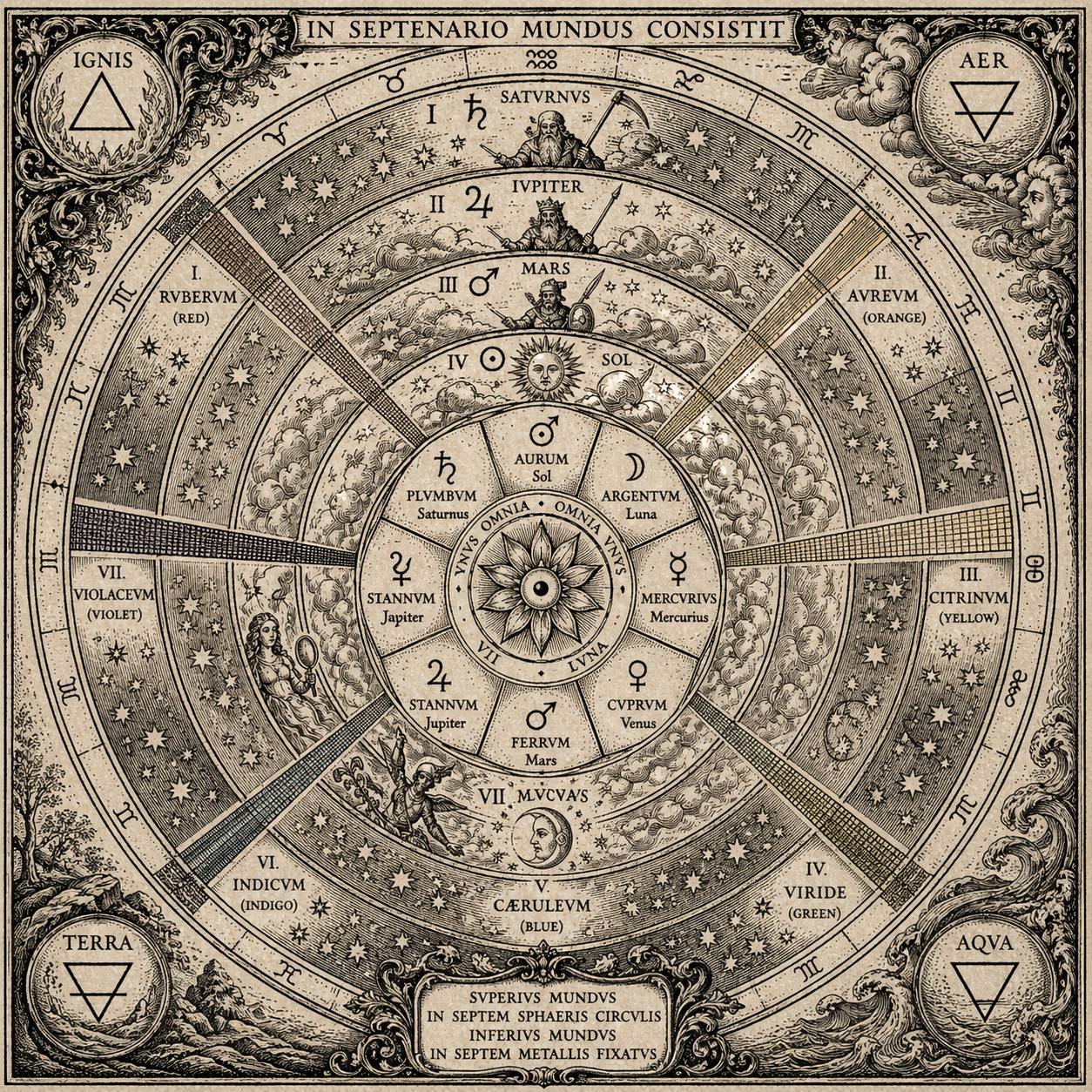
To the alchemists, the cabalists, and the occult philosophers of the Renaissance, seven supplied the very architecture of the world. There were seven planets governing seven metals: gold for the Sun, silver for the Moon, quicksilver for Mercury, copper for Venus, iron for Mars, tin for Jupiter, and lead for Saturn, a correspondence Chaucer himself had reported in The Canon's Yeoman's Tale. There were seven colours in the rainbow and seven notes in the diatonic scale, and these too were held to correspond, each note to its colour and each colour to its planet. The London Phalanx of September 1841, in a remarkable and largely forgotten Fourierist meditation on music, attempted to systematise the entire web (passions, tones, colours, mathematical curves, temperaments, even the four arithmetical operations) under the seven divisions of the diatonic scale, with the further claim that they corresponded in turn to the seven principal passions of the human soul. Friendship was the tonic; love the mediant; ambition the leading-note. The whole Pythagorean dream lived on, in 1841, in a London magazine of utopian socialism.
In the cunning craft of crystal-gazing, or peeping, practised in the north of England and even mentioned, the Globe of June 1891 noted, by the prophet Isaiah, the wizard charged the seer's glass by invoking one of the seven angels who governed the days and hours: Michael, Gabriel, Camsel, Raphael, Sachiel, Anael, and Cassiel. Each angel ruled in turn; the appropriate name had to be uttered at the correct hour, or the glass remained dark. The same seven names appear in the Heptameron of Peter de Abano, in the Hermetic literature of late antiquity, and in the magical papyri recovered from Egypt, a continuity stretching, by the time of the Globe's correspondent, across nearly two thousand years.
Annie Besant, writing in the National Reformer in August 1886, drew the entire Christian inheritance into the orbit of solar mythology. The seven sacred numbers of the ancient sun-worshippers, four (the cardinal directions), seven (the planets), and twelve (the signs of the zodiac), pervaded both Old and New Testaments, and the Book of Revelation in particular was, to her reading, an astrological treatise lightly veiled in Christian dress. She noted the Lamb of God with seven horns and seven eyes; the seven spirits before the throne; the seven angels with seven trumpets; the seven thunders, the seven vials, the seven last plagues. None of it, she argued, was accidental. All of it descended in a continuous line from the worship of the seven planetary lights of Babylon. Christianity is a mere echo of the older faiths, Besant wrote, repeating their phrases and copying their symbols.
• • •
XI. The Bell of Holy Trinity
When the new bell of Holy Trinity Church in Newcastle was dedicated by Dr H. E. Bilbrough, Bishop of Newcastle, in March 1938 and rung for the first time at the close of the consecration service, no rubric in the prayer-book or the order of service prescribed how often it should be tolled. The Rev. H. A. Hand, Vicar of Holy Trinity, asked the Bishop, who suggested seven. Asked afterwards by the Shields Daily News why he had chosen this number, the Bishop could only reply that seven was a kind of sacred number: that the sacraments were seven, the virtues seven, the gifts of the Holy Spirit seven, and that from the earliest times it had evidently been regarded as sacred. He could not explain it further. He simply knew.
The Bishop's instinct, casual as it appears, is the truest monument to the number's persistence. From the cuneiform hemerologies of Babylon to the bell-rope of an English parish church, by way of the prophets of Israel, the schoolmen of Europe, the alchemists of the Renaissance, and the wise women of Cornwall and the Algarve, the same instinct has been handed on without ever quite being explained. As the journalist Keith Brace remarked in the Birmingham Daily Post on the second of January 1970, looking out into the new decade: when one has a number as symbolically loaded as seven, multiplied by a number as scientifically loaded as ten, one is in for something striking.
The skeptics (the writer who answered Frederick Rogers in the Daily News of March 1914, for example, briskly explaining the whole edifice as a coincidence of imperfect astronomy) are very likely correct on the literal level. The ancients counted seven planets because their telescopes were inadequate, and the inheritance of seven days to the week is the residue of that astronomical limitation. Had Uranus been visible to the unaided eye, our weeks might be eight days long, our virtues eight, and our deadly sins likewise. The instinct is, on this reading, no instinct at all but a misapprehension fossilised by repetition.
But the literal account does not quite finish the matter. For some reason that no one has ever been able fully to explicate, humanity has needed a number to express the sense that creation, prayer, suffering, redemption, and time itself fall naturally into patterns that are neither too simple nor too complex, patterns that feel, somehow, complete. Three was not enough; twelve was too many. Four was the world; seven was the world plus the Trinity; nine was a stretch; ten belonged to fingers and toes. Seven sat in the right place. It expressed the moment of completion, the hour of rest, the finished work. As John Munro Gibson had put it in 1881 with characteristic restraint, there might be no firm data in Scripture for determining on what idea the sacredness of the number was founded, but the pattern is there nonetheless, woven into the fabric of every religion that came within its reach.
When the magician of 1903 asked a stranger to choose a number between one and ten, the stranger said seven. He had been saying it, in one form or another, for several thousand years. He shows no sign yet of stopping.
• • •
Principal Sources
Cheltenham Chronicle (8 December 1836); London Phalanx (11 September 1841); Newry Examiner and Louth Advertiser (30 January 1864); Academy (27 November 1875); Leigh Chronicle and Weekly District Advertiser (13 October 1877); East of Fife Record (21 June 1878); Derby Mercury (28 May 1879); Paisley Herald and Renfrewshire Advertiser (14 June 1879); Daily Review, Edinburgh (9 June 1881); National Reformer (22 August 1886); Christian World (10 March 1887); Toronto Daily Mail (10 September 1887); Aberdeen Evening Express (10 September 1888); London Evening Standard (7 May 1890); Canterbury Journal (7 June 1890); Globe (23 June 1891); Bridgend Chronicle (1 September 1893); Hartlepool Northern Daily Mail (14 April 1894); Norfolk News (19 June 1897); Forfar Herald (4 August 1899); Daily Malta Chronicle and Garrison Gazette (15 March 1900); Weekly Journal, Hartlepool (5 June 1903); Suffolk and Essex Free Press (22 March 1905); Londonderry Standard (26 February 1906); Stalybridge Reporter (13 July 1907); East Suffolk Gazette (6 October 1908); Globe (10 March 1913); Daily News, London (6 March 1914); Swindon Advertiser (16 January 1915); Dublin Daily Express (26 November 1917); Brechin Advertiser (7 February 1928); Blackburn Times (20 April 1929); Peterborough Standard (13 March 1931); North Wilts Herald (17 August 1934); Seaham Weekly News (4 September 1936); Sunderland Daily Echo and Shipping Gazette (12 July 1938); Shields Daily News (2 March 1938); Berks and Oxon Advertiser (28 June 1940); Gloucestershire Echo (19 October 1945); West Briton and Cornwall Advertiser (25 April 1955); Liverpool Echo (10 August 1963); Birmingham Daily Post (2 January 1970); War Cry (6 June 1970); Dundee Courier (8 July 1971). Additional reference: John Munro Gibson, The Mosaic Era (London: Hodder and Stoughton, 1881); Richard Samuell, Seven, the Sacred Number (London: Kegan Paul, Trench, 1887).