From Phoenician Altars to Maypole Greens: The Ancient Origins of May Day Folklore
May Day did not begin with maypoles and Morris dancers. Beneath the flowers and ribbons lies a far older world of hilltop fires, cattle rites, dawn dew, sacred hawthorn, and ancient seasonal fears. This article follows the long evolution of May Day folklore from Beltane and the Floralia to the customs that still flicker across Britain and Ireland today.
"The flowery May, who from her green lap throws The yellow cowslip and the pale primrose."
Every year, on the first of May, something stirs. In Edinburgh, in the grey hours before dawn, hardy souls still climb Arthur's Seat to wash their faces in the morning dew. In Padstow, Cornwall, a horse-headed figure capers through the streets to drumbeats that seem older than memory. In Oxford, choristers sing from the top of Magdalen Tower as the sun rises over the spires. And in country churchyards across Britain, standing stones older than Christianity wait in silence, their cup-marks worn smooth by a hundred generations of reverent hands.
May Day is the most ancient public holiday in the world. Its roots reach deeper than Rome, deeper than the Druids, deeper, perhaps, than recorded history itself. To understand it fully is to travel back through layers of civilisation - through Labour marches and Puritan bonfires, through medieval pageants and Druidic sacrifices, through Celtic hillfires and Roman flower processions, all the way to the Phoenician altars of the ancient Near East, where a god called Baal was worshipped with flame on the mountaintops.
This is that story.
Part One: In the Beginning Was the Fire - The Ancient Near Eastern Origins
The oldest thread running through May Day is fire. Long before the Celts danced around their bonfires, long before the Romans garlanded their goddesses with spring flowers, the peoples of the ancient Near East were kindling sacred fires to honour the sun. At Tara, the great ceremonial hill of ancient Ireland, the Beltane signal fire was lit at sunset on the first of May, and answering fires blazed back from every hilltop across the island until the whole land was circled, as one old writer put it, "by a zone of flame."
The god honoured in those flames was Baal - known to the Phoenicians as their principal male deity, identified with the sun and its life-giving power. The Phoenicians, that great seafaring people of the ancient Mediterranean, carried their worship wherever their ships sailed. And those ships, according to persistent antiquarian tradition, reached Britain. The copper mines of Cornwall, the tin of Devon, the great stone circles of Orkney - all speak, in their different ways, of a world more connected than we sometimes imagine.
The very word Beltane encodes this history. In Gaelic, it is Bealltainn - "the fire of Bel." Teine is the Gaelic word for fire, a root that echoes in the English tinder, the Scots dialectal tindle, and in the Irish tenaigin - the "forced fire" produced by rubbing two dry sticks together until they burst into flame. This word survived in living use in the south of Ireland well into the twentieth century, an unbroken linguistic thread connecting a Kerry farmyard to the Phoenician altars of Tyre and Sidon.
A correspondent writing from Birmingham in the Newcastle Chronicle in 1940 traced the fire-god's name still further across the ancient world: the Syrian Baal, the Celtic Bel or Belen, the Slavonic Biel-bog, and the Teutonic Pol - all, he argued, variants of a common root, evidence of a pan-Eurasian solar religion so ancient its origins are lost in the dawn of human civilisation.
Part Two: Rome in May - The Floralia and the Feast of Flora
While the Baal-worshippers lit their hilltop fires, the Romans were doing something altogether more graceful. Every year from the twenty-eighth of April to the third of May, they celebrated the Floralia - the festival of Flora, goddess of flowers and spring fertility. Business ceased. The people gave themselves up, as one Victorian journalist put it, "to excessive hilarity and abandon." Processions of flower-garlanded maidens wound through the streets; games and theatrical performances were staged; the sacred ashes of the festival fires were scattered over the fields as a blessing upon the coming harvest.
Two distinct traditions - fire worship and flower worship - had thus been circling the same date in the calendar for centuries before they met in Britain. The Romans brought the Floralia with them when they came; the Celtic Druids were already there with their Beltane fires. The result was a magnificent confusion of rites that neither wholly replaced the other. As one writer observed with characteristic succinctness in the Aberdeen Press and Journal in 1929: "Two distinct traditions, flower worship and fire worship, seem to have coincided on May Day in these islands, just as Christmas and the heathen Yule fell together in December."
The Romans also bequeathed May Day its most complex taboo: the month was considered deeply inauspicious for marriage. In May they honoured the Lemuria - the festival of the unhappy dead, celebrated on the ninth, eleventh, and thirteenth of the month. This superstition proved remarkably tenacious. "Marry in May, rue for aye" was a proverb widely accepted across Scotland and England well into the nineteenth century. It has even been suggested that Mary Queen of Scots chose to marry the Earl of Bothwell in May 1567 because the calendar gave her no better option - or perhaps, under the circumstances, because superstition had ceased to matter.
Part Three: The Druids and the Need-Fire - Celtic Beltane
When the Romans arrived in Britain, they found the Druids already celebrating the first of May with ceremonies that would have been recognisable, in their broad outlines, to any Baal worshipper from the Levant. The parallels are too precise to be coincidence. Both traditions centred on fire. Both involved the purification of cattle. Both featured a sacred meal prepared in the open air. Both included the casting of lots to select a sacrificial victim.
The Druidic year, the pattern later reconstructed as the Wheel of the Year, was divided into four great fire festivals: Imbolc (February, the lambing festival), Beltane (May, the start of summer), Lugnasad (August, the harvest festival), and Samhain (November, now Halloween, the start of winter). Each was marked by fire, feast, and ritual. Beltane was the greatest of the four.
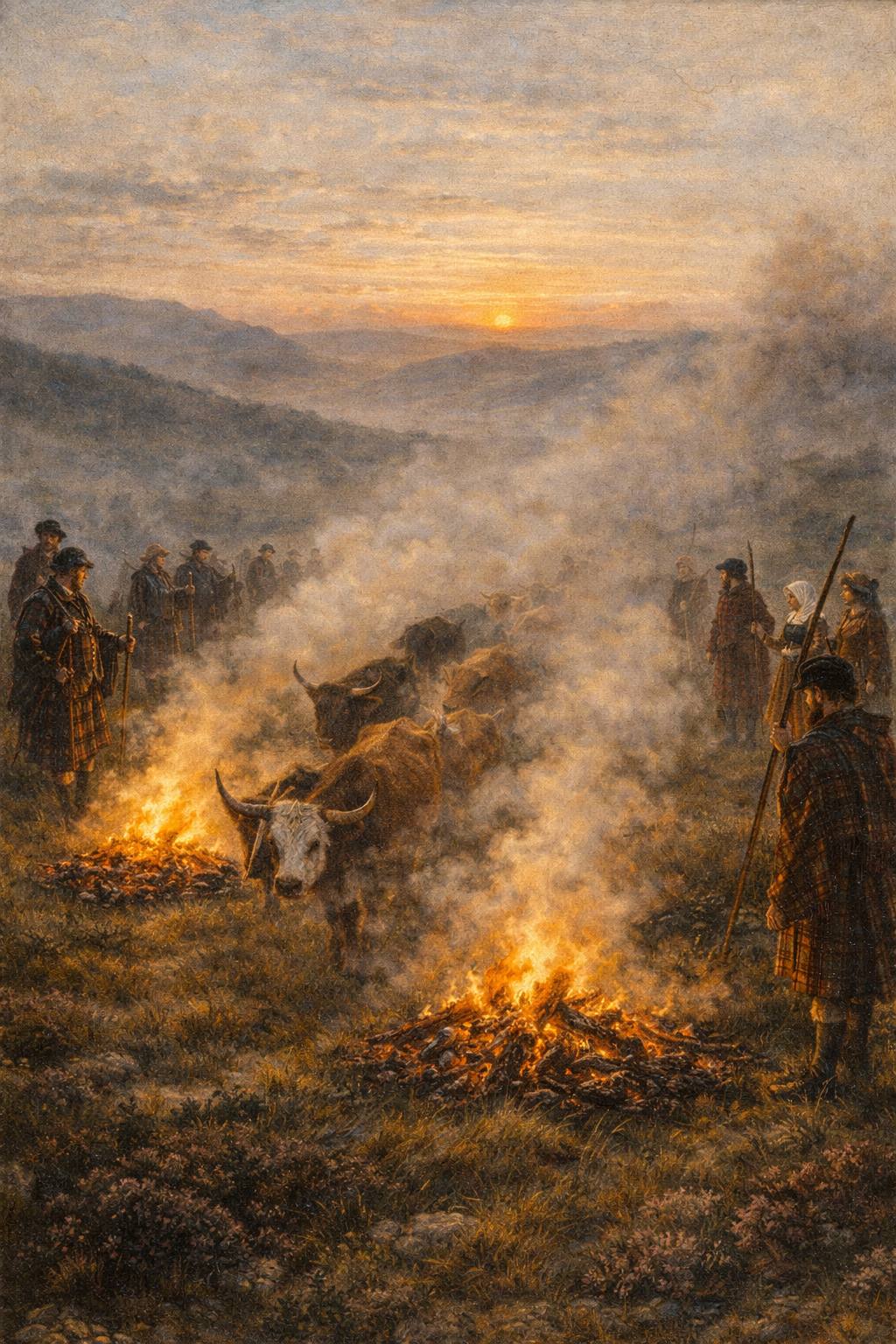
The ceremony as practised in the Scottish Highlands, and described by multiple eyewitnesses well into the eighteenth century, was as follows. On the eve of Beltane, every domestic fire in the district was extinguished. The people assembled before dawn on a nearby hilltop, where a great fire of brushwood and turf had been prepared. The fire was kindled by the teine-éidinn or need-fire - generated not by flint and steel but by the friction of two pieces of dry wood, a technique so ancient it must predate metalworking. This "fire from heaven," produced without human artifice, was believed to have purifying and healing properties of extraordinary power: a sovereign remedy against witchcraft, a cure for malignant disease, and a protection against poison.
Once the fire blazed, the cattle were driven through or between the flames. Children were passed through in their parents' arms. The young men leapt over the fire three times - some accounts give seven - to ensure a good harvest and immunity from evil for the coming year.
Then came the feast: a great caudle of eggs, butter, oatmeal, and milk, prepared over the fire. Before anyone drank, a libation was poured on the ground as an offering to Bel. Then came the ceremony of the Beltane cake.
The cake was divided into as many pieces as there were people present. One piece was smeared black with charcoal. The pieces were placed in a bonnet; everyone drew one blindfold. Whoever drew the blackened piece was the carline - the devoted one. This unfortunate was made to leap three times through the flames. In the eighteenth century, as the minister of Callander described it for Sir John Sinclair's Statistical Account of Scotland, the company made only a "show" of putting the carline into the fire. But there was no doubt what the ceremony had once truly meant. As the minister wrote with remarkable candour: "There is little doubt that these inhuman sacrifices had once been offered in this country as well as in the East."
The nine knobs of the oatmeal cake - each dedicated to a different deity or animal spirit - were broken off one by one and cast into the fire with ritual invocations: "This I give thee, preserve thou my horses. This to thee, preserve thou my sheep. This I give to thee, O Fox! Spare thou my lambs. This to thee, O hooded crow! This to thee, O eagle!" Each knob represented a deal struck between the human community and the forces of nature.
Part Four: The Geography of Fire - Scotland's Beltane Landscape
To understand Beltane is to walk the Highland landscape with new eyes. Certain hills were sacred to the festival for generations; their very names carry the memory.
Tinto Hill in Lanarkshire - "hill of fire" - was one of the great Beltane beacons. A layer of charcoal discovered under the turf on its summit confirmed what the name had always promised: that fires burned here regularly, for a very long time.
Tulliebeltane in Perthshire - "the eminence of the fire of Belus" - stood beside a Druidical temple of eight upright stones, a sacred well of great local veneration, and a smaller stone circle. On Beltane morning, superstitious people came to drink from the well and walk around it nine times - then around the stone temple nine times in turn. Nine was the sacred Druidic number. It appears in the nine knobs of the Beltane cake, in the nine turns around the well, in the nine torches of the Beltane fire ceremony.
Ben Ledi near Callander - "the god's hill" - still saw children playing Beltane games into the twentieth century, rolling bannocks down its slopes to divine their fate, long after the original meaning of the game had been forgotten.
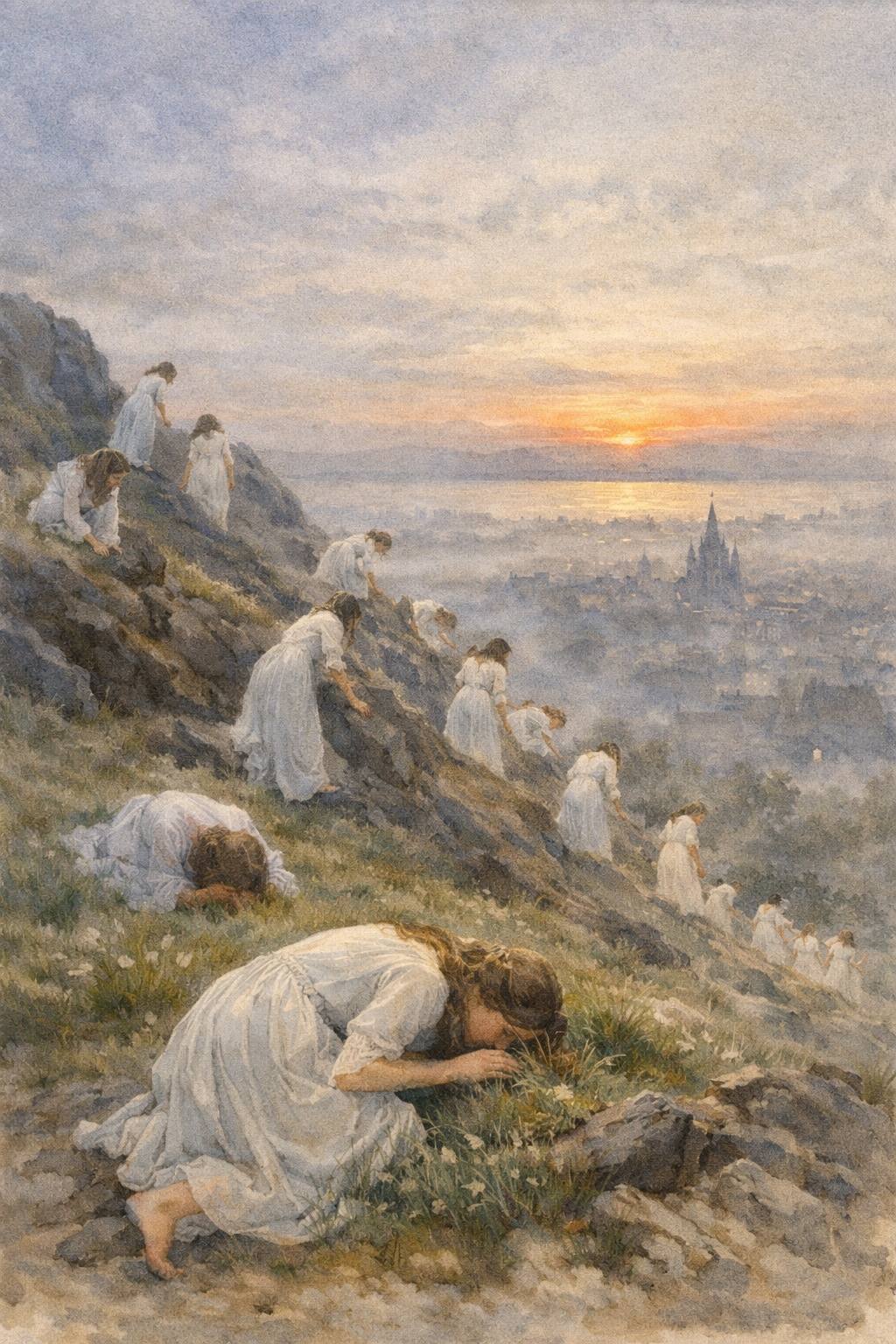
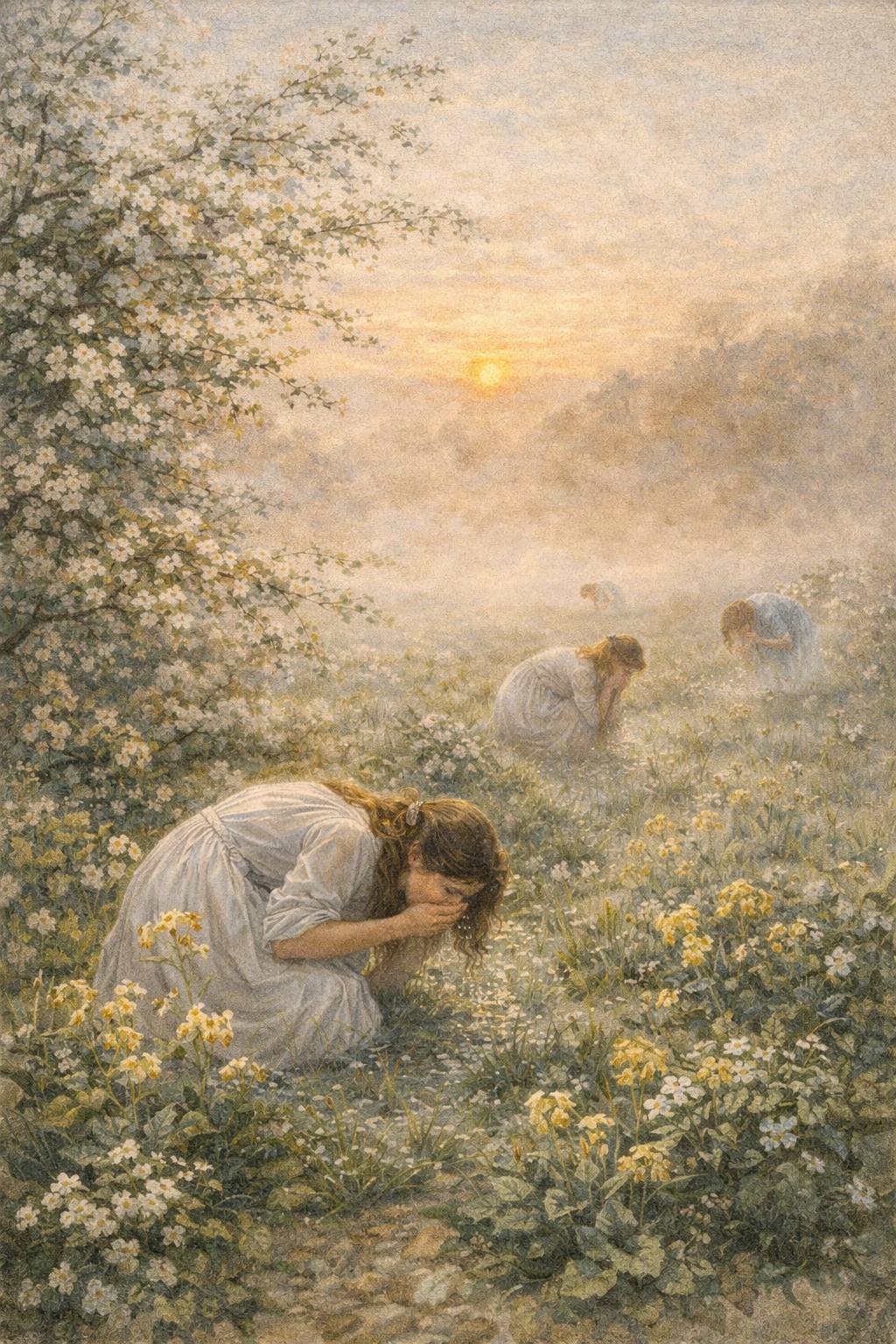
Arthur's Seat in Edinburgh provided the city's gentler Beltane custom: the washing of faces in the morning dew. A century ago, as one vivid contemporary account recorded, "the appearance of so many gay groups perambulating the hill-sides, and the intermediate valleys, searching for dew, and interchanging salutations with endless mirth, has an indescribably cheerful effect." Young women descended to St. Anthony's Well afterwards, drank from its crystal spring, and whispered their wishes. The custom is confirmed as still living as late as 1953, when the Northern Chronicle noted that a BBC radio broadcast on Beltane by the folklorist F. Marian McNeill was timed to coincide with the Edinburgh dawn-climbing season.
Mitchell Hill at Dingwall had its own May morning procession within living memory. In 1941, a correspondent to the North Star and Farmers' Chronicle recalled with evident emotion the last such outing, some sixty years earlier: "We were a bright and happy company of lads and lasses from between 6 to 16 years of age, and we spent a really happy time around the maypole. There was copious dew that morning, and we washed both faces and feet. I remember we had a piper - I think it was sturdy Hector Wemyss - but we also had a fiddle and some flutes. We marched in procession to the hill, where we passed three short hours, from 4 to 7 o'clock. What happy memories."
Part Five: The Long Shadow of Beltane - Ireland's May Day
In Ireland, the first of May was known as La Bealltainn - again, the day of Baal's fire - and its celebration was if anything more richly documented than in Scotland. Lady Wilde, the great Irish folklorist (and mother of Oscar Wilde), collected its customs in her Ancient Cures, Charms, and Usages of Ireland (1890), providing the most detailed picture of Irish May Day belief available.
The great Beltane signal fire at Tara was the hub of the Irish fire network. When it blazed, answering fires rose from every sacred hill across the island until the whole land was ringed with flame. The last of the Pagan High Kings, the chroniclers say, convoked a grand assembly of the nation to meet him at Tara on the feast of Beltane, which was accounted the principal feast of the year.
The Irish May Day taboos were stringent and seriously observed. No fire might be borrowed from a neighbour on that day, nor any strange hand allowed to milk the cows - both acts were believed to hand over the household's fortune to malevolent spirits. No food left over from May Eve might be eaten the following morning; it had to be buried, thrown into running water, or given to animals, for the fairies had stolen the real food in the night and left behind only glamoured lumps of turf. Primroses strewn on the threshold were the surest protection against evil, for no malignant spirit could cross that flower.
The cattle were driven through or between Baal fires, as in Scotland, to protect them from disease for the coming year. In parts of Munster and Connaught, farmers and peasants burned wisps of straw near their cattle for the same reason - a practice recorded as living within memory well into the nineteenth century.
The serpent-dance around the May bush or May-pole was particularly Irish. Lady Wilde described it with precision: all the young men and maidens held hands and danced in a circle around a pole hung with ribbons and garlands, moving from right to left in imitation of the windings of a serpent, "though quite unconscious of the typical meaning of their movements." The May bush itself - a hawthorn decorated with flowers and set before the door - had its own mythological origin legend, told to Lady Wilde by an elderly peasant as a living oral tradition: it commemorated a magic bush that had once intercepted the fiery darts of a sorcerer in a great battle between the Tuatha de Danann and the Milesians.
Nina Condron, writing from personal memory in the Daily News in 1926, captured the darker emotional register of the Irish May Day with extraordinary literary power. In Connemara, she wrote, the first of May was not a day of dancing but a day of fear:
"There are few houses in that remote place would face the dawn of May Day without the mystic green, 'the blessed quicken wood,' nailed over the door, for May Day brings fear along with it; it is a time to beware with doubled vigilance the mischievous activities of the Pookeen."
She connected the fear to its mythological root: Beltane, she argued, was also Balor - the terrible one-eyed King of the Dead of Irish mythology, whose fiery glance brought death to all it touched. The Suil Balor - the evil eye - was Balor's legacy, and on May Day his power was at its height. The Rosary prayer "in the hour of our death" that rose from every Irish cabin on May evenings was, she suggested, older than Christianity: it was the ancient propitiation of the death-god, wearing its new Christian dress.
Part Six: The Maypole and the May Queen - Medieval England
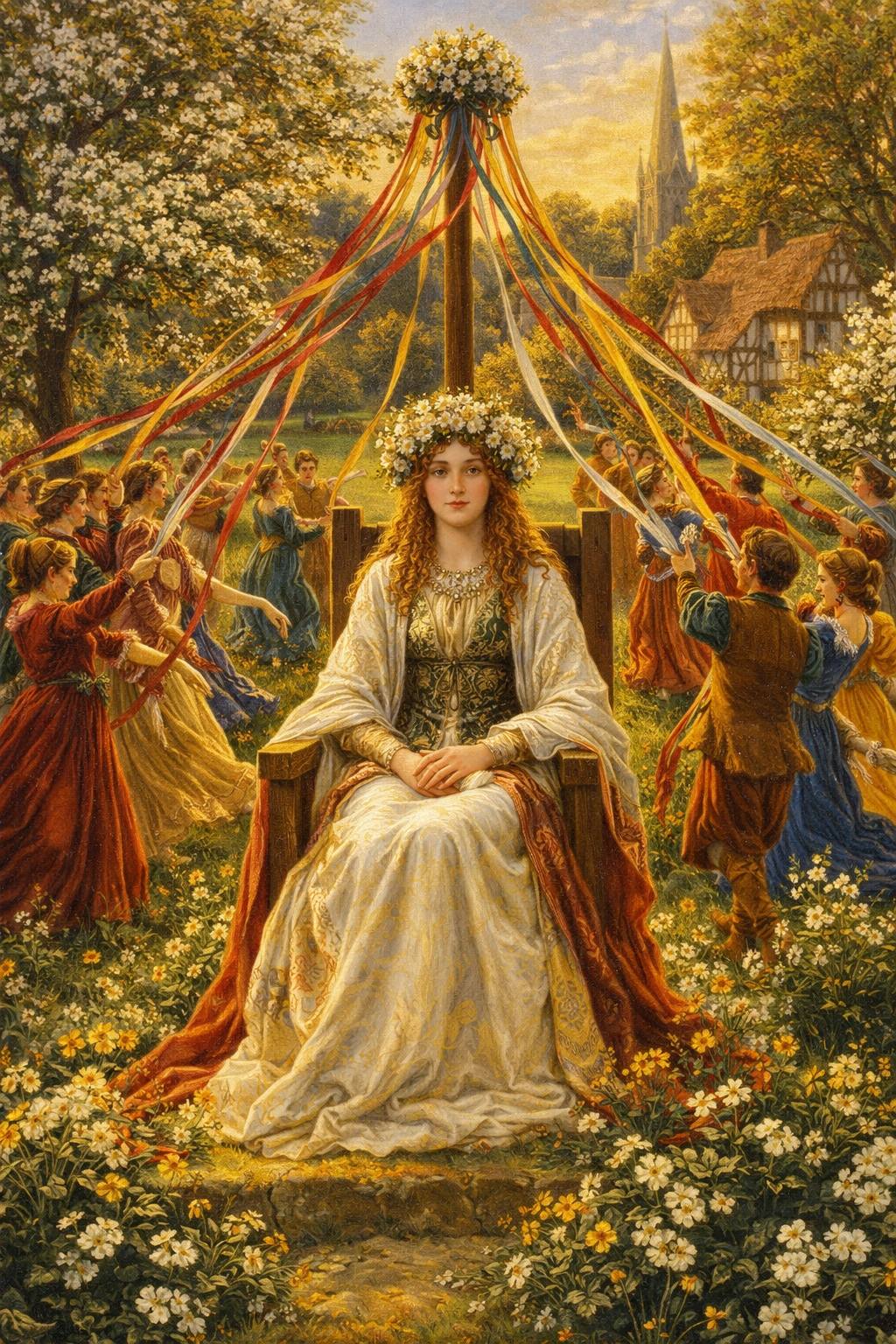
In England, the fire traditions of Beltane faded earlier than in Scotland and Ireland, replaced by the gentler customs of the Floralia: the Maypole, the May Queen, the gathering of hawthorn blossom, and the midnight excursion to the woods.
By the sixteenth century, the May Day customs of England were elaborate and deeply embedded in social life. Philip Stubbes, the Puritan polemicist, described them in his Anatomy of Abuses (1583) with a horrified precision that has made his account indispensable to historians ever since. On the first of May, he wrote, "the juvenile part of both sexes are wont to rise a little after midnight and walk to some neighbouring wood, accompanied with music, and blowing of horns, where they break down branches from the trees and adorn themselves with nosegays and crowns of flowers." They returned at sunrise to decorate their doors and windows with the spoil.
The Maypole itself was a prodigious affair. It required a score or forty yoke of oxen to drag home from the forest, each ox wearing a nosegay of green on his horns. The pole - sometimes eighty, ninety, or even a hundred and thirty-four feet high - was covered with flowers and herbs, painted in variable colours, bound with strings from tip to bottom, and set up on the village green to the sound of drumming, piping, and general festivity. Around it the people danced and feasted all day long.
The Maypole had powerful enemies. In 1644, the Long Parliament passed an Act suppressing May Day celebrations as relics of paganism. For seventeen years, no Maypoles were erected. But at the Restoration in 1661, the Duke of York (afterwards James II) had a Maypole raised in the Strand, London - 134 feet high, a defiant gesture of royal joyfulness. The most famous of all London Maypoles, it stood opposite Somerset House until 1717, when it was taken down and purchased, through the agency of Sir Isaac Newton, to serve as the support for a great telescope presented to the Royal Society by the French astronomer M. Hugon. In this way, an instrument of celestial observation was literally supported by the memory of sun worship.
St. Andrew Undershaft, the City of London church whose name derives from the maypole that annually overtopped its steeple, is the most permanent monument to the Maypole in England. Chaucer alluded to it. The pole before its south door was set up every May Day morning by the joyful townsfolk, "in the midst of the street."
London's May Day was a democratic festival. King Henry VIII himself rode out from Greenwich to Shooter's Hill with Catherine of Aragon to gather hawthorn with the Corporation of London. Guinevere and the Knights of the Round Table, according to Malory, rode into the fields beside Westminster to gather may "early in the morning." Mrs. Pepys went down to Woolwich to roll in the morning dew. The Eton schoolboys had official permission to gather May branches - "if they can do it without wetting their feet," a condition that surely generated its own annual entertainment.
Part Seven: The Abbot of Misrule - Scotland's May Day Games
In Scotland, the Beltane fire tradition coexisted with its own version of the English May games. In the Scottish burghs, the May Day celebrations centred on the Abbot of Careason and the Queen of the May - characters who led processions, presided over games, and represented the spirit of misrule that the season licensed.
The Robin Hood plays were the most popular dramatic feature of Scottish May games, their outlaw hero an archetypal figure of anti-authoritarian freedom perfectly suited to a festival that annually suspended normal social hierarchies. The Scottish Parliament, recognising their power, attempted to suppress them with an Act in 1555. The attempt was not notably successful.
In Edinburgh in 1561, an attempt to enforce the Act produced a full-scale riot. The hammermen of the city rescued one of their mummers who had been condemned to be hanged in July for continuing to perform. The story was recorded by the church historian Calderwood, who noted it had become "one of the first difficulties of the men who had carried through the Reformation how to wrestle the people out of their love of the May games."
The people were not easily wrestled. As late as 1592, the General Assembly of the Church of Scotland was still "groaning over the making of Robin Hood plays." Only at the close of the sixteenth century did the organised games finally cease. But the superstitious customs - the need-fire, the bannock divination, the rowan-branch protections - continued quietly for another two centuries in remote districts, and in the cities the washing of faces in May dew survived well into the twentieth century.
Part Eight: The Wisdom of Wales - Calan Mâi
In Wales, the May Day tradition had its own distinct character and its own linguistic identity. Calan Mâi - New May Day - was the great turning-point of the Welsh agricultural year, the day on which farm servants changed employers, young farmers took possession of new holdings, and newlyweds set up their first home. To this day, ask a Welsh farmer when he entered a particular employment, and he will tell you "last Calan Mâi."
The Welsh May Day procession was led by a birch-pole - the Maypole was a birch in Wales, not an oak - carried from village to village by fifteen or twenty young people dressed in white, the sun-priests of a surviving tradition. With them went a Fool and a Rannaidir, representing Winter and Destruction in comic rags, objects of cheerful mockery as the white-clad summer troupe processed in triumph.
In North Wales, the great centre of this tradition was the "Coleg Volwern" or "Coleg yr Gra," where the competing parishes of the district had their annual rivalry over which could carry the symbol of solar power most proudly. The pride of rival parishes in the honour was fiercely contested.
The Welsh Maypole was, according to the most detailed analysis in the 1876 North Wales Chronicle, nothing less than the Egyptian obelisk transposed to northern soil - a symbol of the sun's rays in vertical form, the generative power of the solar god made visible in wood and ribbon. Philip Stubbes himself noted, when he witnessed the Welsh May celebrations at Llanrhaedr in 1583, that they had preserved traditions he could not find elsewhere in quite the same form.
Part Nine: Customs That Survived - From Westcountry Ram-Slaying to Cheese-Rolling
Beyond the great centres of Celtic tradition, remarkable fragments of May Day custom persisted in every corner of the British Isles, each one a window into a different stratum of the ancient festival.
At Holne, on the edge of Dartmoor in Devon, the villagers assembled before sunrise on May Day, went out to the moors to capture a young ram, brought it back to a granite menhir standing in the field, fastened it to the pillar, and killed it. It was then roasted, and at midday a scramble took place - at the risk of cut hands - for a slice of the meat. Whoever succeeded in eating a piece was said to be lucky for the rest of the year. This was not folklore recorded in the distant past; it was still happening in the early years of the twentieth century, the most explicit surviving animal sacrifice connected with May Day in England.
At Padstow in Cornwall, the 'Obby 'Oss - a figure of extraordinary antiquity, part horse, part man, part dark spirit - has capered through the streets on May Day since before anyone can remember, accompanied by drumbeats and the insistent May Day song. The hobby-horse was dipped in Traitor Pool, and the crowd was sprinkled with the water; a legend of French invaders repelled by red-cloaked women was attached to the ceremony. The Padstow Oss remains one of the most vivid and uncanny of all May Day survivals.
In Gloucester, cheeses were carried on a litter garlanded with blossom to the parish church, rolled around it three times, then carried in triumphal procession through the streets and distributed among the bystanders - a ceremony combining the Roman Floralia with the Beltane circular processional in a form entirely its own.
In Lancashire, the carters decorated their horses with extraordinary elaboration for May Day - real and artificial flowers on every part of the harness, brilliant velvet cloths worked in silver and gold thrown over the horses' loins. The Liverpool Corporation once exhibited a hundred and sixteen decorated horses in a single May Day procession.
At Whalton, near Morpeth in Northumberland, the Baal fire was - and still is - lit on the village green on the old Midsummer Eve, with a history claimed to be nine hundred years long. It is one of the few English fire festivals that has never been extinguished.
In Huntingdonshire, the May Queen's garland was assembled in the shape of a beehive, composed of cowslips, primroses, tulips, kingcups, and green boughs, with a doll representing the goddess Flora at the summit - a portable solar pyramid carried in procession by the Queen's two maids of honour.
Part Ten: The Labour Movement and the Red Flag - May Day's Modern Politics
In the spring of 1890, the American trade union movement launched a series of strikes with one aim: the eight-hour working day. The day chosen was the first of May. In Europe, the Socialist International adopted it as their own. Since then, May Day has been International Workers' Day - a day of marches, manifestos, and red flags.
But the red flag itself, argued the journalist Godfrey Turton in a remarkable 1931 dispatch from Madrid for the Newcastle Daily Chronicle, was no socialist invention: "Red is the colour of life. And at Beltane, the feast of life, it was the colour worn." The ancient Celts tied their protective rowan branches with red wool. Red was the colour of blood and fire and the sun at its rising. The Labour movement had, perhaps, chosen its symbol more atavistically than it knew.
The Labour Leader - the newspaper of Keir Hardie's Independent Labour Party - made the connection explicit as early as 1894. Writing under the pen name "Tricotrin," a columnist argued powerfully that the workers' holiday had deep roots that should give it legitimacy beyond politics:
"Since the Phoenicians worshipped their primary male god, the sun, and since the Druids practised fire-worship - the symbol of sun-worship, the first of May has been a holiday. Beltane, the first of May, was inaugurative of summer and a great feast of joy."
The argument was still being made a hundred and ten years later. In November 2004, a letter to the Aberdeen Press and Journal politely rebuked a correspondent who had suggested May Day was a communist invention: "The festival of Beltane was celebrated at that time of year by the ancient Celts when they drove their animals out to the hills after they had been blessed by Druid priests and sent through a path between two bonfires to keep them safe."
The ancient and the modern, the sacred and the political, had once again found themselves occupying the same date in the calendar - just as the Roman Floralia and the Celtic Beltane had done two thousand years before.
Part Eleven: Suppression, Revival, and the Long Memory of the Land
The history of May Day is in large part the history of suppression. The Puritans suppressed it in 1644. The Scottish Reformation waged war on it for decades. The Catholic Church, recognising it could not extirpate the festival, attempted to Christianise it by identifying it with the feast of the Invention of the Holy Cross. The attempt failed. As the Arbroath Guide noted in 1925, recording a paper read at the Edinburgh Rymour Club, "the policy which proved successful in the case of Christmas and Easter failed there."
It failed because the roots went too deep. The festival was not a doctrinal matter; it was written into the landscape, the calendar, the agricultural cycle, and the deepest layers of folk memory. The Reformation suppressed the May games; it could not suppress the May dew. The Parliament banned the Maypole; it sprang up again within a generation. The Puritans silenced the Robin Hood plays; the people continued to gather hawthorn at midnight, dance at crossroads, and roll bannocks down hillsides at dawn.
The modern revival began in the late nineteenth century, when the combination of folk revivalism, labour politics, and nostalgia for a pre-industrial rural world gave May Day a new cultural energy. The Whitelands College May Queen ceremony, championed by John Ruskin, gave the old tradition an aesthetic and educational gloss. The Edinburgh Beltane Fire Festival was revived in 1988 on Calton Hill, drawing thousands. In Aberdeen in 1995, the Press and Journal announced a Beltane Fair at Westburn Park - "which has its roots in medieval times as an honour to the sun" - with dancers, jugglers, stilt-walkers, and fire-breathers. The ancient and the modern had found each other again.
Epilogue: The Undying Fire
In the end, what survives of May Day is what was always most essential to it: the human response to the annual miracle of the earth's return to life. After the long dark of winter, after the cold and the mud and the short days, the sun rises stronger, the hedgerows burst into flower, the lambs are born, and something in the human heart insists on marking the moment.
The forms have changed almost beyond recognition. The Baal fires are out. The need-fire is forgotten. The Beltane carline no longer dreads the blackened piece of cake. But in Edinburgh, young women still climb Arthur's Seat before dawn. In Padstow, the 'Oss still capers. In Oxford, the Magdalen choir still greets the May sun from a medieval tower. And on May Day mornings across the country, in gardens and parks and on hilltops, people still perform - without quite knowing why - the oldest of all human acts: turning their faces to the rising sun.
"The human heart responds to Nature's smile," wrote A. S. Nelson in the People's Friend of May 1899, "and whether in gay throngs or in pensive solitude man still seeks the solace of her sanctuary."
It was true then. It is true now. The fire may be out on the hill, but its light has never quite gone from the world.
Key Sources and Further Reading
This article draws on newspaper archives from 1866 to 2004, including the Saturday Review, People's Friend, Stirling Observer, Labour Leader, North Star and Farmers' Chronicle, Aberdeen Press and Journal, Dundee Courier, Western Morning News, Weekly Irish Times, Wexford People, Newcastle Chronicle, Edinburgh Evening News, Fife Free Press, and many others. Primary sources consulted include Rev. James Robertson's account in Sir John Sinclair's Statistical Account of Scotland (1791–1799); Thomas Pennant's Tour in Scotland (1771); Lady Wilde's Ancient Cures, Charms, and Usages of Ireland (1890); Alexander Carmichael's Carmina Gadelica (1900); Ramsay of Ochtertyre's Scotland and Scotsmen in the Eighteenth Century; and Philip Stubbes's Anatomy of Abuses (1583).