From Hecate's midnight suppers to staked suicides, gibbeted murderers and phantom dogs: the crossroads has haunted the human imagination for over three thousand years
There is something about the place where two roads cross that has always unsettled us. Long before the tarmac, long before the signpost, long before the gibbet creaking in the wind, our ancestors paused at that particular convergence of paths and felt it: a thinning of the world, a gap between things, a place that belonged to no one and therefore to everyone, including the dead.
The folklore of crossroads is one of the longest-running threads in Western culture, stretching from the stone altars of ancient Greece to the staked skeletons unearthed by Victorian gas-pipe diggers; from the triple-headed goddess Hecate to the phantom monk glimpsed in car headlights on a Leicestershire road in 1949. It winds through Roman milestone inscriptions, medieval witch trials, Cornish devil legends, Somerset suicide graves, and a Sussex wood where someone, in living memory, was apparently sacrificing dogs to a deity worshipped at the crossroads two thousand years before Christ.
This is that story.
The Liminal Place: Why Crossroads Mattered to the Ancient World
To understand why crossroads accumulated such a weight of supernatural significance, we must begin not with ghosts or gibbets but with something more fundamental: the concept of liminality.
A crossroads is, by its very nature, a threshold: a point that belongs to neither road A nor road B nor road C. It structures the world and yet stands outside it. The classical scholar S. I. Johnston, writing in the Zeitschrift für Papyrologie und Epigraphik in 1991, identified this as the key to understanding every ritual, burial, and superstition associated with crossroads across the ancient world. Crossroads were "liminal points or transitional gaps between defined, bounded areas." They were, in her elegant phrase, "convenient vacuums": places where society could dispose of its unwanted dead, its polluted refuse, and its dangerous magic, precisely because they sat outside the jurisdiction of any community.
This liminality generated two distinct categories of ritual. The first was protective: if you had to pass through an uncertain, unclaimed space, you sought divine help in doing so. The second was exploitative: if a place belonged to no one, it was the ideal spot to leave something (or someone) you wanted to be rid of.
Both categories have left their mark on British folklore in ways that will surprise even those who think they know their local ghost stories.
Hecate: The Goddess at the Three Ways
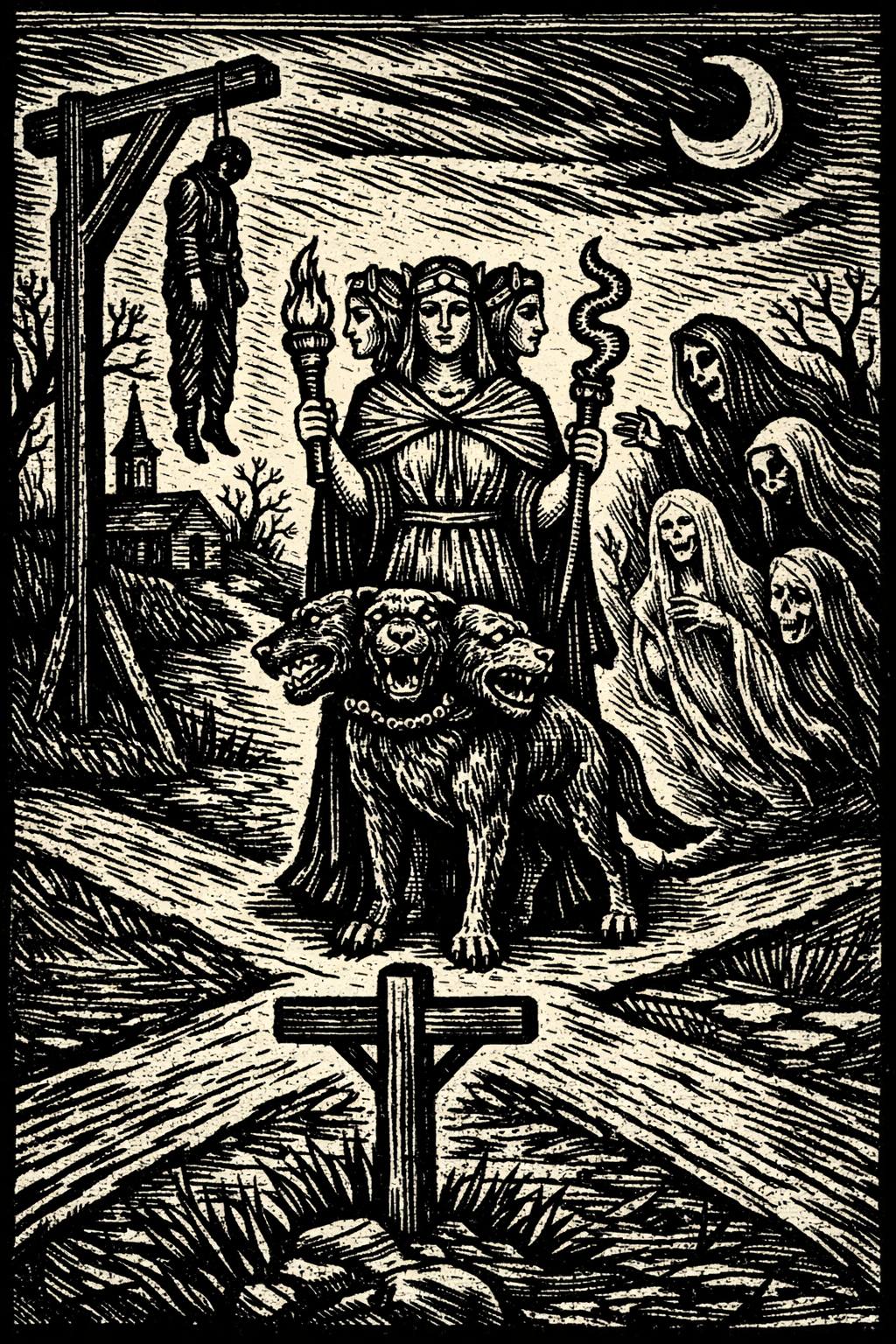
No figure is more central to crossroads mythology than Hecate. She was the goddess of the crossroads in the fullest sense: the junctions did not just fall under her domain, they defined who she was. Her Latin epithet was Trivia: a word that tells us something both profound and, given its modern diminishment to mean inconsequential chatter, rather amusing.
As a 1999 Daily Express column by William Hartston explained, the word "trivia" derives from the Latin tri (three) and via (roads), meaning a crossroads where three streets met. Crossroads, he noted, were places where people stopped to chat and exchange information, and so "trivia" came to mean the sort of gossip encountered there. Hecate was known as Trivia because statues of her, often triple-headed, were habitually erected at three-way junctions.
The triple head was no mere artistic convention. A 1901 lecture reported in the Hastings and Bexhill Independent described Hecate as a goddess "who holds the keys and has three bodies and is goddess of the crossroads," representing threefold aspect: Luna in Heaven, Diana on Earth, and Hecate or Proserpine in the infernal regions. The same threefold nature (crescent moon, full moon, waning moon) governed childbirth, hunting, and the ruling of the dead. Horace's Ode to Diana, reprinted in the Northampton Mercury in 1861, addresses the goddess as "Virgin of the triple form, Guardian of the woods and hills," acknowledging her crossroads role through the name Trivia.
What did the ancient Greeks actually do at Hecate's shrines? Johnston's scholarship draws on Demosthenes, Aristophanes, Plutarch, and other classical sources to describe a regular monthly ritual: on the night of the new moon, suppers were carried to the hekataia (statues or shrines of Hecate) at the crossroads. These offerings were intended to secure the goddess's protection against the dangers inherent in the liminal place. The timing was significant: the new moon marked its own moment of temporal liminality, a disquieting transition between old month and new. The goddess of transitions was supplicated at the transition between months, at the transitional point of the roads.
Interestingly, as a 1921 Daily Express article on the ancient dislike of garlic noted, the Greeks placed garlic on the piles of stones at crossroads "as a supper for Hecate, the goddess of the internal regions", a detail confirmed by the Lincolnshire Standard in 1922, which added that Theophrastus had recorded the same custom. The Greeks held garlic in such abhorrence that it was considered appropriate only for the goddess of the underworld.
This tradition of offerings left at crossroad cairns connects to a much wider pattern. The classical scholar Johnston notes that oxythumia (the polluted remains of household purification rituals) were also regularly deposited at crossroads, precisely because those spaces sat outside any community's jurisdiction. The crossroads was, effectively, the rubbish tip of the supernatural world. And as any folklorist will recognise, the place where you dump your spiritual refuse has a tendency to become haunted.
Hermes, Hermae, and the Road to Milestones
Hecate was not the only divine protector of the crossroads. Hermes, the messenger god, guide of travellers, and psychopomp (conductor of souls to the underworld), was her counterpart in this role. Hermae, stone pillars sacred to Hermes, were erected at crossroads and boundaries throughout the Greek world, serving the same protective function as hekataia. Theophrastus described a superstitious man who piously anointed and worshipped a stone herm chanced upon at the crossroads.
The Roman equivalent of Hermes was Mercury, but the Romans also had their own crossroads deity in the Lares Compitales, household gods worshipped specifically at road junctions, who received offerings at the festival of Compitalia.
From these practices, a 1920 letter to the Sheffield Daily Telegraph argued, the humble milestone evolved. "Hermes in Ancient Greece was, inter alia, the god of roads," wrote the correspondent J.B.W., "and from cairns to his honour at cross-roads there arose angular pillars (Hermae). No doubt the evolution of the milestone in Britain was much the same. The cross-roads cairns would probably have each its distinctive character and serve as a landmark."
It is a remarkable chain of transmission: from a pile of stones left at a Greek crossroads as an offering to Hermes, to the carved Roman milestone, to the eighteenth-century guideposts scattered across the Derbyshire hills that J.B.W. still mourned in 1920. The sacredness of the crossroads was secularised into the practicality of the signpost, but the sense of the crossroads as a place where important information was exchanged, where the traveller's fate might be decided, never entirely disappeared.
The Restless Dead: Why Ghosts Haunt Crossroads
Both Hecate and Hermes were associated with the dead: she as queen of ghosts, he as their guide. This connection is not incidental. Johnston's analysis suggests that restless ghosts were imagined to gather at liminal points precisely because they were the souls of those who had not successfully completed the transition between life and death. Souls that could not find rest would wander with Hecate. Souls expelled from a community through ritual exorcism might find themselves driven to the crossroads. And souls whose bodies were buried at crossroads for various stigmatised reasons would linger there, taking part in the activity around the junction when compelled by a magician or when the conditions were right.
This belief, that the crossroads was a gathering place of the restless dead, explains an otherwise puzzling feature of crossroads folklore: the magical rituals performed there. The Greek magical papyri record instructions for love spells to be performed at crossroads, with wax figures left there and spells inscribed on sherds picked up from the junction. These practices exploited the presence of the dead; a magician who could manipulate the restless souls gathering at a crossroads could put them to work.
The 1922 Lincolnshire Standard described Hecate as she "wandered about in the darkness with the souls of her dead, terrifying the trembling rustics by her appearance, and especially by the howls and whining of the hell-hounds that always announced her approach." It reflects a coherent ancient theology in which the crossroads was a place where the boundary between living and dead became dangerously thin.
The Devil at the Crossroads: Medieval and Early Modern Transformations
With the Christianisation of Europe, Hecate did not disappear. She was absorbed, transformed, and in some respects promoted, into the Devil himself, or at least into the figure of his representative who waited at crossroads to offer deals.
The Faust legend, as a remarkable 1892 article in the London Evening Standard detailed at length, drew on a universal tradition of crossroads compacts. "In the majority of cases," the article explained, "compacts are frequently made with the devil at the boundaries of two roads." The ceremony typically involved arriving at midnight, drawing a magic circle, and summoning the devil, who would appear if addressed three times. The soul was offered in exchange for wealth, success, or power.
What is striking about the Evening Standard article is its breadth of European reference: Westphalian farmers tricking the devil with crowing cocks, Lancashire legends of the devil outwitted by crafty priests, Welsh bridge-building compacts foiled by cunning counterspells, and Scottish traditions of the crossroads as a place of diabolic encounter. The crossroads was the universal meeting point between the human world and whatever lay beneath it.
The 1929 Yorkshire Post took the subject further still, discussing how the French occultist Maître Maurice Garçon had claimed to witness a crossroads invocation in early twentieth-century Paris: a suppliant standing within a magic circle on a moonless night, calling for the evil one to appear. The article placed this in a long tradition: "Marlowe's Faustus gives us all the force of the conflict between new desires for knowledge and old fears that secular knowledge was rebelling against religious authority." From Hecate's supper to Faustus's pact, the crossroads remained the place where transactions between worlds were conducted.
Black Dogs, Black Cocks, and Irish Spells
One of the most consistent features of crossroads magic across cultures is the role of the black animal, particularly the black dog of British folklore. The connection runs deep: Hecate's approach was always announced by howling dogs, and black dogs were sacrificed to her at crossroads in the ancient world.
This motif survived remarkably intact into the early modern period. The 1892 Evening Standard article described a French recipe for invoking the devil: "Take a black cock and go your left side, and go at midnight to where four cross roads meet. Then cry three times aloud, 'Now come,' or 'Now appear!' three times, and the devil will appear; take the cock, and a bargain is made." The Brechin Advertiser of 1953 recorded an Irish spell of the same type, instructing the cash-strapped to go to a crossroads where a murderer had been hanged, take a black cock and "as much money as you can hold in your left hand," dig a hole in the middle of the road, throw the cock over the left shoulder, and thereafter never be left with less money than they started with.
The black dog himself was not always malevolent. An extraordinary 1980 article in the Scunthorpe Evening Telegraph, based on the archaeological survey work of Keith Miller, described the distinctive Lincolnshire tradition in which the phantom black dog, unlike its counterparts in other counties, functioned as a protector rather than an omen of death. A girl threatened by miners on her way to Scunthorpe found a large black dog padding alongside her; when she reached safety and turned to look for it, the dog had vanished. A cyclist in 1912 felt a premonition of evil and then became aware of "heavy breathing and padding feet on his left side" and a large friendly black dog, which melted away once he reached home safely. A woman in Manton reported that the dog regularly accompanied her to Kirton Lindsey; on one wet day she tried to strike it with her umbrella in annoyance, and the umbrella passed straight through it.
The connection between these protective black dogs and Hecate's hound was not lost on investigators. The 1989 West Sussex County Times reported on mysterious events in Clapham Wood near Worthing, where dogs had been disappearing or suffering sudden paralysis since the 1970s. An anonymous informant met the investigator Charles Walker at a point where four footpaths converged in the wood, identifying himself as a member of a group called "The Friends of Hecate" who conducted monthly rituals (including animal sacrifice) in the wood. The group, he claimed, had been active in Sussex for twenty-five years. Walker noted that Hecate "is usually invoked at crossroads and past cults devoted to her would regularly sacrifice dogs in her honour."
Suicide, Stakes, and the Geography of Fear: The British Crossroads Burial
The philosophical dimension of crossroads mythology is striking enough, but its physical legacy is perhaps more immediate, and more disturbing. For centuries, British law and custom required that suicides be buried at crossroads, by night, with a stake driven through the body.
The practice was recorded across the country in abundant detail. In 1894, the Boston Independent and Lincolnshire Advertiser described how "suicides were barbarously buried at night near cross-roads, with a stake driven into the body to mark the grave." The writer recalled personally witnessing, in the early nineteenth century, a suicide buried in a marsh on the sea side of the Old Roman Bank opposite Skirbeck churchyard, without any burial service, until the deceased's friends removed the body by night and reinterred it in consecrated ground, "lest its grieved ghost should lament and mourn."
The 1899 Leeds Times reported a skeleton unearthed at Harborne near Birmingham during road-widening works, with a wooden stake driven through the sternum: "The skeleton was evidently that of a suicide, who, in accordance with the custom of the old days, had had a stake driven through his heart, and then been buried at the dead of night at cross-roads." The same story appeared simultaneously in the Seaham Weekly News, suggesting it made national news.
Why the stake? Why the crossroads? The Liverpool Evening Express explained in 1906: "It was believed that the suicide returned to his former haunts, and the superstitious naturally wished to keep such an unwelcome visitor away. The dead man was therefore interred, with a stake through his breast to prevent him from rising, and at four cross-roads, so that should he by any chance escape he would be unable to find the way." In addition, the head was sometimes severed and placed beneath the arm, to further confuse any wandering ghost.
A 1939 Taunton Courier article elaborated the vampire connection: stakes were originally used on vampires, and suicides were among those believed liable to become vampires. Any creature (animal or human) that had received the attentions of a vampire was also at risk. Even a person who had died naturally in their bed was considered potentially dangerous if a cat reached the body before burial: "It was considered safest that such a body also should be buried at the crossroads with a stake through it." The same article noted that on Exmoor, "a still surviving reason given for watching by the dead is 'to see the cat doesn't get at the body.'"
The Daily Mirror of 1905 recorded a Manchester coroner rebuking a jury for returning a verdict of "suicide whilst temporarily insane," explaining that such a verdict was "a relic of an old superstition from the time when it was the duty of the coroner's officer to drive a stake through the body of a suicide at four cross-roads."
The practice was finally abolished by statute in July 1823, and the last London crossroads suicide burial was that of Abel Griffiths, interred in June of the same year at the junction of Eaton Street and the King's Road. But bodies from the earlier period kept surfacing long afterwards: at Wyton near St. Ives in 1928 (skeletons found during gas pipe excavations), at Faversham in 1927 (bones unearthed at a spot still known as Godfrey's Grave Corner), at a crossroads between Wilmington and Lullington in 1934 (three skeletons together, with 17th-century artifacts, later identified as suicides), and at Yaddlethorpe in 1854, a fact still remembered in a 1984 letter to the Epworth Bells.
Somerset was particularly rich in named crossroads graves. A 1939 Taunton Courier article catalogued at least seventeen Somerset suicide burial sites, each known by the deceased's name: Tommy Tucker's Grave at Faulkland (a woman who died around age twenty, whose stake "wasn't supposed to hold" (people were still afraid to walk past in 1920)), Cannard's Grave near Shepton Mallet (a highwayman driven to suicide by his own ghost), Mary Hunt's Grave near Cricket Malherbie (where sympathetic neighbours later dug up the body and reburied it in the churchyard, defying all religious and civic authority to do so).
Tommy Tucker, as the Somerset Guardian noted in 1932, "was supposed to haunt the roads on moonlight nights."
The Gibbet and the Ghost: Murderers at the Crossroads
The burial of suicides was only half the story. For centuries, British justice also selected crossroads as the location for gibbeting, the public display of executed criminals' bodies, in iron cages, as a warning to travellers and a deterrent to crime.
The most extensively documented example is the Gibbet Crossroads on Watling Street near Lutterworth in Leicestershire, whose ghost stories span at least three centuries of newspaper coverage. The story began in 1676 (or 1678, depending on the source), when a Lutterworth tradesman named William Banbury was robbed and murdered on his way home from Rugby market. His gravestone in Lutterworth churchyard reads: "In memory of William Banbury, killed by a robber upon Over Heath, November 25, 1676." The murderer, a man named Loseby, was hanged and his body gibbeted in chains on a tumulus at the nearby crossroads, which thereafter bore the name Loseby's Gibbet.
The tumulus was eventually demolished (the Watling Street now occupies the site), but the nickname "The Gibbet" persisted, and with it the ghost. A Leicester Evening Mail correspondent reported in March 1934 that a mysterious light had been appearing on the road 200 to 300 yards from the Gibbet crossroads, moving towards observers before suddenly vanishing. A bus load of people travelled from Lutterworth to investigate. A representative of the paper identified the rational explanation: the light was caused by motor vehicles descending hills in a particular way, but the crossroads retained its supernatural reputation. By 1949, the Belfast Telegraph and Leicester Daily Mercury were reporting sightings of a "ghostly white figure dressed like a monk" that scurried across the road and pulled aside its hood to reveal a bald head before vanishing. A garage proprietor named Albert Richardson recalled passengers on his Rugby bus screaming at the appearance of a nocturnal spectre in the headlights as far back as 1935.
The Leicester Evening Mail reported in 1951 that Warwickshire County Council was finally laying the ghost, by felling the roadside spinneys where "according to local superstition, the 'demented and tortured spirit' has his lair," to make way for a roundabout. Whether the roundabout succeeded where centuries of folklore had failed is not recorded.
The Preston Brook crossroads in Cheshire had a similar character: a wooden signpost planted, it was said, over the remains of a notorious highwayman. The Widnes Weekly News of 1964 described groups of young people gathering there on Hallowe'en night, "Ghost watching" in the mist under overhanging trees.
The Devil's Whetstone: Cornish Crossroads Legends
Cornwall produced some of the richest and most distinctive crossroads folklore in Britain, reflecting the county's unique blend of Celtic mythology, non-conformist Christianity, the curse-breaking craft of the Cornish pellar, and deeply embedded belief in the literal presence of the supernatural.
The Longstone at St. Mabyn parish, whose name was recorded in the Cornish Guardian in both 1957 and 1938, stood at a crossroads and was associated with a classic devil-besting legend. The devil challenged a local man to mow an acre of corn in competition, with the man's soul as the stake. The man secretly planted iron harrow-tines in the devil's path, repeatedly blunting his blade. When the devil's scythe finally snapped, he hurled his whetstone away in fury, and it landed upright in a corner of a field, where it remained for centuries until used as building material. The stone's subsequent reputation for strangeness persisted until at least the mid-twentieth century, when "Longstone was a shunned place, and even in those days some people feared to walk through the place after sunset."
The 1938 account in the Cornish Guardian extended the legend into a darkly comic story about a local man taunted about the crossroads by his companions in the Old Inn at St. Mabyn, who convinced him he would face the devil's challenge on his way home. His terror (manipulated by a practical joker with a horse and trap and a draught rug wrapped around himself) ended in genuine disaster when the man, fleeing in panic, destroyed a wheat field, was found unconscious in a pool of blood, and barely survived.
The Truth magazine of 1896 contributed the story of the Devil's Dick: a mysterious bog-oak post bearing the inscription "Here Lies the Devil's Dick," erected not in a churchyard but at a crossroads on a Cornish moor called St. George's Cross. A visiting curate, learning of it from a local shepherd, discovered that the local community had given the man buried there a warning "never to show his face outside of his cottage in the day-" (the story breaks off there, tantalisingly, at the page's end) rather than simply clearing him out, because "when you clears a devil out, Satan always sends a worserer in his place." This was, the shepherd patiently explained, explicitly supported by Scripture.
Rowan, Iron, and Protection: Warding Off Crossroads Spirits
Against the dangers of the crossroads, folk tradition deployed a range of counter-measures. The Hull and East Yorkshire Times of 1923 recorded that on the Yorkshire Wolds, whipstocks for wagon drivers were made from mountain ash (rowan), because anyone driving with such a whip was "quite safe from the power of witches or the evil spirits which haunted cross-roads and bridges." As late as 1890, cheapjacks at the North County fair were still guaranteeing that their whips were of "true wickenwood." The York Castle Depositions recorded a witch admitting defeat against a protected man: "I think I must give this Thomas Bramhall over, for they tye soe much whighen about him, I cannot come to my purpose."
The Dundee Evening Telegraph of 1886 recorded an Umbrian custom of carrying a few small coins when walking at night near Perugia, to fling as an offering at any crossroads, since "assuredly a witch lies there in ambush, ready to work him harm." Travellers who encountered a cairn of stones beside an unfrequented road were expected to add a stone, "so that he may keep down the phantom of the murdered traveller, whose unblessed body has been hastily put underground in this lonely spot."
The fern-seed ritual described in the Westminster Gazette of 1910 combined multiple crossroads traditions. To obtain the magical seed that would make a person invisible (the same boast made by Gadshill in Shakespeare's Henry IV), one should go out at midnight on the night of June 23 to 24, and go "by preference to some ghost-haunted cross-road where a corpse has recently passed." There, at the stroke of midnight, the ferns would bloom momentarily and shed seed that "shines like fiery gold."
The Bronze Age Inheritance: Four Thousand Years of Haunted Crossroads
Perhaps the most remarkable item in this collection is a 2001 report from the Aberdeen Press and Journal, concerning a Bronze Age burial kist unearthed at Home Farm near Udny in Aberdeenshire by farmer Sandy Milton, whose plough dislodged the lid after thirty years of farming the same land. The find (skeletal remains of a youngish male, with a clay beaker and pieces of matting and flint) was dated to approximately 2000 BC.
It was made "just a short distance from the Six Gates Crossroads (reputedly haunted by the ghostly figure of a woman)."
The archaeologists from Aberdeen's Marischal Museum dated the burial. The local newspaper noted the crossroads' reputation. And somewhere in that conjunction (Bronze Age burial, persistent ghost story, haunted road junction) one catches a glimpse of just how deep the roots of crossroads mythology go.
The journalist S.I. Johnston wrote in 1991 that the crossroads rituals of ancient Greece and Rome "can be clarified by distinguishing two fundamental types: protective and exploitive. Both types ultimately grew from the liminal nature of crossroads." She might have been describing every item in this collection of British newspaper cuttings spanning 1815 to 2001.
The stake in the chest. The black dog in the fog. The bald monk vanishing in the headlights. The whipstock of rowan. The black cock at midnight. The whetstone flung across a Cornish field by a frustrated devil. The coins tossed at an Italian crossroads to placate the witch.
All of them are answers to the same ancient question: what do you do, when you find yourself at the place where the roads cross, and you are not entirely sure which world you are in?
Sources: Boston Independent and Lincolnshire Advertiser (1894); Leeds Times (1899); Seaham Weekly News (1899); Daily Mirror (1905); Liverpool Evening Express (1906); Westminster Gazette (1910); Weekly Independent Bromsgrove (1886); Johnson's Sunday Monitor (1815); Sheffield Daily Telegraph (1920); Lincolnshire Standard and Boston Guardian (1922); Hull and East Yorkshire Times (1923); Daily Express (1921, 1999); Diss Express (1927); Evesham Standard (1927); Ross-shire Journal (1927); Cheltenham Chronicle (1928); Yorkshire Post and Leeds Intelligencer (1929); Leicester Evening Mail (1934, 1951, 1955); Somerset Guardian (1932); Taunton Courier (1938, 1939); Cornish Guardian (1938, 1957); Truth (1896); Brechin Advertiser (1953); Ripon Gazette (1958); Wiltshire Times (1960); Widnes Weekly News (1964); Scunthorpe Evening Telegraph (1980); Epworth Bells (1984); Caithness Courier (1983); West Sussex County Times (1989); Sussex Express (2001); Aberdeen Press and Journal (2001); S.I. Johnston, "Crossroads," Zeitschrift für Papyrologie und Epigraphik 88 (1991).