
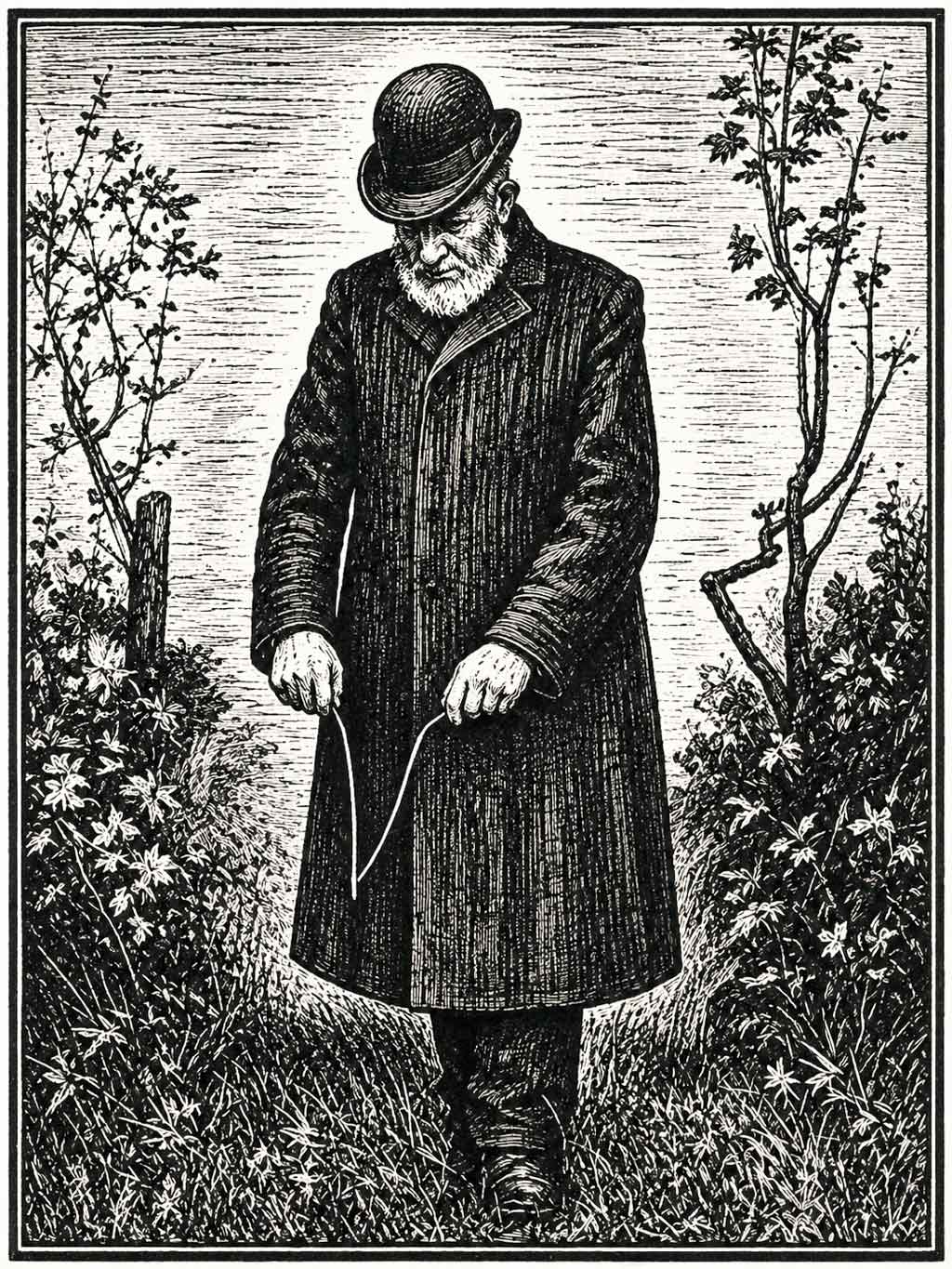
In the spring of 1874 or thereabouts, in a garden three miles outside Bath, a woman named A. W. Buckland watched a man from the Mendip Hills cut a forked branch from a green tree and walk slowly across the lawn. He held one fork in each hand, the point aimed at the ground. When he reached a particular spot the stick began to lift in his fingers, and then, as Buckland recorded two years later in The Journal of the Anthropological Institute of Great Britain and Ireland, it "turned over in his hand with such force as sometimes to break itself."
A well was dug. Water was found.
Buckland was not a credulous woman. She had tried the rod herself, in vain. She listened patiently to the diviner's claim that "not one in a thousand had the power." She read Dr Carpenter on involuntary muscular movement. She knew about the French scientists Chevreul and Biot, who had attributed the rod's twisting to the "expectant attention of the performer." And yet she could not quite let the thing go. The stick had been on the tree five minutes earlier; the man had held it less than one; and something had happened.
This is the perennial problem with rhabdomancy - the formal name for divination by the rod. It refuses to die. It has been condemned by inquisitors, ridiculed by geologists, surcharged by government auditors, denounced by Jesuits and dismissed by professors, and it is still being practised today. Its defenders include a sixteenth-century Saxon mining magistrate, an English baronet of the Royal Society, the Kaiser, a Swiss abbé, a Leamington Spa baker, and Adolf Hitler. Its instruments include hazel twigs, willow withies, candle-snuffers, watch-springs, pendulums, road maps, and (at least once) a German sausage.
This essay traces the long career of water dowsing from its medieval European origins to the present day, drawing on the published sources, the geological literature, and a remarkable run of newspaper reports stretching from the 1880s to the 1940s.
What is Rhabdomancy? A Note on Terminology
The word rhabdomancy comes from the Greek rhabdos (rod) and manteia (divination). It is the umbrella term for any divinatory practice using a rod, wand, or stick. In English-language sources from the seventeenth century onward it overlaps almost completely with the better-known phrases divining rod, dowsing rod, water divining, and water dowsing. American sources prefer water witching, and the practitioner is often called a water witch or simply a dowser.
Adjacent vocabulary is worth knowing:
- Virgula divina or virgula divinatoria - the Latin term, used in early modern mining literature
- Baguette divinatoire - French for the divining rod; a practitioner is a sourcier
- Wünschelrute - the German "wishing-rod"; the user is a Rutengänger
- Hydroscopy - a more technical bibliographic term sometimes used in Continental sources
- Doodlebugging - mostly American slang, typically for oil prospecting
The word dowsing itself has no settled etymology. Sir William Barrett and Theodore Besterman, who produced the most thorough English-language investigation of the subject in 1926, preferred it to "divining rod" despite the obscurity of its origin. By the late nineteenth century it had become the standard term in the English mining and farming districts where the practice flourished.
A small but important distinction: hydromancy - divination by looking into water - is not the same thing as water divining and belongs to a different family of practices (scrying, bowl-gazing, prophetic visions). Rhabdomancy is about finding water, not reading it.
The First Published Account: Agricola, 1556
The earliest serious published description of the rod as a prospecting instrument appears in Georgius Agricola's De Re Metallica, the foundational sixteenth-century treatise on mining. Crucially, Agricola is not writing about water at all. He is writing about silver, copper, lead, tin and gold - the divining rod begins its documented life as an instrument for finding mineral veins.
His description, in the Hoover translation, is precise:
The wizards, who also make use of rings, mirrors and crystals, seek for veins with a divining rod shaped like a fork…
Agricola sets out the technique in detail. The dowser cuts a forked twig - hazel was considered most efficacious, though some practitioners used a different wood for each metal (hazel for silver, ash for copper, pitch pine for lead and tin, iron or steel for gold). The forks were gripped with clenched fists, knuckles upward, the joined end pointing skyward. The dowser then wandered the ground at random, and where the rod twisted downward, a vein was said to lie beneath.
What is striking is that Agricola, writing in 1556, is already sceptical. He notes that miners disputed fiercely whether the rod worked at all, and he constructs an early version of what we would now recognise as a physics objection. Things that attract - magnets, warmed amber - pull objects directly toward themselves. They do not twist them in circles. If a vein had magnetic power over the rod, the rod would tip once toward the vein and be drawn down to the earth; it would not rotate. Since rotation was what people observed, the cause, Agricola concluded, must lie not in the vein but in the manipulation of the holder:
…it must necessarily follow that the manipulation is the cause of the twig's twisting motion.
He goes further and traces the rod's ancestry not to mining tradition but to magic - to the rods of the Egyptian magicians in Exodus, to Circe's transformations, to Mercury's caduceus, the same lineage of ritual instruments catalogued across the long history of grimoires. "Therefore," he writes, "it seems that the divining rod passed to the mines from its impure origin with the magicians." When educated men later rejected the accompanying incantations, the twig itself was retained by what Agricola calls "the unsophisticated common miners." The ritual fell away; the object survived.
This is the pattern that will recur for the next four hundred years. The magic becomes technique; the technique seeks a respectable explanation; the explanation always fails; the practice continues.
From Mines to Wells: How the Divining Rod Became a Water-Finder
The divining rod arrived in England with German miners during the reign of Elizabeth I, according to a 1917 report by Arthur J. Ellis of the United States Geological Survey, summarised in the Settmakers' and Stoneworkers' Journal. It was, at that point, still primarily an instrument for locating ore and buried treasure. The shift to water finding came gradually, and Buckland's 1876 article gives a useful list of what the rod was historically supposed to do: not only find water and metals, but "mark out boundaries, discover corpses, and bring to justice murderers and thieves."
The criminal-detection branch reached its grim apex in 1692 - the year of the Salem witch trials - when a French peasant named Jacques Aymar used a divining rod to track a hunchbacked murderer across the Lyons countryside. The case was a sensation, generated a vast contemporary literature, and contributed to the controversy that eventually led the Inquisition in 1701 to ban the rod's use in criminal prosecution. As late as 1703, Aymard had been employed (one source notes) "to point out with his divining rod Protestants for massacre, under the plea of punishment for crimes they had committed."
By the eighteenth century, most of the rod's other uses were quietly abandoned. As Professor J. W. Gregory of Glasgow University observed in 1927, "the survival of the use of the divining rod in the search for water after its many other uses have been abandoned is due to the shallow supplies of water being scattered abundantly, but so irregularly and elusively that their discovery is often a matter of chance."
In other words: water is found, on average, often enough to keep the practice alive.
The Victorian Heyday: Diviners, Letters and Newspaper Reports
By the late nineteenth century, water divining had become a small but stable rural industry across Britain. The dry summer of 1893 brought a wave of public interest; a reviewer in the London Daily News that December noted that "people wanted water, 'dowsers' (like Mr Mullins and others) sought for water with the mystic 'twig,' and, very often, found it. That fact is admitted by their employers, who, having got their money's worth, are happy in their minds."
The cultural texture of late Victorian dowsing is best caught not in academic papers but in the rural press.
The Cadbury Hill Account, 1889
A letter to the Somerset Standard in January 1889 describes a household halfway up a rocky hill, twelve miles from Bristol, that had no spring water. A "mild little old man" appeared one day at the back door, announced himself as a Dowser, and offered to find water with the twig. He cut a forked branch from a hawthorn bush, walked the garden, and the twig twisted in his fingers above a particular spot. The lady of the house, sceptical, asked to try it herself. She was blindfolded and led randomly about the grounds. After some time the twig twisted in her hands "so vigorously that I had a difficulty in holding them." Two friends took the ends of the twig and "although exerting all their strength, could not prevent the twigs turning as before."
This kind of testimony - eyewitness, slightly bemused, recorded by ordinary people in country newspapers - is the bedrock of the dowsing tradition. It is rarely outrageous. It does not claim too much. It simply says: I saw this; I felt this; the well was dug; the water was there.
Mr. B. Tompkin of Chippenham, 1907
The Fleetwood Express in September 1907 published a long interview with a working dowser named B. Tompkin. He had been called to the Fylde Farm School and the local paper sent a reporter to interview him at his lodgings. The account is unusually rich.
Tompkin had not sought the gift. His own farm had had an inadequate water supply for five years, so serious that he and his wife had contemplated abandoning the place. A neighbour with a "measure" of the gift came to walk the ground; the twig moved, and the neighbour suggested Tompkin try it for himself. The next day, in an orchard with no surface sign of water, Tompkin walked the ground with a V-shaped twig:
After walking about 80 yards I suddenly felt a running or creeping sensation come into my feet, up my legs, and back down my arms, which caused me to look to see what happened. I saw that the rod had risen right up, and was turning over, and it frightened me to feel it turn like that. It caused me to feel very ill, and I at once threw away the twig, thinking that old Harry was not far off. I managed to get into the house, and I was bad for three days.
The detail of feeling so ill that he was bedridden for three days, and the half-joke about "old Harry" (the Devil) being nearby, is psychologically vivid. Whatever Tompkin's gift was, he experienced it as a physical assault.
Tompkin offered the standard early-twentieth-century explanation: electricity. "It is a well-known scientific fact that water is a generator of electricity," he said, "whether in passing through earth in its natural state, or any artificial means employed." The dowser, "being of a sensitive nature or organism, the moment he passes over or comes across these currents, becomes the receiving instrument for the time being," and the rod is "merely used to complete the circuit."
He distinguished gold from silver by the speed of the rod's movement, claimed 425 successful springs by 1899, and noted that the gift was hereditary in some of his children - "but not all." A peculiar fact, he added: of his twin children, one had the gift and the other did not.
J. Timms of Oxford, 1921
If Tompkin represents the modest farmer-dowser, John Timms of 24 Leopold Street, Oxford represents the professional. The Staffordshire Advertiser sent a representative to follow Timms on a job near Stafford in June 1921 and produced a long, admiring profile.
Timms's method was precise. He selected a hazel twig, V-shaped, with branches about a foot long, and held it with his elbows tucked to his sides, thumbs pointed outward. Before beginning, he handed his watch and purse to his host, "remarking that he was susceptible to metal and that its possession might influence the task he had in hand." A member of the party attempted to hold Timms's wrists to check the movement of the twig and was "nearly overbalanced in the attempt." Asked about the source of his power, Timms confessed himself baffled, calling it "an extra sense." He had located, with the help of Dr A. H. Church of Oxford, about a hundred miles of underground streams beneath the city, mapped to reveal that ancient monasteries and old farmhouses had been built on water courses now lost to memory.
Timms's ten-year-old daughter Dorothy had already given public exhibitions of the same faculty.
The Geographical Spread
The newspaper record reveals just how widely diffused this practice was. Mr Cecil Schmitz of Buckingham located a spring at exactly 25 feet at Maids Moreton in 1914. Mr H. Williams of Catchfrench, St Germans (Cornwall), claimed never to have failed in ten years' work and could predict depth "within six inches." Mr S. T. Child of Capel was at work in Borley and the Belchamps in December 1901, using a watch-spring as a supplementary instrument. At Porthcawl in 1898 the Urban District Council was surcharged by the Local Government Board auditor for paying dowsers' fees and for the cost of sinking a fruitless well on their advice - a reminder that not all dowsing ended well.
The Exeter and Plymouth Gazette in 1928 reported the practice "extensively practised over the artesian water areas throughout Australia." The Bideford Rural Council in 1945, considering whether to engage a diviner to advise on housing sites, was momentarily distracted when one councillor suggested "there should be two diviners - one to check the other," and the Chairman replied, "Three would provide a majority. (Laughter.)"
The Believer's Theories: Electricity, Sensitivity, and the "Extra Sense"
From the eighteenth century onward, every generation of dowsing-defenders has reached for the latest physics to explain the practice. As Ellis dryly noted in the 1917 USGS report, "in the later part of the eighteenth century an attempt was made to explain water witching as an electric phenomenon. At almost every step in the advance of science some one has attempted to explain its supposed operation by means of the latest scientific theories."
This is exactly what we see across the newspaper record. Tompkin in 1907 invoked electric currents. The Northern Ensign in 1922 quoted the celebrated chemist Sir William Crookes, who had tested dowsers and found "that those powers were lost if the 'diviner', as he is generally called, stood upon a sheet of plate glass. Clearly glass is a non-conductor of this power just as it is a non-conductor of electricity." A 1928 Taunton Courier item extracted from a letter to Nature described carefully conducted tests at the National Physical Laboratory: a thick glass plate under the dowser's feet caused the sensation to cease, as did rubber tubing covering the ends of the twig, or steel pliers gripping it.
The American engineer Charles Latimer in 1876 staged what he considered a conclusive insulation experiment, strapping ink-bottles to wooden sandals at the Coloma railroad depot in California and walking over a known spring. The rod went dead, and Latimer treated this as physical proof of an electrical mechanism. He also entertained a strange and lovely development of the rod tradition: a 73-year-old Tennessean named Harry Sangster wrote to him claiming that you could discriminate between underground substances by soaking a sponge in a sample of the target, placing the sponge on top of the rod, and walking the ground. The rod would only turn where the buried substance matched the sponge. This is sympathetic magic in the costume of electrical theory - the same gesture Agricola described, three centuries later and with new vocabulary.
Sir William Barrett, professor of experimental physics at the Royal College of Science in Dublin and a founder of the Society for Psychical Research, devoted decades to the question. His view, summarised in the Encyclopaedia Britannica, was that dowsing was "a reflex action excited by some stimulus upon his mind, which may be either a subconscious suggestion, or an actual impression (obscure in its nature) from an external object, or an external mind." He invoked "motor-automatism" - the involuntary, unconscious movements that we now recognise as the ideomotor effect. His final book, completed posthumously by Theodore Besterman in 1926, called this "cryptesthesia" - hidden perception. As one reviewer drily noted, the definition was no clearer than calling an archdeacon "a person who discharges archdiaconal functions." But it gave the practice the dignity of a Greek-derived noun.
The British Society of Dowsers, formed in the 1930s, took up the same line. By 1938 a Mr Noel Macbeth of Chelmsford was telling the Seaham Weekly News that "one in every three of us is a potential dowser," and that dowsing turned on detecting the "waves or invisible rays" emitted by every object, mineral and creature in existence. The vocabulary had simply updated again - from electricity to "waves" - but the underlying claim was unchanged.
The Sceptical Tradition: Carpenter, Wertheimer, and the USGS
Against this, an unbroken sceptical tradition runs from Agricola in 1556 through to the United States Geological Survey in 1917 and beyond.
The core sceptical move is to point at the diviner, not the water. As a medical observer once wrote, quoted in the Taunton Courier:
If there be one thing which is perfectly clear it is that the movement of the wand is due to an unconscious muscular contraction, just like other muscular contractions, except that it is unconscious. The operator is not aware of any exercise of volition and is not conscious of having willed his muscles to move; he, therefore, ascribes the movement to some influence outside himself.
Professor Wertheimer, principal of Bristol University, watched a series of dowsing tests at the Merchant Venturers' Technical College in 1905 and concluded that "the motion of the dowser's rod and the sensations which he experiences are not due to any cause outside himself."
The USGS verdict in 1917 was unusually blunt:
It is doubtful whether so much investigation and discussion have been bestowed on any other subject with such absolute lack of positive results. It is difficult to see how for practical purposes the entire matter could be more thoroughly discredited.
The Survey did not impugn the honesty of all practitioners ("some of them are doubtless men of good character and benevolent intentions") but warned that the mystery surrounding the practice gave swindlers fertile ground. Its advice to inquirers was uncompromising: do not spend money on water witches or their instruments.
The Birmingham Mail in 1901 quoted the engineer E. Bailey-Denton on what may be the most penetrating sceptical observation of all:
Certain dowsers have a genuine faculty for discovering water, but their success is probably only due to shrewd observation and to the conscious or unconscious detection of the surface signs of underground water.
And the Nottingham Journal the same year added a question that has never been satisfactorily answered: how is it "that there never have been any blind diviners, although water finding by this process has been in existence for more than four centuries?"
The sceptical case rests on three pillars: the ideomotor effect explains the rod's movement; prior observation of vegetation, terrain and local geology explains the hits; selective memory (and an industry willing to advertise successes while burying failures) does the rest. Geological textbooks, as Barrett complained, do not even mention the practice.
The Wilder Frontier: Crime, Lost People, and Hitler's Diviners
If water dowsing had remained a quiet rural craft, it might have died with rural England. What kept it visible through the twentieth century was a steady stream of more exotic applications.
The pendulum diviners. By the 1930s, many dowsers had switched from a forked twig to a small weighted pendulum, often suspended on a thread above a map. The Daily Mirror in February 1935 reported on J. A. Clarke, a Leamington Spa baker and member of the British Society of Dowsers, who claimed to be able to trace lost people on an ordinary road map. He needed to handle a personal belonging of the missing person - a handkerchief, for example - and the pendulum, swinging over the map, would follow the route the missing person had taken and stop at their current location.
The Abbé Mermet. Two months earlier, the Belfast Telegraph had reported that a Swiss priest, Abbé Mermet of Montbovon, had been called in by the family of M. Prince, a French judge believed to have been murdered by associates of the financier Alexandre Stavisky. The abbé used a "divining pendulum" to establish the exact route the judge had taken to his death. Mermet became, in the inter-war years, a near-cult figure among continental dowsers, his manuals translated and reprinted across Europe.
The Kaiser and the Führer. In 1909 the Hartlepool Northern Daily Mail reported that "the Kaiser himself has availed himself of the divining rod on more than one occasion." Thirty years later, in October 1939, the Bristol Evening Post carried a more remarkable item: "Hitler has despatched a corps of 7,000 water diviners to the Siegfried Line since defects in the construction of the line have been rumoured." The Wehrmacht General Staff was apparently sceptical, but Hitler "silenced objections by recalling that in 1918, during the setting in place of the giant gun that shelled Paris, water diviners were consulted to ensure that the gun emplacements would remain perfectly dry."
It is one of the more peculiar footnotes of the Second World War.
The Christianised Rod
One last historical detail is worth recording, because it shows how thoroughly the practice insinuated itself into religious as well as scientific cultures. Buckland, drawing on the ecclesiastical historian Pierre Lebrun, describes four old divining rods found in Paris bearing the inscribed names of the three Magi - Balthazar, Caspar and Melchior. She also notes that after the Frisians converted to Christianity, their laws permitted divining rods to be used in proving homicide: two twigs, one marked with a cross, were covered with clean wool and laid on the altar or upon the holy relics, and a prayer was made that God would, by a sign, reveal the guilty.
The USGS report adds a domestic detail. In sixteenth- and seventeenth-century Germany, the rod was sometimes Christianised by being "baptised" - laid in the bed with a newly baptised child, and afterwards addressed by that child's Christian name. The author drily observes: "It is readily conceivable that the motive for surrounding this practice with a religious atmosphere might not have been altogether a belief in its divine character, for at that time anyone found engaged in mysterious works was in danger of being charged with sorcery and burned to death."
The folk-magical and the institutionally religious have never been as separate as official theology likes to pretend, a point made just as forcefully by the church-carved Sator Square.
Why Does Dowsing Survive?
Four centuries after Agricola, all the major sceptical objections to the divining rod remain in place. The ideomotor explanation accounts for the rod's movement. Controlled experiments - at Locking in Somerset under the Society for Psychical Research, at Bristol under Wertheimer, in countless other settings - have produced negative or "inconclusive" results. No government geological survey anywhere endorses the practice. The Vatican banned it for criminal use in 1701 and has not changed its mind.
And yet, in any English county today, a working farmer wanting a borehole on a difficult site can still find a dowser to walk the ground. The British Society of Dowsers, founded in 1933, is still in operation. A 2017 Guardian report noted that several UK water companies had admitted to using dowsing in field investigations. The practice was found in Australian artesian country in 1928, in Cornish copper-mining districts long before that (where it sat alongside the charms and cures of the Cornish pellar tradition), in the German mines of the early modern period, and, in some form, almost everywhere that people have needed to put a well in the ground.
The reasons for its survival are perhaps not so mysterious. Shallow groundwater is widely but irregularly distributed, so a confident walk across a field will hit water often enough to vindicate the walker. Experienced dowsers do read terrain, vegetation and slope, whether consciously or not. Clients remember successes more vividly than failures and tell their neighbours. The instrument itself - a forked twig from any hedge - is freely available and requires no credential. And the experience of using it is, by all accounts, genuinely strange: even sceptics who pick up a hazel rod sometimes feel it twitch in their hands, as A. W. Buckland's blindfolded correspondent did on Cadbury Hill in the 1880s.
What you make of the practice ultimately depends on what kind of explanation you find satisfying. If the ideomotor effect plus selective memory plus environmental observation accounts for everything, then dowsing is a long-running cognitive illusion, harmless when it finds water by accident and harmful when it does not. If you suspect that human bodies are more sensitive to subtle environmental cues than current science quite recognises, you might leave the door slightly ajar.
Either way, the historical interest of rhabdomancy is independent of whether it works. The forked stick connects a sixteenth-century Saxon mine to a twentieth-century Bideford housing committee. It runs through the rod of Moses, the caduceus of Mercury, the virgula divina of Roman augury, the Frisian legal code, the testimony of Lady Milbanke before the Royal Society, the experiments of Sir William Crookes, the wartime improvisations of Adolf Hitler, and the modest agricultural improvements of one Mr Tompkin of Chippenham. Few human practices have endured so long, in so many places, with so little official sanction, and so much demonstrated indifference to the verdict of the experts.
The water diviner, the dowser, the sourcier, the Rutengänger, the water witch - by whatever name, they keep walking the ground, holding a forked stick that bends in their hands above places where, often enough, water is found.
Sources and Further Reading
Primary sources cited:
- Agricola, Georgius. De Re Metallica (1556), Book II, in the Hoover translation (1912).
- Buckland, A. W. "Rhabdomancy and Belomancy, or Divination by the Rod and by the Arrow." Journal of the Anthropological Institute of Great Britain and Ireland, Vol. 5 (1876), pp. 436–450.
- Barrett, Sir William, and Theodore Besterman. The Divining Rod: An Experimental and Psychological Investigation. London: Methuen, 1926.
- Latimer, Charles. The Divining Rod: Virgula Divina - Baculus Divinatorius (Water-Witching). 1876.
- Ellis, Arthur J. The Divining Rod: A History of Water Witching. US Geological Survey Water-Supply Paper 416, 1917.
Newspaper sources consulted:
Somerset Standard (1889), Daily News London (1894), Cheltenham Chronicle (1898), Nottingham Journal (1901), Birmingham Mail (1901), Portsmouth Evening News (1901), Chelmsford Chronicle (1901), Fleetwood Express (1907), Hartlepool Northern Daily Mail (1909), Daily Gazette for Middlesbrough (1914), Settmakers' and Stoneworkers' Journal (1917), Staffordshire Advertiser (1921), Northern Ensign and Weekly Gazette (1922), Western Morning News (1925), Dundee Courier (1925), The Scotsman (1927), Taunton Courier and Western Advertiser (1928, 1940), Exeter and Plymouth Gazette (1928), Belfast Telegraph (1934), Daily Mirror (1935), Sheffield Independent (1935), Seaham Weekly News (1938), Bristol Evening Post (1939), North Devon Journal (1945).