
Few names stir the imagination like Camelot. For centuries poets, chroniclers and dreamers have conjured images of King Arthur’s court: a place of noble fellowship, where the Round Table bound knights in loyalty, and where Guinevere and Lancelot played out their dramas of love and betrayal. But beneath the myth lies a genuine historical puzzle. Was Camelot ever a real place? And if it was, where should we be looking?
The question has occupied historians and archaeologists for generations. From the ramparts of Cadbury Castle in Somerset to the cliffside ruins of Tintagel, from the Great Hall at Winchester to a vanished earthwork outside Stirling, the search for Arthur’s court has run the length of Britain. Along the way it has turned up fragments of ancient walls, imported Mediterranean pottery, forged documents, at least one probably fabricated earthwork, and a great deal about how legend and history get tangled together over five hundred years of retelling.
The Birth of a Legend
Camelot does not appear anywhere in the earliest Arthurian sources, and its absence is telling. Gildas, a British monk writing in the sixth century, describes the aftermath of Roman rule and a great victory over Saxon invaders at a place called Badon Hill, but he never once names Arthur. Nennius, compiling the Historia Brittonum around AD 830, gives Arthur a list of twelve battles fought against the Saxons, culminating at Badon. He is a war leader here, not a king, and there is no mention of a court, a castle or a Round Table.
Arthur only becomes a monarch with a capital in the twelfth century, when Geoffrey of Monmouth wrote his enormously influential Historia Regum Britanniae around 1138. Geoffrey gave Arthur a full royal biography and a court at Caerleon in South Wales, but even Geoffrey’s Arthur has no Camelot and no Round Table. Both arrive slightly later, and from different pens. The Round Table appears first in the Anglo-Norman poet Wace’s Roman de Brut, completed around 1155, as a device Wace says Arthur devised so that none of his knights could claim precedence over another. The name Camelot itself is later still: it is coined by the French poet Chrétien de Troyes in his romance Lancelot, the Knight of the Cart, written in the 1170s for Marie, Countess of Champagne. From that point on, Arthur’s court, the Round Table and the name Camelot travel together, and it is easy to forget that all three were literary additions made decades and centuries after the war leader of the Historia Brittonum was supposed to have lived.
Camelot’s location was never fixed by the romance writers who invented it, which is precisely why it became a blank space for later generations to fill in. Geoffrey placed Arthur’s court at Caerleon. Others, writing later, preferred Winchester. Still others reached for Glastonbury. By the nineteenth century, when the Victorians fell in love with all things medieval, Camelot was everywhere at once: in stained glass windows, in Tennyson’s poetry, and in the enthusiastic place-name speculation of local antiquarian societies up and down the country.
Early Theories: Winchester, Glastonbury, and Beyond
Winchester was long promoted as Camelot, and it still has a genuine medieval object to show visitors: the vast painted disc hanging in the Great Hall of Winchester Castle, popularly known as King Arthur’s Round Table. It was almost certainly built around 1290, very likely under Edward I, perhaps for one of the great Round Table tournaments fashionable among European nobility at the time. It was repainted in 1522, ahead of a state visit by the Holy Roman Emperor Charles V, with a Tudor rose at its centre and a portrait of “King Arthur” on his throne that bears more than a passing resemblance to Henry VIII, whose court commissioned it. Even William Camden, writing in the 1610 edition of his great survey Britain, was unconvinced by the object he had clearly seen with his own eyes: “As concerning that round table there, hanging up against the wall, which the common sort useth to gaze upon with great admiration, as if it had been King Arthur’s table, I have nothing to say but this: that, as any man which vieweth it well may easily perceive, it is nothing so ancient as King Arthur.” A Hampshire newspaper in 1940 still found no shortage of local tradition to draw on when reviving the claim, but the historical case for Winchester as Camelot has never really recovered from Camden’s plain observation, made three centuries earlier, that the table is simply too young.
Glastonbury built its Arthurian reputation on a different kind of evidence entirely. In 1191, monks at Glastonbury Abbey announced the discovery of a grave, sixteen feet down, containing a hollowed oak trunk, two skeletons and a lead cross inscribed with Arthur’s name and that of his queen. The find arrived suspiciously soon after a catastrophic fire had left the abbey in urgent need of pilgrim income and rebuilding funds, and most historians now treat it as a deliberate, well-timed piece of medieval public relations rather than a genuine royal burial. It worked all the same. By the twentieth century, Glastonbury’s identification with the Isle of Avalon was so deeply embedded that Camelot was often simply assumed to lie somewhere nearby, and local pageantry groups such as the Honourable Society of Knights of the Round Table of Glastonbury kept the association alive with costumed ceremony as much as scholarship.
Other candidates looked further afield. Caerleon, with its visible Roman amphitheatre still cut into the Welsh turf, was promoted on the strength of Geoffrey of Monmouth’s own testimony, since it is the court he actually describes. Edinburgh and Carlisle both leaned on place-names: Arthur’s Seat has dominated the Edinburgh skyline in name since at least the reign of James IV in the late fifteenth century, while Carlisle’s associations rest on its identification with “Carduel,” a court named in French romance. More adventurous theories pushed Camelot into Scotland altogether, an idea the noted Arthurian scholar Geoffrey Ashe dismissed outright as “absolute rubbish.” As later research would show, Ashe’s scorn was really only half right: Scotland does have a long-standing and genuinely old Arthurian tradition of its own, just not one that has anything to do with the romance name Camelot (more on that below).
A Somerset Hill: Cadbury Castle
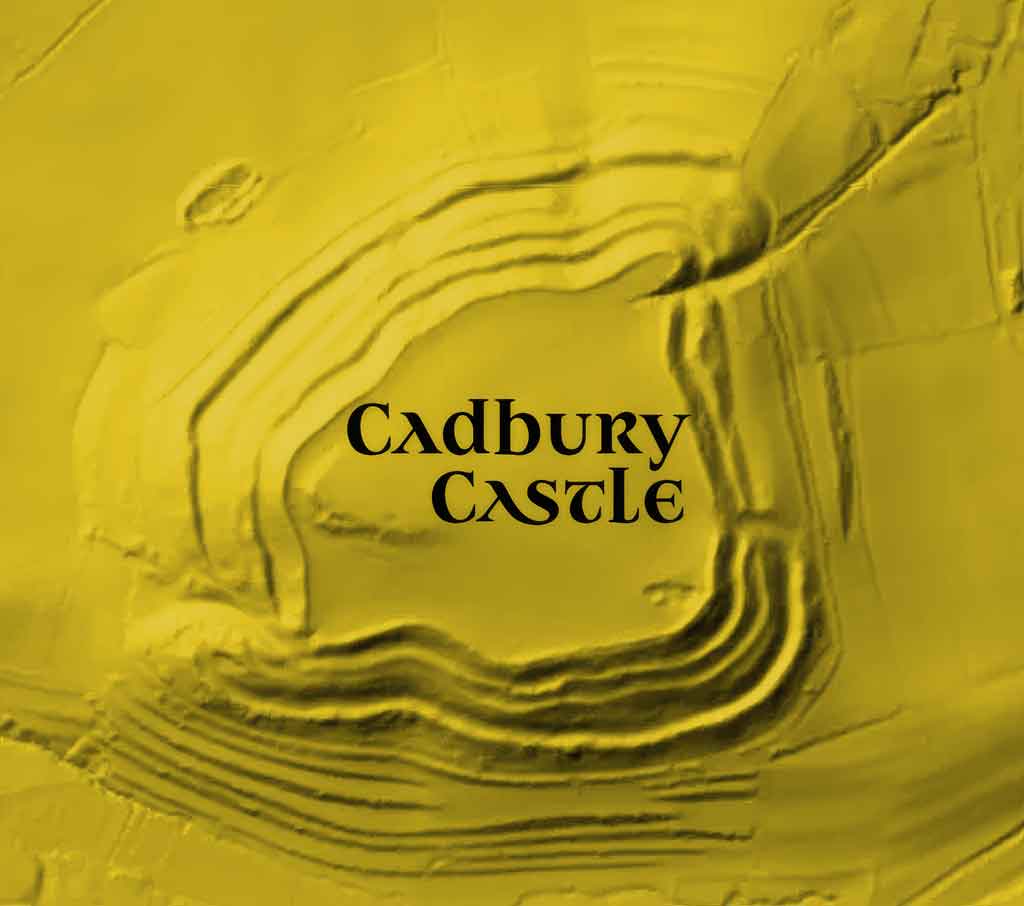
It was in Somerset that the search first took on real archaeological weight. Rising above the countryside near Yeovil, Cadbury Castle is a vast Iron Age hillfort of around eighteen acres, its multiple ramparts still commanding the surrounding farmland from every direction. Local people had called it “Camalet” long before any professional archaeologist took an interest, and a persistent local tradition tied the hill to Arthur.
The earliest surviving written record of that tradition comes from John Leland, antiquary to Henry VIII, who passed through on his great survey of England’s antiquities around 1542 and recorded what villagers told him:
“At the very south ende of the chirch of South-Cadbyri standith Camallate, sumtyme a famose toun or castelle, upon a very torre or hill, wunderfully enstrengtheid of nature… The people can telle nothing ther but that they have hard say that Arture much resortid to Camalat.”
By the middle of the twentieth century, serious scholars had started to take Cadbury seriously as a genuine candidate rather than a piece of colourful folklore. Its scale, its defensive strength and its command of the surrounding lowlands all suggested a site capable of housing a warlord of real regional power. What it needed was excavation, to test the legend against the evidence actually buried in the ground.
Did John Leland Invent Camelot?
There is, however, a complication buried in Leland’s own papers, and it has become one of the more interesting puzzles in modern Arthurian scholarship. Leland’s private notes on Cadbury, quoted above, are plain and observational: he records what the ditches and walls look like, notes the Roman coins turned up by ploughing, and adds, almost as an afterthought, that the locals say Arthur “much resortid” there. There is no drama in it, and no explicit claim that this is the famous Camelot of romance.
Compare that with the version Leland published two years later in his Assertio Inclytissimi Arturii (1544), a fierce Latin defence of Arthur’s historical existence written against the Italian humanist Polydore Vergil, who had publicly doubted Arthur was ever a real king. In the published version, the same hill becomes something closer to a set piece:
“The tradition of the Murotriges living at the bottom of the Camelot mount proclaims, exalts, and sings the name of Arthur who once lived in the castle. It was once the most magnificent and most strongly fortified… Meanwhile, the inhabitants need only plough its surface after first sowing, and every single year they turn up golden, silver, and bronze Roman coins, the embossed faces almost alive.”
Leland goes further still, comparing the ruined hillfort directly to Troy with a paraphrase of Virgil (“cornfields stand where great Troy once was, cattle are stalled within the city bounds”), and quietly upgrades himself from a traveller who had heard about Roman coins to a man who claims to have personally received some as gifts from the locals. The site’s name, “Camelot,” which appears nowhere in his own field notes, appears here for the first time in connection with Cadbury.
Leslie Alcock, who would go on to direct the 1960s excavations, concluded that the Cadbury–Camelot identification was very probably Leland’s own literary invention, made for rhetorical effect in his defence of Arthur rather than reported faithfully from what he had actually been told on site. Writing more than a century earlier, the Somerset antiquarian Rev. J. A. Bennett had reached the opposite conclusion, insisting in 1890 that Leland “did not invent the idea, but spoke of what he heard and saw.”
The truth probably sits between the two. There is genuine circumstantial evidence for an older tradition at Cadbury that predates Leland by two centuries: both Edward I in 1278 and Edward III in 1331 made unexplained overnight detours to stay at Cadbury while travelling to Glastonbury Abbey, detours the historian Caroline Shenton has suggested were deliberately Arthurian pilgrimages rather than accidents of the road. A Welsh manuscript of 1552, recorded by the scribe Elis Gruffydd, mentions a sleeping Arthur “under a hill near Glastonbury,” which the scholar Thomas Jones has argued refers to Cadbury rather than Glastonbury Tor itself. What Leland almost certainly did invent, or at least popularise for the first time in print, was the specific label “Camelot” attached to that older, vaguer hill tradition. Once it was in print, in a book written to defend Arthur’s very existence, it stuck for good.
The Camelot Research Committee
The modern excavation story does not begin with a professional archaeologist, but with an amateur enthusiast. In the early 1960s, Mrs Mary Harfield, a 77-year-old housewife from Penselwood, became convinced that the lonely hill near her village concealed Arthur’s stronghold. When she heard that the surrounding fields were about to be ploughed, she went out and collected what looked like fragments of pottery and part of an oil jar. One fragment was identified as Mediterranean in origin, exactly the sort of imported luxury good that only a wealthy patron, perhaps even a ruler, could have afforded in the difficult centuries after Rome’s departure.
Unwilling to let the matter drop, Harfield rang the commanding officer at the RAF base near Yeovil and asked whether he could arrange a reconnaissance flight over the hill. Amused but curious, the RAF obliged. The resulting aerial photographs showed the ghostly outlines of buried structures beneath the crops, and strengthened her conviction that something significant lay underground.
Harfield’s finds eventually reached leading archaeologists, among them Sir Mortimer Wheeler, one of the most celebrated excavators of his generation. By 1966 a formal body had been established to investigate properly: the Camelot Research Committee, chaired by Wheeler and directed in the field by Leslie Alcock of University College, Cardiff, with the West Country historian C. A. Ralegh Radford also on board. Their brief was straightforward. Investigate Cadbury Castle systematically, and find out whether it could plausibly have been the fortress behind the legend.
The ‘Big Dig’ at Cadbury
In 1966 the committee launched what the press quickly nicknamed the “Big Dig”: the largest excavation ever mounted on a British hillfort, running across five seasons and drawing in students, volunteers and specialists from across the country. The Honourable Society of Knights of the Round Table of Glastonbury lent a certain chivalric theatre to proceedings, and journalists kept up a steady stream of coverage, eager for any hint that Camelot had been found.
The archaeology beneath the theatre was genuinely striking. Under the Iron Age ramparts, Alcock’s team found clear evidence of reoccupation in the fifth and sixth centuries, precisely the period in which Arthur is supposed to have lived. Post-holes traced the outline of a large timber hall, roughly 65 feet long, with a floor area later calculated at around 182 square metres, comparable to the hall excavated at the British stronghold of Buiston crannog in Scotland and not far off the royal Anglo-Saxon hall at Yeavering in Northumbria. Imported amphorae and glassware from the eastern Mediterranean pointed to trade contacts stretching far beyond Somerset, the kind of luxury goods one would expect around a warlord of real wealth and standing.
Even more striking was the scale of the refortification itself. The old Iron Age defences had been rebuilt on an enormous scale using a timber-laced rampart technique, a task that would have needed a workforce of hundreds if not thousands to fell, cart and build. Alcock argued this was evidence of a major regional power centre, one whose scale, by his own later reckoning, was matched only by Tintagel among fortified sites of the period.
It is worth being precise about the dating, because this is exactly where the archaeology gets more cautious than the headlines of the 1960s suggested. The imported pottery found in the rampart material was manufactured somewhere between 460 and 470, though it need not have been deposited on site immediately. Alcock himself, writing fifteen years after the dig ended, put the likely date for the refortification and hall at “470 to 530 as close as we can get,” while the Battle of Badon, Arthur’s legendary victory, can only be dated from the Annales Cambriae to somewhere between 491 and 516. The two windows overlap, but only loosely, and Alcock openly abandoned his own earlier, more confident theory that the rampart had been built specifically as a base for a Badon campaign, admitting in 1982 that the idea “was endorsed by several reviewers, but I now regard it as quite inadequate.” The refortification could belong to Ambrosius Aurelianus or an immediate successor, to the Badon campaign itself, or to an entirely separate period of civil strife among the Britons. The archaeology, on its own, cannot decide between them.
After the Big Dig: The South Cadbury Environs Project
Alcock’s excavation ended in 1970, but Cadbury’s archaeological story did not stop there. His full technical report on the early medieval evidence was not published until 1995, twenty-five years later, with the earlier prehistoric and Roman material following in a separate volume by a different research team in 2000. From 1992 onward, a fresh initiative, the South Cadbury Environs Project, began looking outward from the hillfort into the surrounding landscape, led by Richard Tabor and Paul Johnson with volunteers from the South East Somerset Archaeological and Historical Society, and later joined by University of Birmingham training excavations under Peter Leach.
Geophysical survey across a plateau called Sigwells, just southeast of the hillfort, identified at least six distinct, datable field and boundary systems running from the Bronze Age through to the early medieval period. Neolithic ritual pits and a possible Bronze Age boat burial were found aligned on Glastonbury Tor, eighteen kilometres to the northwest, showing the hill had spiritual significance thousands of years before any Arthurian association existed. The survey also identified a violent, deliberate destruction of Cadbury’s south-west gate, evidenced by burning and a scatter of human remains along the approach route, dated to the first century BC, centuries before the Roman conquest and entirely unrelated to the later “Arthurian” reoccupation that made the site famous.
One detail from this later research is too good to leave out. The archaeologist David Morgan Evans has argued there is reasonably strong evidence that someone, quite possibly Cadbury’s owners the Hungerford family, made a deliberate attempt to promote the site as a Camelot tourist attraction as early as the seventeenth century. Long before the Camelot Research Committee, and long before the Victorians, someone had already worked out that a hillfort with Arthur’s name attached to it was worth a visit.
Is Cadbury Castle the Only Cadbury in Somerset?
One awkward complication rarely makes it into popular retellings of the Camelot story: Somerset has more than one hillfort called Cadbury, and the confusion goes back further than most people realise. As early as 1922, the archaeologist H. St George Gray, excavating a much smaller hillfort near Clevedon, felt obliged to open his report with a disclaimer: “The fame of Cadbury Camp, near Tickenham, is considerably lessened from the fact that a much larger Cadbury (Cadbury Castle, or Camelot) is situated in the heart of the county at South Cadbury.” Gray counted three separate Cadbury camps in Somerset alone. Writing sixty years later, Alcock added a fourth, “above Exeter,” and noted that the name “Camelot” remained genuinely useful for one reason above all: it let historians distinguish South Cadbury from “those by Congresbury or Tickenham.”
The Congresbury hillfort turns out to be more than a footnote. Excavated in 1959 by Keith Gardner for the Clevedon and District Archaeological Society, it produced its own spread of imported East Mediterranean amphora sherds, the same distinctive “Bii” ware that became central to Alcock’s case for high-status, elite occupation at South Cadbury. The Congresbury hillfort has no Arthurian legend attached to it at all, which makes it a useful reality check: the pattern of hillforts being reoccupied and supplied with expensive Mediterranean imports in the fifth and sixth centuries was a genuine, wider phenomenon across sub-Roman Britain, not something unique to the one hill that happens to carry Arthur’s name.
Rival Claimants to Camelot
Even while spades were turning soil at South Cadbury, other places continued to press their own claims, and the Round Table proved to be a remarkably portable idea. At Windsor, Edward III went so far as to commission an actual round building some two hundred feet across within the castle walls in 1344, intended as a meeting house for a new order of knighthood before the project was scaled back into what became the Order of the Garter; the fifteenth-century traveller William Worcester still recorded seeing its remains decades later. Near Penrith in Cumbria, a prehistoric henge monument acquired the name “King Arthur’s Round Table” by at least the sixteenth century, and a stone circle on Anglesey known as Bwrdd Arthur, “Arthur’s Table,” carries the same idea into Wales.
Scotland’s claim is older and stranger than most people realise. Stirling Castle was being marketed to visitors as Arthur’s own stronghold from at least the fourteenth century, in a tradition that seems to trace back to the political propaganda of King David II. The distinctive earthwork known as the King’s Knot, still visible in the castle grounds today, was very likely built in the 1360s to resemble an ancient monument and used for jousting, decades before being reshaped again in the seventeenth century. When the French chronicler Jean Froissart visited on royal business in 1365, he was told the castle had once been called “Sinaudon” and had hosted Arthur’s Round Table; a Burgundian visitor in 1421 was told Arthur himself had built it; and William Worcester, touring Britain around 1477, recorded flatly that “King Arthur kept the Round Table in Stirling Castle.” None of this has anything to do with the French romance name Camelot, which makes it a genuinely separate, home-grown Scottish Arthurian tradition rather than a late import.
Remarkably, Stirlingshire also produced its own, entirely independent “Camelot.” William Camden, touring Scotland for his 1610 Britain, recorded a ruined site on the banks of the River Carron near Falkirk that local people already called Camelot, close to a curious round stone structure known as Arthur’s Oven. Camden was sceptical of the name himself, suggesting the site was more likely the Roman-era Coria Damniorum mentioned by Ptolemy, but the fact that two unconnected communities, three hundred miles apart, had each independently attached the name Camelot to a ruined hillside says a great deal about how badly Britain wanted somewhere real to hang the legend on.
Back in the south, Tintagel in Cornwall retains a strong claim as Arthur’s birthplace under Geoffrey of Monmouth’s account, and excavations there in the 1990s and 2000s produced Mediterranean pottery of the same fifth and sixth-century date range found at Cadbury, alongside a stone inscribed with the name “Artognou.” Caerleon, meanwhile, is the one candidate with a direct textual claim to being Arthur’s actual court, since it is the site Geoffrey himself describes in detail. Each contender adds its own colour to the legend, but none has produced fortifications and evidence of concentrated wealth on the scale uncovered at South Cadbury.
Folklore and Enchantment at Cadbury
If archaeology offered one kind of evidence, the oral tradition recorded from villagers living around the hill offered a different, older kind entirely. In 1890 the Reverend J. A. Bennett, vicar of South Cadbury and a native of the parish, gathered up decades of local testimony before it could be forgotten, and what he recorded is remarkably specific.
The hill itself was said to be hollow. A well on its eastern face was known as King Arthur’s Well; a second spring lay directly opposite on the western slope. Villagers had a test for the hollowness of the hill: one person would clap down the stone cover on the well while a companion listened at the far spring, and claimed they could hear the noise carried straight through the ground between them. One farmer told Bennett he had once watched a barley stack, built in full view of the fields below, apparently sink from sight before threshing time, which he took as further proof the ground beneath was hollow rather than solid.
The hill’s other residents, in local memory, were fairies. Fragments of a stone handmill, or quern, found in an excavated hut on the summit were explained by one labourer as proof of what “the fairies wanted with carrying corn up here”: grinding stolen grain in their own hidden mill. The fairies were said to have abandoned the hill only when church bells were first hung nearby, leaving their gold buried behind them, along with the iron gates that generations of villagers swore led into the hill’s interior, reported independently by more than one informant decades apart, though never actually found.
Arthur himself was the most persistent tenant. On the night of a full moon, it was said, Arthur and his men rode round the hill on horses shod with silver, then stopped to water them at a nearby spring, sometimes called the Wishing Well. A silver horseshoe had reportedly once turned up in the very track where they rode, an eerie echo of the silver horseshoe Leland himself claimed to have heard about two centuries earlier during his own visit. A trackway running from the hill’s western gate towards Glastonbury was still known in Bennett’s day as King Arthur’s Lane; one labourer told him he sometimes heard Arthur and his hounds passing along it on rough winter nights. Every Christmas Eve, tradition held, Arthur and his knights rode down from the hill to drink at a spring beside the church at nearby Sutton Montis.
Modern scholarship has raised one genuinely puzzling point about all this folklore: there is no explicit written record of a sleeping Arthur specifically at Cadbury before the nineteenth century, even though the tradition feels, and probably is, much older than that. It is entirely possible that some of what Bennett recorded had already been shaped, at least in part, by villagers who had read Camden or heard of Leland’s earlier writings and folded that reading back into their own oral tradition, a reminder that folklore and written history do not always flow in one tidy direction.
Camelot Between Myth and History
Camelot has always existed somewhere between imagination and fact. Medieval poets conjured its shining halls out of nothing. Tudor antiquarians dressed up a Somerset hillfort in the language of Troy. Victorian dreamers turned it into pageantry and stained glass. Twentieth-century archaeologists brought trowels, geophysical survey equipment and radiocarbon dates to a hill above the Somerset Levels, hoping the soil itself might settle the question. Each age found, more or less, the version of Camelot it had gone looking for.
At Cadbury the physical evidence is genuinely substantial: a fortress refortified on a scale matched by almost nowhere else in Britain, in exactly the decades when Roman order was collapsing and Saxon power was rising; a feasting hall large enough for a warlord and his retinue; imported glass and pottery that speak of trade routes reaching all the way to the eastern Mediterranean. And the folklore, layered on top across four centuries of retelling, from Leland’s silver horseshoe to Bennett’s hollow hill and sleeping king, keeps insisting that the past has never entirely left the hill, only settled a little further into the ground.
Perhaps the most honest word on the subject belongs to Leslie Alcock himself, the man who dug more of Cadbury Castle than anyone else ever has. Fifteen years after his own excavation made headlines around the world, in a 1982 lecture given at the British Academy, he told his audience plainly where he now stood: “My position on the historicity of Arthur is one of agnosticism, and for the present I shall discuss Cadbury-Camelot without Arthur.” The man whose spadework had done more than any other single piece of research to put Cadbury and Camelot in the same sentence had, by the end, chosen caution over romance.
That does not make the search a failure. Camelot may never have been one single, locatable place at all. It may be better understood as an idea that different generations kept relocating to wherever they most needed it: a vision of lost unity, a dream of order and loyalty holding the line against chaos. Seen that way, Cadbury, Tintagel, Winchester, Stirling and Caerleon are not really rivals competing for one prize. Each preserves its own fragment of the same story, and each offers its own doorway into it. Camelot endures as a kind of mirror. Searching for Arthur’s court, each generation has really been searching for itself, for that imagined golden moment when courage and fellowship might hold back the dark. Whether or not Cadbury was ever truly Camelot, the search has kept Arthur’s shadow walking beside us for eight hundred years, and shows no sign of stopping now.
Frequently Asked Questions
Was Camelot a real place?
Almost certainly not as the romances describe it. The name Camelot first appears in French poetry of the 1170s, written more than six centuries after Arthur was supposed to have lived, and no place called Camelot is recorded anywhere before then. What may well be real is the underlying pattern the legend describes: a powerful British warlord operating from a genuinely large, heavily fortified hilltop stronghold in the difficult decades after Roman Britain collapsed.
Where was Camelot supposed to be located?
There has never been agreement. Geoffrey of Monmouth placed Arthur’s court at Caerleon in South Wales. Later writers and local traditions proposed Winchester, Glastonbury, Tintagel, Stirling and, most persuasively of all on archaeological grounds, Cadbury Castle in Somerset, which antiquary John Leland identified with Camelot in the 1540s.
Why is Cadbury Castle linked to Camelot?
Cadbury Castle is a genuinely enormous Iron Age hillfort that was dramatically refortified in the fifth or sixth century, exactly the period in which Arthur is traditionally placed. Excavations directed by Leslie Alcock between 1966 and 1970 found a large timber hall and imported Mediterranean pottery, evidence of a wealthy, powerful stronghold unmatched by almost any other site of the period in Britain.
Did John Leland invent the name Camelot for Cadbury Castle?
Very possibly, at least in the specific form we know it. Leland’s own private field notes describe Cadbury’s ruins factually and mention only that locals believed Arthur had “resorted” there. It was only in his later published defence of Arthur, the Assertio Inclytissimi Arturii of 1544, that he named the hill Camelot outright and dressed the description up rhetorically. Some evidence, including unexplained royal visits to Cadbury in 1278 and 1331, suggests an older, vaguer Arthurian tradition existed at the site before Leland arrived, even if the specific label was his.
What did archaeologists actually find at Cadbury Castle?
Leslie Alcock’s 1966–70 excavation found evidence of a massive timber-laced rampart and a large rectangular feasting hall, both dated to roughly AD 470–530, along with amphorae and glassware imported from the eastern Mediterranean. Later fieldwork by the South Cadbury Environs Project, from 1992 onward, traced the surrounding landscape’s use back to the Neolithic period and forward past the Anglo-Saxon era.
Is Cadbury Castle the only place in Somerset called Cadbury?
No. Somerset has at least three other sites with “Cadbury” in the name, at Congresbury, Tickenham and near Exeter, none of which carry any Arthurian legend. Archaeologists have used the name “Camelot” since at least the 1920s specifically to distinguish South Cadbury from its unrelated namesakes.
Did Leslie Alcock believe Cadbury Castle really was Camelot?
By the end of his career, no, or at least not with any confidence about Arthur specifically. In a 1982 lecture reviewing his own excavation fifteen years on, Alcock described his position on Arthur’s historical existence as one of “agnosticism,” and walked back his earlier, more confident claim that Cadbury’s refortification had been built for a specific military campaign against the Saxons.
What is the Round Table, and did it really exist?
The Round Table first appears in literature in Wace’s Roman de Brut, around 1155, as a device to stop Arthur’s knights quarrelling over precedence. The physical “Round Table” now on display at Winchester is a genuine medieval artefact, but archaeological and documentary research dates its construction to around 1290, more than 750 years after Arthur was supposed to have lived, with its painted decoration added in 1522 under Henry VIII.
Further Reading and Sources
- J. A. Bennett, “Camelot,” Proceedings of the Somersetshire Archaeological and Natural History Society, new series XVI, part II (1890)
- Leslie Alcock, By South Cadbury is that Camelot…: The Excavation of Cadbury Castle 1966–1970 (Thames and Hudson, 1972)
- Leslie Alcock, “Cadbury-Camelot: A Fifteen-Year Perspective,” Proceedings of the British Academy 68 (1982/83), pp. 355–388
- Leslie Alcock, S. J. Stevenson and C. R. Musson, Cadbury Castle, Somerset: The Early Medieval Archaeology (University of Wales Press, 1995)
- Richard Tabor, “Cadbury Castle: Focusing the Landscape,” in the Somerset Archaeological and Natural History Society’s 150th anniversary volume
- H. St George Gray, Trial-Excavations at Cadbury Camp, Tickenham, Somerset, 1922, Proceedings of the Somersetshire Archaeological and Natural History Society (1923)
- Keith S. Gardner, Excavations at Cadbury Camp, Congresbury, Somerset (Clevedon and District Archaeological Society, 1959)
- Mary Bateman, Localising Arthur in England and Wales, 1400–1610, PhD thesis, University of Bristol (2020)
- William Camden, Britain (English translation of Britannia, 1610 edition)
- John Leland, The Itinerary and Assertio Inclytissimi Arturii (1544)