Long before anyone asked whether a mushroom was a plant, an animal, or something stranger, people already knew it was dangerous to ignore. A ring of dark grass appears in a meadow overnight, too perfect to be natural. A scarlet-and-white cap erupts from bare earth in hours and rots to slime within days. Eat the wrong one and you might die in agony, or laugh uncontrollably, or see the room fill with roses and grinning faces. Across three thousand years and half a dozen civilisations, people reached for the same explanation: something other than nature was at work. Fairies. Gods. The Devil. Lightning from the hand of a storm-god. This is the story of how the humble mushroom became one of the most heretical objects in human folklore - equally at home in a Welsh fairy legend, a Vedic hymn, a Roman poisoning plot, and, some have argued, the Garden of Eden itself.
Contents
- Why Mushrooms Unsettled Us: Mycophobia and the Overnight Miracle
- The Toadstool and the Toad: A Name Steeped in Old Magic
- Fairy Rings: The Dancing Grounds of the Little People
- Lost in the Ring: Welsh Legends of Fairy Abduction
- Bwyd Ellyllon: Wales' "Goblins' Food"
- Fairy Butter, Fairy Bread, and the Furniture of Faerie
- Witches, the Devil, and the Fungus Between Them
- Soma: Was a Mushroom Once Worshipped as a God?
- The Eleusinian Mysteries and the Kykeon
- Born of Lightning: A Myth That Spans Three Continents
- The Plaincourault Fresco: Was Eden's Tree a Toadstool?
- Drunk on Toadstools: The Fly Agaric of Siberia
- The Viking Berserker Myth - Busted
- Food of the Gods: Rome's Mushroom Cult of Death
- Frequently Asked Questions
- Sources & Further Reading
Why Mushrooms Unsettled Us: Mycophobia and the Overnight Miracle
In 1927, the mycologist R. Gordon Wasson watched his Russian-born wife Valentina gather wild mushrooms on their honeymoon in the Catskills with what he could only describe as ecstasy. Wasson, raised an "Anglo-Saxon oaf" as he later put it, begged her to put the poisonous things down. That single clash of instincts - one culture's rapture against another's revulsion - became the question that occupied the rest of his life: why do some peoples treat mushrooms as food fit for gods, while others treat them as something closer to a curse?
The English-speaking world has always leaned toward the curse. The mycologists Eleanour and R. T. Rolfe, writing in 1925, borrowed a term from an earlier writer, W. D. Hay, to describe it:
"This popular sentiment, which we may coin the word 'Fungophobia' to express, is very curious… It is so deep and intense a prejudice that it amounts to a national superstition."
Part of the fear was practical - fungus poisoning was a real and often fatal hazard long before field guides existed to sort the edible from the deadly. But part of it was something closer to metaphysical unease. A mushroom has no seed you can see, no flower, no obvious parent plant. It simply arrives - sometimes overnight, sometimes in a single perfect ring - and then it rots away just as fast, dissolving into black liquid or bursting into a cloud of spores. Chroniclers in 1348 linked the sudden appearance of monstrous fungi to the arrival of the Black Death itself, describing them as "scarlet and mauve and liver and black… as though the sick earth had burst into foul pustules." A thing that grows that fast, dies that fast, and sometimes kills you besides, was never going to be filed away as an ordinary plant. It needed a story.
The Toadstool and the Toad: A Name Steeped in Old Magic
Start with the word itself. "Toadstool" sounds almost too on-the-nose - a stool for a toad to sit on - and English folklore duly supplied the image. Edmund Spenser wrote of "the griesly Todestol… And loathed paddocks lording on the same," and the herbalist Gerard warned that poisonous mushrooms grow "where old rusty iron lieth, or rotten clouts, or neere to serpent's dens," warning strange-food lovers to "beware of licking honey among thornes." The toad, in medieval and early modern Europe, was widely treated as a stand-in for the Devil himself, so a stool built for a toad was as good as branding the fungus beneath it demonic property.
But look closer and the word gets stranger. Wasson, tracing "toadstool" and its cognates across Europe, found it thriving in English, Norwegian, Danish, Low German, Dutch, Frisian, Breton, Welsh, and Irish - and almost entirely absent from standard French, the other Romance languages, and standard High German. Mapped out, the distribution forms an unmistakable shape:
"…the citadel of the 'toadstool' is in the ring of peoples who dwell around the shores of the North and Irish Seas, a gigantic and evil fairy-ring, as it were, embracing the surviving Celts, many of the Germanic peoples, provincial France… and the Spanish Basque country."
Wasson's provocative theory is that this is no coincidence of etymology. He argues the fly agaric mushroom was once sacred and shamanically potent across the Celtic and Germanic north - so charged with awe that people stopped saying its real name aloud, replacing it with an evasive euphemism, much as English speakers once avoided naming the fairies directly and called them "the good neighbours" instead. What survived into the modern language, on this theory, isn't really a description of a toad's furniture. It's the fossil of a pagan taboo.
Fairy Rings: The Dancing Grounds of the Little People
If there is one piece of mushroom folklore that never went away, it's the fairy ring - a band of darker, lusher grass, sometimes studded with toadstools, appearing in an old pasture as if drawn with a compass. Shakespeare returns to the image three separate times. Prospero, in The Tempest, addresses the fairies directly:
"You demi-puppets, that / By moonshine do the green sour ringlets make, / Whereof the ewe not bites; and you whose pastime / Is to make midnight mushrooms."
In The Merry Wives of Windsor, Mistress Quickly instructs the fairies to "nightly… sing, / Like to the Garter's compass, in a ring." Wirt Sikes, cataloguing Welsh belief in 1880, found the superstition still very much alive in adult memory, if not always adult conviction:
"The peasantry no longer believe that the fairies can be seen dancing there, nor that the cap of invisibility will fall on the head of one who enters the circle; but they do believe that the fairies… made these circles with the tread of their tripping feet, and that some misfortune will probably befall any person intruding upon this forbidden ground."
The taboos clustered thickly around the rings. Girls gathering May-dew to improve their complexion avoided the grass inside a ring "for fear of displeasing these little beings, and so losing their personal charms." Cattle were said to refuse to graze on ring-grass - except, according to Sikes, in Wales, where the opposite belief took hold: "the Welsh sheep… are the only beasts which will eat the grass that grows in the fairy rings… hence the superiority of Welsh mutton over any mutton in the wide world." Near Alnwick, running around a ring more than nine times was thought to invite misfortune. A Scots proverb put the danger plainly: "He wha tills the fairy green, / Nae luck again sall hae."
Naturally, once belief in fairies began to fade, someone had to propose a respectable alternative explanation - and for two centuries, the leading candidate was lightning. Erasmus Darwin, grandfather of Charles Darwin, was still defending the lightning theory in 1791. It took until 1807 for Dr. William Wollaston to correctly attribute the rings to fungal growth, and until 1796 for the botanist William Withering to confirm it: the fungus's underground network (mycelium) spreads outward year on year, exhausting nutrients at its centre while enriching a growing ring at its edge - exactly the "midnight mushrooms" of Shakespeare's fairies, now explained, and just as strange for the explaining.
Lost in the Ring: Welsh Legends of Fairy Abduction
Wales preserved the darkest version of Britain's fairy abduction lore: step inside a ring, and you might not come back the way you expect. In the parish of Llanwrin, a magical yew stood over what local tradition called "the Dancing Place of the Goblin." Two farm-servants fell asleep beneath it; one of them, Iago, vanished into the ring itself. He was rescued a year later, on the precise instructions of a local "conjuror" - approach the circle, never step inside it, and snatch the boy out as he danced past with the fairies. Iago believed only minutes had passed. As soon as he tasted food again, he crumbled to dust.
The same fate met a Carmarthenshire farmer who joined the Tylwyth Teg dancing in a fairy ring while out fetching horses. He couldn't leave until, years later, a passer-by broke the spell by invoking God's name - at which point "he stepped from the fairy circle and instantly crumbled away and mingled his dust with the earth." Near Neath, an old estate gardener claimed to have watched fairies dancing for years around a Roman standing stone that stood, by local reckoning, on a fairy ring - until the stone was removed to a grotto, after which the fairies were never seen there again, an act of sacrilege he was certain would not go unpunished.
Read against Wasson's taboo theory above, and against Britain's wider changeling folklore, these Welsh tales start to look less like whimsical fairy-tales and more like inherited warnings: don't take what belongs to the ring, don't eat what grows there uninvited, and if you do, don't expect to return unchanged.
Bwyd Ellyllon: Wales' "Goblins' Food"
Nowhere is the fungus-fairy connection more explicit than in Welsh folk vocabulary itself. Two independent nineteenth-century folklorists, Wirt Sikes and Elias Owen, working decades apart and drawing on the same source (Pughe's Welsh Dictionary), record precisely the same folk-taxonomy:
"Their food is specified in Welsh folk-lore as fairy butter and fairy victuals, ymenyn tylwyth teg and bwyd ellyllon; the latter the toad-stool, or poisonous mushroom… Their gloves, menyg ellyllon, are the bells of the digitalis, or fox-glove." - Wirt Sikes, British Goblins
"…the Mushroom, Fairy Food… Bwyd Eityllon [Ellyllon], or Goblins' Food. This was a kind of fungus or mushroom." - Elias Owen, Welsh Folk-lore
Toadstool as literal goblin food; foxglove bells as goblin gloves - a whole wardrobe and larder assembled for the Tylwyth Teg out of the plants people already found faintly sinister. A Breconshire legend takes the idea one step further: the fairies were said to reward kind peasants with loaves of bread, which turned to toadstools by morning unless eaten immediately, in darkness, and in silence - a gift from the Otherworld that reverts to its true, uncanny nature the instant ordinary rules are broken.
Fairy Butter, Fairy Bread, and the Furniture of Faerie
Once you start looking, an entire miniature economy of fairy household goods turns out to be made of fungus, and the same vocabulary shows up again and again across completely independent regional sources - a sign of just how widely shared this folk imagination once was.
- Fairy butter - a soft yellow fungus (Tremella or Exidia) found on rotting wood, "supposed to be made in the night, and scattered about by the Fairies." The Welsh version is different again: a petroleum-like substance found deep in limestone cavities, called Menyn Tylwyth Teg.
- Fallen stars - gelatinous fungi appearing overnight on gravel paths, as though dropped from the sky.
- Fairy cheese - the fruit of the mallow plant, grouped in folk-memory alongside the fungal items even though botanically unrelated.
- Fairy purses - small Lincolnshire cup-fungi "like nests with eggs."
- Fairy tables / pixie-stools - toadstools themselves, especially near a ring.
- Fairies' Bath - the scarlet elf-cup, Peziza coccinea, doubling as a hat in some tellings.
The pattern isn't confined to Britain. Nineteenth-century botanist George Watt recorded the common mushroom's vernacular Indian name as "Kullalic-div" - "the Fairies' Cap" - and when the American mycologist Charles McIlvaine catalogued folk names for U.S. species decades later, the same instinct had simply crossed the Atlantic: Tremella albida as "Fairy bread… the choicest baking," Pezizae as "wassail cups" for creatures with appetites "better suited to Fairy appetites than to those of mortals."
Even the etymology of "pixie-stool" turns out to encode a piece of mythology in miniature. According to the plant-lore scholar R. C. A. Prior, the word preserves "the identity of the king of the fairies, Puck, with the toad" - pixie being a diminutive of Puck, and the pixie-stool simply the toad-stool by another name. The word "puffball" carries the same fingerprint: it derives, Rolfe notes, from "puck or poukball," Puck's own Celtic name surviving in Irish puca, Welsh pwca, Icelandic and Swedish puke - all meaning elf, hobgoblin, or demon.
Witches, the Devil, and the Fungus Between Them
Not every ring belonged to fairies. On the Sussex downs, the very same phenomenon went by a darker name: "hag-tracks," from the belief that witches, not fairies, danced there at midnight. And fungus folklore split cleanly along the same line as fairy folklore itself - benign wonder on one side, malevolent magic on the other.
A yellow jelly fungus known as Witch's Butter carried its own small ritual of counter-magic, the same curse-breaking instinct behind the craft of the Cornish pellars. Elias Owen recorded the custom directly:
"Should anyone think himself witched, all that he has got to do is to procure 'witch's butter,' and then thrust a pin into it. It was thought that this pin penetrated the wicked witch, and every pin thrust into the fungus went into her body, and thus she was forced to appear, and undo her mischief."
Sweden preserved a strikingly similar belief about the same substance, there called troll smör ("Troll's Butter") - the product, supposedly, of witches and trolls milking other people's cows and discarding the enchanted result. Deformed, twiggy fungal growths on tree branches, meanwhile, were explained as literal witches' brooms, left behind after nocturnal flights - a folk-etymology so tidy it barely needed the fungus to be true.
The Devil claimed his own share of the fungus kingdom outright. Puffballs became "the Devil's Snuff-box" across large parts of England; the stinkhorn - a fungus whose shape and smell made the association almost inevitable - was "the Devil's Stinkpot" in Yorkshire and "the Devil's Horn" in Norfolk. In Scotland, puffball spores were "Blind Men's Een," believed to cause blindness if they touched the eyes. American mycologists, writing more skeptically a century later, still couldn't resist naming a poisonous bolete Boletus Satanus - tempered, at least, by the old proverb that "the Devil is not as black as he is painted."
Soma: Was a Mushroom Once Worshipped as a God?
All of this is folk survival - fragments of a bigger belief, worn down by centuries of retelling into charming superstition. But R. Gordon Wasson's life's work argued that somewhere behind the fairy tales lay something much larger: an actual, functioning religion built around a mushroom, and one whose scripture survives intact.
The Rig Veda, one of the oldest religious texts on Earth, devotes 120 of its 1,028 hymns to a being called Soma - simultaneously a god, a plant, and the sacred juice pressed from that plant. Wasson called it "the only plant that man has ever deified," and after decades of research staked his reputation on identifying it:
"My candidate for the identity of Soma is Amanita muscaria… the brilliant red mushroom with white spots familiar in forests and folklore throughout northern Eurasia."
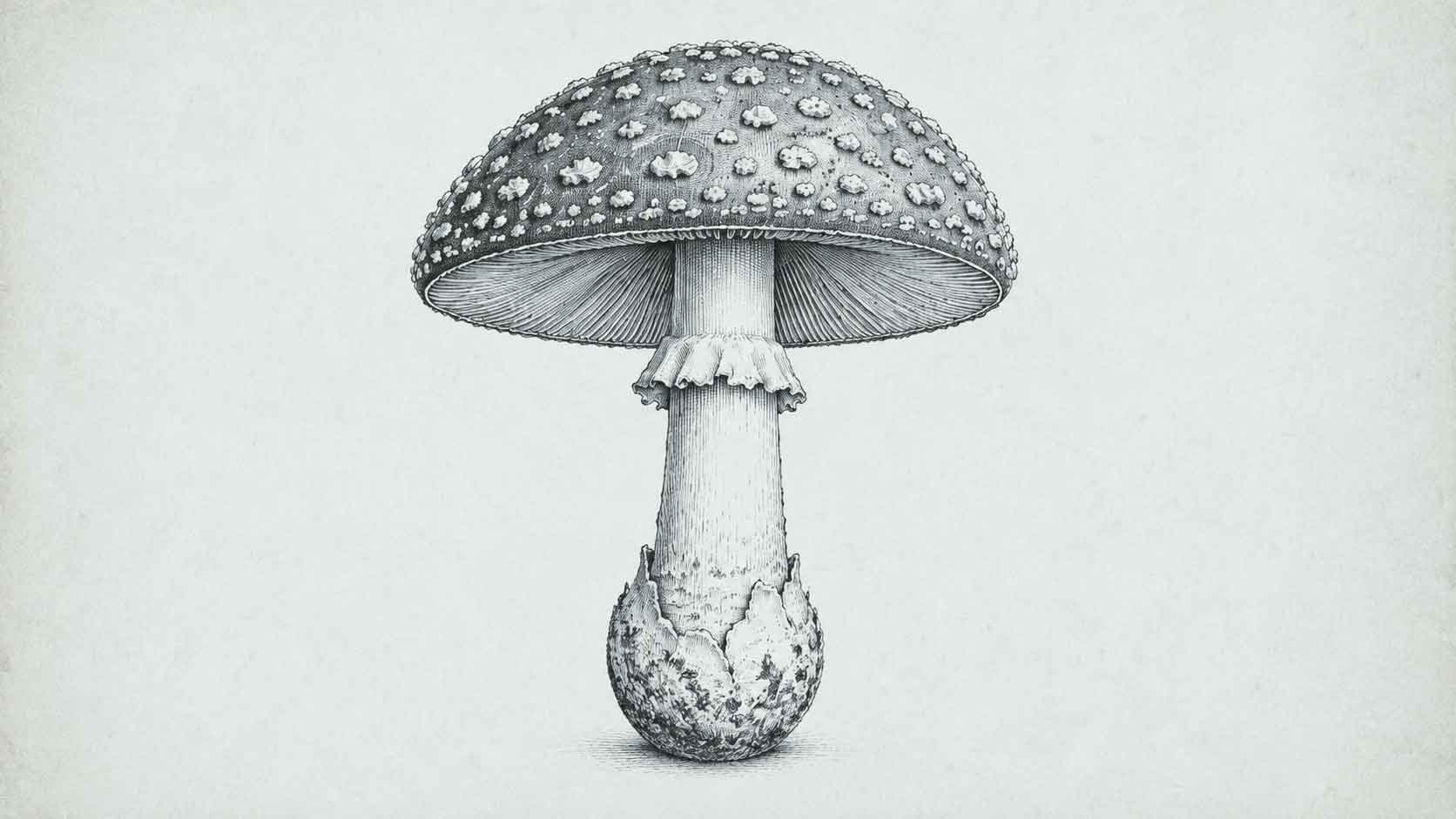
The fly agaric - the same scarlet, white-spotted toadstool that decorates Christmas cards and garden gnomes - was not, on this theory, a decorative mushroom at all, but the literal body of a god, consumed in shamanic ritual across Siberia for millennia before the Vedic hymns were ever composed. Wasson found supporting evidence in the mushroom's own name across dozens of Eurasian languages: consistently evasive, consistently euphemistic, never quite saying the plain thing - the linguistic residue, he argued, of the same naming-taboo that gave English "toadstool."
It was partly in response to this research that a committee of scholars, including the classicist Carl Ruck, coined an entirely new English word in the 1970s: entheogen, "god generated within" - deliberately built to replace "hallucinogen," a word Wasson considered close to a lie, since it implies the visions produced are merely false, rather than, as believers across cultures and centuries insisted, a genuine encounter with the divine.
The Eleusinian Mysteries and the Kykeon
Wasson didn't stop at India. Working with Albert Hofmann - the chemist who first synthesised LSD - and Carl Ruck, he proposed that the kykeon, the sacred potion drunk at the climax of the Eleusinian Mysteries, the most important religious rite of the ancient Greek world, was itself an entheogenic brew: a carefully controlled preparation of ergot, the same fungus that in uncontrolled doses causes convulsive poisoning and gangrene, grown on grain from the plain near Eleusis.
The claim, published in 1978 as The Road to Eleusis, did not go down well in every classics department:
"One well known English professor of Greek burst out in anger at our saying that a potent potion was drunk at Eleusis… He seemed to wish to join the class of those pastors in our Bible Belt who… seriously pretended that Jesus served grape juice, not wine, at his Last Supper!"
Whether or not the specific chemistry holds up, the reaction itself is revealing. The idea that Western civilisation's most revered ancient religious rites may have depended on a psychoactive fungus remains one of the most heretical suggestions in the study of classical religion - which is, of course, exactly the kind of question this magazine exists to keep asking.
Born of Lightning: A Myth That Spans Three Continents
One detail keeps resurfacing wherever sacred mushrooms are discussed, in places with no plausible route of cultural contact between them: the idea that the mushroom is not born of soil or seed at all, but struck into being by lightning.
In the Rig Veda, Soma carries the epithet Aja Ekapad - "not-born, single-foot" - born of a lightning strike, not from ordinary generation. In 1955, the Zapotec healer Aristeo Matías told Wasson directly that the sacred mushrooms of Oaxaca were the offspring of "the Great Lightning Bolt" mating with "the fecund mother earth." Among the Quiché Maya of Guatemala, the mycologist Bernard Lowy discovered that kakuljá - the word for a devastating lightning strike - is also the everyday name for Amanita muscaria itself; market vendors warned him off the kakuljá he had gathered, calling it itzel ocox, "the evil mushroom." The Popol Vuh names a member of its divine trinity Kakuljá Huracán - "lightning, one-leg" - the likely deep root, by way of Spanish, of the English word "hurricane."
And in the classical Mediterranean, the very same conviction attached itself to truffles. Theophrastus records the belief that truffles are generated by autumn thunderstorms; Plutarch devotes an entire dinner-party dialogue to the theory that a "generating fluid" carried in thunder produces them underground, since truffles - unlike ordinary plants - visibly lack any root or shoot. Juvenal alludes to the same idea, describing a feast graced with truffles "if the longed-for thunders have produced the precious dainties." Centuries later, once fairy-belief began to fade in Britain, lightning was the very first replacement theory reached for to explain fairy rings (see above) - the same folk logic, recycled onto a new mystery, on the other side of the world from where it began.
The Plaincourault Fresco: Was Eden's Tree a Toadstool?
Few images have caused more excitement in fringe scholarship than a faded fresco in a ruined chapel at Plaincourault, in the French region of Berry, painted around 1291. It depicts the Fall of Man - and the Tree of Knowledge is rendered not as any recognisable tree, but as a branching red-and-white form that, to modern eyes, looks remarkably like an Amanita muscaria, serpent coiled through its "branches," Eve standing beside it in evident doubt about what she has just eaten.
The theory that this fresco preserves a secret memory of a psychoactive-mushroom cult surviving inside medieval Christianity was first floated before the Société Mycologique de France in 1910, and it has never quite gone away since - it remains one of the most widely shared images in modern discussion of entheogens and religion. What is less widely shared is that Wasson himself, the man whose work did more than anyone's to popularise the mushroom-and-religion thesis, investigated the fresco and rejected the claim. He corresponded with the art historian Erwin Panofsky, who explained in 1952 that the "mushroom tree" is in fact a recognised, recurring convention in Romanesque and early Gothic art - a stylised descendant of schematic pine-tree motifs going back to Roman and Early Christian painting. Panofsky's verdict was blunt: "the similarity with Amanita muscaria is purely fortuitous."
It's a useful corrective to keep in mind. The most seductive heretical readings of history are not always the correct ones - and the willingness to test a beautiful theory against the evidence, and abandon it if it fails, is itself part of what makes Wasson's wider case worth taking seriously.
Drunk on Toadstools: The Fly Agaric of Siberia
Whatever the truth about Vedic gods and Gothic frescoes, one fact about Amanita muscaria is beyond dispute: for centuries, it genuinely was used across Siberia and Kamchatka to get deliberately, ritually intoxicated - and European travellers' accounts of the practice were reprinted in British newspapers for well over a hundred years, treated as a strange foreign curiosity worth retelling again and again.
The method, described almost identically by sources a century apart, involved drying the mushrooms, then swallowing them whole, rolled into a bolus:
"If a person under its influence wishes to step over a straw or small stick, he takes a stride or a jump sufficient to clear the trunk of a tree; a talkative person cannot keep silence or secrets; and one fond of music is perpetually singing."
The strangest detail concerns what happened afterward. The active compounds in fly agaric pass through the body largely unmetabolised - meaning a drinker's urine remains as intoxicating as the mushroom itself, and can be drunk by a second person, a third, even a fifth, stretching a handful of mushrooms into a week-long communal binge. The Russian-American traveller Kennan recorded a Koryak band sharing a single toadstool this way, staying "drunk for a week." Wasson later connected this practice to a startling piece of religious history: medieval Chinese sources describe Manichaean devotees in Fukien province eating red mushrooms and treating urine as sacred ritual water for ablution - a possible surviving echo, he suggested, of the same mushroom cult, filtered through an entirely different religious tradition centuries later.
British newspaper readers absorbed a sanitised version of all this for generations. An 1852 Liverpool Albion clipping explains that the mushroom "intoxicates people who eat it," used by "the Kamtschatkadales, as a substitute for alcoholic liquors." An 1892 piece in the Cumberland & Westmorland Herald repeats the leap-over-a-log detail nearly word for word. By 1871, homeopathic chemists in Reading were selling bottled "Agaricus Muscarius" as a chilblain remedy - the sacred intoxicant of Siberian shamans, quietly reduced to a Victorian foot cream.
The Viking Berserker Myth - Busted
No piece of mushroom folklore has proven more durable, or more wrong, than the claim that Viking berserkers worked themselves into their legendary battle-rage by eating fly agaric. The theory was invented whole-cloth by the Swedish scholar Samuel Ödman in 1784, based on nothing more than secondhand travellers' tales from Siberia, and it was subsequently repeated as established fact in Scandinavian textbooks for two centuries.
Wasson - the very scholar whose work made Amanita muscaria famous as a sacred intoxicant - devoted part of Soma to demolishing it outright:
"The fly-agaric is never mentioned in the Sagas or Eddas… There is no record of an oral tradition antedating the 19th century of such a practice."
"The symptoms of fly-agaric inebriation are the opposite of berserk-raging… The effect of the fly-agaric is soothing, comforting, quieting, tranquillizing."
None of this stopped the theory circulating in the British press well into the twentieth century. A Burnley Gazette science column in 1886 states as fact that the fly agaric "induced symptoms of frenzy, similar to that of the Berserkers." Country Life was still repeating it in 1937: "Scandinavian traditions say that the Vikings went berserk by eating it." It is, in miniature, a perfect case study in how a folklore claim can outlive its own debunking by well over a century - a caution worth remembering the next time a tidy, dramatic explanation for a historical mystery starts circulating online.
Food of the Gods: Rome's Mushroom Cult of Death
Rome's relationship with fungi was less mystical than shamanic Siberia's, but no less charged. Pliny records that mushrooms were "the only food which dainty voluptuaries themselves prepare with their own hands… using amber knives and silver service," and special cooking vessels, boletaria, were reserved exclusively for the prized Boletus - almost certainly what we would now call Amanita caesarea, Caesar's mushroom, which the Greeks themselves called Cibus Deorum: food of the gods.
That title turned savagely ironic in AD 54. Pliny, Suetonius, and Tacitus all agree that the empress Agrippina poisoned the Emperor Claudius with a dish of his favourite boleti, clearing the succession for her son Nero. Nero, fully aware of how his stepfather had died, made no effort to hide the joke:
"…he used to declare that Boleti were food of the gods. This was obviously a joking allusion to the apotheosis of his predecessor."
The Romans also inherited - and repeated for centuries - a folk theory about why some mushrooms killed and others didn't: poisonous fungi, Pliny and Dioscorides both claimed, absorbed venom by growing near serpents' dens, "breathed on" by the snake as the mushroom opened. The advice that followed was entirely practical: gather your fungi "until the serpents retire into their holes." The image proved so durable that Renaissance herbals were still illustrating poisonous mushrooms with coiled serpents in 1560, more than 1,500 years after Pliny first wrote the theory down.
Fungi even had their own dedicated place on the religious calendar. The Robigalia, said to have been instituted by King Numa himself, was held every April 25th to appease Robigus, a rust-god believed responsible for the fungal blight (Puccinia graminis) that could destroy an entire wheat harvest. A procession walked five miles from Rome to a sacred grove, where a red-coated dog and a sheep were sacrificed and wine poured out to "the stern Rust-god" - an entire state cult built, in the end, around not being infected by a fungus.
Frequently Asked Questions
Why are mushrooms associated with fairies in folklore?
Mostly because of fairy rings - the naturally occurring circles of dark grass and toadstools produced by underground fungal growth. Before the botanical explanation was confirmed in the late 1700s and early 1800s, these rings were widely explained as the dance-tracks of fairies, and the toadstools growing within them were said to be fairy furniture, food, or the residue of fairy revels.
What is "Bwyd Ellyllon"?
It's a Welsh term meaning "goblins' food," recorded independently by two nineteenth-century folklorists as the specific folk-name for toadstools or poisonous mushrooms, part of a wider Welsh vocabulary that also named foxgloves "fairy gloves" and a limestone mineral deposit "fairy butter."
Is it true that Soma, the Vedic god, was a mushroom?
It's a serious scholarly hypothesis, not a settled fact. R. Gordon Wasson argued at length that Soma, the deified plant of the Rig Veda, was Amanita muscaria, the fly agaric mushroom, based on linguistic, ethnographic, and textual evidence. The theory remains debated among Vedic scholars, but it fundamentally reshaped how historians think about the possible role of psychoactive plants in the origins of religion.
Does the Plaincourault fresco really show a magic mushroom in the Garden of Eden?
The fresco genuinely exists and does resemble a fly agaric to modern eyes, but the leading art-historical explanation - accepted even by Wasson himself - is that it depicts a conventional stylised "mushroom tree" common in Romanesque and Gothic religious art, unrelated to any actual mushroom cult.
Did Vikings really eat fly agaric mushrooms before going berserk in battle?
No credible evidence supports this. The theory originated with an eighteenth-century Swedish scholar working from secondhand Siberian travel accounts, not from any Norse source. The fly agaric is never mentioned in the Sagas or Eddas, and its actual effects are calming rather than rage-inducing.
Why did the Fly Agaric mushroom become linked to Siberian shamanism?
Amanita muscaria was used for centuries by peoples across Siberia and Kamchatka to produce deliberate intoxication, often within a shamanic or ritual context, well documented by eighteenth- and nineteenth-century travellers and still referenced in popular science writing into the twentieth century.
Sources & Further Reading
This article draws on primary and secondary sources spanning more than two thousand years, from Roman natural history to twentieth-century ethnomycology and nineteenth-century British newspaper archives. Readers wanting to go deeper should start with the following:
- Wasson, R. Gordon. Soma: Divine Mushroom of Immortality. Ethno-Mycological Studies No. 1, 1968.
- Wasson, R. Gordon. "Persephone's Quest," in Persephone's Quest: Entheogens and the Origins of Religion. Yale University Press, 1986.
- Wasson, R. Gordon, Albert Hofmann, and Carl A. P. Ruck. The Road to Eleusis: Unveiling the Secret of the Mysteries. Harcourt Brace Jovanovich, 1978.
- Buller, A. H. Reginald. "The Fungus Lore of the Greeks and Romans." Presidential Address, Transactions of the British Mycological Society, 1914.
- Pliny the Elder. Natural History (Bostock & Riley translation), Books XXV–XXXI.
- Rolfe, R. T., and F. W. Rolfe. The Romance of the Fungus World. Chapman & Hall, 1925.
- Sikes, Wirt. British Goblins: Welsh Folk-lore, Fairy Mythology, Legends and Traditions. 1880.
- Owen, Elias. Welsh Folk-lore: A Collection of the Folk-tales and Legends of North Wales. 1896.
- Thiselton-Dyer, T. F. The Folk-Lore of Plants.
- Skinner, Charles M. Myths and Legends of Flowers, Trees, Fruits, and Plants.
- Prior, R. C. A. On the Popular Names of British Plants.
- Ellacombe, Henry N. The Plant-Lore and Garden-Craft of Shakespeare.
- Cooke, M. C. A Plain and Easy Account of the British Fungi. 1871.
- Folkard, Richard. Plant Lore, Legends and Lyrics. 1884.
- McIlvaine, Charles, and Robert K. Macadam. Toadstools, Mushrooms, Fungi, Edible and Poisonous; One Thousand American Fungi. 1900.
- Verrill, A. E. "A Recent Case of Mushroom Intoxication." Science, New Series, Vol. XL, No. 1029 (18 September 1914).
- Beckstead, Robert T. "Restoration and the Sacred Mushroom." Sunstone Symposium paper, 2007.
- "The Doctor: A Medical and Philosophical Penny Magazine," Vol. III, No. 176 (1 July 1835).
- British provincial newspaper archives, 1826–1937, including the Hampshire Advertiser, Cumberland & Westmorland Herald, Birmingham Daily Post, Dublin Medical Press, Liverpool Albion, Burnley Gazette, and Country Life.