
On a clear day you can see it from twenty miles away and not know what you're looking at. A pale, broken line strung along the shoulder of a Berkshire hill, too abstract to read from below, too strange to be anything but deliberate. Climb up beside it, though, and it dissolves entirely: you're standing on bare chalk in a shallow trench, unable to tell head from tail. Only from the air, or from across the Vale that takes its name from the thing, does the Uffington White Horse resolve into what it's always been: 110 metres of galloping, beaked, weightless animal, cut into an Oxfordshire hillside and scoured clean for longer than anyone can account for.
For most of the last three hundred years, people have been confidently wrong about it. It was Alfred's monument to a battle. It was a Saxon tribal badge. It was a Celtic coin blown up to the size of a hill. Every generation that looked at it saw its own history reflected back. Then, in the 1990s, a team with a soil-dating technique and a hidden 1953 excavation report finally asked the horse itself, rather than the books about it, how old it was. The answer embarrassed almost everyone who'd gone before, and rewrote the monument's entire story by about two thousand years.
This is that story: the mystery, the argument, the dig that settled it, and the extraordinary tangle of myth (dragons, invisible smiths, horse goddesses, a sun that seems to ride on the animal's back at midwinter) that grew up around a piece of Bronze Age chalk long after everyone had forgotten who cut it.
What Exactly Is the Uffington White Horse?
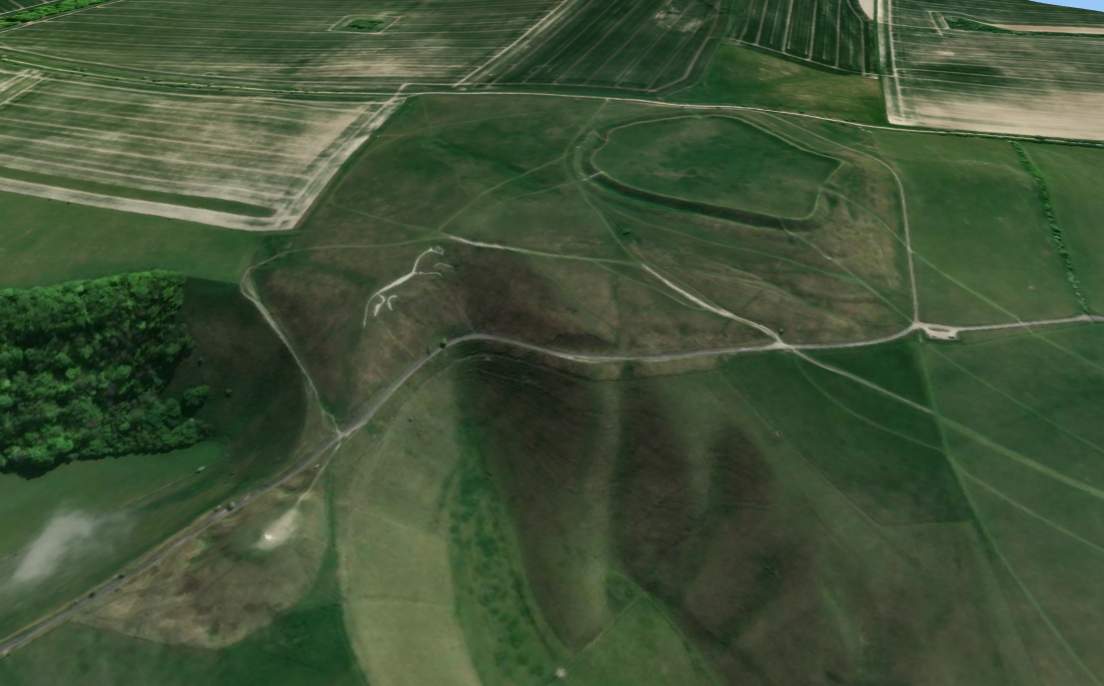
The White Horse sits on the steep scarp face of White Horse Hill, on the edge of the Berkshire Downs (administratively Oxfordshire since 1974), above the village of Uffington and the broad, flat Vale of White Horse it lends its name to. It shares the hilltop with a fortified Iron Age enclosure called Uffington Castle, a dry chalk valley known as the Manger, and a flat-topped mound at the foot of the slope called Dragon Hill, all of which, it turns out, belong together far more closely than anyone realised until recently.
The figure itself is not what most people expect a "white horse" to be. It bears almost no resemblance to a naturalistic animal: a beaked, bird-like head; a long attenuated body that flows directly into an impossibly thin, sweeping tail; four disjointed, splayed legs that don't connect to a torso in any anatomically sensible way. Seen end to end it stretches 110 metres, and, according to the Victorian antiquarian W. C. Plenderleath's careful measurements, runs 355 feet nose to tail and 120 feet ear to hoof. It is not cut into turf so much as cut through it: a trench roughly a metre deep, packed with rammed and "puddled" chalk, so that the whole design reads as a bright line against green grass rather than a silhouette of exposed rock.
Daniel Defoe, passing through in the 1720s, gave what turned out to be the first accurate account of how it was actually built, decades before anyone had dug so much as a test pit to check: "Looking South from the Vale, we see a trench cut on the side of a high green hill, in the shape of a Horse, and not ill-shaped neither... at a distance you see the exact shape of a White Horse, but so large, as to take up near an acre of ground."
He was right, and it would be nearly three centuries before anyone could tell him how right.
Three Centuries of Confidently Wrong Answers
The trouble with the White Horse, for a very long time, was that nobody had any way to date it. There's no inscription, no burial deliberately associated with its cutting, nothing datable trapped underneath it that anyone could find with 18th- or 19th-century tools. Which meant the question of its age was fought out almost entirely on paper: through etymology, half-remembered chronicles, and increasingly heated pamphlets.
The earliest documented theory belongs to the 17th-century antiquary John Aubrey, who floated the idea (reported secondhand through William Camden's Britannia) that the horse was cut by Hengist, the semi-legendary 5th-century leader of the Jutish invasion of Britain, as his heraldic device. It's a tidy theory: both "Hengist" and his brother "Horsa"'s names essentially mean "horse" or "stallion" in Old Germanic, and a horse carved into the hills of the kingdom they were said to have founded has an obvious appeal. Camden's own edition of Britannia raises it directly, in the same breath as another idea that would prove surprisingly durable: that the nearby mound was "a barrow call'd Dragon-hill," and might be "the tumulus of Uther Pendragon."
The theory that actually won the public imagination arrived in 1738, when the Oxford don Francis Wise published A Letter to Dr Mead concerning some Antiquities in Berkshire. Wise's argument was confident, patriotic, and extremely specific: the horse, he said, was cut by King Alfred's men the day after the Battle of Ashdown (871 AD), to commemorate a decisive victory over the Danes fought on the very down beneath it. He built the case on real medieval charter evidence: place-names like "Aysshedoune" and "Æscesdoune" clustered exactly where he needed the battle to have happened, braided together with a long detour through Tacitus, Germanic sacred-horse cults, and the heraldry of the House of Hanover, then reigning in Britain, whose arms also happened to feature a white horse.
It was a beautifully constructed argument. It was also, we now know, wrong by about two thousand years. But the error is not the most interesting thing about it: what matters more is what else is buried in the same 1738 letter. Reading through Wise's original text, it turns out to be the earliest printed source for two of the site's most enduring legends. Wise is the first writer to put into print the story of Wayland's Smithy, the Neolithic burial chamber up on the Ridgeway, said to be haunted by an invisible smith who will reshoe a traveller's horse overnight for the price of a coin left on the stones: "At this place lived formerly an invisible Smith; and if a traveller's Horse had lost a Shoe upon the road, he had no more to do, than to bring the Horse to this place, with a piece of money... he might come again and find the money gone, but the Horse new shod."
And he is the first to record, in the same letter, the local tale that St George killed the dragon on Dragon Hill, and the bare, grassless patch on its crown where the dragon's poisoned blood is supposed to have fallen, "which they imagine proceeds from the venemous bloud that issued from the Dragon's wound." Wise didn't invent either story (he's explicit that both were already old oral tradition among "the country people"), but 1738 is the moment they enter the historical record. Fittingly, Wise himself thought the "dragon" name was a folk-corruption of Pendragon, "Chief of Kings," quietly agreeing, without seeming to notice it, with Camden and Aubrey's older, rival theory.
Wise's Alfred theory did not go unchallenged for long. Within two years the pamphleteer William Asplin, writing under the pseudonym "Philalethes Rusticus," published a scorching rebuttal, The Impertinence and Imposture of Modern Antiquaries Display'd, accusing Wise of nothing less than fraud dressed up as scholarship: "We have here a Detection, clear as the Sun, of an Impoſture, I had almoſt ſaid, the moſt Notorious and Flagrant the preſent Age has yet ſeen."
Wise struck back in 1742 with Further Observations, defending his theory and extending the comparison to other British hill-figures: the White Horse of Westbury in Wiltshire, the Red Horse of Tysoe in Warwickshire, the Cerne Abbas Giant in Dorset. An anonymous defender then published in Wise's favour, and the whole four-year sequence (attack, rebuttal, counter-rebuttal, defence) played out entirely in print before most of Georgian Britain had even heard of the monument. The Alfred theory, born in genuine controversy, nonetheless went on to become the unquestioned popular explanation for the next hundred and fifty years.
The first serious crack in the Alfred consensus came from an unlikely direction: numismatics. In 1758, William Stukeley's daughter Anna, familiar with her father's cabinet of British coins, visited Berkshire and wrote home that the horse was "very much in the scheme of the British horses on the reverse of their coins." She meant the crude, stylised, disjointed horse designs found on pre-Roman British and Gaulish currency. It was a throwaway observation from a family of antiquaries, decades ahead of its time.
By 1845, it had become a formal rival theory. In a paper read to the Society of Antiquaries, William J. Thoms dismantled Wise's dating on documentary grounds, pointing to two 11th- and 12th-century Abingdon Abbey cartularies that name the site "Mons Albi Equi," Hill of the White Horse, securely dating the name to within a few decades of the Norman Conquest, far earlier than Wise's evidence had reached. Thoms argued for an older, pre-Christian Saxon horse-cult origin instead. His colleague John Yonge Akerman, replying in the same volume, disagreed on the specifics but agreed the horse was older than Alfred, championing the Celtic/coin-art theory directly and comparing the figure to Gaulish coinage depicting the horse-goddess Epona. By the time the Rev. W. C. Plenderleath published his 1892 survey of England's chalk-cut horses, the Alfred story was still the default popular account, but it now had serious, published rivals, and the ground had genuinely started to shift.
The Dig That Finally Answered the Question
For all this argument, nobody had actually dug the horse in any systematic way, until, almost by accident, it turned out someone already had, and had hidden the evidence.
During restoration work in 1951–3, the archaeologist W. F. Grimes secretly excavated a small trench at the horse's beak. What he found upended a basic assumption everyone had shared for two centuries: the figure isn't simply an exposure of the natural white bedrock. It has its own built structure: layers of rammed and "puddled" chalk, evidence of repeated resurfacing, proof the beak had once been slightly longer. Grimes never published it. The report vanished into Ministry of Works archives and was forgotten for forty years, until a team led by David Miles and Simon Palmer, excavating the site for Oxford Archaeology between 1989 and 1995, rediscovered it, the find that kicked off the modern project.
Their excavation, published in 2003 as Uffington White Horse and Its Landscape, applied a technique unavailable to any of the 18th- or 19th-century antiquaries: Optically Stimulated Luminescence (OSL) dating, which measures how long buried sediment grains have been shielded from sunlight. Samples taken from colluvium trapped beneath and between the earliest layers of chalk gave a construction date of 1380–550 BC at 68% confidence (1740–210 BC at 95% confidence), with only a 2.5% statistical chance the horse was cut any later than 210 BC.
In other words: the White Horse is not Saxon. It is not even, strictly, Iron Age in the sense Piggott and the coin-art theorists imagined. It was first cut sometime in the late Bronze Age, roughly contemporary with (perhaps even slightly predating) the construction of the adjacent Uffington Castle hillfort, whose earliest timber-laced rampart has been dated to around the 8th or 7th century BC by pottery finds. Wise's Alfred, Camden's Hengist, and Akerman's Iron Age coin-makers were all, in their different ways, arguing about a monument that was already somewhere between 1,400 and 2,600 years old by the time any of them were born.
There's a beautifully concrete piece of corroborating evidence buried in the excavation's environmental report, easy to miss and hard to forget once you know it: a small, dry-loving snail called Abida secale, which needs continuously bare, disturbed chalk to survive and doesn't colonise ordinary farmland or settlement debris, turns up in soil samples from the horse's belly from its earliest construction phase onward, and nowhere else on the hill. The snail is, in effect, a three-thousand-year biological witness that the figure has been kept open and scoured, generation after generation, almost without a break, since the Bronze Age.
So Why Was It Actually Built?
Knowing when the horse was cut turned out to be easier than knowing why. The excavators themselves, in their final synthesis chapter, deliberately declined to resolve the question, framing "functional versus sacred" as a false, modern dichotomy the Bronze Age builders would not have recognised.
What the dig did establish is that the horse didn't stand alone. Four kilometres south, at Tower Hill, a schoolteacher walking her dog in 1993 stumbled on a hoard of 92 bronze objects (axes, rings, casting waste) buried at the threshold of an entirely unfortified, undefended roundhouse, dated by typology to the same 8th–7th century BC horizon as the hillfort. The excavators draw out the obvious tension: the "defended" hillfort at Uffington held almost no metalwork at all, while the open, undefended farmstead a few kilometres away held a small fortune in bronze. Whatever the ramparts of Uffington Castle were for, simple wealth-protection doesn't seem to have been high on the list, which strengthens the case that the hillfort itself functioned less as a permanent fortified settlement and more as a periodically visited ceremonial gathering place, built and rebuilt as a communal act in its own right.
Set against that backdrop, the horse reads less like a territorial signpost and more like the most visible piece of a much larger pattern of hilltop ritual activity, one that continued, in radically different forms, for the next three thousand years: Roman-period burials dug into an already-ancient barrow on the hill, an Anglo-Saxon cemetery inserted into another, a boundary marker in 10th-century Wessex charters, a medieval "wonder of Britain" ranked second only to Stonehenge, a Georgian pamphlet war, a Victorian county fair, and (the excavators note, almost as an aside) 20th-century visitors leaving crystals "to recharge" on the eye of the horse and holding drumming circles on the hillside during their own fieldwork.
The most striking recent attempt to explain the "why" comes from archaeologist Joshua Pollard, whose 2016 paper for the journal Antiquity proposes the horse functioned as an active "sun-horse": not a static emblem to be read from a distance, but a device that participated in the sun's daily journey, in the same cosmological tradition as the Bronze Age Scandinavian Trundholm Chariot of the Sun. Pollard observed and photographed the effect himself on 23 December 2015: viewed from Dragon Hill at midwinter, the sun rises directly behind the horse and appears to roll along its back, staying low on the horizon. He extends the idea into a wider ritual circuit linking Dragon Hill, the Manger, the springs at Woolstone Wells, and Wayland's Smithy: the horse's westward gallop tracing the sun's path, the Smithy marking where it descends into the underworld for the night.
Whether or not you find the solar reading persuasive, it captures something true about the site: a monument that took a genuinely enormous, sustained communal effort to build and maintain (the hillfort's first ditch alone has been estimated at over 10,500 person-hours of labour) is not the kind of thing a Bronze Age community did casually. Someone needed everyone to keep believing in it.
The Landscape of Legend
By the time folklore collectors and Victorian novelists got hold of the site, the horse had accumulated a whole mythology of its own, only loosely tethered to whatever the Bronze Age builders actually intended.
Dragon Hill, the flat-topped mound directly below the horse, is where local tradition places the death of the dragon (locally "King George," never "Saint George," kills it), and the bare patch on the summit is the scorch of its blood, where "nothing'll grow... not so much as a thistle," as Thomas Hughes recorded a Berkshire farmer telling it in 1859. Older, rival readings connect the mound instead to Uther Pendragon, father of Arthur, or read "Dragon" as a garbled survival of the British title Pendragon ("Chief of Kings") attached to some forgotten war-leader buried there. The truth of the mound's construction is still unresolved: geophysical survey found no clear internal structure, but a modern excavator did once find a buried, pentacle-inscribed copy of Walter Scott's Demonology and Witchcraft, tucked into the topsoil near the round barrow, a piece of 20th-century ritual deposit on a site that has apparently never stopped attracting them.
Two and a half kilometres along the Ridgeway sits Wayland's Smithy, a Neolithic chambered long barrow that long predates the horse by well over a thousand years, but was drawn into its orbit anyway. The invisible-smith legend (leave your horse and a coin overnight, come back to find the coin gone and the horse freshly shod) is generally traced to the Anglo-Saxon adoption of Volund (Old Norse Völundr), the maimed smith-god of Norse myth, depicted escaping captivity on forged wings on the 7th-century Franks Casket, now in the British Museum. Some writers, following the folklorist Diana Woolner, push the connection further still, reading Wayland as a localised form of Odin himself, and reinterpreting the entire St George/Dragon Hill legend as a Christianised echo of the same horse-cult, Norse-derived tradition.
And running underneath both legends is a persistent, older thread: the horse as goddess rather than mere emblem. Twentieth-century writers, drawing on the folklorist Anne Ross's 1967 comparisons, connect the Uffington figure to Epona, the Gaulish horse-goddess worshipped as far as the Roman cavalry carried her cult, and to the Welsh Rhiannon, who appears in the Mabinogion riding a horse that cannot be overtaken. It's a reading the archaeology can neither confirm nor rule out, but it sits comfortably alongside a Bronze Age culture that, by Pollard's account, may have needed a horse to carry the sun across the sky every day for three thousand years.
The Scouring: A Festival Older Than Anyone Could Remember
If there's one piece of the White Horse story that isn't legend, it's the custom that kept the monument alive at all: the Scouring. Roughly every seven years (though the actual historical record is far more irregular than the folk-rule suggests) the local community would re-cut the trench, clear out the encroaching turf, and repack the chalk, typically wrapping the work into a full country fair.
Nobody captured this better than Thomas Hughes, author of Tom Brown's School Days and an organiser of the real 1857 Scouring, who wrote it up the same year as a lightly fictionalised travelogue, The Scouring of the White Horse. Working from an old 1776 prize handbill, newspaper notices, and interviews with elderly villagers whose memories stretched back decades, Hughes reconstructed a documented list of scourings running from 1736 through to his own 1857 event, and described the fair itself in loving detail: backsword and cudgel-play for cash prizes, a cart-horse race, a donkey race for a flitch of bacon, a greased pole with a leg of mutton at the top, cheese-races tumbling down the Manger, and (by his account) upwards of 30,000 people at the 1780 gathering alone, according to the Reading Mercury's report at the time.
Hughes also puts a fictional parson in his novel to make the underlying point explicit, comparing the custom to the Levitical feasts of the Old Testament: a periodic, communal act binding "the whole country side" together in memory of something too old for anyone alive to have witnessed. He wasn't far wrong, even if his chronology was: the Scouring wasn't invented to commemorate Alfred's battle. If the OSL dating and the molluscan evidence are right, some version of it has been happening, on and off, since roughly the time the Egyptian New Kingdom was giving way to the Third Intermediate Period, which makes it, quite plausibly, the oldest continuously observed folk custom in Britain.
Why It's Still There
Pull all of this together and the White Horse stops looking like a puzzle with a single correct answer and starts looking like something else entirely: a monument whose meaning was never fixed, only its shape. Bronze Age communities cut it for reasons we can only theorise about. Iron Age farmers built a hillfort beside it and, whatever else they did there, kept it maintained. Roman-period Britons buried their dead in the barrows nearby and left coins in their mouths. Anglo-Saxon settlers used the horse as a charter boundary-marker without ever once writing its name down. Medieval clerks ranked it the second wonder of Britain, just behind Stonehenge. Georgian dons went to war over what it meant. A Victorian novelist turned its festival into literature. Today, National Trust wardens who maintain the hill report visitors wishing on the horse's eye, leaving crystals to "recharge," and holding drumming circles on the slope beside it, the latest chapter in a habit of communal attention to this one hillside that has, on the current evidence, never actually stopped.
Nobody who first cut that chalk trench in the late Bronze Age could have imagined Francis Wise, or Thomas Hughes, or a laboratory measuring how long a buried grain of sand had been shielded from sunlight. But they would probably recognise the impulse behind all three: something on this hill was worth going back to, again and again, for reasons each generation had to work out for itself.
Frequently Asked Questions
How old is the Uffington White Horse?
Optically Stimulated Luminescence (OSL) dating of colluvium samples taken beneath the earliest layers of chalk gives a construction date of 1380–550 BC at 68% confidence (1740–210 BC at 95% confidence), placing it in the late Bronze Age to early Iron Age. It is one of the oldest hill figures in Britain and predates the Anglo-Saxon period, and the theories built around it, by well over a thousand years.
Who made the Uffington White Horse, and why?
We don't know who, specifically, and archaeologists deliberately avoid claiming certainty about why. The monument appears to be roughly contemporary with the nearby Uffington Castle hillfort, and its construction and repeated maintenance (the "Scouring") likely represented a major communal, ceremonial undertaking rather than a simple boundary marker or tribal badge. One recent theory (Joshua Pollard, 2016) proposes it functioned as an active "sun-horse" tied to midwinter solar alignments viewed from Dragon Hill.
Was the White Horse really cut by King Alfred to commemorate a battle?
No. This was the dominant theory for over a century, first proposed by Francis Wise in 1738, linking the horse to Alfred's victory over the Danes at the Battle of Ashdown (871 AD). It was disputed almost immediately by other antiquaries and definitively disproved by OSL dating in the 1990s, which shows the horse is roughly 2,000 years older than Alfred's reign.
Is the Uffington White Horse Bronze Age or Iron Age?
The current dating evidence points to the late Bronze Age to early Iron Age transition, broadly 1380–550 BC. Earlier 20th-century scholars (notably Stuart Piggott, 1931) argued for a purely Iron Age date based on stylistic comparison to Celtic coin art; excavation and OSL dating pushed the earliest confirmed date back several centuries further, into the Bronze Age.
Why is the mound below the horse called Dragon Hill?
Local tradition holds that St George killed the dragon on this flat-topped mound, and that the bare, grassless patch on its summit marks where the dragon's blood fell. Some antiquarians (Camden, Wise) argued instead that "Dragon" is a corruption of the British title "Pendragon" (Chief of Kings), possibly linking the mound to a legendary war-leader buried there. Its origin (natural chalk spur or partly artificial mound) hasn't been conclusively settled by excavation.
What is Wayland's Smithy, and is it connected to the White Horse?
Wayland's Smithy is a Neolithic chambered long barrow roughly 2.5 km from the White Horse along the Ridgeway, considerably older than the horse itself. It's the setting of a legend, first recorded in print by Francis Wise in 1738, of an invisible smith who will reshoe a traveller's horse overnight in exchange for a coin, a story generally traced to the Anglo-Saxon adoption of the Norse smith-god Volund.
What is the Scouring of the White Horse?
The Scouring is the periodic communal re-cutting and cleaning of the chalk figure, historically bundled with a country fair featuring games, backsword fighting, and racing. It's documented as far back as 1736 and was famously described by novelist Thomas Hughes, who helped organise the 1857 event. Molluscan evidence from the 2003 excavation suggests some version of this maintenance has continued, with gaps, since the horse's original construction in the Bronze Age.
Can you actually see the shape of the horse standing next to it?
Not really. This is one of the most disorienting things about visiting. The figure is so large and so foreshortened from ground level that it's very difficult to make out its shape while standing on the hillside. It's best appreciated from a distance across the Vale of White Horse, or from the air.
How big is the Uffington White Horse?
Approximately 110 metres (360 feet) from nose to tail, according to modern measurement, closely matching the Victorian antiquarian W. C. Plenderleath's 1892 figures of 355 feet nose-to-tail and 120 feet ear-to-hoof.