
Beneath the Pump Room in the city of Bath, in a chamber that was sealed for fifteen hundred years, an underground river runs hot from the earth at a quarter of a million gallons a day. The water surfaces at 46 degrees Celsius, has done so for as long as anyone can remember, and continues to do so now. To the people who lived in this valley before the Romans arrived, this hot spring was not a curiosity but a goddess. They called her Sulis. The Romans, when they came, agreed she was a goddess, but called her Sulis Minerva, and built her one of the largest sanctuaries in Britain.
This is the story of who she was, or rather, the story of who she might have been, because Sulis is one of the most contested deities of the ancient British world. The evidence we have for her is rich but fragmentary: a temple complex, a famous and disputed pediment, around 130 lead curse tablets thrown into her spring, a handful of inscribed altars, and a name whose meaning has been argued over for two centuries. Almost everything else is reconstruction.
Sulis before the Romans
The strongest single piece of evidence that Sulis was venerated before the Roman conquest is a small hoard of eighteen Iron Age Celtic coins recovered from her sacred spring, dated to roughly the mid-first century BC. Cunliffe and others have read these as votive offerings to a pre-existing spring deity, and a faint gravel causeway approaching the spring from the south-west has been suggested as a possible processional route from the same period.
Both lines of evidence are thin, however. As McBurney points out in his comprehensive study of the cult, eighteen coins and a gravel path do not amount to a fully attested Iron Age sanctuary, and Louise Revell goes further: a critical assessment, she suggests in passing, would dismantle the case for pre-Roman worship at Bath much as Scheid did for the supposedly ancient sanctuary at Trier. We can say with some confidence that the spring was known and probably revered before the Romans arrived. We cannot say with confidence what form that reverence took, who exactly held it, or how Sulis was understood by her earliest worshippers.
What we do have, instead, is legend. The medieval chronicler Geoffrey of Monmouth recorded a story (and it is only a story, written more than a thousand years after any historical kernel it might contain) that the springs at Bath had been discovered around 500 BC by Prince Bladud, the father of King Lear. Banished from his father's court after contracting leprosy, Bladud became a swineherd in Keynsham. His pigs caught the same disease. One day they wallowed in the steaming mud of the Bath valley and emerged cured, and Bladud, joining them, was cured himself. He returned to court, was restored to his birthright, and founded a city around the healing waters.
The Bladud legend has nothing to do with Sulis. But it tells us something about how the springs were remembered: a place where transformation happened, where what was wrong could be made right, not just warm water to bathe in.
The name and what it might mean
The Romans called the settlement that grew around the springs Aquae Sulis: the Waters of Sulis. Or possibly Aquae Solis: the Waters of the Sun. Which form is correct, and what the name actually means, has been argued over since the eighteenth century.
The case for Aquae Solis is essentially that the manuscripts of the Antonine Itinerary, the late Roman road-book in which the city is mentioned, sometimes give Solis, and that sol is a familiar Latin word meaning sun. The case for Aquae Sulis (now the scholarly consensus) rests on the inscriptions themselves. The altars and dedication stones recovered from Bath give the goddess's name as Sul, Suli, or Sulis, never Sol. As an anonymous correspondent to the Bath Chronicle observed in 1940, copyists working from a difficult original were far more likely to alter the unfamiliar Sulis to the familiar Solis than the other way round.
Even once you accept Sulis as the correct form, the name's meaning remains unsettled. Three main proposals have circulated:
The solar etymology holds that Sul and sol are ultimately related. This was the standard view of Victorian antiquaries, and it has continuing modern advocates: the Encyclopedia of Celtic Mythology and Folklore describes Sulis flatly as "the de facto Celtic solar deity," and Miranda Green and Barry Cunliffe have both leaned in this direction at various points. The Reverend H.M. Scarth, writing in the 1860s and 70s, noted that "Sul" was connected with Minerva on the Bath altars and read this as evidence that Sul, like Sol, was the sun under another name.
The eye/opening etymology holds that Sul derives from the Goidelic Celtic root that produces Gaelic súil, "an eye" or "an opening." A correspondent calling himself H.B. wrote to the Bath Herald in 1880 to argue this case forcefully, suggesting that Sulis simply meant "the opening of the fountain of warm baths," and rejecting the solar reading as a pun on a Latin word that the Celts would not have recognised.
The Phoenician etymology is now a curiosity rather than a contender, but it had a serious airing in 1865 in Once a Week, where an anonymous writer (signing himself A.R.) traced Sulis through a place called Suol on the south coast of Spain to ancient Phoenician trading posts in North Africa, and even to Brittany, where a place called Baud was once supposedly known as Sulis. The argument is rich in nineteenth-century ethnographic enthusiasm and short on linguistic rigour, but it preserved at least one observation that has not been disproved: there is a small place in Brittany associated with healing waters that bore a name resembling Sulis.
The most likely answer, on present evidence, is that Sulis is a Celtic theonym whose ultimate root is genuinely difficult to recover, and that its connection to sol is at most a happy coincidence exploited by the Romans in their identification of the goddess with Minerva. The 1940 Bath Chronicle note got it about right: "local inscriptions and dedications prove conclusively the existence of a local deity, Sul, or Sulis Minerva."
The Romans arrive: Sulis becomes Sulis Minerva
When Roman forces moved west under Aulus Plautius after the conquest of AD 43, they encountered the springs at Bath within about two decades. By the late Neronian or early Flavian period (somewhere between AD 65 and AD 75), a Roman temple in classical style had been raised on the site, and the engineering of the spring into a vast lined reservoir had begun. The settlement that grew up around it took the name Aquae Sulis, and the goddess who had ruled the springs acquired a Roman face: she became Sulis Minerva.
This pairing of names is one of the most-discussed features of the cult, because the two halves are not symmetrical. As Jane Webster has argued, when Celtic and Roman deities were paired in the western provinces, the Celtic name almost always came first: Sulis Minerva, Lenus Mars, Apollo Grannus is the rare exception. Webster reads this as evidence that the Celtic deity retained primary authority in the worshipper's mind: the Roman name was a kind of interpretative gloss for outsiders, not a takeover. McBurney supports this in his detailed analysis of the Bath inscriptions: the goddess is invoked far more often as Sulis alone than as Sulis Minerva, and there is exactly one inscription (Tab. Sul. 65) where Minerva precedes Sulis. On every other surviving altar and tablet, when both names appear, Sulis comes first.
The Romanisation of the cult was nonetheless thorough. The temple was a classical tetrastyle prostyle building raised on a high podium, fronted by four Corinthian columns. Its precinct was paved and surrounded by porticoes. A priest is attested by inscription: Gaius Calpurnius Receptus, who lived to seventy-five and whose freedwoman wife Calpurnia Trifosa raised his memorial (RIB 155). A haruspex, the only one ever recorded from Roman Britain, dedicated a statue base to the goddess: Lucius Marcius Memor, whose surviving inscription reads simply Deae Suli, L. Marcius Memor harusp(ex), d(ono) d(edit): "To the goddess Sulis, Lucius Marcius Memor, soothsayer, gave this as a gift" (RIB 3049). His base was found still standing on its original paving in front of the great altar, an extraordinary survival.
Ritual at the temple was, as far as we can tell, conducted in Roman fashion. Animal sacrifice took place at the great altar that stood in the precinct courtyard. The altar's four corner stones, three of which survive, were sculpted with images of Olympian deities. (One of those corner stones had a remarkable journey: at some point in the medieval period it was carried eight miles from Bath to the village of Compton Dando, where it was built into the wall of the Church of St Mary the Virgin and stayed there, unrecognised, until the eighteenth century. It was returned to Bath in 1997.)
A temple full of other gods
It is easy to imagine the Bath sanctuary as monomaniacally devoted to Sulis. It was not. Webster catalogues a striking range of secondary divine presences at the site:
A curse tablet from the spring is addressed to Mars, evidently in a separate temple within the precinct or nearby. There is an altar to Diana (RIB 138), the huntress goddess elsewhere identified with the moon. The Suleviae, a triad of Celtic mother-goddesses linguistically related to Sulis but probably distinct in cult, are attested at Bath including in a dedication by the sculptor Sulinus, son of Maturus (RIB 150, and yes, his personal name is formed from the goddess's). A relief depicts the three mother goddesses in a schematic style. Rosmerta and Mercury are shown above three small cucullati, hooded figures of obscure but evidently popular cult. And a Treveran dedicated an altar (RIB 140) to Loucetius Mars (the name Loucetius meaning roughly "the fair shining one") and Nemetona, a goddess of the sacred grove.
A goddess of war named Nemetona is also mentioned by Charles Squire in his survey of British religious dedications in Celtic Myths and Legends, where he treats her alongside the various foreign and minor deities of the province. The point is that Bath, however much it belonged to Sulis, was not exclusively hers. The temple precinct housed a crowded set of overlapping cults, and Sulis presided over it without monopolising it.
The famous pediment: a heretical reading
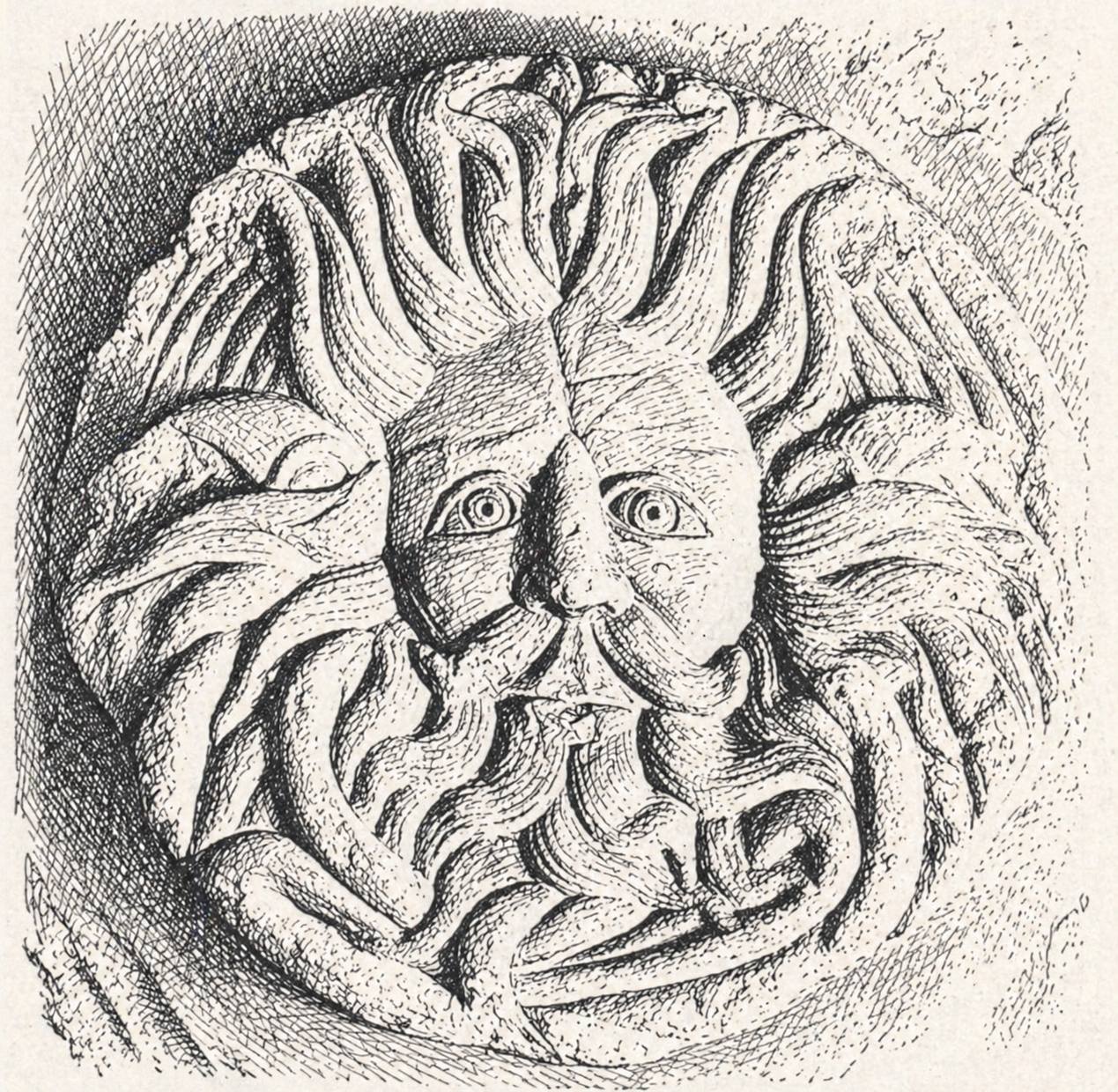
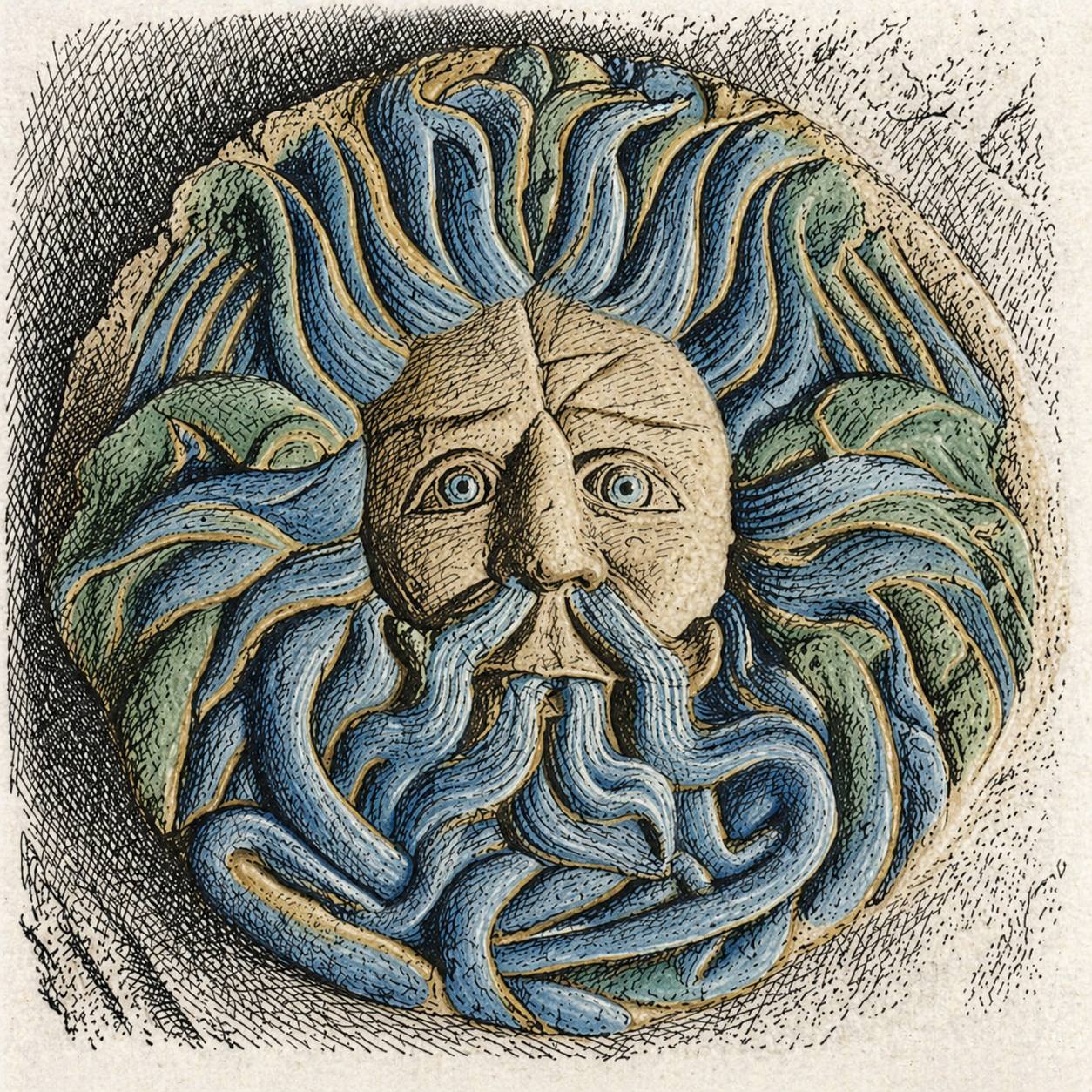
If you have seen one image from Roman Bath, you have probably seen the great central face from the temple pediment: a male, bearded, moustachioed visage with wild streaming hair set within a circular medallion, framed by two winged Victories. It is one of the most reproduced objects in British archaeology, and its identification has never been settled.
The standard reading calls it a Gorgon. The Gorgon's head was the emblem of Minerva, displayed on her aegis, and a temple of Sulis Minerva is exactly where one would expect to find one. But classical Gorgons are female. They are not bearded, not moustachioed, and they do not look like the Bath face. Country Life in 1999 acknowledged the awkwardness with a careful phrase: the pediment shows "a Classical gorgon" combined with "the attributes of a Celtic deity," produced (in their reading) by Gaulish craftsmen. The pediment is, on this view, a hybrid object: Roman emblem rendered through Celtic eyes.
A second tradition reads the face as solar. Sun deities in Romano-Celtic art are frequently shown with hair radiating outward like rays, and the streaming forms around the Bath face have been read this way since the 1830s. The Reverend W.L. Bowles, writing in 1828, identified the face as "the head of Belenus, the Celtic Baal, known by the hair going round the face in a complete circle as rays," a reading he linked to the solar etymology of Sulis itself. McBurney, writing in 2016, finds the physical evidence at Bath too thin to support a solar reading; the chronology fits the rise of Sol Invictus in the third century, but the iconography alone cannot bear the weight.
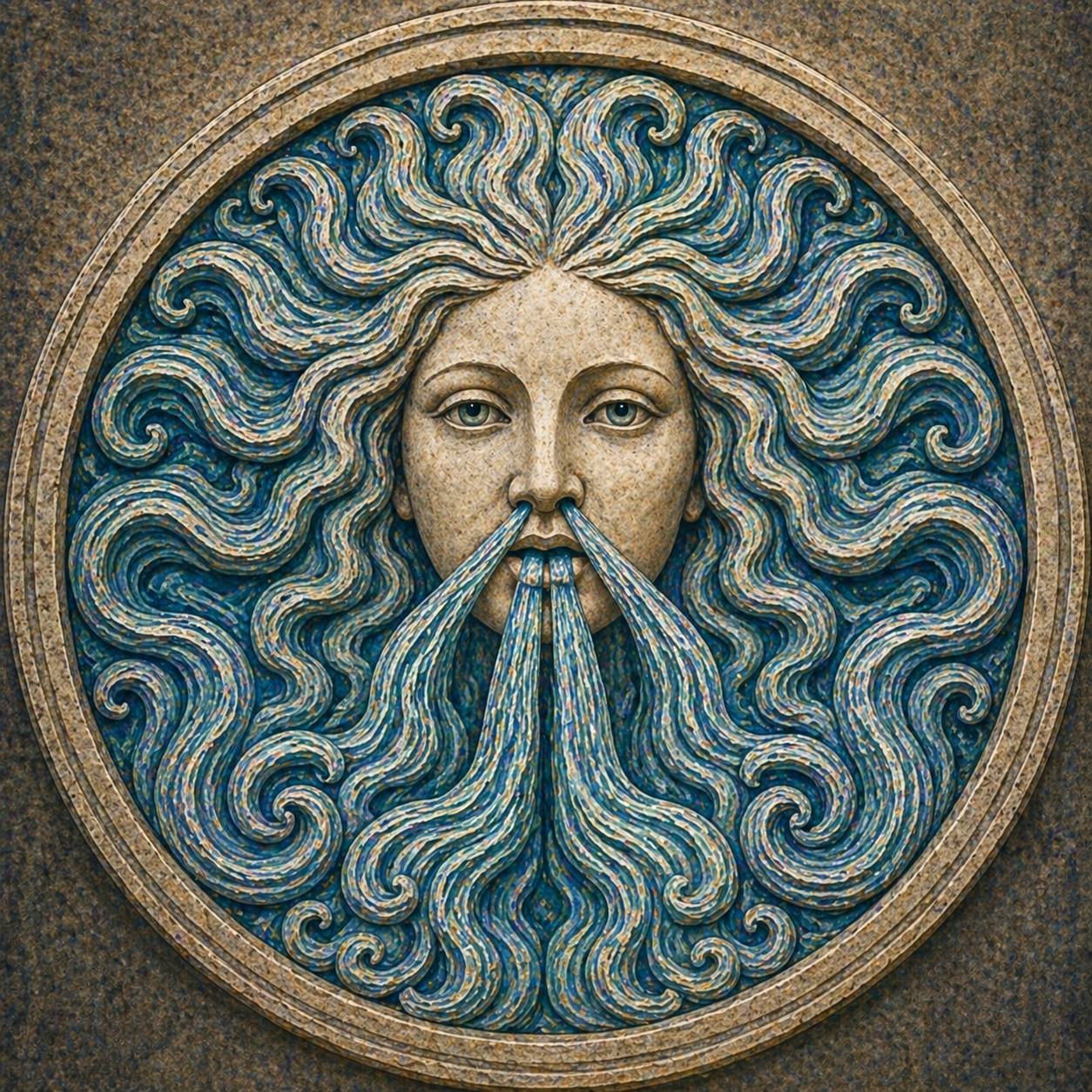
There is a third reading, which to my knowledge has not been advanced in print but which the carving itself seems to invite. The face appears to be exhaling water. What is conventionally read as a moustache resolves, when one looks closely, into a pair of streams flowing from the figure's nostrils and mouth. These streams gather at the base of the medallion and continue downward in coiled, plaited forms strikingly reminiscent of Celtic interlace: knotted rivers braiding into one another. This is, after all, the temple of a water deity. The cult is conducted in and around water. Worshippers throw their offerings into water. Curse tablets are dropped into water. A face from which water flows would be of a piece with the entire ritual life of the shrine in a way that a Gorgon (borrowed from elsewhere as a Minervan attribute) is not.
This is a personal observation rather than a published argument, and the conventional readings have two centuries of scholarship behind them. But the iconography of the Bath face is plural enough that the question of what it shows remains genuinely open. Whether the carving was understood by its Roman viewers as Gorgon, sun, or springhead (or as all three at once) may be the wrong question. It may have been built precisely to support multiple readings.
Voices from the spring: the curse tablets
The most extraordinary single body of evidence for Sulis's cult is something the Romans never intended to be evidence at all. Between 1979 and 1980, Barry Cunliffe's team draining the King's Bath above the Roman reservoir recovered more than 130 small folded sheets of lead alloy. These were defixiones: what scholars now call curse tablets, though, as their decipherer Roger Tomlin has argued, they are better thought of as something closer to legal pleas than to curses.
Tomlin's painstaking work over the following decade, using a raking light to catch the bright stylus-cuts that had darkened over centuries to match the surrounding lead, produced editions of the legible texts. The result was published in 1988 as Tabellae Sulis: the most important single contribution ever made to our understanding of the cult.
The tablets follow a remarkably consistent pattern. A worshipper has been the victim of theft, usually at the baths themselves: a cloak, a bathing tunic, a pair of gloves, a handful of silver coins, a bronze vessel, an iron pan, a bracelet, a ring. They write, or copy from a model, a request to Sulis. The stolen object is described, the suspect or suspects named (where known), and the goddess is asked to either compel the thief to return the goods or to inflict on him a graduated suite of physical and mental afflictions: sleeplessness, ill health, the loss of his wits, the loss of his eyes, the loss of his blood, the loss of his life. Crucially, the formulation often includes a catch-all phrase to ensure no thief could escape on a technicality: si vir si femina, si servus si liber, si puer si puella: "whether man or woman, whether slave or free, whether boy or girl."
A handful of examples convey the flavour:
The dedicant Solinus has lost his bathing tunic and cloak. He gives them, in the legal sense, to the goddess: "I give to your divinity and majesty (my) bathing tunic and cloak. Do not allow sleep or health to him who has done me wrong, whether man or woman, whether slave or free, unless he reveals himself and brings those goods to your temple."
Docilianus has lost a caracalla, a hooded cloak. He asks Sulis to afflict the thief with maximum death and to deny him sleep or children "now and in the future, until he has brought my hooded cloak to the temple of her divinity."
Annianus has had six silver coins stolen from his purse. His tablet, written in mirror script with letters reversed, opens with the unique formula: "Whether pagan or Christian, whoever, whether man or woman, whether boy or girl, whether slave or free, has stolen from me six silver coins from my purse, you, Lady Goddess, are to exact them from him." Eighteen suspects are listed on the reverse. Tomlin reads this tablet as fourth-century (the only century in which "pagan" and "Christian" formed mutually exclusive social categories) and suggests Annianus may himself have been a lapsed or broad-minded Christian who saw Sulis as transcending the religious division of his own day.
Uricalus, in an unusual document, records an oath sworn at the spring by himself, his wife, his son, his daughter, his brother, and his sister-in-law on 12 April. The tablet concludes: "Whosoever has perjured himself there, you are to make him pay for it to the goddess Sulis in his own blood." This is the only tablet to provide an internal date, and it places Sulis in the company of other "ordeal springs" of the ancient world: the Gallic spring sacred to Apollo Grannus that punished perjury, the Sicilian pool where false oaths were scalded out of the swearer.
Civilis has had his ploughshare stolen. Since he is unlikely to have lived in Bath itself, the tablet shows that Sulis's reach extended into the rural hinterland.
Lovernisca (whose Celtic name means "Vixen") has lost a mafortium, a short cape worn over the head and shoulders that would later, in Christianised form, become the head-covering of monks and nuns.
The tablets also tell us something about who Sulis's worshippers actually were. Tomlin tabulated more than 150 names across the corpus: twenty-one petitioners and the rest suspects. Not one is explicitly a Roman citizen (none bears the tria nomina that would mark citizen status). More than half the names are Celtic, the rest "ordinary Roman names no more distinctive than modern Christian names." Compared with the substantial purses lost by legionaries on Hadrian's Wall, the small sums and modest objects mourned by Sulis's petitioners suggest a population from a lower economic and social stratum than is sometimes assumed for the temple's clientele. As Louise Revell has argued, the picture conveyed by the inscribed altars (cosmopolitan, official, military-connected) needs to be balanced against the picture conveyed by the curse tablets (local, lower-status, often Celtic-named).
A further finding from Tomlin's work has reshaped our understanding of how the cult functioned. He tabulated the handwriting of 89 tablets and found that only two were written by the same hand, and those two turned out to be halves of a single document. There were, in other words, no professional curse-tablet scribes at Bath. Petitioners wrote their own tablets, very likely after consultation with temple staff about formulae and procedure. Five tablets in the collection are not real inscriptions at all, but repetitive scratched patterns intended to look like writing, apparently the work of illiterate worshippers conforming to local ritual convention.
Healer and avenger
Sulis was, in her capacity as goddess of the hot springs, a healer, part of a much wider British tradition of sacred wells and healing waters. The waters cured rheumatism, eased the gout, soothed skin conditions, and were drunk for any number of internal complaints. The Petravinus of one nineteenth-century satire, mocking the Edwardian craze for spas, came back year after year for his gout, and the joke worked precisely because it was true: people came to Bath because the springs worked.
But Sulis was also, on the evidence of the curse tablets, a goddess who could blast a man with sleeplessness, drain his blood, take his eyes, and consume his life. This duality is not unusual in ancient religion (McBurney compares it explicitly to Apollo, who could both heal and destroy) but it is striking. The goddess who restored health to those who came to her in supplication could also, when properly invoked against a thief, take it away with surgical precision. As Tomlin observed, "the classical features of Sulis Minerva can become a gorgon's mask."
Whether her avenging power "worked" in any literal sense is a question Tomlin returned to repeatedly. The two-century span of the tablet deposition (roughly the second to the fourth century AD) does suggest a sustained belief that it did. He raised the possibility of psychosomatic effect (the thief who knew himself cursed, even if anonymously, and felt the curse take hold) and pointed to nineteenth-century parallels at St Aelian's Well in Denbighshire, where a local magician was gaoled in 1831 for taking fees to lift curses, and where victims were known to "waste away and die." The closest ancient analogue Tomlin found was in the confession-cult inscriptions of Asia Minor, where altars survive recording crimes acknowledged by the perpetrators themselves under the pressure of illness or misfortune. One such altar in fact records the recovery of a cloak stolen from a bath-house, restored to the temple after divine punishment compelled the thief, precisely the scenario imagined by hundreds of Sulis's petitioners.
Was Sulis worshipped only at Bath?
One of the most striking features of Sulis's cult is its localisation. She was not a goddess who travelled. McBurney, Davidson, and Webster all treat her as fundamentally tied to one place (Bath, and specifically the spring at Bath) in a way that distinguishes her from the more portable deities of the Roman pantheon.
The epigraphic record bears this out. Of all the surviving Roman inscriptions in Britain, every dedication to Sulis comes from Bath itself, with one exception: a single altar found at Alzei in Upper Germany (CIL XIII 6266), reading simply DEA SVL. That single continental outlier is most plausibly explained as a dedication by a Briton, or by someone with personal connections to Bath, rather than as evidence of a wider cult.
The picture is complicated, however, by the Suleviae. This triad of Celtic mother-goddesses, whose name is etymologically related to Sulis but whose cult is distinct, is attested across the Celtic world: at Bath itself (in the Sulinus altar), at Nîmes in southern France, in the Rhineland, and elsewhere. The Reverend Scarth in 1862 noted an altar at Nîmes dedicated to Suliviae Idennices Minervae. The 1879 Graphic article on "Sylphs and Goblins" played wittily with the connection, treating sulfi, sylfi, and the feminine suleva as Gallic forms recorded by Roman antiquaries, possibly the linguistic ancestors of the early modern sylph. Lina Eckenstein, writing in 1907, suggested in a piece of folklore-historical speculation that the children's marriage game "Sally Waters" (sung in dozens of regional variants across England) preserved a memory of "Sul of the waters of Bath, and her followers, or ministrants, the Suleviae." It is a charming theory, and almost certainly more charming than true, but it captures something genuine about how diffuse the Sul- and Suleviae- traditions seem to have been.
Whether the Suleviae are properly understood as Sulis under other names elsewhere, or as a separate cult merely sharing a linguistic root, remains unresolved. The cautious view, taken by Webster and McBurney, treats them as related but distinct. The bolder view, taken by some popular sources and by the Encyclopedia of Celtic Culture, sees the Suleviae as Sulis's continental "attestations." Without further inscriptional evidence, the question is unlikely to be settled.
The afterlife of Sulis
The temple at Bath fell into disuse during the late fourth and early fifth centuries, in line with the wider collapse of Roman authority in Britain. By the time the legions formally departed in 410 (or whenever in that decade the actual disconnection occurred), the cult of Sulis was already in decline. The vaulted roof over the spring eventually collapsed inward, and during the 1979 excavations Cunliffe's team found the brick rib-vaulting lying in the spring exactly where it had fallen, fifteen hundred years earlier.
The site was not, however, abandoned. The eighth-century Anglo-Saxon poem known as The Ruin (preserved in the Exeter Book) describes a wrecked Roman city of stone courts and gushing hot springs, of toppled towers and frost-covered bastions battered and fallen. The poem can be read as a description of any number of decayed Roman sites, but the gushing hot spring is unusually specific, and most scholars accept that the poet had Bath in mind. Whoever wrote those lines saw the spring still running, and the structures of the cult of Sulis still standing in ruined silhouette over it.
Christian foundations followed. As Elizabeth Rees has documented, in 675 King Osric of the Hwicce (a sub-kingdom of Mercia) granted land to Abbess Berta to establish a convent of nuns at Bath. In 757–8 land was made over to the monks of St Peter's Church. Saxon burials have been found just north of the spring, above the east end of the Roman baths. The sacred site continued to be sacred; only the deity changed.
Even the fourth-century curse tablets had begun to register the religious transition. Annianus's "whether pagan or Christian" formula presupposes a Bath in which both populations existed and were both potential thieves. Excavations on Walcot Street in 2000 uncovered two probable late fourth-century Christian burials oriented east–west, without grave goods, in lead and wooden coffins, possibly contemporary with the latest curse-tablet activity at the spring.
Sulis's cult itself disappeared. But the goddess proved unexpectedly durable in folklore and imagination. The "Sally Waters" marriage game, with its sprinkling of pans and its kissing in or out of water, may or may not preserve a memory of her, but it certainly survived in regional variants across the country into the early twentieth century. The pediment face has become one of the iconic objects of British antiquity. A British Rail InterCity locomotive was named Sulis Minerva in 1992. Moyra Caldecott published a novel about the goddess called The Waters of Sul in 1997 (originally to have been titled Aquae Sulis, until copyright complications forced the change). The Roman city itself, drawing more visitors annually than at any time in its history, remains in essence what it has always been: a religious complex centred on a goddess of the spring, whether or not the people coming through its turnstiles know her name.
Why Sulis still matters
Sulis sits at an unusually rich intersection of evidence. She is one of very few Celtic deities whose pre-Roman, Romanised, and post-Roman afterlives can all be partly traced; one of even fewer whose worshippers have left behind their own written voices, in the form of the curse tablets; and one of a tiny number whose cult site has been excavated to a level of detail that allows the reconstruction of actual ritual practice.
She is also a deity who resists easy reading. Was she a sun goddess, or a goddess of the spring? A healer, or an avenger? A local cult hostage to a single hot spring, or one face of a wider continental Celtic divinity worshipped across the empire? A Celtic survival under a Roman veneer, or a thoroughly Romanised reinvention with a Celtic name retained for sentiment? The honest answer to most of these questions is that the evidence does not force a conclusion. Sulis was probably more than one thing at once, and probably meant different things to different worshippers: to the Roman officers who dedicated polished altars in formal Latin, and to the Celtic-named labourers who scratched their petitions for stolen cloaks onto rolled sheets of lead.
The strangest face she presents to us may be the one carved into the stone above her temple's entrance: a bearded male visage, hair streaming, water apparently flowing from nose and mouth, that scholars have called a Gorgon for two centuries while quietly admitting it is not really a Gorgon. Whatever she was, she was not what the Romans named her. She was older than that, and stranger.
She is still there, in a sense. The spring still runs. The water still surfaces at 46 degrees. And every visitor to the King's Bath who looks down into the steaming water is standing more or less where, for two thousand years, people came to ask a goddess for something they could not get any other way.
Further reading
For the temple complex and the archaeology of the site, the indispensable works are Barry Cunliffe and Peter Davenport, The Temple of Sulis Minerva at Bath, Volume 1: The Site (Oxford, 1985), and Cunliffe (ed.), The Temple of Sulis Minerva at Bath, Volume 2: The Finds from the Sacred Spring (Oxford, 1988).
For the curse tablets, R.S.O. Tomlin's Tabellae Sulis: Roman Inscribed Tablets of Tin and Lead from the Sacred Spring at Bath (Oxford, 1988) is the standard edition; his more accessible essay "Voices from the Sacred Spring" appeared in Bath History vol. 4 (1992).
For the cult in its wider Celtic-Roman context, see Jane Webster, The British Celts and their Gods under Rome (1986); Hilda Ellis Davidson, The Lost Beliefs of Northern Europe (1993); Louise Revell, "Religion and Ritual in the Western Provinces," Greece & Rome 54.2 (2007). For a recent thesis-length treatment, James McBurney, The Cult of Sulis-Minerva at Bath (MA thesis, Victoria University of Wellington, 2016) is freely available online.
The full inscriptional record can be searched at the Roman Inscriptions of Britain database (romaninscriptionsofbritain.org), which also holds the altars recovered from Coventina's shrine on Hadrian's Wall, another British water goddess known largely through her votive offerings.