A magician bought a miracle, a statue was mistranslated, and a real man from Samaria disappeared into two thousand years of legend.
Somewhere in first-century Samaria, a man named Simon made enough of an impression that people stopped him in the street and called him "the Power of God." He converted to the new Jesus movement, was baptized, and then did something so audacious that his name became a byword for religious corruption for the next two millennia: he tried to buy the Holy Spirit.
That's the whole historical record. Nineteen verses in the Acts of the Apostles. And yet from that slim, ambiguous episode, the early church built one of the strangest figures in religious history: a flying sorcerer, a self-declared god, the "father of all heresies," a man whose disciples supposedly worshipped him as Zeus incarnate in a temple by the Tiber. Strip away the legend, and there may be almost nothing left of the real Simon at all. Which raises the question the sources themselves keep circling: was Simon Magus ever really the villain the church needed him to be, or was he simply the first man convenient enough to blame?
This is the story of how that happened, told through the earliest sources that survive: the book of Acts, Justin Martyr, Irenaeus, Hippolytus, the Pseudo-Clementine romances, and the long afterlife of Simon's legend in medieval and early modern scholarship.
The Simon of Acts: A Minor Character with a Major Problem
The oldest and most sober account of Simon appears in Acts 8:9–24. Before Philip the Evangelist arrived in Samaria, Simon had already made a name for himself: he "practiced magic in the city and amazed the people of Samaria, claiming to be someone great." The crowd, high and low, had a name for him: "This man is the power of God that is called Great" (Acts 8:10). It's a striking title, and scholars have long debated exactly what Samaritan audiences meant by it. Was Simon claiming to be a manifestation of the God of Israel himself, in the tradition of Samaritan expectations for a "Standing One," an eternal, unchanging revealer? Or is this simply Luke's shorthand for "the local celebrity wonder-worker," dressed up for dramatic effect before Peter arrives to put him in his place?
Whatever the crowd meant by it, Simon himself believed, or claimed to. He was baptized and "followed Philip everywhere, astonished by the great signs and miracles he saw." Then Peter and John arrived from Jerusalem, laid hands on the Samaritan converts, and the Holy Spirit visibly fell on them. Simon, seeing this, offered money for the same power: "Give me also this ability, so that everyone I lay my hands on may receive the Holy Spirit." Peter's rebuke is blistering: "May your silver perish with you... your heart is not right before God," and Simon, chastened, asks Peter to pray for him. And then he simply vanishes from the text.
Modern biblical scholarship has picked this short episode apart at the seams. Source critics have long noticed that Acts 8:4–25 reads like a patchwork: the narrative focus jumps oddly from Philip to Peter, there's a strange flashback interrupting the flow to explain who Simon was, and the description of Simon as a devoted new convert in verse 13 sits uneasily against the power-hungry figure of verses 19–22. Several major commentators (Dibelius, Haenchen, Conzelmann, Schneider) have argued that Luke stitched together at least two separate traditions: one about Philip's mission, and a distinct Simon story concerning his conversion, baptism, and his infamous offer of money. Whether Simon was, historically, a magician at all, or simply an early convert whose reputation curdled in later retelling, isn't something Acts by itself can settle. What Acts does accomplish, deliberately or not, is planting a name and a moral, the sin of trying to purchase spiritual power, that later centuries would spend enormous energy elaborating.
Justin Martyr: The Man Who Started the Legend
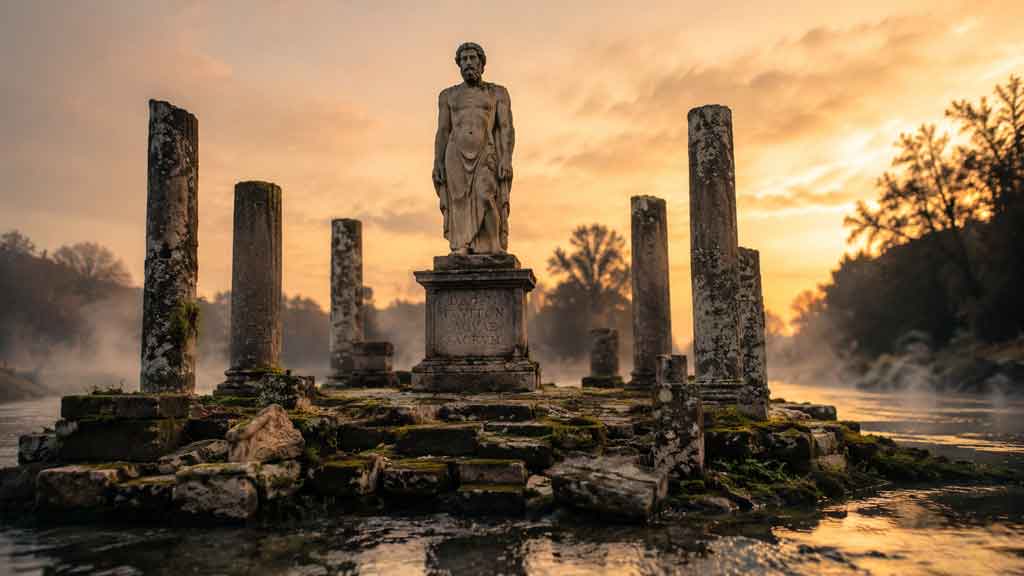
For roughly a century after Acts, Simon disappears from the record entirely. Then, around 150 CE, Justin Martyr (himself a native of Samaria, writing to defend Christianity to the Roman emperor) revives him with startling new details. Justin tells Antoninus Pius that a Samaritan magician named Simon, from the village of Gitta, worked wonders "through the art of the demons operating in him" in the city of Rome itself, under the emperor Claudius. The Romans, Justin says, were so amazed they declared Simon a god and erected a statue to him on an island in the Tiber, inscribed Simoni Deo Sancto: "To Simon, the Holy God." Justin adds that Simon traveled with a woman named Helen, described as a former prostitute he had redeemed, and that almost all Samaritans, along with a few people elsewhere, worshipped Simon as "the first god."
None of this appears in Acts. Where did Justin get it? Scholars such as Robert Casey concluded that all of Justin's information about Simon "appears to have been derived from other sources," very likely a now-lost heresiological handbook Justin himself refers to, his Syntagma against all the heresies. In other words, Justin wasn't reporting eyewitness memory; he was compiling and passing along whatever the anti-heretical rumor mill of his day already contained. Every major heresy-hunter who came after him (Irenaeus, Tertullian, Hippolytus) drew on this same lost source, which means the entire later tradition about Simon largely traces back to one second-century writer's secondhand testimony.
The Statue That Wasn't There
The most famous, and most thoroughly debunked, detail in Justin's account is the statue. In 1574, workers on the Tiber island uncovered a stone inscribed not to Simoni Deo Sancto but to Semoni Sanco Deo Fidio: a dedication to Semo Sancus, an old Sabine oath-god, given by a private citizen named Sextus Pompeius. The resemblance in wording is almost certainly why Justin, or an informant he trusted, mistook it, or a monument like it, for evidence of Simon's cult in Rome. For a source that shaped an entire heresiological tradition, that's a rather shaky foundation: a philological coincidence mistaken for a smoking gun.
But the story doesn't end there, and this is where the sources get genuinely interesting rather than simply embarrassing for Justin. Later writers, including Irenaeus, describe Simonians actually worshipping images of Simon modeled on Jupiter and of Helen modeled on Minerva. Some historians (Gerd Lüdemann among them, building on Casey) have argued that this isn't just Justin's error being copied forward. It's plausible that a real Simonian community did exist in Rome, and that at some point they adopted the existing Semo Sancus monument (or one like it) as their own devotional site, given how common it was in the ancient world for different religious groups to repurpose shared sacred spaces. If so, the statue's story has two layers: an honest antiquarian mistake by Justin, later followed by an actual cult practice that made the mistake look, in hindsight, almost prophetic.
Dositheus and the Lunar Thirty: A Rival Messiah You've Never Heard Of
If Justin gives us the legend's foundation, the Pseudo-Clementine literature, a body of romance-like Jewish-Christian writings from the third and fourth centuries, gives us its most baroque flourishes. Chief among them is the shadowy figure of Dositheus, who according to this tradition was, like Simon, a disciple of John the Baptist.
The story goes that when John died, Simon happened to be away in Alexandria, so Dositheus assumed leadership of the group. He organized his followers into a fixed circle of chiefs, traditionally counted as twenty-nine and a half, deliberately matching the number of days in a lunar month, with one of them a woman named Helena, whose very name echoes Selene, the moon. Later systems built around Jesus, by contrast, were organized on a solar pattern: twelve disciples for the months, or the signs of the zodiac. Whether or not any of this reflects real first-century practice, the text is refreshingly explicit about its own symbolism: this is lunar theology laid out on purpose, not something modern readers are reading into it after the fact.
Dositheus claimed the title "the Standing One," a title loaded with meaning in Samaritan tradition, evoking an eternal, unchanging divine principle. When Simon returned and began to undermine him, the two came to a bizarre confrontation: Dositheus, enraged, struck Simon with his staff, and the staff passed through Simon's body "as if he had been smoke." Dositheus, stunned, asked Simon directly: "If you are the Standing One, I will worship you too." Simon said that he was. Dositheus fell down, worshipped him, handed over leadership to Simon, and, not many days later, died.
It's pure legend, almost folkloric in shape, and no responsible historian treats it as biography. But it tells us something valuable about how early Christian and Samaritan-adjacent movements thought about religious authority: titles like "the Standing One" were up for grabs, messianic claims were competitive and sometimes literally staged as contests, and the loser of such a contest didn't just lose an argument: in the story's own logic, he died of it.
Josephus's Near-Miss
One more thread is worth pulling before moving into full heresiology: the Jewish historian Josephus, writing in the late first century, mentions a Cyprian magician named Atomos (or Simon) who helped the Roman governor Antonius Felix seduce Drusilla away from her husband. Some later apologists, eager to corroborate the Acts story with independent testimony, pounced on this passage as proof that Simon Magus really had operated at the highest levels of Roman society. The trouble is that Josephus's magician is explicitly a Cyprian Jew, not a Samaritan, and the episode has nothing to do with Philip, Peter, or the Holy Spirit. It may be an entirely different person who happened to share a common name, pressed into service by later readers hungry for confirmation. It's a good reminder of a pattern that recurs constantly in this material: eagerness to corroborate the legend has often outpaced the evidence for it.
From Convert to Cosmic Villain: Irenaeus, Hippolytus, and the Birth of "Father of All Heresies"
By the time Irenaeus was writing his Against Heresies around 180 CE, Simon had been fully promoted from a chastened convert to the fountainhead of every heresy the church wanted to condemn. Irenaeus reports that Simon claimed to be "the loftiest of powers," the Father over all, manifesting as the Son in Judea, the Father in Samaria, and the Holy Spirit among the other nations. He describes the Simonians as libertines who practiced magic, used love-potions, kept household spirits, and worshipped statues of Simon and Helen as Jupiter and Minerva. It's a genealogical move as much as a historical claim: by making Simon the trunk of the heretical family tree, Irenaeus could trace every subsequent group he disliked (Valentinians, Basilidians, Marcionites) back to a single, safely discredited root. It's tidy. It's also, as several modern scholars have pointed out, more useful as rhetoric than reliable as history, since the heresiologists were largely copying each other and a shared, lost source rather than independently verifying anything.
Hippolytus of Rome, writing his Refutation of All Heresies in the early third century, preserves the most philosophically ambitious material attributed to Simon: a text he calls the Apophasis Megale, "the Great Declaration" or "Great Revelation." Whether any of this actually goes back to the historical Simon, or to unknown disciples writing generations later in his name, has been argued over since the nineteenth century, and no consensus has been reached. What survives is striking regardless of authorship: a cosmology built on Fire as the "Universal Root," with a hidden and a manifest aspect, generating opposing pairs (syzygies) that structure the whole universe; a divine Silence from which an "Epinoia" (a great feminine Thought or Intelligence) emerges to give rise to all things; and the repeated formula that Simon "stood, stands, and will stand," the same "Standing One" title claimed earlier by Dositheus, now claimed permanently by Simon himself, along with the assertion that he suffered as the Son in Judea, appeared as the Father in Samaria, and moved as the Holy Spirit among the nations.
If genuine, the Apophasis would be a remarkable survival: one of the very few "Gnostic" texts we have that isn't filtered entirely through a hostile source. If it's the invention of later Simonian disciples, it's still valuable as evidence of how quickly and elaborately a movement could grow up around a name, independent of whatever the historical person actually said or did.
Miracle Versus Magic: The Double Standard at the Heart of the Story
One thread runs under nearly the entire tradition, whether in Acts, in Justin, or in the later apologists like the eighteenth-century writer William Weston, who devoted an entire dissertation to defending the plausibility of the Simon legends: the ancient world had no neutral, agreed-upon line between "miracle" and "magic." What Peter does in Acts is a sign of divine favor. What Simon does with apparently the same kind of showmanship, astonishing crowds, performing wonders, is fraud, sorcery, demonic trickery. The distinction was almost entirely a matter of who was doing the judging. Later Christian apologists happily accepted classical testimony about magicians and wonder-workers when it suited their case (citing Suetonius, Lucian, and others on the general credibility of ancient magic) while dismissing Simon's own wonders as empty deception. It's the same move Justin makes when he insists Simon's miracles were worked "through the agency of demons" rather than granting they might be the same category of performance as anyone else's, including, pointedly, Jesus's own.
This double standard is worth dwelling on, because it explains so much of why Simon was useful to the tradition that vilified him. A rival wonder-worker who claimed divine status was not simply a competitor to be argued with: he was a walking demonstration that "signs and wonders" alone proved nothing, and that discernment, doctrine, and the right chain of authority were what actually separated true religion from false. Simon became the permanent proof text for that argument, much as Apollonius of Tyana served the same purpose for pagan critics on the other side of the debate, whether or not the historical man himself ever asked for the job.
Simon in Rome: Peter's Rival, Nero's Court Magician
By the time later Christian narrative literature (the Acts of Peter, and much later devotional works like the 1871 Jesuit narrative Simon Peter and Simon Magus) got hold of the story, Simon had become a full-blown antagonist to the apostle Peter himself, operating in Nero's Rome, flying through the air by demonic power, and finally plummeting to his death when Peter's prayers broke the spell holding him aloft. This is legend built on legend: a moral drama pitting true apostolic power against false magical power, staged as literally as possible, with Simon's fatal fall serving as the visible proof of which side God was on. Seventeenth-century English pamphlets, like George Fox the Elder's 1663 tract on "Old Simon the Sorcerer," kept the figure alive as a byword for religious fraud well into the early modern period, proof of how durable and useful the caricature had become, completely independent of whatever evidence, if any, still connected it to a real Samaritan convert baptized by Philip.
Was Simon the "Father of Gnosticism"? The Case for Skepticism
For much of the nineteenth and twentieth centuries, textbooks confidently called Simon Magus the founder or "father" of Gnosticism: the sprawling family of early Christian and para-Christian movements built around secret saving knowledge (gnosis), cosmic emanations, and a distinction between a lesser creator-god and a higher, unknowable divine source. The discovery of the Nag Hammadi library in 1945 (a cache of genuinely Gnostic texts, written by Gnostics rather than by their opponents) gave scholars, for the first time, material to compare against what the heresiologists had claimed. And the comparison wasn't flattering to the old genealogy: it became much harder to draw a straight line from a first-century Samaritan magician to the fully developed second- and third-century systems of Valentinus, Basilides, or the authors of the Nag Hammadi texts.
It's worth being precise about what changed and when, though. Nag Hammadi didn't single-handedly overturn the "father of Gnosticism" idea: some historians, Adolf von Harnack among them, already doubted the neat chain Irenaeus proposed, purely on source-critical grounds: the heresiologists were suspiciously tidy, and they were clearly copying each other and a shared lost source rather than testifying independently. Nag Hammadi gave that existing doubt real textual teeth. The honest scholarly position today isn't "Simon obviously wasn't a Gnostic influence at all," but something more careful: the case for Simon as literal historical founder was always thinner than the confident textbook language suggested, and it's grown thinner still.
A Legend Doing a Legend's Job
Step back from the details and a pattern comes into focus. Nearly every stage of Simon's story (the statue, the flying contest with Peter, the lunar cult of Dositheus, the elaborate fire cosmology of the Apophasis) arrives well after the fact, from writers with a live stake in making Simon as villainous, as cosmic, and as thoroughly defeated as possible. That doesn't mean none of it reflects anything real. Real Simonian communities probably did exist; a real magician probably did draw a crowd in Samaria; a real statue probably was misread on the Tiber. But the Simon who comes down to us, sorcerer, self-proclaimed god, father of every heresy the church wanted to name, is best understood less as a biography and more as a mirror: a constructed negative image of everything orthodox Christianity wanted to define itself against. The historical man from Samaria gave the tradition a name to hang the legend on. Everything else, the tradition built.
Frequently Asked Questions
Who was Simon Magus? Simon Magus was a Samaritan figure first mentioned in Acts 8:9–24, where he is described as a magician who impressed crowds, converted to Christianity under the preaching of Philip the Evangelist, and was later rebuked by Peter for trying to buy the power to bestow the Holy Spirit. Later Christian writers expanded him into a far more elaborate figure: a rival to Peter, a self-declared god, and the supposed "father of all heresies."
What does "Simon Magus" mean? "Magus" is Latin/Greek for "magician" or "sorcerer," the same root behind the English word "magic." It's a descriptive title rather than a surname, reflecting how Simon was known to his contemporaries in Acts and in later Christian sources.
Why is Simon Magus called the "father of heresy" or "father of Gnosticism"? Second-century heresiologists like Irenaeus traced the various Christian movements they opposed (Valentinians, Basilidians, Marcionites, and others) back to Simon as a common ancestor, largely to discredit them by association. Modern scholars are skeptical of this genealogy; the label reflects ancient anti-heretical rhetoric more than verified historical influence, and the discovery of the Nag Hammadi texts in 1945 made the direct line even harder to sustain.
Is the "Simoni Deo Sancto" statue real? A statue matching that exact inscription has never been found. In 1574, a monument was discovered on Rome's Tiber Island dedicated to "Semoni Sanco Deo Fidio," an old Sabine god, almost certainly what Justin Martyr, writing around 150 CE, mistook or was misled about when he reported a statue honoring Simon. Some scholars think a real Simonian cult in Rome may later have adopted the same or a similar monument for its own worship, which would explain why the confusion persisted.
Who was Dositheus, and how does he relate to Simon Magus? Dositheus appears in the Pseudo-Clementine literature as a fellow disciple of John the Baptist who briefly led a rival community organized around a lunar-symbolic structure of thirty chiefs. According to the legend, he and Simon clashed over the title "the Standing One," a contest Dositheus lost, and, in the story, died shortly after conceding it to Simon.
Was Simon Magus a real historical person? Almost certainly a real person is behind the name: Acts is generally regarded by scholars as preserving an authentic, if brief and possibly composite, tradition about a Samaritan convert. But the elaborate later biography (Roman fame, a temple cult, cosmic titles, a flying contest with Peter) is largely the product of decades and centuries of theological elaboration, not eyewitness history.
What is the Apophasis Megale? The Apophasis Megale ("Great Declaration") is a philosophical text preserved by Hippolytus of Rome in his Refutation of All Heresies, attributed to Simon or his followers. It describes a cosmology built around Fire as the root of all things and a divine Silence from which the universe emerges. Scholars remain divided on whether it preserves genuine first-century teaching or is a later composition written in Simon's name.
Sources
- Haar, Stephen. Simon Magus: The First Gnostic? Berlin: de Gruyter, 2003.
- Mead, G.R.S. Essay on Simon Magus. Reprinted by the Philaletheians, 2018.
- Mead, G.R.S. Fragments of a Faith Forgotten. 1900.
- Simon Magus transcriptions (compiled primary-source excerpts, including nineteenth-century correspondence on the Simoni Deo Sancto controversy).
- Hülsen, Dr. De Simonis Magi vita atque doctrina (Berlin Gymnasium annual report, 1868).
- Franco, Rev. John Joseph, S.J. Simon Peter and Simon Magus: of the Early Days of Christianity in Rome. Philadelphia: Peter F. Cunningham, 1871.
- Weston, William. Dissertations on Some of the Most Remarkable Wonders of Antiquity, Dissertation IV. Cambridge, 1748.
- Fox, George the Elder. Old Simon the Sorcerer (pamphlet, 1663).
- The Acts of the Apostles, chapter 8 (New Testament).
- Justin Martyr, First Apology, chapters 26 and 56.
- Irenaeus, Against Heresies, Book I, chapter 23.
- Hippolytus, Refutation of All Heresies, Book VI, chapters 9–19.
- The Pseudo-Clementine Homilies, Book II.
- Josephus, Jewish Antiquities, Book XX.
This article draws on primary patristic sources alongside historical-critical scholarship. Where ancient sources disagree or later legend departs from the earliest record, that tension is noted rather than resolved: the disagreements are part of the story.