In the autumn of 1876, in a boggy hollow a hundred yards south of Hadrian's Wall, a Northumberland landowner named John Clayton ordered his workmen to dig out what locals had long dismissed as a "cold bath." What came out of that pit over the following weeks would force scholars across Europe to rewrite their lists of the gods of Roman Britain - and would introduce the world to a deity whose name, Clayton noted with frank astonishment, was "unrecorded on the roll of Roman divinities."
Her name was Coventina, and her sanctuary at Carrawburgh on Hadrian's Wall is one of the most extraordinary archaeological discoveries ever made in Britain.
A Boggy Field, a Lead Mine, and a Lost Spring
The site sits below the western rampart of Carrawburgh fort - known in Roman times as Procolitia (or, in some sources, Brocolitia), one of the smaller forts strung along Hadrian's Wall between Chesters and Housesteads. For most of the eighteenth and nineteenth centuries, nobody would have given the spot a second look. The eighteenth-century antiquary John Horsley had noted in his Britannia Romana (1732) that "about a year ago they discovered a well; it is a good spring, and the receptacle for the water is about seven feet square within… The people called it a cold bath, and rightly judged it to be Roman." But by the time Dr Bruce published his great handbook on the Roman Wall in 1867, no remains of any such bath were visible. The well had vanished under the bog.
The catalyst for its rediscovery was, of all things, lead mining. A short distance away, underground operations had drained the spring that had fed the marsh for centuries, and the boggy field where the well had stood gradually dried out. Local miners prospecting in the area noticed dressed Roman masonry rising out of the dry ground.
When word reached John Clayton - who happened to own the land, the fort, and great stretches of Hadrian's Wall besides - he did what he always did: he sent for spades.
Who Was John Clayton?
Before we go down into the well, we owe a moment to the man who made the discovery possible.
John Clayton (1792–1890) was, as a 1963 retrospective in the Newcastle Journal put it, a man who "during the greater part of his life was also an active and painstaking antiquary." That sentence undersells him drastically. Clayton was Town Clerk of Newcastle, an immensely capable solicitor, and the heir to the Chesters estate - through which ran the Roman fort of Cilurnum and several miles of Hadrian's Wall. From the 1830s onwards he pursued a single, extraordinary project: whenever an estate bearing a portion of the Wall came on the market, John Clayton bought it. Over the decades he amassed ownership of the Wall and its forts for many miles, including Borcovicus (Housesteads), Vindolanda, and Procolitia (Carrawburgh) - and he excavated steadily wherever he went.
He is the reason great portions of Hadrian's Wall still stand. He is the reason the Chesters Museum at Chollerford houses one of the greatest collections of Romano-British inscribed stone in existence. And in 1876, when those workmen drew his attention to a curious bit of dressed masonry rising out of a Northumberland bog, he was eighty-four years old - and still ready to dig.
What Came Out of the Well
What Clayton found, foot by foot, was an underground stone tank measuring 8 feet 6 inches by 7 feet 9 inches, set deep in masonry walls more than seven feet high. It was full to the brim with the most extraordinary stratified deposit of votive offerings ever recovered in Britain.
In his own words, presented to the Newcastle Society of Antiquaries on 7 December 1876, Clayton described the descent:
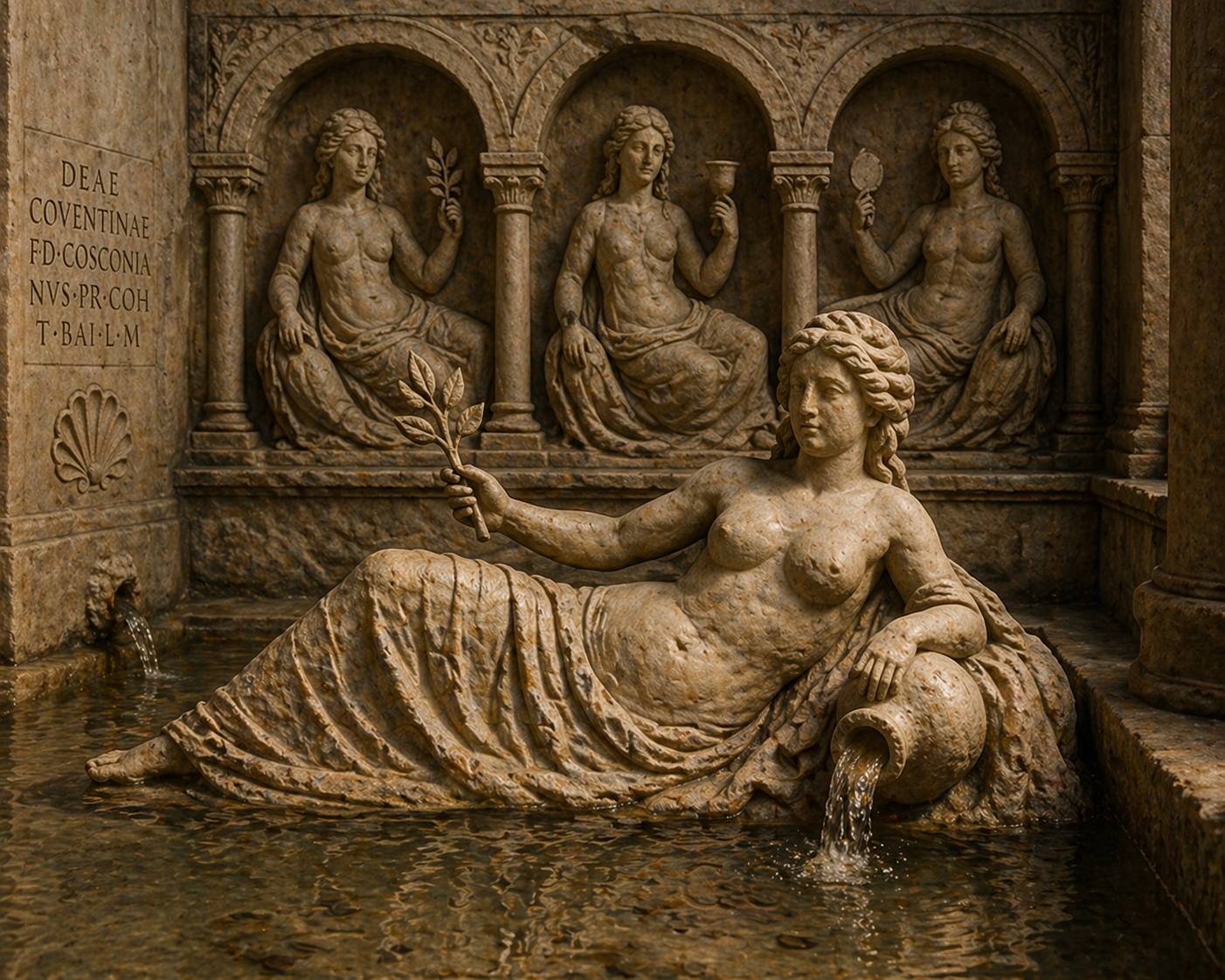
"Within a foot of the surface the excavator in digging down came upon a mass of copper coins, many of them of the debased metal of the lower Empire, spread over the whole surface. Part of a human skull, the concave part upwards, was found here filled with coins. He then began to meet with altars, and fragments of bowls of Samian ware, and glass, and bones of animals, and at the depth of about 3 feet found two elaborate vases of earthenware, both bearing inscriptions, and a sculptured stone representing three Naiads, or water nymphs."
Below this came better coins of the higher Empire - "of superior metal," Clayton noted - together with brooches, rings, dice, beads. And then, near the bottom:
"A massive votive tablet, dedicated to the goddess Coventina, by Titus Domitius Cosconianus, a Roman military Præfect, in command of the First Cohort of Batavian Auxiliaries."
The final tally was staggering. Modern accounts give roughly 13,500 coins (some sources go as high as 16,000), running from a silver denarius of Mark Antony struck shortly before the battle of Actium in 31 BC, all the way down to bronzes of Gratian (emperor 367–383 AD) - a span of more than four centuries. There were 24 altars, a handful of them blank and clearly held in reserve by the priests for future dedications. There were two extraordinary inscribed vases. There were brooches, rings, beads, dice, an ivory stylus, glass and pottery, leather, jet and shale, the tusks of wild boars and the antlers of deer, a small bronze head of the goddess herself, and two further bronze heads representing L'Allegro and Il Penseroso - Mirth and Melancholy - whose comically grinning and miserable faces delighted Clayton when they emerged from the muck.
It was an offering deposit on a scale unmatched anywhere in Roman Britain. Dr Bruce told the Society of Antiquaries that "never before, he believed, had there been in England so very remarkable a discovery of coins and altars made; and this discovery had attracted the attention not only of people in this country, but of the learned throughout Europe, and America, and perhaps Asia."
A Goddess Unknown to the Romans
The most remarkable thing of all was the goddess herself - because nobody, anywhere in the Roman Empire, had ever heard of her. Unlike Epona, the Celtic horse goddess who was formally absorbed into the Roman pantheon, Coventina appears nowhere outside this one Northumberland bog.
The great votive tablet of Titus Domitius Cosconianus - Hubner of Berlin dated it to the reign of Antoninus Pius, around AD 140 - depicted her reclining on the leaf of a gigantic water-lily, waving in her right hand a branch of palm. Other altars from the well called her Dea Nympha ("goddess-nymph"), Augusta ("Augusta"), and Sancta ("holy") - the latter two titles, as scholars have noted, being remarkably rare for any deity outside the Roman pantheon proper. Her name appears on the inscriptions in a bewildering variety of spellings: Coventina, Conventina, Covventina, Covontina, Covetina - the name was clearly unstable in the mouths of her worshippers, many of them barely literate auxiliary soldiers from across the northern provinces.
Clayton's first 1876 paper to the Newcastle Antiquaries summed it up bluntly: "This tablet is inscribed to a goddess whose name is unrecorded on the roll of Roman divinities."
So who was she?
The Etymology Wars
Clayton's second great paper, delivered on 2 August 1877 after the temple itself had been excavated around the well, took up the question of where her name came from - and laid out the menu of theories that scholars have been picking over ever since.
The candidates were:
- Mr Roach Smith suggested that she derived her name from the Convenae (or Couvenae), a people of Aquitania in southern Gaul, "inhabiting a country abounding in springs and rivulets" and "addicted to the worship of water deities." This had the small additional virtue that the First Cohort of Aquitanians had built the fort at Carrawburgh around AD 133 and might plausibly have brought their goddess with them.
- Dr Wake Smart of Cranbourne offered a Celtic root: Gover (or Cover), meaning "a rivulet, or head of a rivulet."
- Dr Hooppell, "strong in Celtic lore," argued for Cof (pronounced "Cov") meaning "memory" and Cofen meaning "memorial" - the temple, on this view, would have been raised in remembrance of some event.
- Mr Carr-Ellison had presented a paper to the Society earlier in 1877 making a case for a Greek derivation.
- And one anonymous correspondent, with a touch of romance, had suggested "that the Roman officer who took the lead in the creation of the goddess and her temple might possibly have named the goddess after some divine creature, the object of his adoration in Italy, who had declined to share his lot amongst the barbarians… but to whom he continued devoted."
Clayton refused to be drawn. "The derivation of the name of the goddess may, without inconvenience, remain an open question," he ruled - though he could not resist quoting Mr Frank Buckland's recommendation that Coventina be adopted "as the Christian name of infant beauties hereafter born on the banks of the Tyne." Clayton noted with regret that "we have not yet heard of an instance of the adoption of the recommendation."
A modern reading, advanced by Norah Jolliffe in 1941 and now broadly accepted, takes Coventina's name as connected to Latin conventus / conventio - "a coming together, a meeting." The well as a place where soldiers from Aquitania, Germany, the Rhineland, and the Netherlands all came to make offerings would, on that reading, be the very embodiment of its goddess: the gathering-place. The name first attested in Britain has also turned up since Clayton's day on a small number of altars in Galicia in north-western Spain - though scholars now generally treat those as a separate, locally-named deity.
A more fanciful theory - which makes no scholarly headway but which has its champions - appeared in the Rugby Observer in 1934, claiming that the city of Coventry itself preserves Coventina's name: that Cofentre meant "the dwelling place of Coventina," and that her shrine survived at Swanswell pool until Christian times, when its functions were taken over by St Osberg. Modern place-name scholarship derives Coventry rather more soberly from a personal name Cofa + treow (tree). But the columnist also asked a question that stops you for a moment: "Query - is this how the word 'coven' came to indicate a gathering of witches?"
It does not, of course. But you can see why someone might wonder.
The Inscriptions in Detail
The altars from the well are now mostly housed in Chesters Museum at Chollerford, where many of them can still be seen. The principal inscriptions catalogued in the standard Roman Inscriptions of Britain (RIB 1522 to 1535, plus the two inscribed incense burners 2457.2 and 2457.3) tell us a great deal about who worshipped here:
- Bellicus, fulfilling a vow (RIB 1522).
- Mausaeus, optio of the First Cohort of Frixiavones (RIB 1523).
- Aurelius Campester of the First Cohort of Cubernians (RIB 1524).
- Two German auxiliaries, Aurelius Crotus and Maduhus, the latter dedicating "for himself and his family" (RIB 1525, 1526).
- A decurion (RIB 1527) and an unnamed soldier (RIB 1529).
- Vinomathus, Vinomathus, and Crotus again (RIB 1528, 1532) - the same Crotus who, on RIB 1532, dedicated specifically pro mea salute, "for my welfare," a clear echo of the well's healing reputation.
- Vincentius, addressing the goddess as Dea Sancta - "the holy goddess" (RIB 1533).
- And, most importantly, two prefects of the First Cohort of Batavians: Titus D. Cosconianus, who set up the great central votive tablet (RIB 1534), and Aelius Tertius (RIB 1535).
The two ceramic vases are perhaps the most remarkable objects of all. Both were inscribed with messages from a single dedicator: Saturninus Gabinius, who declares that he made them with his own hands as votive offerings to Coventina Augusta. The longer inscription reads:
COVENTINA AGVSTA VOTV / MANIBVS SVIS SATVRNINVS FECIT GABINIVS
- "An offering to Coventina Augusta. Saturninus Gabinius made (this) with his own hands."
These vases would later become the centrepiece of one of the great Victorian antiquarian feuds.
Clayton vs. the Liverpool Critic
In late December 1876, a self-confident Liverpool antiquary named W. Thompson Watkin published a letter in the Newcastle Daily Chronicle announcing that he was "by no means satisfied" with Clayton's readings of the Coventina inscriptions. The point on which Watkin chose to take his stand was the inscription on the Saturninus Gabinius vase. Where Clayton (advised by Professor Hubner of Berlin) read votum manibus suis as "an offering with his (the potter's) own hands," Watkin grandly proposed translating it as "a vow to her shades below" - taking manibus as a dative of manes, the spirits of the dead.
Clayton's reply, delivered to the Society of Antiquaries on 12 January 1878 and reprinted in the Hexham Herald, is one of the most enjoyable pieces of Victorian scholarly demolition ever published. He patiently explains that votum can mean either a vow or the offering itself. He notes that "manibus suis" grammatically belongs to the dedicator - "the potter, and it would then have occurred to him that the potter had more need of his hands than of his shades in manufacturing his pots, and he would thus have escaped the anomaly of providing a goddess with shades." He suggests that if Mr Watkin requires a sound Latin scholar, "we have perfect Latin scholars here and at Durham, any one of whom would set the critic right, and might confer upon him a permanent benefit by diminishing his confidence in his own scholarship." And he closes, deadpan: "It is refreshing to see that after his literary adventures in Northumberland he can sit down at Liverpool in a state of happiness and contentment. Where ignorance is bliss 'tis folly to be wise."
The Newcastle Journal reported the chairman's introduction with dry approval: "The main difference between them was not upon an antiquarian point, but upon the construction of Latin; and he thought they would be satisfied that the Liverpool Latin must give way to the Newcastle Latin. (Laughter and applause.)"
How the Treasure Came to Be Buried
Why was the well so densely packed with offerings, valuables, and altars? The Victorians debated this furiously. Some suggested the contents were all votive - coins thrown in over centuries, with the altars added at moments of crisis. Others argued that the well was being used as an emergency strongroom, with valuables and sacred objects hurled in for safekeeping.
Clayton's preferred explanation, set out in his 1877 paper, was both elegant and tragic. Most of the coins, he believed, were genuine offerings, accumulating over more than two centuries: small deposits from "love-sick damsels" casting in their trinkets, soldiers paying their vows, worshippers giving thanks for healing. Some, he conceded, were "of the 3rd Consulate (AD 140) and of the 4th Consulate (AD 145) of Antoninus Pius, which have never been in circulation" - coins that had gone straight from the mint into the well at the temple's foundation.
But the altars themselves, Clayton argued, were a different matter. They were not damaged. Not one of the twenty-four altars showed "a fracture nor scratch." They had been carefully placed at the bottom of the well - and so had a dozen blank altars that had not yet been carved, and the two delicate Saturninus Gabinius vases of "fragile materials and delicate workmanship, which are quite undamaged." This was not desecration. This was concealment.
"The priests of the Goddess Coventina seem to have foreseen the approaching storm, and to have saved from desecration the votive tablet and altars in the temple, including a dozen blank altars prepared for the purpose of receiving inscriptions, by depositing them for concealment in the well."
The "approaching storm" was the Edicts of Theodosius, extended to the western Empire in 386 (Clayton's date) - laws aimed at extinguishing pagan worship across the Roman world. The temple of Sequana at the source of the Seine was sacked and burnt at this period, its altars smashed. The priests at Procolitia, Clayton suggests, saw what was coming, slipped their goddess's belongings into the safe darkness of the well, and - "probably were glad to escape with their lives."
If he was right, then everything Clayton's diggers brought up that autumn was a careful, last-minute act of devotional preservation, sealed under fourteen centuries of mud.
A Sad Footnote: The Coin Raid
Not everything went smoothly during the dig. Clayton, with characteristic open-handedness, allowed locals to come and search the spoil heaps. He came to regret it: "On one Sunday a body of forty miners came down and took possession of the well, and held it all day, and would carry away two or three thousand coins."
His colleagues at the Society of Antiquaries were horrified. "The presence of a single policeman would have prevented it," Clayton observed, but it was too late. The raiders, he was told, "were under the impression that 'the coins belonged to the Ancient Romans,' and that there could be no harm in taking them." Mr Longstaffe of the Society told the meeting tartly that what mattered was "to let people know that the coins were of no commercial value at all."
"They have found that out," Clayton replied.
An unknown number of Coventina's offerings - possibly one in five - disappeared that Sunday into pubs, drawers, and pawnshops across north Tynedale, never catalogued and never recovered.
Coventina in the Wider Religious Landscape
The recent scholarship on Coventina has placed her in a much richer context than the Victorians could have managed. The most thorough modern study - Deb Mayers's 2017 thesis on the religious landscape of Carrawburgh - argues that the well at Coventina's sanctuary was the anchor of the entire religious topography of the fort. Three temples sit along the same little stream that rises at her well: the well-shrine itself, a mithraeum dedicated to the soldier-god Mithras (built by the Batavians around AD 198–211), and the Shrine to the Nymphs and Genius Loci. All three drew their water from her spring.
The connection runs deeper still. Springs were sacred in both the Iron Age Celtic and the Roman religious imaginations, and many of the most important shrines on the Continent - Sequana at the source of the Seine, the goddess at Bath who became Sulis Minerva, the deities of the Aquae Apollinares - were focused on springheads. Carrawburgh's spring, "still bubbling up into its stone tank" when the German troops at the fort first encountered it, would have been recognisable to all of them as a holy place. Whether Coventina herself was an Iron Age British goddess given a Roman accent, or a deity newly conjured under Roman rule by a syncretism of all the spring-traditions her worshippers brought with them, is a question we will probably never answer.
What is clear is that her cult crossed every cultural boundary the Empire could throw at it. Britons, Aquitanians, Germans, Frisiavones, Cubernians, and the famously hard-fighting Batavians all left their names at her well over a span of two and a half centuries. If Norah Jolliffe was right that her name comes from conventus, "the gathering," then the name fits the goddess perfectly.
The Long Echo: Cloutie Wells and Well-Dressing
Even after Theodosius and the legions and the long Anglian darkness, something of the cult that Coventina represented refused to die. The 1929 Derbyshire Times essay by Basil Barham makes the connection explicit, suggesting that the Tissington well-dressing tradition - the dressing of village wells with garlands, texts, and elaborate clay-pressed tableaux on Ascension Day - is a "relic of the graceful side of paganism… a natural way of expressing gratitude to the nymph or woodland deity who dealt there and haunted the spot with beneficent presence." Barham puts it more romantically still:
"Poor Coventina was left in her lonely Tyneside home, there to await the return of her worshippers, who, alas, came back no more. But they had taken with them to their fastnesses in the lower Pennines, to the South Midlands and West to Shropshire and even Gloucester, memories of their water Goddess and the offerings they had made; memories which survived so strongly that even to this day the people of Tissington and other Derbyshire villages deck their wells with finery."
Whether or not the genealogy is quite that clean - and folklorists are properly cautious about claiming unbroken continuity - the impulse is unmistakeable. The Cloutie Well at Culloden, where pilgrims still tie strips of cloth to the trees on the first Sunday of May. The holy wells of Cornwall, hung with rags. Roses Bower and Ramshaw's Mill and the Devil's Stone in north Tynedale, all noted by the Reverend Mr Hall when he commented on Clayton's first paper in 1876. The pennies still thrown into the wells at Tissington and into the cracked masonry of Coventina's tank itself - Sidney Sterck, writing in the Newcastle Journal in 1963, recorded that on a 1949 international archaeological pilgrimage to Hadrian's Wall, "200 archaeologists from this country and abroad… dip[ped] into their pockets and shower coins into the well, arguing unto themselves, maybe: 'When in Roman Britain do as the Romans did.'"
Visiting Coventina Today
The well itself, sadly, is no longer a sight to gladden the visitor's heart. As a 1934 Rugby Observer column noted, all that remains today is "only a swampy patch with the broken masonry hidden among the reeds." The Roman fort at Carrawburgh is itself unexcavated - a low rectangular platform in the field beside the B6318 - and the stream that fed Coventina's spring was permanently destroyed by the lead mining that, ironically, allowed her well to be discovered in the first place.
But the Clayton Museum at Chesters Roman Fort, near Chollerford in Northumberland, holds her altars, her votive tablet, the great relief of three reclining nymphs whose identification is still disputed, the inscribed vases of Saturninus Gabinius, and her bronze portrait head, beside the busts of Mirth and Melancholy that came up out of the bog with her. The Great North Museum: Hancock in Newcastle holds further material from Carrawburgh, including the spectacular reconstruction of the interior of the mithraeum. Both are essential pilgrimage sites for anyone interested in the lost gods of Roman Britain.
John Clayton's Legacy
When John Clayton died in 1890 at the age of 97 - eight years after the Edicts of Theodosius, you might say, had finally caught up with him - he left behind a body of antiquarian work that would have been remarkable for any Victorian, but which is almost incredible for a working solicitor and country gentleman. He had bought, preserved, and excavated more of Hadrian's Wall than any other private individual in history. He had founded the museum that now bears his collection's name. He had defended his readings of the Coventina inscriptions against the worst that the Liverpool antiquary could throw at him. And - most importantly for our story - he had identified, named, and brought into the historical record a goddess about whom Rome itself had nothing to say.
It is fashionable in modern archaeology to be cautious about Victorian excavators. Many of them dug carelessly, recorded badly, lost as much as they found. Clayton was something different. He was patient, meticulous, and - as Dr Bruce told the Society of Antiquaries in 1877 - "had read many papers before the Society, but he did not think he had read any which was so full, so thorough, and so complete in all respects" as the great Coventina paper. He was, in every sense the Victorians liked to use, a scholar-gentleman - and our knowledge of one of Roman Britain's strangest deities is owed almost entirely to him.
If you find yourself walking the Wall some misty afternoon, and a swampy patch of reeds catches your eye between Chesters and Housesteads, stop a moment. Throw a coin if you like. The goddess has been used to it for nearly two thousand years.
Further Reading
- Allason-Jones, L. & McKay, B. (1985) - Coventina's Well: A Shrine on Hadrian's Wall. The standard modern monograph.
- Mayers, D. (2017) - The Religious Landscape of Carrawburgh (MA thesis, University of Glasgow).
- Davidson, H. E. (1993) - The Lost Beliefs of Northern Europe.
- The Roman Inscriptions of Britain online: full searchable database of Coventina inscriptions at https://romaninscriptionsofbritain.org/inscriptions/search?qv=coventina
- The original Clayton papers (1876–78) survive in the Newcastle Journal and Hexham Herald and Northumbrian Gazette archives.
To Visit
- Chesters Roman Fort and Clayton Museum, Chollerford, Northumberland
- Great North Museum: Hancock, Newcastle upon Tyne
- Carrawburgh itself: the platform of the fort and the (overgrown) site of Coventina's Well lie beside the B6318 between Chollerford and Greenhead. Park at the Mithraeum.