He is the god whose name is the sound of the storm. Taranis (from the Celtic root taran, "thunder") was worshipped from the heaths of northern Britain to the shores of the Adriatic, and yet only seven altars carrying his name have ever been recovered from the soil of the Roman world. He stands at the edge of what we can know about Celtic religion: named in a single Roman poem, glimpsed on a handful of stones, and tangled, perhaps, with the most haunting image in all of antiquity: the wicker giant set ablaze with living men inside.
This is what survives of Taranis, the Celtic god who was almost lost.
What Does the Name "Taranis" Mean?
The Celtic word taran (preserved in Welsh taran and Old Irish toirn) simply means "thunder." Taranis is therefore not a personal name in the way that Zeus or Odin are personal names. He is, more precisely, The Thunderer: a functional title that attached itself to the Celtic sky-god across an enormous geographical range.
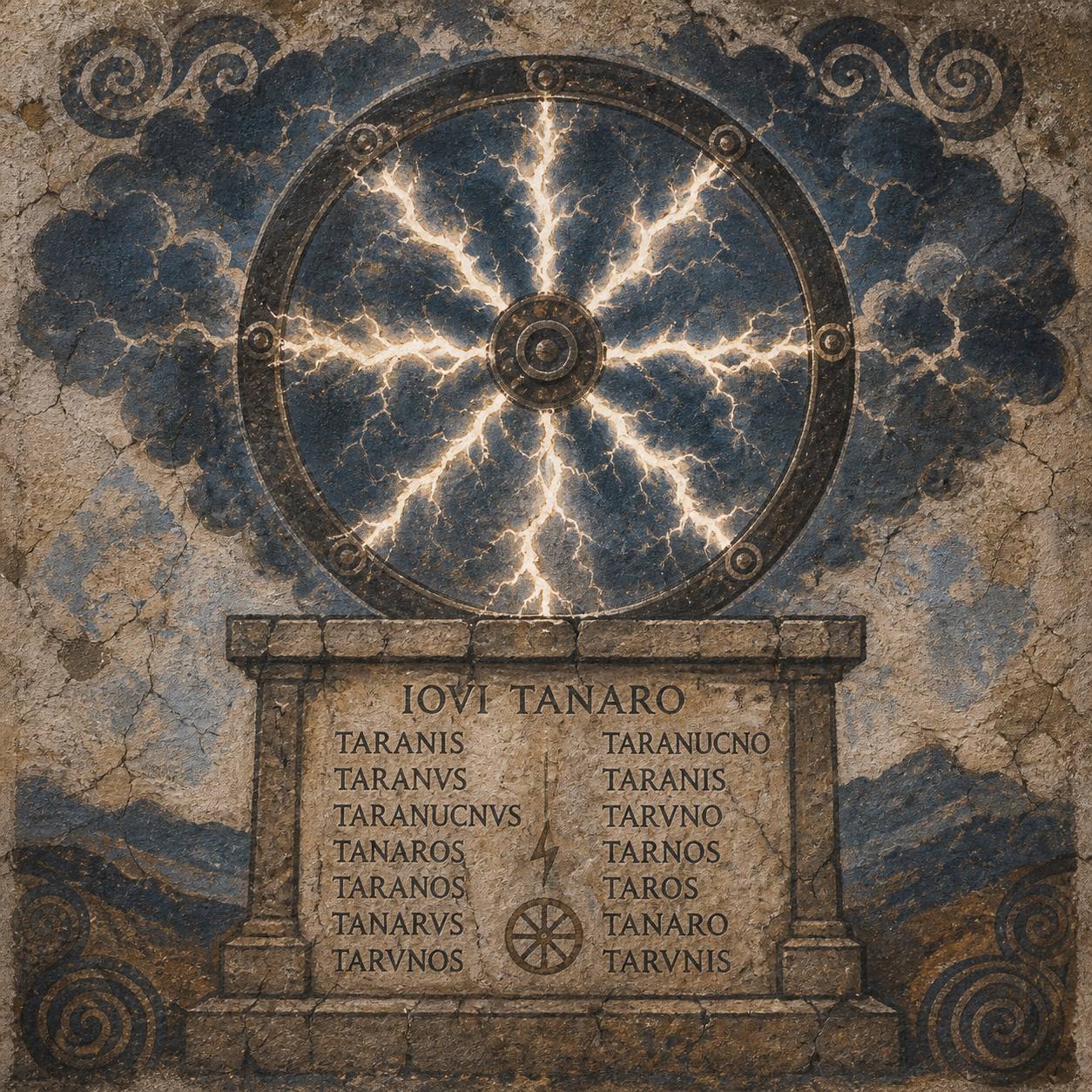
Inscriptions and classical sources record several variant forms:
- Taranis (Lucan's spelling)
- Taranus (a Greek-letter inscription from Orgon in southern Gaul)
- Tanarus (the Chester altar in Roman Britain)
- Taran (a fragmentary stone from Tours)
- Taranucnus or Taranucus (Rhineland and central Gaul)
These are dialect variants of a single concept rather than separate gods. The metathesis between Taran- and Tanar- (the swapping of the r and the n) is a well-known feature of Celtic phonology, and it explains why the same deity can appear under apparently different names on monuments only a few hundred miles apart.
The Only Literary Source: Lucan's Pharsalia
Almost everything later writers said about Taranis traces back to a single passage in the Roman poet Marcus Annaeus Lucanus (Lucan) writing his Pharsalia in the early second century AD about Caesar's wars in Gaul a century earlier. In Book I, lines 444–446, Lucan names three Gaulish gods who demanded human sacrifice:
…where dire Teutates' altar stands, Where Hesus is appeased with cruel rites, And Taranis' shrine is no kinder than Scythian Diana's.
That is the entire literary basis for Taranis as a named deity. One Roman poet, three lines, naming a triad: Teutates (drowning sacrifices in cauldrons), Esus (hanged victims, ritually stabbed), and Taranis (those given to the fire). Centuries later, medieval Berne scholiasts working with Lucan's text equated Taranis variously with Jupiter and with Dis Pater, the Roman god of the underworld, but those are late guesses, not classical evidence.
The thinness of the literary record is one of the great frustrations of Celtic scholarship. As the antiquarian writer Ella Young put it in 1910, the gods of the Celts come down to us only "in the meagre references of classical writers," reconstructed laboriously from "the detritus of the old mythology in the hero tales and folk-lore."
The Seven Altars: Inscriptions from Britain to Dalmatia
Where Lucan provides one literary witness, the archaeological record provides exactly seven inscribed altars to Taranis. They are scattered across the Western Roman Empire in a way that suggests genuine geographical reach, even if their absolute number is small:
• Böckingen (Rhineland): Deo Taranucno
• Godramstein (Rhineland): Taranucnus
• Orgon (Gaul, south): Taranus (Greek letters)
• Tours (Central Gaul): Taran
• Thauron (Central Gaul): Iuppiter Taranucus
• Scardona (Dalmatia): Iuppiter Taranus
• Chester (Roman Britain): Iuppiter Optimus Maximus Tanarus
The Orgon stone is particularly evocative. Discovered in the demolition of an old chapel in the Bouches-du-Rhône, it bears a Gaulish dedication in Greek characters: ΟΥΗΒΡΟΥΜΑΡΟΣ ΔΕΔΕ · ΤΑΡΑΝΟΟΥ ΒΡΑΤΟΥΔΕ · ΚΑΝΤΕΝΑ: "Vēbrumāros gave by decree these gifts to Taranus." The -brumāros element means "great-browed"; the bratude may be cognate with Irish bráth, "judgment." The whole phrase is a Celt of southern Gaul, around the time of Julius Caesar, conducting his religion in the alphabet of his Greek neighbours from Massilia.
Three of the seven altars pair Taranis directly with Jupiter: Iuppiter Taranus, Iuppiter Taranucus, Iuppiter Optimus Maximus Tanarus, confirming that the Celtic thunderer was already being assimilated to the Roman sky-god by Imperial times. The four others name him alone, which is what allows scholars to argue that Taranis existed as an independent deity before the Roman conflation, not merely as a Celtic epithet bolted onto Jupiter after the conquest.
Britain's Taranis: The Chester Altar
The single inscription to Taranis from Roman Britain is the Chester altar, dug up in 1653 from a cellar on Foregate Street and now preserved among the Arundelian Marbles at Oxford. The dedication, dated by its consular formula to AD 154, was made by Lucius Bruttius Praesens, a primipilus (chief centurion) of the Twentieth Legion Valeria Victrix, to Iuppiter Optimus Maximus Tanarus: "Jupiter Best and Greatest, the Thunderer."
A vigorous Victorian debate raged over the form Tanarus versus Taranis. The 19th-century antiquary William Camden read the British dedication as evidence that "the Britons worshipped Jupiter under the name Tanaris," while later scholars suggested the Chester carver had simply made a metathesis error (switching r and n) for the more usual Taranis. Either reading confirms the same essential point: by the middle of the second century, a senior Roman officer stationed in northern Britain found it natural to dedicate an altar to the Celtic thunder-god under the official titulature of imperial Jupiter.
Taranis was not a fringe survival. He was on the official altars of the Roman army.
The Wheel and the Thunderbolt: An Iconographic Puzzle
Anyone who has seen the spoked wheels carved on Romano-Celtic altars across Europe will have read, in some popular reference, that this is the symbol of Taranis. The reality is more interesting and more contested.
The wheel (a sun-symbol that doubles as a thunder-symbol, since wheels and rolling thunder share an ancient association) appears on roughly two hundred carved stone monuments across the Celtic provinces. It accompanies a bearded figure who often also holds a thunderbolt. The temptation to call this figure "Taranis" is irresistible.
But here is the awkward fact: the name Taranis never once appears alongside a wheel on any of those two hundred monuments. The seven altars that do name Taranis carry no wheel imagery. The hundreds of wheel-monuments carry no name. The connection between name and image is an inference, not a documented identification.
Modern scholars split on what to do about this. Miranda Green, in her authoritative chapter on Jupiter, Taranis, and the solar wheel, has argued that the equation of Taranis with the wheel-god has "absolutely no evidence" and should be set aside. Manfred Hainzmann, working on Romano-Celtic religion in the Danube provinces, takes the opposite view: the spoked wheel "simultaneously a sun-wheel and a thunder-wheel" makes the identification with Taranis probable, even if not provable. The honest answer is that we do not know, and that some of the most beautiful images of what looks like the Celtic thunder-god may belong to a deity whose name has simply been forgotten.
The most striking British image often called Taranis is the Corbridge pottery mould, found at the Roman fort on Hadrian's Wall. The figure is bearded, helmeted, and elderly, holding a rectangular shield in one hand and a crooked club-like object that scholars read as a stylised fulmen (a lightning-bolt) in the other. Beside him stands the wheel. The pose was nicknamed "Harry Lauder" by older antiquaries after the Scottish music-hall comedian famous for his crooked walking sticks. As one 1982 newspaper review put it, the Corbridge image has "a hint of humour" alongside its ritual gravity.
The Corbridge mould is one of the very rare British depictions of any named Celtic deity, and Graham Webster identified it firmly with Taranis. Whether he was right (whether anyone has ever securely identified an image of Taranis) remains an open question.
Fire, the Wicker Man, and Taranis
The grimmest detail in Lucan's Pharsalia is the offhand reference to Taranis demanding human sacrifice "by burning." Roman writers loved this image and amplified it. Caesar, in the De Bello Gallico, claims the Druids built enormous wicker effigies in human form, filled their osier limbs with living men, and set them ablaze:
Others have figures of vast size, the limbs of which formed of osiers they fill with living men, which being set on fire, the men perish enveloped in the flames.
A later 1872 commentator surveying ancient sacrifice for the National Reformer reported the same tradition: "the Gauls used, in time of war or great national danger, to build huge wicker baskets, which they filled with men and burnt as an expiation for the rest of the people."
Whether such gigantic fire-rituals genuinely took place at the scale Roman propaganda described, or whether Caesar was reaching for the most lurid image of Celtic barbarism he could imagine to justify his conquests, has never been settled. What can be said is that the idea of fire-sacrifice, attached firmly to Taranis in the classical tradition, has had an enormous afterlife: most visibly in the burning man of modern folk horror, but also in the genuine archaeological evidence for ritual fires on hilltops, the so-called Beltane fires of the Celtic calendar, and the persistent association of high places like Sarn Hill in Worcestershire with the British thunder-god, "where Druidic fires blazed thrice a year."
Roman Identifications: Jupiter, Dis Pater, and the Romano-Celtic Synthesis
When Roman administrators tried to make sense of the gods they encountered in conquered territory, they reached for the standard equation: every foreign deity was really one of the twelve Olympians wearing local clothes. Caesar in his famous summary of Gaulish religion lists five gods: Mercury, Apollo, Mars, Jupiter, Minerva, without giving their Celtic names. Later inscriptions filled in the gaps: Apollini Granno, Marti Toutati, and Iovi Tarano. Taranis, the inscriptions confirm, was the Celtic Jupiter.
But the Berne scholia complicate the picture. They equate Taranis not only with Jupiter but with Dis Pater, the Roman god of the underworld. This is not as strange as it sounds: the Celtic sky-god, like the Norse Thor or the Vedic Indra, was a god of cosmic order who fought back the powers of chaos. The Roman Jupiter ruled the heavens. The Roman Dis Pater ruled the dead. A Celtic deity who did both (who held the storm and the world-ending fire) could plausibly be slotted into either Roman role depending on which face of him one was looking at.
This is the broader pattern of Romano-Celtic religion: not the simple replacement of Celtic gods by Roman ones, but a layered synthesis in which the same indigenous numen could wear several Roman masks depending on context.
Echoes in Welsh Tradition: "Taran" in the Mabinogion
The name Taranis falls out of the historical record after the collapse of Roman Britain, but not entirely. In the medieval Welsh tales gathered into the Mabinogion, among the seven survivors of Bran the Blessed's catastrophic Irish expedition, is one Glunen, son of Taran. Charles Squire, in his Mythology of the British Islands, suggested in a footnote that this Taran may preserve the Welsh memory of the continental thunder-god, an Iron Age divine name surviving into the Christian Middle Ages as a personal name in the genealogies of heroes.
The evidence is slight, but the linguistic match is exact: taran in Welsh still means thunder, and a son-of-thunder hero in the deepest stratum of Welsh storytelling is at least suggestive. Taranis, it seems, may not have died with the last Druid, he may simply have moved sideways into legend.
The Antiquarian Imagination
No survey of Taranis would be complete without acknowledging the strange afterlife he enjoyed in 18th- and 19th-century British antiquarianism. Writers like the Rev. W. L. Bowles, in his Hermes Britannicus (1828), built elaborate theories in which Taranis was the Celtic god of thunder presiding over hilltop temples; in which Avebury was a temple of Mercury-Teutates; in which St. Anne's Hill near Devizes was originally Tan Hill (from Tanaris); and in which the whole structure of British folk-religion could be read as a debased survival of an Egypto-Phoenician sun-cult.
These speculations spawned fierce newspaper controversies: the antiquary Edward Duke of Lake House waged a long polemic against Bowles in the Devizes and Wiltshire Gazette of 1827–28, arguing that "Tan Hill" was simply a corruption of "St. Anne's Hill" and that Bowles was reading too much into a coincidence. Modern scholarship, broadly, has sided with Duke. But the imaginative tradition the Victorian antiquaries created (Taranis as thunderer of the high places, his fires burning thrice yearly, his sacred wheel rolling across the heavens) has persisted in popular Celtic imagination far more vividly than the dry epigraphic facts.
Taranis Today: The God We Almost Lost
What can finally be said, with the firmness the seven altars allow?
Taranis was a real Celtic god, named in a real Roman poem, worshipped from Roman Britain to Roman Dalmatia, equated with Jupiter on official altars, and remembered as the recipient of the most terrible of the Druidic sacrifices: those given to the fire. His name simply means thunder, and that name has survived, in the Welsh word taran and perhaps in the Mabinogion's Taran, into the medieval and modern imagination.
What he looked like, whether the spoked wheel that decorates so many Romano-Celtic altars is truly his symbol or some other forgotten god's, whether the wicker man was a real ritual or a Roman libel, these questions remain genuinely open. The honest answer is that Taranis is a god we glimpse across an evidentiary chasm.
For modern Celtic and revivalist pagans, that ambiguity is part of his appeal. Taranis is not a god whose dossier has been closed. He is a thundercloud on the horizon: real, named, worshipped, and still (after two thousand years) only half visible through the storm.
Sources for this article include Lucan's Pharsalia (Book I), the Corpus Inscriptionum Latinarum*, the Chester altar (RIB 452), Miranda Green's "Jupiter, Taranis and the Solar Wheel" in* Pagan Gods and Shrines of the Roman Empire*, Graham Webster's* The British Celts and Their Gods Under Rome*, Manfred Hainzmann's epigraphic studies of Aquincum, and historical newspaper transcriptions ranging from 1827 to 1998 covering British antiquarian debate, Romano-Celtic archaeology, and Celtic mythography.*