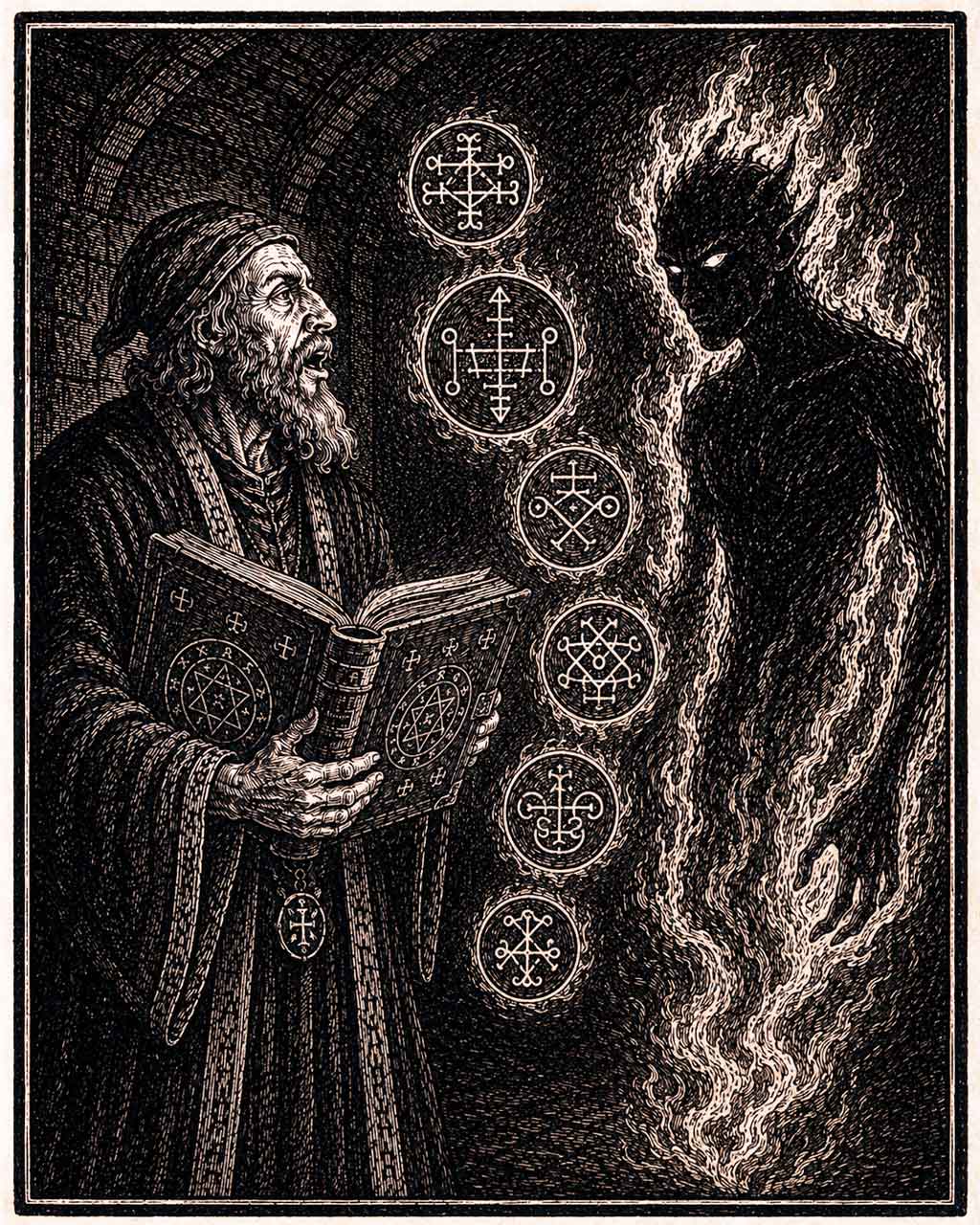
There is an old superstition, recorded in a London newspaper in 1896, that the devil may be raised by placing a piece of bread and cheese in a churchyard and dancing backwards around it seven times at midnight. The writer (almost certainly Andrew Lang) added drily that the necromancers who actually knew their business never disturbed the fiend so early; three or four in the morning was the accepted hour. The joke conceals a serious point. Magic, in the West, has almost never been a matter of improvisation. It has been a matter of the book: the right words, in the right order, copied with the right care, recited at the right time. The book is the technology. And the name we give to that book is the grimoire.
The word itself is a clue. Grimoire is simply the Old French grammaire, "grammar," the same root that gives us the English glamour, which once meant a magical enchantment cast over the eyes. To possess a grammar, in an age when almost no one could read, was already to possess something close to sorcery. A grimoire is a grammar of the unseen: a manual of correspondences, names, seals, conjurations, and procedures by which the practitioner proposes to command spirits, cure disease, find treasure, win love, or peer into the future. Its history is far longer and far stranger than the candle-lit Victorian image suggests. It runs from the libraries of Nineveh to the Bibliothèque Bleue of provincial France, and it carries, more or less intact, ideas that were already ancient when Christ was born.
This is the story of that book.
The Oldest Magic: Sumer, Akkad, and the Power of the Name
Long before there were grimoires there were tablets, and the oldest surviving spell-books in the world are written in cuneiform on baked clay. In the city-states of ancient Mesopotamia (Sumer, then Akkad, Babylon, and Assyria) magic was not a marginal or disreputable art. It was a profession with a curriculum. The āšipu, the exorcist-priest, trained for years in the recitation of incantation-series with names like Maqlû ("Burning") and Šurpu ("Incineration"), great compendia of formulae for unbinding witchcraft, expelling demons, and restoring a sufferer to health. The afflicted were tormented by named entities: the fever-demon, the night-hag, the wind-spirits that prowled the threshold, and the cure lay in naming them correctly and commanding them away.
That single conviction, that to know a thing's true name is to hold power over it, is the load-bearing wall of the entire Western magical tradition. It is Sumerian, it is Egyptian, it is Jewish, and it survives, almost word for word, into the printed chapbooks sold by French peddlers in the nineteenth century. A Victorian commentator reviewing Charles Godfrey Leland's Gypsy Sorcery in 1891 put the genealogy bluntly: the magic of the Chaldeans and that of the wandering Romany, he wrote, were as alike as two peas in a pod, and many of their exorcisms were "as ancient as Nineveh." He was not exaggerating for effect. The exorcism, the formal expulsion of a hostile spirit by adjuration, really is one of the oldest forms of magic on record, and the fact that so many later traditions preserved so many exorcisms, all recognisably related, is among the best proofs we have of the long descent of the lore.
What Mesopotamia bequeathed to its heirs, then, was not a particular spell but an entire grammar: the idea that the cosmos is populated by named powers, that those powers can be compelled by speech, and that the speech must be preserved exactly, in writing, lest its virtue be lost.
Egypt: Words of Power and the Books of Thoth
If Mesopotamia supplied the grammar, Egypt supplied the prestige. For the whole of antiquity and most of the Middle Ages, Egypt was magic. There is a saying preserved in the Talmud, repeated approvingly in an 1899 lecture summary, that when ten measures of magic came down into the world, Egypt took nine. The reputation was earned. Egyptian religion was saturated with what the texts call heka, a creative, magical force so fundamental it was personified as a god in its own right, present at the making of the world.
The Egyptian dead travelled into the afterlife armed with spells. The Book of the Dead (more accurately the Book of Coming Forth by Day) is in large part a magical handbook for the deceased: chapters to preserve the name in the next world, to give the heart power, to ward off the demons of the underworld, to compel the ferryman and the gatekeepers. When the British Museum published its great Egyptian papyri at the close of the nineteenth century, scholars marvelled at rolls eighty and ninety feet long, painted and inscribed for men named Nu and Hunefer and for the priestess Anhai, every one of them a passport written in the grammar of heka. Among the most extraordinary was the papyrus of Nesi-Amsu, which contains the Book of Overthrowing Apep, a ritual against the serpent-fiend who nightly threatened the sun. To destroy him, the magician made a wax figure of the monster, wrote his name upon it in green ink, and burned it; or fashioned images of the fiend and his attendants, inscribed their names, pierced them with a spear, and consigned them to the fire. The principle is identical to the Mesopotamian one and to the European witch's poppet that would follow: the name and the image together give power over the thing itself.
This is why the Egyptians were so anxious about names. The Morning Post, reporting on the British Museum's magical papyri in 1901, caught the logic precisely: the name was held to be the most vital element in nature, and unless a thing had a name it could not exist; if its name were lost, it perished. The dead carried "secret names" into the afterlife as a defence; the gods themselves were thought to guard hidden names; and the magician who could learn a name had taken a corner of creation hostage. By the late period the priesthood had elaborated this into a whole science of Words of Power (hekau) and the "knowing of Names," the recitation of which, correctly performed, compelled gods and demons alike.
Out of this matrix came the figure who would dominate the entire later tradition under a borrowed name: Thoth, the ibis-headed scribe-god, lord of writing, measurement, and magic, whom the Greeks identified with Hermes and crowned "Thrice-Great": Hermes Trismegistus. The Egyptian tales of the magician-prince Setne Khamwas (a real son of Ramesses II, transfigured by legend into a master sorcerer) turn on his hunt for "the magic rolls written by the fingers of the scribe-god Thoth." That phrase, the book written by the god, is the seed of every later grimoire's claim to divine or angelic authorship. When a medieval text insists it was dictated by God to Adam, or copied from the writings of Solomon, or revealed by an angel, it is repeating, across three thousand years, the Egyptian boast of the Books of Thoth.
The Charmers of Serpents
One thread of Egyptian magic ran unbroken from the Pharaohs into the Islamic Middle Ages and beyond: the charming of snakes and scorpions. An Arabic manuscript by the great Egyptian historian al-Maqrīzī, translated into English in 1823, preserves a vivid scene. The Emir Taktbag, governor of Qūṣ, arrests a sorceress and orders her to demonstrate her art. Her great secret, she says, is to charm a scorpion by pronouncing the name of a chosen victim, whom the creature will then pursue and sting to death. The Emir, recklessly, makes himself the target. The sorceress looses the scorpion; it hunts him relentlessly, follows him onto a seat set in the middle of a water-tank, climbs the wall, crosses the ceiling, and drops from directly overhead, until the Emir, who has never once taken his eyes off it, strikes it dead at the last instant. He then has the sorceress executed.
The anecdote is a perfect miniature of how magic actually travelled: as a hereditary craft, passed down in families, attached to specific animals and specific verbal formulae. The classical world knew these specialists as the Psylli, a North African people famous for handling serpents with impunity; Pliny and Plutarch wrote of them, Cato of Utica took some across the Libyan desert, and Augustus was said to have summoned them to try to revive the dying Cleopatra from the asp's bite. Al-Maqrīzī's Egypt still swarmed with their successors: the ḥāwī of medieval Arabic, the "takers of serpents" of the Coptic texts, and he records two splendidly comic episodes in which collections of charmed vipers escape inside a mosque and a vizier's marble courtyard, scattering pious men up the pillars and into the minaret. One terrified secretary, ordered by the vizier to keep watch overnight for escaped asps and scorpions, wrote back that he would sooner divorce his wife by an irrevocable oath than sleep in his house that night. Magic, here, is not theology; it is a trade, a danger, and a joke. And it is continuous, the same art the Bible's psalmist had in mind when he wrote of the deaf adder that will not hear the voice of the charmer.
The Greek Magical Papyri: The Melting-Pot of the Ancient World
The single richest deposit of ancient magic ever recovered is a cache of papyri dug out of the sands of Egypt and now scattered through the museums of Europe. Written in Greek (with stretches of Egyptian Demotic, and salted with Hebrew), and dating mostly to the early centuries of the Christian era, the Greek Magical Papyri (known to scholars as the PGM) are the working notebooks of practising magicians of the Hellenistic and Roman world. A reviewer in 1894 described them with a connoisseur's relish: rich in queer titles, promising mountains and marvels to the purchasing public, the surviving wreckage of a once-enormous magical book-trade. The Christian Church, following the example of the Ephesian converts in the Book of Acts who burned their magical books, destroyed such works at every opportunity, which is why what survives is so rare, and so precious.
When the modern scholar Hans Dieter Betz assembled the standard English edition, he stressed that the papyri are not a chaotic jumble but the record of a genuine fusion. The dominant culture is Hellenistic; the substrate is Egyptian, "in part survived, in part profoundly hellenized"; and the traffic runs both ways, so that Greek gods are Egyptianised even as Egyptian gods are dressed in Greek. Into this mixture flows a substantial Jewish element: the divine names Iao, Sabaoth, Adonai, the patriarchs, whole liturgical fragments, and, by the second and third centuries, a Christian one. The most arresting single fact about the PGM is that the name of Jesus appears in them not as an object of worship but as a tool: a word of power among other words of power, deployed by pagan and half-pagan practitioners precisely because it was reputed to work. One exorcism conjures a demon "by the god of the Hebrews, Jesus"; another hails "Jesus Chrestos, the Holy Spirit, the Son of the Father" in the same breath as it commands the unclean spirit out in chains. As Betz observed, in the hands of these wandering practitioners even Jesus could be assimilated into the great ecumenical syncretism of the age.
Here, then, is the crucible. Everything that the later grimoire tradition would inherit: the strings of barbarous, half-Hebrew, half-Egyptian names (the galimatias or gibberish that so amused Victorian scholars); the seals and sigils; the wax figures; the recitation of a god's "saving acts" before making a demand; the use of amulets and phylacteries; the technology of the divine name, all of it is already present, fully formed, in these Egyptian notebooks. The grimoire was not invented in medieval Europe. It was imported, and its passport was stamped in Alexandria.
Jewish Magic: Solomon, the Sword of Moses, and the Power of the Name
No tradition contributed more to the medieval grimoire than the Jewish one, and no figure looms larger over it than King Solomon. The Bible itself supplied the seed: Solomon was famous for a wisdom that extended to speaking "of trees… and of beasts, and of fowl, and of creeping things, and of fishes," and post-biblical legend swiftly expanded this into mastery over the spirit-world. By late antiquity, Solomon was the archetypal magician-king who had bound the demons by the power of a sealing ring engraved with the Name of God and compelled them to build the Temple. The pseudepigraphic Testament of Solomon tells the story at length; and from it descends the most influential magical book in Western history, the Clavicula Salomonis, the Key of Solomon.
Alongside it ran a deep and genuinely ancient stream of Jewish magical practice. The Sefer ha-Razim ("Book of Mysteries"), the Hekhalot visionary literature, and the Sword of Moses (a text published from manuscript by Moses Gaster in 1896) preserve the same machinery the magical papyri reveal: the coercion of angels and spirits by their secret names, organised by the conviction that the Ineffable Name, the Name by which the world was created, gives its possessor mastery over creation. A sceptical reviewer of the Sword of Moses (again, almost certainly Andrew Lang) caught the principle exactly: the one who knew the true name could "get the Absolute into a corner, and dictate terms to deities and demons." This is why Jewish magic developed its elaborate apparatus of substitutes and anagrams for the Name: the Tetragrammaton YHVH, the seventy-two-fold Shemhamphorasch derived from three verses of Exodus, the coined names of angels, every one of which would be carried wholesale into the Christian grimoires.
This Jewish stream did not stay in Jewish hands. As the Austrian papyrologist Karl Wessely showed from the Fayum manuscripts, and as an Aberdeen paper reported in 1886, the chief vehicle for the spread of Jewish and Jewish-Christian religious ideas into Egypt was precisely the magical papyri, with their charms transcribed into Greek letters. When a learned audience in London heard the Reverend Hermann Gollancz lecture on "Mediaeval Jewish Magic" in 1903, they were told how the Solomonic tradition wound its way through the Clavicula Salomonis and into the Faust legend itself: Faust's poodle being greeted, in Goethe's drama, with the line that "the key of Solomon worketh well." Gollancz had even discovered, among his late father's books, a complete Hebrew manuscript of the Key of Solomon, which he believed had been carried into Europe from the East by the followers of the false messiah Sabbatai Zevi.
Abramelin: The Sacred Magic of Abraham of Worms
The supreme literary monument of this Jewish-magical current is the fifteenth-century Sacred Magic of Abramelin the Mage, framed as a letter from a German Jew, Abraham of Worms, to his son Lamech, recording a system he claimed to have learned in Egypt from a desert sage called Abra-Melin. Translated into English in 1898 by S. L. MacGregor Mathers of the Hermetic Order of the Golden Dawn, it is the most psychologically sophisticated of all the grimoires, and a deliberate rebuke to the others.
Where most grimoires teach the magician to coerce spirits, Abramelin inverts the whole structure. Its goal is what Mathers called the magnum opus: by six months of purity, prayer, fasting, and self-denial, to attain "the Knowledge and Conversation of the Holy Guardian Angel." Only once the operator has obtained this inner, upward relationship (the angel appearing "in unequalled beauty," speaking with a sweetness no human tongue could express) is he authorised, over three further days, to summon the demonic hierarchy: the Four Princes (Lucifer, Leviathan, Satan, Belial), the Eight Sub-Princes (Astaroth, Magoth, Asmodeus, Beelzebub, Oriens, Paimon, Ariton, Amaymon), and their legions, and to bind them by oath upon the wand. Crucially, no pact is ever signed. The magician incurs no debt, because his power is delegated from above. Abraham scorns the election of lucky days, the elaborate metal pentacles, and the catalogue of conjurations that fill the other books, insisting that "the True Wisdom of the Lord can operate… every day, and at any moment." It is, in a single sentence, the doctrine that the operator does not bargain with darkness: he becomes the kind of person before whom darkness has nothing to bargain with. The book would become the central rite of Mathers's Golden Dawn and, later, of Aleister Crowley's Thelema.
Early Christianity: Amulets, Exorcism, and the Inheritance of Egypt
It is tempting to imagine that Christianity arrived as the clean opposite of all this, and the Church certainly tried to be. Saint Paul's preaching at Ephesus famously moved converts to bring their magical books together and burn them before all men. Yet the deeper truth, recovered by the papyrus discoveries, is that early Christianity grew up inside the magical world rather than outside it, and absorbed a great deal of it.
A 1913 review of P. D. Scott-Moncrieff's Paganism and Christianity in Egypt laid out the picture with care. The first Christians in Egypt continued to mummify their dead and to leave them food and drink; the image of the Virgin and Child was adapted, with little modification, from representations of Isis nursing Horus; and the favourite Egyptian icon of Saint George spearing the dragon descended directly from Horus spearing the serpent-god Set. The magical papyri, Scott-Moncrieff noted, embedded fragments of older religions "like fossils in rocks." A 1923 address to Glasgow churchmen on the new papyrus discoveries made the same point from the orthodox side: the discoveries proved how powerfully superstition still gripped the popular mind, with amulets (now bearing passages from the Gospel in place of the old heathen spells) worn even by Christian converts, exactly as the magical books of Acts 19 had once been worn.
The famous tale of the centurion of Capernaum, retold in a 1956 newspaper feature by the biblical scholar Hugh Schonfield, turns on this very inheritance. The centurion's request that Jesus merely "speak a word" to heal his servant reflects the universal ancient assumption that sickness was demonic and that the cure lay in identifying the demon and pronouncing its name correctly, the same logic that produced the Egyptian Words of Power, the shrinking-formula Shabriri / Abriri / Riri / Ri for the demon of blindness, and the protective amulet Abracadabra, diminished letter by letter to nothing. The Church would spend a thousand years trying to draw a clean line between licit prayer and illicit spell, between the exorcism performed by a priest and the conjuration performed by a magician. The line was always porous, because both drew on the same ancient grammar of the Name.
The Medieval Grimoire: Solomon, Honorius, and the School of Toledo
By the High Middle Ages, the grimoire emerges as a recognisable genre, and the medieval mind drew a sharp distinction between two kinds of practitioner. The Victorian antiquary Thomas Wright, whose Narratives of Sorcery and Magic a Scottish paper excerpted in 1851, put it neatly: the witch was "an ignorant instrument in the hands of the demons," a slave without recompense; the magician, by contrast, "had become their master by the powerful intermediation of a science," a science available only to the few and recorded in books. The witch was poor and despised; the magician was learned, dangerous, and literate. The grimoire was his instrument of mastery.
Medieval Europe acquired this science largely through two channels, both running through the Islamic world. The first was Spain. Wright relates the legend of Gerbert (the brilliant tenth-century scholar who became Pope Sylvester II) studying at Toledo, that spiritual no-man's-land between Christendom and Islam, in the house of a Saracen philosopher who owned a book of magic, a grimoire, of unusual power. Gerbert, the story goes, stole the book by seducing the philosopher's daughter, fled with the demon-summoning text, and afterwards rose to the papacy by infernal help. The tale is pure folklore, but it preserves a real historical memory: it was through Arabic Spain that the magical and astrological learning of the ancient East, including the great astral grimoire the Picatrix, translated from the Arabic Ghāyat al-Ḥakīm, re-entered Latin Europe.
The second channel produced the books themselves. The Key of Solomon circulated widely in Latin, Italian, and French manuscripts, "the foundation and fountain head," as Mathers's publisher Redway advertised in 1888, "of much of the ceremonial magic of the mediaeval occultists." Its darker cousins multiplied: the Grimorium Verum, the Grimoire of Honorius, and the Lemegeton or Lesser Key of Solomon with its catalogue of seventy-two spirits. The Sworn Book of Honorius (Liber Iuratus), attributed to a legendary "Honorius of Thebes" and later confused with the historical Pope Honorius III, lent the genre a spurious papal authority. A reviewer in Public Opinion in 1877 noted with relish that this Honorian manual, the Conjurationes adversus principem tenebrarum, was assigned to a pope, contained spells of every degree of unintelligibility, and included a charm "powerful for getting rid of hares and rabbits" by mixing salt and rabbit's hair and reciting a half-French, half-nonsense formula at sunrise.
That the medieval mind took such things with deadly seriousness is shown by its courts. The same article records that at Aix in Provence, caterpillars and locusts were repeatedly and solemnly summoned into court, assigned counsel, and formally exorcised and sentenced to leave the country only after lengthy legal argument. A magic that could be litigated was a magic that was believed. The legend of Theophilus (the cleric who sold his soul to recover his lost office, and was saved only by the Virgin's intercession) gave Europe its template for the diabolical pact centuries before Faust gave it a name. And the great philosopher-saint Albertus Magnus found his name, like Solomon's, posthumously attached to popular books of secrets he never wrote, so that "Albert the Great" and "Little Albert" would become household grimoires.
The Black Books of Early Modern Europe
The Renaissance, far from killing magic, systematised it. Heinrich Cornelius Agrippa's Three Books of Occult Philosophy (1533) became the great encyclopedia of the field, and a spurious Fourth Book, together with the Heptameron of Peter of Abano, supplied ready-made conjurations under his prestigious name. Paracelsus scattered talismanic and medical magic through his voluminous works; the astral talismans of the planets, each cast in its proper metal (gold for the Sun, silver for the Moon, iron for Mars, lead for Saturn), passed from his pages into folk practice and were still being described, almost verbatim, in a French chapbook on "the occult sciences" reprinted in an 1866 Irish newspaper. At the same time, Christian scholars such as Pico della Mirandola and Johannes Reuchlin married the Jewish Kabbalah to Christian theology, producing the "Christian Cabala" that would underpin the learned magic of the next three centuries.
Below this learned tier, a vast popular literature flourished. In France the cheap, blue-covered booklets of the Bibliothèque Bleue, hawked from village to village by the colporteurs, carried grimoires to a mass readership: Le Petit Albert, Le Grand Albert, and above all the notorious Grand Grimoire, often issued under a false papal wrapper as the Grimoire du Pape Honorius. These books are a study in syncretism. A surviving 1760 edition opens with a prologue invoking the authority of "the rabbis" and is signed by one "Antonio Venitiana, del Rabina," reflecting the persistent French myth that all true magic was secretly Jewish in origin. Its operating chapters teach the would-be magician to fast and pray for a quarter-moon; to forge a forked "Blasting Rod" of virgin hazel; to sacrifice a kid; to draw a cabbalistic circle marked with the name of Jesus; and then to summon the Emperor Lucifer and his minister Lucifuge Rofocale by a torrent of names, Adonay, Eloïm, Ariel, Jehovam alongside the elemental spirits of Paracelsus, Sylphæ, Salamandræ, Gnomus, threatening them with the blasting rod until they appear and agree to deliver a buried treasure. The climax is the pact: the spirit signs his sigil; the magician signs in his own blood, pledging himself in twenty years. The bargain is Faust's, made cheap and portable for the village reader.
These same books bound in, almost incongruously, a genuinely medieval Latin Honorian conjuration, the Citatato praedictorum Spirituum, which works not by threat but by Christological invocation, beseeching Christ "by thy nativity, by thy baptism, by thy passion and cross" for power over the angels cast down from heaven, and citing "that name by which Solomon constrained the demons." The French state regarded all of it as a public menace and suppressed the trade; as a piece reprinted from Once a Week in 1862 observed, Le Petit Albert and Le Grand Grimoire were thereafter "still smuggled through the provinces," prized by the peasants all the more highly for being condemned by the authorities.
The Occult Revival: Lévi, Mathers, Waite, and the Modern Grimoire
The nineteenth century, that supposed age of steam and scepticism, produced the greatest grimoire revival since the Renaissance. In France, the former seminarian Éliphas Lévi (Alphonse Louis Constant) reframed the whole tradition as a coherent transcendental science in Dogme et Rituel de la Haute Magie (1856), treating the Key of Solomon as a text of the highest authority. In England, the publisher George Redway issued an "Esoteric Series" (announced with great fanfare in The Academy in 1888) that put the old manuscripts into print for a new generation of seekers: Thomas Vaughan's alchemical writings, handbooks of cartomancy and palmistry, and, crucially, S. L. MacGregor Mathers's translation of the Key of Solomon the King, edited from manuscripts in the British Museum and printed in English, the publisher boasted, for the very first time.
Mathers, co-founder of the Hermetic Order of the Golden Dawn, became the great modern transmitter of the grimoire tradition: his Key of Solomon (1889), his Abramelin (1898), and his Lesser Key of Solomon placed the medieval texts in the hands of a magical revival that would shape twentieth-century occultism through the Golden Dawn and its most notorious alumnus, Aleister Crowley. His colleague and rival Arthur Edward Waite took a more guarded, scholarly line. Waite's Book of Ceremonial Magic (an expanded 1911 edition of his earlier Book of Black Magic and of Pacts) surveyed the whole goetic literature, the Key of Solomon, the Grimorium Verum, the Grimoire of Honorius, with critical detachment. Reviewers found him exasperating and irresistible in equal measure. The Saturday Review in 1912 mocked the "drawing-room wizards" who would devour his "sumptuous volume," and recorded his stern self-description: he was concerned, he said, "first of all with the preservation of the Secret Tradition inviolate." The London Daily Chronicle in 1911 noted, with a journalist's eye for the present tense, that the superstitions Waite chronicled were no museum pieces: in the fashionable quarters of the city, the palmist and the crystal-gazer still drove a roaring trade, and faith in the lucky "mascot" remained the creed of the smart set.
And the tradition kept absorbing new tributaries. Charles Godfrey Leland's Gypsy Sorcery and Fortune-Telling (1891) argued that the Romany were "the heirs of the early magi," carrying incantations "almost as old as the stars," a claim a reviewer in the St. James's Budget treated with affectionate scepticism, while admitting that gypsy exorcisms really did look "as ancient as Nineveh." The wheel had come full circle. The same grammar of names and binding-formulae that the āšipu had chanted over a fever-patient in Babylon was being sold, in cheap printed form, on the streets of Victorian London.
Why the Grimoire Endures
What is most striking, looking across four thousand years, is not how much changed but how little. Strip away the local costume (Sumerian demon, Egyptian serpent-fiend, Jewish angel, Christian devil) and the same machine is running underneath. Name the power. Compel it by its name. Preserve the words exactly, in writing, because their virtue lives in their precise order. Prepare yourself by purity and abstinence. Inscribe the seal; draw the circle; recite the conjuration; make the demand; dismiss the spirit. From the clay tablets of Nineveh to the blue chapbooks of Troyes, the grimoire is one long act of copying: each scribe convinced that the book in his hands descends, through an unbroken chain of masters, from a source that is divine, or angelic, or at the very least very old.
That conviction is the grimoire's deepest spell, and it has never quite been broken. The book promises that somewhere, in the right words, lies power: over disease, over fortune, over the dead, over the future. It is a promise as old as writing itself, and as the reviewers of a sceptical age never tired of pointing out, almost nobody ever stopped to ask whether the spells actually worked. They didn't need to. The grimoire's real magic was always the same: it made its owner feel that the universe could be read, and therefore commanded: that creation, like the book itself, was a grammar, and that the patient student might one day learn to speak it.
Frequently Asked Questions About Grimoires
What is a grimoire? A grimoire is a textbook of magic: a manual containing the names of spirits, magical seals and symbols, conjurations, ritual instructions, and recipes for producing magical effects such as healing, divination, treasure-finding, love, and the summoning of spirits. The word derives from the Old French grammaire ("grammar"), reflecting the idea that magic, like language, was a learned system of rules.
What is the oldest grimoire? There is no single "first" grimoire, but the oldest surviving magical handbooks are the cuneiform incantation series of ancient Mesopotamia (such as Maqlû and Šurpu) and the Egyptian funerary and magical texts, including the Book of the Dead and the magical papyri. The directly ancestral spell-books of the European tradition are the Greek Magical Papyri of Roman-era Egypt.
Who was the grimoire tradition attributed to? Grimoires almost always claimed an ancient and authoritative author to lend them prestige. The most common attributions are to King Solomon (the Key of Solomon), Moses (the Sword of Moses, the Sixth and Seventh Books of Moses), Pope Honorius (the Grimoire of Honorius / Sworn Book), Albertus Magnus (Grand and Petit Albert), and the god Thoth/Hermes Trismegistus.
What is the Key of Solomon? The Clavicula Salomonis or Key of Solomon is the most influential grimoire in Western history. Circulating in medieval and Renaissance manuscripts and attributed to King Solomon, it provides instructions for ceremonial magic, talismans (pentacles), and the evocation of spirits. It was first printed in English by S. L. MacGregor Mathers in 1889.
What is the difference between white and black magic in the grimoires? The grimoires themselves often drew the line not by method but by intent and authority. "White" or sacred magic (as in the Abramelin operation) worked by purity and the invocation of God and angels to command spirits for good ends; "black" magic worked by coercion, pacts with devils, and the desecration of holy things for selfish or harmful ends. In practice the two shaded into one another, since both relied on the same divine names and the same underlying grammar of compulsion.
Are grimoires connected to ancient Egyptian and Jewish magic? Yes, directly. The medieval European grimoire inherited its core ideas (the magical power of the divine name, the use of seals and figures, the binding of spirits, and the recitation of barbarous names) from the Greek Magical Papyri of Greco-Roman Egypt, which had in turn fused Egyptian, Greek, and Jewish elements. The Solomonic tradition and the Kabbalistic science of the divine names were major Jewish contributions, carried into Christian Europe through Spain and through scholars of the Renaissance Christian Cabala.