Every year, almost exactly six months out from Christmas Day, Britain stops work for a long weekend in late May. It feels as though it ought to mean something. The light has come back, the hawthorn is in flower, the country is at its most generous. Yet most of us would struggle to say what the Spring Bank Holiday is actually for. We have a day off, we drive somewhere, we light a barbecue if it isn't raining, and we go back to work on Tuesday.
This wasn't always a hollow Monday. It used to be Whit Monday, the second day of Whitsuntide, and for the better part of a thousand years it was one of the most densely meaningful points in the English year. It carried the religious weight of Pentecost, the green chaos of a midsummer fertility festival, mystery plays performed in the street, Morris dancers with bells on their shins, parish ales brewed strong by the churchwardens, and a great wash of folk belief about fairies, drowned men, mock burials and what happens to children born on the wrong day. Then, very quietly, in 1971, a Government Bill detached Whit Monday from the religious calendar and fixed the bank holiday to the last Monday in May. The folklore had been thinning for a century already. After that, it more or less drained away.
This is the story of what we lost.
What Is Whitsun? The Tangle Behind the Name
Even the name is uncertain. Victorian and early twentieth-century papers spent decades arguing about it, and never quite settled the matter.
The most common explanation traces Whit Sunday back to White Sunday. In the early Church, Pentecost was one of the chief seasons for baptising new converts, who were clothed in white linen as they came into the faith. The Anglo-Saxon name Hwita Sunnandæg - literally "white Sunday" - was already in use before the Norman Conquest. The Icelandic Hvíta-Sunnudagr and the Welsh Sulgwyn both carry the same meaning. The white robes survive, in vestigial form, in modern christening gowns.
A rival theory pulls the word back to wit, the Old English term for wisdom and understanding. On the day of Pentecost, according to the Acts of the Apostles, the disciples received the gift of tongues and the sudden capacity to be understood by speakers of every language. A fourteenth-century rhyme summarises this position neatly:
This day Witsonday is cald, For wisdom and wit sevene fald Was guen to the Apostles on this day.
Others stretched further, looking for the word in the pagan Anglo-Saxon Witentide - the season when the wise men of the Witenagemot were chosen, supposedly dedicated to Hertha, the goddess of peace and fertility, and marked by the suspension of all hostilities. Some traced the name to white meat, the dishes of milk and curd that the rich were said to give to the poor at this season, "for the love of God that they might become more pure and fit to receive the Holy Ghost." That custom genuinely survived in Worcestershire, Shropshire and Warwickshire well into the seventeenth century. One Belfast paper in 1936 cheerfully admitted defeat in the title of its article: No One Knows the Origin of Whitsun.
What the etymological squabble really shows is how thickly meaning had built up around the day. Whitsun didn't have one origin; it had a stack of them, layered over each other like sediment.
The Religious Layer: Pentecost and the Birthday of the Church
At its theological core, Whitsun is Pentecost - the seventh Sunday after Easter, fifty days from the Resurrection. It commemorates the descent of the Holy Spirit on the Apostles: the rushing mighty wind, the cloven tongues of fire, the sudden polyglot preaching that, by tradition, marks the founding of the Christian Church.
The medieval Church did not let an image like that go to waste. In some parishes, red vestments were worn and rose leaves were scattered down from the ceiling to mimic the descent of the tongues of flame. Trumpets were blown to represent the wind. Branches of silver birch were hung about the church and rushes strewn on the floor. In the most theatrical churches, a wooden dove was suspended from the roof and slowly lowered into the nave at the critical moment of the service - sometimes accompanied by dropped balls of fire to drive the point home. Spanish and continental churches had similar dove ceremonies, and a doggerel verse preserved from the period mocks them gently:
On Whit Sunday white pigeons tame in strings from heaven flie, And one that framed is of wood, still hangeth in the skie…
This was Whitsun at its most ecclesiastical: dramatic, performative, anchored to the Easter cycle, and one of only three days in the year on which William the Conqueror wore his crown in state. At Easter he wore it in Winchester; at Midwinter in Gloucester; at Pentecost in Westminster. Whitsun was kingly weather.
The Pagan Undercurrent: A Vegetation Festival in Disguise
Beneath all this Christian apparatus, almost every Victorian commentator on Whitsuntide noticed something else moving. The festival fell at the turn into summer. It absorbed customs that had nothing obvious to do with the descent of the Holy Spirit. King Arthur, in the romances, held his great feast at Pentecost not because Malory was being pious but because that was when courts were held, when knights rode, when adventures began. A line from the medieval romance of Bevis of Hampton - quoted endlessly in the nineteenth-century papers - captures the seasonal flavour:
In somer at Whitsontyde, Whan knightes most on horsebacke ride, A cours let they make on a day, Steedes and palfray for to assay, Which horse that best may ren.
The folklorist James Frazer and others traced what they took to be older vegetation rites carried forward under Christian cover. In parts of the Pinsk district, villages decorated a "May" - a girl crowned and wrapped in foliage and carried through the streets. In Little Russia they took round a "poplar," represented by a girl with bright flowers in her hair. In Holland, poor women begged at Whitsuntide accompanied by a little girl called the Pinksterbloem, the Whitsun Flower, decked out with garlands and seated on a wagon. In the Swiss canton of Aargau, a young man was encased in a frame of basketwork called the Whitsun basket and led to the village well, where his supporters had to defend his position against lads from the neighbouring villages. In the Pilsen district of Bohemia, a boy was chosen as king, dressed in flowers and ribbons, and put through a mock trial in a green arbour outside the village; if he could not flee from his pursuers, he was "beheaded" with a wooden sword and his crown struck from his head.
The interpretation, plainly drawn from late-Victorian theories of sacrificial kingship, was that the "king" embodied the spirit of vegetation, and his ritual death and renewal guaranteed the year's growth. Whatever one makes of that, the pattern is striking: across Europe, Whitsun was the moment when the green world was being symbolically married, crowned, paraded and put to death. It was a fertility festival hiding in plain sight inside a Christian feast.
Whitsun Ales: The Parish Feast
Of all the lost institutions of Whitsuntide, the Whitsun Ale is perhaps the most evocative - and the one most worth mourning. It was the parish festival in its richest form: part charitable fund-raiser, part communal feast, part open-air theatre.
The mechanism was simple. The churchwardens brewed a strong ale, often using malt donated by parishioners. A barn near the church, or sometimes a purpose-built "Church House," was prepared. A Lord and Lady of the Ale were elected to preside, supported by a small court of officers - sword-bearer, mace-bearer, purse-bearer, jester - and for several days, occasionally weeks, the parish ate, drank, danced, played at bowls, watched Morris dancers and settled its quarrels over tankards. The proceeds, after the costs of provisions were met, went straight back into the parish: to the upkeep of the church, to dowries for poor brides, to apprenticeships for orphans, and to the general relief of the poor.
Whitsun Ales were so woven into parish economics that John Aubrey, surveying North Wiltshire, recorded that in his grandfather's day there had been no need for poor rates - "the Church-ale of Whitsuntide did the business." In Cornwall, the antiquary Richard Carew described how two young men of the parish were chosen each year as wardens, going round the houses collecting whatever provisions people would voluntarily give. The neighbouring parishes visited each other in turn, and a quiet competition ran between rival wardens to see which could be most generous in gathering and most thrifty in spending. Whatever surplus remained after the feast was kept by the parish to defray "any extraordinary charge."
There were variants for every social purpose. Clerk Ales supplemented the meagre wages of parish clerks. Bid Ales were thrown for the relief of a specific person who had fallen on hard times - neighbours brought meal, eggs, malt or pork, and the host put on a feast to which the guests paid for their share, raising the funds for him to begin again. Bride Ales, the ancestor of our modern word bridal, raised dowries.
The ales attracted Puritan disapproval almost immediately, and were already being suppressed by local justices in the early seventeenth century - an order by Lord Chief Justice Popham, signed at Bridgwater, sealed their decline. Still they lingered in pockets. Shakespeare called them "holy ales." Their afterlife survives in the modern village fete, the parish bring-and-buy, the church bazaar - pale, sober descendants of something that once involved several days of dancing, drinking, archery, wrestling, and what one nineteenth-century writer delicately called "a demoralising debauch of a week's, or even a month's duration."
Morris Dancing and the Whitsun Drum
No Whitsun feast was complete without dancing, and the Whitsun dance was the Morris. The name itself preserves an older history: through the Spanish Morisco and the French Morique, the dance was associated, rightly or wrongly, with Moorish Spain. By the time it had naturalised in England by the sixteenth century, it had absorbed the older pageant dances of Robin Hood and Maid Marian - and so a Morris troupe might consist of a Robin, a Maid Marian, a friar, a piper or taborer, a fool ("dyaard"), and a circle of dancers with bells strapped to their legs.
Whitsun Morris dancers became proverbial. Shakespeare gives the Dauphin in Henry V the line about the English being "busied with a Whitsun morris-dance." Herefordshire was particularly famous for its Morris men and for their longevity: a James I pamphlet records a troupe of ten Herefordshire Morris dancers whose ages, added together, came to twelve hundred years. A century later, another local troupe's youngest member was seventy-nine, with the others ranging from ninety-five to a hundred and nine. One Elizabethan Morris dancer, the actor Will Kemp, famously celebrated Whitsun by dancing all the way from Norwich to London - a feat that took him four days.
Mystery Plays: The Whitsun Birthday of English Drama
The other great Whitsuntide spectacle was the mystery play - the cycle of short scriptural dramas performed in the streets of medieval cities by the trade guilds. Whitsun was their season. At Chester, the plays were performed on the Monday, Tuesday and Wednesday of Whitsun week. At Coventry, Wakefield and York, the cycles ran on similar timetables.
The mechanism was extraordinary. Each play in the cycle dramatised a different episode from the Bible, beginning with the Creation and running through to the Last Judgement. Each guild took the play most fitting to its trade: the plasterers staged the Creation, the shipwrights built Noah's Ark, the water carriers of the Dee performed the Flood, the bakers put on the Last Supper, and - in a moment of guild humour that gave generations of historians a chuckle - the cooks staged The Harrowing of Hell. The Drapers at Chester took the Creation, the Tanners the Fall of Lucifer.
The plays were performed on pageants - wheeled wagons, sometimes built two or three storeys high. The top was Heaven, occupied by God and his angels. The middle was the world, the stage proper. The bottom was Hell, with Beelzebub and his attendants in dresses of black and yellow, occasionally splashed with crimson, with claws on their fingers and toes, emerging from a "Hell mouth" of luridly painted canvas. Each wagon rolled through the streets stopping at appointed stations, played its piece, and trundled on to the next, while the audience waited for the following wagon to bring them the next episode.
Surviving guild account books still record the unintentional comedy of medieval stagecraft:
- "For keeping of fire at Hell mouth - 4d."
- "Paid for setting the world afire - 4d."
- "Three skins for Noah's coat, making it and a rope to hang the ship in kirk - 7s."
- "Painting and repairing angels' wings and the devil's head - 4d."
The actor playing God at Coventry received 3s. 4d. for his trouble. The player doubling as Judas and the cock that crowed for Peter's denial got 8d.
Inside the official biblical text, the guilds embroidered freely. Noah's wife at Chester was a famous shrew, refusing to board the Ark and standing outside scolding her husband until he dragged her in. At the Garden of Eden, when Adam tried to swallow the apple whole, it stuck in his throat - the Adam's apple. The Harrowing of Hell was made into broad comedy in which the cooks' devils were outwitted by saintly heroes, to roars from the crowd.
These were the seedbeds of English drama. Marlowe, Shakespeare and Sheridan all descend, by an unbroken line of inheritance, from these Whitsun wagons. When Whitsun lost its theatrical life - the Reformation suppressed the cycles, deeming them dangerously Popish and profane - it lost the soil out of which the Elizabethan stage had grown.
The Dark Folklore: Mock Burials, Drowned Men and Fairy Brides
For all its festivity, Whitsuntide had a darker stratum of belief - a particular concentration of taboo, omen and outright dread. In the rural North of England, and especially in Ireland, a child born on Whit Sunday was believed to be doomed either to kill or be killed. A correspondent to the Tyrone Constitution in 1895 reported the superstition still circulating in parts of Ireland. The Portsmouth Evening News in 1883 noted the case of an Irish prisoner who, having been born on a Whit Monday, was hanged on the very same date - a coincidence that breathed new life into a belief the writer otherwise hoped was dying out.
To avert the fate, the infant was made the victim of a mock murder: laid in a shallow grave, covered with twigs and bits of turf, and then "exhumed" a few minutes later. Having been symbolically killed and resurrected, the child was held to have outrun its doom. Variants persisted into the twentieth century in which the burial was performed in effigy rather than with the living child. In County Louth, a child born on Whit Monday was called a king sheen, from the Irish cingciseach, and was expected to be a great soldier - one fated either to kill or to be killed in battle.
Water was particularly dangerous. Lady Wilde's Ancient Legends of Ireland preserves the belief that at Whitsuntide no one should bathe, cross a stream or sail in a boat. The dead who had drowned in the sea around about would rise on the night of Whitsun and ride over the waves on white horses with pale faces and burning eyes, holding strange revels and trying to carry the living down to live with them for ever. She tells of a fisherman named Murrey who, having forgotten the night, was almost caught by the dead - saved only by a friend who had drowned the year before calling out to him as he passed: "Hasten, hasten to your home, for the dead who are with me want you for their company, and if once a dead hand touches you, there is no help, you are lost for ever."
There was one curious exception. If a bride steered the boat, it was safe. The bride's protection - sometimes also extended to bridges, water and crossings - appears in several Irish accounts, a fragment of an older idea that the bride is a luck-bringer.
Even more characteristic was the fairy abduction, again most fully recorded in Ireland. Whitsun was the season at which the fairy queens made their greatest efforts to carry off the finest young men of the country. Lady Wilde tells the story of two brothers in County Wexford returning home one Whitsuntide evening across a wide field lit by the setting sun. They saw a group of strange girls dancing in white, their long hair floating loose. One of them came over to the younger brother, called him by name - "Come, dance with me, Brian. I have waited long for you" - and led him into the ring. He danced until the darkness fell. He never came home that night. A year later, on the same evening, his mother - armed with a charm given by a fairy doctor - found him still dancing in the same field with his fairy bride, and broke the spell by laying her head on his shoulder and weeping.
Smaller superstitions flickered everywhere. It was unlucky to fall asleep on Whit Sunday. It was unlucky to cut your nails on Whit Monday. It was lucky to wear new clothes, especially something white. Horses foaled at Whitsun would grow up dangerous unless the spell was taken off them. Whit Sunday's weather was held to be the opposite of Holy Thursday's, and a fine Whit Sunday prophesied a successful harvest. In Derbyshire, people rose before dawn on Whitsun morning to watch the sunrise, in the belief that any prayer made at the precise moment of sunrise would be granted - and that the sun, on that day alone, danced as it rose, turning over itself like a wheel.
There was even a lover's test. A girl would take her sweetheart to a local pond, well or stream on Whit Sunday morning, and ask him to look down into the water. If the reflection was clear and steady, he would be faithful for ever. If the reflection trembled, broke or grew misty, his affections were already wavering - and she had her answer.
Cheese, Cakes, Bread and Beer: The Regional Customs
Across England, Whitsuntide threw up an extraordinary variety of regional customs, many of which somehow survived the suppression of the ales and have been revived in modified form in modern times.
At Cooper's Hill, near Brockworth in Gloucestershire, a Double Gloucester cheese encased in wood is still rolled down a near-vertical slope on Whit Monday, with competitors flinging themselves down the hill after it. The race began as the assertion of a grazing right on the hill, and the winner of each heat takes the cheese itself. The starter, by tradition, wears a white beaver hat and a smock and fires a pistol.
At St Briavels, in the Forest of Dean, the villagers gather beneath the high churchyard wall on Whit Sunday evening, and the oldest inhabitant of the village throws down tiny cubes of bread and cheese to the crowd below - securing for another year their immemorial right (traced by some to King John, by others to a Lady Godiva-like ride by a Countess of Hereford) to cut as much wood as they require from a thousand acres of the Forest called the Hudnalls.
At Kingsteignton in Devon, a deer, provided by the local squire, is roasted in the open air at Whitsun, washed down with mugs of cider, in commemoration of a fountain that sprang up during a drought after the villagers prayed for water - the Miracle of Spring.
At Lichfield, the Court of Arraye and Distribution of the Bower Cakes preserves the ghost of a militia muster: twelve boys are dressed in chain mail and inspected by local magistrates, after which they receive cakes and the town officers retire to the Bower House on Greenhill for a luncheon - a survival, distantly, of Henry V's commission of arms.
At Wishford in Wiltshire, villagers rise before dawn on Whit Monday to gather oak branches in nearby Grovely Wood, defying an attempted ban by an Earl of Pembroke that was resisted by a local woman named Grace Reed. They march back through the village with banners reading Grovely! Grovely! Grovely! All Grovely!
At Dunmow, in Essex, the hilarious mock trial for the Dunmow Flitch has been held since 1244 - a flitch of bacon going to any newly-married man who can prove that he has not, sleeping or waking, repented of his marriage for a year and a day.
At Ashton-on-Clun in Shropshire, a tall poplar is dressed in flags, ribbons and streamers and known for miles around as the Wedding Tree - fulfilling the bequest of a wealthy local woman who, a century or more ago, left money for the village's poor on condition that the tree be decorated every Whitsun in honour of her marriage.
At South Harting in Sussex, the men of the village walk in procession through the streets on Whit Sunday wearing large rosettes and carrying peeled hazel sticks, ending at the church for a service after which seventy-two gallons of brown ale are doled out by the churchwardens. (A shilling fine was once imposed on those who slipped out during the sermon for a surreptitious sip.) At Buxton, the wells are dressed with flowers in elaborate designs. At Bristol, the Lord Mayor processes to St Mary Redcliffe over a floor strewn with rushes, and the Mayor's Sword Bearer is permitted - uniquely among the laity - to keep his cap on inside the church.
And then, at Preston in Lancashire, the Whit Walks: the great Whit Monday processions in which every church, mission and Sunday school in the town turned out, marching with banners and brass bands, the Roman Catholic and Protestant denominations each taking their turn through the streets. The numbers ran into the tens of thousands, and the timetable was so finely calibrated that each denomination had its own streets to itself for a given period. Some of the marchers were toddlers of three. Others were eighty and had walked every Whit Monday for fifty years.
"St Lubbock's Day": How Whit Monday Became a Bank Holiday
If Whit Monday is the ancestor of the modern Spring Bank Holiday, the man largely responsible for the transition is Sir John Lubbock, later Lord Avebury - a banker, naturalist and politician who in 1871 piloted through Parliament the Bank Holidays Act. Until then, Whit Monday had been a sort of half-holiday: closely observed in some trades and parishes, ignored in others. Lubbock's Act made it a full statutory bank holiday across England, Wales and Ireland, alongside Easter Monday, the first Monday in August, and Boxing Day.
So enthusiastically was the new arrangement received that Whit Monday became known, half-jokingly, as St Lubbock's Day - a coinage that turns up in newspapers from the 1880s onwards as a wry recognition that the bank holiday had become more important than the religious feast. The Belper News in 1904 noted that Lord Avebury was now better remembered for the holiday than for his books on bees and ants - "all this is as nothing beside the fact that he induced Parliament to found the Bank Holiday, when every office toiler has a day's rest with a day's pay." It was the first time in modern British history that the state had stepped into the position formerly occupied by the Church - saying this day, you may rest. The day was Whit Monday because Whit Monday was already the natural moving holiday of late spring, anchored to the Easter cycle, observed by parish processions, friendly societies, Sunday schools and country fairs.
1971: The Year Whit Monday Was Cut Loose
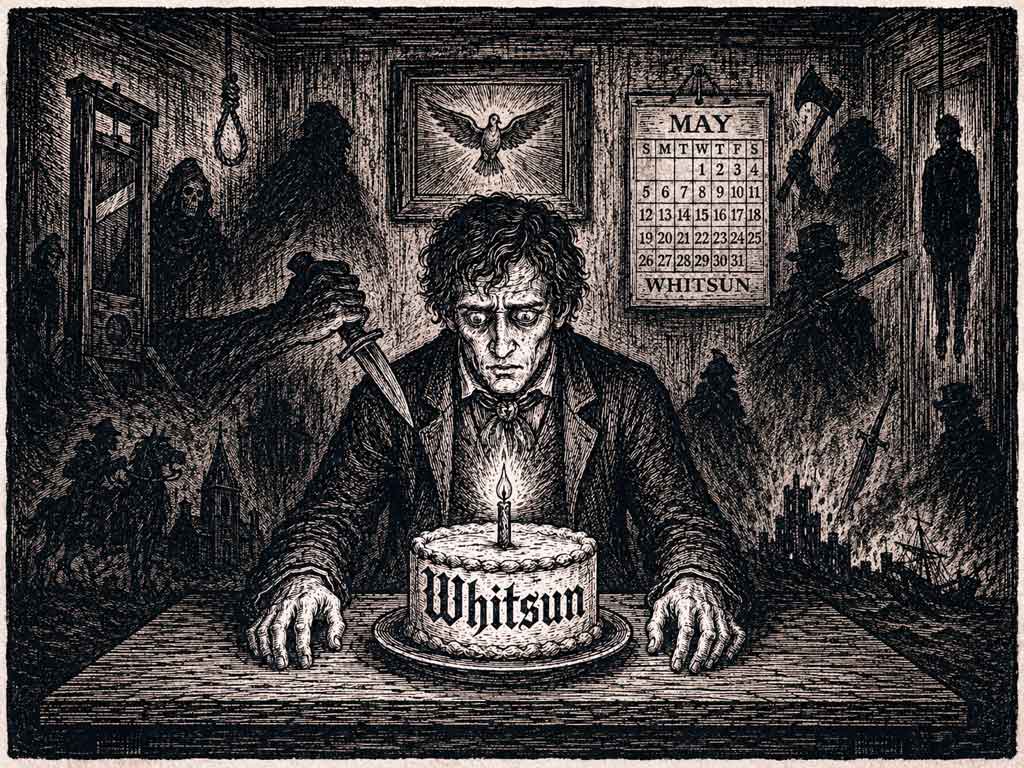
The thing that killed Whitsun, more than the Reformation, more than the suppression of the ales, more than the slow Victorian fade of the mystery plays, was an administrative decision. In 1971, a Government Bill - confirming experimental changes that had been running since 1963 - fixed the Whitsun bank holiday to the last Monday in May. From that point on, Whit Monday and the bank holiday could not be relied on to coincide. The bank holiday became permanent and predictable. Whit Monday went back to being a movable religious feast, observed (when at all) by the churches and almost nobody else.
The change was made for sensible reasons. Pentecost moves with Easter, which moves with the lunar calendar, and Whit Monday could fall anywhere from mid-May to mid-June. Fixing the bank holiday gave the travel industry, the schools, the railways and the manufacturers a date they could plan around. It avoided the worst congestion of peak periods. It made the year more legible to administrators.
What it could not do was carry the meaning across with it. The earlier Whitsun had been held together by a stack of overlapping reasons - Pentecost, the descent of the Spirit, the white robes, the baptisms, the medieval kingship rites, the parish ales, the Morris dancers, the mystery plays, the green processions, the fairy lore, the lover-tests, the mock burials, the warnings about water. It was a knot. Cut one thread and the rest, for a while, held. But the religious calendar was the cord that ran through the middle of all of them. Once Whit Monday was no longer Whit Monday, it stopped reminding people of any of it.
A reader writing to the Dundee Courier in 1970 already saw what was coming, complaining that the press were calling the wrong Sunday Whitsunday: "Or is it going to be an annual occurrence shifting Whitsunday to suit holiday arrangements with no thought given to the origin of Whitsun at all." A clergyman in the same column, with weary realism, replied that most churches were "now quite willing to accept that religious festivals should be geared to the national economic way of life." The shift had already happened in the minds of the planners. The Bill simply made it law.
The Empty Altar: Why the Late May Bank Holiday Feels Like Nothing
It is striking how thoroughly the cultural memory was lost. Most people under the age of fifty have never heard the word Whitsun used in conversation. The Whit Walks at Preston are smaller than they were. The mystery plays survive as period revivals, performed in cathedrals and at festivals by enthusiasts, rather than as the living theatre of the streets. Morris dancing has had its modern revival, but no longer belongs especially to Whit. The folklore - fairy abductions, drowned riders, mock burials, lovers' reflections - survives mostly in the kind of archive this article has been mining.
The Spring Bank Holiday now sits at one of the great turning points of the year, almost exactly opposite Christmas Day, and yet feels weightless beside it. Christmas still says, even to the most secular household, this is what winter means. The late-May bank holiday no longer says this is what summer means. It says: Monday off.
That is not a small loss. The older Whitsuntide gave its communities a structured way of marking the turn into summer - through ritual, theatre, food, drink, dance and a particular kind of dangerous folklore that took the season's beauty seriously enough to warn people about its edges. It also gave the parish a financial mechanism for looking after its poor, its orphans, its brides and its church, all in a single weekend of festivity. The current arrangement gives us a day off and a traffic report.
There is something almost archaeological about it. The calendar still leaves the space open - we still stop, travel, gather, cook outdoors, sit in gardens, drive to the coast if the weather behaves - but the inherited symbolic language has gone missing. We are walking around a footprint without quite knowing what stood there.
It is like finding a stone circle in a retail park.
Bringing Whitsun Back
If any of the older Whitsuntide is worth retrieving, it isn't the mock burials of unlucky babies, or the warning that the drowned ride white horses on the waves. It is the structural genius of the festival: a single weekend that could hold the green explosion of early summer, communal generosity, public theatre, neighbourly drinking, courtship, charity and a sense that the year was passing through a meaningful hinge. The Whitsun ales raised the parish poor relief. The mystery plays gave the trades a stake in public art. The processions allowed children, old people and entire denominations to walk together through their own streets, in their own clothes, behind their own banners.
You can imagine a version of the Spring Bank Holiday that quietly reclaimed some of this. A street pageant. A village ale, properly so called. A walk. A cheese rolled down a hill. A long table outside the church. A bonfire, even - light and fire being, in the older folklore, the great protections at Whitsun against malevolent influences. The day is already free. The calendar already cleared the altar. All that is missing is the will to put something on it.
Failing that, at least the next time you find yourself with nothing to do on a long Monday in late May, you might know what you are not doing - and what, until very recently in historical terms, the rest of your village would have been doing instead.
Sources for this article draw on newspaper accounts of Whitsuntide customs published between 1870 and 1971, including the Tyrone Constitution, Bristol Mercury, Sunderland Daily Echo, Country Life, Westminster Gazette, Pall Mall Gazette, Dundee Courier, Newcastle Daily Chronicle, Liverpool Echo, Driffield Times, Liverpool Daily Post, Gloucester Citizen, Western Morning News, Belfast Telegraph, South London Press, Daily Herald and the Epworth Bells, together with Lady Wilde's Ancient Legends, Mystic Charms and Superstitions of Ireland and Chambers's Book of Days.