
A note on spelling before we start: this saint's name appears in historical sources as Swithun, Swithin, and even the Latinised Swithunus. Modern scholarship generally prefers Swithun for the man and his cult, while the popular weather rhyme has always been attached to the folk form St Swithin's Day. That's the convention we'll follow here: Swithun the bishop, Swithin the superstition.
For centuries, the name of Saint Swithun has conjured visions of rain-drenched summers, ploughshares glowing red-hot on a cathedral floor, and (rather more improbably) a basket of miraculously mended eggs. But who was the man behind the weather legend? Why did his feast day, 15th July, come to govern the fate of harvests and the ripening of apples across the whole of England? And why do two respectable ecclesiastical authorities flatly disagree about whether he was ever a monk at all? This is the fuller story, pieced together from Anglo-Saxon charters, monastic account rolls, Bollandist hagiography, and three centuries of English folklore collecting.
The Real Saint Swithun
Swithun was born early in the ninth century, most likely into a noble West Saxon family, and was sent as a boy to the monastery attached to Winchester's cathedral. He was ordained priest by Bishop Helmstan, and, according to one 19th-century account, was made "provost" of the church at Winton, effectively head of its monastic community, some years before he became bishop himself.
King Egbert of Wessex kept two trusted counsellors at his side: Ealhstan of Sherborne handled secular business, while Swithun managed ecclesiastical affairs. Egbert entrusted his son Æthelwulf's education to Swithun, and a Mercian charter (granted by King Wiglaf to Croyland Abbey) records Swithun witnessing as "priest of King Egbert." When Æthelwulf, as the crown's only surviving heir, needed to leave the monastic vows he had briefly taken in order to marry and secure the succession, he is said to have obtained a papal dispensation from Leo III to marry Osburga, a woman later remembered as "very holy", and the mother, among four sons, of the future Alfred the Great.
Helmstan died in 852 (though some medieval chroniclers place the vacancy as early as 837 or 838, the exact year already a point of scholarly dispute by the time the Bollandist editors of the Acta Sanctorum went looking for it centuries later). Whatever the precise date, Æthelwulf and the Winchester clergy were unanimous in wanting Swithun as their bishop, and he was consecrated by Ceolnoth, Archbishop of Canterbury, on 30 October 852, a date precise enough to survive in more than one independent source.
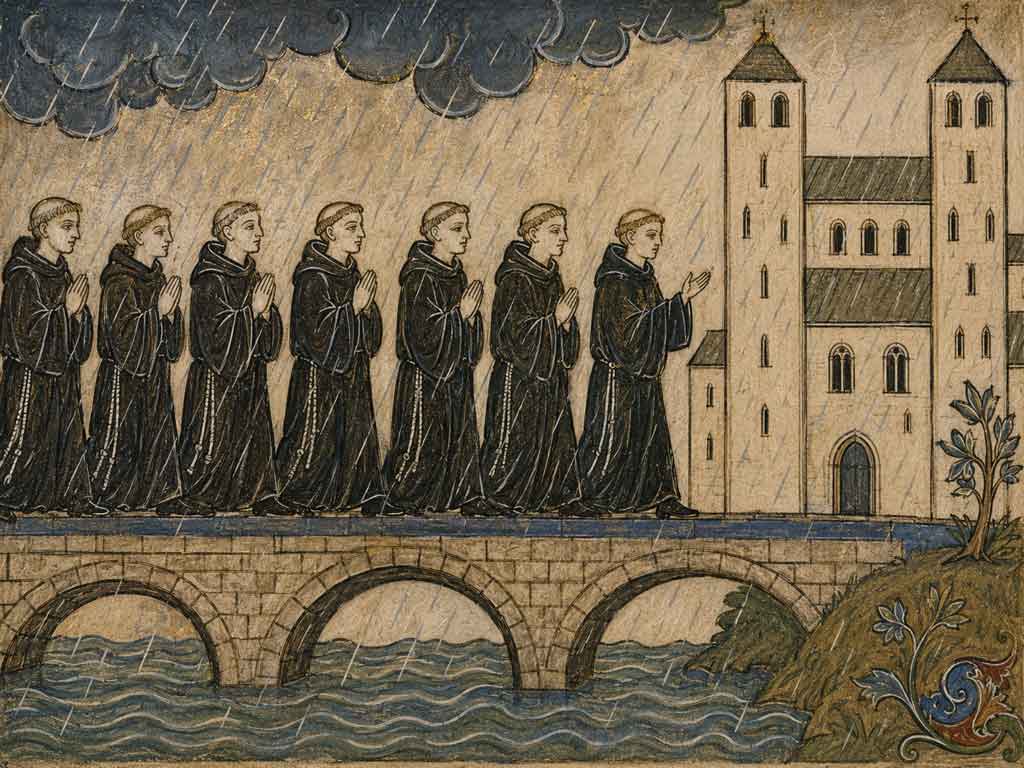
As bishop, Swithun is remembered for an almost theatrical humility. He built and repaired churches around Winchester, and when he travelled to consecrate them he insisted on walking barefoot; to avoid drawing admiring crowds, he made these journeys by night. He built a stone bridge at the eastern edge of the city for the benefit of ordinary travellers, a bridge important enough that its name still marks a boundary line in a surviving Anglo-Saxon land-charter belonging to Queen Ealhswith, Alfred's wife, complete with its own defensive earthwork. And on Swithun's advice, Winchester's cathedral precinct was ringed with a defensive wall against the Danes, a wall so effective that when the Danes later burned Canterbury, Winchester itself was spared.
Swithun's most consequential legacy, though, may be political rather than architectural. He is traditionally credited with a hand in Æthelwulf's celebrated charter of 855, which granted a tenth of the crown's lands to the Church "for the honour of our Lord Jesus Christ, the Blessed Virgin, and all Saints." Æthelwulf reportedly carried this charter to Rome himself and laid it personally on the altar of the Apostles, alongside a confirmation of England's long-running Peter's Pence tribute (first offered by King Ine in 726 and Offa of Mercia in 794). It was almost certainly Swithun who accompanied the young Alfred on that same journey to Rome, tutoring, by extension, the boy who would grow up to become England's most celebrated early king.
Swithun outlived his royal pupil's father by only a few years. Æthelwulf died in 857; the kingdom passed briefly to Æthelbald, then, on his death around 860–861, to Æthelbald's brother Æthelberht, under whom the Danes plundered Winchester before being driven back to the Isle of Thanet. Swithun died on 2 July 862, and, as he had requested, was buried not inside his cathedral but outside its north wall, "where passers-by might tread above his head, and the dews of heaven fall on his grave."
The Translation and the Legend of Rain
For over a century, Swithun's grave remained exactly where he'd asked: humble, exposed, and outdoors. Then, in 971, Bishop Æthelwold (the same reforming bishop who had re-established Benedictine monks at Winchester after a period of secular control) had the by-then-forgotten grave rediscovered and the relics moved with great ceremony into a shrine inside the new cathedral, on 15 July. The building was completed in 980 and dedicated jointly to St Peter, St Paul, and St Swithun; the church's Benedictine priory took the same joint dedication, and was known for centuries afterwards as Oldminster.
This is the moment the legend hangs its hat on. According to the most commonly repeated version, the monks (newly enthusiastic about their canonised bishop) decided it was undignified for a saint to lie in an open churchyard, and planned to move him into the choir with full solemn procession. It rained so violently, and for so long, that the removal had to be abandoned; some tellings even say the monks read the deluge as a rebuke and built a chapel over the original grave instead, rather than moving him at all. Out of this, real or embellished, grew the proverb known to every English schoolchild since:
St Swithin's day, if thou dost rain,
For forty days it will remain;
St Swithin's day, if thou be fair,
For forty days 'twill rain nae mair.
There is a genuine meteorological kernel here, whatever the monks made of it: the jet stream tends to settle into a pattern around mid-July, and a wet or dry start to that window does statistically correlate with the following weeks more often than pure chance would predict. For an agrarian society watching its harvest, a folk rule that captured even a rough seasonal tendency was worth remembering, and worth blaming on a saint.
Swithun's relics didn't stay put even then. In 1093, when Bishop Walkelin's grand Norman cathedral (the building substantially still standing today) was far enough along, the relics were translated a second time into a new, costlier shrine, attended by nearly every bishop and abbot in England.
Was Swithun actually canonised, and by whom? Here the sources genuinely disagree. The seventeenth-century antiquarian John Brand states flatly that Swithun "was canonized by the then Pope." The Catholic Encyclopedia (1912) instead says he "was canonized by popular acclamation" after a wave of miraculous cures, which fits far better with how sainthood generally worked in this period, long before formal papal canonisation processes existed. The two accounts can't really both be literally true: a legend that had already drifted for over a century by the time of its first written biography had plenty of room to accumulate this kind of embellishment.
Even the question of whether Swithun was ever a monk turns out to be contested. The Catholic Encyclopedia states there is "no evidence" he was a Benedictine monk or prior before becoming bishop. The Bollandists' Acta Sanctorum, by contrast, quotes what it presents as Swithun's own written profession of monastic vows, made before Archbishop Ceolnoth prior to his consecration: "Ego, Swithunus monachus, servulus servorum Dei..." ("I, Swithun, a monk, servant of the servants of God..."). Two respectable sources, working from the same thin store of early material, reach opposite conclusions, a useful reminder of how much of Swithun's biography rests on documents whose authenticity was already being argued over a thousand years ago.
One miracle story from the shrine's later history deserves special mention, because it has nothing to do with rain. In the reign of Edward the Confessor, Queen Emma, his mother, was accused of an improper relationship with Ælfwine, Bishop of Winchester. Confined by her son at Wherwell Abbey, she demanded to clear her name at Swithun's own shrine, and did so, according to the Acta Sanctorum, by walking barefoot and blindfolded across nine red-hot ploughshares laid on the church floor, emerging entirely unharmed while the king and his court looked on in astonishment. In gratitude, Emma granted the priory nine manors (plus two more of her own), and was herself buried at St Swithun's when she died in 1052. It is one of the most vivid trial-by-ordeal stories to survive from Anglo-Saxon England, and it happened, of all places, at the rain saint's own tomb.
A Miracle for Every Day
The scale of Swithun's posthumous reputation is easy to underestimate if you only know the weather rhyme. His earliest biographers (writing, by their own admission, generations after his death) complained bitterly about how little material survived. An old English homily now in the British Museum laments: "We have not found in books how the bishop lived in this world ere that he departed to Christ... it was their carelessness who knew him in life, that they would not write his works and conversation for future men." Ælfric of Eynsham, writing not long after, voiced the same regret in Old English even as he thanked God for revealing the bishop's sanctity through "manegum wundrum" (many miracles).
Those miracles, once they started being recorded, were catalogued with almost bureaucratic precision. Two named early writers (Lantfred, whose account is considered close to contemporary with the 971 translation, and Wulfstan the Cantor, a monk of Winchester who versified the story a few decades later) between them preserve tallies that read more like a hospital ledger than a legend: at the translation itself, a boy crippled from birth was healed; three blind women had their sight restored; a woman was freed from iron fetters; a paralytic and a blind noblewoman were cured; twenty-five people were healed in a single day; thirty-six over the following three days; and one hundred and twenty-four more within the next fortnight. William of Malmesbury, writing later, adds his own eyewitness claim: a man whose eyes had been gouged out by robbers, he says, had his sight restored through Swithun's merits, the scarring around his eyelids the only trace of the old injury.
Not every miracle was so solemn. Poor Robin's Almanack (1697) preserves a small folk-tale that must have circulated independently of the official Vita: a woman, having broken her eggs by stumbling over someone's legs, was crying over the wreckage when St Swithun happened by and made them "all as sound, or more, than ever they were before." It's the same egg-mending miracle later writers have echoed ever since, right down to modern retellings of the legend.
The number forty runs through all of this: not because it is uniquely Swithun's, but because it is one of the most reused units of symbolic time in the entire Christian and pre-Christian world. Chambers's Book of Days lists it alongside the forty days of Lent, Moses's forty days on the mountain, the forty days of the Flood, a widow's forty-day right to remain in her late husband's house under Magna Carta, a knight's forty days of military service, even a pagan mourning-rite for Proserpina that the early Christian writer Tertullian noted ran to exactly the same length. Swithun's forty days of rain aren't a special case; they're the English weather-lore instance of a number that folklore reaches for automatically whenever it wants to signal "a complete period of testing."
Apples and Orchard Lore
In rural tradition, Swithun was not only the bishop of rainfall but of orchards. Apples, it was said, would not ripen properly until after his feast day, and picking was delayed until the weather had shown its hand. One old saying held it more poetically still: rain on St Swithin's Day was the saint christening the apples, a small act of blessing folded into what was, on its face, just another wet English July. There's a real seasonal logic underneath the charm: mid-July marks the hinge between early summer growth and late-summer ripening, and fruit that had survived a "christening" of rain was considered to have passed a natural threshold on its way to harvest.
The Literary Afterlife
Educated writers from the Restoration onward treated the Swithun legend less as devotion and more as a stock joke about English credulity, which shows just how thoroughly the story had penetrated the culture. Ben Jonson has a character in Every Man Out of His Humour grumble about the weather on "St Swithin's, the fifteenth day... it was a rule held afore I was able to hold a plough." Charles Churchill compressed the whole legend into a single couplet: "St James gives oysters, and St Swithin rain." And John Gay, in Trivia: Or, the Art of Walking the Streets of London (1716), used Swithun's feast alongside St Paul's Day weather-lore as his prime example of the "vulgar tales" a sensible pedestrian ought to ignore, closing the passage with a flatly skeptical couplet: "Let not such vulgar tales debase thy mind; / Nor Paul nor Swithin rule the clouds and wind." Gay's Swithun appears, tellingly, in a mock-heroic poem about umbrellas, mud, and navigating London's gutters, proof of how far the legend had drifted from theology into pure urban small talk within less than a thousand years.
Even the calendar reform of 1752 got dragged into the joke. A "pleasant writer" in the periodical The World (usually attributed to Horace Walpole, Lord Orford) mocked the switch from Julian to Gregorian dating by asking, "Could they imagine that St Swithin would accommodate his rainy planet to the convenience of their calculations?" It's a genuinely sharp point, and one folklorists still raise today: any legend anchored to a specific calendar date has to reckon with the fact that the date itself has moved.
The Pilgrim Route and the Life of the Priory
Long after Swithun's death, the Benedictine community that grew up around his shrine (the Priory of St Peter and St Swithun, or Oldminster) became one of the great institutions of medieval Winchester, and its surviving account rolls give an unusually intimate picture of how a major English shrine actually functioned day to day.
St Swithun's sat squarely on one of the busiest routes in England. Merchants and nobles landing at Southampton from Le Havre or Bordeaux would find it "the first hostelry along their road" to London. Far more numerous were pilgrims travelling the Pilgrims' Way (through Alton, Farnham, along the Hog's Back to Guildford, over Box Hill, through Dorking) on their way from the west of England toward Canterbury and the shrine of Thomas Becket. For many, Swithun's older, gentler sanctity made Winchester a natural stopping point before the final leg of the journey. The priory's Pilgrims' Hall, built in the thirteenth or fourteenth century, still stands, its roof timbers blackened by centuries of hearth-smoke; travellers would rest there, keep vigil at the shrine hoping for a cure, and receive broken food from the Prior's own kitchen before continuing east.
Physically, the priory and the saint's name were bound together. The defensive wall Swithun had reputedly advised building against the Danes still guarded the monastery's own quarter of the city centuries later, and the monks took direct responsibility for the King's Gate and South Gate. The King's Gate was topped, appropriately, by a small church dedicated to St Swithun, originally built to let the priory's own servants and retainers worship separately from the monks (the church burned down in the thirteenth century, was rebuilt, and remarkably still stands today, straddling the old gateway).
The priory also profited handsomely from St Giles's Fair, running wine, spice, and fur stalls each September while the Lord Prior processed up the hill in new robes for the occasion. By the time of the Dissolution, St Swithun's Priory was valued in the King's Books at over £1,500 a year, comfortably solvent compared to its grand neighbour Hyde Abbey, valued at less than a third as much. That reflects shrewd management under a run of powerful bishops including William of Wykeham and Cardinal Beaufort. It didn't survive the Dissolution any better for its wealth: the shrine itself was destroyed and Swithun's relics scattered in 1538, and the neighbouring nunnery of St Mary's (Nunnaminster) limped on only another four years after "the grand Priory of St Swithun and Hyde Abbey had fallen before the advance of the general destruction."
Churches dedicated to St Swithun remain clustered across southern England even now, most thickly around Winchester itself: St Swithun-upon-Kingsgate, and the villages of Martyr Worthy and Headbourne Worthy nearby, both thought to lie on the old pilgrimage corridor, along with outlying dedications such as Nately Scures. Many sit near springs or streams, a fitting resting place for a saint whose name became synonymous with water falling from the sky.
European Rain Saints and the Seven Sleepers
Swithun is far from the only saint whose feast day was drafted into weather forecasting. The French had St Médard (8 July) and, on the fifteenth of the same month, St Gervais (the very same date as Swithun's translation feast) with an almost identical rhyme: "S'il pleut le jour de St. Médard, il pleut quarante jours plus tard." An older Latin tradition attached the same forty-day rule to the Translation of St Martin on 4 July. The Catholic Encyclopedia, working from a different manuscript tradition, instead links the French belief to 8 June and the joint feast of Sts Gervasius and Protasius, a genuine scholarly disagreement about which saints, and which date, actually anchor the French parallel. It shows how loosely these folk-attributions were pinned to the calendar in the first place. In Flanders, St Godelieve's day (6 July) carried a similar weight, and further afield the reckoning shifted seasons entirely: in Germany, the Seven Sleepers of Ephesus (27 June), the legendary sleepers linked to the same city that also features in the story of Mary Magdalene's tomb, were believed to fix the weather for the following seven weeks, not forty days. English folklore even bookended Swithun's own influence: a proverb held that whatever rain Swithun brought, St Bartholomew's Day (24 August) would finally "wipe dry" with its "dusty mantle", and folk-belief extended the same forty-day rain-rule again to St Simon and St Jude's Day in October. Taken together, these form a continent-wide habit of pinning meteorological anxiety to the nearest convenient saint's day, and Swithun is simply the version that happened to stick in English memory.
Fact or Folklore?
Weather records compiled at Greenwich in the nineteenth century found, unsurprisingly, mixed results for the forty-day claim taken literally. But the belief's persistence into the twentieth century, and beyond, has a more interesting explanation than simple credulity. As noted above, the Gregorian calendar reform of 1752 shifted dates by eleven days; some have argued the "true" old-style St Swithin's Day now falls closer to 27th July, nearer the point the jet stream typically settles for the summer. Whether or not that reasoning holds up to scrutiny, it captures something real about how folklore survives: not because every detail is literally accurate, but because it keeps just enough of a kernel of observed truth to feel worth repeating, generation after generation, monk to monk, almanac to almanac, right down to the newspaper columns that still invoke his name every July.
A Prayer for Rain
In an age of climate change, prolonged heatwaves, and water shortages, people still half-jokingly look to the sky each 15th July and think of St Swithun. It's a strange kind of afterlife for a ninth-century bishop remembered in his own time mostly for tutoring a king and building a bridge, but perhaps a fitting one. Long after his shrine was broken up and his relics scattered, the humble grave he asked for, "where the rain of heaven might fall," has outlasted the cathedral that eventually swallowed it.
Sources:
- William Andrews (ed.), Bygone Hampshire (1899), including "St Swithin" by Rev. Geo. S. Tyack and "Winchester Cathedral" by England Howlett
- John Brand, Observations on Popular Antiquities (various editions)
- Douglas Raymund Webster, "Swithin, Saint," The Catholic Encyclopedia, Vol. XIV (1912)
- Acta Sanctorum, July, Vol. I: "De S. Swithuno Episc. Conf." (Bollandists), drawing on Lantfred, Wulfstan the Cantor, Goscelin, and William of Malmesbury
- Justorum Semita; or, The Path of the Just (19th c.), entry for 15 July
- Compotus Rolls of the Obedientiaries of St Swithun's Priory, Winchester (Hampshire Record Society)
- An Ancient Manuscript... formerly belonging to St Mary's Abbey, or Nunnaminster, Winchester
- Robert Chambers, The Book of Days (1863–64)
- John Gay, Trivia: Or, the Art of Walking the Streets of London (1716)
- Ælfric's Lives of Saints
- 19th- and 20th-century newspaper accounts and weather reports
- Worthy Churches Project (worthychurches.org.uk)
- A Clerk of Oxford blog (aclerkofoxford.blogspot.com)