Halloween was once the most important night of the Scottish farming year, reckoned so precisely that households counted down from it, night by night, to the next great date on the calendar. Woven into the seasonal, spiritual, and economic life of the Celtic and later Christianised world, it has narrowed in living memory to a night of costumes, sweets, and plastic horror. Under the pumpkins and the fangs sits a longer and stranger history: hilltop fires extinguished and relit under druidic law, ale poured into the sea for a forgotten god, girls fainting over burning hazelnuts, and a farming calendar that didn't end at Halloween at all but kept counting through Bonfire Night to Martinmas, eleven days later.
A Sacred Time: Samhain and the Fire Festivals
Before Christianity reached Britain, the Celts marked the turning of the year with four great fire festivals, the same cycle that later produced the midsummer bonfires of St John's Eve. The last and darkest of the four was Samhain, marking the final harvest and the start of winter, sitting directly opposite Beltane on the wheel of the year. At Samhain, so the old belief ran, the veil between the world of the living and the world of the dead grew thin enough to cross.
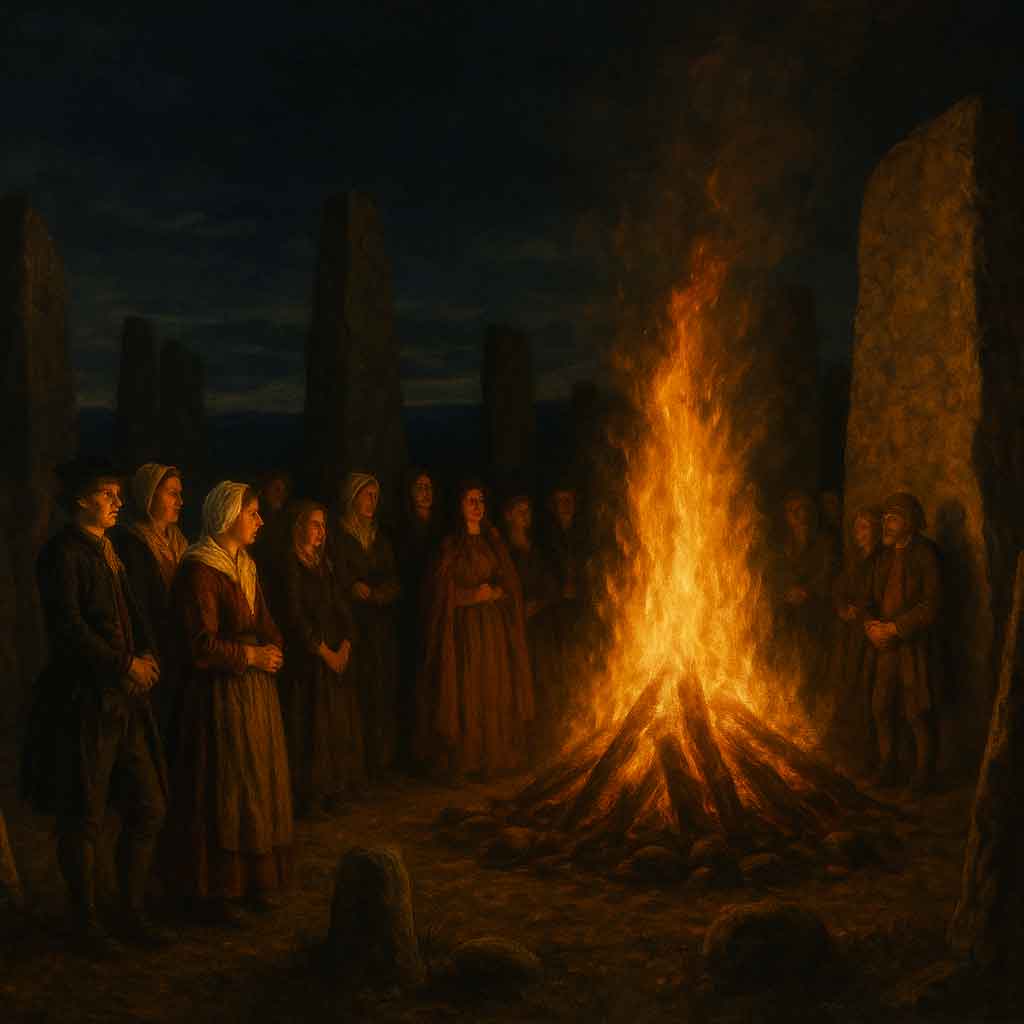
Fires were put out across the country and relit from a single sanctioned source. The nineteenth-century folklorist James Napier, gathering customs still remembered in the west of Scotland, preserved an older account of how the ritual worked:
"It was at this season that the Druids usually met in the most central places of every country to adjust every dispute and decide every controversy. On that occasion, all the fires in the country were extinguished on the preceding evening, in order to be supplied next day by a portion of the holy fire which was kindled and consecrated by the Druids. Of this, no person who had infringed the peace... was to have share, till he had first made all the reparation and submission which the Druids required of him... none being allowed to give him house or fire, or shew him the least office of humanity."
Refusing someone fire in a Scottish winter came close to a death sentence. The custom handed the Druids something close to judicial power over the whole community: settle your disputes before Samhain, or go cold.
Napier also recorded the festival's older name, and with it a claim that has followed Halloween ever since - a link to fire-worship far beyond Britain:
"The Celtic name for the autumn festival was Sham-in, meaning Baal's Fire... The Hebrews and Phoenicians called this festival Baal-Shewin, a name signifying the principle of order."
Modern Celtic linguistics traces "Samhain" to a much simpler root, roughly "summer's end," and the Baal connection doesn't hold up as etymology. But the belief itself is genuine and well documented: nineteenth-century Scots antiquarians read their own Halloween bonfires as kin to the Baal-fires of the ancient Near East, and the comparison shaped a century of writing about the festival, whatever its actual origin.
The bonfires were real enough on their own terms. Napier interviewed a man who had watched them burning as late as 1860:
"For several days before Hallowe'en, boys and youths collected wood and conveyed it to the most prominent places on the hill sides in their neighbourhood. Some of the heaps were as large as a corn-stack or hay-rick. After dark on Hallowe'en, these heaps were kindled, and for several hours both sides of Loch Tay were illuminated as far as the eye could see."
The same pattern held far to the north-east, in the farming district of Buchan, Aberdeenshire, where villagers lit fires on Knock, Dunshillock, Biffie, and Auchmachar, "and from the top of Aikey Brae scores of such bonfires might have been seen" - hillside after hillside catching light for one night a year.
The fire did more than mark the date. Cattle were driven through the smoke to "sain" them, cleansing them of the coming winter's ills exactly as they were driven through Beltane smoke each spring to purge the ills of the one just ending. Once the wood burned down, the ashes themselves turned into an oracle. Three separate accounts - from Perthshire, from Callander, and from North Wales - describe the same ritual, unconnected but identical in substance: each household member marked a stone and buried it in the embers before bed, then checked at dawn to see whose had gone missing.
"The ashes of the fire were carefully collected in the form of a circle, and a stone put in near the circumference for every person in the several families concerned in getting up the fire; and whatever stone is moved out its place or injured before next morning, the person represented by the stone is devoted or fey, and is supposed not to live twelve months from that day."
In North Wales the same rite went by the name Coel Coeth, and villagers fled the dying embers "to escape from the black short-tailed sow" the moment the flames dropped. Three regions, one shared fear: a missing stone meant a missing year of life.
The building of the fire had its own ritual, and in the north-east of Scotland it was explicitly aimed at witches, not spirits in general. Boys went from door to door collecting fuel with a set formula - "Ge's a peat t' burn the witches" - before hauling everything to the highest ground near the farm. Once the pile was lit, youths lay down close enough to let the smoke roll over them, then jumped through it, and when the fire finally burned out, the ashes were kicked and scattered, right foot first and then left, each person trying to spread more than the last. Walter Gregor, who collected the custom in Banffshire and Aberdeenshire, records that the same chant, "fire! blaze an burn the witches," was used at both Beltane in May and Hallowe'en in autumn - one ritual, repeated at opposite ends of the farming year, to burn off whatever malice had built up since the fire was last lit.
On the Isle of Lewis, in the Outer Hebrides, the fire gave way to something stranger - an offering not to a spirit of flame but a spirit of water. The seventeenth-century traveller Martin Martin recorded the ritual, and antiquarians were still quoting him two centuries later almost word for word:
"It was long before the minister there could persuade the people to relinquish a ridiculous custom they had of going by night on Hallow-tide to the Church of St. Mulvay, whence one of their number went into the sea to the waist, with a cup of ale brewed for the occasion with malt contributed by the inhabitants (each family giving a peck), and pouring the liquid into the water, addressed a propitiatory allocution to a sea-god called Shony, who was supposed to have an influence over the crops. They then returned to church, observed a moment's dead silence, extinguished at a given signal the candle on the altar, and proceeded to the fields, where the rest of the night was spent in revelry."
Shony's home was Lewis, not St Kilda, though the two islands are often run together in retellings. Martin Martin recorded a separate, equally striking custom for St Kilda itself: islanders marked All Saints by baking "a large cake, in the form of a triangle, furrowed round, which was to be all eaten that night." Between the two, the Outer Hebrides show a people settling accounts with more than one power before winter closed in - land, sea, and the dead all wanted their due.
The Divining Night
By the eighteenth century the fire rites had shrunk from hillside ceremony to something practised at the hearth, but the underlying question hadn't changed: who would you marry, and when. Robert Burns set down the fullest record of these games in his 1785 poem Halloween, and even then he was writing as an antiquarian rather than a participant - his editors note that "these customs had ceased many years before Rab wrote this piece," so that Burns himself was already working from stories told to him as a child.
Burning nuts was the simplest test. A couple would name a nut each and set the pair side by side in the fire: burn quietly together, and the match would hold; leap apart, and it wouldn't. Burns records both outcomes in the same breath:
"Poor Willie, wi' his bow-kail runt, / Was burnt wi' primsie Mally; / An' Mary, nae doubt, took the drunt, / To be compar'd to Willie: / Mally's nit lap out, wi' pridefu' fling..."
"Nell had the fause-house in her min', / She pits hersel an' Rob in; / In loving bleeze they sweetly join, / Till white in ase they're sobbin..."
Pulling kail stalks blindfolded was riskier, since the whole household went out into the field, hand in hand, eyes shut, to grope for the first stalk they touched. Its size, straightness, and the amount of soil clinging to the root read as a verdict on the future spouse's looks, fortune, and temper, and the stalks were afterwards hung above the door - the first person to walk in under a given name was taken as confirmation. A version recorded in Aberdeenshire in 1951 added its own flourish: girls threw the pulled stalk clean over the roof and noted which direction it landed, to work out where a future husband lived.
Sowing hempseed at midnight was the rite that actually frightened people. Walking alone through the stackyard, scattering seed behind you and reciting "Hemp-seed I saw thee, / An' her that is to be my lass / Come after me, an' draw thee," was meant to summon a vision of your future spouse over your shoulder. Burns' character Jamie Fleck tries it as a dare and is left "sae sairly frighted" by an ordinary noise in the dark that it takes him days to recover. Aberdeenshire had its own version of the same rite using flax rather than hemp: a maiden walked alone across the ridges of a field at dusk, sowing lint-seed and repeating "Lint-seed I saw ye, / Lint-seed I saw ye; / Lat him it's to be my lad / Come aifter me, and pu' me," then looked back over her left shoulder to catch her future husband's apparition crossing the field behind her, mid-stride, as though pulling flax of his own.
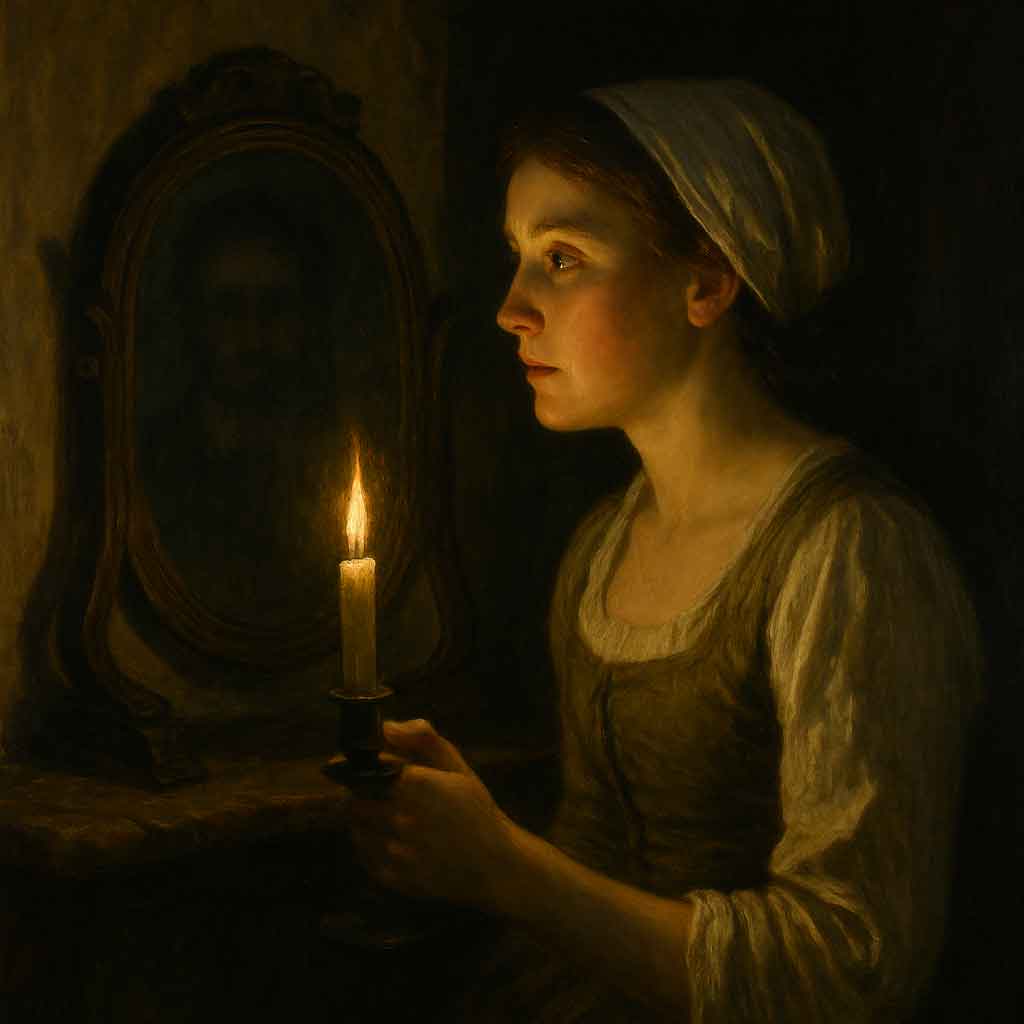
The mirror rite carried the same warning built in. Young Jenny wants to eat an apple in front of a looking-glass to see her future husband's face appear behind her own - the custom now most associated with Halloween folklore worldwide - and her grandmother's response is fury rather than indulgence: forcing a vision this way risked seeing the Devil instead of a sweetheart, and "monie a ane has gotten a fright, / An' liv'd an' died deleeret" - lived and died insane. The most serious version of that warning made it into the historical record rather than a poem. In 1802, a girl named Isobel Carr reportedly died of shock after performing the hempseed rite and believing she had seen an apparition, a case widely reported at the time as proof that the old superstitions could do real harm.
Other tests were quieter but no less earnest. A blindfolded choice among three dishes - one holding clean water, one foul water, one left empty - foretold marriage, widowhood, or a life alone. A length of blue yarn thrown down a dark kiln and wound back in while calling into the darkness was meant to have something unseen catch the far end and answer to a name. An Aberdeenshire account from 1951 lists a further catalogue that never made it into Burns: chapped potatoes served with a ring, a coin, and a button baked inside to mark out who would marry, who'd grow rich, and who'd stay single; a hot ember turned in the peat ash to see whether it glowed warm or died with a dull hiss; and a tuft of straw pulled blind from a cottage's thatched eaves, checked afterwards for a stray hair that would give away a future spouse's colouring.
An 1834 account from a farmhouse near Glen Cullen shows the same games being played across the Irish Sea, in spirit if not in dialect - nuts set to burn "just for the sake ov thryin' iv her sweetheart id lave her or not," kale stalks pulled "causing much laughter" over the crooked ones, and dishes of salt, sand, and water read by touch to guess who'd marry within the year. All of it happened, the writer notes, in a room where ghost stories were being traded around the fire at the very same time. Divination and haunting weren't two separate activities on Halloween. They were the same evening.
One Aberdeenshire rite made that overlap literal. To learn her future husband, a maiden went not to any stream but "to a south-running stream, or to a ford where the dead and the living crossed" - a river crossing customarily used by funeral processions on the way to the burial ground - and washed the sleeve of her shirt in it. Back home, she hung the wet sleeve to dry in front of the fire and kept watch from her bed. If the rite worked, her future husband's apparition came in the night and turned the sleeve over to dry the other side. The divination worked because the ford itself was already a threshold between the living and the dead; walking to it and back was the point as much as the washing.
A Time of Spirits and the Dead
Halloween's other name across the Irish Sea makes its meaning plainer than "Hallowe'en" ever does. Lady Wilde, collecting Irish folk belief in the 1880s, called it simply November Eve and paired it directly with May Day as the year's two great turning points: "Lá Baal Tinné, or May Day (Sacred to the Sun), and Lá Samnah, or November Eve (sacred to the Moon)." On this one night, she recorded, the dead were owed food and courtesy like living guests:
"Food should be left out on November Eve for the dead, who are then wandering about. If the food disappears, it is a sign that the spirits have taken it, for no mortal would dare to touch or eat of the food so left. Never turn your head to look if you fancy you hear footsteps behind you on that night; for the dead are walking then, and their glance would kill."
The dead did not walk alone. Wilde's fullest tale on the subject has the dead and the fairies sharing a single festival on the hillside, drinking from fairy cups until moonset, with mortals warned to stay indoors on pain of being swept into the dance themselves - "that one night of all the year when the dead can leave their graves and dance in the moonlight on the hill, and mortals should stay at home and never dare to look on them." A companion tale, "The Dance of the Dead," marks the season's true close: the revels ran until the very last night of November, after which the dead "must all go back to their graves and lie in the chill, cold earth without music or wine till the next November comes round."
Wales gave the same night its own named terror. Village rhyme warned of dark spirits loose on every stile, and singled out the worst of them by name: the Hwch Du Gwta, a black, tailless sow, said to prowl on Nos Galan Gaeaf, Allhallows' Eve. The Scottish Gaelic word for any demon abroad that night, Samhanach, comes directly from Samhain itself. One Merionethshire story holds that a vanished fiddler, Iolo ap Huw, became huntsman to the fairy king Gwyn ap Nudd, so that "every Halloween he may be found cheering Cŵn Annwn, the Hounds of the Other World, over Cader Idris" - a Welsh Wild Hunt riding out on the one night the doors between worlds stood open.
Scottish tradition told a gentler version of the same rule: don't linger past midnight, and don't join the dance. A well-travelled Highland tale describes two young men who stumble on a lit, music-filled dwelling on their way home one Hallowe'en. One joins the dancers; the other, more wary, sticks a needle into the doorframe as he enters, which lets him leave again at will. When he returns for his friend a year to the night later, the man is still dancing, danced to skin and bone, and is only permitted to finish the reel before being led back out into the ordinary world. On Skye, farmers told of their own horses found galloping the cliff edge at full pelt on Hallowmas night, ridden by fairies "sitting with their faces to the tail" - one small, vivid image of a night when the natural order simply didn't hold.
Buchan farmers made their own, more practical peace with the dead and the devil alike. A strip of ground was left permanently uncultivated at the border of every field - "the gweedman's craft," handed over to the devil and evil spirits outright, so that they would have no cause to trespass on the rest of the farm. It reads less like folk story than folk law: don't provoke what you can't fight, and give it a boundary of its own instead.
One Long Season: Halloween, Bonfire Night, and Martinmas
It's worth asking why Bonfire Night, a seventeenth-century political anniversary with no obvious connection to the old year's turning, took root so easily just five nights after Halloween. The full story of how the 1605 Gunpowder Plot became Bonfire Night is told here. One answer comes from the American folklorist Ervin Beck, who surveyed 649 schoolchildren across seven Sheffield schools in the early 1980s and found fires and fireworks being lit from Hallowe'en onward, door-to-door begging running continuously through to the fifth of November, and Halloween songs turning up at bonfires. He read the evidence as proof of "a coherent season of events" rather than three distinct, unrelated nights.
Not every historian agrees. Karen Allen's doctoral study of the same customs in Leeds, supervised by the folklorist Ronald Hutton, found the three occasions had kept their separate names and their own institutional identities well into the twentieth century, concluding there was "little evidence... to support the claim by Beck that Mischief Night is 'merging' with Hallowe'en or Bonfire Night." Sheffield and Leeds, thirty miles apart, appear to have experienced their autumns quite differently - which is itself informative. A season doesn't need every town to mark it identically to be real. It only needs the underlying calendar logic to be shared.
That logic is older than either study, and it has a third, earlier anchor: Martinmas, the eleventh of November. The medieval feast of St Martin sat at what the folklorist Martin Walsh called the true close of the agricultural year - the last of the harvest in, livestock slaughtered and salted for winter, and, in Walsh's account, a "winter revelling season" that could run on for several days past the feast itself rather than stopping dead on one date. Halloween opened that season. Martinmas closed it.
Nowhere is the link clearer than in Aberdeenshire, where the same local rhyme turns up four separate times across seventy years, in four different sources, all saying essentially the same thing. The earliest is Walter Gregor's, collected from farm servants in Banffshire and Aberdeenshire and published in 1881:
"This is Hallaeven, / The morn is Halladay; / Nine free nichts till Martinmas, / An soon they'll wear away."
Gregor is precise about who sang it and when: "the half-yearly servants on the farm, if they intended changing masters," sang the rhyme "during the burning of the fire and the scattering of the ashes" - meaning the countdown to Martinmas was chanted out loud at the Hallowe'en bonfire itself, by the very workers about to leave for a new position when their contracts turned over. Two newspaper accounts of the same district, one from 1934 and one from 1951, preserve an almost identical version of the same rhyme, word for word across fifty and seventy years respectively:
"This is Hallowe'en, and the morn's Hallowday, and it's nine free nichts ere Martinmas, and that'll seen wear awa'!"
Farm servants, hired on six-month contracts that turned over at Martinmas, counted their last free nights from Halloween itself, as though the two dates marked opposite ends of a single measured span rather than separate occasions that simply happened to sit near each other on the calendar. A related 1926 account of bonfire-building near Old Deer describes boys lighting hillside fires at "the proper time - nine free nights before the term of Martinmas, old style" - the same nine-night count, attached this time to fire rather than rhyme. Under the pre-1752 Old Style calendar the arithmetic lines up cleanly: Halloween fell eleven or twelve days later than it does now, putting it just over a week before Martinmas on the twenty-second. Bonfire Night, on the fifth of November, sits within that span - not a replacement for the old Halloween fires, and not quite a rival to them either, but one more beat in a season already built to hold fire, feasting, and a little licensed misrule for a week and a half at a stretch.
The End of the Old Halloween
By the early twentieth century, the old Halloween was already being written up as a thing of the past rather than practised as a living custom. A 1934 newspaper lamented:
"The venerable and natural Halloween is gone... It belonged to a pastoral and humble civilisation... It is a great pity that Halloween should have become an anachronism, as it was bound to follow the stagecoach and the plough-ox."
The same year, on the other side of the country, the Buchan Observer ran its own valediction, and it is more precise about what had actually been lost. The huge hillside bonfires and the torchlit processions round the farm buildings had, the paper reported, been "largely abandoned" - but the domestic customs held on regardless: "ducking for apples, burning nuts, eating mashed potatoes, and other homely amusements... may be said to have lost none of their popularity." Decline, on this evidence, didn't arrive all at once. The public spectacle went first. The fireside games, quieter and cheaper to keep, outlasted them by decades.
Even royalty had, by then, already turned the old custom into staged nostalgia rather than lived practice. In 1871, the Dundee Advertiser reported "The Queen's Hallowe'en" at Balmoral: up to 200 torch-bearers processing to a bonfire, Queen Victoria and her family watching from the castle windows, and the night's centrepiece a cart-drawn effigy of a Hallowe'en witch, escorted by a guard of boys and a piper, burned to cheers while the household danced. The scene is striking precisely because it is not spontaneous folk custom any longer - it is heritage theatre, staged for an audience, sixty years before the newspaper obituary that pronounced Halloween "gone." The tradition that 1934 mourned had, in some places, already been revived once before.
Something of the older season survived anyway, in a form few people now connect to Halloween at all. English children going door to door on All Souls' Day to beg for "soul-cakes," singing for their supper with the rhyme "Soul! soul! for a soul-cake; / Pray, good mistress, for a soul-cake. / One for Peter, two for Paul, / Three for them that made us all," were doing much what modern trick-or-treaters do: asking strangers for food in exchange for a performance, on a night when doing so was licensed rather than strange. Souling didn't survive under its own name. It survived by changing its name and its costume, the way most of this festival's oldest customs eventually did.
Conclusion: A Return to Meaning?
Read together, these accounts make Halloween look less like a single, sacred festival that decayed in a straight line into candy and plastic, and more like the opening beat of a working season: begun at the fires of Samhain, redirected by the Church toward All Souls, measured out by farm servants in nine counted nights, and eventually joined, almost by accident, by gunpowder and a burning effigy on the fifth of November. Divination, mourning, mischief, and fire belonged to the same stretch of the year because that stretch of the year was where a farming community had the least work to do and the most to fear: harvest in, stock slaughtered, contracts turning over, and the year's last light going out for six months.
None of that requires giving up the costumes and the sweets. It only asks that the season be allowed to run its old length again - past the thirty-first, past the fifth, and on toward the eleventh - and that whoever lights the fire this year knows roughly what they're relighting.
Let the fire be lit again.
Frequently Asked Questions
What is Samhain and how is it connected to Halloween?
Samhain was one of the four great Celtic fire festivals, marking the end of the harvest and the start of winter at the close of October. It was a night when hilltop fires were extinguished and relit under druidic supervision and the boundary between the living and the dead was believed to grow thin. Halloween, and later All Hallows' Eve, grew directly out of this older festival.
Who was Shony, and where was he worshipped?
Shony was a sea-god propitiated on the Isle of Lewis in the Outer Hebrides. According to the seventeenth-century traveller Martin Martin, islanders waded into the sea at Hallow-tide and poured out an offering of specially brewed ale, asking Shony for a good crop the following year. The neighbouring island of St Kilda had its own, separate All Saints' custom of baking and eating a large triangular cake.
Why did people burn nuts and pull kale stalks at Halloween?
Both were courtship divinations. Burning a pair of nuts side by side was thought to predict whether a couple would marry, depending on whether the nuts burned quietly together or leapt apart. Pulling a kale or cabbage stalk blindfolded, meanwhile, was believed to reveal the size, shape, and temper of a future husband or wife through the shape of the stalk itself.
Is Halloween connected to Bonfire Night and Martinmas?
Historically, yes, at least in parts of rural Scotland. An Aberdeenshire farm rhyme, first recorded by the folklorist Walter Gregor in 1881 and still being quoted word for word in local newspapers in 1934 and 1951, counts Halloween and Martinmas (11 November) as the two ends of a single "nine free nights," the stretch of freedom before farm-service contracts turned over. Bonfire Night, on 5 November, falls within that span, supporting the folklorist Ervin Beck's argument that Halloween, Bonfire Night, and Martinmas once formed one continuous "season of events" rather than three unrelated occasions.
Why do children go trick-or-treating at Halloween?
The custom has several ancestors, the clearest being "souling," the English practice of going door to door on All Souls' Day asking for soul-cakes in exchange for prayers for the dead, and the Scottish custom of guising, where children in disguise performed a song, poem, or trick before being given food or coins. Both licensed exactly the kind of door-to-door begging that trick-or-treating preserves today.
Further Reading
Primary and period sources
- Robert Burns, "Halloween" (1785), in Understanding Robert Burns
- John Rhys, Celtic Folklore: Welsh and Manx (Oxford, 1901)
- James Napier, Folk Lore, or Superstitious Beliefs in the West of Scotland Within This Century (Paisley: Alex. Gardner, 1879)
- Walter Gregor, Notes on the Folk-Lore of the North-East of Scotland, Publications of the Folk-Lore Society VII (London, 1881)
- Lady Jane Wilde, Ancient Legends, Mystic Charms, and Superstitions of Ireland, Vol. I (Boston: Ticknor and Co., 1887)
- John Gregorson Campbell, Superstitions of the Highlands and Islands of Scotland (Glasgow: James MacLehose and Sons, 1900)
- W. Carew Hazlitt, Faiths and Folklore: A Dictionary of National Beliefs, Superstitions and Popular Customs, Vol. I (London: Reeves and Turner, 1905)
- John Brand and Sir Henry Ellis, Observations on the Popular Antiquities of Great Britain, Vol. II (London: Henry G. Bohn, 1854)
- Robert Chambers, The Book of Days: A Miscellany of Popular Antiquities, Vol. I (London and Edinburgh: W. & R. Chambers, 1864)
- "Hallowe'en" and "The Irish Peasants - Halloween," The Dublin Penny Journal, Vol. III, No. 121 (25 October 1834)
- "Holidays a Hundred Years Ago," Buchan Observer and East Aberdeenshire Advertiser (2 November 1926); "Hallowe'en" (30 October 1934); "Hallowe'en in Days That Hae Been" (30 October 1951)
Modern scholarship
- Karen Allen, The History of Hallowe'en and Related Festivals in Leeds and its District, PhD thesis, University of Bristol (supervised by Ronald Hutton)
- Ervin Beck, "Children's Guy Fawkes Customs in Sheffield," Folklore, Vol. 95, No. ii (1984), 191-203
- Ervin Beck, "Trickster on the Threshold: An Interpretation of Children's Autumn Traditions," Folklore, Vol. 96, No. 1 (1985), 24-28
- Martin Walsh, "Medieval English 'Martinmesse': The Archaeology of a Forgotten Festival," Folklore, Vol. 111, No. 2 (2000), 231-254
- Stephen Sayers, "The Halloween Feast," in Foley et al. (eds.), Treat or Trick? Halloween in a Globalising World, 18-28