Morris dancing looks like the gentlest thing England ever produced: bells on the shins, ribbons on the hat, sticks knocked together on a village green on a Saturday afternoon. Underneath that is a genuinely unresolved argument. Where does the word "Morris" actually come from? Why did dancers black their faces, for how long, and why did some sides start doing it again decades after everyone assumed the practice was finished? The people who first wrote these questions down, a Restoration lexicographer, a Georgian antiquarian, an Edwardian folk-song collector, disagreed with each other about the answers, and their disagreements have since been flattened into the tidy line that now sits in most quick explainers: "Morris" comes from "Moorish," and that settles it. It doesn't. The paper trail is stranger than that, and it runs through a Tudor banqueting hall, a 1661 dictionary, a French dance manual, and, more unexpectedly, a 1930s dispute over whether English sword and morris teams were secretly the last survivors of an ancient Germanic warrior cult.
Where the Word Actually Comes From
The oldest clean definition anyone gives is Thomas Blount's, in his dictionary Glossographia (1656; the copy referenced here is the 1661 second edition):
"Morisco (Span.) a Moor; also a Dance so called, wherein there were usually five men, and a Boy dressed in a Girl's habit, whom they call the Maid Marrion... Common people call it a Morris-Dance."
That's the whole modern story in one sentence, written 350 years before anyone was arguing about it on the internet: Morris as a worn-down English pronunciation of Morisco, Spanish for a Moor, attached to a specific five-men-and-a-boy dance troupe with Maid Marian already part of the cast. John Brand copied this definition straight into his own Observations on Popular Antiquities in 1813, and Cecil Sharp was still quoting it in 1907. It is the root citation for almost everything written about the word since.
What gets lost is that the antiquarians who repeated Blount's etymology didn't actually agree on what it meant. Francis Douce, whose 1807 "Dissertation on the Ancient English Morris Dance" did more than any other single essay to fix the Moorish story in the public mind, was arguing directly against Joseph Strutt, who thought the whole thing was a mistake. Strutt's objection was practical: the real Spanish Morisco was danced with castanets clicking at the fingers, not with bells sewn into a costume, and to him that made the "genuine Moorish dance... exceedingly different from the morris-dance formerly practised in this country." Douce's counter was that borrowed customs always change shape as they travel, and that too many countries, independently, had settled on words derived from "Moor" for this dance to be coincidence. He also passed on a claim, sourced through the Elizabethan scholar Junius, that morris dancers "usually blackened their faces, that they might the better pass for Moors" - a line that has been repeated ever since as settled fact, though it originates as one antiquarian's citation of another writer's aside about Roman puppet shows, not as an observed English practice.
The story that gets attached to all this, that John of Gaunt, Duke of Lancaster, personally imported the dance from Spain under Edward III, having "a Spanish wife and call[ing] himself King of Castile," rests on a single 18th-century biographical footnote and doesn't hold up well even by Douce's own standards. Gaunt really did marry into the Castilian royal line and briefly claim its crown, so the story has a plausible hook to hang on. But when Douce examined it directly, he rejected it:
"It has been supposed that the morris dance was first brought into England in the time of Edward the Third, when John of Gaunt returned from Spain; but it is much more probable that we had it from our Gallic neighbours, or even from the Flemings. Few if any vestiges of it can be traced beyond the reign of Henry the Seventh."
In other words: the antiquarian most associated with popularising the Moorish theory looked specifically at the Gaunt legend and threw it out, favouring a 15th-century French or Flemish import instead, more than a century after Gaunt is supposed to have brought it home. Later historians studying the actual dated record land in roughly the same place, tracing the word through French morisque into Flemish morisch and only then into English moryssh, moris, morris, arriving with the rest of Burgundian Flanders' 15th-century fashion for elaborate court spectacle. The Edward III story is worth knowing, because it's still repeated, but it should be told as a legend Douce himself examined and discarded, not as something he established.
A Court Trick Before It Was a Village Dance
The earliest solid evidence for the "Moorish" dancer puts him at a banqueting table, not a maypole. The French dancing master Thoinot Arbeau, remembering his own youth in his 1589 manual Orchésographie, describes exactly this kind of after-dinner turn:
"In fashionable society when I was young, a small boy, his face daubed with black and his forehead swathed in a white or yellow kerchief, would make an appearance after supper. He wore leggings covered with little bells and performed a morris, the whole length of the hall, backwards and forwards."
Arbeau was born around 1519, so this recollection describes French court entertainment from roughly the 1530s or 1540s, decades before he wrote it down and decades before England has any comparable record. England's own earliest match for it isn't a village account either. It's Edward Hall's chronicle of the first year of Henry VIII's reign, describing a mummery staged at court in 1509 or 1510:
"The torchebearers were appareyled in Crymosyn satyne and grene, lyke Moreskoes, their faces blacke: And the kyng brought in a mommerye."
Henry VIII, twelve months into his reign, staging his own blacked-up "Moresco" torchbearers for a court party. That is the oldest concrete English evidence in this entire story, and it belongs entirely to the aristocracy. The historian John Forrest, working through every dated mention of morris dancing between 1458 and 1750 as a single body of evidence, found the same pattern holding for decades afterward: the documented setting for morris was the royal court until the early 1500s, then urban streets and church property through the mid-to-late 1500s, and only in the 1600s does "rural location" become the dominant context at all. The popular assumption runs the story backwards, imagining an ancient village dance later borrowed upward for royal entertainment. The paper trail says the opposite happened first.
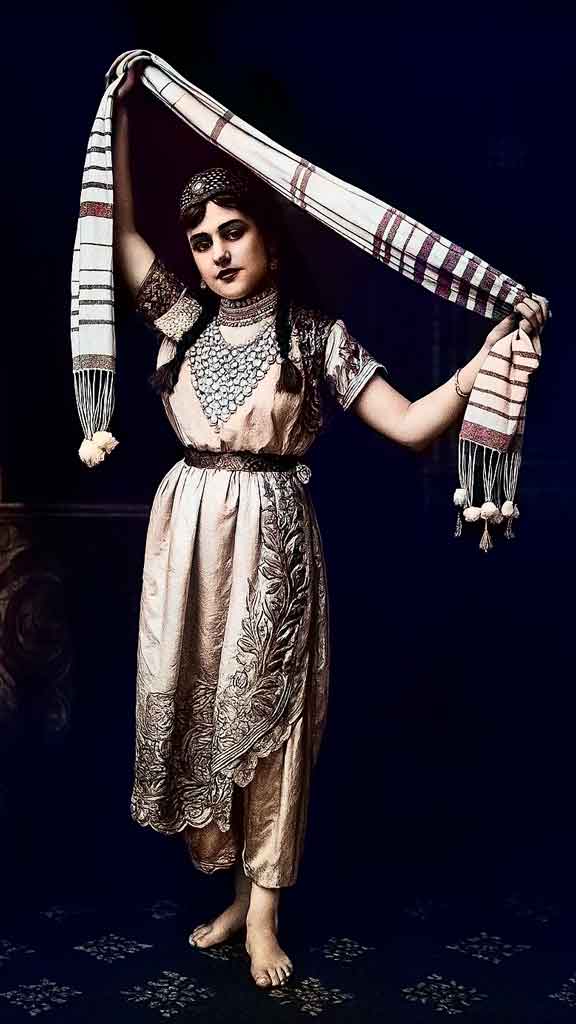
By the time morris dancing does show up in ordinary parish life, the exotic edge has mostly worn off it. Churchwardens' accounts from Kingston-upon-Thames, recording payments for the Robin Hood and May Games under Henry VII and Henry VIII, include the wonderfully blunt entry "for paynting of the Mores garments" - the costume itself simply called "the Moor's clothes" in the parish ledger, with no further explanation needed because everyone already knew what that meant. The exotic label had become ordinary parish equipment.
Plough Monday and the Working Year
One of the clearest surviving links between morris dancing and the agricultural calendar is Plough Monday, the Monday after Twelfth Night. In the north of England, farm labourers dragged a plough from door to door collecting money for drink, a custom probably rooted in the old feudal requirement that workers return to their lord's land once Christmas was over and the ploughing season began.
Men in disguise, faces blackened or hidden behind costume, performed dances and rough comic skits alongside the plough. A recurring figure was Bessy and the Fool, a pairing that turns up across England's mumming tradition and shares its DNA with the midwinter misrule figures explored in our piece on the Lord of Misrule. These processions carried ribbons, bright colour, and clog-shod dancing to music while working the crowd for coins. One 18th-century observer described the scene plainly:
"The Moriscoe dancers... appeared in their shirts with ribbons of various colours tied round their arms and across their shoulders. They dance into alehouses, &c. and always beg money."
By the time this was written, the word "Morisco" had drifted a long way from any Spanish or North African reference point. It was simply the English word for door-to-door festival dancing with a collection box attached.
Whitsuntide Revels and Morris Ales
Whitsuntide, fifty days after Easter, was the other great morris season. Before the Reformation, churches used it to stage miracle plays; Chester's cathedral was particularly known for "Mysteries" that folded morris-style performance into religious drama. As the festival secularised, villages held Whitsun Ales: fundraising parties with brewed ale, a "Lord and Lady of the Ale" presiding, and morris dancing on the green or by the churchyard wall.
Shakespeare uses the custom as a byword for harmless English distraction. In Henry V, the French mock England's war preparations by comparing them to something trifling back home:
"Were busied with a Whitsun Morris-dance."
Local variants multiplied. Kidlington, Oxfordshire, staged Whitsun processions behind a "Lady of the Lamb"; Greenhill, near Lichfield, paraded mechanical effigies of local tradesmen on poles; Eton ran mock-Roman processions as a fundraising spectacle. As with May Day, the pageantry and the fundraising were inseparable, and morris dancing sat comfortably inside both.
One Name for Many Different Dances
"Morris dancing" was never a single, unified tradition, and it still isn't. The Cotswold-style Headington dances and the stage-influenced Esperance style, revived within a few years of each other in the early 1900s, moved differently enough that Cecil Sharp felt the need to correct people publicly. Writing to the Westminster Gazette, he insisted:
"The Morris is a straight-leg dance, as the best traditional dancers will always tell you... The action should be forward and backward, not up and down, a movement which, so far as I know, is peculiar to the Morris dance."
Sharp was fighting a losing battle against exactly the kind of flattening this whole subject keeps suffering: distinct regional traditions, sword dances from the north, mummers' plays, guising customs, each with its own steps, costumes, and calendar, get absorbed into one convenient label. It's a fair question whether calling all of it "Morris dancing" does the underlying folk culture any favours, or whether it just makes a genuinely varied, locally-rooted set of customs easier to sell as a single, marketable national brand.
The Blackened Face: Four Explanations, and an Argument That Never Settles
Face-blackening in morris has been given at least four different explanations over the last 400 years, and none of them has ever fully displaced the others.
The oldest is the Moorish theory already covered above: blacken the face, and you look like a Moor, which is where the dance supposedly came from in the first place. Cecil Sharp took this claim apart in his 1907 Morris Book, and did it more sharply than most of what has been written since. Having laid out the case for a Moorish origin, he rejected it, and borrowed a line from the scholar E. K. Chambers that reverses the whole causal chain:
"The faces were not blackened because the dancers represented Moors, but rather the dancers were thought to represent Moors because their faces were blackened."
That is: blacking up came first, for whatever reason, and the "Moorish" explanation was invented afterward to make sense of it, not the other way round. Sharp's own replacement theory, that the dance survives from "some primitive religious ceremonial" involving animal sacrifice and fertility rites, was itself a product of the Edwardian folklore fashion for finding pagan survivals everywhere, and it hasn't fared much better under later scrutiny than the theory it replaced.
The second explanation is disguise, plain and simple, anonymity for people doing something they'd rather not be recognised for. This has real evidence behind it: rioters in Kent and Essex charcoaled their faces in 1450-51 while posing as "servants of the Queen of the Fairies," Henry VII paid for "the making of a disguising for a morysse" in 1501, and by 1723 the Waltham Black Act made appearing in public "in disguise, either by mask or by blackened face" a capital offence. Poachers really did black their faces to avoid identification, and that image, the folk hero slipping past the gamekeeper in the dark, has become the go-to modern justification for the practice generally. There's a wrinkle worth knowing, though: the folklorist Theresa Buckland has argued that this specific "it's only disguise" explanation was itself substantially shaped by Cecil Sharp's own writing in 1911, then repeated through decades of English Folk Dance and Song Society publications until dancers themselves came to believe it as received wisdom. Even the innocent explanation has a documented moment where someone decided it, rather than simply observed it.
A third, thinner explanation points to coal dust and hard economic times, unemployed labourers and out-of-work builders blacking up while begging through the 17th and 18th centuries' worst winters. It has some circumstantial support but nothing like the paper trail behind the disguise theory.
A fourth explanation is more recent and more specific to a handful of regional traditions: 19th-century American minstrel shows, which arrived in England in the late 1830s, may have reshaped how Border Morris in particular presented itself. The pattern is suggestive rather than conclusive: Shakespeare-era references to morris dancing never mention blackface at all, while Border teams recorded around the same period as touring minstrel shows typically did black up. That doesn't make minstrelsy the origin of the whole tradition, but it may well have reinforced and re-coded an existing practice for that specific regional style.
By 1963, the practice already read as a relic even to its own practitioners. Ron "Skip" Hooker, described in a newspaper clipping from that year as an expert on morris dancing, put it this way:
"The Morris men formed a sort of all-male secret society in many parts of the country. They would all dance with black faces, until quite recently. People think they originated from the 'Moors'."
"Until quite recently" is doing a lot of work in that sentence. Even by 1963, blackface was something Hooker described in the past tense, as a fading custom rather than a living one. It didn't stay in the past. Face-blackening saw a real resurgence among some sides in the late 20th and early 21st centuries, often among groups explicitly resisting what they saw as unnecessary modern reinterpretation, a reversal of the decline Hooker had already clocked decades earlier. The racial reading of the practice has only become harder to avoid since: the Canadian folklorist Pauline Greenhill has pointed out that audiences unfamiliar with any of this specific local history, particularly non-English and non-white audiences, reasonably read full-face black makeup through the lens of minstrelsy and racism, whatever explanation the dancers themselves might offer. In July 2020, in the same summer a far-right group publicly encouraged its followers to take up morris dancing as a route into "traditional" English culture, the Joint Morris Organisation, representing the Morris Federation, the Morris Ring, and Open Morris, formally called on member sides to stop using full-face black or other skin-tone makeup, warning that continuing could cost teams their insurance and their invitations to public events. Most sides now perform in blue, green, or patterned colours instead, or drop face paint altogether.
The Other Origin Myth: When Morris Became "Aryan"
The Moorish theory isn't the only origin story that's been built on top of a blackened face, and it isn't even the most troubling one. In 1908, the German scholar Leopold von Schroeder pointed to England's blacked-up morris dancers as evidence for something else entirely: an unbroken line of "Aryan" prehistory running from Tacitus's account of Germanic tribesmen leaping among swords, through medieval Shrovetide processions, to the morris and sword teams still dancing in English villages. Schroeder named the Moorish connection directly, and dismissed it, arguing the blackened face was simply the dark variant of the white-shirted Germanic sword-dancer's costume, grouping morris dancers together with soot-blacked chimney sweeps and smiths in what he called a shared vegetation-spirit tradition, stretching unbroken back to pre-Christian Germanic warrior cults.
That theory didn't stay in an academic footnote. Through the 1930s, the English folklorist Rolf Gardiner, who danced with Cambridge Morris at university and later co-founded The Morris Ring in 1934, the very organisation that still coordinates English morris clubs today, promoted a version of it energetically. Gardiner argued that morris and sword teams were an ancient Germanic "Blutbruderschaft," a blood brotherhood; he claimed to see "sun signs" in morris dance figures; he corresponded with German academics operating under Nazi cultural policy; and in 1936 he brought a Yorkshire longsword team to a congress held alongside the Berlin Olympics. According to research by the folk historian Georgina Boyes, Gardiner explicitly framed the new Morris Ring, in a letter to fellow revivalists, as validated by the latest German scholarship on ancient Germanic male fellowships.
Put the two myths side by side and the real pattern becomes obvious. One story wants morris to be secretly Moorish; the other wants it to be secretly Aryan. They are opposites, built for completely different political purposes, and they use exactly the same piece of evidence, a blackened face and a set of bells, to get there. Neither one is actually about what the dancers were doing. Both are about what somebody, an Elizabethan lexicographer, a Georgian antiquarian, a Nazi-era folklorist, needed morris dancing to secretly be.
History with Responsibility
Morris dancing is a living tradition, and living traditions change. Face-blackening, once excused as harmless custom, now gets the scrutiny it should have had much earlier, and most sides have quietly moved on to other colours without losing anything that actually mattered about the dance itself, the bells, the sticks, the local tunes, the calendar it's tied to.
What the record actually shows is more interesting than either the Moorish legend or its Aryan rival: a dance that starts, as far as anyone can prove, in a Tudor banqueting hall and a set of French court accounts, drifts down through parish Whitsun Ales and Plough Monday collections, gets rebuilt again by Edwardian folk-song collectors with their own theories, and gets fought over again by people looking for a usable past. Hooker was already describing blackface in the past tense in 1963. If people were questioning it that long ago, the real question isn't whether the tradition can survive without it. It's why it took this long to ask.
Further Reading and Sources
- Thomas Blount, Glossographia (1656; 2nd edition, 1661)
- Francis Douce, Illustrations of Shakspeare, and of Ancient Manners, vol. II, "Dissertation on the Ancient English Morris Dance" (1807)
- Joseph Strutt, The Sports and Pastimes of the People of England (1801)
- John Brand, Observations on Popular Antiquities, arranged and revised by Henry Ellis (1813)
- Thoinot Arbeau (Jehan Tabourot), Orchésographie (Langres, 1589); trans. Mary Stewart Evans, ed. Julia Sutton, as Orchesography (Dover Publications)
- Edward Hall, The Union of the Two Noble and Illustre Families of Lancastre and York ("Hall's Chronicle"), 1548
- Cecil Sharp, The Morris Book, Part I (1907)
- John Forrest, The History of Morris Dancing, 1458–1750 (James Clarke & Co., 1999)
- Georgina Boyes, "Dancing Spies: Nazi Attempts to Infiltrate the English Folk Revival," Folk Music Journal
- E. C. Cawte, In Comes I: An Introductory Study of Music and Dance Custom (1978)
- Geraldine Heng, The Invention of Race in the European Middle Ages (Cambridge University Press, 2018)